

Age-related brain deviations and aggression
Open accessThe DOI matches its Crossref record; 49 of the 49 references it cites were found in a registry or an index.
Abstract
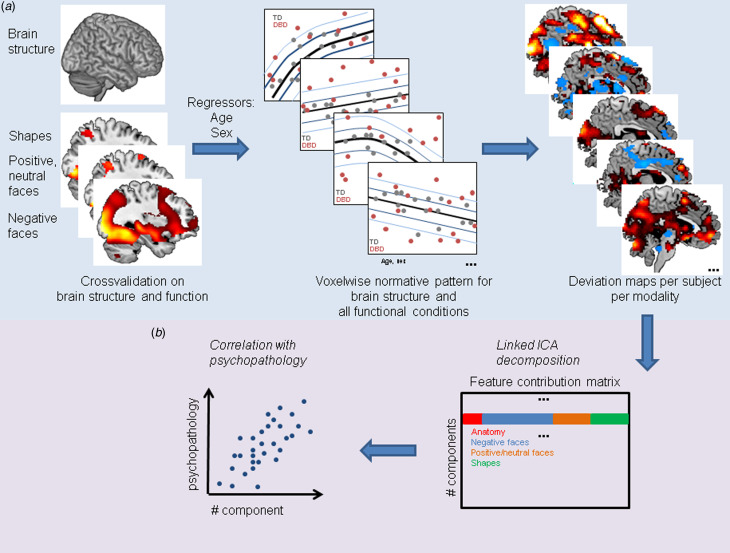
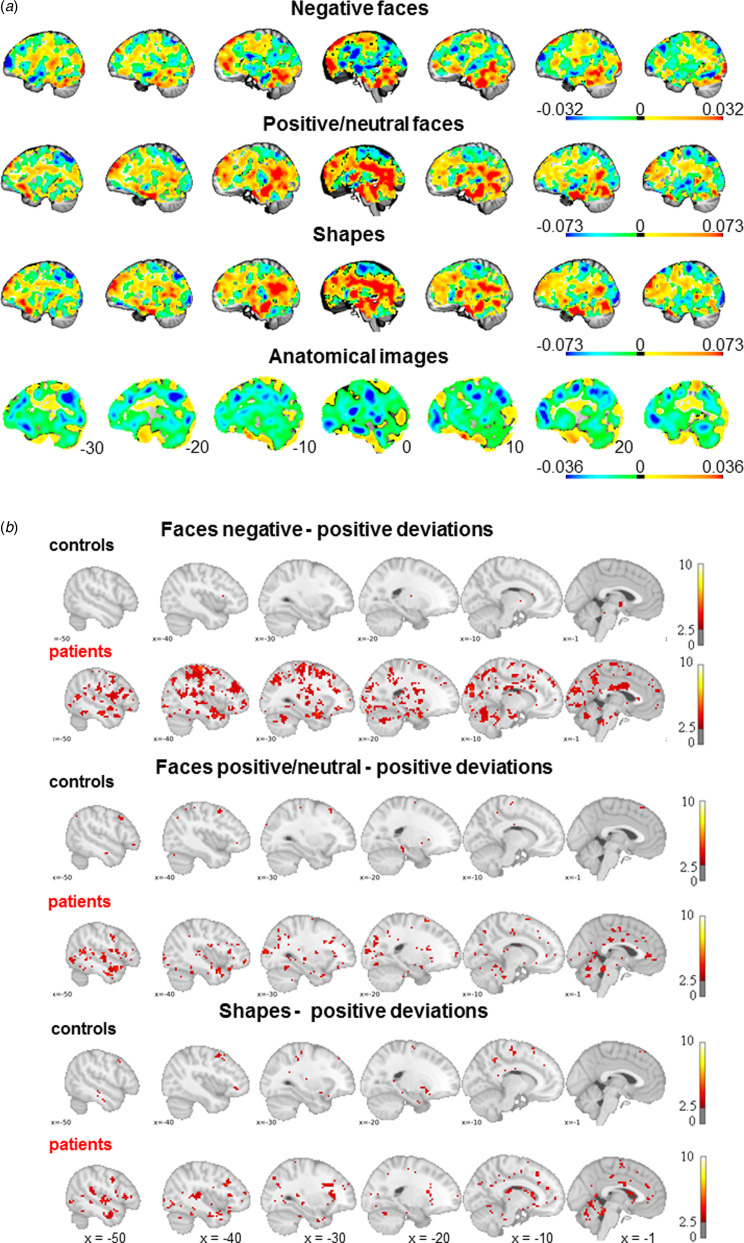
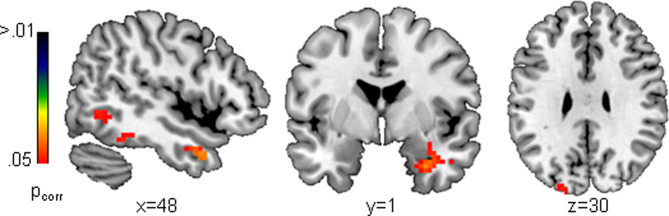
Background: Disruptive behavior disorders (DBD) are heterogeneous at the clinical and the biological level. Therefore, the aims were to dissect the heterogeneous neurodevelopmental deviations of the affective brain circuitry and provide an integration of these differences across modalities. Methods: We combined two novel approaches. First, normative modeling to map deviations from the typical age-related pattern at the level of the individual of (i) activity during emotion matching and (ii) of anatomical images derived from DBD cases (n= 77) and controls (n= 52) aged 8–18 years from the EU-funded Aggressotype and MATRICS consortia. Second, linked independent component analysis to integrate subject-specific deviations from both modalities. Results: While cases exhibited on average a higher activity than would be expected for their age during face processing in regions such as the amygdala when compared to controls these positive deviations were widespread at the individual level. A multimodal integration of all functional and anatomical deviations explained 23% of the variance in the clinical DBD phenotype. Most notably, the top marker, encompassing the default mode network (DMN) and subcortical regions such as the amygdala and the striatum, was related to aggression across the whole sample. Conclusions: Overall increased age-related deviations in the amygdala in DBD suggest a maturational delay, which has to be further validated in future studies. Further, the integration of individual deviation patterns from multiple imaging modalities allowed to dissect some of the heterogeneity of DBD and identified the DMN, the striatum and the amygdala as neural signatures that were associated with aggression.
Overview
The claims and statistics of this paper haven’t been checked yet.
Free: it reads the open-access text and checks the first 5 claims that cite a source we can check. Create a free account to check every claim.
Integrity signals
Registry
Cites
Statistics
Figures

Verification
Claims the paper makes
The claims and statistics of this paper haven’t been checked yet.
Free: it reads the open-access text and checks the first 5 claims that cite a source we can check. Create a free account to check every claim.
Claims other papers make about this one
Each is checked against this paper’s own text: does it say what the citing paper says it does?
The source backs part of the claim, not all of it — or backs it for a different population, condition or comparison.
In the citing paper
“Notably, these individual-level statistics have revealed a higher predictive power of functionality when compared to unmodelled raw data 70 .”
From Candidate diagnostic biomarkers for neurodevelopmental disorders in children and adolescents: a systematic review (2023) · cites this paper as [70]
Experimental — accuracy not yet measured
Self-check
Percentages, sums and reported differences re-computed from the paper’s own numbers.
The self-check needs the paper’s full text.
Citations
Cites
Controlling the False Discovery Rate: A Practical and Powerful Approach to Multiple Testing
Benjamini, Y., & Hochberg, Y. (1995) · Journal of the Royal Statistical Society Series B: Statistical Methodology · doi:10.1111/j.2517-6161.1995.tb02031.x · Cited by 109,482 · cited 1×
“Multiple comparison were controlled for using FDR correction with the Benjamini – Hochberg method (Benjamini & Hochberg, 1995).”
MethodKAUFMAN, J., BIRMAHER, B., BRENT, D., RAO, U., FLYNN, C., MORECI, P., WILLIAMSON, D., & RYAN, N. (1997) · Journal of the American Academy of Child & Adolescent Psychiatry · doi:10.1097/00004583-199707000-00021 · Cited by 10,148 · cited 1×
“In the control group, no DSM axis I disorder, assessed via the K-SADS (Kaufman et al., 1997), and no clinical score in the CBCL, TRF or YSR was allowed, according to standard cutoffs for these instruments.”
MethodAdjusting batch effects in microarray expression data using empirical Bayes methods
Johnson, W. E., Li, C., & Rabinovic, A. (2007) · Biostatistics · doi:10.1093/biostatistics/kxj037 · Cited by 8,658 · cited 2×
“In a further step, scanner variance in these images was removed using ComBat (Johnson et al., 2007).”
MethodPolanczyk, G. V., Salum, G. A., Sugaya, L. S., Caye, A., & Rohde, L. A. (2015) · Journal of Child Psychology and Psychiatry · doi:10.1111/jcpp.12381 · Cited by 3,990 · cited 1×
“Aggressive behavior is commonly seen in disruptive behavior disorders (DBD), including oppositional defiant disorder (ODD) and conduct disorder (CD), prevalent in 5.7% of the youth population (Polanczyk, Salum, Sugaya, Caye, & Rohde, 2015).”
BackgroundInfluentialA self‐report measure of pubertal status: Reliability, validity and initial norms
Petersen, A. C., Crockett, L., Richards, M., & Boxer, A. (1988) · Journal of Youth and Adolescence · doi:10.1007/bf01537962 · Cited by 3,129 · cited 1×
“Pubertal status was assessed with the Pubertal Development Scale (Petersen, Crockett, Richards, & Boxer, 1988).”
Functional-anatomic fractionation of the brain’s default network
Andrews-Hanna, J. R., Reidler, J. S., Sepulcre, J., Poulin, R., & Buckner, R. L. (2010) · Neuron · doi:10.1016/j.neuron.2010.02.005 · Cited by 2,767
Raine, A., Dodge, K., Loeber, R., Gatzke‐Kopp, L., Lynam, D., Reynolds, C., Stouthamer‐Loeber, M., & Liu, J. (2006) · Aggressive Behavior · doi:10.1002/ab.20115 · Cited by 1,652 · cited 2×
“The parent-rated Inventory of Callous-Unemotional Traits (ICU) (Essau, Sasagawa, & Frick, 2006) and the self-reported Reactive Proactive Aggression Questionnaire (RPQ) (Raine et al., 2006) were used to assess features of aggression.”
MethodModulating emotional responses: effects of a neocortical network on the limbic system
Hariri, A. R., Bookheimer, S. Y., & Mazziotta, J. C. (2000) · NeuroReport · doi:10.1097/00001756-200001170-00009 · Cited by 1,277
Callous-unemotional traits in a community sample of adolescents
Essau, C. A., Sasagawa, S., & Frick, P. J. (2006) · Assessment · doi:10.1177/1073191106287354 · Cited by 875
Tensorial extensions of independent component analysis for multisubject FMRI analysis
Beckmann, C. F., & Smith, S. M. (2005) · NeuroImage · doi:10.1016/j.neuroimage.2004.10.043 · Cited by 761 · cited 1×
“Further, each independent component provides also a map of spatial variation per modality and a vector reflecting the relative contribution of each modality to the component (Beckmann & Smith, 2005).”
BackgroundSelf-citation
Cited by
Evidence for embracing normative modeling
Rutherford, S., Barkema, P., Tso, I. F., Sripada, C., Beckmann, C. F., Ruhe, H. G., & Marquand, A. F. (2023) · eLife · doi:10.7554/elife.85082 · Cited by 175
Self-citationCortese, S., Solmi, M., Michelini, G., Bellato, A., Blanner, C., Canozzi, A., Eudave, L., Farhat, L. C., Højlund, M., Köhler‐Forsberg, O., et al. (2023) · World Psychiatry · doi:10.1002/wps.21037 · Cited by 147
Self-citationA stable and replicable neural signature of lifespan adversity in the adult brain
Holz, N. E., Zabihi, M., Kia, S. M., Monninger, M., Aggensteiner, P.-M., Siehl, S., Floris, D. L., Bokde, A. L. W., Desrivières, S., Flor, H., et al. (2023) · Nature Neuroscience · doi:10.1038/s41593-023-01410-8 · Cited by 76
“Finally, given that individual variability on top of normative models has shown superior predictive power regarding psychopathology when compared to unmodeled data 31,32 , we investigated how individual deviations from normative brain trajectories are associated with psychopathology.”
Self-citationPsychopharmacology in children and adolescents: unmet needs and opportunities
Cortese, S., Purper‐Ouakil, D., Apter, A., Arango, C., Baeza, I., Banaschewski, T., Buitelaar, J. K., Castro‐Fornieles, J., Coghill, D., Cohen, D., et al. (2023) · The Lancet Psychiatry · doi:10.1016/s2215-0366(23)00345-0 · Cited by 44
Self-citationFraza, C., Rutherford, S., Bučková, B., Beckmann, C., & Marquand, A. (2025) · Neuroscience and Biobehavioral Reviews · doi:10.1016/j.neubiorev.2025.106284 · Cited by 27
“…and Shape (GAMLSS) (Bethlehem et al., 2022; Dinga et al., 2021a), Gaussian Process Regression (GPR) (Marquand et al., 2016a; Kumar et al., 2023a; Holz et al., 2023b), polynomial regression (Lawrence et al., 2021; Bethlehem et al., 2020; Jing et al., 2023), quantile regression (Lv et al., 2021;…”
InfluentialSelf-citation
Metadata
- Authors
- Holz, N. E., Floris, D. L., Llera, A., Aggensteiner, P. M., Kia, S. M., Wolfers, T., Baumeister, S., Böttinger, B., Glennon, J. C., Hoekstra, P. J., Dietrich, A., Saam, M. C., Schulze, U. M. E., Lythgoe, D. J., Williams, S. C. R., Santosh, P., Rosa-Justicia, M., Bargallo, N., Castro-Fornieles, J., Arango, C., Penzol, M. J., Walitza, S., Meyer-Lindenberg, A., Zwiers, M., Franke, B., Buitelaar, J., Naaijen, J., Brandeis, D., Beckmann, C., Banaschewski, T., & Marquand, A. F.
- Affiliations
- Radboud University Nijmegen (NL)
- Heidelberg University (DE)
- Oslo University Hospital (NO)
- Radboud University Medical Center (NL)
- University Medical Center Groningen (NL)
- Universität Ulm (DE)
- King's College London (GB)
- Hospital General Universitario Gregorio Marañón (ES)
- University of Zurich (CH)
- Corresponding author
- Holz, Nathalie E.
- ORCID
- Holz, Nathalie E.
- Floris, Dorothea L.
- Llera, Alberto
- Aggensteiner, Pascal M.
- Kia, Seyed Mostafa
- Wolfers, Thomas
- Baumeister, Sarah
- Böttinger, Boris
- Glennon, Jeffrey C.
- Hoekstra, Pieter J.
- Dietrich, Andrea
- Schulze, Ulrike M. E.
- Lythgoe, David J.
- Santosh, Paramala
- Arango, Celso
- Walitza, Susanne
- Zwiers, Marcel
- Franke, Barbara
- Buitelaar, Jan
- Naaijen, Jilly
- Beckmann, Christian
- Banaschewski, Tobias
- Venue
- Psychological Medicine
- Publisher
- Cambridge University Press (CUP)
- Published
- 2022-04-22
- Volume
- 53
- Issue
- 9
- Pages
- 4012-4021
- ISSN
- 0033-2917 (ISSN-L)
- 1469-8978
- PMC
- PMC10325848
- OpenAlex
- W4224240698
- Cited by
- 23
- References
- 46
- Citations by year
- 2026: 2 · 2025: 8 · 2024: 7 · 2023: 6
- FWCI
- 4.80
- Type
- journal article
- Language
- en
- Open access
- hybrid
- doi.org
- Licence
- Locations
- Psychological Medicine (publishedVersion, other-oa)
- PubMed Central (publishedVersion, cc-by)
- PubMed (publishedVersion)
- University of Groningen research database (University of Groningen / Centre for Information Technology) (publishedVersion, cc-by)
- Radboud Repository (Radboud University) (submittedVersion)
- Data Archiving and Networked Services (DANS) (submittedVersion, other-oa)
- Research Portal (King's College London) (submittedVersion, other-oa)
- NORA - Norwegian Open Research Archives (submittedVersion, cc-by)
- Repository for Publications and Research Data (ETH Zurich) (submittedVersion, cc-by)
- Zurich Open Repository and Archive (University of Zurich) (submittedVersion)
- ETH Zürich Research Collection
- Funders
- DFG (DFG HO 5674/2-1, GRK2350/1)
- Topics
- Social Sciences › Psychology › Clinical Psychology › Psychopathy, Forensic Psychiatry, Sexual Offending
- Life Sciences › Neuroscience › Cognitive Neuroscience › Neural and Behavioral Psychology Studies
- Social Sciences › Psychology › Clinical Psychology › Child and Adolescent Psychosocial and Emotional Development
- Keywords
- disruptive behavior disorders, aggression, amygdala, default mode network, striatum, face processing, multimodal neuroimaging integration, MATRICS
- MeSH terms
- Aggression, Brain, Brain Mapping, Emotions, Humans, Magnetic Resonance Imaging, Attention Deficit and Disruptive Behavior Disorders
About these checks
Registry, retraction, Cites and statistics results are computed, not judged, with one exception: a printed reference that no index lists is read once by a model before it counts as a citation error. Claims are extracted by a model and kept only when their quote appears verbatim in the text; each cited source is then checked, with a model’s help, for whether it says what the claim relies on. Those verdicts can be wrong — read the claim’s quote and the cited source before relying on one.
Statistics and arithmetic are recomputed, not judged.
Confidence bands are shown only for fields calibrated on our annotated test set. None is calibrated yet, so no band is shown.
What counts as a claim ›How we measure confidence ›How we check this ›
Are you an author, or do you see a problem with this page? Request a review
How to cite
Cite CoChat for the checks on this page, and the paper for its own findings.
- This page
- CoChat. (2026). Citation check: Age-related brain deviations and aggression. https://app.cochat.ai/papers/10.1017/s003329172200068x
- The paper
- Holz, N. E., Floris, D. L., Llera, A., Aggensteiner, P. M., Kia, S. M., Wolfers, T., Baumeister, S., Böttinger, B., Glennon, J. C., Hoekstra, P. J., Dietrich, A., Saam, M. C., Schulze, U. M. E., Lythgoe, D. J., Williams, S. C. R., Santosh, P., Rosa-Justicia, M., Bargallo, N., Castro-Fornieles, J., . . . Marquand, A. F. (2023). Age-related brain deviations and aggression. Psychological Medicine. https://doi.org/10.1017/s003329172200068x
Data sources
Bibliographic data: Semantic Scholar, OpenAlex, Crossref.
Contains information from the Semantic Scholar Academic Graph Datasets, made available under the ODC Attribution License (ODC-BY 1.0).
Semantic Scholar’s data is described in: Kinney, R., et al. (2023). The Semantic Scholar Open Data Platform. arXiv:2301.10140.
