

Between Qum and Qayrawān: Unearthing early Shii ḥadı̄th sources
Open accessThe DOI matches its Crossref record; 19 of the 19 references it cites were found in a registry or an index; none of the 8 sources its claims cite is checked for support yet.
Abstract
In this article, I develop and test a new methodology of unearthing early Shii ḥadı̄th sources that served as the basis for the later collections of the fourth/tenth century. This method, besides answering the question of historicity, enables us to understand the dissemination of texts across times and regions. As a case-study, I examine what is alleged to have been the first Shii legal ḥadı̄th collection, a work attributed to ʿUbaydullāh b. ʿAlī al-Ḥalabī (d. c. 148/765). By comparing the reports transmitted on the authority of al-Ḥalabī in the Twelver ḥadı̄th compendium originating in Qum, al-Kulaynī's al-Kāfī, and an Ismaili legal ḥadı̄th composition, al-Qāḍī al-Nuʿmān's al-Īḍāḥ, composed in Qayrawān, I demonstrate that both works trace their material to an earlier Kūfan source of the second/eighth century, with each work drawing on the same material independently. A cross-regional textual analysis of later ḥadı̄th compendia, in this case composed by contemporaneous scholars, residing in different regions, affiliated to dissimilar religious persuasions, reveals the transmission of identical material; this finding contributes to our understanding of both geographical transmission of early sources and compositional arrangements of the later ḥadı̄th compendia.
Overview
CoChat Summary
TL;DR
The article proposes cross-regional textual analysis to unearth early Shii ḥadīth sources by comparing later compendia compiled contemporaneously in different regions by authors of different persuasions. Applying it to al-Ḥalabī’s alleged first Shii legal ḥadīth collection in al-Kulaynī’s al-Kāfī and al-Qāḍī al-Nuʿmān’s al-Īḍāḥ, it argues both independently drew on an earlier Kūfan source.
Key findings
- Cross-regional comparison found 23 reports on the authority of al-Ḥalabī in al-Īḍāḥ identical to those in al-Kāfī; adding 14 identical reports in other Twelver compendia yields 41% of all surviving reports, suggesting a shared earlier source.
- Al-Īḍāḥ cites al-Ḥalabī 103 times: Jāmiʿ al-Ḥalabī 51 times and Kitāb al-masāʾil 52 times; al-Qāḍī al-Nuʿmān treated them as two separate works, while al-Kulaynī’s isnāds and other Twelver compendia make no distinction between them.
- In the chapter on al-ṣalāt, al-Kāfī cites only 46 reports from al-Ḥalabī, compared with 104 in a rather incomplete portion of the same chapter in the extant fragment of al-Īḍāḥ; al-Kulaynī likely relied on intermediary nawādir rather than direct access to early uṣūl.
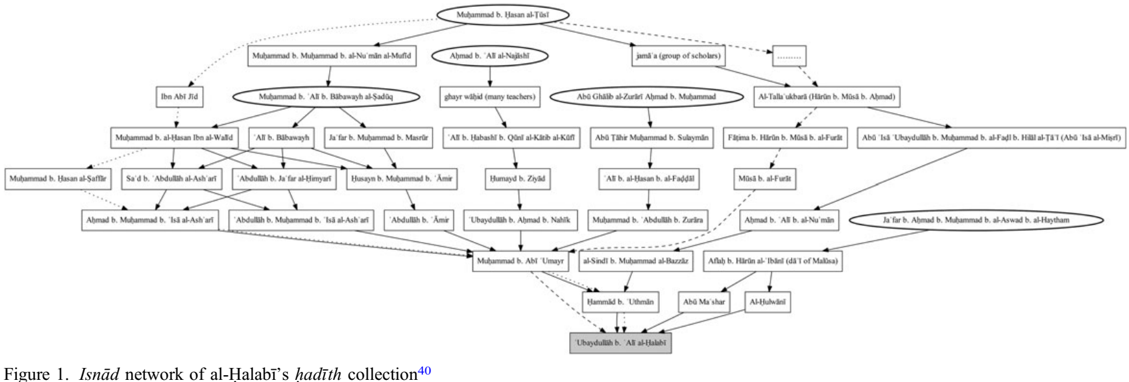
- Table 2 reports al-Kāfī contains 504 reports from ʿUbaydullāh b. ʿAlī al-Ḥalabī, 446 via Ḥammād on his authority, and 523 via Ibn Abī ʿUmayr on Ḥammād; totals across four Twelver compendia are 1,544, 1,261, and 1,362 respectively.
Methods
- Develops “cross-regional textual analysis”: compare later ḥadīth collections that are contemporaneous, compiled in different regions, and authored by scholars of distinct religious persuasions, to identify independent attestation of earlier sources.
- Case study compares reports attributed to ʿUbaydullāh b. ʿAlī al-Ḥalabī in al-Kulaynī’s al-Kāfī (Qum/Twelver) and al-Qāḍī al-Nuʿmān’s al-Īḍāḥ (Qayrawān/Ismaili), using isnād networks, bio-bibliographical dictionaries, and searches in the Dirāyat al-nūr database.
- Analysis addresses historicity of al-Ḥalabī’s collection, its incorporation and compositional arrangement in the later compendia, and the question of its authorship.
Limitations
- Stated: the three stringent conditions for the method are not immediately available in all cases, since most later Shii ḥadīth collections were composed by non-contemporaneous Twelver scholars of Qum and Baghdad.
- Stated: al-Īḍāḥ survives only as a small fragment containing citations from a meagre 21 early sources; a complete manuscript, if found, would greatly enrich understanding.
- Stated: cross-regional analysis does not always yield overwhelming identical material; for al-Ḥalabī’s collection, 41% of identical material was discovered, with the remaining 59% difference attributed to dissemination across time and regions. Evident: the authorship conclusion remains inconclusive because of overlapping reports and al-Qāḍī al-Nuʿmān’s apparent attribution of both collections to a single author.
Model-written summary. Check it against the paper before relying on it.
Integrity signals
Registry
Cites
Statistics
Figures
Verification
Claims the paper makes
0 Valid · 7 Not valid · 8 Not checked · 100 Own results and interpretations
In the paper
“The biographical dictionaries reveal that duplicating and synthesizing isnāds were not uncommon practices.”
§ Between Qum and Qayrawān: Unearthing early Shii ḥadı̄th sources* > Introduction
What the sources say
- Not matchedcites Ibn Buṭṭa
This doesn’t read as a citation we can look up.
plain- Asserted: passes — The authors put it forward as true.
- Checkable: passes — It can be checked against evidence.
- Load-bearing: passes — The paper’s conclusions depend on it.
- Based: passes — The paper gives a reason why it holds.
- Not matched
A result the paper reports from its own data — it cites no other source for it, so there is none to check. The quote shows it is in the paper.
In the paper
“Al-Ṭūsī relates these reports on the authority of Muḥammad al-Ḥalabī via ʿAbdullāh b.Muskān.”
§ Between Qum and Qayrawān: Unearthing early Shii ḥadı̄th sources* > 3. Authorship
plain- Asserted: passes — The authors put it forward as true.
- Checkable: passes — It can be checked against evidence.
- Load-bearing: passes — The paper’s conclusions depend on it.
- Based: passes — The paper gives a reason why it holds.
The paper states this without a source or data behind it here, so there is nothing to check it against. The quote shows it is in the paper.
In the paper
“Furthermore, there is no mention of Kitāb al-masāʾil under the entries of ʿUbaydullāh b. ʿAlī al-Ḥalabī in any of the extant Twelver bio-bibliographical dictionaries.”
§ Between Qum and Qayrawān: Unearthing early Shii ḥadı̄th sources* > 3. Authorship
plain- Asserted: passes — The authors put it forward as true.
- Checkable: passes — It can be checked against evidence.
- Load-bearing: passes — The paper’s conclusions depend on it.
- Based: unclear — It is unclear why the paper says it holds.
A result the paper states — it cites no source for it, so there is none to check. The quote shows it is in the paper.
In the paper
“If one adds 14 identical reports cited in Twelver ḥadı̄th compendia on the authority of ʿUbaydullāh al-Ḥalabī or other Ḥalabīs to the 23 reports in al-Kāfī, this resemblance occurs in 41 per cent of all surviving reports.”
§ Between Qum and Qayrawān: Unearthing early Shii ḥadı̄th sources* > Additional information
plainstates an association- Asserted: passes — The authors put it forward as true.
- Checkable: passes — It can be checked against evidence.
- Load-bearing: passes — The paper’s conclusions depend on it.
- Based: passes — The paper gives a reason why it holds.
A result the paper reports from its own data — it cites no other source for it, so there is none to check. The quote shows it is in the paper.
In the paper
“Verbatim citations of a significant number of reports, 53 in total, could not be traced in al-Kāfī or any other Twelver ḥadı ̄th collection.”
§ Between Qum and Qayrawān: Unearthing early Shii ḥadı̄th sources* > 2. Composition and compositional arrangements
plain- Asserted: passes — The authors put it forward as true.
- Checkable: passes — It can be checked against evidence.
- Load-bearing: passes — The paper’s conclusions depend on it.
- Based: passes — The paper gives a reason why it holds.
62 more claims
Create a free account to see all 115 claims and every source verdict.
- It may state two separate claims as one. 26
- Probably not a substantial claim. 28
Self-check
Percentages, sums and reported differences re-computed from the paper’s own numbers.
Each contradiction between two passages listed here was confirmed by an independent check.
Rated minor: it would not touch a result — a value no result rests on, a p-value that stays on the same side of the significance level, or a conflict that is clerical, resolved elsewhere in the paper, or outside its own findings.
In the paper
§ Between Qum and Qayrawān: Unearthing early Shii ḥadı̄th sources* > Cross-regional textual analysis
“Ibn Bābawayh (d.381/991)”
§ Between Qum and Qayrawān: Unearthing early Shii ḥadı̄th sources* > Travel history and isnād network
“Ibn Bābawayh's (d.380/991)”
Citations
Cites
The Origins of Muhammadan Jurisprudence
Anderson, J. N. D., & Schacht, J. (1952) · Die Welt des Islams · doi:10.2307/1569046 · Cited by 641
Walker, P. E. (2002) · doi:10.5040/9780755611690 · Cited by 153
Early Muslim Dogma: A Source-Critical Study
(1981) · Cited by 87
Dating Muslim traditions: A survey
Motzki, H. (2005) · Arabica · doi:10.1163/1570058053640349 · Cited by 83
Fatimid Institutions of Learning
Walker, P. E. (1997) · Journal of the American Research Center in Egypt · doi:10.2307/40000806 · Cited by 79
Madelung, W. (1976) · Journal of Near Eastern Studies · doi:10.1086/372451 · Cited by 73
(2000) · doi:10.1163/9789004452909 · Cited by 66
Motzki, H., der Voort, N. B.-V., & Anthony, S. W. (2010) · BRILL eBooks · doi:10.1163/ej.9789004180499.i-504 · Cited by 48
Early Shiite hermeneutics and the dating ofKitāb Sulaym ibn Qays
Gleave, R. (2015) · Bulletin of the School of Oriental and African Studies · doi:10.1017/s0041977x15000038 · Cited by 28
Research works printed but not linked: 7
- Kohlberg, 1987, Shiʿism, Resistance, and Revolution, 38
- Al-Qāḍī al-Nuʿmān, al-Īḍāḥ, 52, 159. 440 K U M A I L R A J A N I https://doi.org/10.1017/S0041977X2100077X Published online by Cambridge University Press
- Koren, 2009, Methodological approaches to Islamic studies, Der Islam, 68, 87
- Kohlberg, 1987, Al-Uṣūl al-Arbaʿumiʾa, Jerusalem Studies in Arabic and Islam, 10, 128
- Abbott, 1976, Studies in Arabic Literary Papyri II: Qurʾanic Commentary and Tradition
- Modarressi, 2003, Tradition and Survival: A Bibliographical Survey of Early Shīʿite Literature
- Sezgin, 1967, Geschichte des arabischen Schrifttums, Band I: Qurʾānwissenschaften, Hadith, Geschichte, Fiqh, Dogmatik, Mystik bis ca. 430 H
Metadata
- Authors
- Rajani, K.
- Affiliations
- University of Exeter (GB)
- Corresponding author
- Rajani, Kumail
- ORCID
- Rajani, Kumail
- Venue
- Bulletin of the School of Oriental and African Studies
- Publisher
- Cambridge University Press (CUP)
- Published
- 2021-10
- Volume
- 84
- Issue
- 3
- Pages
- 419-442
- ISSN
- 0041-977X (ISSN-L)
- 1474-0699
- OpenAlex
- W4200367139
- Cited by
- 1
- References
- 18
- Citations by year
- 2023: 1
- FWCI
- 1.55
- Type
- journal article
- Language
- en
- Open access
- hybrid
- doi.org
- Locations
- Bulletin of the School of Oriental and African Studies (publishedVersion, cc-by)
- Funders
- European Research Council Advanced Award: Law, Authority and Learning in Imami Shiʿite Islam (695245)
- Topics
- Social Sciences › Arts and Humanities › Religious studies › Islamic Thought and Society Studies
- Social Sciences › Political Science and International Relations › Islamic Studies and History
- Social Sciences › Arts and Humanities › Religious studies › Qur’anic Interpretation Studies
- Keywords
- hadith collections, al-Kafi, Kufa, Qom, textual transmission
About these checks
Registry, retraction, Cites and statistics results are computed, not judged, with one exception: a printed reference that no index lists is read once by a model before it counts as a citation error. Claims are extracted by a model and kept only when their quote appears verbatim in the text; each cited source is then checked, with a model’s help, for whether it says what the claim relies on. Those verdicts can be wrong — read the claim’s quote and the cited source before relying on one.
A language model drew the claims from the paper on 2026-10-05, under version 3 of the claim definition (model deepseek-v4.1-flash, prompt extract-v3).
A second model labelled each claim on 2026-10-05 (model jev-1.13-20260917, definition revision gold-guideline-v0.2).
Statistics and arithmetic are recomputed, not judged.
Confidence bands are shown only for fields calibrated on our annotated test set. None is calibrated yet, so no band is shown.
What counts as a claim ›How we measure confidence ›How we check this ›
Are you an author, or do you see a problem with this page? Request a review
How to cite
Cite CoChat for the checks on this page, and the paper for its own findings.
- This page
- CoChat. (2026). Citation check: Between Qum and Qayrawān: Unearthing early Shii ḥadı̄th sources. https://app.cochat.ai/papers/10.1017/s0041977x2100077x
- The paper
- Rajani, K. (2021). Between Qum and Qayrawān: Unearthing early Shii ḥadı̄th sources. Bulletin of the School of Oriental and African Studies. https://doi.org/10.1017/s0041977x2100077x
Data sources
Bibliographic data: Semantic Scholar, OpenAlex, Crossref.
Contains information from the Semantic Scholar Academic Graph Datasets, made available under the ODC Attribution License (ODC-BY 1.0).
Semantic Scholar’s data is described in: Kinney, R., et al. (2023). The Semantic Scholar Open Data Platform. arXiv:2301.10140.
