

Washington Representative Careers and the Institutionalization of the Civil Rights Movement
Open accessThe DOI matches its Crossref record; 7 of the 7 references it cites were found in a registry or an index; none of the 28 sources its claims cite is checked for support yet.
Abstract
Though observers at the time noted that a well-coordinated lobbying campaign contributed to enactment of the Civil Rights Act of 1964, subsequent popular and scholarly accounts have largely ignored the role of institutional advocacy, focusing instead on either the inspirational effects of direct-action protest outside of Washington or unhindered institutional activity by policymakers themselves to explain the achievement of this legislation. In contrast, this article investigates civil rights movement organizations’ engagement in federal legislative lobbying and the broader network of labor, religious, and other public interest lobbyists within which their Washington representatives collaborated. Using archived sign-in sheets from meetings hosted by the Leadership Conference on Civil Rights, I identify 138 individuals who participated in the Civil Rights Act’s lobbying campaign as Washington representatives of various organizations. Drawing on their memoirs, obituaries, and other records of their professional careers, I trace these Washington representatives’ paths to the Civil Rights Act lobby. This descriptive analysis reveals a critical mass of Washington representatives with ample Beltway experience, findings that challenge conventional periodization of the civil rights movement’s institutionalization and suggest new interconnections in the development of the administrative and civil rights states.
Overview
CoChat Summary
TL;DR
This article reconstructs the personnel of the Civil Rights Act of 1964 lobbying campaign through archived Leadership Conference on Civil Rights sign-in sheets, identifying 138 Washington representatives from 80+ organizations. It argues that the pre-Voting Rights Act civil rights movement already had a substantial, experienced institutional lobbying network, challenging conventional periodization of institutionalization.
Key findings
- The Civil Rights Act lobby was broader than Congressional Quarterly’s list: 86 organizations had formally affiliated with the Leadership Conference by July 1964, and 80 were represented at two or more Washington Representatives meetings, including about 30 not in the CQ report and 26 not LCCR members. All four organizations McAdam credits with initiating most *New York Times*-reported protest events from 1961 to 1965—NAACP, SCLC, SNCC, and CORE—simultaneously participated in lobbying, with three having established a Washington office before the Civil Rights Act’s passage.
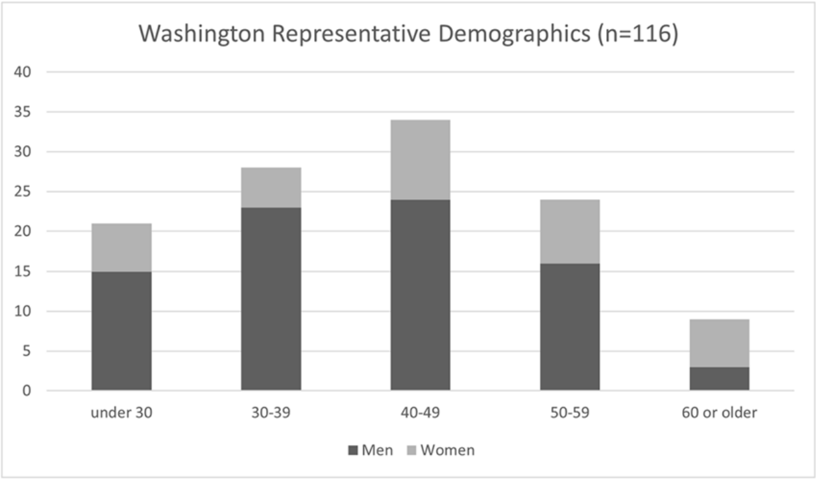
- Most Washington representatives were experienced professionals rather than newcomers: 93 men and 45 women; of 116 with conclusively identified birth years, about 60 percent (n = 70) were aged 35–60 in 1963, while fewer than a fifth (n = 21) were under 30. More than half came as full-time, salaried government relations personnel; 35 of the 57 with conclusive DC arrival dates arrived before 1960, only six relocated just in time for the campaign, and just one—Jane O’Grady—was a true Beltway newcomer.
- Many had prior lobbying and federal service: 29 had registered as congressional lobbyists under the Federal Regulation of Lobbying Act of 1946, including seven among the first registrants in 1947 and nine during the 1950s; about 20 had at least a decade of continuous congressional lobbying experience by 1963, 17 others had lobbied since the mid-to-late 1950s, and 15 began in 1960 or 1961. Approximately 25 were “revolving door” lobbyists, and many had New Deal, World War II, or postwar agency experience, especially in the FEPC.
- These findings challenge conventional periodization by showing institutional lobbying alongside direct-action protest before 1965, and they suggest new interconnections between the administrative state and the civil rights state.
Methods
- Descriptive study of the LCCR’s Washington Representatives meetings. From archived sign-in sheets, the author identified 133 individuals who attended at least two of the 44 meetings held in the year before the Civil Rights Act’s passage, then added five others named in the CQ report or other documentation, for a total of 138.
- Pre-June-1963 careers were traced using memoirs, biographies, oral histories, obituaries, hiring and retirement announcements, genealogical records, organizational archives, and Congressional Record lobbyist registrations from 1947 through 1964; the author sought information on age, organizational affiliation, DC arrival, prior lobbying, legislative, and federal agency experience.
- Analysis is qualitative pattern identification with elemental descriptive statistics; data limitations precluded quantitative analysis beyond that.
Limitations
- Stated in the paper: data limitations preclude quantitative analysis beyond elemental descriptive statistics; there is no central repository for Washington representatives’ career information; sign-in sheets list only names and home organizations; the author could not answer all questions for all 138 individuals; and investigating the substantive impact of early agency experience or lobbyists’ policy tastes is beyond the article’s scope.
- Evident from the text: the sample depends on a two-meeting attendance threshold plus CQ and other additions, so lobbyists who attended fewer meetings, did not sign in, or lobbied outside the LCCR may be missed; reliance on archived and online biographical traces may undercount or misclassify careers.
- Evident from the text: the descriptive design cannot establish causal effects of lobbyists’ backgrounds on the Civil Rights Act’s content or passage; the paper explicitly frames such questions as future research.
Model-written summary. Check it against the paper before relying on it.
Integrity signals
Registry
Cites
Statistics
Figures
Verification
Claims the paper makes
0 Valid · 2 Not valid · 22 Not checked · 55 Own results and interpretations
A result the paper reports from its own data — it cites no other source for it, so there is none to check. The quote shows it is in the paper.
In the paper
“Civil rights movement organizations-including those best known for extra-institutional insurgency-lobbied Congress simultaneously with their directaction protest campaign sponsorship prior to 1965, and they did so in collaboration with an experienced coterie of religious, labor, and other public interest lobbyists.”
plainstates an association- Asserted: passes — The authors put it forward as true.
- Checkable: passes — It can be checked against evidence.
- Load-bearing: passes — The paper’s conclusions depend on it.
- Based: passes — The paper gives a reason why it holds.
- Rests on an assumption not shown here.
A result the paper reports from its own data — it cites no other source for it, so there is none to check. The quote shows it is in the paper.
In the paper
“Using these sign-in sheets, I identified 133 individuals who attended at least two of the 44 Washington Representatives meetings that were held in the year leading up to the Civil Rights Act's passage.”
plainn = 133- Asserted: passes — The authors put it forward as true.
- Checkable: passes — It can be checked against evidence.
- Load-bearing: passes — The paper’s conclusions depend on it.
- Based: passes — The paper gives a reason why it holds.
- Rests on 2 assumptions not shown here.
A result the paper reports from its own data — it cites no other source for it, so there is none to check. The quote shows it is in the paper.
In the paper
“A second intriguing finding is that the emergence of the Civil Rights Act's lobbyist network was intertwined with federal state building in the 1930s and 1940s.”
plainstates an association- Asserted: passes — The authors put it forward as true.
- Checkable: passes — It can be checked against evidence.
- Load-bearing: passes — The paper’s conclusions depend on it.
- Based: passes — The paper gives a reason why it holds.
- Rests on 2 assumptions not shown here.
A result the paper reports from its own data — it cites no other source for it, so there is none to check. The quote shows it is in the paper.
In the paper
“Civil rights movement organizations-including those best known for extra-institutional insurgency-lobbied Congress simultaneously with their directaction protest campaign sponsorship prior to 1965, and they did so in collaboration with an experienced coterie of religious, labor, and other public interest lobbyists.”
plainstates an association- Asserted: passes — The authors put it forward as true.
- Checkable: passes — It can be checked against evidence.
- Load-bearing: passes — The paper’s conclusions depend on it.
- Based: passes — The paper gives a reason why it holds.
- Rests on an assumption not shown here.
A result the paper reports from its own data — it cites no other source for it, so there is none to check. The quote shows it is in the paper.
In the paper
“In contrast, quite a few Washington representatives had prior experience in federal government agencies.”
plain- Asserted: passes — The authors put it forward as true.
- Checkable: passes — It can be checked against evidence.
- Load-bearing: unclear — It is unclear whether the paper’s conclusions depend on it.
- Based: passes — The paper gives a reason why it holds.
38 more claims
Create a free account to see all 79 claims and every source verdict.
- Probably not a substantial claim. 13
- It may state two separate claims as one. 25
Self-check
Percentages, sums and reported differences re-computed from the paper’s own numbers.
Each contradiction between two passages listed here was confirmed by an independent check.
Rated minor: it would not touch a result — a value no result rests on, a p-value that stays on the same side of the significance level, or a conflict that is clerical, resolved elsewhere in the paper, or outside its own findings.
In the paper
§ 3. The Civil Rights Act lobby's organizational landscape · p. 6
“'Memorandum Re: Legislative History of HR 7152,' March 31, 1963”
§ 2. Tracing Washington representatives' paths to the civil rights act lobby · p. 5
“The first Washington Representatives meeting was held on July 17, 1963, about a month after President Kennedy delivered his proposal for an omnibus civil rights bill to Congress”
Citations
Cites
The Long Civil Rights Movement and the Political Uses of the Past
Hall, J. D. (2005) · Journal of American History · doi:10.2307/3660172 · Cited by 899
The Dynamics of Protest Waves: West Germany, 1965 to 1989
Koopmans, R. (1993) · American Sociological Review · doi:10.2307/2096279 · Cited by 379
Black Lives Matter in Historical Perspective
Francis, M. M., & Rigueur, L. W. (2021) · Annual Review of Law and Social Science · doi:10.1146/annurev-lawsocsci-122120-100052 · Cited by 142
Meyer, D. S. (1993) · Sociological Forum · doi:10.1007/bf01115488 · Cited by 131
CARPENTER, D., & MOORE, C. D. (2014) · American Political Science Review · doi:10.1017/s000305541400029x · Cited by 107
Disentangling Protest Cycles: An Event-History Analysis of New Social Movements in Western Europe
Jung, J. K. (2010) · Mobilization An International Quarterly · doi:10.17813/maiq.15.1.86260543m3110705 · Cited by 64
Blackhawk, M., Carpenter, D. P., Resch, T., & Schneer, B. (2020) · Legislative Studies Quarterly · doi:10.1111/lsq.12305 · Cited by 23
Research works printed but not linked: 3
- 85 See especially McAdam, Political Process , and Aldon D. Morris, The Origins of the Civil Rights Movement: Black Communities Organizing for Change (New York: Free Press, 1984).
- 86 Forexample,Francis, Civil Rights ; Kevin J. McMahon, Reconsidering Roosevelt on Race: How the Presidency Paved the Road to Brown (Chicago, IL: University of Chicago Press, 2004); Sidney Milkis and Katherine Rader, 'The March on Washington Movement, the Fair Employment Practices Committee, and the Long Quest for Racial Justice, ' Studies in American Political Development 38 (2024): 16-35.
- 87 E.g., Barry Burden, Personal Roots of Representation (Princeton, NJ: Princeton University Press, 2007); Christopher Adolph, Bankers, Bureaucrats, and Central Bank Politics: The Myth of Neutrality (Cambridge, UK: Cambridge University Press, 2013).
Cited by
Understanding Environmental Sociology
Stoddart, M. C. J., Lahsen, M., & Swarnakar, P. (2026) · Edward Elgar Publishing eBooks · doi:10.4337/9781035313051
Metadata
- Authors
- Gelbman, S.
- Affiliations
- Wabash College (US)
- Corresponding author
- Gelbman, Shamira
- ORCID
- Gelbman, Shamira
- Venue
- Studies in American Political Development
- Publisher
- Cambridge University Press (CUP)
- Published
- 2025-04
- Volume
- 39
- Issue
- 1
- Pages
- 1-13
- ISSN
- 0898-588X (ISSN-L)
- 1469-8692
- OpenAlex
- W4409272092
- Cited by
- 0
- References
- 6
- FWCI
- 0.00
- Type
- journal article
- Language
- en
- Open access
- hybrid
- doi.org
- Locations
- Studies in American Political Development (publishedVersion, cc-by)
- Topics
- Social Sciences › Sociology and Political Science › Race, History, and American Society
- Social Sciences › Arts and Humanities › History › American Political and Social Dynamics
- Social Sciences › Political Science and International Relations › Electoral Systems and Political Participation
- Keywords
- Civil Rights Act of 1964, civil rights movement, lobbying, civil rights organizations, legislative advocacy, administrative state
About these checks
Registry, retraction, Cites and statistics results are computed, not judged, with one exception: a printed reference that no index lists is read once by a model before it counts as a citation error. Claims are extracted by a model and kept only when their quote appears verbatim in the text; each cited source is then checked, with a model’s help, for whether it says what the claim relies on. Those verdicts can be wrong — read the claim’s quote and the cited source before relying on one.
A language model drew the claims from the paper on 2026-10-10, under version 3 of the claim definition (model deepseek-v4.1-flash, prompt extract-v3).
A second model labelled each claim on 2026-10-10 (model jev-1.13-20260917, definition revision gold-guideline-v0.2).
Statistics and arithmetic are recomputed, not judged.
Confidence bands are shown only for fields calibrated on our annotated test set. None is calibrated yet, so no band is shown.
What counts as a claim ›How we measure confidence ›How we check this ›
Are you an author, or do you see a problem with this page? Request a review
How to cite
Cite CoChat for the checks on this page, and the paper for its own findings.
- This page
- CoChat. (2026). Citation check: Washington Representative Careers and the Institutionalization of the Civil Rights Movement. https://app.cochat.ai/papers/10.1017/s0898588x2500001x
- The paper
- Gelbman, S. (2025). Washington Representative Careers and the Institutionalization of the Civil Rights Movement. Studies in American Political Development. https://doi.org/10.1017/s0898588x2500001x
Data sources
Bibliographic data: Semantic Scholar, OpenAlex, Crossref.
Contains information from the Semantic Scholar Academic Graph Datasets, made available under the ODC Attribution License (ODC-BY 1.0).
Semantic Scholar’s data is described in: Kinney, R., et al. (2023). The Semantic Scholar Open Data Platform. arXiv:2301.10140.
