

Susceptibility to peer influence in adolescents: Associations between psychophysiology and behavior
Open accessThe DOI matches its Crossref record; 73 of the 73 references it cites were found in a registry or an index.
Abstract
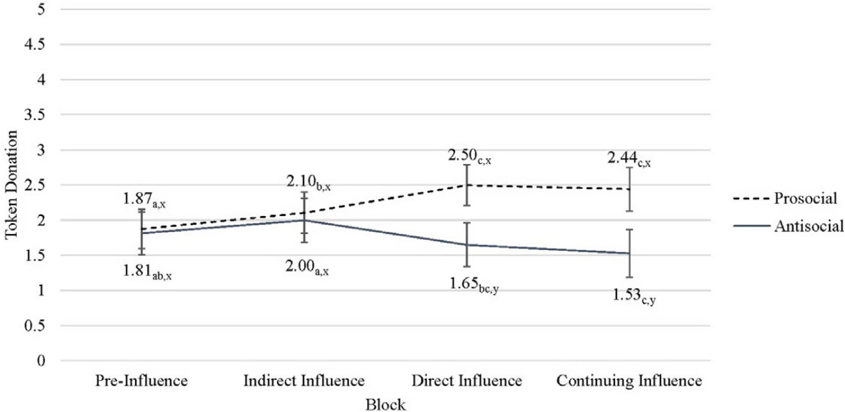
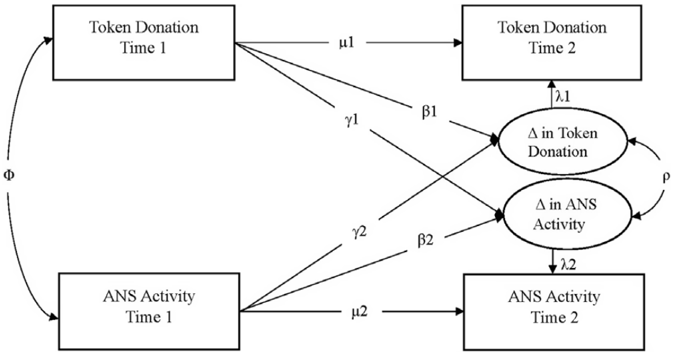
The current study investigated in-the-moment links between adolescents’ autonomic nervous system activity and susceptibility to three types of peer influence (indirect, direct, continuing) on two types of behavior (antisocial, prosocial). The sample included 144 racially ethnically diverse adolescents (46% male, 53% female, 1% other;Mage = 16.02 years). We assessed susceptibility to peer influence behaviorally using the Public Goods Game (PGG) while measuring adolescents’ mean heart rate (MHR) and pre-ejection period (PEP). Three key findings emerged from bivariate dual latent change score modeling: (1) adolescents whose MHR increased more as they transitioned from playing the PGG alone (pre-influence) to playing while simply observed by peers (indirect influence) displayed more prosocial behavior; (2) adolescents whose PEP activity increased more (greater PEP activity = shorter PEP latency) as they transitioned from indirect influence to being encouraged by peers to engage in antisocial behavior (direct influence) engaged in more antisocial behavior; and (3) adolescents whose PEP activity decreased less as they transitioned from direct influence on prosocial behavior to playing the PGG alone again (continuing influence) displayed more continuing prosocial behavior (marginal effect). The discussion focuses on the role of psychophysiology in understanding adolescents’ susceptibility to peer influence.
Overview
The claims and statistics of this paper haven’t been checked yet.
Free: it reads the open-access text and checks the first 5 claims that cite a source we can check. Create a free account to check every claim.
Integrity signals
Registry
Cites
Statistics
Figures
Verification
Claims the paper makes
The claims and statistics of this paper haven’t been checked yet.
Free: it reads the open-access text and checks the first 5 claims that cite a source we can check. Create a free account to check every claim.
Self-check
Percentages, sums and reported differences re-computed from the paper’s own numbers.
The self-check needs the paper’s full text.
Citations
Cites
The Handbook of experimental economics
(1995) · Choice Reviews Online · doi:10.5860/choice.33-1645 · Cited by 3,679
A model of neurovisceral integration in emotion regulation and dysregulation
Thayer, J. F., & Lane, R. D. (2000) · Journal of Affective Disorders · doi:10.1016/s0165-0327(00)00338-4 · Cited by 3,092 · cited 1×
“MHR indexes either SNS activity (Anderson & Adolphs, 2014) or PNS activity (Thayer & Lane, 2000), depending upon the use of the vagal brake as assessed through respiratory sinus arrhythmia (RSA; Porges, 2001).”
MethodUSING THE CORRECT STATISTICAL TEST FOR THE EQUALITY OF REGRESSION COEFFICIENTS
PATERNOSTER, R., BRAME, R., MAZEROLLE, P., & PIQUERO, A. (1998) · Criminology · doi:10.1111/j.1745-9125.1998.tb01268.x · Cited by 2,742 · cited 1×
“When significant effects emerged in either theMHR or PEPmodel for a transition, we tested whether the path of primary interest ρ differed between ANS indices in these two models (Paternoster et al., 1998).”
MethodGardner, M., & Steinberg, L. (2005) · Developmental Psychology · doi:10.1037/0012-1649.41.4.625 · Cited by 2,218 · cited 3×
“…which permits unrestricted re-use, distribution and reproduction, provided the original article is properly cited. https://doi.org/10.1017/S0954579422000967 Published online by Cambridge University Press effect (Gardner & Steinberg, 2005; Reynolds et al., 2014; Silva et al., 2016).”
BackgroundMethodInfluentialHandbook of peer interactions, relationships, and groups
(2009) · Choice Reviews Online · doi:10.5860/choice.46-6491 · Cited by 1,931
The polyvagal theory: phylogenetic substrates of a social nervous system.
Porges, S. W. (2001) · International Journal of Psychophysiology · doi:10.1016/s0167-8760(01)00162-3 · Cited by 1,582 · cited 1×
“MHR indexes either SNS activity (Anderson & Adolphs, 2014) or PNS activity (Thayer & Lane, 2000), depending upon the use of the vagal brake as assessed through respiratory sinus arrhythmia (RSA; Porges, 2001).”
MethodAge differences in resistance to peer influence.
Steinberg, L., & Monahan, K. C. (2007) · Developmental Psychology · doi:10.1037/0012-1649.43.6.1531 · Cited by 1,566 · cited 1×
“Although teens are typically more susceptible to peer influence than adults (Steinberg & Monahan, 2007), some adolescents are more susceptible than others.”
BackgroundSocial Comparisons and Pro-social Behavior: Testing “Conditional Cooperation” in a Field Experiment
Frey, B. S., & Meier, S. (2004) · American Economic Review · doi:10.1257/0002828043052187 · Cited by 1,184 · cited 1×
“Moreover, peer influence on prosocial behavior continues when peers are no longer present, although again, this effect often is weaker than the preceding effect of direct influence (Choukas-Bradley et al., 2015; Frey & Meier, 2004; van Hoorn et al., 2014).”
BackgroundHandbook of Developmental Cognitive Neuroscience
(2008) · The MIT Press eBooks · doi:10.7551/mitpress/7437.001.0001 · Cited by 1,182
Peers increase adolescent risk taking by enhancing activity in the brain’s reward circuitry
Chein, J., Albert, D., O’Brien, L., Uckert, K., & Steinberg, L. (2011) · Developmental Science · doi:10.1111/j.1467-7687.2010.01035.x · Cited by 1,180
Research works printed but not linked: 3
- Allen, J. P., & Antonishak, J. (2008). Adolescent peer influences: Beyond the dark side. In M. J. Prinstein & K.A. Dodge (Eds.), Understanding peer influ- ence in children and adolescents (pp. 141-160). New York: Guilford Press.
- Müller, C., & Minger, M. (2013). Which children and adolescents are most susceptible to peer influence? A systematic review regarding antisocial behavior. Empirical Special Education, 2, 107-129.
- Muthén, L., & Muthén, B. (1998-2017). Mplus user's guide. Los Angeles, CA: Muthén & Muthén.
Cited by
Li, W., He, Q.-F., Lan, J., Attiq‐Ur‐Rehman, Ge, M., Shen, L.-T., Hu, F., Jia, Y.-J., & Chen, H. (2024) · Journal of Youth and Adolescence · doi:10.1007/s10964-024-02079-3 · Cited by 54
“…predictive effect on behavior (Wang & Qi, 2023), exposure to peers engaging in antisocial activities such as smoking, drinking, or drug use can lead to the adoption of similar behaviors in adolescents (Farrell et al., 2022), even persisting after peer in fl uence has diminished(Meehan et al., 2022).”
Meehan, Z. M., & Hubbard, J. A. (2026) · Journal of Adolescence · doi:10.1002/jad.70214 · Cited by 3
Self-citationField, N. H., & Prinstein, M. J. (2023) · Elsevier eBooks · doi:10.1016/b978-0-323-96023-6.00016-6 · Cited by 4
Denk, B., Pruessner, J. C., Farah, S., Barth, C., Putra, P. U., Lenggenhager, B., & Grütter, J. (2026) · Scientific Reports · doi:10.1038/s41598-026-41275-y · Cited by 2
Saeedi, N., Borhani, K., & Golbabaei, S. (2026) · Scientific Reports · doi:10.1038/s41598-026-64831-y · Cited by 1
“For this purpose, we designed a study comprising a knowledge-based contest followed by a modified public goods game (PGG 52,53 ;.”
Metadata
- Authors
- Meehan, Z. M., Hubbard, J. A., Moore, C. C., & Mlawer, F.
- Affiliations
- University of Delaware (US)
- Corresponding author
- Hubbard, Julie A.
- Venue
- Development and Psychopathology
- Publisher
- Cambridge University Press (CUP)
- Published
- 2022-09-23
- Volume
- 36
- Issue
- 1
- Pages
- 69-81
- ISSN
- 0954-5794 (ISSN-L)
- 1469-2198
- OpenAlex
- W4296793941
- Cited by
- 12
- References
- 73
- Citations by year
- 2026: 5 · 2025: 3 · 2024: 3 · 2023: 1
- FWCI
- 1.60
- Type
- journal article
- Language
- en
- Open access
- hybrid
- doi.org
- Locations
- Development and Psychopathology (publishedVersion, cc-by)
- PubMed (publishedVersion)
- Library, Museums and Press - UDSpace (University of Delaware) (submittedVersion, cc-by)
- Topics
- Social Sciences › Psychology › Clinical Psychology › Child and Adolescent Psychosocial and Emotional Development
- Health Sciences › Medicine › Cardiology and Cardiovascular Medicine › Heart Rate Variability and Autonomic Control
- Life Sciences › Neuroscience › Cognitive Neuroscience › Neural and Behavioral Psychology Studies
- Keywords
- peer influence, adolescents, autonomic nervous system, heart rate, pre-ejection period, prosocial behavior, antisocial behavior, public goods game, indirect influence, psychophysiology, peer encouragement
- MeSH terms
- Peer Influence, Adolescent, Adolescent Behavior, Female, Humans, Male, Peer Group, Psychophysiology, Social Behavior
About these checks
Registry, retraction, Cites and statistics results are computed, not judged, with one exception: a printed reference that no index lists is read once by a model before it counts as a citation error. Claims are extracted by a model and kept only when their quote appears verbatim in the text; each cited source is then checked, with a model’s help, for whether it says what the claim relies on. Those verdicts can be wrong — read the claim’s quote and the cited source before relying on one.
Statistics and arithmetic are recomputed, not judged.
Confidence bands are shown only for fields calibrated on our annotated test set. None is calibrated yet, so no band is shown.
What counts as a claim ›How we measure confidence ›How we check this ›
Are you an author, or do you see a problem with this page? Request a review
Data sources
Bibliographic data: Semantic Scholar, OpenAlex, Crossref.
Contains information from the Semantic Scholar Academic Graph Datasets, made available under the ODC Attribution License (ODC-BY 1.0).
Semantic Scholar’s data is described in: Kinney, R., et al. (2023). The Semantic Scholar Open Data Platform. arXiv:2301.10140.
