

Reframing the Uruk Expansion: Glocalization and Local Dynamics in the Late Chalcolithic Adhaim-Sirwan Drainage Basin, Iraqi Kurdistan
Open accessThe DOI matches its Crossref record; 69 of the 71 references it cites were found in a registry or an index, and 1 are not checked yet; none of the 59 sources its claims cite is checked for support yet.
Abstract
Within this paper, glocalization is presented to explain the heterogeneity of the Uruk Expansion/Phenomenon, a process which saw extensive interactions and cultural integration across Mesopotamia during the fourth millennium bce, characterized by the spread of southern Mesopotamian material culture and cultural practices. Through close examination of archaeological data from the Adhaim-Sirwan Drainage Basin, southern Iraqi Kurdistan, a region which is emerging as a focus of intense culture-contact during the Uruk Phenomenon, I contend that a glocalized perspective of this phenomenon better illuminates its regional nuances and complexities, as well as the interactions between local and Uruk communities within the Adhaim-Sirwan. By employing a glocalizing framework, this paper demonstrates that cultural interactions led to varied adaptations of the Uruk Phenomenon and illustrates the dynamic interplay between global influences and local responses. Ultimately, this paper advocates for a nuanced understanding of the Uruk Phenomenon, highlighting its regional variability and the importance of local agency in shaping cultural outcomes, thereby framing it as a distinctly glocalized process rather than an expression of globalization.
Checked 2026-11-24 · 1 reference not checked yet
Overview
CoChat Summary
TL;DR
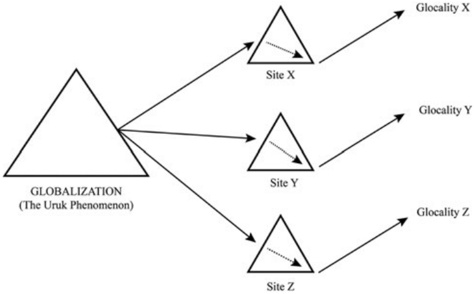
This paper argues that glocalization, rather than globalization or World Systems Theory, better explains the heterogeneous Uruk Phenomenon in the Late Chalcolithic Adhaim-Sirwan Drainage Basin, Iraqi Kurdistan. It synthesizes archaeological evidence to show that local communities selectively adopted, adapted, or rejected Uruk material culture and practices, producing site-specific glocal outcomes.
Key findings
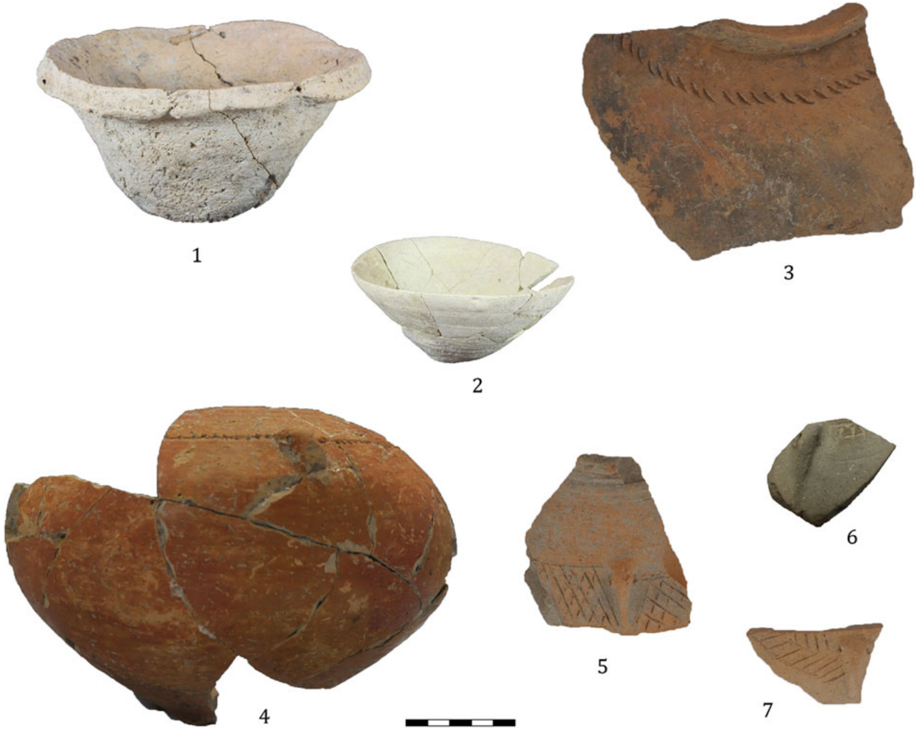
- The Adhaim-Sirwan shows early Uruk culture-contact in LC2–LC3, observed mainly through Bevelled Rim Bowls (BRBs), before the mature LC4 Uruk Phenomenon; radiocarbon dates indicate the high point of Uruk contact was brief but pronounced, broadly spanning LC4 (3600–3400 BCE per Table 1).
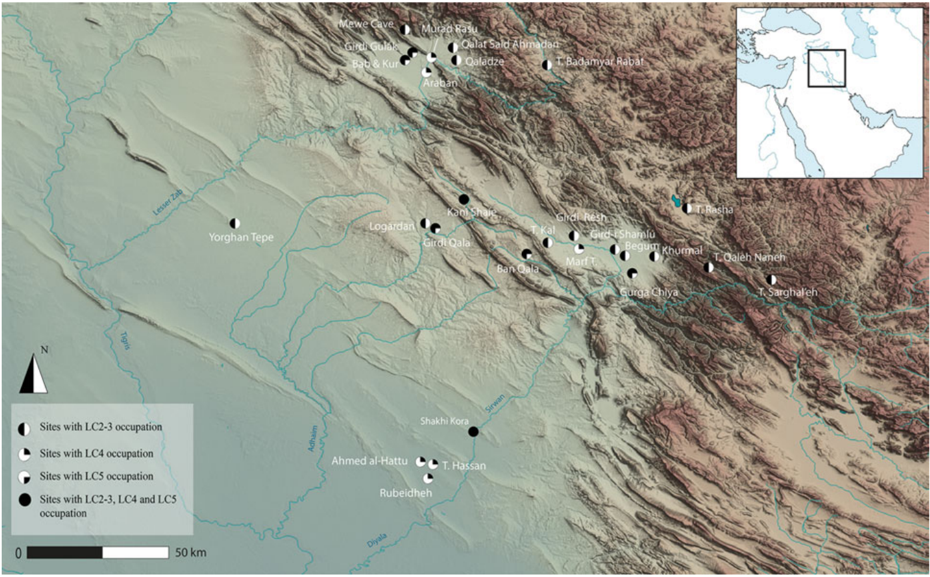
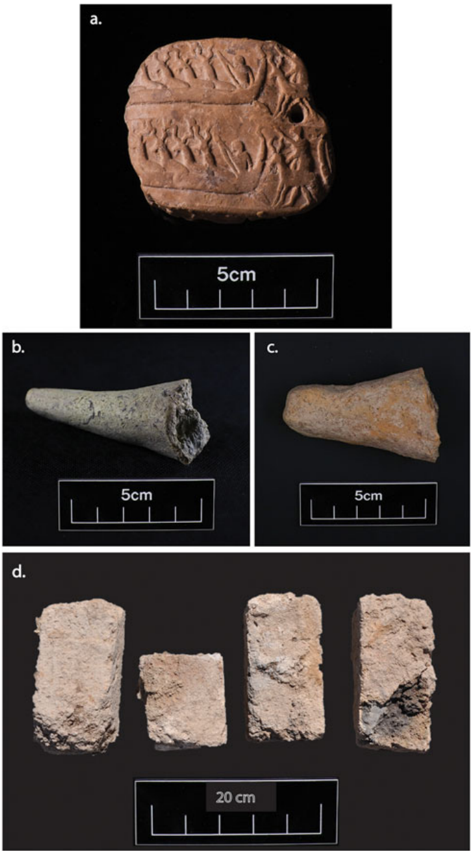
- LC4 variability is marked: local centres such as Kani Shaie, Girdi Qala, Shakhi Kora and Logardan have Uruk-related architecture, administration/bureaucracy and material culture, while small rural sites such as Gurga Chiya and Rubeidheh show limited uptake; the Rania features large-scale Uruk pottery production and an industrialized landscape.
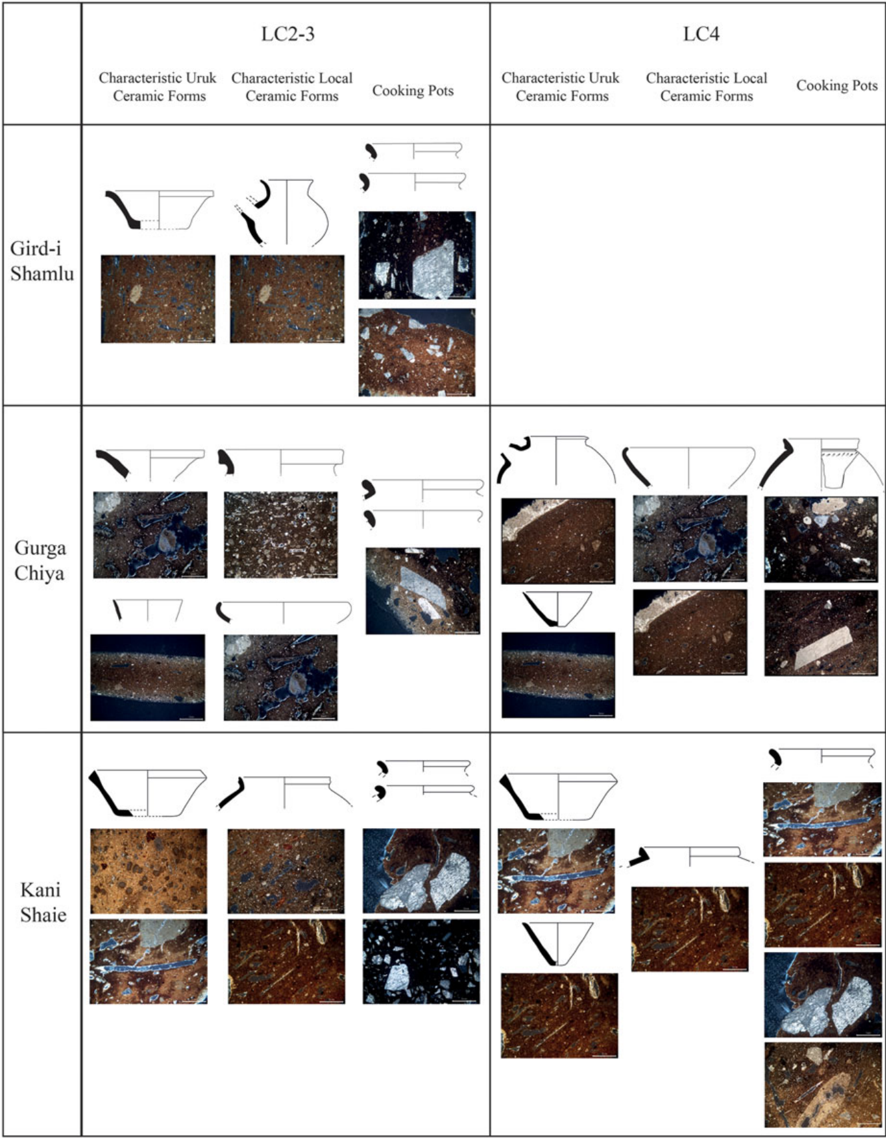
- Ceramic petrography shows no clear dichotomy between Uruk and local tempers: at Kani Shaie, Uruk vessels did not use distinct clay recipes compared with local ceramics, while at Gurga Chiya mineral-tempered ceramics increase through LC4 and at Logardan/Girdi Qala mineral tempering gradually increases, indicating site-specific potting choices.
- LC5 is virtually absent from the Transtigridian Piedmont including Iraqi Kurdistan, with Kani Shaie one of very few confirmed LC5 sites; lower Adhaim-Sirwan/Shakhi Kora maintained closer southern Mesopotamian connections, while the upper Adhaim-Sirwan shows weakened ties, a possible prolonged LC4, or unresolved LC5 chronology.
Methods
- Design: interpretive/theoretical synthesis applying glocalization, especially Roudometof’s model, to the Uruk Phenomenon, using the Adhaim-Sirwan Basin as a case study.
- Data: published archaeological evidence from excavations and surveys in the Adhaim-Sirwan and adjacent regions, including ceramics (BRBs, Uruk wares), architecture, administrative objects, radiocarbon dates, and petrographic/archaeometric analyses.
- Analysis: qualitative comparison of site-specific assemblages and chronologies across LC2–LC5 to assess variable local uptake of Uruk material culture and practices.
Limitations
- Stated in the paper: excavations at relevant sites are ongoing and not fully published, limiting depth of analysis; additional absolute dating is needed, especially for the initial appearance of the Uruk; absolute and ceramic chronologies of the north-central Zagros are poorly defined; and the root causes of the Uruk Phenomenon are beyond the paper’s scope.
- Evident from the text: the argument is a synthesis of available and sometimes unpublished or personal-communication evidence rather than new primary excavation data, and interpretations of early LC2–LC3 contact and LC5 are explicitly provisional.
Model-written summary. Check it against the paper before relying on it.
Integrity signals
Registry
Cites
Statistics
Figures
Verification
Claims the paper makes
0 Valid · 7 Not valid · 41 Not checked · 42 Own results and interpretations
The paper states this without a source or data behind it here, so there is nothing to check it against. The quote shows it is in the paper.
In the paper
“while within Girdi Qala the increase in mineral-tempered vessels, traditionally ascribed as an Uruk cultural practice, denotes a noteworthy change in vessel production”
§ Reframing the Uruk Expansion: Glocalization and Local Dynamics in the Late Chalcolithic Adhaim-Sirwan Drainage Basin, Iraqi Kurdistan > Discussion. Glocalizing the global Uruk Phenomenon
plainSingle case- Asserted: passes — The authors put it forward as true.
- Checkable: passes — It can be checked against evidence.
- Load-bearing: passes — The paper’s conclusions depend on it.
- Based: unclear — It is unclear why the paper says it holds.
The paper states this without a source or data behind it here, so there is nothing to check it against. The quote shows it is in the paper.
In the paper
“The early expression and culture contact of the LC2-3 saw a relatively muted, restricted uptake in Uruk material culture, largely though not exclusively limited to the incorporation of BRBs within culinary practices.”
§ Reframing the Uruk Expansion: Glocalization and Local Dynamics in the Late Chalcolithic Adhaim-Sirwan Drainage Basin, Iraqi Kurdistan > Discussion. Glocalizing the global Uruk Phenomenon
plain- Asserted: passes — The authors put it forward as true.
- Checkable: passes — It can be checked against evidence.
- Load-bearing: passes — The paper’s conclusions depend on it.
- Based: unclear — It is unclear why the paper says it holds.
A result the paper states — it cites no source for it, so there is none to check. The quote shows it is in the paper.
In the paper
“The LC4 saw greater variability in the uptake of Uruk material culture.”
§ Reframing the Uruk Expansion: Glocalization and Local Dynamics in the Late Chalcolithic Adhaim-Sirwan Drainage Basin, Iraqi Kurdistan > Discussion. Glocalizing the global Uruk Phenomenon
plain- Asserted: passes — The authors put it forward as true.
- Checkable: passes — It can be checked against evidence.
- Load-bearing: passes — The paper’s conclusions depend on it.
- Based: passes — The paper gives a reason why it holds.
A result the paper states — it cites no source for it, so there is none to check. The quote shows it is in the paper.
In the paper
“Local centres such as Girdi Qala, Kani Shaie and Shakhi Kora embrace a wider range of Uruk material culture, including monumental buildings decorated with wall-cones present alongside Uruk bureaucracy and administration.”
§ Reframing the Uruk Expansion: Glocalization and Local Dynamics in the Late Chalcolithic Adhaim-Sirwan Drainage Basin, Iraqi Kurdistan > Discussion. Glocalizing the global Uruk Phenomenon
plain- Asserted: passes — The authors put it forward as true.
- Checkable: passes — It can be checked against evidence.
- Load-bearing: passes — The paper’s conclusions depend on it.
- Based: passes — The paper gives a reason why it holds.
In the paper
“Analysis of clay recipes from Kani Shaie phase Vd (LC3) shows that Uruk vessels did not use distinct clay recipes compared to local ceramics (Lewis 2022b).”
§ Reframing the Uruk Expansion: Glocalization and Local Dynamics in the Late Chalcolithic Adhaim-Sirwan Drainage Basin, Iraqi Kurdistan > LC2-3 in the Adhaim-Sirwan: emerging culture-contact and the initial transmission of the Uruk Phenomenon
What the sources say
- Not matchedcites Lewis 2022b
More than one paper fits this citation.
plain- Asserted: passes — The authors put it forward as true.
- Checkable: passes — It can be checked against evidence.
- Load-bearing: passes — The paper’s conclusions depend on it.
- Based: passes — The paper gives a reason why it holds.
- Not matched
35 more claims
Create a free account to see all 90 claims and to verify the 33 references still open.
- It may state two separate claims as one. 39
- Probably not a substantial claim. 19
Citations
Cites
Communities of Practice: Learning, Meaning, and Identity
Wenger, E. (1998) · doi:10.1017/cbo9780511803932 · Cited by 23,500
The Postmodern Condition: A Report on Knowledge
Lyotard, J.-F., Bennington, G., & Massumi, B. (1984) · Poetics Today · doi:10.2307/1772278 · Cited by 14,728
Globalization: Social Theory and Global Culture
Robertson, R. (2000) · SAGE Publications Ltd eBooks · doi:10.4135/9781446280447 · Cited by 3,538
Rethinking Globalization: Glocalization/Grobalization and Something/Nothing
Ritzer, G. (2003) · Sociological Theory · doi:10.1111/1467-9558.00185 · Cited by 324
Theorizing glocalization: Three interpretations 1
Roudometof, V. N. (2015) · European Journal of Social Theory · doi:10.1177/1368431015605443 · Cited by 310
Ancient Mesopotamia at the Dawn of Civilization: The Evolution of an Urban Landscape
Algaze, G. (2008) · University of Chicago Press eBooks · doi:10.7208/chicago/9780226013787.001.0001 · Cited by 280
The Routledge Handbook of Archaeology and Globalization
(2016) · Routledge eBooks · doi:10.4324/9781315449005 · Cited by 263
Early Mesopotamian urbanism: a new view from the north
Oates, J., McMahon, A., Karsgaard, P., Quntar, S. A., & Ur, J. (2007) · Antiquity · doi:10.1017/s0003598x00095600 · Cited by 252
Roudometof, V. (2016) · Routledge eBooks · doi:10.4324/9781315858296 · Cited by 240
Textile Extensification, Alienation, and Social Stratification in Ancient Mesopotamia
McCorriston, J. (1997) · Current Anthropology · doi:10.1086/204643 · Cited by 222
The Routledge handbook of archaeology and globalization
Hodos, T., & Geurds, A. (2017) · Cited by 159
The Uruk world system: the dynamics of expansion of early Mesopotamian civilization
(1993) · Choice Reviews Online · doi:10.5860/choice.31-2243 · Cited by 157
What Makes Civilization?: The Ancient Near East and the Future of the West
Wengrow, D. (2010) · Cited by 141
Early Urbanism in Northern Mesopotamia
McMahon, A. (2020) · Journal of Archaeological Research · doi:10.1007/s10814-019-09136-7 · Cited by 137
Globalisation or glocalisation?
Robertson, R. (2012) · The Journal of International Communication · doi:10.1080/13216597.2012.709925 · Cited by 123
The Archaeology of Hybrid Material Culture
Card, J. J. (2013) · Project Muse (Johns Hopkins University) · Cited by 105
Mobile Pastoralism and the Formation of Near Eastern Civilizations: Weaving Together Society
Porter, A. (2012) · doi:10.1017/cbo9780511895012 · Cited by 100
Handbook of Culture and Glocalization
Roudometof, V. N., & Dessì, U. (2022) · Edward Elgar Publishing eBooks · doi:10.4337/9781839109010 · Cited by 73
Petrie, C. A. (2013) · Oxbow Books · doi:10.2307/j.ctvh1dn46 · Cited by 61
Tepe Gawra: The Evolution of a Small, Prehistoric Center in Northern Iraq
Rothman, M. S., & Peasnall, B. L. (2001) · Academic Commons (Stony Brook University) · Cited by 55
Late Uruk in Greater Mesopotamia : Expansion or Collapse
Johnson, G. (1988) · Cited by 55
Reinders, L. (2004) · AGORA Magazine · doi:10.21825/agora.v20i4.9658 · Cited by 50
Different Trajectories in State Formation in Greater Mesopotamia: A View from Arslantepe (Turkey)
Frangipane, M. (2018) · Journal of Archaeological Research · doi:10.1007/s10814-017-9106-2 · Cited by 49
THE ERBIL PLAIN ARCHAEOLOGICAL SURVEY: PRELIMINARY RESULTS, 2012–2020
Ur, J. A., Babakr, N., Palermo, R., Creamer, P. M., Soroush, M., Ramand, S., & Nováček, K. (2021) · Iraq · doi:10.1017/irq.2021.2 · Cited by 43
Excavations at Tell Mohammed 'Arab in the Eski Mosul Dam Salvage Project
Roaf, M. (1984) · Iraq · doi:10.2307/4200223 · Cited by 39
Intermarriage, Technological Diffusion, and Boundary Objects in the U.S. Southwest
Mills, B. J. (2018) · Journal of Archaeological Method and Theory · doi:10.1007/s10816-018-9392-0 · Cited by 33
Cultural Interaction at Hassek Höyük, Turkey. New Evidence from Pottery Analysis
Helwing, B. (1999) · Paléorient · doi:10.3406/paleo.1999.991 · Cited by 31
van Alten, D. C. D. (2017) · Religions · doi:10.3390/rel8080140 · Cited by 29
Glocalisation: An international communication framework?
KRAIDY, M. M. (2003) · The Journal of International Communication · doi:10.1080/13216597.2003.9751953 · Cited by 28
Early Fourth Millennium Developments in Southwestern Iran
Wright, H. T., Neely, J. A., Johnson, G. A., & Speth, J. D. (1975) · Iran · doi:10.2307/4300530 · Cited by 27
New evidence on Uruk expansion in the Central Mesopotamian Zagros Piedmont
Vallet, R., Baldi, J. S., Naccaro, H., Rasheed, K., Saber, S. A., & Hamarasheed, S. J. (2017) · Paléorient · doi:10.3406/paleo.2017.5752 · Cited by 26
Renette, S., Jayyab, K. A., Gibbon, E., Lewis, M. P., Abdullkarim Qadir, Z., Cabral, R., & Tomé, A. G. (2021) · Iraq · doi:10.1017/irq.2021.1 · Cited by 24
Self-citationFurholt, M. (2020) · Préhistoires méditerranéennes · doi:10.4000/pm.2383 · Cited by 22
Renette, S., & Ghasrian, S. M. (2020) · Paléorient · doi:10.4000/paleorient.366 · Cited by 19
Carter, R., Wengrow, D., Saber, S. A., Hamarashi, S. J., Shepperson, M., Roberts, K., Lewis, M. P., Marsh, A., Carretero, L. G., Sosnowska, H., et al. (2020) · Iraq · doi:10.1017/irq.2020.3 · Cited by 18
Self-citationVallet, R., Baldi, J. S., Zingarello, M., Sauvage, M., Naccaro, H., Paladre, C., Padovani, C., Bridey, F., Rasheed, K., Raeuf, K., et al. (2019) · Paléorient · doi:10.4000/paleorient.751 · Cited by 17
REVISITING TELL BEGUM: A PREHISTORIC SITE IN THE SHAHRIZOR PLAIN, IRAQI KURDISTAN
Nieuwenhuyse, O., Odaka, T., Kaneda, A., Mühl, S., Rasheed, K., & Altaweel, M. (2016) · Iraq · doi:10.1017/irq.2016.7 · Cited by 15
Translocality and glocalization: a conceptual exploration
Roudometof, V. N., & Carpentier, N. (2022) · Edward Elgar Publishing eBooks · doi:10.4337/9781839109010.00029 · Cited by 14
Researchs on the antiquities of Saddam Dam Basin Salvage and other researches
wa-'t-Turāṯ, I. A. M. A.-ʿ. L.-'.-Ā. (1987) · Cited by 14
Sconzo, P. (2019) · Paléorient · doi:10.4000/paleorient.745 · Cited by 13
The Kani Shaie Archaeological Project
Tomé, A., Cabral, R., & Renette, S. (2016) · The Archaeology of the Kurdistan Region of Iraq and Adjacent Regions · doi:10.2307/j.ctvxrq0m8.44 · Cited by 13
Globalization/Glocalization: Developments in Theory and Application
Beyer, P. (2021) · BRILL eBooks · doi:10.1163/9789004500365 · Cited by 13
Siedlungsgeschichte im mittleren Osttigrisgebiet vom Neolithikum bis in die neuassyrische Zeit
Mühl, S. (2013) · Cited by 12
Renette, S., Lewis, M. P., Wencel, M. M., Farahani, A., & Tomé, A. (2023) · Radiocarbon · doi:10.1017/rdc.2022.72 · Cited by 11
Self-citationCeramics and long-distance trade in early Mesopotamian states
Emberling, G., & Minc, L. (2016) · Journal of Archaeological Science: Reports · doi:10.1016/j.jasrep.2016.02.024 · Cited by 11
Giraud, J., Baldi, J. S., Bonilauri, S., Mashkour, M., Lemée, M., Pichon, F., Mura, M., Pot, M.-A., Jamialahmadi, M., Biglari, F., et al. (2019) · Paléorient · doi:10.4000/paleorient.702 · Cited by 11
Studi di Archeologia del Vicino Oriente: Scritti degli allievi fiorentini per Paolo Emilio Pecorella
Mazzoni, E. B. S., & Mazzoni, S. (2012) · Studi e saggi · doi:10.36253/978-88-6655-145-4 · Cited by 11
MacGinnis, J., Raheem, K. R., Ismail, B. B., Ahmad, M., Cabral, R., Dusting, A., Greenfield, T. L., Hazell, G., Iasonos, A., Kertai, D., et al. (2020) · Iraq · doi:10.1017/irq.2019.11 · Cited by 10
Glatz, C., Del Bravo, F., Chelazzi, F., Calderbank, D., Heimvik, S. G., Bendrey, R., Hald, M. M., Lewis, M., Palyvos, A., Sarris, A., et al. (2025) · Antiquity · doi:10.15184/aqy.2024.189 · Cited by 8
Self-citationAbedi, A., Heidari, R., Salimi, S., & Eskandari, N. (2019) · Documenta Praehistorica · doi:10.4312/dp.46.26 · Cited by 7
Lewis, M. P., Quinn, P. S., & Carter, R. (2020) · Journal of Archaeological Science: Reports · doi:10.1016/j.jasrep.2020.102516 · Cited by 5
Self-citationBan Qala: A Late Chalcolithic Site in the Qara Dagh Valley of Iraqi Kurdistan
Catanzariti, A., Tanaka, T., & Maskevich, A. (2020) · Harrassowitz Verlag eBooks · doi:10.13173/9783447113670.043 · Cited by 5
Du monde proto-urbain aux villes mésopotamiennes: Questions d’échelle et de morphogénèse
Butterlin, P. (2021) · Histoire urbaine · doi:10.3917/rhu.061.0011 · Cited by 4
The Marivan Plain Archaeological Project: Western Iran and its neighbours in the Chalcolithic Period
Dadaneh, M. Z., Ghasrian, S. M., Colantoni, C., & Skuldbøl, T. B. B. (2019) · Antiquity · doi:10.15184/aqy.2019.198 · Cited by 4
Interdisciplinary perspectives on glocalization
Salazar, N., Barrett, J. H., Robertson, R., Roudometof, V. N., & Sherratt, S. (2018) · Lirias · Cited by 3
CNRS, U. 5. A., & Baldi, J. S. (2021) · Interdisciplinaria Archaeologica Natural Sciences in Archaeology · doi:10.24916/iansa.2021.2.6 · Cited by 3
Iamoni, M., Valente, R., Scattini, M., & Hasan, B. J. (2022) · Institutional Research Information System (University of Udine) · Cited by 3
Mucheshi, A. S., Azarshab, A., & Ghaffari, Z. (2012) · Cited by 3
Fuensanta, J. G., Martín, A. M., & Muminov, O. U. (2021) · Cuadernos de Prehistoria y Arqueología de la Universidad Autónoma de Madrid · doi:10.15366/cupauam2021.47.2.002 · Cited by 2
Ławecka, D. (2017) · Polish Archaeology in the Mediterranean · doi:10.5604/01.3001.0010.1876 · Cited by 2
Jebel Aruda an Uruk period temple and settlement in Syria
van Driel, G., & van Driel-Murray, C. (2023) · Cited by 2
Thrashing out Late Chalcolithic Trajectories in the Zagros Foothills
Jesper, E., & Deborah, G. (2021) · CINECA IRIS Institutial research information system (University of Pisa) · doi:10.2143/ana.47.0.3289566 · Cited by 1
Archaeological Survey of Qaladze (Sulaymania Governorate, Iraq) 2013
D’Agostino, A., Eidem, J., Giannessi, D., Mazzoni, S., Orsi, V., & Raheem, K. R. (2016) · CINECA IRIS Institutial research information system (University of Pisa) · Cited by 1
München, L. C. N. M. I. C. 2., Baldi, J. S., Iamoni, M., Peyronel, L., Sconzo, P., & München, I. C. O. T. A. O. T. A. N. E. 2. (n.d.) · Cited by 1
(2001)
(1929)
(2018) · HAL
(2003) · CNRS Éditions eBooks
(2024) · HAL
Research works printed but not linked: 26
- Hijara, I., 1976. Excavations in the Plain of Shahrizor: Tell Gerdi Resh - First Season 1971. Sumer 31, 59-82. (In Arabic)
- Nobari, A.H., A. Binandeh, J. Nestani & H.V. Nasab, 2012. Excavation at Lavin Tepe in northwest Iran. Ancient Near Eastern Studies 49, 95-117.
- Fine, L.J. & J.E. Thompson, 2018. Introduction, in 'Glocal Archaeology', issue eds L.J. Fine & J.E. Thompson. Archaeological Review from Cambridge 33(1), 3-11.
- Odaka, T., O. Maeda, K. Shimogama, Y.S. Hayakawa, N.A. Mohammed & K. Rasheed, 2023. Late prehistoric investigations at Shakar Tepe, the Shahrizor Plain, Iraqi Kurdistan: preliminary results of the first season (2019), in The Proceedings of the 12th International Congress on the Archaeology of the Ancient Near East, Vol. 2: Field Reports. Islamic Archaeology, eds N. Marchetti, F. Cavaliere, E. Cirelli, C. D'Orazio, G. Giacosa, M. Guidetti & E. Mariani. Wiesbaden: Harrassowitz, 415-28.
- Montoya Gonzalez, R., 2021. The global, the local, and the glocal. A new reading of the Priapus mosaic from the Hispano-Roman villa of Bobadilla (Antequera, Málaga). Memoirs of the American Academy in Rome 66, 92-114.
- Killick, R. (ed.), 1988. Excavations at Tell Rubeidheh. (Iraq Archaeological Reports 2; Hamrin Salvage Project Report 7.) Warminster: British School of Archaeology in Iraq.
- Reichel, C., 2009. Beyond the Garden of Eden -competition and early warfare in northern Syria (4500-3000 BC), in Schlachfeldarchäologie- Battlefield Archaeology, ed. H. Meller. Halle: Landesdenkmalamt, 17-30.
- Stein, G.J., 1999. Rethinking World-Systems: Diasporas, colonies, and inter- action in Uruk Mesopotamia. Tucson (AZ): University of Arizona Press.
- Paladre, C., R. al Debs & A.H. Amin, 2016. Archaeological survey of Girdi Qala North Mound, in Report on the Second Season of Excavations at Girdi Qala and Logardan, ed. R. Vallet. Unpublished report submitted to the Directorate of Antiquities of Suleymaniah, 89-95.
- Skuldbøl, T.B.B. & C. Colantoni, 2022. Unravelling early urbanism and cul- tural encounters in Late Chalcolithic northeastern Iraq, in Late Chalcolithic Northern Mesopotamia in Context. Papers from a Workshop held at the 11th ICAANE in Munich, April 5th, 2018, eds J.S. Baldi, M. Iamoni, L. Peyronel & P. Sconzo. (Subartu 48.) Turnhout: Brepols, 3-23.
- Strommenger, E., D. Sürenhagen & D. Rittig, 2014. Die Kleinfunde von Habuba Kabira-Süd. (Wissenschaftliche Eröffentlichung der Deutschen Orient-Gesellschaft 141.) Wiesbaden: Harrassowitz.
- Abu Al-Soof, B., 1966. Short sounding at Qalinj Agha (Erbil). Sumer 22, 77-82.
- Vacca, A. & L. Peyronel, 2022. Towards a definition of the Late Chalcolithic period in the Erbil Plain: the contribution of the Helawa pottery sequence, in Late Chalcolithic Northern Mesopotamia in Context. Papers from a Workshop held at the 11th ICAANE in Munich, April 5th, 2018, eds J.S. Baldi, M. Iamoni, L. Peyronel & P. Sconzo. (Subartu 48.) Turnhout: Brepols, 85-103.
- Tsuneki, A., K. Rasheed, S.A. Saber, et al., 2016. Excavations at Qalat Said Ahmadan, Qaladizah, Iraq-Kurdistan: Second Interim Report (2015 season). al-Rāfidān 37, 89-140.
- Lewis, M.P., 2024. Regionalised trajectories and social change in the Early Bronze Age Zagros piedmont. A case study from Kani Shaie, Iraqi Kurdistan, in Early Bronze Age in Iraqi Kurdistan: Recontextualization of archaeological data, ed. B. Couturaud. Paris: Presses de l'Ifpo, 253-68.
- Aydoğan, I., M. Batihan & S. Sağlamtimur, 2022. On the edge of Mesopotamia: the presence of Uruk and Uruk-related material cul- ture in the Upper Tigris region, in Chalcolithic Northern Mesopotamia in Context. Papers from a Workshop held at the 11th ICAANE in Munich, April 5th, 2018, eds J.S. Baldi, M. Iamoni, L. Peyronel & P. Sconzo. (Subartu 48.) Turnhout: Brepols, 165-78.
- Stein, G.J., 2018. Excavations at Surezha (Erbil Plain, Kurdistan Region, Iraq). University of Chicago Oriental Institute Annual Report 2017-2018, 29-43.
- Baldi, J.S., M. Iamoni, L. Peyronel & P. Sconzo (eds), 2022. Late Chalcolithic Northern Mesopotamia in Context. Papers from a Workshop held at the 11th ICAANE in Munich, April 5th, 2018. (Subartu 48.) Turnhout: Brepols.
- Saed Mucheshi, A., S. Mohammadi Ghasrian & E. Azizi, 2018. Tappeh Qaleh Naneh in Marivan: an archaeological site in western Iran. Bastanshenakht 5, 7-20. (In Persian)
- Sürenhagen, D., 1981.
- Starr, R.F.S., 1939. Nuzi. Report on the Excavation at Yorgan Tepe near Kirkuk, Iraq. Conducted by Harvard University in conjunction with the American Schools of Oriental Research and the University Museum of Philadelphia, 1927-1931. Cambridge (MA): Harvard University Press.
- Lewis, M.P., 2022a. The 'Uruk Conundrum' in the Shahrizor, Iraqi-Kurdistan: petrographic developments, ceramic variation and cultural connections at Gird-i Shamlu and Gurga Chiya, in Late Chalcolithic Northern Mesopotamia in Context. Papers from a Workshop held at the 11th ICAANE in Munich, April 5th, 2018, eds J.S. Baldi, M. Iamoni, L. Peyronel & P. Sconzo. (Subartu 48.) Turnhout: Brepols, 65-85.
- Abu Al-Soof, B., 1964. Uruk pottery from the Dokan and Shahrzur Districts. Sumer 20, 37-44.
- Wallerstein, I., 1974. The Modern World System. New York: Academic Press.
- Lewis, M.P., 2022b. Social Transformations and Ceramic Production dur- ing the 4th-3rd Millennium BCE in Iraqi Kurdistan. Unpublished PhD thesis, University of Cambridge.
- Pollock, S., 2001. The Uruk period in southern Mesopotamia, in Uruk Mesopotamia and Its Neighbors: Cross-cultural interactions in the era of state formation, ed. M.S. Rothman. Santa Fe (NM): School of American Research Press, 181-231.
Cited by
Lewis, M. P. (2025) · Journal of Archaeological Science: Reports · doi:10.1016/j.jasrep.2025.105005 · Cited by 4
Self-citationPalermo, R., & Doglio, M. (2026) · Bulletin of the American Society of Overseas Research · doi:10.1086/742391 · Cited by 1
Can, Ş. (2026) · Cambridge Archaeological Journal · doi:10.1017/s0959774326100687
Tomé, A., Lopes, M. D. C., Lewis, M. P., & Renette, S. (2026) · Conimbriga Revista de Arqueologia · doi:10.14195/1647-8657_65_1
Self-citationVaiglova, P. (2026) · ANU Open Research (Australian National University)
Metadata
- Authors
- Lewis, M. P.
- Affiliations
- University of Coimbra (PT)
- Corresponding author
- Lewis, Michael P.
- ORCID
- Lewis, Michael P.
- Venue
- Cambridge Archaeological Journal
- Publisher
- Cambridge University Press (CUP)
- Published
- 2025-03-26
- Volume
- 35
- Issue
- 2
- Pages
- 332-346
- ISSN
- 0959-7743 (ISSN-L)
- 1474-0540
- OpenAlex
- W4408847476
- Semantic Scholar
- 989a081c2c74b9fba594debe57bcbb62d7a74d12
- Cited by
- 5
- References
- 71
- Citations by year
- 2026: 4 · 2025: 1
- FWCI
- 8.68
- Type
- journal article
- Language
- en
- Open access
- hybrid
- doi.org
- Locations
- Cambridge Archaeological Journal (publishedVersion, cc-by)
- Funders
- Arts and Humanities Research Council
- Topics
- Social Sciences › Arts and Humanities › Archeology (arts and humanities) › Ancient Near East History
- Social Sciences › Arts and Humanities › History › Eurasian Exchange Networks
- Social Sciences › Arts and Humanities › Archeology (arts and humanities) › Ancient Mediterranean Archaeology and History
- Keywords
- Uruk expansion, glocalization, Late Chalcolithic, Iraqi Kurdistan, southern Mesopotamia, cultural contact, local agency, regional variation, Mesopotamian archaeology
About these checks
Registry, retraction, Cites and statistics results are computed, not judged, with one exception: a printed reference that no index lists is read once by a model before it counts as a citation error. Claims are extracted by a model and kept only when their quote appears verbatim in the text; each cited source is then checked, with a model’s help, for whether it says what the claim relies on. Those verdicts can be wrong — read the claim’s quote and the cited source before relying on one.
A language model drew the claims from the paper on 2026-11-24, under version 3 of the claim definition (model deepseek-v4.1-flash, prompt extract-v3).
A second model labelled each claim on 2026-11-24 (model jev-1.13-20260917, definition revision gold-guideline-v0.2).
Statistics and arithmetic are recomputed, not judged.
Confidence bands are shown only for fields calibrated on our annotated test set. None is calibrated yet, so no band is shown.
What counts as a claim ›How we measure confidence ›How we check this ›
Are you an author, or do you see a problem with this page? Request a review
Data sources
Bibliographic data: Semantic Scholar, OpenAlex, Crossref.
Contains information from the Semantic Scholar Academic Graph Datasets, made available under the ODC Attribution License (ODC-BY 1.0).
Semantic Scholar’s data is described in: Kinney, R., et al. (2023). The Semantic Scholar Open Data Platform. arXiv:2301.10140.
