

The Argumentative Steps in the Halakhic Give-and-Take Conversations in the Mishnah and Tosefta: A Method to Measure the Degree of Aggressiveness in the Conversations
Open accessThe DOI matches its Crossref record; 11 of the 13 references it cites were found in a registry or an index; none of the 3 sources its claims cite is checked for support yet.
Abstract
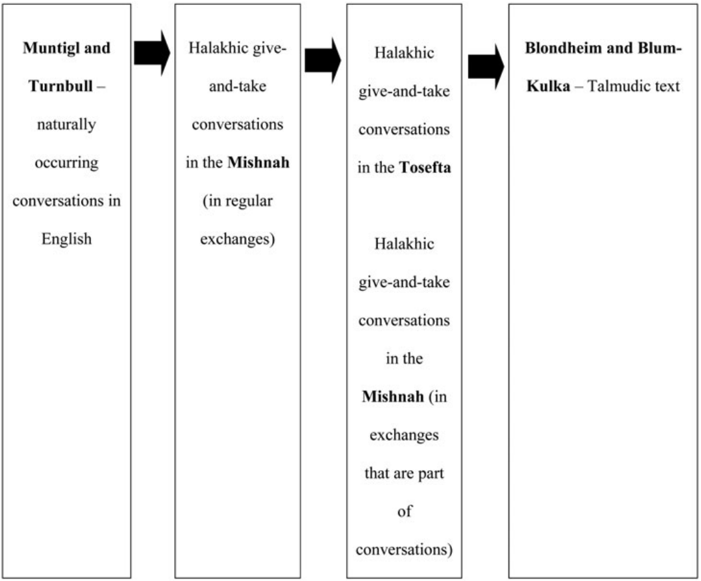
This article describes the argumentative steps in the halakhic give-and-take conversations in the Mishnah and Tosefta, which are two compilations written in Tannaitic language, the language that had been used in the first period of Mishnaic Hebrew. The argumentative steps in the conversations are examined, i.e., the connection between the arguments of the sages when they present their views in the conversations. The analysis of argumentative steps in halakhic give-and-take conversations in the Mishnah and Tosefta is based on the model proposed by Muntigl and Turnbull (1998). This model has classified the four types of disagreement acts, which were found in naturally occurring conversations: counterclaim, contradiction, challenge and irrelevancy claim; and it also ranks the degree of aggressiveness of the acts. The study conducted by Blondheim and Blum-Kulka (2001) on a Talmudic text was also based on Muntigl and Turnbull's study. The aim of this article is to try to assess the degree of aggressiveness of the halakhic give-and-take conversations in the Mishnah and Tosefta by means of an examination of the types of argumentative steps. The findings from these two compilations are compared to the findings of the two previous studies.
Overview
CoChat Summary
TL;DR
This article applies Muntigl and Turnbull’s (1998) four-type disagreement model to halakhic give-and-take conversations in the Mishnah and Tosefta, measuring aggressiveness through argumentative steps. It finds the Tosefta’s regular exchanges more aggressive than the Mishnah’s, while the Mishnah’s multi-exchange conversations are more aggressive than the Tosefta’s, with both compilations falling between M&T’s naturally occurring English conversations and Blondheim and Blum-Kulka’s Talmudic text.
Key findings
- In the Tosefta’s 88 regular two-part exchanges, the order was challenge 43%, counterclaim 39%, contradiction 14%, and irrelevancy claim 4%; high-aggression acts (irrelevancy claim + challenge) were 47%, versus 53% for intermediate/low acts. In the 43 Tosefta exchanges from multi-exchange conversations, challenge and counterclaim were equal at 37%, contradiction was 23%, irrelevancy claim 3%; high-aggression acts were 40%, versus 60% intermediate/low.
- In the Mishnah’s 116 regular two-part exchanges, the order was counterclaim 43%, contradiction 34%, challenge 20%, and irrelevancy claim 3%; high-aggression acts were 23%, versus 77% intermediate/low. In the 40 Mishnah exchanges from multi-exchange conversations, challenge was 52.5%, contradiction 35%, counterclaim 12.5%, and irrelevancy claim 0%; high-aggression acts were 52.5%, versus 47.5% intermediate/low.
- Comparing compilations: Tosefta regular exchanges were more aggressive than Mishnah regular exchanges; Mishnah multi-exchange conversations were more aggressive than Tosefta multi-exchange conversations; Mishnah regular exchanges were less aggressive than Mishnah multi-exchange exchanges and both Tosefta exchange types.
- Compared with prior studies: M&T’s naturally occurring English conversations showed low aggressiveness; Blondheim and Blum-Kulka’s Talmudic text showed high aggressiveness (irrelevancy claim 18.7%, challenge 28.6%, contradiction 45%, counterclaim 7.7%; high-aggression pair 47.3% vs low-aggression pair 52.8%). The Mishnah and Tosefta conversations fall between these extremes.
Methods
- Design: conversation-analytic/discourse analysis of argumentative steps, using Muntigl and Turnbull’s four disagreement acts—irrelevancy claim, challenge, contradiction, counterclaim—and their aggressiveness ranking. Each exchange was examined on its own, even within multi-exchange conversations; only the first speech act in each exchange part was considered.
- Data: The Tosefta corpus covers halakhic give-and-take conversations in the orders Zera’im, Moe’d, and Nashim: 118 conversations containing 172 exchanges. The first part examined 88 two-part exchanges (76% of 115 two-part exchanges after removing 57 partial exchanges); the second part examined 43 exchanges from multi-exchange conversations. The Mishnah comparison came from a previous study of 190 conversations and 240 exchanges: 116 regular two-part exchanges (77% of 151 two-part exchanges after removing 88 partial exchanges) and 40 exchanges from multi-exchange conversations.
- Analysis: For regular exchanges, the second part was examined in relation to the first part; for multi-exchange conversations, the first part of an exchange was examined in relation to the second part of the preceding exchange. Findings were compared by frequency and by M&T’s high, intermediate, and low aggressiveness categories, then compared with M&T (1998) and Blondheim and Blum-Kulka (2001).
Limitations
- Stated: The article does not directly address the general discussion of the relationship between the Mishnah and Tosefta; no satisfactory explanation was found for why the difference between exchange types appears only in the Mishnah and not in the Tosefta. The author also states that conclusions about rabbinic compilations require examining Talmudic conversations with similar methodology and scope, and continuing to examine other rabbinic compilations.
- Stated: M&T’s second issue—regularities in T2–T3 sequences, i.e. the influence of the second turn on the third—was not examined because the structure of the arguments in the corpus did not allow for a similar examination.
- Evident from the text: The Tosefta corpus is limited to three orders (Zera’im, Moe’d, Nashim); the analysis includes only exchanges containing the prevalent speech acts of asserting, asking, and answering, and only the first speech act in each exchange part. The paper also notes that the Mishnah and Tosefta are written Tannaitic compilations, unlike M&T’s natural spoken conversations, though the author argues the model can still be applied.
Model-written summary. Check it against the paper before relying on it.
Integrity signals
Registry
Cites
Statistics
Figures
Verification
Claims the paper makes
0 Valid · 1 Not valid · 3 Not checked · 26 Own results and interpretations
A result the paper reports from its own data — it cites no other source for it, so there is none to check. The quote shows it is in the paper.
In the paper
“the two compilations are similar only for the rarest argumentative step -the irrelevancy claim”
plain- Asserted: passes — The authors put it forward as true.
- Checkable: passes — It can be checked against evidence.
- Load-bearing: passes — The paper’s conclusions depend on it.
- Based: passes — The paper gives a reason why it holds.
A result the paper reports from its own data — it cites no other source for it, so there is none to check. The quote shows it is in the paper.
In the paper
“Only in the conversation noted here is there a number of exchanges greater than six.”
plainSingle case- Asserted: passes — The authors put it forward as true.
- Checkable: passes — It can be checked against evidence.
- Load-bearing: unclear — It is unclear whether the paper’s conclusions depend on it.
- Based: passes — The paper gives a reason why it holds.
A result the paper reports from its own data — it cites no other source for it, so there is none to check. The quote shows it is in the paper.
In the paper
“In the study on the halakhic give-and-take conversations in the Tosefta , a similarity could be seen in the findings from both parts of the examination: The order of frequency that was found was challenge, counterclaim, contradiction and irrelevancy claim (in the second part of the examination, the two first argumentative steps were identical in frequency).”
hedged- Asserted: passes — The authors put it forward as true.
- Checkable: passes — It can be checked against evidence.
- Load-bearing: passes — The paper’s conclusions depend on it.
- Based: passes — The paper gives a reason why it holds.
A result the paper reports from its own data — it cites no other source for it, so there is none to check. The quote shows it is in the paper.
In the paper
“In both types of exchanges, we find that the steps at the intermediate and low aggressive levels are more common than the steps at the high aggressive level”
plain- Asserted: passes — The authors put it forward as true.
- Checkable: passes — It can be checked against evidence.
- Load-bearing: passes — The paper’s conclusions depend on it.
- Based: passes — The paper gives a reason why it holds.
A result the paper reports from its own data — it cites no other source for it, so there is none to check. The quote shows it is in the paper.
In the paper
“contradiction is in the mid-range in terms of frequency in both types of exchanges”
plain- Asserted: passes — The authors put it forward as true.
- Checkable: passes — It can be checked against evidence.
- Load-bearing: passes — The paper’s conclusions depend on it.
- Based: passes — The paper gives a reason why it holds.
13 more claims
Create a free account to see all 30 claims and every source verdict.
- It may state two separate claims as one. 6
- Probably not a substantial claim. 6
Citations
Cites
Jewish argument as sociability
Schiffrin, D. (1984) · Language in Society · doi:10.1017/s0047404500010526 · Cited by 372
Conversational structure and facework in arguing
Muntigl, P., & Turnbull, W. (1998) · Journal of Pragmatics · doi:10.1016/s0378-2166(97)00048-9 · Cited by 233
Angouri, J., & Locher, M. A. (2012) · Journal of Pragmatics · doi:10.1016/j.pragma.2012.06.011 · Cited by 176
Blum‐Kulka, S., Blondheim, M., & Dori‐Hacohen, G. (2002) · Journal of Pragmatics · doi:10.1016/s0378-2166(02)00076-0 · Cited by 113
Disagreeing: Sequential placement and internal structure of disagreements in conflict episodes
Gruber, H. (1998) · Text and Talk · doi:10.1515/text.1.1998.18.4.467 · Cited by 68
Negotiation Outcome Classification Using Language Features
Twitchell, D. P., Jensen, M. L., Derrick, D. C., Burgoon, J. K., & Nunamaker, J. F. (2012) · Group Decision and Negotiation · doi:10.1007/s10726-012-9301-y · Cited by 28
Conflict Talk: A Discourse Analytical Perspective
Leung, S. (2002) · Studies in Applied Linguistics and TESOL · doi:10.7916/d8862tzt · Cited by 26
Blondheim, M., & Blum‐Kulka, S. (2001) · The Communication Review · doi:10.1080/10714420109359483 · Cited by 8
Conflict talk:A Discourse Analytical Perspective
Shuxi, Q. (2013) · Journal of Chongqing Three-gorges University · Cited by 2
Shemesh-Raiskin, R. (2020) · Cambridge semitic languages and cultures · doi:10.11647/obp.0164.03 · Cited by 1
Self-citation
Research works printed but not linked: 3
- Hauptman, 2001, Does the Tosefta precede the Mishnah: Halakhah, Aggada, and narrative coherence, Judaism, 50, 115
- Friedman, 2013, Studies in Tannaitic Literature: Methodology, Terminology and Content, 3
- Feliks, 2004, The relationship between the parallels in the Tosefta and Mishna, Talelei Orot, 11, 55
Metadata
- Authors
- SHEMESH-RAISKIN, R.
- Venue
- Journal of the Royal Asiatic Society
- Publisher
- Cambridge University Press (CUP)
- Published
- 2020-12-09
- Volume
- 31
- Issue
- 2
- Pages
- 219-242
- ISSN
- 1356-1863 (ISSN-L)
- 1474-0591
- OpenAlex
- W3111297613
- Cited by
- 0
- References
- 13
- FWCI
- 0.00
- Type
- journal article
- Language
- en
- Open access
- hybrid
- doi.org
- Locations
- Journal of the Royal Asiatic Society (publishedVersion, cc-by)
- Topics
- Social Sciences › Linguistics and Language › Linguistics and Discourse Analysis
- Social Sciences › Arts and Humanities › Language and Linguistics › Language, Discourse, Communication Strategies
- Social Sciences › Arts and Humanities › Religious studies › Biblical Studies and Interpretation
- Keywords
- Mishnah, Tosefta, Tannaim, aggression, counterclaim, contradiction, challenges
About these checks
Registry, retraction, Cites and statistics results are computed, not judged, with one exception: a printed reference that no index lists is read once by a model before it counts as a citation error. Claims are extracted by a model and kept only when their quote appears verbatim in the text; each cited source is then checked, with a model’s help, for whether it says what the claim relies on. Those verdicts can be wrong — read the claim’s quote and the cited source before relying on one.
A language model drew the claims from the paper on 2026-10-04, under version 3 of the claim definition (model deepseek-v4.1-flash, prompt extract-v3).
A second model labelled each claim on 2026-10-04 (model jev-1.13-20260917, definition revision gold-guideline-v0.2).
Statistics and arithmetic are recomputed, not judged.
Confidence bands are shown only for fields calibrated on our annotated test set. None is calibrated yet, so no band is shown.
What counts as a claim ›How we measure confidence ›How we check this ›
Are you an author, or do you see a problem with this page? Request a review
How to cite
Cite CoChat for the checks on this page, and the paper for its own findings.
- This page
- CoChat. (2026). Citation check: The Argumentative Steps in the Halakhic Give-and-Take Conversations in the Mishnah and Tosefta: A Method to Measure the Degree of Aggressiveness in the Conversations. https://app.cochat.ai/papers/10.1017/s1356186320000620
- The paper
- SHEMESH-RAISKIN, R. (2021). The Argumentative Steps in the Halakhic Give-and-Take Conversations in the Mishnah and Tosefta: A Method to Measure the Degree of Aggressiveness in the Conversations. Journal of the Royal Asiatic Society. https://doi.org/10.1017/s1356186320000620
Data sources
Bibliographic data: Semantic Scholar, OpenAlex, Crossref.
Contains information from the Semantic Scholar Academic Graph Datasets, made available under the ODC Attribution License (ODC-BY 1.0).
Semantic Scholar’s data is described in: Kinney, R., et al. (2023). The Semantic Scholar Open Data Platform. arXiv:2301.10140.
