

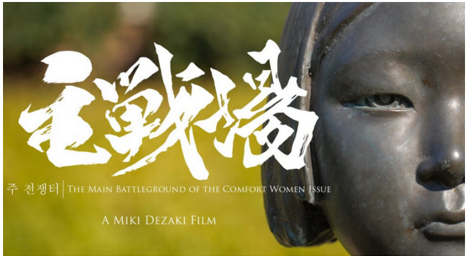
Debating Shusenjo - the Main Battlefield of the Comfort Women Issue: Director Miki Dezaki in conversation with Mark R. Frost and Edward Vickers
Open accessThe DOI matches its Crossref record; none of the 1 sources its claims cite is checked for support yet.
Abstract
This Asia-Pacific Journal: Japan Focus special issue on “The Comfort Women as Public History” concludes with documentary filmmaker Miki Dezaki in conversation with Edward Vickers and Mark R. Frost. Dezaki's film Shusenjo, released in 2018, examines the controversy over “comfort women” within Japan, as well as its implications for Korea-Japan relations. Dezaki, himself Japanese-American, also devotes considerable attention to the growing ramifications of this controversy within the United States, as an instance of the increasing international significance of the comfort women issue. In this discussion, he, Frost and Vickers reflect on the messages of the film, the experience of making and distributing it, and what this reveals about the difficulty - and importance - of doing public history in a manner that respects the complexity of the past.
Overview
CoChat Summary
TL;DR
This Asia-Pacific Journal interview features documentary filmmaker Miki Dezaki in conversation with Mark R. Frost and Edward Vickers about his 2018 film *Shusenjo*, the comfort women controversy, its reception, and the politics of public history. Dezaki discusses right-wing denial networks, Japanese government pressure on screenings, and the tension between historical complexity and activist clarity.
Key findings
- *Shusenjo* was released in 2018, premiered at the Busan International Film Festival, and ran in Tokyo until the end of January 2020—about 9 or 10 months. Dezaki faced litigation from several prominent Japanese rightists who claimed they were “deceived” into agreeing to interviews; the 2019 Kawasaki Film Festival initially censored the film under city-office pressure before showing it on the last day after an outcry that included director Hirokazu Koreda.
- Dezaki reports that Japanese consulates contacted universities or screenings in Lyon, UCLA, and UC Berkeley, expressing “disappointment” that the film was being shown; the Stanford screening was private. He links such pressure to relationships and funding networks in Japan studies.
- The film identifies Nippon Kaigi as a key organization behind denialist history-making. Dezaki says its impact was greater in South Korea than in Japan: after the film’s South Korean release on July 25 [2019], Nippon Kaigi became a major media topic there, while in Japan discussion of Nippon Kaigi had already broken from 2015.
- Dezaki argues that simplification and hyperbole by comfort women supporters can become ammunition for opponents, while rightists manipulate nuance. He also describes attempted co-optation from Korean media and activists, and notes that some US comfort women activists declined screenings because the film also criticized them.
Methods
- The article is an interview/conversation conducted via Zoom by Mark R. Frost and Edward Vickers with Miki Dezaki, originally planned for Tokyo but moved online because of COVID-19; it followed a September 2019 screening at a Kyushu University conference.
- The discussion reflects on the making and distribution of *Shusenjo*, its reception, Nippon Kaigi, positionality, reconciliation, and public history; there is no formal sampling, dataset, or quantitative analysis.
- The piece is part of the special issue “The Comfort Women as Public History”; for legal reasons, the discussion does not extend to the ongoing Japanese court action.
Limitations
- Stated: for legal reasons, the discussion does not extend to the ongoing Japanese court action.
- Stated: the COVID-19 emergency forced cancellation of the planned Tokyo interview and Dezaki’s roadshow, so the interview was conducted via Zoom.
- Evident from the text: as a single-filmmaker conversation, it presents Dezaki’s and the interviewers’ perspectives rather than systematic evidence, with no formal methodology, sample, or generalizable findings.
Model-written summary. Check it against the paper before relying on it.
Integrity signals
Registry
Cites
Statistics
Figures
Verification
Claims the paper makes
0 Valid · 11 Not valid · 1 Not checked · 26 Own results and interpretations
- Probably not a substantial claim. 38
- It may state two separate claims as one. 17
Citations
Cites
Still being checked.
Cited by
Kase Hideaki's Revisionist Vision for Twenty-First-Century Japan: A Final Interview and Obituary
Kowner, R. (2023) · Japan focus · doi:10.1017/s1557466023019472 · Cited by 1
Does defiance work? How defying “naming and shaming” shapes foreign public opinion
Kim, C. J., & Liu, D. (2026) · Journal of Peace Research · doi:10.1093/jopres/xjag054
Yasukuni, Nankín y las "mujeres del solaz": las disputas en torno a la memoria histórica de Japón
García, F. R. (2026) · Araucaria · doi:10.12795/araucaria.2026.i63.21
Metadata
- Authors
- Dezaki, M.
- Affiliations
- Sophia University (JP)
- Corresponding author
- Dezaki, Miki
- Venue
- Asia-Pacific Journal
- Publisher
- Cambridge University Press (CUP)
- Published
- 2021-03
- Volume
- 19
- Issue
- 7
- Pages
- 1-16
- ISSN
- 1557-4660 (ISSN-L)
- OpenAlex
- W3154529827
- Semantic Scholar
- 3249c1513a2d15620df71962188a6b59739df7f2
- Cited by
- 3
- References
- 0
- Citations by year
- 2026: 2 · 2023: 1
- FWCI
- 0.67
- Type
- journal article
- Language
- en
- Open access
- gold
- doi.org
- Licence
- Locations
- Japan focus (publishedVersion, cc-by-nc-nd)
- UCL Discovery (University College London) (submittedVersion)
- Topics
- Social Sciences › Cultural Studies › Memory, Trauma, and Commemoration
- Social Sciences › Cultural Studies › Japanese History and Culture
- Social Sciences › Arts and Humanities › History › Memory, violence, and history
- Keywords
- comfort women, public history, documentary filmmaking, Japan-Korea relations, historical memory, film distribution, historical complexity
About these checks
Registry, retraction, Cites and statistics results are computed, not judged, with one exception: a printed reference that no index lists is read once by a model before it counts as a citation error. Claims are extracted by a model and kept only when their quote appears verbatim in the text; each cited source is then checked, with a model’s help, for whether it says what the claim relies on. Those verdicts can be wrong — read the claim’s quote and the cited source before relying on one.
A language model drew the claims from the paper on 2026-11-22, under version 3 of the claim definition (model deepseek-v4.1-flash, prompt extract-v3).
A second model labelled each claim on 2026-11-22 (model jev-1.13-20260917, definition revision gold-guideline-v0.2).
Statistics and arithmetic are recomputed, not judged.
Confidence bands are shown only for fields calibrated on our annotated test set. None is calibrated yet, so no band is shown.
What counts as a claim ›How we measure confidence ›How we check this ›
Are you an author, or do you see a problem with this page? Request a review
How to cite
Cite CoChat for the checks on this page, and the paper for its own findings.
- This page
- CoChat. (2026). Citation check: Debating Shusenjo - the Main Battlefield of the Comfort Women Issue: Director Miki Dezaki in conversation with Mark R. Frost and Edward Vickers. https://app.cochat.ai/papers/10.1017/s1557466021030916
- The paper
- Dezaki, M. (2021). Debating Shusenjo - the Main Battlefield of the Comfort Women Issue: Director Miki Dezaki in conversation with Mark R. Frost and Edward Vickers. Asia-Pacific Journal. https://doi.org/10.1017/s1557466021030916
Data sources
Bibliographic data: Semantic Scholar, OpenAlex, Crossref.
Contains information from the Semantic Scholar Academic Graph Datasets, made available under the ODC Attribution License (ODC-BY 1.0).
Semantic Scholar’s data is described in: Kinney, R., et al. (2023). The Semantic Scholar Open Data Platform. arXiv:2301.10140.
