

The DOI matches its Crossref record.
Complexation with Ionic Polysaccharides Mitigates pH-Dependent Degradation of Soy Protein Fibril Structure and Functionality
Open accessAbstract
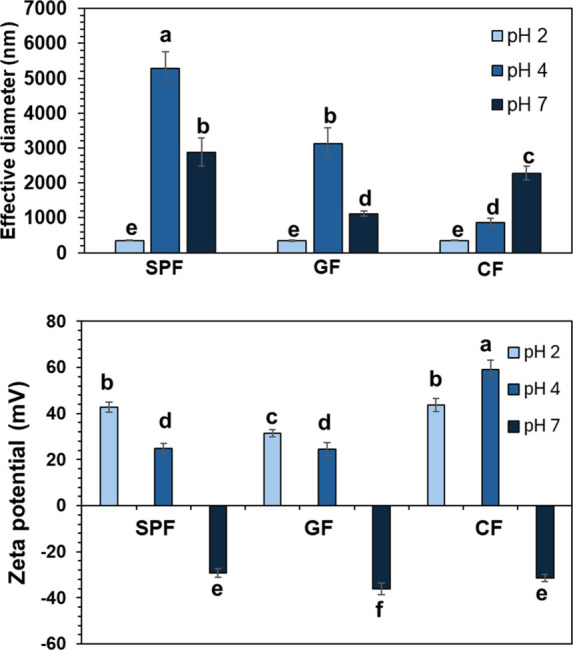
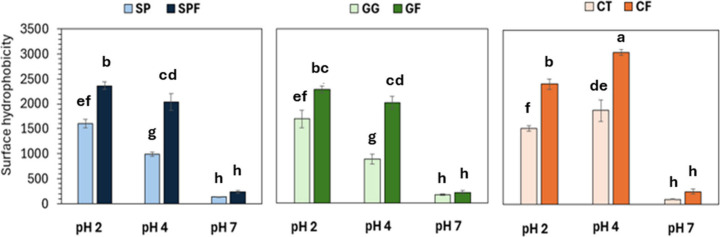
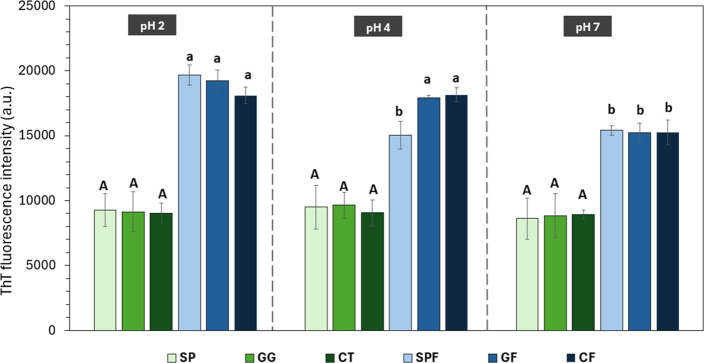
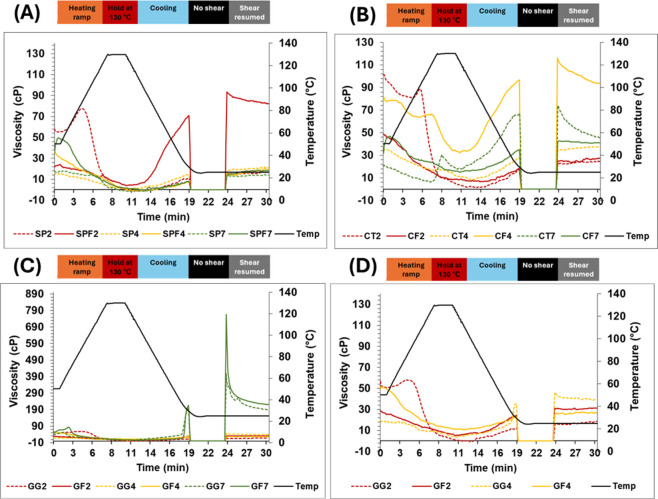
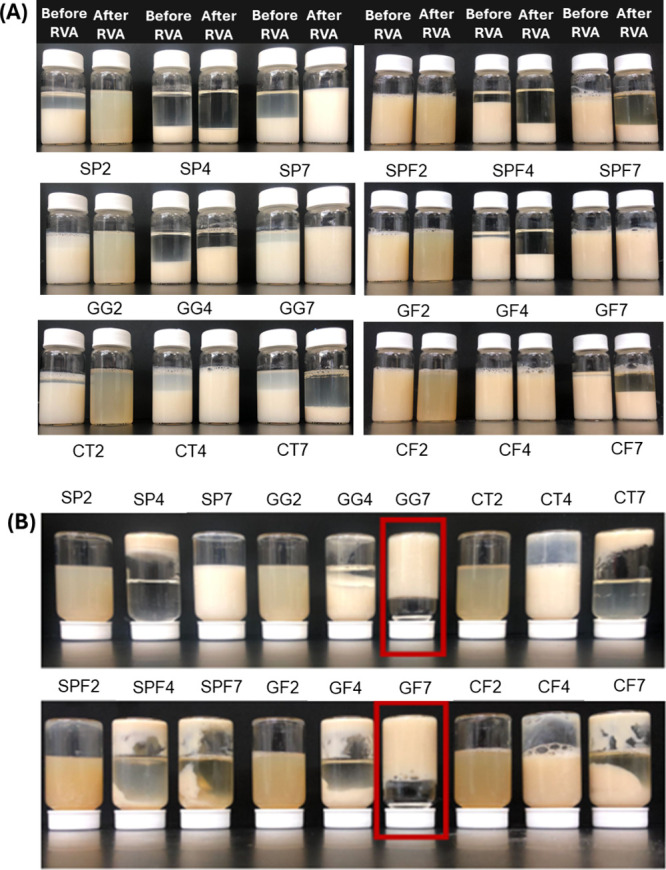
This study explored complexation of soy protein fibrils with gellan gum (anionic) and chitosan (cationic) to mitigate pH-induced degradation of fibril structure and function. Unfibrillated proteins combined with polysaccharides were studied as controls. Chitosan complexation preserved fibril integrity, with a moderate particle size increase (∼2.5x) and AFM imaging of fibrils alongside some aggregates when pH was increased from 2 to 4. FTIR analysis confirmed that chitosan best preserved the fibril β-sheet structure, primarily through electrostatic interactions. A Rapid Visco Analyzer study revealed that chitosan-modified fibrils retained their gelling ability at pH 4 (final viscosity ≈ 115 cP), comparable to fibrils at pH 2 (∼93 cP). Gellan gum complexation resulted in the formation of self-supporting gels at pH 7 (final viscosity ≈ 688 cP), likely due to electrostatic repulsion between like-charged components. Overall, this work provides valuable insights into mitigating pH-induced fibril degradation, thus expanding the potential applications of protein fibrils in food matrices.
Overview
The claims and statistics of this paper haven’t been checked yet.
Run the check — free, no account needed. It reads the open-access text and checks the sources it cites.
Integrity signals
Registry
Cites
Statistics
Figures
Verification
Claims the paper makes
The claims and statistics of this paper haven’t been checked yet.
Run the check — free, no account needed. It reads the open-access text and checks the sources it cites.
Claims other papers make about this one
Each is checked against this paper’s own text: does it say what the citing paper says it does?
The source backs part of the claim, not all of it — or backs it for a different population, condition or comparison.
In the citing paper
“For instance, anionic polysaccharides often cross‐link with positively charged protein regions while neutral polysaccharides may fill interstitial spaces in protein matrix to reinforce the gel network (Sawant and Girard 2025; J. Wang, Chang, et al. 2025).”
From Designing Protein Gels for Nutrient Delivery: From Formulation to Digestion (2026) · cites this paper as Sawant and Girard 2025
Experimental — accuracy not yet measuredThe source backs part of the claim, not all of it — or backs it for a different population, condition or comparison.
In the citing paper
“Polysaccharides are versatile regulators of protein gelation depending on their charge, molecular weight, and compatibility with proteins.”
From Designing Protein Gels for Nutrient Delivery: From Formulation to Digestion (2026) · cites this paper as Sawant and Girard 2025
Experimental — accuracy not yet measured
Self-check
Percentages, sums and reported differences re-computed from the paper’s own numbers.
The self-check needs the paper’s full text.
Citations
Cites
No references could be resolved yet.
Research works printed but not linked: 52
- 10.1016/j.foodhyd.2022.107547 · DOI
- 10.1080/10408398.2016.1271770 · DOI
- 10.1111/1750-3841.17581 · DOI
- 10.1016/j.cis.2019.05.002 · DOI
- 10.1016/j.foodhyd.2023.109084 · DOI
- 10.3389/fnut.2022.909877 · DOI
- 10.1016/j.foodhyd.2024.110027 · DOI
- 10.1021/bm500762u · DOI
- 10.1007/s11483-019-09567-1 · DOI
- 10.1016/j.ijbiomac.2025.140067 · DOI
- 10.1016/j.biotechadv.2006.07.003 · DOI
- 10.1016/j.ijbiomac.2025.143735 · DOI
- 10.1021/jf101045b · DOI
- 10.3390/foods11040587 · DOI
- 10.1016/j.foodhyd.2022.108100 · DOI
- 10.3390/foods12050908 · DOI
- 10.1016/j.ijbiomac.2021.01.010 · DOI
- 10.21769/BioProtoc.2732 · DOI
- 10.1016/j.foodhyd.2018.03.033 · DOI
- 10.1016/j.cocis.2017.03.006 · DOI
- 10.1016/j.matlet.2021.131114 · DOI
- 10.1016/j.carbpol.2013.02.053 · DOI
- 10.1016/j.ijbiomac.2023.127956 · DOI
- 10.1016/j.foodres.2015.08.012 · DOI · Paper page
- 10.1006/abio.1993.1433 · DOI
- 10.1016/S0021-9258(17)39198-6 · DOI
- 10.1016/j.foodhyd.2022.108307 · DOI
- 10.1039/D1RA06878D · DOI
- 10.1021/jf4055215 · DOI
- 10.1021/jf1021658 · DOI
- 10.1016/j.ijbiomac.2020.01.258 · DOI
- 10.1016/j.foodres.2013.11.016 · DOI
- 10.1016/j.foodres.2011.01.057 · DOI
- 10.1016/j.biomaterials.2022.121455 · DOI
- 10.1016/j.foodchem.2024.142707 · DOI
- 10.1016/j.ejpb.2005.08.005 · DOI
- 10.1016/j.foodhyd.2024.110893 · DOI
- 10.1016/j.fochx.2024.101957 · DOI
- 10.1016/j.crfs.2023.100487 · DOI
- 10.1371/journal.pcbi.1002169 · DOI
- 10.3168/jds.2013-6843 · DOI
- 10.1016/j.foodhyd.2019.105554 · DOI
- 10.1016/j.ultsonch.2021.105741 · DOI
- 10.1016/j.foodhyd.2025.111660 · DOI
- 10.1016/j.ijbiomac.2025.140004 · DOI
- 10.1016/j.foodres.2020.109856 · DOI
- 10.1016/j.idairyj.2008.05.006 · DOI
- 10.1016/j.carbpol.2020.116247 · DOI
- 10.1016/S0268-005X(97)80023-9 · DOI
- 10.1016/j.foodres.2014.05.014 · DOI
- 10.1002/jsfa.12512 · DOI
- 10.1021/jf00080a007 · DOI
Cited by
Sorted by citations
Designing Protein Gels for Nutrient Delivery: From Formulation to Digestion
Dong, X., Wang, Y., Chen, X. D., & Selomulya, C. (2026) · Comprehensive Reviews in Food Science and Food Safety · doi:10.1111/1541-4337.70424 · Cited by 17
“For instance, anionic polysaccharides often cross-link with positively charged protein regions while neutral polysaccharides may fill interstitial spaces in protein matrix to reinforce the gel network (Sawant and Girard 2025 ; J. Wang, Chang, et al. 2025 ).”
Metadata
- Authors
- Sawant, S., & Girard, A. L.
- Affiliations
- University of Wisconsin–Madison (US)
- Corresponding author
- Girard, Audrey L.
- Venue
- Journal of Agricultural and Food Chemistry
- Publisher
- American Chemical Society (ACS)
- Published
- 2025-08-18
- Volume
- 73
- Issue
- 36
- Pages
- 22734-22745
- ISSN
- 0021-8561 (ISSN-L)
- 1520-5118
- PMC
- PMC12503362
- OpenAlex
- W4413289162
- Cited by
- 14
- References
- 0
- Citations by year
- 2026: 13 · 2025: 1
- FWCI
- 6.61
- Type
- journal article
- Language
- en
- Open access
- hybrid
- doi.org
- Licence
- Locations
- Journal of Agricultural and Food Chemistry (publishedVersion, cc-by)
- Europe PMC (PubMed Central) (publishedVersion, cc-by)
- PubMed (publishedVersion)
- PubMed Central (publishedVersion, cc-by)
- Funders
- USDA Soybean and Nitrogen Fixation Research Unit at Raleigh, NC
- Topics
- Life Sciences › Agricultural and Biological Sciences › Food Science › Proteins in Food Systems
- Life Sciences › Agricultural and Biological Sciences › Food Science › Polysaccharides Composition and Applications
- Physical Sciences › Materials Science › Biomaterials › Silk-based biomaterials and applications
- Keywords
- gellan gum, chitosan, beta-sheet, electrostatic interactions, gelling ability, viscosity, protein self-assembly, food gels
- MeSH terms
- Hydrogen-Ion Concentration, Particle Size, Polysaccharides, Polysaccharides, Bacterial, Viscosity, Spectroscopy, Fourier Transform Infrared, Soybean Proteins, Chitosan
About these checks
Registry, retraction, Cites and statistics results are computed, not judged, with one exception: a printed reference that no index lists is read once by a model before it counts as a citation error. Claims are extracted by a model and kept only when their quote appears verbatim in the text; each cited source is then checked, with a model’s help, for whether it says what the claim relies on. Those verdicts can be wrong — read the claim’s quote and the cited source before relying on one.
Statistics and arithmetic are recomputed, not judged.
Confidence bands are shown only for fields calibrated on our annotated test set. None is calibrated yet, so no band is shown.
What counts as a claim ›How we measure confidence ›How we check this ›
Are you an author, or do you see a problem with this page? Request a review
How to cite
Cite CoChat for the checks on this page, and the paper for its own findings.
- This page
- CoChat. (2026). Citation check: Complexation with Ionic Polysaccharides Mitigates pH-Dependent Degradation of Soy Protein Fibril Structure and Functionality. https://app.cochat.ai/papers/10.1021/acs.jafc.5c07627
- The paper
- Sawant, S., & Girard, A. L. (2025). Complexation with Ionic Polysaccharides Mitigates pH-Dependent Degradation of Soy Protein Fibril Structure and Functionality. Journal of Agricultural and Food Chemistry. https://doi.org/10.1021/acs.jafc.5c07627
