

The DOI matches its Crossref record; 30 of the 30 references it cites were found in a registry or an index.
ZINC-22─A Free Multi-Billion-Scale Database of Tangible Compounds for Ligand Discovery
Open accessPublished version of a preprint
Abstract
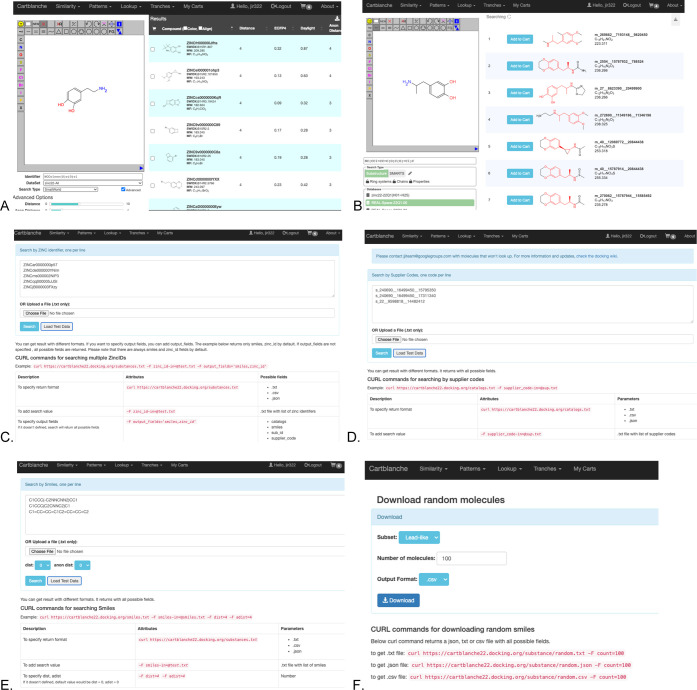
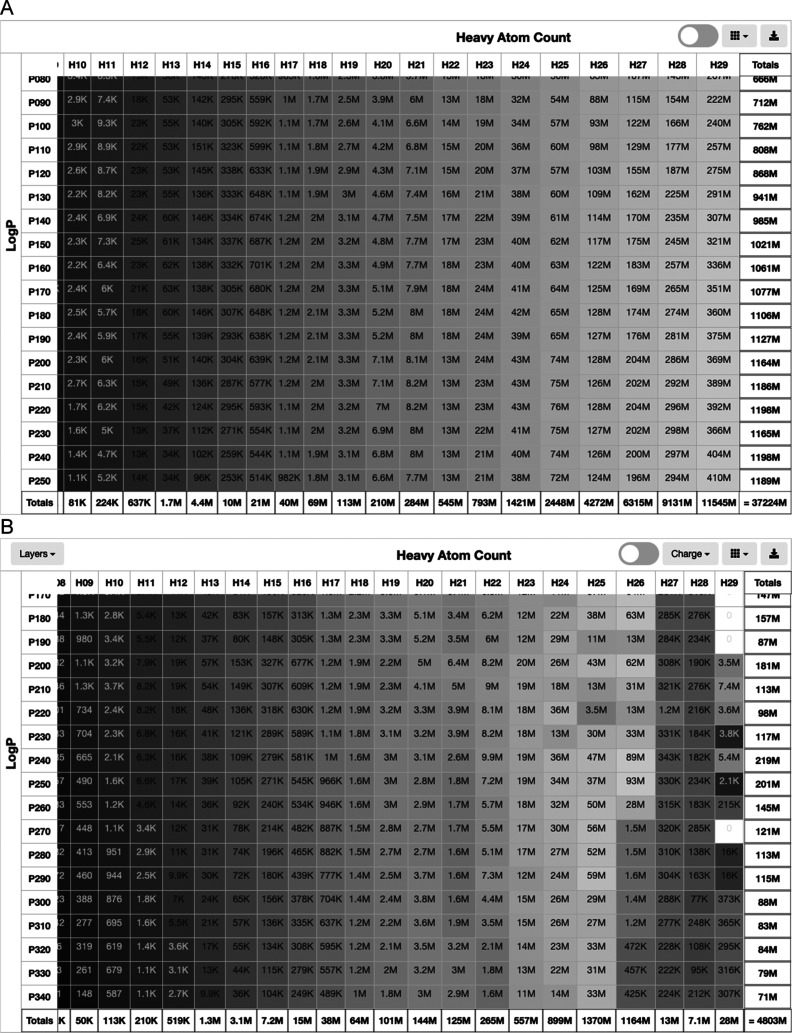
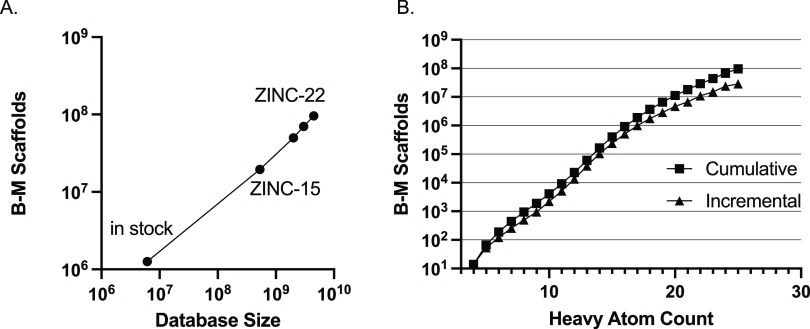
High Resolution Image Download MS PowerPoint Slide Purchasable chemical space has grown rapidly into the tens of billions of molecules, providing unprecedented opportunities for ligand discovery but straining the tools that might exploit these molecules at scale. We have therefore developed ZINC-22, a database of commercially accessible small molecules derived from multi-billion-scale make-on-demand libraries. The new database and tools enable analog searching in this vast new space via a facile GUI, CartBlanche, drawing on similarity methods that scale sublinearly in the number of molecules. The new library also uses data organization methods, enabling rapid lookup of molecules and their physical properties, including conformations, partial atomic charges, c Log P values, and solvation energies, all crucial for molecule docking, which had become slow with older database organizations in previous versions of ZINC. As the libraries have continued to grow, we have been interested in finding whether molecular diversity has suffered, for instance, because certain scaffolds have come to dominate via easy analoging. This has not occurred thus far, and chemical diversity continues to grow with database size, with a log increase in Bemis–Murcko scaffolds for every two-log unit increase in database size. Most new scaffolds come from compounds with the highest heavy atom count. Finally, we consider the implications for databases like ZINC as the libraries grow toward and beyond the trillion-molecule range. ZINC is freely available to everyone and may be accessed at cartblanche22.docking.org, via Globus, and in the Amazon AWS and Oracle OCI clouds.
Overview
The claims and statistics of this paper haven’t been checked yet.
Run the check — free, no account needed. It reads the open-access text and checks the sources it cites.
Integrity signals
Registry
Cites
Statistics
Figures
Verification
Claims the paper makes
The claims and statistics of this paper haven’t been checked yet.
Run the check — free, no account needed. It reads the open-access text and checks the sources it cites.
Self-check
Percentages, sums and reported differences re-computed from the paper’s own numbers.
The self-check needs the paper’s full text.
Citations
Cites
ZINC − A Free Database of Commercially Available Compounds for Virtual Screening
Irwin, J. J., & Shoichet, B. K. (2005) · Journal of Chemical Information and Modeling · doi:10.1021/ci049714+ · Cited by 4,058
Self-citationZINC 15 – Ligand Discovery for Everyone
Sterling, T., & Irwin, J. J. (2015) · Journal of Chemical Information and Modeling · doi:10.1021/acs.jcim.5b00559 · Cited by 3,224
Self-citationZINC: A Free Tool to Discover Chemistry for Biology
Irwin, J. J., Sterling, T., Mysinger, M. M., Bolstad, E. S. D., & Coleman, R. G. (2012) · Journal of Chemical Information and Modeling · doi:10.1021/ci3001277 · Cited by 2,611
Self-citationZINC20─A Free Ultralarge-Scale Chemical Database for Ligand Discovery
Irwin, J. J., Tang, K. G., Young, J., Dandarchuluun, C., Wong, B. R., Khurelbaatar, M., Moroz, Y. S., Mayfield, J. W., & Sayle, R. A. (2020) · Journal of Chemical Information and Modeling · doi:10.1021/acs.jcim.0c00675 · Cited by 1,122
Self-citationUltra-large library docking for discovering new chemotypes
Lyu, J., Wang, S., Balius, T. E., Singh, I., Levit, A., Moroz, Y. S., O’Meara, M. J., Che, T., Algaa, E., Tolmachova, K., et al. (2019) · Nature · doi:10.1038/s41586-019-0917-9 · Cited by 998
Self-citationAn open-source drug discovery platform enables ultra-large virtual screens
Gorgulla, C., Boeszoermenyi, A., Wang, Z., Fischer, P. D., Coote, P. W., Das, K. M., Malets, Y. S., Radchenko, D. S., Moroz, Y. S., Scott, D. A., et al. (2020) · Nature · doi:10.1038/s41586-020-2117-z · Cited by 677
Self-citationEfficient Exploration of Chemical Space with Docking and Deep Learning
Ying, Y., Yao, K., Repasky, M. P., Leswing, K., Abel, R., Shoichet, B. K., & Jerome, S. V. (2021) · Journal of Chemical Theory and Computation · doi:10.1021/acs.jctc.1c00810 · Cited by 480
The next level in chemical space navigation: going far beyond enumerable compound libraries
Hoffmann, T., & Gastreich, M. (2019) · Drug Discovery Today · doi:10.1016/j.drudis.2019.02.013 · Cited by 253
A model binding site for testing scoring functions in molecular docking.
Wei, B. Q., Baase, W. A., Weaver, L. H., Matthews, B. W., & Shoichet, B. K. (2002) · Journal of Molecular Biology · doi:10.1016/s0022-2836(02)00777-5 · Cited by 237
Structures of the σ2 receptor enable docking for bioactive ligand discovery
Alon, A., Lyu, J., Braz, J. M., Tummino, T. A., Craik, V., O’Meara, M. J., Webb, C. M., Radchenko, D. S., Moroz, Y. S., Huang, X.-P., et al. (2021) · Nature · doi:10.1038/s41586-021-04175-x · Cited by 211
Self-citationModeling the expansion of virtual screening libraries
Lyu, J., Irwin, J. J., & Shoichet, B. K. (2023) · Nature Chemical Biology · doi:10.1038/s41589-022-01234-w · Cited by 193
Self-citationExploration of Ultralarge Compound Collections for Drug Discovery
Warr, W. A., Nicklaus, M. C., Nicolaou, C. A., & Rarey, M. (2022) · Journal of Chemical Information and Modeling · doi:10.1021/acs.jcim.2c00224 · Cited by 161
DeepScaffold: A Comprehensive Tool for Scaffold-Based De Novo Drug Discovery Using Deep Learning
Li, Y., Hu, J., Wang, Y., Zhou, J., Zhang, L., & Liu, Z. (2019) · Journal of Chemical Information and Modeling · doi:10.1021/acs.jcim.9b00727 · Cited by 144
Artificial intelligence in virtual screening: Models versus experiments
Murugan, N. A., Priya, G. R., Sastry, G. N., & Markidis, S. (2022) · Drug Discovery Today · doi:10.1016/j.drudis.2022.05.013 · Cited by 99
Chemical Space Exploration with Active Learning and Alchemical Free Energies
Khalak, Y., Tresadern, G., Hahn, D. F., de Groot, B. L., & Gapsys, V. (2022) · Journal of Chemical Theory and Computation · doi:10.1021/acs.jctc.2c00752 · Cited by 93
Virtual Screening in the Cloud: How Big Is Big Enough?
Grebner, C., Malmerberg, E., Shewmaker, A., Batista, J., Nicholls, A. O., & Sadowski, J. (2019) · Journal of Chemical Information and Modeling · doi:10.1021/acs.jcim.9b00779 · Cited by 73
Virtual Screening with Gnina 1.0
Sunseri, J., & Koes, D. (2021) · Molecules · doi:10.3390/molecules26237369 · Cited by 71
Topological Similarity Search in Large Combinatorial Fragment Spaces
Bellmann, L., Penner, P., & Rarey, M. (2020) · Journal of Chemical Information and Modeling · doi:10.1021/acs.jcim.0c00850 · Cited by 67
Maximum Common Substructure Searching in Combinatorial Make-on-Demand Compound Spaces
Schmidt, R., Klein, R., & Rarey, M. (2021) · Journal of Chemical Information and Modeling · doi:10.1021/acs.jcim.1c00640 · Cited by 67
Ligand Strain Energy in Large Library Docking
Gu, S., Smith, M. S., Ying, Y., Irwin, J. J., & Shoichet, B. K. (2021) · Journal of Chemical Information and Modeling · doi:10.1021/acs.jcim.1c00368 · Cited by 62
Self-citationBellmann, L., Penner, P., Gastreich, M., & Rarey, M. (2022) · Journal of Chemical Information and Modeling · doi:10.1021/acs.jcim.1c01378 · Cited by 43
Müller, J., Klein, R., Tarkhanova, O. O., Gryniukova, A., Borysko, P., Merkl, S., Ruf, M., Neumann, A., Gastreich, M., Moroz, Y. S., et al. (2022) · Journal of Medicinal Chemistry · doi:10.1021/acs.jmedchem.2c00813 · Cited by 43
Self-citationSAR by Space: Enriching Hit Sets from the Chemical Space
Klingler, F., Gastreich, M., Grygorenko, O. O., Savych, O., Borysko, P., Griniukova, A., Gubina, K. E., Lemmen, C., & Moroz, Y. S. (2019) · Molecules · doi:10.3390/molecules24173096 · Cited by 40
Self-citationSmartGraph: a network pharmacology investigation platform
Zahoránszky-Köhalmi, G., Sheils, T. K., & Oprea, T. I. (2020) · Journal of Cheminformatics · doi:10.1186/s13321-020-0409-9 · Cited by 31
Parks, C. D., Gaieb, Z., & Amaro, R. E. (2020) · Frontiers in Molecular Biosciences · doi:10.3389/fmolb.2020.00093 · Cited by 18
Nițulescu, G. M. (2022) · Molecules · doi:10.3390/molecules27103300 · Cited by 16
Very large virtual compound spaces: construction, storage and utility in drug discovery
Peng, Z. (2013) · Drug Discovery Today Technologies · doi:10.1016/j.ddtec.2013.01.004 · Cited by 15
Extending accessible chemical space for the identification of novel leads
Bajorath, J. (2016) · Expert Opinion on Drug Discovery · doi:10.1080/17460441.2016.1210126 · Cited by 14
Automatic Identification of Analogue Series from Large Compound Data Sets: Methods and Applications
Naveja, J. J., & Vogt, M. (2021) · Molecules · doi:10.3390/molecules26175291 · Cited by 11
Coverage Score: A Model Agnostic Method to Efficiently Explore Chemical Space
Woodward, D. J., Bradley, A. R., & van Hoorn, W. P. (2022) · Journal of Chemical Information and Modeling · doi:10.1021/acs.jcim.2c00258 · Cited by 8
Research works printed but not linked: 2
- 10.26434/chemrxiv-2022-6lv34-v2 · DOI
- 10.1038/s41586-019-0917-9 · DOI · Paper page
Cited by
Sorted by citations
Artificial intelligence in drug development
Zhang, K., Yang, X., Wang, Y., Yu, Y., Huang, N., Li, G. L., Li, X., Wu, J. C., & Yang, S. (2025) · Nature Medicine · doi:10.1038/s41591-024-03434-4 · Cited by 585
Integrating QSAR modelling and deep learning in drug discovery: the emergence of deep QSAR
Tropsha, A., Isayev, O., Varnek, A. A., Schneider, G., & Cherkasov, A. R. (2023) · Nature Reviews Drug Discovery · doi:10.1038/s41573-023-00832-0 · Cited by 447
Artificial Intelligence for Drug Discovery: Are We There Yet?
Hasselgren, C., & Oprea, T. I. (2024) · Annual Review of Pharmacology and Toxicology · doi:10.1146/annurev-pharmtox-040323-040828 · Cited by 236
“subset of the ZINC database (123), enriched with known active and inactive kinase inhibitors from ChEMBL (124).”
BackgroundMachine learning in preclinical drug discovery
Catacutan, D. B., Alexander, J., Arnold, A., & Stokes, J. M. (2024) · Nature Chemical Biology · doi:10.1038/s41589-024-01679-1 · Cited by 227
Metadata
- Authors
- Tingle, B. I., Tang, K. G., Castanon, M., Gutierrez, J. J., Khurelbaatar, M., Dandarchuluun, C., Moroz, Y. S., & Irwin, J. J.
- Affiliations
- University of California, San Francisco (US)
- Taras Shevchenko National University of Kyiv (UA)
- Corresponding author
- Irwin, John J.
- Venue
- Journal of Chemical Information and Modeling
- Publisher
- American Chemical Society (ACS)
- Published
- 2023-02-15
- Volume
- 63
- Issue
- 4
- Pages
- 1166-1176
- ISSN
- 1549-9596 (ISSN-L)
- 1549-960X
- PMC
- PMC9976280
- OpenAlex
- W4320857994
- Cited by
- 314
- References
- 30
- Citations by year
- 2026: 122 · 2025: 106 · 2024: 62 · 2023: 23
- FWCI
- 44.82
- Type
- journal article
- Language
- en
- Open access
- hybrid
- doi.org
- Locations
- Journal of Chemical Information and Modeling (publishedVersion, cc-by)
- ChemRxiv (acceptedVersion, cc-by)
- PubMed Central (publishedVersion, cc-by)
- PubMed (publishedVersion)
- eScholarship (California Digital Library) (submittedVersion, cc-by)
- Funders
- National Institutes of Health (GM133836)
- Topics
- Life Sciences › Pharmacology, Toxicology and Pharmaceutics › Drug Discovery › Computational Drug Discovery Methods
- Physical Sciences › Materials Science › Materials Chemistry › Machine Learning in Materials Science
- Physical Sciences › Chemistry › Organic Chemistry › Synthesis and Characterization of Heterocyclic Compounds
- Keywords
- chemical databases, similarity search, molecular docking, chemical diversity, Bemis-Murcko scaffolds, solvation energy, partial atomic charges, molecular conformation
- MeSH terms
- Ligands, Molecular Conformation, Zinc, Databases, Factual, Molecular Docking Simulation
About these checks
Registry, retraction, Cites and statistics results are computed, not judged, with one exception: a printed reference that no index lists is read once by a model before it counts as a citation error. Claims are extracted by a model and kept only when their quote appears verbatim in the text; each cited source is then checked, with a model’s help, for whether it says what the claim relies on. Those verdicts can be wrong — read the claim’s quote and the cited source before relying on one.
Statistics and arithmetic are recomputed, not judged.
Confidence bands are shown only for fields calibrated on our annotated test set. None is calibrated yet, so no band is shown.
What counts as a claim ›How we measure confidence ›How we check this ›
Are you an author, or do you see a problem with this page? Request a review
