

The DOI matches its Crossref record; 1 of the 1 references it cites were found in a registry or an index.
Efficient and Continuous Carrier-Envelope Phase Control for Terahertz Lightwave-Driven Scanning Probe Microscopy
Open accessAbstract
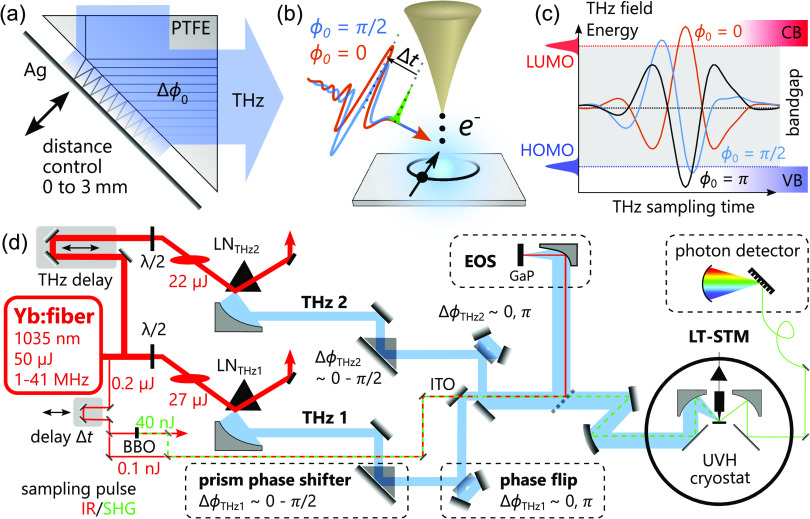
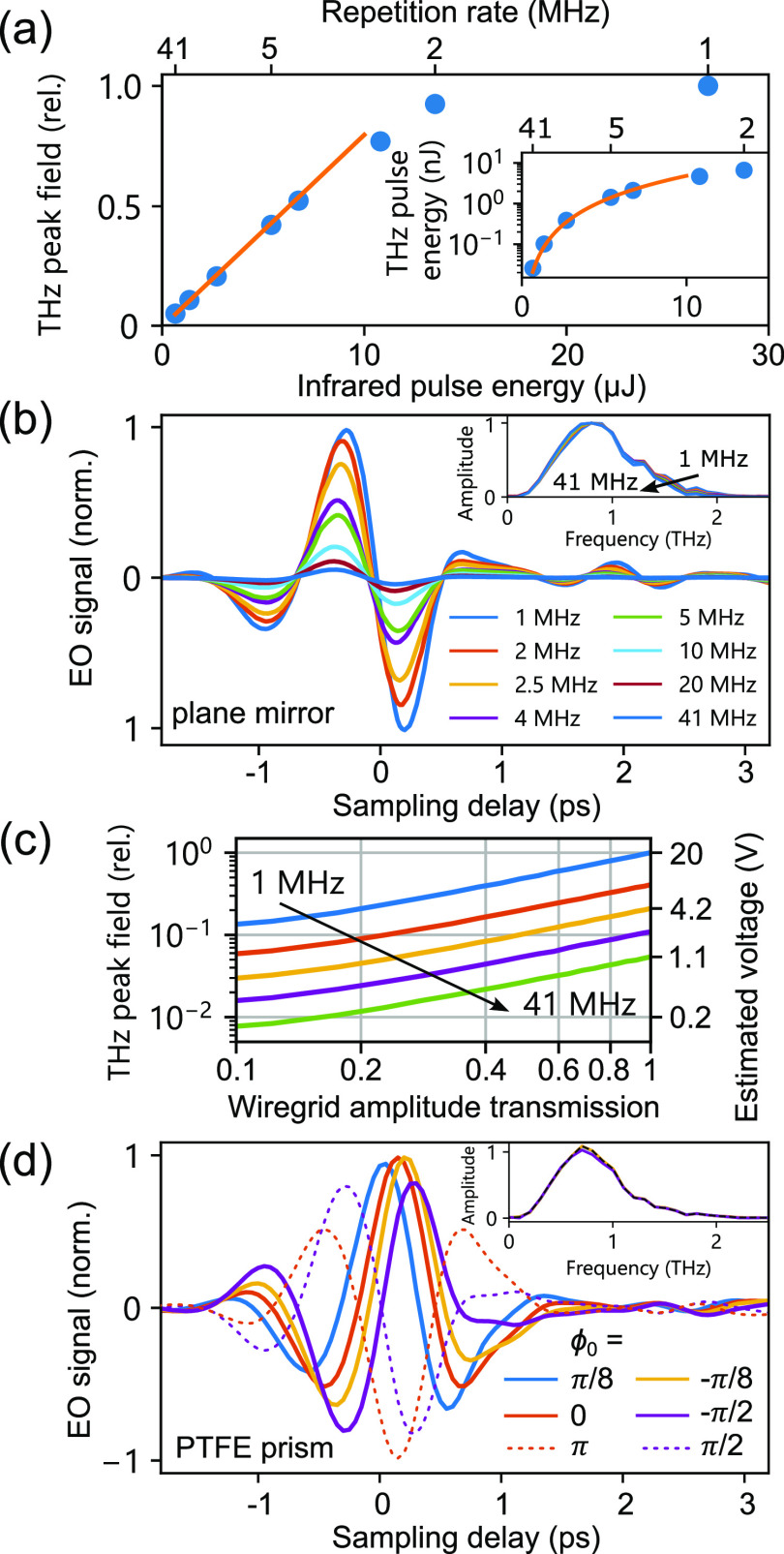
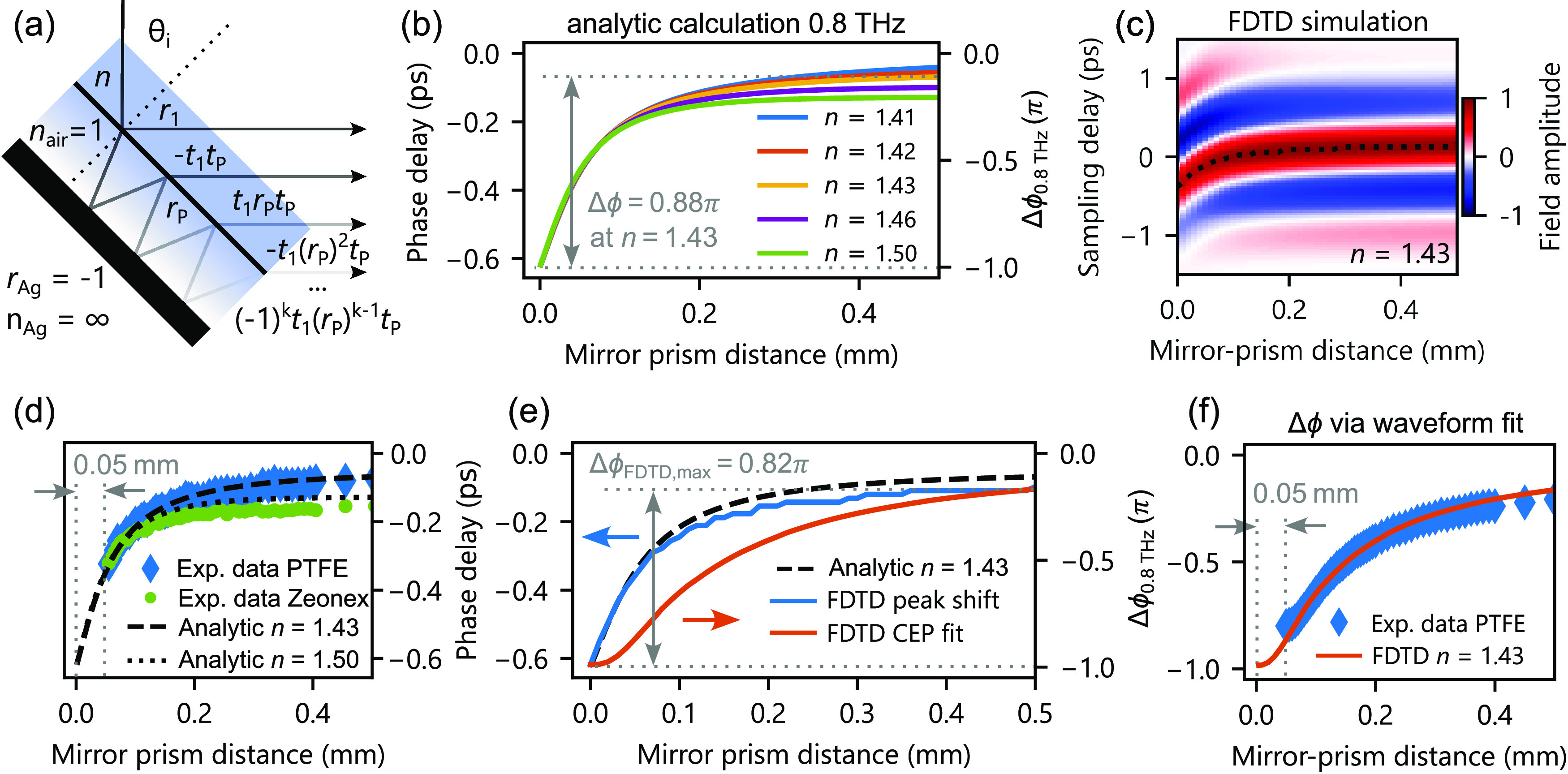
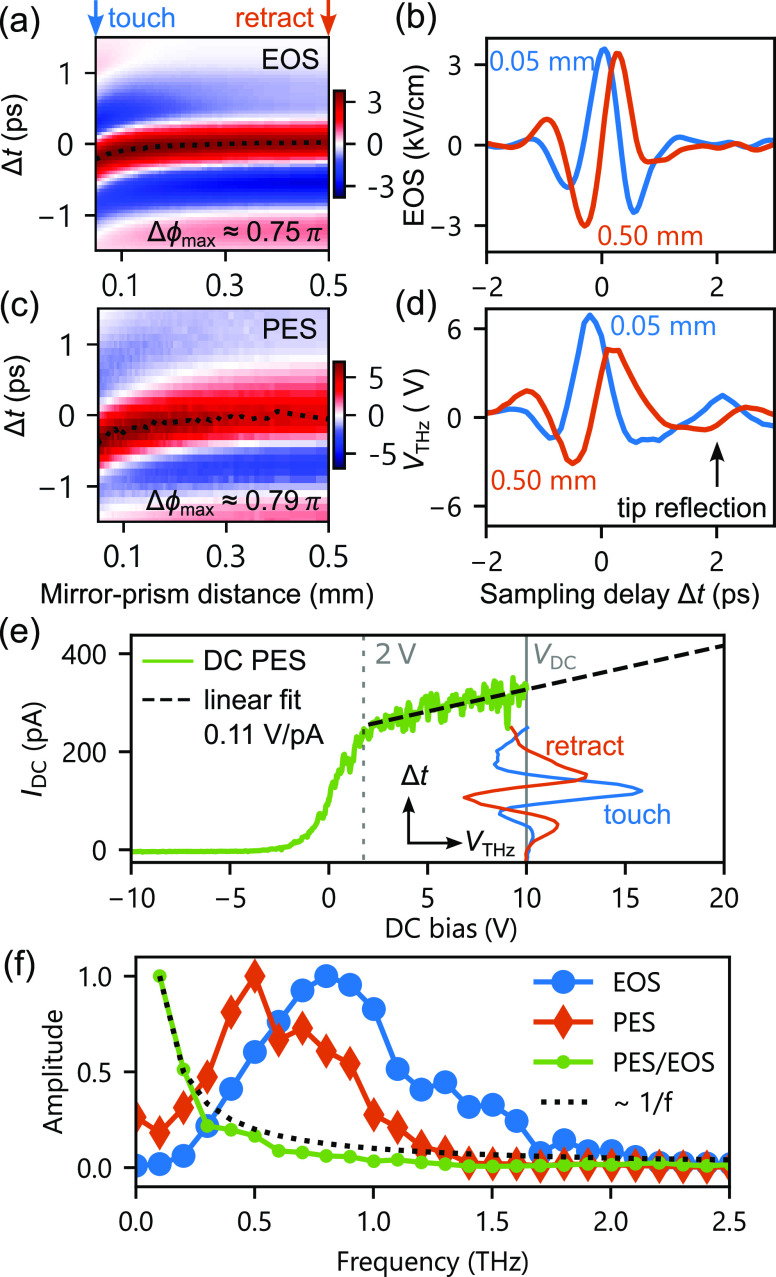
The fundamental understanding of quantum dynamics in advanced materials requires precise characterization at the limit of spatiotemporal resolution. Ultrafast scanning tunneling microscopy is a powerful tool combining the benefits of picosecond time resolution provided by single-cycle terahertz (THz) pulses and atomic spatial resolution of a scanning tunneling microscope (STM). For the selective excitation of localized electronic states, the transient field profile must be tailored to the energetic structure of the system. Here, we present an advanced THz-STM setup combining multi-MHz repetition rates, strong THz near fields, and continuous carrier-envelope phase (CEP) control of the transient waveform. In particular, we employ frustrated total internal reflection as an efficient and cost-effective method for precise CEP control of single-cycle THz pulses with >60% field transmissivity, high pointing stability, and continuous phase shifting of up to 0.75 π in the far and near field. Efficient THz generation and dispersion management enable peak THz voltages at the tip-sample junction exceeding 20 V at 1 MHz and 1 V at 41 MHz. The system comprises two distinct THz generation arms, which facilitate individual pulse shaping and amplitude modulation. This unique feature enables the flexible implementation of various THz pump-probe schemes, thereby facilitating the study of electronic and excitonic excited-state propagation in nanostructures and low-dimensional materials systems. Scalability of the repetition rate up to 41 MHz, combined with a state-of-the-art low-temperature STM, paves the way toward the investigation of dynamical processes in atomic quantum systems at their native length and time scales.
Overview
The claims and statistics of this paper haven’t been checked yet.
Run the check — free, no account needed. It reads the open-access text and checks the sources it cites.
Integrity signals
Registry
Cites
Statistics
Figures
Verification
Claims the paper makes
The claims and statistics of this paper haven’t been checked yet.
Run the check — free, no account needed. It reads the open-access text and checks the sources it cites.
Claims other papers make about this one
Each is checked against this paper’s own text: does it say what the citing paper says it does?
The source backs part of the claim, not all of it — or backs it for a different population, condition or comparison.
In the citing paper
“The ability to find the carrier-envelope phase easily from the absolute spectral phase will allow setups to be optimised for maximal peak electric field [8], relevant for nonlinear THz spectroscopy techniques such as 2D THz and THz STM.”
From A Tutorial on THz Pulse Analysis: Accurate Retrieval of Pulse Arrival Times, Spectral Energy Density and Absolute Spectral Phase (2025) · cites this paper as [8]
Experimental — accuracy not yet measuredThe cited source says what the claim attributes to it.
In the citing paper
“Allerbeck et al. demonstrated how to modify the CEP of a THz pulse using frustrated total internal reflection in a prism coupled to a metal mirror [8].”
From A Tutorial on THz Pulse Analysis: Accurate Retrieval of Pulse Arrival Times, Spectral Energy Density and Absolute Spectral Phase (2025) · cites this paper as [8]
Self-check
Percentages, sums and reported differences re-computed from the paper’s own numbers.
The self-check needs the paper’s full text.
Citations
Cites
Jitter-free terahertz pulses from LiNbO 3
Kuttruff, J., Tsarev, M. V., & Baum, P. (2021) · Optics Letters · doi:10.1364/ol.430507 · Cited by 14
Self-citation
Research works printed but not linked: 51
- 10.1038/nature19816 · DOI
- 10.1038/s41567-019-0745-8 · DOI
- 10.1021/acsphotonics.2c00995 · DOI
- 10.1021/acsphotonics.3c00584 · DOI
- 10.1038/nphoton.2013.151 · DOI
- 10.1021/acsphotonics.9b00266 · DOI
- 10.1021/acsphotonics.0c01652 · DOI
- 10.1021/acsphotonics.0c01572 · DOI
- 10.1126/sciadv.abq5682 · DOI
- 10.1038/s41566-021-00813-y · DOI
- 10.1021/acsphotonics.0c01755 · DOI
- 10.1088/1361-648X/abfe21 · DOI
- 10.1126/science.abn9220 · DOI
- 10.1364/OE.18.012311 · DOI
- 10.1007/s00340-015-6315-6 · DOI
- 10.1002/adom.201900681 · DOI
- 10.1364/OL.386305 · DOI
- 10.1364/PRJ.428418 · DOI
- 10.1364/OE.457773 · DOI
- 10.1038/s41467-021-26656-3 · DOI
- 10.1364/OE.26.013876 · DOI
- 10.1038/s41467-022-35517-6 · DOI
- 10.1364/OL.41.000986 · DOI · Paper page
- 10.1021/acs.nanolett.8b02161 · DOI
- 10.1103/PhysRevLett.83.3410 · DOI
- 10.1364/OL.26.000485 · DOI
- 10.1103/PhysRevLett.92.113001 · DOI
- 10.1038/nphoton.2016.205 · DOI
- 10.1002/adom.202200541 · DOI
- 10.1134/S0021364007190046 · DOI
- 10.1103/PhysRevB.105.115427 · DOI
- 10.1063/5.0144218 · DOI
- 10.1038/s41566-020-00720-8 · DOI
- 10.1021/acsphotonics.0c00386 · DOI
- 10.1364/OE.426228 · DOI
- 10.1088/1612-202X/ab4d56 · DOI
- 10.1126/science.aat1603 · DOI
- Bichon, J.; Pillet, A.; Sklia, A.; Petitprez, D.; Peretti, R.; Eliet, S. In Complex Refractive Index Determination of PTFE, TPX and Polypropylene Windows for TeraHertz Broadband Spectroscopy , 022 47th International Conference on Infrared, Millimeter and Terahertz Waves (IRMMW-THz); IEEE: Delft, Netherlands, 2022. · DOI
- 10.1109/ACCESS.2020.2996278 · DOI
- 10.12693/APhysPolA.116.585 · DOI
- 10.1038/nphys2974 · DOI
- 10.1038/nphys4047 · DOI
- 10.1038/s41586-020-2620-2 · DOI
- 10.1038/s41566-021-00835-6 · DOI
- 10.1021/acsami.2c04736 · DOI
- 10.1126/science.aae0003 · DOI
- 10.1103/PhysRevApplied.11.024034 · DOI
- 10.1103/PhysRevLett.124.054801 · DOI
- 10.1063/5.0065185 · DOI
- 10.1063/1.1656779 · DOI
- 10.1063/1.118691 · DOI
Cited by
Sorted by citations
Lloyd-Hughes, J., Chopra, N., Deveikis, J., Pandya, R., & Woolley, J. (2025) · Journal of Infrared, Millimeter, and Terahertz Waves · doi:10.1007/s10762-025-01052-w · Cited by 6
“The ability to find the carrier-envelope phase easily from the absolute spectral phase will allow setups to be optimised for maximal peak electric field [8], relevant for nonlinear THz spectroscopy techniques such as 2D THz and THz STM.”
Influential
Metadata
- Authors
- Allerbeck, J., Kuttruff, J., Bobzien, L., Huberich, L., Tsarev, M., & Schuler, B.
- Affiliations
- Empa (CH)
- University of Konstanz (DE)
- Corresponding author
- Allerbeck, Jonas
- Schuler, Bruno
- Venue
- ACS Photonics
- Publisher
- American Chemical Society (ACS)
- Published
- 2023-10-11
- Volume
- 10
- Issue
- 11
- Pages
- 3888-3895
- ISSN
- 2330-4022 (ISSN-L)
- PMC
- PMC10655500
- OpenAlex
- W4387540611
- Cited by
- 20
- References
- 1
- Citations by year
- 2026: 6 · 2025: 6 · 2024: 8
- FWCI
- 1.49
- Type
- journal article
- Language
- en
- Open access
- hybrid
- doi.org
- Licence
- Locations
- ACS Photonics (publishedVersion, cc-by)
- PubMed Central (publishedVersion, cc-by)
- PubMed (publishedVersion)
- DORA Empa (Swiss Federal Laboratories for Materials Science and Technology (Empa)) (submittedVersion, cc-by)
- KOPS (University of Konstanz) (submittedVersion, cc-by)
- Funders
- Deutsche Forschungsgemeinschaft (SFB 1432)
- H2020 European Research Council (948243)
- Topics
- Physical Sciences › Engineering › Electrical and Electronic Engineering › Terahertz technology and applications
- Physical Sciences › Physics and Astronomy › Atomic and Molecular Physics, and Optics › Laser-Matter Interactions and Applications
- Physical Sciences › Physics and Astronomy › Atomic and Molecular Physics, and Optics › Near-Field Optical Microscopy
- Keywords
- carrier-envelope phase control, frustrated total internal reflection, single-cycle terahertz pulses, pulse shaping, excitonic dynamics, low-dimensional materials, electronic dynamics
About these checks
Registry, retraction, Cites and statistics results are computed, not judged, with one exception: a printed reference that no index lists is read once by a model before it counts as a citation error. Claims are extracted by a model and kept only when their quote appears verbatim in the text; each cited source is then checked, with a model’s help, for whether it says what the claim relies on. Those verdicts can be wrong — read the claim’s quote and the cited source before relying on one.
Statistics and arithmetic are recomputed, not judged.
Confidence bands are shown only for fields calibrated on our annotated test set. None is calibrated yet, so no band is shown.
What counts as a claim ›How we measure confidence ›How we check this ›
Are you an author, or do you see a problem with this page? Request a review
How to cite
Cite CoChat for the checks on this page, and the paper for its own findings.
- This page
- CoChat. (2026). Citation check: Efficient and Continuous Carrier-Envelope Phase Control for Terahertz Lightwave-Driven Scanning Probe Microscopy. https://app.cochat.ai/papers/10.1021/acsphotonics.3c00555
- The paper
- Allerbeck, J., Kuttruff, J., Bobzien, L., Huberich, L., Tsarev, M., & Schuler, B. (2023). Efficient and Continuous Carrier-Envelope Phase Control for Terahertz Lightwave-Driven Scanning Probe Microscopy. ACS Photonics. https://doi.org/10.1021/acsphotonics.3c00555
