

The Step-by-Step Robinson Annulation of Chalcone and Ethyl Acetoacetate: An Advanced Undergraduate Project in Organic Synthesis and Structural Analysis
Open accessThe DOI matches its Crossref record; 2 of the 2 references it cites were found in a registry or an index; none of the 2 sources its claims cite is checked for support yet.
Abstract
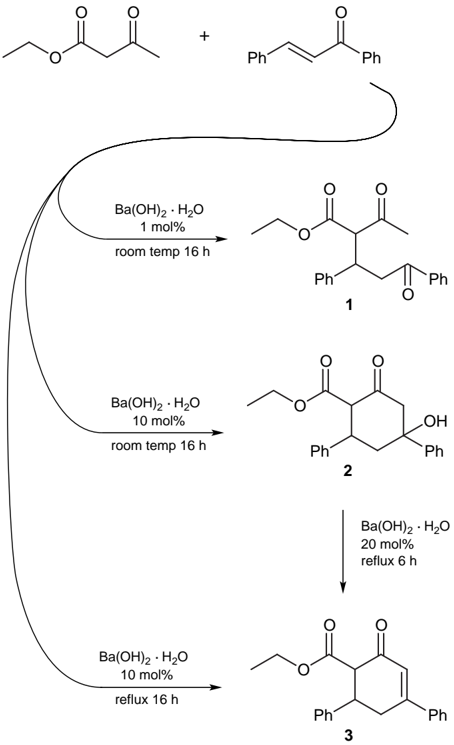
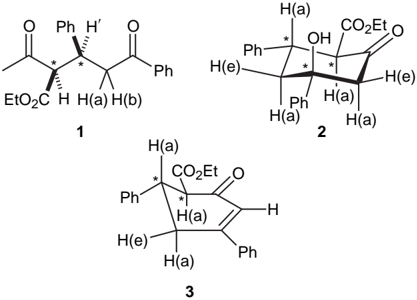
The Robinson annulation is a three-step process involving a Michael addition followed by an internal aldol condensation and a dehydration. Under appropriate experimental conditions, it is possible to stop the reaction after every step and to isolate the three products separately. This feature is particularly attractive in the frame of an organic chemistry course. It allows students to confirm experimentally the validity of the stepwise mechanism and to obtain a more thorough understanding of the whole process. It also permits them to synthesize a rich set of related molecules that can be compared and characterized through various analytical techniques. Thus, a stoichiometric mixture of chalcone and ethyl acetoacetate was reacted in ethanol. Depending on the quantity of barium hydroxide monohydrate used as catalyst, the reaction time, and the temperature, three different products were obtained. Their full IR, 1 H, 13 C, COSY, NOESY, and HETCOR NMR spectra are supplied. Examination of the spectroscopic data helps uncover many challenging structural analysis problems. Among them, the diastereoselective formation of chiral centers during the annulation process, the distinction between axial and equatorial substituents on a cyclohexane ring, and the possibility of a keto–enol tautomerism are extensively discussed.
Overview
CoChat Summary
TL;DR
The paper presents an advanced undergraduate organic chemistry project built around a stepwise Robinson annulation of chalcone and ethyl acetoacetate. By adjusting barium hydroxide, time, and temperature, students can isolate three intermediates/products and use IR and multinuclear NMR to analyze their structures.
Key findings
- A stoichiometric mixture of chalcone and ethyl acetoacetate in ethanol, with barium hydroxide monohydrate as catalyst, can be driven to yield three different products depending on catalyst amount, reaction time, and temperature.
- The reaction is described as a three-step process: Michael addition, then internal aldol condensation, then dehydration.
- The authors report supplying full IR, ¹H, ¹³C, COSY, NOESY, and HETCOR NMR spectra for the products.
- The project is framed as useful for discussing diastereoselective formation of chiral centers, axial vs equatorial substituents on cyclohexane rings, and keto-enol tautomerism.
Methods
- Design: An advanced undergraduate laboratory project in organic synthesis and structural analysis, centered on stepwise control of the Robinson annulation.
- Sample/materials: Stoichiometric chalcone and ethyl acetoacetate reacted in ethanol with barium hydroxide monohydrate as catalyst.
- Analysis: Product characterization by IR and ¹H, ¹³C, COSY, NOESY, and HETCOR NMR spectroscopy; the paper uses spectroscopic interpretation to support structural assignments.
Limitations
- The paper does not state any explicit experimental limitations or failure rates.
- Evident from the abstract: the report is presented as an instructional project and does not provide quantitative yield, sample size, or statistical analysis; this is not stated in the paper.
Model-written summary. Check it against the paper before relying on it.
Integrity signals
Registry
Cites
Statistics
Figures
Verification
Claims the paper makes
0 Valid · 0 Not valid · 1 Not checked · 4 Own results and interpretations
A result the paper reports from its own data — it cites no other source for it, so there is none to check. The quote shows it is in the paper.
In the paper
“Depending on the quantity of barium hydroxide monohydrate used as catalyst, the reaction time, and the temperature, three different products were obtained.”
plainstates a cause- Asserted: passes — The authors put it forward as true.
- Checkable: passes — It can be checked against evidence.
- Load-bearing: passes — The paper’s conclusions depend on it.
- Based: passes — The paper gives a reason why it holds.
A conclusion the paper draws from its own results — it cites no other source for it, so there is none to check. The quote shows it is in the paper.
In the paper
“It also permits them to synthesize a rich set of related molecules that can be compared and characterized through various analytical techniques.”
plainstates a cause- Asserted: passes — The authors put it forward as true.
- Checkable: passes — It can be checked against evidence.
- Load-bearing: passes — The paper’s conclusions depend on it.
- Based: passes — The paper gives a reason why it holds.
- It may state two separate claims as one. 2
- Probably not a substantial claim. 1
Citations
Cites
Spectrometric identification of organic compounds
Simon, W. (1963) · Microchemical Journal · doi:10.1016/0026-265x(63)90068-7 · Cited by 1,472
Kemp, W. (1991) · doi:10.1007/978-1-349-15203-2 · Cited by 231
Research works printed but not linked: 18
- See for example: McMurry. J. Organic Chemistry, 6th ed.; Brooks/Cole: Pacific Groove, CA, 2004; Chapter 23.
- Vollhardt, K. P. C.; Schore, N. E. Organic Chemistiy 4th ed.; W. H. Freeman: New York, 2002; Chapter 18.
- Poon, T. J. Chem. Educ. 2002, 79, 264-267.
- Wachter-Jurcsak, N.; Reddin, K J. Chem. Educ. 2001, 78, 1264-1265.
- Hull, L. J. Chem. Educ. 2001, 78, 226-227.
- Harrison, E. A., Jr. J. Chem. Educ. 1998, 75, 636-637.
- Tanis, M. W. J. Chem. Educ. 1997, 74, 112-113.
- Clausen, T. P.; Johnson, B.; Wood, J. J. Chem. Educ. 1996, 73, 266.
- Ram, R. N.; Varsha, K. J. Chem. Educ. 1990, 67, 985-986.
- Coutlangus, M. L.; Filla, S. A.; Rowland, A. T. J. Chem. Educ. 1989, 66, 520-522.
- Hathaway, B. A. J. Chem. Educ. 1987, 64, 367-368.
- Hawbecker, B. L.; Kurtz, D. W; Putnam, T. D.; Ahlers, P. A.; Gerber, G. D. J. Chem. Educ. 1978, 55, 540-541.
- Angres, I.; Zieger, H. E. J. Chem. Educ. 1974, 51, 64.
- Jung M. E. Tetrahedron 1976, 32, 3-31.
- Mundy, B. P. J. Chem. Educ. 1973, 50, 110-113.
- Garcia-Raso, A.; Garcia-Raso, J.; Sinisterra, J. V.; Mestres, R. J. Chem. Educ. 1986, 63, 443.
- Iglesias, M.; Marinas, J. M.; Sinisterra, J. V. Tetrahedron 1987, 43, 2335-2342.
- Barrios, J.; Rojas, R.; Alcanrara, A. R.; Sinisterra, J. V. J. Catal. 1988, 112, 528-542.
Cited by
Rocchi, D., González, J. F., & Menéndez, J. C. (2012) · Green Chemistry · doi:10.1039/c2gc36221j · Cited by 32
Molecular Modeling of an Electrophilic Addition Reaction with “Unexpected” Regiochemistry
Best, K. T., Li, D., & Helms, E. D. (2017) · Journal of Chemical Education · doi:10.1021/acs.jchemed.6b00488 · Cited by 11
A Short Review on Synthetic Methodologies of Flavonoids
Murtaza, M., Tajammal, A., Ashfaq, M. H., et al. (2022) · Asian Journal of Pharmacy and Technology · doi:10.52711/2231-5713.2022.00010 · Cited by 7
Valova, M. S., Koryakova, O. V., Ganebnykh, I. N., et al. (2014) · Russian Journal of Organic Chemistry · doi:10.1134/s1070428014100066 · Cited by 2
Korman, M., Paz, E., Franklin, T. J., et al. (2020) · Journal of Chemical Education · doi:10.1021/acs.jchemed.9b00653 · Cited by 1
Metadata
- Authors
- Delaude, L., Grandjean, J., & Noels, A. F.
- Affiliations
- University of Liège (BE)
- ORCID
- Delaude, Lionel
- Venue
- Journal of Chemical Education
- Publisher
- American Chemical Society (ACS)
- Published
- 2006-08
- Volume
- 83
- Issue
- 8
- Pages
- 1225
- ISSN
- 0021-9584 (ISSN-L)
- 1938-1328
- OpenAlex
- W2066886491
- Cited by
- 10
- References
- 1
- Citations by year
- 2026: 1 · 2022: 1 · 2020: 1 · 2018: 1 · 2017: 2 · 2016: 1 · 2014: 1 · 2012: 1
- FWCI
- 0.00
- Type
- journal article
- Language
- en
- Open access
- green
- orbi.uliege.be
- Licence
- other-oa
- Locations
- Journal of Chemical Education (publishedVersion)
- Open Repository and Bibliography (University of Liège) (submittedVersion, other-oa)
- Topics
- Social Sciences › Education › Various Chemistry Research Topics
- Physical Sciences › Chemistry › Spectroscopy › Molecular spectroscopy and chirality
- Social Sciences › Education › Chemistry Education and Research
- Keywords
- Robinson annulation, chalcones, ethyl acetoacetate, Michael addition, dehydration, stepwise mechanism, diastereoselectivity, stereogenic centers, axial and equatorial substituents, cyclohexane ring, keto-enol tautomerism, NMR structural analysis
About these checks
Registry, retraction, Cites and statistics results are computed, not judged, with one exception: a printed reference that no index lists is read once by a model before it counts as a citation error. Claims are extracted by a model and kept only when their quote appears verbatim in the text; each cited source is then checked, with a model’s help, for whether it says what the claim relies on. Those verdicts can be wrong — read the claim’s quote and the cited source before relying on one.
A language model drew the claims from the paper on 2026-10-10, under version 3 of the claim definition (model deepseek-v4.1-flash, prompt extract-v3).
A second model labelled each claim on 2026-10-10 (model jev-1.13-20260917, definition revision gold-guideline-v0.2).
Statistics and arithmetic are recomputed, not judged.
Confidence bands are shown only for fields calibrated on our annotated test set. None is calibrated yet, so no band is shown.
What counts as a claim ›How we measure confidence ›How we check this ›
Are you an author, or do you see a problem with this page? Request a review
Data sources
Bibliographic data: Semantic Scholar, OpenAlex, Crossref.
Contains information from the Semantic Scholar Academic Graph Datasets, made available under the ODC Attribution License (ODC-BY 1.0).
Semantic Scholar’s data is described in: Kinney, R., et al. (2023). The Semantic Scholar Open Data Platform. arXiv:2301.10140.
