

Investigating new material from Early Bronze Age Troy—isotopic and chemical composition of copper alloys
Open accessThe DOI matches its Crossref record; 40 of the 41 references it cites were found in a registry or an index, and 1 are not checked yet; none of the 34 sources its claims cite is checked for support yet.
Abstract
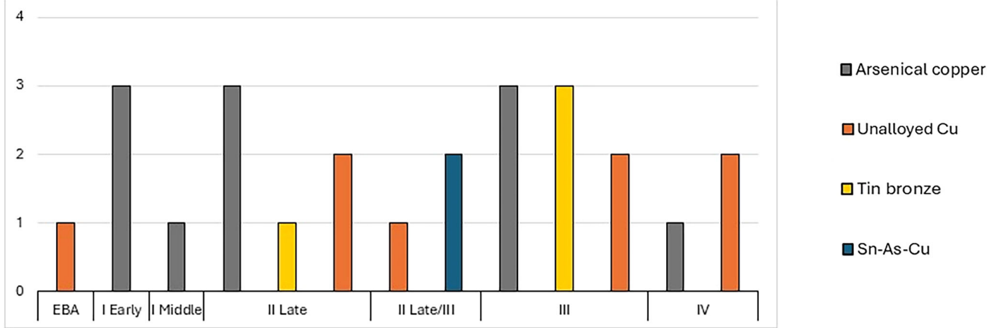
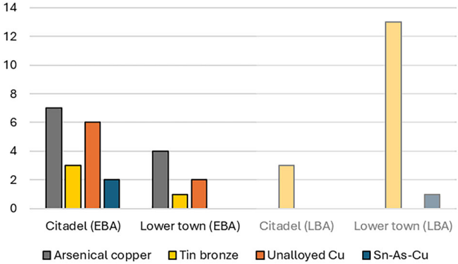
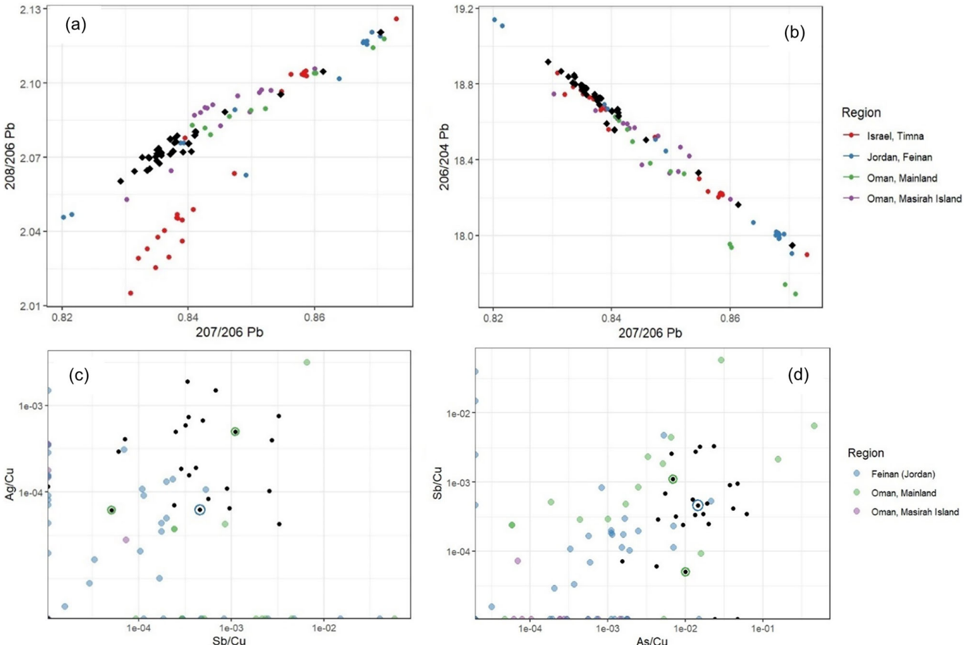
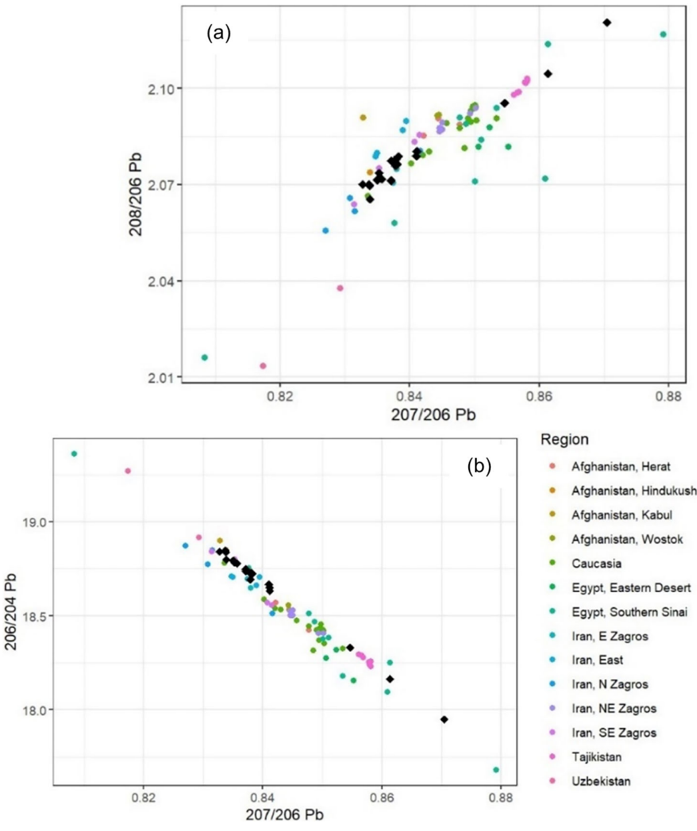
Research on Trojan metallurgy has traditionally focused on the composition and circulation of copper and its alloys, though early excavations provided limited stratigraphic dating for Early Bronze Age objects. More recent excavations (Korfmann/Pernicka) have yielded well-stratified finds, which were examined in this study through X-ray fluorescence and lead isotope analysis. Arsenical copper dominates the assemblage, followed by unalloyed copper and tin bronze—the latter appearing in Troy II (Late) and vanishing in Troy IV, primarily within the citadel. Notably, some Troy II–III objects derive from geologically old copper sources absent in the Aegean/Anatolian core region, with the Arabian Peninsula proposed as a possible origin. Some tin bronzes exhibit regional lead isotope signatures, suggesting local alloying rather than exclusive importation of finished bronze. Statistical tests further confirm that arsenic, antimony, and cobalt concentrations remain stable across corroded and uncorroded samples, supporting their reliability for compositional analysis.
Checked 2026-11-24 · 1 reference not checked yet
Overview
CoChat Summary
TL;DR
New XRF and lead isotope analyses of well-stratified Early Bronze Age copper alloys from Troy show arsenical copper dominated, with tin bronze appearing in Troy II (Late) and absent by Troy IV, mostly in the citadel. Some Troy II–III objects have geologically old, non-local lead isotope signatures pointing outside the Aegean/Anatolian core, possibly to Oman/Jordan, while some tin bronzes have regional signatures indicating local alloying.
Key findings
- Arsenical copper was the predominant copper-based material, followed by unalloyed copper and tin bronze; tin bronze appears in Troy II (Late) and vanishes in Troy IV, primarily within the citadel.
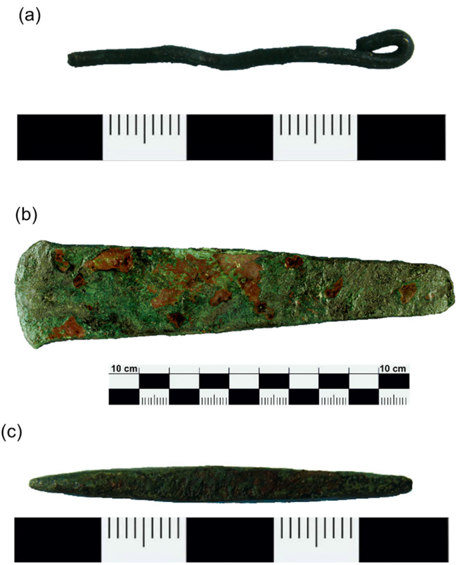
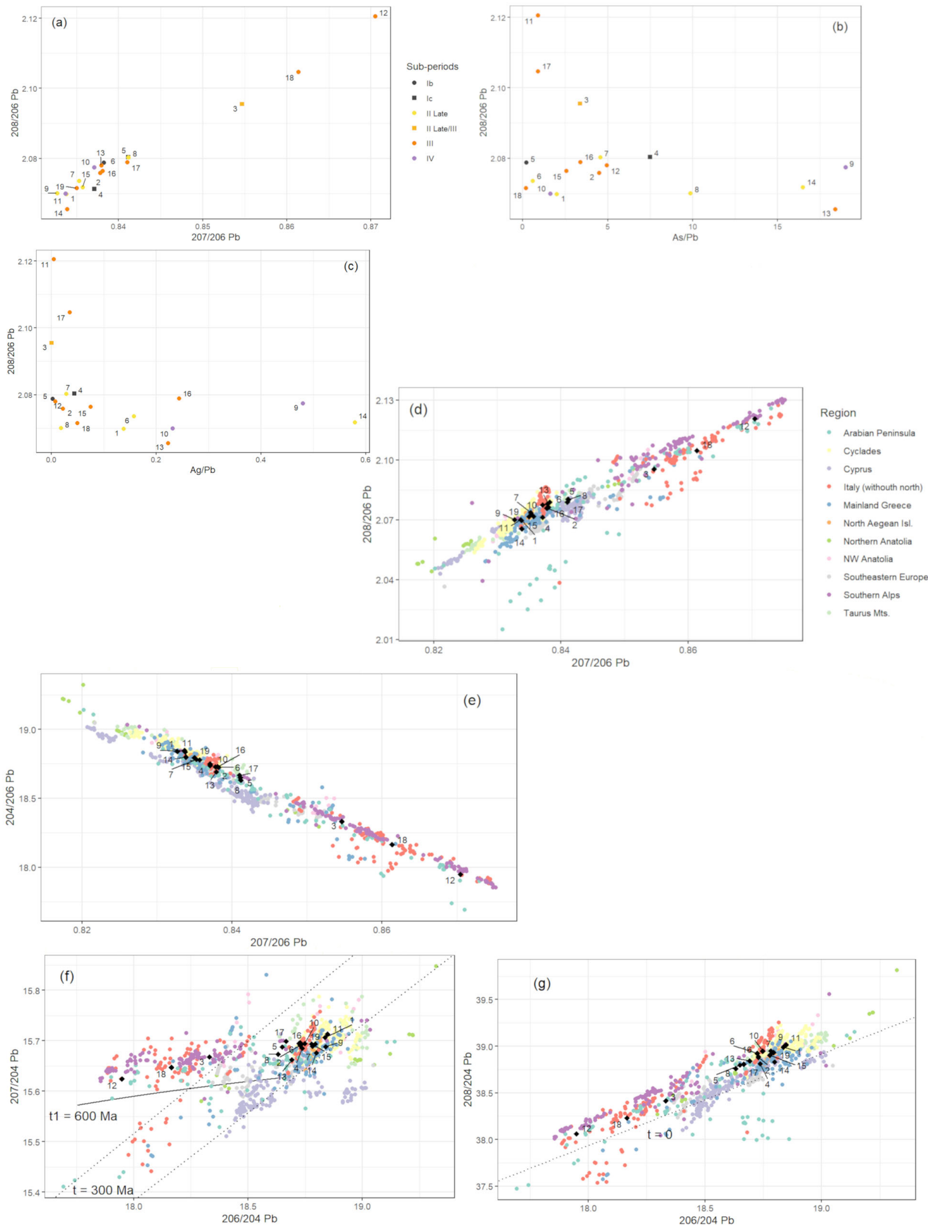
- Three finds from Troy II Late and/or Troy III have exotic, geologically old lead isotope signatures: a chisel with As-Sn-Cu composition, an ornamental pin of unalloyed copper, and a pin shaft of tin bronze, all recovered from the citadel; Omani and Jordanian ores are possible sources.
- Some tin bronzes exhibit regional lead isotope signatures, suggesting local alloying rather than exclusive importation of finished bronze; arsenic and tin contents reach up to 4.8 wt% in uncorroded samples, and pin tin contents range between 1.85% Sn and ≈3.5% Sn, below the mean 9.13 wt% of Trojan and Troad tin bronzes from this period.
- Statistical tests showed p-values >0.05 for As, Sb, Co, Se, and Bi, indicating no significant difference in means between corroded and uncorroded samples, whereas Pb, Fe, and Ni had p-values <0.05.
Methods
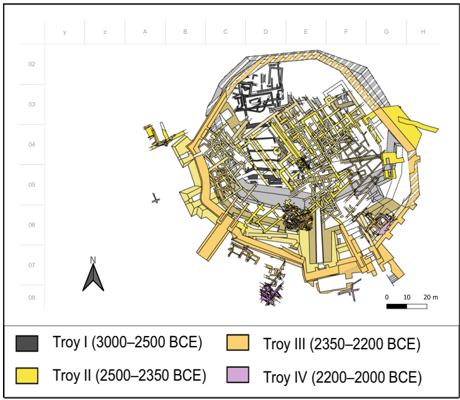
- Analysed material came exclusively from the 1987–2012 Korfmann/Pernicka excavations and included mainly utilitarian objects (awls, needles, chisels, flat axes) and ornaments (pins); 18 sampled objects were from the citadel, including Megaron 1, and seven from the Lower Town.
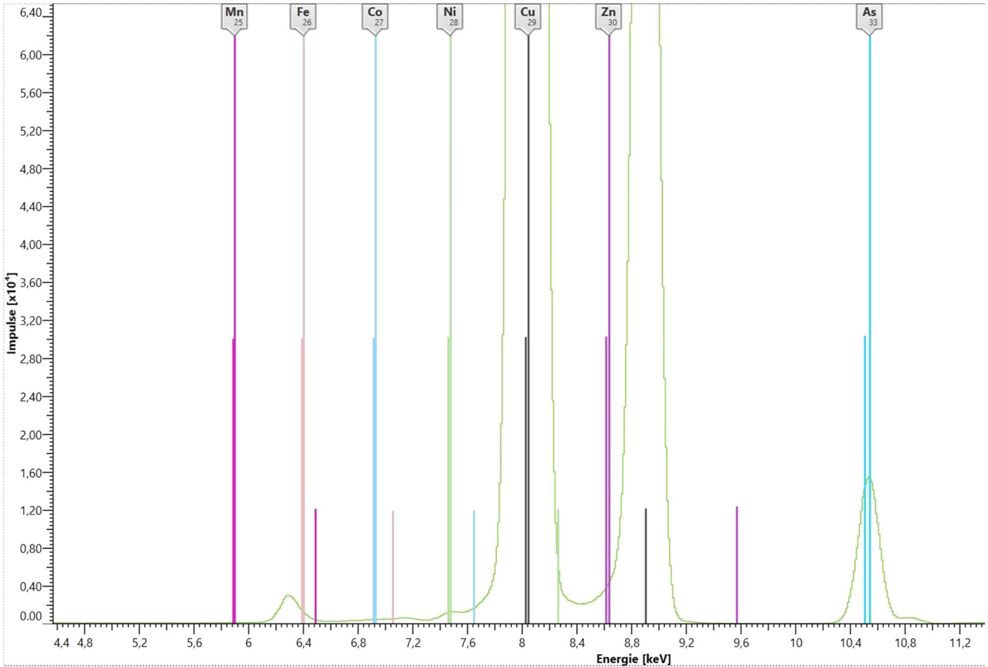
- Chemical composition was measured by EDXRF for samples >10 mg and µ-XRF for well-preserved samples <10 mg, with three measurements per sample and BAM reference materials; 19 objects were subjected to lead isotope analysis by MC-ICP-MS after lead purification, with NIST SRM-981 controls.
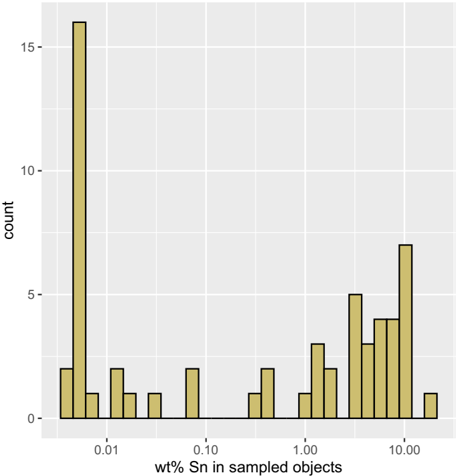
- A t-test (CI = 95%) on log10-transformed data compared fully corroded (P3) and uncorroded (P1) samples; alloy thresholds were set by hiatus inspection at As ≈1.5 wt% and Sn ≈0.1 wt%.
Limitations
- Stated: the sample size is not extensive and the number of finds is not balanced between the Lower Town and the citadel; strict balanced sample size across periods was only partially feasible due to varying sample numbers.
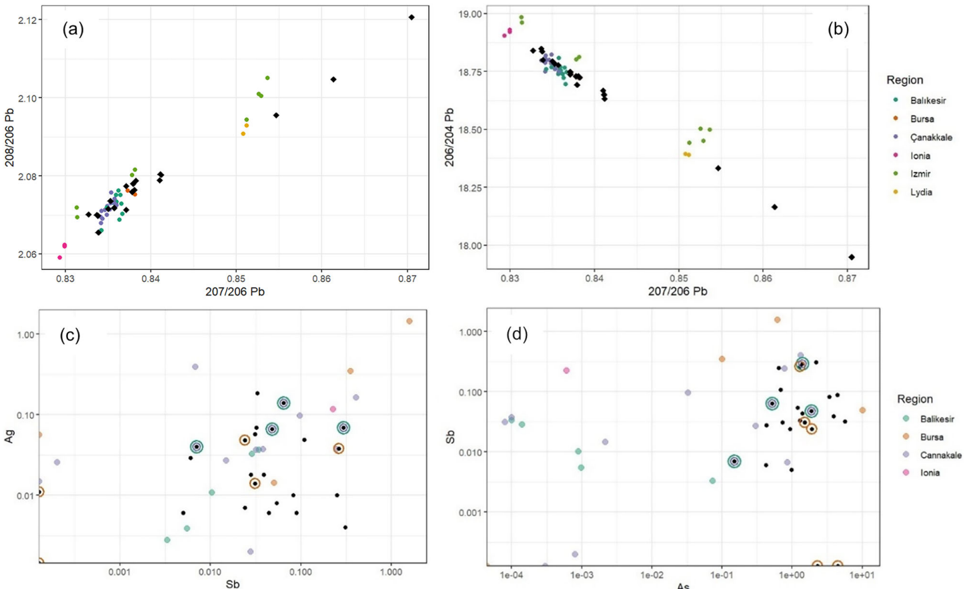
- Stated: lead isotope analysis alone is not conclusive for provenance, trace element analysis alone cannot determine provenance, and some regions were not examined in detail due to insufficient elemental data, including northern Central Asia, northern South Asia, and Egypt; Taurus and Bulgarian ores also had missing or insufficient trace element data.
- Evident from text: the absence of tin bronzes in Troy IV may be due to small sample size for that period; corrosion affects Pb, Fe, and Ni, and arsenic can be enriched on corroded surfaces, limiting qualitative evaluations.
Model-written summary. Check it against the paper before relying on it.
Integrity signals
Registry
Cites
Statistics
Figures
Verification
Claims the paper makes
0 Valid · 1 Not valid · 22 Not checked · 88 Own results and interpretations
A result the paper reports from its own data — it cites no other source for it, so there is none to check. The quote shows it is in the paper.
In the paper
“only two objects are made of tin bronze, namely the fragment of an awl or pin (D07.0357)dating to Troy II Late, which is also the only EBA tin bronze object that has been recovered from outside the citadel, and a needle dating to Troy III (G06.1119)”
§ Investigating new material from Early Bronze Age Troy-isotopic and chemical composition of copper alloys Check for updates > Provenance
plain- Asserted: passes — The authors put it forward as true.
- Checkable: passes — It can be checked against evidence.
- Load-bearing: passes — The paper’s conclusions depend on it.
- Based: passes — The paper gives a reason why it holds.
A result the paper reports from its own data — it cites no other source for it, so there is none to check. The quote shows it is in the paper.
In the paper
“All were recovered from within the citadel.”
§ Investigating new material from Early Bronze Age Troy-isotopic and chemical composition of copper alloys Check for updates > Provenance
plain- Asserted: passes — The authors put it forward as true.
- Checkable: passes — It can be checked against evidence.
- Load-bearing: unclear — It is unclear whether the paper’s conclusions depend on it.
- Based: passes — The paper gives a reason why it holds.
A result the paper reports from its own data — it cites no other source for it, so there is none to check. The quote shows it is in the paper.
In the paper
“Pins show the largest variety in alloy type, including arsenical copper, unalloyed copper and tin bronze.”
§ Investigating new material from Early Bronze Age Troy-isotopic and chemical composition of copper alloys Check for updates > Composition of EBA Trojan copper alloys
plainstates an association- Asserted: passes — The authors put it forward as true.
- Checkable: passes — It can be checked against evidence.
- Load-bearing: unclear — It is unclear whether the paper’s conclusions depend on it.
- Based: passes — The paper gives a reason why it holds.
A result the paper reports from its own data — it cites no other source for it, so there is none to check. The quote shows it is in the paper.
In the paper
“In both the corroded and collective samples, the most distinctive hiatus for tin was at Sn ≈0.1 wt%”
§ Investigating new material from Early Bronze Age Troy-isotopic and chemical composition of copper alloys Check for updates > Defining limits for the types of copper alloys
plain- Asserted: passes — The authors put it forward as true.
- Checkable: passes — It can be checked against evidence.
- Load-bearing: passes — The paper’s conclusions depend on it.
- Based: passes — The paper gives a reason why it holds.
A result the paper reports from its own data — it cites no other source for it, so there is none to check. The quote shows it is in the paper.
In the paper
“Arsenical copper dominates the assemblage”
- Also stated in: § Composition of EBA Trojan copper alloys · plain
“arsenical copper-as defined above-was the predominant type of copper-based material at Troy in the Early Bronze Age”
§ Investigating new material from Early Bronze Age Troy-isotopic and chemical composition of copper alloys Check for updates > Abstract
plain- Asserted: passes — The authors put it forward as true.
- Checkable: passes — It can be checked against evidence.
- Load-bearing: passes — The paper’s conclusions depend on it.
- Based: passes — The paper gives a reason why it holds.
- Rests on an assumption not shown here.
- Also stated in: § Composition of EBA Trojan copper alloys · plain
67 more claims
Create a free account to see all 111 claims and to verify the 31 references still open.
- It may state two separate claims as one. 25
- Probably not a substantial claim. 16
- The quote only partly states this claim. 2
Citations
Cites
Provenance Determination of Archaeological Metal Objects
Pernicka, E. (2014) · Springer eBooks · doi:10.1007/978-1-4614-9017-3_11 · Cited by 338
Self-citationMetal provenancing using isotopes and the Oxford archaeological lead isotope database (OXALID)
Stos-Gale, Z. A., & Gale, N. H. (2009) · Archaeological and Anthropological Sciences · doi:10.1007/s12520-009-0011-6 · Cited by 326
Niederschlag, E., Pernicka, E., Seifert, T., & Bartelheim, M. (2003) · Archaeometry · doi:10.1111/1475-4754.00097 · Cited by 223
Self-citationTheory of Hydrothermal Systems
Norton, D. L. (1984) · Annual Review of Earth and Planetary Sciences · doi:10.1146/annurev.ea.12.050184.001103 · Cited by 204
Stos-Gale, Z. A., Maliotis, G., Gale, N. H., & ANNETTS, N. (1997) · Archaeometry · doi:10.1111/j.1475-4754.1997.tb00792.x · Cited by 177
Chemical Composition and Lead Isotopy of Copper and Bronze from Nuragic Sardinia
Begemann, F., Schmitt-Strecker, S., Pernicka, E., & Schiavo, F. L. (2001) · European Journal of Archaeology · doi:10.1177/146195710100400102 · Cited by 141
Self-citationYener, K. A., Sayre, E. V., Joel, E. C., Özbal, H., Barnes, I. L., & Brill, R. H. (1991) · Journal of Archaeological Science · doi:10.1016/0305-4403(91)90053-r · Cited by 123
Pernicka, E., Begemann, F., Schmitt-Strecker, S., & Wagner, G. A. (1993) · Praehistorische Zeitschrift · doi:10.1515/prhz.1993.68.1.1 · Cited by 112
Self-citationNew insights into Levantine copper trade: analysis of ingots from the Bronze and Iron Ages in Israel
Yahalom‐Mack, N., Galili, E., Segal, I., Behar, A. E., Boaretto, E., Shilstein, S., & Finkelstein, I. (2014) · Journal of Archaeological Science · doi:10.1016/j.jas.2014.02.004 · Cited by 107
Zur Ausbreitung vorderasiatischer Innovationen in die frühbronzezeitliche Ägäis
Rahmstorf, L. (2006) · Praehistorische Zeitschrift · doi:10.1515/pz.2006.002 · Cited by 107
Research works printed but not linked: 18
- Muhly, J. D. & Pernicka, E. Early Trojan metallurgy and the metals trade. Heinrich Schliemann: Grundl. Ergeb. Mod. Archaol. 100, 309-318 (1992).
- Efe, T. Once again on Early Bronze Age Trade and Trade Routes in Western Anatolia. In From Past to Present Studies in Memory of Manfred O Korfmann, Studıa Troıca Monographien Vol. 11 (eds Blum, S. W. E., Efe, T., Kienlin, T. L., Pernicka, E.) 121-133 (Dr. Rudolf Habelt, Bonn, 2020).
- Begemann, F., Schmitt-Strecker, S. & Pernicka, E. The metal finds from Thermi III-V: a chemical and lead isotope study. Stud. Troica2, 219-239 (1992).
- Muhly, J. D. Copper and tin: the distribution of mineral resources and the nature of the metals trade in the Bronze Age. Separatum from Transactions of the Connecticut Academy of Arts and Sciences, 43. 155-535 (Distributed by Archon Books, Hamden, Conn. 1973)
- Seeliger, T. C. et al. Archäometallurgische Untersuchungen in Nord- und Ostanatolien [Archaeometallurgical Investigations in Northern and Eastern Anatolia] (in German). Jahrb. Röm.-Ger. Zentralmus. Mainz 32, 597-659 (1985).
- Stos-Gale, Z. A. Bronze Age metal sources and the movement of metals between the Aegean and Anatolia. Von Baden bis Troja Ressourcennutzung, Metallurgie und Wissenstransfer: Eine Jubiläumsschrift für Ernst Pernicka. Orient. Eur. Archaeol. 3, 375-398 (2016).
- Wagner, G. A. et al. Geologische Untersuchungen zur frühen Metallurgie in Nordwestanatolien [Geological investigations on Early Metallurgy in NW Anatolia] (in German). Bull. Miner. Res. Explor. Inst. Turk. 101, 45-81 (1985).
- Kassianidou, V. Mining landscapes of prehistoric Cyprus. Metalla 20, 36-45 (2013).
- Pernicka, E. Trace element fingerprinting of ancient copper: a guide to technology or provenance? In Metals in Antiquity. BAR International Series (eds Young, S. M. M., Pollard A. M., Budd P. & Ixer R. A.) 163-171 (Archaeopress, Oxford, 1999).
- Rapp, G. J. Native copper and the beginning of smelting: chemical studies. In Early Metallurgy in Cyprus 4000-500 BC: Acta of the International Archaeological Symposium, Larnaca, Cyprus, 1-6 June 1981 (eds Muhly, J. D., Maddin, R., Karageorghis, V.) 33-38 (Lacarna, 1982).
- Lamb, W. Excavations at Thermi in Lesbos (Cambridge University Press, Cambridge, 1936).
- Cultraro, M. Domestic architecture and public space in Early Bronze Age Poliochni (Lemnos). Br. Sch. Athens Stud. 15, 55-64 (2007).
- Hirao, Y., Enemoto, J. & Tachikawa, H. Lead isotope ratios of copper, zinc and lead minerals in Turkey-in relation to the provenance study of artefacts. In Essays on Ancient Anatolia and its Surrounding Civilizations. Bulletin of the Middle Eastern Culture Center in Japan (eds Mikasa, T. & Prince, H. I. H.) 89-114 (Otto Harrassowitz, Wiesbaden, 1995).
- Bassiakos, Y. & Philaniotou, O. Early copper production on Kythnos: archaeological evidence and analytical approaches to the reconstruction of metallurgical process. In Metallurgy in the Early Bronze Age Aegean. Sheffield Studies in Aegean Archaeology Vol. 7 (eds Day, P. M. & Doonan, R. C. P.) 19-56 (Oxford, 2007).
- Hauptmann, A., Heitkemper, E., Begemann, F., Schmitt-Strecker, S. & Pernicka, E. Early copper produced at Feinan, Wadi Araba, Jordan: the composition of ores and copper. Archeomaterials(USA). 6, 1-33 (1992).
- Wickham, H., Averick, M., Bryan, J., Chang, W., McGowan, L. D., François, R. et al. Welcome to the tidyverse. J. Open Source Softw. 4, 1686 (2019).
- Wickham, H. ggplot2: Elegant Graphics for Data Analysis (Springer- Verlag, New York, 2016).
- Venables, W. N. & Ripley, B. D. Modern Applied Statistics with S, 4th edn (Springer, New York, 2002).
Cited by
Still being checked.
Metadata
- Authors
- Finkel, N., Pernicka, E., & Pieniążek, M.
- Affiliations
- University of Tübingen (DE)
- Curt Engelhorn Centre Archaeometry (DE)
- Corresponding author
- Finkel, Nina
- Venue
- npj Heritage Science
- Published
- 2025-11-03
- Volume
- 13
- Issue
- 1
- Pages
- 557
- ISSN
- 3059-3220 (ISSN-L)
- OpenAlex
- W4415804551
- Cited by
- 0
- References
- 40
- FWCI
- 0.00
- Type
- journal article
- Language
- en
- Open access
- hybrid
- doi.org
- Licence
- cc-by
- creativecommons.org/licenses/by/4.0 (tdm)
- creativecommons.org/licenses/by/4.0 (vor)
- Locations
- npj Heritage Science (publishedVersion, cc-by)
- Funders
- DFG (498049685)
- Topics
- Social Sciences › Archeology › Metallurgy and Cultural Artifacts
- Social Sciences › Arts and Humanities › Archeology (arts and humanities) › Cultural Heritage Materials Analysis
- Social Sciences › Arts and Humanities › Archeology (arts and humanities) › Ancient Mediterranean Archaeology and History
- Keywords
- copper alloys, arsenical copper, tin bronze, lead isotope analysis, copper provenance, alloy composition, citadel
About these checks
Registry, retraction, Cites and statistics results are computed, not judged, with one exception: a printed reference that no index lists is read once by a model before it counts as a citation error. Claims are extracted by a model and kept only when their quote appears verbatim in the text; each cited source is then checked, with a model’s help, for whether it says what the claim relies on. Those verdicts can be wrong — read the claim’s quote and the cited source before relying on one.
A language model drew the claims from the paper on 2026-11-24, under version 3 of the claim definition (model deepseek-v4.1-flash, prompt extract-v3).
A second model labelled each claim on 2026-11-24 (model jev-1.13-20260917, definition revision gold-guideline-v0.2).
Statistics and arithmetic are recomputed, not judged.
Confidence bands are shown only for fields calibrated on our annotated test set. None is calibrated yet, so no band is shown.
What counts as a claim ›How we measure confidence ›How we check this ›
Are you an author, or do you see a problem with this page? Request a review
How to cite
Cite CoChat for the checks on this page, and the paper for its own findings.
- This page
- CoChat. (2026). Citation check: Investigating new material from Early Bronze Age Troy—isotopic and chemical composition of copper alloys. https://app.cochat.ai/papers/10.1038/s40494-025-01917-2
- The paper
- Finkel, N., Pernicka, E., & Pieniążek, M. (2025). Investigating new material from Early Bronze Age Troy—isotopic and chemical composition of copper alloys. npj Heritage Science. https://doi.org/10.1038/s40494-025-01917-2
Data sources
Bibliographic data: Semantic Scholar, OpenAlex, Crossref.
Contains information from the Semantic Scholar Academic Graph Datasets, made available under the ODC Attribution License (ODC-BY 1.0).
Semantic Scholar’s data is described in: Kinney, R., et al. (2023). The Semantic Scholar Open Data Platform. arXiv:2301.10140.
