

The DOI matches its Crossref record; 74 of the 76 references it cites were found in a registry or an index.
Metasurface-enabled on-chip multiplexed diffractive neural networks in the visible
Open accessAbstract
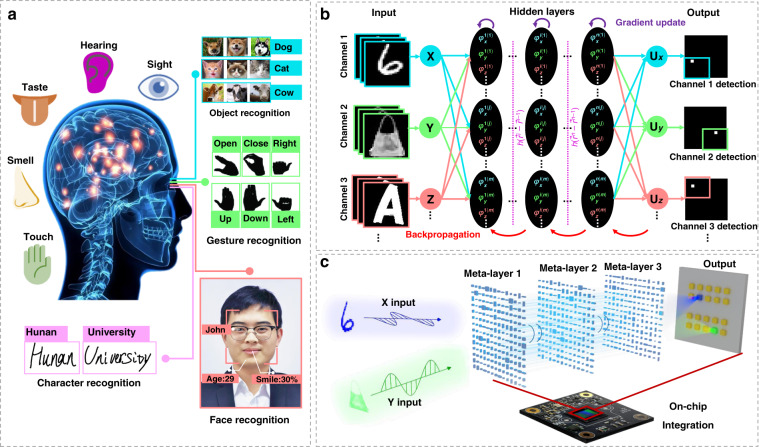
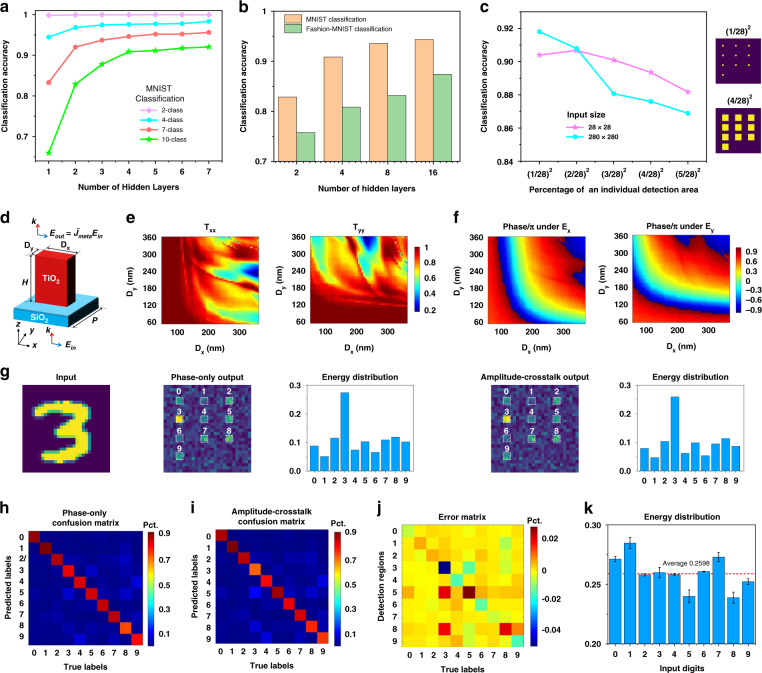
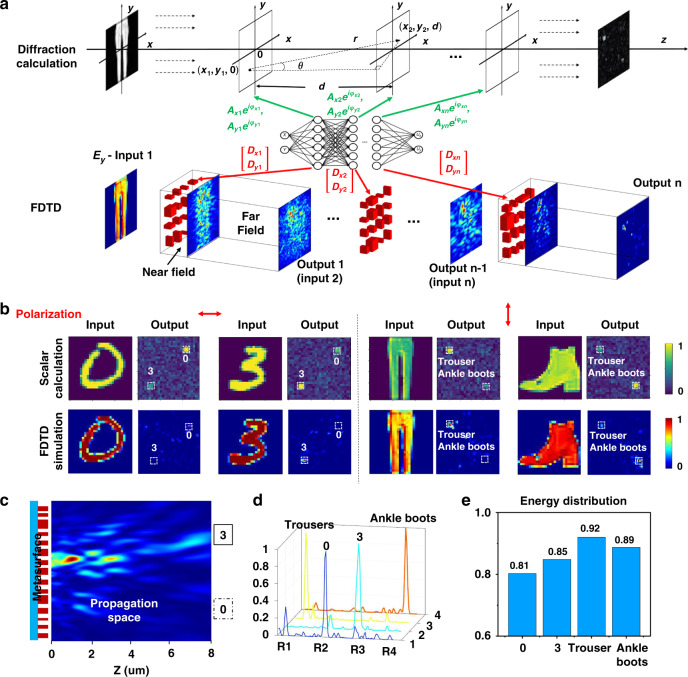
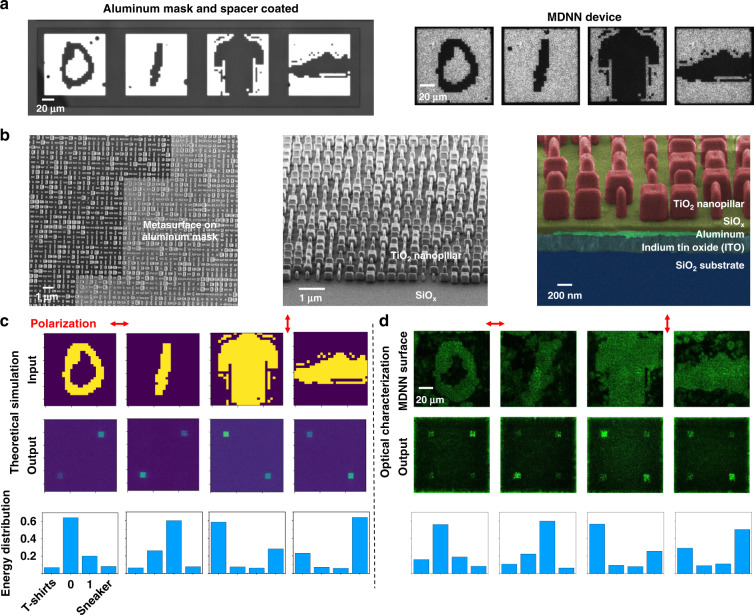
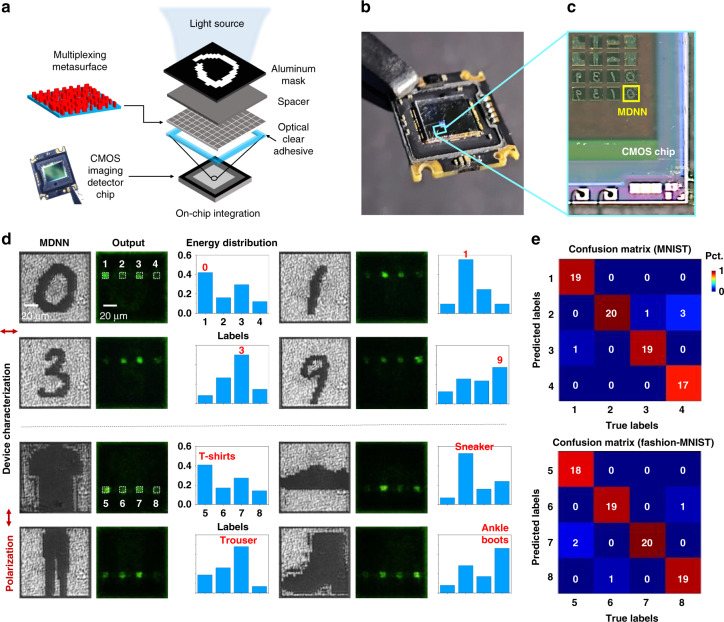
Replacing electrons with photons is a compelling route toward high-speed, massively parallel, and low-power artificial intelligence computing. Recently, diffractive networks composed of phase surfaces were trained to perform machine learning tasks through linear optical transformations. However, the existing architectures often comprise bulky components and, most critically, they cannot mimic the human brain for multitasking. Here, we demonstrate a multi-skilled diffractive neural network based on a metasurface device, which can perform on-chip multi-channel sensing and multitasking in the visible. The polarization multiplexing scheme of the subwavelength nanostructures is applied to construct a multi-channel classifier framework for simultaneous recognition of digital and fashionable items. The areal density of the artificial neurons can reach up to 6.25 × 10 6 mm −2 multiplied by the number of channels. The metasurface is integrated with the mature complementary metal-oxide semiconductor imaging sensor, providing a chip-scale architecture to process information directly at physical layers for energy-efficient and ultra-fast image processing in machine vision, autonomous driving, and precision medicine.
Overview
The claims and statistics of this paper haven’t been checked yet.
Run the check — free, no account needed. It reads the open-access text and checks the sources it cites.
Integrity signals
Registry
Cites
Statistics
Figures
Verification
Claims the paper makes
The claims and statistics of this paper haven’t been checked yet.
Run the check — free, no account needed. It reads the open-access text and checks the sources it cites.
Claims other papers make about this one
Each is checked against this paper’s own text: does it say what the citing paper says it does?
The source backs part of the claim, not all of it — or backs it for a different population, condition or comparison.
In the citing paper
“Recent prototypes have demonstrated SIMs with impressive capabilities for applications such as MIMO beamforming [25], radar sensing [26], and image classification [27].”
From Emerging Technologies in Intelligent Metasurfaces: Shaping the Future of Wireless Communications (2026) · cites this paper as [27]
Experimental — accuracy not yet measuredThe cited source says what the claim attributes to it.
In the citing paper
“To enhance the parallelism capability of SIM, Luo et al. [27] developed a SIM device that can simultaneously recognize digital and fashionable items by leveraging polarization multiplexing in the visible spectrum.”
From Emerging Technologies in Intelligent Metasurfaces: Shaping the Future of Wireless Communications (2026) · cites this paper as [27]
Self-check
Percentages, sums and reported differences re-computed from the paper’s own numbers.
The self-check needs the paper’s full text.
Citations
Cites
Deep Residual Learning for Image Recognition
He, K., Zhang, X., Ren, S., & Sun, J. (2016) · 2016 IEEE Conference on Computer Vision and Pattern Recognition (CVPR) · doi:10.1109/cvpr.2016.90 · Cited by 235,474
Very Deep Convolutional Networks for Large-Scale Image Recognition
Simonyan, K., & Zisserman, A. (2014) · arXiv · doi:10.48550/arxiv.1409.1556 · Cited by 114,148
LeCun, Y., Bengio, Y., & Hinton, G. (2015) · Nature · doi:10.1038/nature14539 · Cited by 84,126
Gradient-based learning applied to document recognition
Lecun, Y., Bottou, L., Bengio, Y., & Haffner, P. (1998) · Proceedings of the IEEE · doi:10.1109/5.726791 · Cited by 58,805
Deep learning in neural networks: an overview
Schmidhuber, J. (2015) · Neural Networks · doi:10.1016/j.neunet.2014.09.003 · Cited by 18,570
Mastering the game of Go with deep neural networks and tree search
Silver, D., Huang, A., Maddison, C. J., Guez, A., Sifre, L., van den Driessche, G., Schrittwieser, J., Antonoglou, I., Panneershelvam, V., Lanctot, M., et al. (2016) · Nature · doi:10.1038/nature16961 · Cited by 15,612
Light Propagation with Phase Discontinuities: Generalized Laws of Reflection and Refraction
Yu, N., Genevet, P., Kats, M. A., Aieta, F., Tetienne, J.-P., Capasso, F., & Gaburro, Z. (2011) · Science · doi:10.1126/science.1210713 · Cited by 10,361
Speech recognition with deep recurrent neural networks
Graves, A., Mohamed, A.-R., & Hinton, G. (2013) · 2013 IEEE International Conference on Acoustics, Speech and Signal Processing · doi:10.1109/icassp.2013.6638947 · Cited by 8,893
Artificial neural networks: a tutorial
Jain, A. K., Mao, J., & Mohiuddin, K. M. (1996) · Computer · doi:10.1109/2.485891 · Cited by 5,095
A million spiking-neuron integrated circuit with a scalable communication network and interface
Merolla, P. A., Arthur, J. V., Alvarez-Icaza, R., Cassidy, A. S., Sawada, J., Akopyan, F., Jackson, B. L., Imam, N., Chen, G., Nakamura, Y., et al. (2014) · Science · doi:10.1126/science.1254642 · Cited by 4,270
Research works printed but not linked: 1
- Xiao, H., Rasul, K. & Vollgraf, R. Fashion-MNIST: a novel image dataset for benchmarking machine learning algorithms. arXiv 1708, 07747 (2017).
Cited by
Sorted by citations
Dielectric metalens for miniaturized imaging systems: progress and challenges
Pan, M., Fu, Y., Zheng, M., Chen, H., Zang, Y., Duan, H., Li, Q., Qiu, M., & Hu, Y. (2022) · Light Science & Applications · doi:10.1038/s41377-022-00885-7 · Cited by 398
Self-citationOptical neural networks: progress and challenges
Fu, T., Zhang, J., Sun, R. C., Huang, Y., Xu, W. X., Yang, S., Zhu, Z., & Chen, H. (2024) · Light Science & Applications · doi:10.1038/s41377-024-01590-3 · Cited by 339
Integrated metasurfaces for re-envisioning a near-future disruptive optical platform
Yang, Y., Seong, J., Choi, M., Park, J., Kim, G., Kim, H., Jeong, J., Jung, C., Kim, J., Jeon, G., et al. (2023) · Light Science & Applications · doi:10.1038/s41377-023-01169-4 · Cited by 261
Diffractive optical computing in free space
Hu, J., Mengü, D., Tzarouchis, D. C., Edwards, B. E., Engheta, N., & Özcan, A. (2024) · Nature Communications · doi:10.1038/s41467-024-45982-w · Cited by 233
Intelligent metaphotonics empowered by machine learning
Krasikov, S., Tranter, A. D., Bogdanov, A., & Kivshar, Y. S. (2022) · Opto-Electronic Advances · doi:10.29026/oea.2022.210147 · Cited by 169
Metadata
- Authors
- Luo, X., Hu, Y., Ou, X., Li, X., Lai, J., Liu, N., Cheng, X., Pan, A., & Duan, H.
- Affiliations
- Tongji University (CN)
- Hunan University (CN)
- University of Stuttgart (DE)
- Corresponding author
- Hu, Yueqiang
- Duan, Huigao
- Venue
- Light: Science & Applications
- Published
- 2022-05-27
- Volume
- 11
- Issue
- 1
- Pages
- 158-158
- ISSN
- 2047-7538 (ISSN-L)
- PMC
- PMC9142536
- OpenAlex
- W3184400519
- Cited by
- 335
- References
- 76
- Citations by year
- 2026: 58 · 2025: 105 · 2024: 100 · 2023: 56 · 2022: 15
- FWCI
- 15.91
- Type
- journal article
- Language
- en
- Open access
- gold
- doi.org
- Locations
- Light Science & Applications (publishedVersion, cc-by)
- PubMed Central (publishedVersion, cc-by)
- PubMed (publishedVersion)
- arXiv (Cornell University) (submittedVersion)
- DOAJ (DOAJ: Directory of Open Access Journals) (submittedVersion)
- Figshare (submittedVersion, cc-by)
- arXiv (Cornell University)
- Funders
- National Natural Science Foundation of China (52005175)
- Topics
- Physical Sciences › Materials Science › Electronic, Optical and Magnetic Materials › Metamaterials and Metasurfaces Applications
- Physical Sciences › Computer Science › Artificial Intelligence › Neural Networks and Reservoir Computing
- Physical Sciences › Engineering › Electrical and Electronic Engineering › Advanced Memory and Neural Computing
- Keywords
- metasurfaces, diffractive neural networks, polarization multiplexing, on-chip image processing, optical neuromorphic computing, artificial neurons
About these checks
Registry, retraction, Cites and statistics results are computed, not judged, with one exception: a printed reference that no index lists is read once by a model before it counts as a citation error. Claims are extracted by a model and kept only when their quote appears verbatim in the text; each cited source is then checked, with a model’s help, for whether it says what the claim relies on. Those verdicts can be wrong — read the claim’s quote and the cited source before relying on one.
Statistics and arithmetic are recomputed, not judged.
Confidence bands are shown only for fields calibrated on our annotated test set. None is calibrated yet, so no band is shown.
What counts as a claim ›How we measure confidence ›How we check this ›
Are you an author, or do you see a problem with this page? Request a review
