

Extracellular vesicle-based point-of-care testing for diagnosis and monitoring of Alzheimer’s disease
Open accessPublished version of a preprint
The DOI matches its Crossref record; 75 of the 75 references it cites were found in a registry or an index.
Abstract
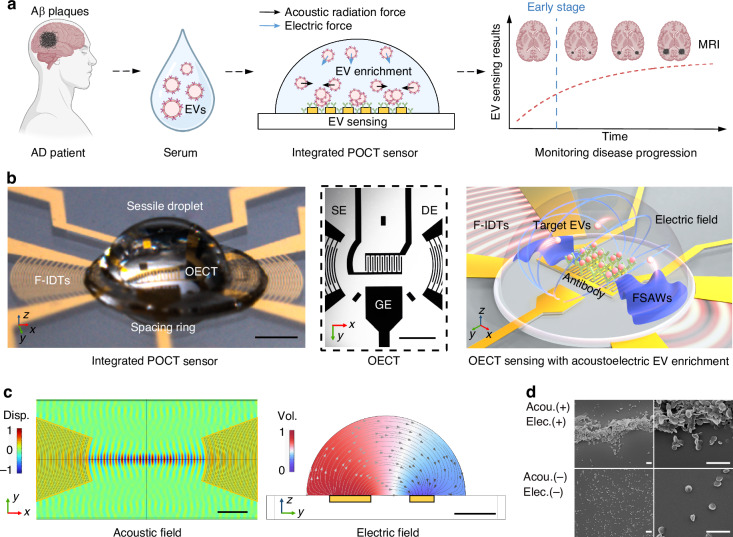
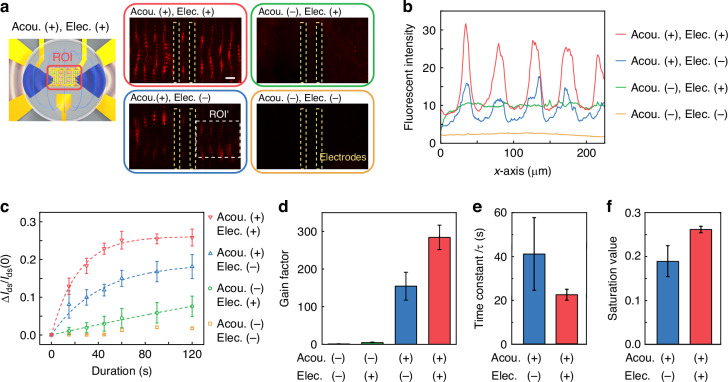
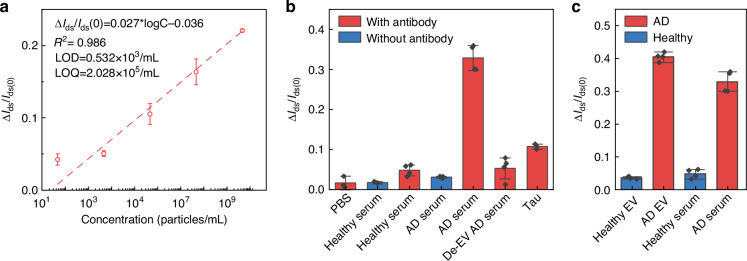
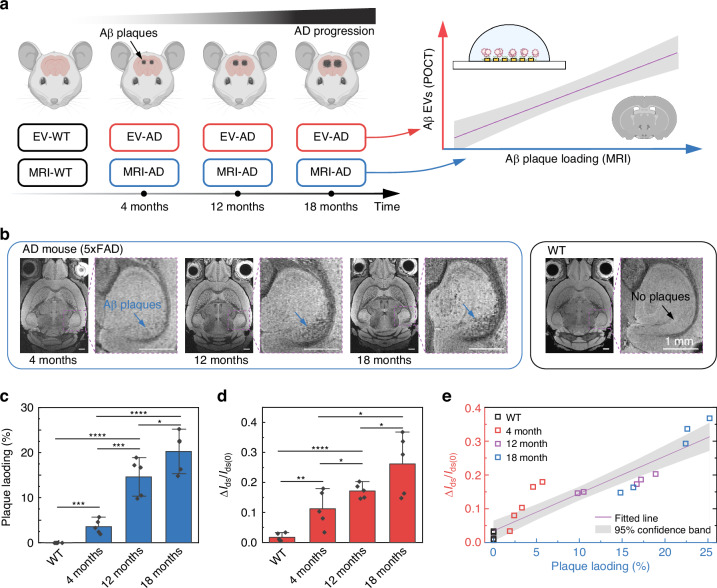
Extracellular vesicles (EVs) show potential for early diagnosis of Alzheimer's disease (AD) and monitoring of its progression. However, EV-based AD diagnosis faces challenges due to the small size and low abundance of biomarkers. Here, we report a fully integrated organic electrochemical transistor (OECT) sensor for ultrafast, accurate, and convenient point-of-care testing (POCT) of serum EVs from AD patients. By utilizing acoustoelectric enrichment, the EVs can be quickly propelled, significantly enriched, and specifically bound to the OECT detection area, achieving a gain of over 280 times response in 30 s. The integrated POCT sensor can detect serum EVs from AD patients with a limit of detection as low as 500 EV particles/mL and a reduced detection time of just two minutes. Furthermore, the integrated POCT sensors were used to monitor AD progression in an AD mouse model by testing the mouse Aβ EVs at different time courses (up to 18 months) and compared with the Aβ accumulation using high-resolution magnetic resonance imaging (MRI). This innovative technology has the potential for accurate and rapid diagnosis of Alzheimer's and other neurodegenerative diseases, and monitoring of disease progression and treatment response.
Overview
The claims and statistics of this paper haven’t been checked yet.
Free: it reads the open-access text and checks the first 5 claims that cite a source we can check. Create a free account to check every claim.
Integrity signals
Registry
Cites
Statistics
Figures
Verification
Claims the paper makes
The claims and statistics of this paper haven’t been checked yet.
Free: it reads the open-access text and checks the first 5 claims that cite a source we can check. Create a free account to check every claim.
Claims other papers make about this one
Each is checked against this paper’s own text: does it say what the citing paper says it does?
The source backs part of the claim, not all of it — or backs it for a different population, condition or comparison.
In the citing paper
“Instead, ongoing clinical trial studies are investigating EVs’ cargo, such as Aβ and tau proteins, for potential AD markers, due to their superior sensitivity, specificity, and accessibility in saliva, blood, and other body fluids [224,225].”
From The Impact of Neurotoxin Proteins Trafficked by Primary Cilia and Extracellular Vesicles in Neurodegenerative Diseases (2025) · cites this paper as [224]
Experimental — accuracy not yet measured
Self-check
Percentages, sums and reported differences re-computed from the paper’s own numbers.
The self-check needs the paper’s full text.
Citations
Cites
Scheltens, P., De Strooper, B., Kivipelto, M., Holstege, H., Chételat, G., Teunissen, C. E., Cummings, J., & van der Flier, W. M. (2021) · The Lancet · doi:10.1016/s0140-6736(20)32205-4 · Cited by 5,465
The present and future role of microfluidics in biomedical research
Sackmann, E. K., Fulton, A. L., & Beebe, D. J. (2014) · Nature · doi:10.1038/nature13118 · Cited by 2,995
New Technologies for Analysis of Extracellular Vesicles
Shao, H., Im, H., Castro, C. M., Breakefield, X., Weissleder, R., & Lee, H. (2018) · Chemical Reviews · doi:10.1021/acs.chemrev.7b00534 · Cited by 1,675
Alzheimer’s disease β-amyloid peptides are released in association with exosomes
Rajendran, L., Honsho, M., Zahn, T. R., Keller, P., Geiger, K. D., Verkade, P., & Simons, K. (2006) · Proceedings of the National Academy of Sciences · doi:10.1073/pnas.0603838103 · Cited by 1,343
Label-free detection and molecular profiling of exosomes with a nano-plasmonic sensor
Im, H., Shao, H., Park, Y. I., Peterson, V. M., Castro, C. M., Weissleder, R., & Lee, H. (2014) · Nature Biotechnology · doi:10.1038/nbt.2886 · Cited by 1,321
Challenges and directions in studying cell–cell communication by extracellular vesicles
van Niel, G., Carter, D. R. F., Clayton, A., Lambert, D. W., Raposo, G., & Vader, P. (2022) · Nature Reviews Molecular Cell Biology · doi:10.1038/s41580-022-00460-3 · Cited by 1,229 · cited 1×
“Extracellular vesicles (EVs) are nano/microscale membrane-enclosed vesicles secreted by cells 5,6 , and highly abundant in various bio fl uids including blood and cerebrospinal fl uid 7 .”
Acoustofluidics 7: The acoustic radiation force on small particles
Bruus, H. (2012) · Lab on a Chip · doi:10.1039/c2lc21068a · Cited by 1,019
Microscale acoustofluidics: Microfluidics driven via acoustics and ultrasonics
Friend, J., & Yeo, L. Y. (2011) · Reviews of Modern Physics · doi:10.1103/revmodphys.83.647 · Cited by 964
Self-citationHigh transconductance organic electrochemical transistors
Khodagholy, D., Rivnay, J., Sessolo, M., Gurfinkel, M., Leleux, P., Jimison, L. H., Stavrinidou, E., Herve, T., Sanaur, S., Owens, R. M., et al. (2013) · Nature Communications · doi:10.1038/ncomms3133 · Cited by 862
Exosomes as a new frontier of cancer liquid biopsy
Yu, D., Li, Y., Wang, M., Gu, J., Xu, W., Cai, H., Fang, X., & Zhang, X. (2022) · Molecular Cancer · doi:10.1186/s12943-022-01509-9 · Cited by 855
Self-citation
Cited by
Intelligent sensing devices and systems for personalized mental health
Xing, Y., Yang, Y., Yang, K., Lu, A., Xing, L., Mackie, K., & Guo, F. (2025) · Med-X · doi:10.1007/s44258-025-00057-3 · Cited by 28
Self-citationCentral Nervous System-Derived Extracellular Vesicles as Biomarkers in Alzheimer’s Disease
Yu, Y., Wang, Z., Chai, Z., Ma, S., Li, A., & Li, Y. (2025) · International Journal of Molecular Sciences · doi:10.3390/ijms26178272 · Cited by 26
“This device successfully monitored rising A β -positive EV levels in an AD mouse model over 18 months, correlating with plaque progression [181].”
Pei, J., Perumal, N. C., Meng, P., Long, Q., & Palanisamy, C. P. (2025) · Ageing Research Reviews · doi:10.1016/j.arr.2025.102904 · Cited by 37
Cook‐Calvete, A., Delgado-Marín, M., Fernandez-Rodriguez, B. M., Zaragoza, C., & Saura, M. (2025) · Biomolecules · doi:10.3390/biom15111548 · Cited by 7
“Comparative studies further show that EV lipidomic and miRNA profiles mirror key pathological processes in the valve: for instance, oxidized phospholipids indicate oxidative stress, while downregulation of miR-30b reflects osteogenic reprogramming of VICs [7,16,73,74].”
Extracellular Vesicles for Acute Care Testing: A Review of Potential Laboratory Applications
Mohapatra, N., Carney, R. P., Wang, A., Grimsrud, K., & Tran, N. K. (2025) · The Journal of Applied Laboratory Medicine · doi:10.1093/jalm/jfaf200 · Cited by 6
Abdullah, S. A., Ghadami, S., Khan, M. A. R., Ebrahimi, F., Nowlin, K. S., Ignatova, T., & Dellinger, K. (2025) · Advanced Sensor Research · doi:10.1002/adsr.202500034 · Cited by 4
Danna, R., Kondle, S., Amar, O., Mabourakh, M., Chen, G., Fadol, W. B., & Mohieldin, A. M. (2025) · Biology · doi:10.3390/biology14121787 · Cited by 2
“Instead, ongoing clinical trial studies are investigating EVs’ cargo, such as A β and tau proteins, for potential AD markers, due to their superior sensitivity, specificity, and accessibility in saliva, blood, and other body fluids [224,225].”
Ahamed, M. A., Guo, B., Khalid, M. A. U., Pal, T., Guo, F., & Guan, W. (2026) · Nano Today · doi:10.1016/j.nantod.2026.103033 · Cited by 2
Self-citationInterplay between extracellular vesicles and mitochondria
Coelho, P., & Pinheiro, P. S. (2025) · Elsevier eBooks · doi:10.1016/b978-0-443-29283-5.00004-2 · Cited by 1
Delbaz, A., & John, J. A. S. (2026) · Cells · doi:10.3390/cells15080690 · Cited by 2
Kwon, D.-I., Yoo, Y., Jin, J.-H., Park, J. H., Han, G. E., Kim, K., Yoon, J. S., Kang, S. M., & Kang, D. H. (2026) · Microsystems & Nanoengineering · doi:10.1038/s41378-026-01381-3 · Cited by 1
“Such an integrated platform can be utilized in diverse fi elds, including bedside healthcare 1 – 4 , infectious disease management 5 – 7 , environmental monitoring 8 , food safety investigation 9 , and drug screening 10 .”
He, X., Wei, W., Yu, H., Wang, Y., Shen, X. C., Li, T., Wang, B., Wang, Y., Mei, Z., & Duan, X. (2026) · Biosensors and Bioelectronics · doi:10.1016/j.bios.2026.119085
Nemati, S. S., Nilghaz, A., & Dehghan, G. (2026) · Results in Chemistry · doi:10.1016/j.rechem.2026.103735
Acoustofluidics for translational medicine
He, Y., Rufo, J., Yang, K., Chen, Y., Drinkwater, B. W., Zheng, H., Lee, L. P., & Huang, T. J. (2026) · Nature Reviews Bioengineering · doi:10.1038/s44222-026-00479-7 · Cited by 1
“For example, a fully integrated chip isolates blood-based nanoscale biomarkers and detects them electrically on-chip 65 .”
InfluentialSelf-citationSingh, S., Naithani, D., Raj, G., & Narang, J. (2026) · ACS Applied Bio Materials · doi:10.1021/acsabm.6c00105
Selective photoacoustic handling of microparticles via annular laser beams
Luo, G., He, Y. L., Zhang, W., Collins, D. J., Liu, Y., Yang, M., Pan, F., & Su, Z. (2026) · Microsystems & Nanoengineering · doi:10.1038/s41378-026-01428-5
“…demonstrated in a broad range of applications such as deterministic one-to-one pairing of T cells with tumor (or other effector-target) cells 31 – 33 , enrichment and preliminary puri fi cation of circulating tumor cells (CTCs) 34 , high-integrity concentration of exosomes and other nanovesicles…”
Extracellular Vesicle-Derived microRNAs as Diagnostic Biomarkers Across Neurodegenerative Diseases
Tevlek, A. (2026) · IntechOpen eBooks · doi:10.5772/intechopen.1017741
Metadata
- Authors
- Li, X., Chen, J., Yang, Y., Cai, H., Ao, Z., Xing, Y., Li, K., Yang, K., Guan, W., Friend, J., Lee, L. P., Wang, N., & Guo, F.
- Affiliations
- Indiana University Bloomington (US)
- The University of Texas Southwestern Medical Center (US)
- Brigham and Women's Hospital (US)
- University of California San Diego (US)
- Corresponding author
- Lee, Luke P.
- Wang, Nian
- Guo, Feng
- ORCID
- Venue
- Microsystems & Nanoengineering
- Published
- 2025-04-17
- Volume
- 11
- Issue
- 1
- Pages
- 65-65
- ISSN
- 2055-7434 (ISSN-L)
- PMC
- PMC12006457
- OpenAlex
- W4409521872
- Cited by
- 17
- References
- 75
- Citations by year
- 2026: 9 · 2025: 8
- FWCI
- 3.80
- Type
- journal article
- Language
- en
- Open access
- gold
- doi.org
- Licence
- cc-by-nc-nd
- creativecommons.org/licenses/by-nc-nd/4.0 (tdm)
- creativecommons.org/licenses/by-nc-nd/4.0 (vor)
- Locations
- Microsystems & Nanoengineering (publishedVersion, cc-by-nc-nd)
- bioRxiv (Cold Spring Harbor Laboratory) (acceptedVersion)
- PubMed Central (publishedVersion, cc-by-nc-nd)
- PubMed (publishedVersion)
- PubMed Central (submittedVersion)
- DOAJ (DOAJ: Directory of Open Access Journals) (submittedVersion, cc-by-sa)
- Funders
- National Institute of Health Awards
- Topics
- Physical Sciences › Chemistry › Analytical Chemistry › Electrochemical sensors and biosensors
- Life Sciences › Biochemistry, Genetics and Molecular Biology › Molecular Biology › Extracellular vesicles in disease
- Physical Sciences › Engineering › Biomedical Engineering › Biosensors and Analytical Detection
- Keywords
- extracellular vesicles, Alzheimer's disease, point-of-care testing, amyloid-beta, disease progression monitoring, neurodegenerative disease diagnosis, mouse model
About these checks
Registry, retraction, Cites and statistics results are computed, not judged, with one exception: a printed reference that no index lists is read once by a model before it counts as a citation error. Claims are extracted by a model and kept only when their quote appears verbatim in the text; each cited source is then checked, with a model’s help, for whether it says what the claim relies on. Those verdicts can be wrong — read the claim’s quote and the cited source before relying on one.
Statistics and arithmetic are recomputed, not judged.
Confidence bands are shown only for fields calibrated on our annotated test set. None is calibrated yet, so no band is shown.
What counts as a claim ›How we measure confidence ›How we check this ›
Are you an author, or do you see a problem with this page? Request a review
Data sources
Bibliographic data: Semantic Scholar, OpenAlex, Crossref.
Contains information from the Semantic Scholar Academic Graph Datasets, made available under the ODC Attribution License (ODC-BY 1.0).
Semantic Scholar’s data is described in: Kinney, R., et al. (2023). The Semantic Scholar Open Data Platform. arXiv:2301.10140.
