

Relative effectiveness of antidepressant treatments in treatment-resistant depression: a systematic review and network meta-analysis of randomized controlled trials
Open accessThe DOI matches its Crossref record; 26 of the 26 references it cites were found in a registry or an index.
Abstract
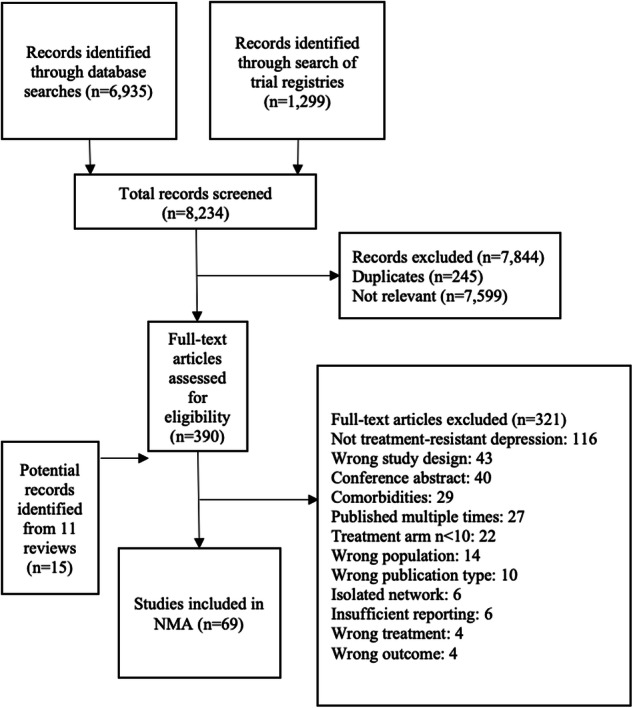
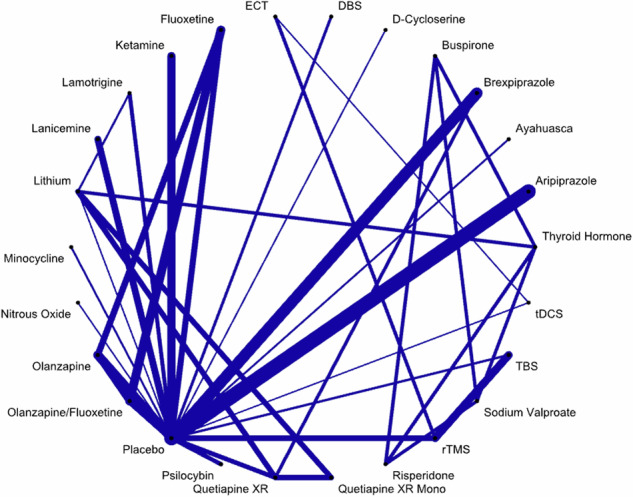
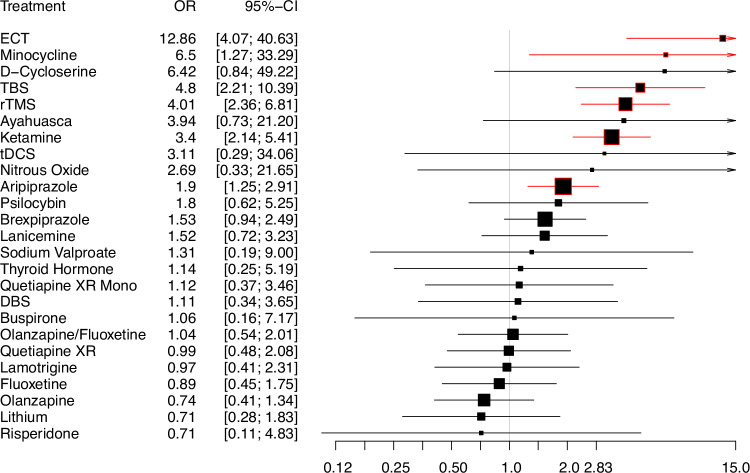
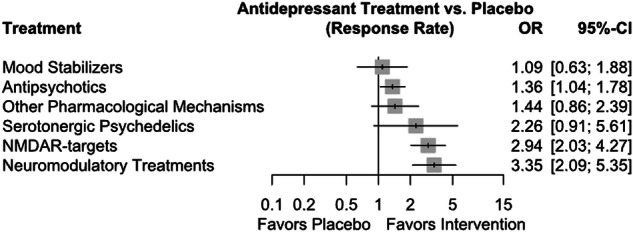
This systematic review and network meta-analysis (NMA) sought to compare different antidepressant treatments for treatment-resistant depression (TRD) in order to facilitate evidence-based choices. A literature search of PubMed, Cochrane Library, and Embase from inception until April 13th, 2023 identified randomized, controlled trials (RCTs) of adults with depression who had not responded to at least two antidepressant trials; all RCTs had ≥10 participants per study arm, and participants with bipolar or psychotic depression were excluded. The Cochrane Risk of Bias Tool-2 was used to assess study quality. Response rate was the primary outcome measure. Odds ratios (ORs) using a random effects NMA are reported. From 8234 records, 69 RCTs were included in this analysis, encompassing 10,285 participants (5662 F/4623 M) and 25 separate treatments. Six of the 25 treatments demonstrated a higher response rate versus placebo or sham treatment: electroconvulsive therapy (ECT), minocycline, theta-burst stimulation (TBS), repetitive transcranial magnetic stimulation (rTMS), ketamine, and aripiprazole. ORs ranged from 1.9 (95%CI = [1.25; 2.91]) for aripiprazole to 12.86 (95%CI = [4.07; 40.63]) for ECT. Moderate heterogeneity of the model was observed (I 2 = 47.3% (95%CI [26.8–62%]). Of the included studies, 12.5% were rated as having high risk of bias, 28.13% as having low risk, and 59.38% as showing some concerns. Several effective treatments for TRD showed robust treatment effects across outcomes (ECT, TBS, rTMS, and ketamine), and others showed promising results for some, but not all, outcomes (minocycline, aripiprazole). These findings may help guide evidence-based treatment choices for TRD. Study Registration: PROSPERO (#CRD42023420584).
Overview
The claims and statistics of this paper haven’t been checked yet.
Free: it reads the open-access text and checks the first 5 claims that cite a source we can check. Create a free account to check every claim.
Integrity signals
Registry
Cites
Statistics
Figures
Verification
Claims the paper makes
The claims and statistics of this paper haven’t been checked yet.
Free: it reads the open-access text and checks the first 5 claims that cite a source we can check. Create a free account to check every claim.
Claims other papers make about this one
Each is checked against this paper’s own text: does it say what the citing paper says it does?
The source backs part of the claim, not all of it — or backs it for a different population, condition or comparison.
In the citing paper
“The evidence regarding quetiapine’s efficacy in TRD varies among studies: earlier meta-analyses reported limited efficacy and noted safety concerns compared to placebo [50], whereas a recent open-label randomized controlled trial indicated potential benefits versus lithium [51].”
From Efficacy and safety of esketamine for “treatment resistant depression”: registered report for a systematic review with an individual patient data meta-analysis of randomized, double-blind, placebo-controlled trials (2025) · cites this paper as [50]
Experimental — accuracy not yet measuredThe cited source says what the claim attributes to it.
In the citing paper
“Moreover, the approval of quetiapine for TRD was based on an even more lenient definition of resistance, requiring failure of only one prior antidepressant [50].”
Self-check
Percentages, sums and reported differences re-computed from the paper’s own numbers.
The self-check needs the paper’s full text.
Citations
Cites
Shamseer, L., Moher, D., Clarke, M., Ghersi, D., Liberati, A., Petticrew, M., Shekelle, P., Stewart, L. A., & the PRISMA-P Group (2015) · BMJ · doi:10.1136/bmj.g7647 · Cited by 13,120 · cited 1×
“The study adhered to the Preferred Reporting Items for Systematic Reviews and Meta-Analyses (PRISMA) and its extension statement for NMAs [9].”
Antidepressant Drug Effects and Depression Severity: A Patient-Level Meta-analysis
Fournier, J. C., DeRubeis, R. J., Hollon, S. D., Dimidjian, S., Amsterdam, J. D., Shelton, R. C., & Fawcett, J. (2010) · JAMA · doi:10.1001/jama.2009.1943 · Cited by 2,009
Mutz, J., Vipulananthan, V., Carter, B., Hurlemann, R., Fu, C. H. Y., & Young, A. H. (2019) · BMJ · doi:10.1136/bmj.l1079 · Cited by 427
Bahji, A., Vazquez, G. H., & Zarate, C. A. (2021) · Journal of Affective Disorders · doi:10.1016/j.jad.2020.09.071 · Cited by 408
Self-citationKetamine versus ECT for Nonpsychotic Treatment-Resistant Major Depression
Anand, A., Mathew, S. J., Sanacora, G., Murrough, J. W., Goes, F. S., Altinay, M., Aloysi, A. S., Asghar-Ali, A. A., Barnett, B. S., Chang, L. C., et al. (2023) · New England Journal of Medicine · doi:10.1056/nejmoa2302399 · Cited by 276
Zimmerman, M., Posternak, M. A., & Chelminski, I. (2004) · Journal of Psychiatric Research · doi:10.1016/j.jpsychires.2004.03.007 · Cited by 229 · cited 1×
“To compare the severity of depressive symptoms, a mapping formula was used to convert Hamilton Depression Rating Scale-17 (HAM-D) scores and respective SDs to Montgomery-Asberg Depression Rating Scale (MADRS) scores (MADRS = 1.04×HAM-D17 + 10.13) [10].”
InfluentialEsketamine Nasal Spray versus Quetiapine for Treatment-Resistant Depression
Reif, A., Bitter, I., Buyze, J., Cebulla, K., Frey, R., Fu, D.-J., Ito, T., Kambarov, Y., Llorca, P.-M., Oliveira-Maia, A. J., et al. (2023) · New England Journal of Medicine · doi:10.1056/nejmoa2304145 · Cited by 222
Nuñez, N. A., Joseph, B., Pahwa, M., Kumar, R., Resendez, M. G., Prokop, L. J., Veldic, M., Seshadri, A., Biernacka, J. M., Frye, M. A., et al. (2022) · Journal of Affective Disorders · doi:10.1016/j.jad.2021.12.134 · Cited by 215
Ren, J., Li, H., Palaniyappan, L., Liu, H., Wang, J., Li, C., & Rossini, P. M. (2014) · Progress in Neuro-Psychopharmacology and Biological Psychiatry · doi:10.1016/j.pnpbp.2014.02.004 · Cited by 199
Zhou, X., Ravindran, A. V., Qin, B., Del Giovane, C., Li, Q., Bauer, M., Liu, Y., Fang, Y., da Silva, T., Zhang, Y., et al. (2015) · The Journal of Clinical Psychiatry · doi:10.4088/jcp.14r09204 · Cited by 189
Cited by
Bai, B., Li, Y., Chen, X., Huang, J., Chen, Q., Du, X., Huang, C., & Yang, Y. (2025) · BMC Psychiatry · doi:10.1186/s12888-025-06783-7 · Cited by 15
“A meta-analysis investigating anti-depression remedies in treating TRD showed that the response rate of ari-piprazole was significantly higher than placebo [16].”
New insights into the mechanisms of electroconvulsive therapy in treatment-resistant depression
Ruiz, A. C., Haseeb, A., Baumgartner, W., Leung, E., Scaini, G., & Quevedo, J. (2025) · Frontiers in Psychiatry · doi:10.3389/fpsyt.2025.1614076 · Cited by 20
Doxycycline: An essential tool for Alzheimer’s disease
Forloni, G. (2025) · Biomedicine & Pharmacotherapy · doi:10.1016/j.biopha.2025.118159 · Cited by 12
Kang, Y., Jung, J., Han, K., Auer, D. P., & Ham, B. (2025) · Journal of Affective Disorders · doi:10.1016/j.jad.2025.120607 · Cited by 8
Role of Genetic and Epigenetic Biomarkers in Treatment-Resistant Depression: A Literature Review
Sulić, P., Pavičić, A. R., Ivančić, B. Đ., Božina, T., Božina, N., & Živković, M. (2025) · Genes · doi:10.3390/genes16121443 · Cited by 9
Cheng, K., Zhao, H., He, K., Xia, X., Wang, Y., Wang, S., & Li, W. (2026) · Frontiers in Pharmacology · doi:10.3389/fphar.2025.1748824 · Cited by 7
Mathai, D. S., Cluck, M., Aslam, A. M., Amato, E., Azam, A., Banov, M., Barrett, K. A., Bonnett, C. J., Feifel, D., Grundmann, N., et al. (2026) · Journal of Affective Disorders · doi:10.1016/j.jad.2026.121970 · Cited by 7
Naudet, F., Pellen, C., Fodor, L. A., Gastaldon, C., Barbui, C., Turner, E. H., Le Pabic, E., & Cristea, I. A. (2025) · BMC Medicine · doi:10.1186/s12916-025-04435-x · Cited by 6
“The evidence regarding quetiapine’s efficacy in TRD varies among studies: earlier meta-analyses reported limited efficacy and noted safety concerns compared to placebo [50], whereas a recent open-label randomized controlled trial indicated potential benefits versus lithium [51].”
Tsuji, A., Nishida, K., Imazu, S., Kawabata, Y., Toyoda, K., Matsumoto, K., Onishi, N., Kubo, Y., Yamane, T., Kinoshita, S., et al. (2025) · Journal of Affective Disorders · doi:10.1016/j.jad.2025.03.168 · Cited by 5
Adjunctive d-serine treatment for major depressive disorder: A randomized clinical trial
Sempach, L., Schaub, A.-C., Brühl, A. B., Sterzer, P., Lang, U. E., & Schmidt, A. (2025) · Journal of Affective Disorders · doi:10.1016/j.jad.2025.119504 · Cited by 5
Botulinum Toxin: An Unconventional Tool for the Treatment of Depression?
Gambini, M., Gurrieri, R., Russomanno, G., Cecchini, G., Mucci, F., Carbone, M. G., & Marazziti, D. (2025) · Brain Sciences · doi:10.3390/brainsci15090971 · Cited by 6
Silberbauer, L., Eggerstorfer, B., Michenthaler, P., Reichel, S., Stimpfl, T., Vanicek, T., Naderi‐Heiden, A., Kasper, S. F., Lanzenberger, R. R., & Gryglewski, G. (2025) · Journal of Affective Disorders · doi:10.1016/j.jad.2025.120466 · Cited by 7
Self-citationEfficacy of probiotic intervention in unmedicated depression: a systematic review and meta-analysis
Haiyan, L., Dan, W., Wan, X., Xiuxiu, C., Ye, L., Zhiguo, C., & Liu, T. (2026) · Frontiers in Psychiatry · doi:10.3389/fpsyt.2025.1608238 · Cited by 3
de Miranda, A. S., Toscano, E. C. D. B., Venna, V. R., Graeff, F. G., & Teixeira, A. L. (2025) · Expert Opinion on Drug Discovery · doi:10.1080/17460441.2025.2460674 · Cited by 4
“Intravenous racemic ketamine seems to be more efficacious than intranasal esketamine in short-duration studies [8,158], but more studies are needed to confirm its long-term safety and efficacy [6,8].”
InfluentialChristoforou, L., & Sutcliffe, K. (2025) · BMC Health Services Research · doi:10.1186/s12913-025-13445-7 · Cited by 2
Lieb, A., Zrenner, B., Becker-Sadzio, J., Gordon, P. C., Kozák, G., Zrenner, C., Martus, P., Ziemann, U., & Fallgatter, A. J. (2026) · European Archives of Psychiatry and Clinical Neuroscience · doi:10.1007/s00406-025-02176-9 · Cited by 2
Frycz, B. A., Dutsch-Wicherek, M., Płaza, O., Szulc, A., Bijata, M., Włodarczyk, J., & Dzwonek, J. (2026) · Pharmacological Reports · doi:10.1007/s43440-026-00827-9 · Cited by 2
Silberbauer, L., Reed, M. B., Gryglewski, G., Murgaš, M., Nics, L., Godbersen, G. M., Stimpfl, T., Hahn, A., Hacker, M., & Lanzenberger, R. R. (2026) · Translational Psychiatry · doi:10.1038/s41398-026-03849-2 · Cited by 3
Self-citationZhang, H., Chen, J., Chen, J., Liu, Y., Yu, J., Wang, J., Zhou, Y., Yu, L., Kwan, H. Y., & Zhao, X. (2025) · Journal of Traditional Chinese Medical Sciences · doi:10.1016/j.jtcms.2025.09.002 · Cited by 1
Treatment-Resistant Neuropsychiatric Symptoms in Dementia: Development of a Conceptual Framework
O'Hara‐Veintimilla, K., Borda, M. G., Olivera, J., Sánchez-Pérez, M., Vik‐Mo, A. O., & Hui, D. (2026) · Journal of the American Medical Directors Association · doi:10.1016/j.jamda.2025.106074 · Cited by 1
Eckert, D., & Kasper, S. F. (2026) · The World Journal of Biological Psychiatry · doi:10.1080/15622975.2026.2617195 · Cited by 3
Zhang, Y., Zhang, Y., Zhang, K., Wang, L., Huang, D., Zhen, F., Wang, R., & An, C. (2026) · Neuropsychiatric Disease and Treatment · doi:10.2147/ndt.s586583 · Cited by 1
“12,13 Consequently, neuromodulation presents a promising therapeutic alternative.”
Persistent anhedonic dysregulation of positive social emotion processing in major depression
Bezmaternykh, D. D., Melnikov, M. Y., Petrovskiy, E. D., Геннадьевна, М. К., Savelov, A. A., Natarova, K. A., Hu, Q., Wang, J., Wang, J., Sambataro, F., et al. (2026) · Journal of Affective Disorders · doi:10.1016/j.jad.2026.122049 · Cited by 1
Tomé, Â. R., Real, J. I., Rial, D., Silva, A. C., Gonçalves, F. Q., Lemos, C., Simões, A. P., Silva, H. B. L., Serchov, T., Biber, K., et al. (2026) · Neuropharmacology · doi:10.1016/j.neuropharm.2026.111056 · Cited by 1
Zhao, H., Gao, Y., Zhang, K., Tang, C., & Shen, W. (2026) · Frontiers in Psychiatry · doi:10.3389/fpsyt.2026.1845974 · Cited by 1
“However, medications carry risks including frequent adverse effects, suboptimal ef fi cacy, addictive potential, and resistance development (15, 16).”
Regen, F. (2026) · Springer eBooks · doi:10.1007/978-3-662-72452-1_1 · Cited by 1
Depression in neurodegenerative disease: neurobiological mechanisms and emerging treatments
Costello, H., Reeves, S., Glue, P., Young, A. H., & Howard, R. J. (2026) · Molecular Psychiatry · doi:10.1038/s41380-026-03728-8 · Cited by 3
“Only neuromo-dulatory interventions such as electroconvulsive therapy (ECT) and repetitive transcranial magnetic stimulation (rTMS) have demonstrated superior ef fi cacy in comparative analyses [45].”
InfluentialTang, Y., Hong, Y., Liu, S., Zhou, W., Gong, T., & Pang, Y. (2025) · medRxiv · doi:10.1101/2025.04.26.25326495
Innovative pharmacological depression treatment
Möller, H., Rupprecht, R., & Reif, A. (2025) · European Archives of Psychiatry and Clinical Neuroscience · doi:10.1007/s00406-025-02040-w
Landwehr, A., Ewart, T., Bobotis, B. C., & Tremblay, M. (2025) · Preprints.org · doi:10.20944/preprints202509.1761.v1
Rao, G. P., Chyanya Deepak, P., Gurugubelli, S., Devi, A. U., Gongareddy, M., & Akoju, Y. (2025) · Indian Journal of Public Health Research & Development · doi:10.37506/jfc9aw22
Flores, C., & Villalba, P. D. R. G. (2025) · Revista Multidisciplinar de Estudios Generales · doi:10.70577/reg.v4i4.425
Electroconvulsive therapy: from mechanisms to clinical practice
(2025) · Frontiers research topics · doi:10.3389/978-2-8325-7182-8
CDA-AMC (2026) · Canadian Journal of Health Technologies · doi:10.51731/cjht.2026.1327
Sympathetic activation but not dissociation linked to ketamine’s sustained antidepressant effect
Andrashko, V., Novak, T., Kopeček, M., Šuláková, A., Knop, V., & Horacek, J. (2026) · Therapeutic Advances in Psychopharmacology · doi:10.1177/20451253261419636
“76 Similarly, in a randomized study, esketamine demonstrated greater antidepressant efficacy compared to quetiapine in treatment-resistant depression.”
Samalin, L., Arnoud, A., Ducher, L., Charpeaud, T., Jabaudon-Gandet, M., & Llorca, P. (2026) · Encyclopédie médico-chirurgicale. Psychiatrie · doi:10.1016/s0246-1072(25)48449-1
Runia, N., Mol, G. J. J., Bergfeld, I. O., van Wingen, G. A., & Mocking, R. J. T. (2026) · Neuropsychopharmacology · doi:10.1038/s41386-026-02392-4
Aktuelle Perspektiven der Elektrokonvulsionstherapie
Schnellbächer, G. J., Conca, A., & Grözinger, M. (2026) · Der Nervenarzt · doi:10.1007/s00115-026-01966-3
Filho, L. D. C. B., Soares, I. P., COSNER, L. C., Silveira, A. F., & Martins, T. S. D. (2026) · Brazilian Journal of Animal and Environmental Research · doi:10.34188/bjaerv9n2-033
AI-driven depression detection using EEG signal determinants and MTO
Akbari, H., Korani, W., & Kumar, P. M. (2026) · Elsevier eBooks · doi:10.1016/b978-0-443-44638-2.00011-7
Insuasti, J. P. B., Vargas, D. P. C., & Yánez, V. A. V. (2026) · Esprint Investigación · doi:10.61347/ei.v5i1.283
Baldinger, P. (2026) · International Journal of Psychiatry in Clinical Practice · doi:10.1080/13651501.2026.2657050
“Additionally, meta-analyses comparing the efficacy of different pharmacological and non-pharmacological treatments e.g. in treatment-resistant depression, are available (Guo et al., 2024; espinoza and Kellner, 2022; Saelens et al., 2025).”
Eckert, D., & Kasper, S. F. (2026) · International Journal of Psychiatry in Clinical Practice · doi:10.1080/13651501.2026.2663307
“…(Bai et al., 2025; Bauer et al., 2013; Bauer & Dopfmer, 1999; Bschor & Bauer, 2006; Crossley & Bauer, 2007; Davies et al., 2019; Nelson et al., 2014; Saelens et al., 2025; Spielmans et al., 2013), with quetiapine as the only drug approved in Europe for insufficient response to antidepressants.”
Breit, S. (2026) · Journal of Psychiatry and Brain Science · doi:10.20900/jpbs.20260006
“A recent network meta-analysis of randomized controlled trials (RCTs) indicated that ECT is the most effective therapy for TRD [83].”
Stewart, L. H., Berthold‐Losleben, M., Kvam, T.-M., Lien, L., Andreassen, O. A., & Clausen, I. (2026) · Drug Science Policy and Law · doi:10.1177/20503245261452347
Bu, F., Qin, L., Zi-yang, L. O. U., Xie, Y., Zhang, S. Z., Xiong, L., & Wen, Y. (2026) · Drug Design Development and Therapy · doi:10.2147/dddt.s609327
“53 Earlier augmentation, earlier use of a mechanistically distinct strategy, or earlier identification of pseudo-resistance due to poor exposure or intolerance may be more informative than another conventional substitution.”
Antipsychotics in clinical practice: agitation, polypharmacy, and treatment resistance
Serretti, A. (2026) · International Clinical Psychopharmacology · doi:10.1097/yic.0000000000000631
Association of depression with keratitis: A bidirectional 2-sample Mendelian randomization study
Zhang, Y., Niu, D., Chen, M., Ji, M., Zhang, J., & Zhou, R. (2026) · Medicine · doi:10.1097/md.0000000000048882
“[40] Third, integrated ophthalmology-psychiatry care models should be developed, as effective management of underlying depression may improve keratitis treatment outcomes and enhance patients’ quality of life.”
Rush, S., & Nasrallah, H. A. (2026) · Expert Review of Neurotherapeutics · doi:10.1080/14737175.2026.2675008
“In TRD, repeated SSRI trials rarely confer incremental benefit, and persistence at this stage primarily delays escalation to mechanistically broader interventions [53].”
InfluentialAntidepressant fluoxetine engages astrocytic cAMP via purinergic signallingPreprint
Marston, C. M., Mujmer, K., Cardoso, B. V., Kasparov, S., Teschemacher, A. G., & Mosienko, V. (2026) · bioRxiv (Cold Spring Harbor Laboratory) · doi:10.64898/2026.06.04.730071
“SSRIs alleviate depressive symptoms in 40-60% of patients, although evaluating their efficacy is challenging due to the heterogeneity in symptom severity and clinical presentation (4,5).”
Young, A. H., Bartova, L., Cardoner, N., Demyttenaere, K., Fagiolini, A. M., Godinov, Y., Dzib, J. F. G., von Holt, C., McIntyre, R. S., Oliveira-Maia, A. J., et al. (2026) · European Psychiatry · doi:10.1192/j.eurpsy.2026.12229
“Consequently, managing TRD often requires more complex treatment strategies; however, current clinical treatment pathways remain highly heterogeneous across settings [11, 17, 18].”
Montero, A. A. (2026) · Revista de Psiquiatría y Salud Mental · doi:10.1016/j.sjpmh.2026.03.007
Kynurenic Acid Offers Added Value in Predicting ECT Outcomes in Depression
Dellink, A., Belge, J.-B., Sienaert, P. A., Lambrichts, S., Schrijvers, D. L., van Diermen, L., Morrens, M., & Coppens, V. (2026) · Neuropsychobiology · doi:10.1159/000552240
Glue, P., & Beaglehole, B. (2026) · The Journal of Clinical Pharmacology · doi:10.1002/jcph.70225
Korzeniowski, W., Koceniak, P., Waszkiewicz, N., Walczewski, K., Rusin, G., & Antczak, J. (2026) · Frontiers in Psychiatry · doi:10.3389/fpsyt.2026.1849161
“An alternative is the repetitive transcranial magnetic stimulation (rTMS), which is one of the most widely used modalities of brain stimulation, especially in treatment-resistant depression (41, 42).”
CSF galanin and noradrenaline downregulation by psilocybin therapy in major depressive disorder
Pasławski, W., Doyon, D., Ekman, C. J., Yngwe, H., Mamula, D., Zarȩba-Pasławska, J., Beckman, M., Xu, Q., Hökfelt, T., Tiger, M., et al. (2026) · Neuropsychopharmacology · doi:10.1038/s41386-026-02490-3
“Despite decades of pharmacological research, up to two-thirds of the MDD patients fail to achieve remission with fi rst-line treatment, and up to one-third meet criteria for treatment-resistant depression (TRD) [2].”
Neuroscientific Basis of Ketamine and Its Role in the Management of Depression
Blackstock, T., Wentling, J. G., Duplechin, M. O., Shekoohi, S., & Kaye, A. D. (2026) · Springer eBooks · doi:10.1007/978-3-032-25214-2_3
Real‑world implementation of rTMS for depression: a comparative study of Sweden and Japan
Noda, Y., Lundberg, J., Nordenskjöld, A., & Bodén, R. (2026) · Nordic Journal of Psychiatry · doi:10.1080/08039488.2026.2723945
New treatments for treatment-resistant depression: esketamine controversies – a narrative review
Vinberg, M. (2026) · Danish Medical Journal · doi:10.61409/a02260078
Shen, Y., Fan, Y., & Li, Z. (2026) · Scientific Reports · doi:10.1038/s41598-026-71197-8
Liyanage, W., Vyas, P., Kale, N. R., Labastida, J. A., Keuthan, C. J., Mehta, K., Berlinicke, C. A., Pokala, S., Kathuria, A., Zack, D. J., et al. (2026) · Nano Today · doi:10.1016/j.nantod.2026.103193
Metabolic modulation in Major Depression: potential pharmacological strategies
Gutiérrez, N. H. (2026) · UCrea (University of Cantabria)
Sekundaputra, A. S., & Rahmawati (2026) · The International Journal of Medical Science and Health Research · doi:10.70070/fdkn3z10
Isotalo, R. (2026) · UTUPub (University of Turku)
Liu, K.-W., Su, T., Cheng, C.-M., Lin, W.-C., Bai, Y.-M., Tsai, S., Li, C.-T., & Chen, M. (2026) · Psychiatry Research · doi:10.1016/j.psychres.2026.117571
Metadata
- Authors
- Saelens, J., Gramser, A., Watzal, V., Zarate, C. A., Lanzenberger, R., & Kraus, C.
- Affiliations
- Medical University of Vienna (AT)
- National Institutes of Health (US)
- Corresponding author
- Kraus, Christoph
- Venue
- Neuropsychopharmacology
- Published
- 2024-12-30
- Volume
- 50
- Issue
- 6
- Pages
- 913-919
- ISSN
- 0893-133X (ISSN-L)
- 1740-634X
- PMC
- PMC12032262
- OpenAlex
- W4405890096
- Cited by
- 51
- References
- 26
- Citations by year
- 2026: 35 · 2025: 16
- FWCI
- 3.19
- Type
- journal article
- Language
- en
- Open access
- hybrid
- doi.org
- Licence
- cc-by
- creativecommons.org/licenses/by/4.0 (tdm)
- creativecommons.org/licenses/by/4.0 (vor)
- Locations
- Neuropsychopharmacology (publishedVersion, cc-by)
- PubMed Central (publishedVersion, cc-by)
- PubMed (publishedVersion)
- Funders
- U.S. Department of Health & Human Services | NIH | National Institute of Mental Health (ZIAMH002857)
- Topics
- Health Sciences › Medicine › Pharmacology (medical) › Treatment of Major Depression
- Health Sciences › Medicine › Psychiatry and Mental health › Electroconvulsive Therapy Studies
- Life Sciences › Neuroscience › Neurology › Transcranial Magnetic Stimulation Studies
- Keywords
- treatment-resistant depression, antidepressant treatment, electroconvulsive therapy, minocycline, theta burst stimulation, repetitive transcranial magnetic stimulation, ketamine, aripiprazole, response rate, non-pharmacological depression treatment
- MeSH terms
- Network Meta-Analysis as Topic, Antidepressive Agents, Humans, Randomized Controlled Trials as Topic, Treatment Outcome, Depressive Disorder, Treatment-Resistant
About these checks
Registry, retraction, Cites and statistics results are computed, not judged, with one exception: a printed reference that no index lists is read once by a model before it counts as a citation error. Claims are extracted by a model and kept only when their quote appears verbatim in the text; each cited source is then checked, with a model’s help, for whether it says what the claim relies on. Those verdicts can be wrong — read the claim’s quote and the cited source before relying on one.
Statistics and arithmetic are recomputed, not judged.
Confidence bands are shown only for fields calibrated on our annotated test set. None is calibrated yet, so no band is shown.
What counts as a claim ›How we measure confidence ›How we check this ›
Are you an author, or do you see a problem with this page? Request a review
Data sources
Bibliographic data: Semantic Scholar, OpenAlex, Crossref.
Contains information from the Semantic Scholar Academic Graph Datasets, made available under the ODC Attribution License (ODC-BY 1.0).
Semantic Scholar’s data is described in: Kinney, R., et al. (2023). The Semantic Scholar Open Data Platform. arXiv:2301.10140.
