

Clinical efficacy of nanohydroxyapatite-containing toothpaste at relieving dentin hypersensitivity: an 8 weeks randomized control trial
Open accessThe DOI matches its Crossref record; 57 of the 57 references it cites were found in a registry or an index.
Abstract
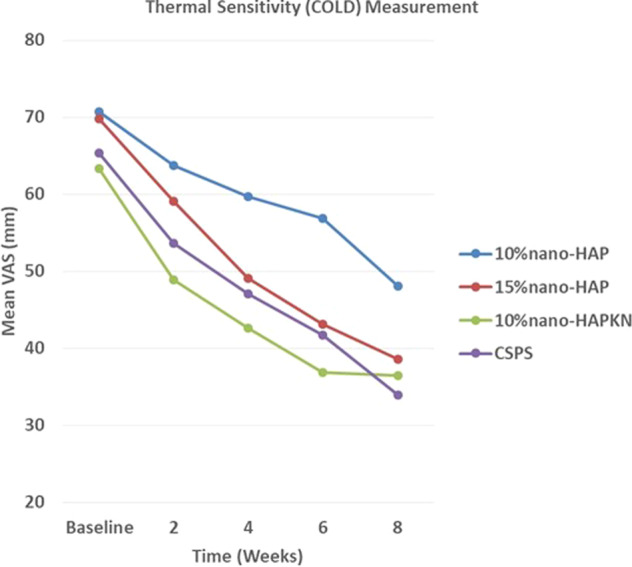
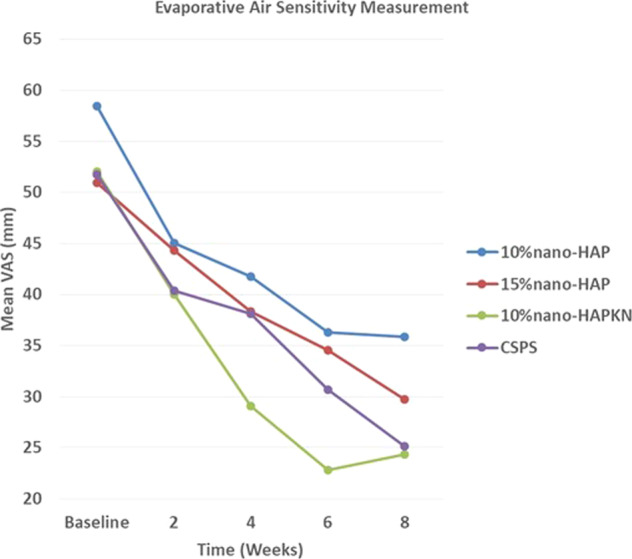
Objective: The objective of this study was to investigate and compare the effectiveness of several toothpastes containing nanohydroxyapatite (nano-HAP) to relieve dentin hypersensitivity (DHS) with that of a commercial desensitizing dentifrice containing calcium sodium phosphosilicate (CSPS). Materials and methods: In this double-blind, randomized, parallel-group clinical trial, patients diagnosed with DHS and qualified to participate were randomized into four groups: toothpaste containing 10% nano-HAP (10%nano-HAP), 15% nano-HAP (15%nano-HAP), 10% nano-HAP supplemented with potassium nitrate (KNO 3 ) (10%nano-HAPKN), or CSPS. Subjects’ baseline and post-treatment sensitivities were assessed using visual analog scale (VAS) after the application of ice-cold and air stimuli. Subjects used their assigned toothpaste for routine toothbrushing twice daily. Post-treatment sensitivity was assessed every 2 or 8 weeks. Mean change in VAS (mm) from baseline at each time point were compared using random-intercept, mixed-model analysis and Duncan test ( P < 0.05). Results: With either air or cold stimulus, VAS indicated a significant ( P < 0.001) reduction from baseline DHS at each time point with all test toothpastes. Among the nano-HAP toothpastes, 15%nano-HAP and 10%nano-HAPKN were consistent in DHS reduction with both stimuli. With either stimuli, the CSPS did not significantly differ from 15%nano-HAP and 10%nano-HAPKN at any time point. Conclusions: Toothpaste containing nano-HAP (10 or 15%) alone or supplemented with KNO 3 was as effective as CSPS for relief of DHS symptoms when used at least twice daily.
Overview
The claims and statistics of this paper haven’t been checked yet.
Free: it reads the open-access text and checks the first 5 claims that cite a source we can check. Create a free account to check every claim.
Integrity signals
Registry
Cites
Statistics
Figures
Verification
Claims the paper makes
The claims and statistics of this paper haven’t been checked yet.
Free: it reads the open-access text and checks the first 5 claims that cite a source we can check. Create a free account to check every claim.
Claims other papers make about this one
Each is checked against this paper’s own text: does it say what the citing paper says it does?
The cited source says what the claim attributes to it.
In the citing paper
“Some studies have shown an increased effectiveness in dentin sensitivity with the increasing HAP content [65] and, in this review, we note that 0.25% was not very effective in tooth whitening, whereas there was a dose-response of whitening when 3% HAP was compared to 15% HAP [49].”
From Tooth Whitening with Hydroxyapatite: A Systematic Review (2023) · cites this paper as [65]
The check wasn’t confident either way, so it gives no verdict — never disputed.
In the citing paper
“Therefore, a dose-response-relationship between HAP-concentration and both whitening effect and adhesion to the enamel is likely, as shown in these studies [49,64,65].”
From Tooth Whitening with Hydroxyapatite: A Systematic Review (2023) · cites this paper as [65]
Experimental — accuracy not yet measured
Self-check
Percentages, sums and reported differences re-computed from the paper’s own numbers.
The self-check needs the paper’s full text.
Citations
Cites
Consensus-based recommendations for the diagnosis and management of dentin hypersensitivity.
(2003) · PubMed · Cited by 577
Enamel and dentine remineralization by nano-hydroxyapatite toothpastes
Tschoppe, P., Zandim, D. L., Martus, P., & Kielbassa, A. M. (2011) · Journal of Dentistry · doi:10.1016/j.jdent.2011.03.008 · Cited by 446
Diagnosis and treatment of dentinal hypersensitivity
Porto, I. C. C. M., Andrade, A. K. M., & Montes, M. A. J. R. (2009) · Journal of Oral Science · doi:10.2334/josnusd.51.323 · Cited by 281
A cross‐sectional study of dentine hypersensitivity
Rees, J. S., & Addy, M. (2002) · Journal of Clinical Periodontology · doi:10.1034/j.1600-051x.2002.291104.x · Cited by 267 · cited 2×
“This is because the randomization of the subjects was based on their age to ensure there is no significant difference in age between the groups due to the reported variation in DHS prevalence between age groups.(5) However, we must admit that stratification based on the baseline DHS values is more important than the a…”
BackgroundCalcium Sodium Phosphosilicate (NovaMin®): Remineralization Potential
Burwell, A. K., Litkowski, L. J., & Greenspan, D. C. (2009) · Advances in Dental Research · doi:10.1177/0895937409335621 · Cited by 209
Chabanski, M. B., Gillam, D. G., Bulman, J. S., & Newman, H. N. (1996) · Journal of Clinical Periodontology · doi:10.1111/j.1600-051x.1996.tb00525.x · Cited by 172 · cited 1×
“The prevalence of DHS in patients referred for specialist periodontal care is higher than that in the general patient population.(7) The most commonly affected teeth are the maxillary and mandibular canines and premolars, with the cervical area of the buccal surface being the most affected tooth region.”
BackgroundAmaechi, B. T., AbdulAzees, P. A., Alshareif, D. O., Shehata, M. A., Lima, P. P. D. C. S., Abdollahi, A., Kalkhorani, P. S., & Evans, V. (2019) · BDJ Open · doi:10.1038/s41405-019-0026-8 · Cited by 169
Self-citationPrevalence of dentine hypersensitivity in a general dental population.
Irwin, C. R., & McCusker, P. (1997) · PubMed · Cited by 163
Remineralization of early caries by a nano-hydroxyapatite dentifrice.
Najibfard, K., Ramalingam, K., Chedjieu, I. P., & Amaechi, B. T. (2011) · PubMed · Cited by 152
Self-citationMarto, C. M., Paula, A. B., Nunes, T., Pimenta, M. C., Abrantes, A. M., Pires, A. S., Laranjo, M., Coelho, A. S. E. D. C., Donato, H., Botelho, M. F., et al. (2019) · Journal of Oral Rehabilitation · doi:10.1111/joor.12842 · Cited by 148
Research works printed but not linked: 1
- Kawamata H Ohta K Saito T Hayman R Investigation of dentinal surface coating by nano-hydroxyapatite J. Dent. Res. 2010 89 2988
Cited by
Nanohydroxyapatite in dentistry: A comprehensive review
Pushpalatha, C., Gayathri, V. S., Sowmya, S. V., Augustine, D., Alamoudi, A. A., Zidane, B., Albar, N. H. M., & Bhandi, S. (2023) · The Saudi Dental Journal · doi:10.1016/j.sdentj.2023.05.018 · Cited by 135
Nano-Hydroxyapatite (nHAp) in the Remineralization of Early Dental Caries: A Scoping Review
Anil, A., Ibraheem, W., Meshni, A. A., Preethanath, R. S., & Anil, S. (2022) · International Journal of Environmental Research and Public Health · doi:10.3390/ijerph19095629 · Cited by 119
“The most frequently utilized concentration in the RCTs was 10% nHAp [16,17,57,60,61].”
BackgroundMethodInfluentialAdvancements in nanohydroxyapatite: synthesis, biomedical applications and composite developments
Zhao, R., Meng, X., Pan, Z., Li, Y., Qian, H., Zhu, X., Yang, X., & Zhang, X. (2024) · Regenerative Biomaterials · doi:10.1093/rb/rbae129 · Cited by 67
Nanotechnology in toothpaste: Fundamentals, trends, and safety
Abedi, M., Ghasemi, Y., & Nemati, M. M. (2024) · Heliyon · doi:10.1016/j.heliyon.2024.e24949 · Cited by 52
Limeback, H., Enax, J., & Meyer, F. (2023) · Biomimetics · doi:10.3390/biomimetics8040331 · Cited by 45
“Amaechi [72] 2021 10% and 15% nHAP toothpaste 10% HAP + 5% KNO3 Na-MFP (1400 ppm F-) + CPSC 104 adults -8 weeks 10% HAP ± KNO3 reduced DH and 15% HAP worked better than 10% HAP yes”
MethodAmaechi, B. T., Farah, R., Liu, J. A., Phillips, T. S., Perozo, B. I., Kataoka, Y., Meyer, F., & Enax, J. (2022) · BDJ Open · doi:10.1038/s41405-022-00126-4 · Cited by 42
“Besides caries prevention [22, 23, 30, 33] and remineralization, HAP offers further benefits like reducing dentin hypersensitivity [34, 35], biofilm management [36, 37], erosion protection [38, 39], and whitening [40, 41].”
BackgroundSelf-citationLimeback, H., Enax, J., & Meyer, F. (2023) · Biomimetics · doi:10.3390/biomimetics8010023 · Cited by 33
Evaluation of Bioactive Glass Treatment for Dentin Hypersensitivity: A Systematic Review
Petrović, D., Galić, D., Seifert, D., Lešić, N., & Smolić, M. (2023) · Biomedicines · doi:10.3390/biomedicines11071992 · Cited by 36
“The VAS was used after evaporative [27,30,32,33], thermal [27–30], and tactile stimulation [28,30,32] or to assess subjective sensitivity [29], whereas the Schiff scale was only used in one study to assess pain after thermal stimulation [28].”
InfluentialTooth Whitening with Hydroxyapatite: A Systematic Review
Limeback, H., Meyer, F., & Enax, J. (2023) · Dentistry Journal · doi:10.3390/dj11020050 · Cited by 26
“Therefore, a dose-response-relationship between HAP-concentration and both whitening effect and adhesion to the enamel is likely, as shown in these studies [49,64,65].”
BackgroundResultPolyakova, M., Sokhova, I., Doroshina, V., Arakelyan, M., Novozhilova, N., & Babina, K. (2022) · Journal of International Society of Preventive and Community Dentistry · doi:10.4103/jispcd.jispcd_333_21 · Cited by 27
“The desensitizing effect of HAP and nHAP-containing agents has been reported in a number of clinical studies.[14,15,18,20-22] A recent systematic review by de Melo”
BackgroundMaillard, M., Bandiaky, O. N., Maunoury, S., Alliot, C., Alliot‐Licht, B., Serisier, S., & Renard, E. (2023) · Bioengineering · doi:10.3390/bioengineering10040447 · Cited by 21
“orange indicates uncertain or moderate risk of bias [32,34,36,44,49], and red indicates high risk of”
BackgroundInfluentialRecent advances in the study of therapeutic materials and techniques for dentin hypersensitivity
Dai, T., Xie, X., Cao, M., Li, D., Cai, X., & Chen, J. (2025) · Journal of Dentistry · doi:10.1016/j.jdent.2025.105719 · Cited by 19
An Overview of Nanotechnology in Dental Medicine
Nicolae, C.-L., Pîrvulescu, D.-C., Niculescu, A.-G., Rădulescu, M., Grumezescu, A. M., & Croitoru, G.-A. (2024) · Journal of Composites Science · doi:10.3390/jcs8090352 · Cited by 19
Nanomaterial-Enhanced Dentistry: A Clinical Perspective
Manoj, S., Sreena, R., Divya, R., Ebinesh, S., Akshaya, S., Angel, S. S., & Nathanael, A. J. (2025) · ACS Biomaterials Science & Engineering · doi:10.1021/acsbiomaterials.5c00350 · Cited by 7
Hegde, M. N., Kumari, S., Shetty, N., Lakshmi, V. C., Hegde, N., Hegde, N. N., Singh, J., Sirdesai, A., & Bandyopadhyay, P. (2023) · PubMed Central · doi:10.4103/jcd.jcd_542_22 · Cited by 7
“[12]”
Dentin hypersensitivity, an enigma revisited: Mechanisms, diagnosis and therapeutic advances
Kaur, A., Lau, H., Rohilla, S., & Pancharia, A. (2026) · Journal of Conservative Dentistry and Endodontics · doi:10.4103/jcde.jcde_41_26 · Cited by 6
“[35,36] These materials have shown encouraging results in reducing sensitivity when used in dentifrices or professional applications.”
Nano hydroxyapatite toothpaste as a treatment for dentine hypersensitivity: A systematic review
Oubenyahya, H. (2021) · Saudi Journal of Oral Sciences · doi:10.4103/sjoralsci.sjoralsci_27_21 · Cited by 8
Reis, A. L. M., dos Reis, M. D. C., Mazzola, T., Pegoraro, J. V. D. C., de Lima, D. C., & Fernandes, L. A. (2023) · International Journal of Case Reports and Images · doi:10.5348/101386z01ar2023cr · Cited by 5
Ribeiro, R. N., Silva, R. M. F. D. C. E., Filho, R. L. D. F., Ferreira, L. D. A. Q., de Carvalho, P. D. S., de Oliveira, L. F. C., Diniz, I. M. A., Vasconcellos, W. A., Domingues, R. Z., & Andrade, Â. L. (2025) · ACS Omega · doi:10.1021/acsomega.5c08486 · Cited by 4
Creeth, J. E., Goyal, C. R., Qiu, J., Lamptey, M., Sanchez, E., Qaqish, J., & Pereira, P. G. (2026) · Journal of Dentistry · doi:10.1016/j.jdent.2026.106710 · Cited by 2
Rhamdiyah, F. K., Cahyaningrum, S. E., & Agustini, R. (2024) · Tropical Journal of Natural Product Research · doi:10.26538/tjnpr/v8i8.6 · Cited by 2
Mohammad, M., & Jehad, R. H. (2025) · Journal of Oral Biology and Craniofacial Research · doi:10.1016/j.jobcr.2025.06.018 · Cited by 1
“35 In contrast to study reporting strong remineralizing effects of nano-hydroxyapatite, Najibfard et al. conducted an in vitro study comparing toothpaste formulations containing 5 % and 10 % n-HAP.”
Freitas, C. M. T., Patil, S. V., & Eisenhuth, G. (2025) · World Journal of Dentistry · doi:10.5005/jp-journals-10015-2669 · Cited by 2
Yan, K., Si, W., Guo, J., Liu, J., Zheng, Y., Hou, X., & Fan, S. (2025) · European journal of medical research · doi:10.1186/s40001-025-03249-0 · Cited by 1
Advanced Nonrestorative Treatment Modalities to Alleviate Dentin Hypersensitivity: An Update
Vinothkumar, T. S. (2025) · World Journal of Dentistry · doi:10.5005/jp-journals-10015-2601 · Cited by 1
BDJ Open 2021 - our most successful year to date
Lewney, J. (2022) · BDJ · doi:10.1038/s41415-022-4197-7 · Cited by 1
Corridore, D., Vozza, I., Carlo, G. D., Guerra, F., Santucci, F., Mercuri, P., & Saccucci, M. (2024) · Minerva Dental and Oral Science · doi:10.23736/s2724-6329.24.05073-3 · Cited by 1
Dwivedi, P., Thorat, V., Rathod, V., Joshi, N., Halan, V., & Srivastava, M. (2022) · International Journal of Health Sciences · doi:10.53730/ijhs.v6ns4.11406
Singh, J., Sirdesai, A., & Bandyopadhyay, P. (2023) · International Journal of Herbal Medicine · doi:10.22271/flora.2023.v11.i4a.871
Review of Selected Over-the-Counter Toothpastes in the Management of Dentine Hypersensitivity
Sadia, H., & Gillam, D. G. (2024) · doi:10.31038/jdmr.2024713
Die Behandlung der Dentinhypersensibilität in der Praxis – ein Update
Nguyen, A. D., Witting, C., Pütz, N., & Gernhardt, C. R. (2024) · wissen kompakt · doi:10.1007/s11838-024-00192-4
Soleimanyfar, M. F., & Tabatabaei, S. H. (2024) · Journal of International Society of Preventive and Community Dentistry · doi:10.4103/jispcd.jispcd_80_24
Future Strategies for the Development of Desensitizing Products
Hill, R. G., & Gillam, D. G. (2024) · Springer eBooks · doi:10.1007/978-3-031-74321-4_9
Effect of desensitizing and anti-erosive toothpastes on dentin chemical composition and morphology
Castelo, R., Dotta, T. C., Arnez, M. M., de Almeida, L., Tirapelli, C., Ramos, A. P., & Catirse, A. B. C. E. B. (2025) · Precision Nanomedicine · doi:10.33218/001c.142126
Bhavsar, S. S., Gulve, M., Kolhe, S. J., Patel, S. P., & Pawar, P. A. (2025) · International Dental Journal of Student Research · doi:10.18231/j.idjsr.12727.1758800964
Calcium phosphate nanoparticles in dentistry
Yari, D., Moaddabi, A., Yazdian‐Robati, R., & Salmasi, Z. (2025) · Elsevier eBooks · doi:10.1016/b978-0-443-31392-9.00012-1
Scribante, A., Pellegrini, M., Chiesa, A., Crea, S., & Butera, A. (2025) · Oral · doi:10.3390/oral5040100
“These findings align with RCTs documenting clinically significant decreases in hypersensitivity with nano-HAp dentifrices compared to fluoride or calcium sodium phosphosilicate [38,59].”
Bhasin, M., Jain, J., & Subramaniam, K. (2025) · Clinical Dentistry · doi:10.33882/clinicaldent.15.40045
Ostrovskaya, I., Vavilova, T. D., Алекберова, Г. И., Minaev, A. V., Фасимовна, Я. Г., & Rubtsova, O. G. (2026) · Problems of Biological Medical and Pharmaceutical Chemistry · doi:10.29296/25877313-2026-02-05
Suma, S., Jerusha, T., P, G. M., Chandrashekar, B. R., & Pradeep, S. (2026) · Journal of the California Dental Association · doi:10.1080/19424396.2026.2617001
Managing first permanent molars in children with molar–incisor hypomineralization
Monteiro, J., Gilchrist, F., & RODD, H. D. (2026) · Dental Update · doi:10.12968/denu.2026.53.2.121
Basapogu, S., Revankar, V. U., Rani, A. V., Pucha, A. R., Karnam, S., & Basimi, S. (2026) · International Journal of Prosthodontics and Restorative Dentistry · doi:10.5005/jp-journals-10019-1530
Gummadi, T., Dhulipalla, R., Katuri, K. K., Boyapati, R., Gaddam, L., & Bhimavarapu, S. (2026) · Selcuk Dental Journal · doi:10.15311/selcukdentj.1742829
Er:YAG laser in oral medicine: mechanisms, efficacy, and future perspectives
Li, S., An, J., Li, Y., & Zhang, C. L. (2026) · Oral Science and Homeostatic Medicine · doi:10.26599/oshm.2026.9610053
Comparative Efficacy of Two Occluding Toothpastes: An 8 Weeks Randomised Control Trial
Mason, S., Hall, C., Zang, P., & Parkinson, C. R. (2026) · International Journal of Dental Hygiene · doi:10.1111/idh.70098
Ishii, K., Suzuki, T., Akabane, C., Iiizumi, G., Suzuki, N., Fukuda, Y., Suzuki, K., Kawaguchi, N., Zhu, R., Li, D., et al. (2026) · BDJ Open · doi:10.1038/s41405-026-00452-x
Kamath, G., Varun, K., Rai, N., Nayak, R., Pentapati, K. C., & Saraswathi, V. (2026) · BMC Oral Health · doi:10.1186/s12903-026-09036-5
“Nano-HAp-based dentifrices have played a significant role in the reduction of DH by occlusion of microscopic dentinal tubules [12].”
Saxena, V., Shoukath, S., Saxena, P., Jatol-Tekade, S., Kumari, S. M., Bachani, K., & Kamthan, S. (2026) · Journal of Oral Biology and Craniofacial Research · doi:10.1016/j.jobcr.2026.101500
Pollard, A. J., Pollard, T., Glenny, A., Clarkson, J., Walsh, T., Davies, M., Sounack, T., Wright, M., Seong, J., Twigg, J., et al. (2026) · Periodontology 2000 · doi:10.1111/prd.70079 · Cited by 1
Naeem, S. (2026) · Research Square · doi:10.21203/rs.3.rs-11046882/v1
Nanocomposite in Paediatric Dentistry – A Systematic Review
Rasveya, S., & Kumar, D. (2024) · Journal of Neonatal Surgery
Саркисян, Н. Г., Гайсина, Е. Ф., & Игоревна, А. П. (2022) · Evrazijskij žurnal zdravoohraneniâ.
Mohammed, Z., & Aldulaimy, D. A. (2025) · Mustansiria Dental Journal · doi:10.32828/mdj.v21i2.1159
More, P., Agarwala, B., Kataki, R., Deka, A., Borah, D., & Roy, D. (2026) · International Journal of Drug Delivery Technology · doi:10.25258/ijddt.16.86s.144
Metadata
- Authors
- Amaechi, B. T., Lemke, K. C., Saha, S., Luong, M. N., & Gelfond, J.
- Affiliations
- The University of Texas at San Antonio Health Science Center (US)
- Corresponding author
- Amaechi, Bennett Tochukwu
- Venue
- BDJ Open
- Published
- 2021-06-25
- Volume
- 7
- Issue
- 1
- Pages
- 23-23
- ISSN
- 2056-807X (ISSN-L)
- PMC
- PMC8233401
- OpenAlex
- W3173639011
- Semantic Scholar
- 24f922c48fc7a815c2a6036f0dd8e6f65befd3d4
- Cited by
- 48
- References
- 57
- Citations by year
- 2026: 13 · 2025: 10 · 2024: 10 · 2023: 9 · 2022: 5 · 2021: 1
- FWCI
- 6.52
- Type
- journal article
- Language
- en
- Open access
- gold
- doi.org
- Licence
- cc-by
- creativecommons.org/licenses/by/4.0 (tdm)
- creativecommons.org/licenses/by/4.0 (vor)
- Locations
- BDJ Open (publishedVersion, cc-by)
- PubMed Central (publishedVersion, cc-by)
- PubMed (publishedVersion)
- DOAJ (DOAJ: Directory of Open Access Journals) (submittedVersion, cc-by-sa)
- Funders
- Sangi Co., Ltd., Japan.
- Sangi Co., Ltd, Japan
- Topics
- Health Sciences › Dentistry › General Dentistry › Dental Erosion and Treatment
- Health Sciences › Dentistry › General Dentistry › Dental Health and Care Utilization
- Health Sciences › Dentistry › Oral Surgery › Endodontics and Root Canal Treatments
- Keywords
- dentin hypersensitivity, hydroxyapatite nanoparticles, toothpaste, desensitizing dentifrices, calcium sodium phosphosilicate, potassium nitrate, toothbrushing
About these checks
Registry, retraction, Cites and statistics results are computed, not judged, with one exception: a printed reference that no index lists is read once by a model before it counts as a citation error. Claims are extracted by a model and kept only when their quote appears verbatim in the text; each cited source is then checked, with a model’s help, for whether it says what the claim relies on. Those verdicts can be wrong — read the claim’s quote and the cited source before relying on one.
Statistics and arithmetic are recomputed, not judged.
Confidence bands are shown only for fields calibrated on our annotated test set. None is calibrated yet, so no band is shown.
What counts as a claim ›How we measure confidence ›How we check this ›
Are you an author, or do you see a problem with this page? Request a review
Data sources
Bibliographic data: Semantic Scholar, OpenAlex, Crossref.
Contains information from the Semantic Scholar Academic Graph Datasets, made available under the ODC Attribution License (ODC-BY 1.0).
Semantic Scholar’s data is described in: Kinney, R., et al. (2023). The Semantic Scholar Open Data Platform. arXiv:2301.10140.
