

Long-term efficacy and safety of dasatinib in patients with chronic myeloid leukemia in accelerated phase who are resistant to or intolerant of imatinib
Open accessThe DOI matches its Crossref record; 8 of the 8 references it cites were found in a registry or an index.
Abstract
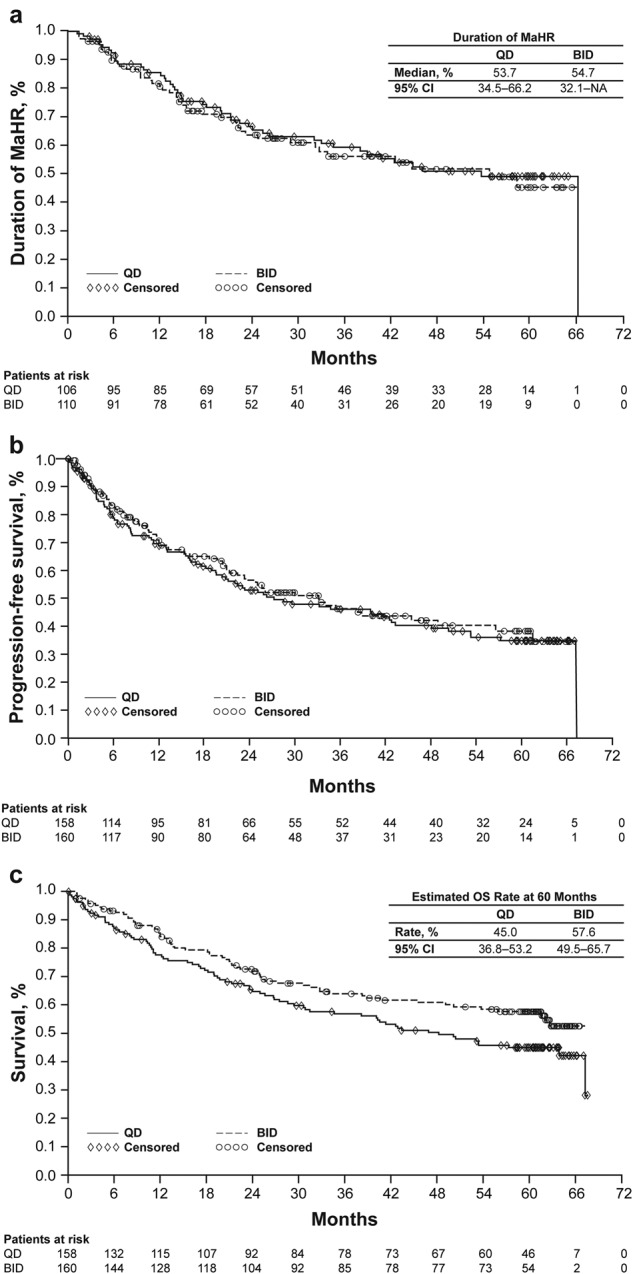
Treatment with a frontline BCR-ABL1 tyrosine kinase inhibitor (TKI; e.g., imatinib, dasatinib, and nilotinib) allows patients with chronic myeloid leukemia (CML) in chronic phase (CP) to achieve a near normal life expectancy 1 , whereas treatment for CML in accelerated phase (AP) is more problematic. While reports describe outcomes for patients with CML-AP at initial diagnosis 2 , 3 , outcomes have been historically worse once CP disease has progressed to AP. Approximately 50% of patients with CML-AP who receive imatinib as initial treatment develop imatinib resistance 4 and experience disease progression 5 . Second-generation TKIs are indicated for patients with CML-CP or advanced CML resistant to/intolerant of prior therapy (including imatinib) 6 . After initial approval of dasatinib twice a day (BID) for the treatment of patients with CML resistant to/intolerant of imatinib in all stages, this phase 3 CA180-035 study (NCT00123487) was developed to investigate once (QD) or twice (BID) a day dasatinib treatment in patients with CML-AP, CML in blast phase, or Ph+ acute lymphoblastic leukemia resistant to/intolerant of imatinib.
Overview
The claims and statistics of this paper haven’t been checked yet.
Free: it reads the open-access text and checks the first 5 claims that cite a source we can check. Create a free account to check every claim.
Integrity signals
Registry
Cites
Statistics
Figures
Verification
Claims the paper makes
The claims and statistics of this paper haven’t been checked yet.
Free: it reads the open-access text and checks the first 5 claims that cite a source we can check. Create a free account to check every claim.
Claims other papers make about this one
Each is checked against this paper’s own text: does it say what the citing paper says it does?
The source backs part of the claim, not all of it — or backs it for a different population, condition or comparison.
In the citing paper
“This intermittent ‘hit-and-run’ strategy of senolytic administration could serve to reduce side effects of agents such as D, which generally appear after weeks to months of continuous administration118,119.”
From Cellular senescence and senolytics: the path to the clinic (2022) · cites this paper as [119]
Experimental — accuracy not yet measured
Self-check
Percentages, sums and reported differences re-computed from the paper’s own numbers.
The self-check needs the paper’s full text.
Citations
Cites
Sasaki, K., Strom, S. S., O'Brien, S., Jabbour, E., Ravandi, F., Konopleva, M., Borthakur, G., Pemmaraju, N., Daver, N., Jain, P., et al. (2015) · The Lancet Haematology · doi:10.1016/s2352-3026(15)00048-4 · Cited by 318
Self-citationShah, N. P., Rousselot, P., Schiffer, C., Rea, D., Cortes, J. E., Milone, J., Mohamed, H., Healey, D., Kantarjian, H., Hochhaus, A., et al. (2016) · American Journal of Hematology · doi:10.1002/ajh.24423 · Cited by 181
Self-citationKantarjian, H., Cortes, J., Kim, D.-W., Dorlhiac-Llacer, P., Pasquini, R., DiPersio, J., Müller, M. C., Radich, J. P., Khoury, H. J., Khoroshko, N., et al. (2009) · Blood · doi:10.1182/blood-2008-11-186817 · Cited by 172
Self-citationOhanian, M., Kantarjian, H. M., Quintas-Cardama, A., Jabbour, E., Abruzzo, L., Verstovsek, S., Borthakur, G., Ravandi, F., Garcia-Manero, G., Champlin, R., et al. (2014) · Clinical Lymphoma Myeloma and Leukemia · doi:10.1016/j.clml.2013.08.008 · Cited by 56
Self-citationRéa, D., Étienne, G., Nicolini, F. E., Cony‐Makhoul, P., Johnson‐Ansah, H., Legros, L., Huguet, F., Tulliez, M., Gardembas, M., Bouabdallah, K. K., et al. (2012) · Leukemia · doi:10.1038/leu.2012.92 · Cited by 44
Pasqüini, R., Ottmann, O. G., Goh, Y. T., Kim, D., Llacer, P. E. D., DiPersio, J. F., Khoury, H. J., Tornout, J. M. V., Damokosh, A. I., & Kantarjian, H. M. (2007) · Journal of Clinical Oncology · doi:10.1200/jco.2007.25.18_suppl.7025 · Cited by 12
Self-citationCytogenetic Clonal Evolution in Patients with Chronic Myeloid Leukemia
Argüden, Y. T., Ar, M. C., Yılmaz, Ş., Öngören, Ş., Kuru, D., Üre, Ü., Çırakoğlu, A., Eşkazan, A. E., Güven, G. S., Çetin, G., et al. (2009) · Biotechnology & Biotechnological Equipment · doi:10.2478/v10133-009-0022-6 · Cited by 4
Major progress in understanding progression in chronic myeloid leukemia
Radich, J. P. (2015) · The Journal of Experimental Medicine · doi:10.1084/jem.21210insight1 · Cited by 2
Cited by
Cellular senescence and senolytics: the path to the clinic
Chaib, S., Tchkonia, T., & Kirkland, J. L. (2022) · Nature Medicine · doi:10.1038/s41591-022-01923-y · Cited by 1,134
Cortes, J., Pavlovsky, C., & Saußele, S. (2021) · The Lancet · doi:10.1016/s0140-6736(21)01204-6 · Cited by 184
Self-citationPathogenesis and management of accelerated and blast phases of chronic myeloid leukemia
Senapati, J., Jabbour, E. J., Kantarjian, H. M., & Short, N. J. (2022) · Leukemia · doi:10.1038/s41375-022-01736-5 · Cited by 106
“Together, these data provide some evidence that secondgeneration TKIs may be preferable in patients with de novo CMLAP.”
BackgroundResultInfluentialSelf-citationManagement of Chronic Myeloid Leukemia in Advanced Phase
Bonifacio, M., Stagno, F., Scaffidi, L., Krampera, M., & Raimondo, F. D. (2019) · Frontiers in Oncology · doi:10.3389/fonc.2019.01132 · Cited by 82
“Although numerically higher, the different OS rate does not suggest a higher efficacy of the twice daily regimen, but it is likely to be related to the subsequent therapies, since only 40 patients (13% of the original cohort) continued to receive their assigned treatment beyond 5 years (86).”
BackgroundZhang, X., Yang, Y., Yang, Y., Chen, H., Tu, H., & Li, J. (2020) · Stem Cells International · doi:10.1155/2020/8890201 · Cited by 65
2-aminothiazoles in drug discovery: Privileged structures or toxicophores?
Jakopin, Ž. (2020) · Chemico-Biological Interactions · doi:10.1016/j.cbi.2020.109244 · Cited by 50
Chemically inducible split protein regulators for mammalian cells
Rihtar, E., Lebar, T., Lainšček, D., Kores, K., Lešnik, S., Bren, U., & Jerala, R. (2022) · Nature Chemical Biology · doi:10.1038/s41589-022-01136-x · Cited by 42
Vedova, L. D., Baron, G., Morazzoni, P., Aldini, G., & Gado, F. (2025) · Pharmaceuticals · doi:10.3390/ph18020138 · Cited by 43
Hassan, N. M. E., Shehatou, G. S. G., Kenawy, H. I., & Said, E. (2021) · Environmental Toxicology and Pharmacology · doi:10.1016/j.etap.2021.103625 · Cited by 19
Massimino, M., Tirrò, E., Stella, S., Manzella, L., Pennisi, M. S., Romano, C., Vitale, S. R., Puma, A., Tomarchio, C., Gregorio, S. D., et al. (2021) · Frontiers in Pharmacology · doi:10.3389/fphar.2021.669469 · Cited by 16
“The introduction of ABL1-directed TKIs has dramatically improved the hematological, cytogenetic andmolecular responses of leukemia patients displaying a BCR-ABL1 chimeric fusion (Hochhaus et al., 2017; Ottmann et al., 2018; Saglio et al., 2018).”
BackgroundKantarjian, H. M., & Tefferi, A. (2023) · American Journal of Hematology · doi:10.1002/ajh.27007 · Cited by 19
Self-citationMin, H. K., Kim, S. H., Won, J., Kim, K., Lee, J., Lee, S., & Kim, H. (2023) · International Journal of Rheumatic Diseases · doi:10.1111/1756-185x.14627 · Cited by 15
Translating cellular senescence research into clinical practice for metabolic disease
Chaib, S., Palmer, A. K., Wyles, S. P., Musi, N., Kirkland, J. L., & Tchkonia, T. (2025) · Nature Reviews Endocrinology · doi:10.1038/s41574-025-01187-9 · Cited by 19
“Senolytics are typically administered intermittently, which also limits their potential adverse effects compared with drugs that require continuous administration 127–129 .”
Antineoplastic kinase inhibitors: A new class of potent anti-amoebic compounds
Sauvey, C., Ehrenkaufer, G. M., Shi, D., Debnath, A., & Abagyan, R. A. (2021) · PLoS neglected tropical diseases · doi:10.1371/journal.pntd.0008425 · Cited by 14
Huang, J., Zhou, J.-H., Dai, Y., Liu, Y., Li, F., Gong, S., Zhang, Y., & Kou, J. (2023) · Journal of Natural Medicines · doi:10.1007/s11418-023-01715-9 · Cited by 13
“It is used clinically to treat chronic myeloid leukemia and acute lymphoblastic leukemia [4], as well as leukemia patients resistant to Imatinib, dasatinib inhibits wild-type BCR-ABL much stronger than the first-line treatment drug Imatinib at 325 times [5, 6].”
BackgroundYQFM Alleviates Side Effects Caused by Dasatinib through the ROCK/MLC Pathway in Mice
Liu, Y., Dai, Y., Xu, H., Zhou, Q., Li, F., Yu, B., Zhang, Y., & Kou, J. (2020) · Evidence-based Complementary and Alternative Medicine · doi:10.1155/2020/4646029 · Cited by 13
“However, Dasatinib has serious side effects [1, 2].”
Iurlo, A., Cattaneo, D., Bucelli, C., Spallarossa, P., & Passamonti, F. (2023) · Current Treatment Options in Oncology · doi:10.1007/s11864-023-01149-1 · Cited by 12
“Similar results were also reported in phase III studies evaluating the efficacy and tolerability of DAS 140 mg/day vs. 70 mg BID in accelerated-(CML-AP) or blast phase-CML, and in Ph-positive acute lymphoblastic leukemia (ALL) [48–51].”
Yang, S.-F., Li, P. S., Fang, Z., Liang, S., Tian, H., Sun, B., Xu, K., & Zeng, C. (2022) · Beilstein Journal of Organic Chemistry · doi:10.3762/bjoc.18.130 · Cited by 8
Lai, Y., Chang, H., Chen, H., Chang, G., & Chen, J. J. W. (2020) · Research Square · doi:10.21203/rs.3.rs-131947/v1 · Cited by 11
An Update on the Management of Advanced Phase Chronic Myeloid Leukemia
Short, N. J., Senapati, J., & Jabbour, E. J. (2023) · Current Hematologic Malignancy Reports · doi:10.1007/s11899-023-00709-4 · Cited by 7
Meng, B., Qu, Y., Yang, B., Fu, C., He, Y., Li, J., Wan, R., Li, X., Xue, Z., Cao, Z., et al. (2026) · Nature Biomedical Engineering · doi:10.1038/s41551-025-01584-5 · Cited by 6
Sunildutt, N., Ahmed, F., Salih, A. R. C., Kim, H. C., & Choi, K. H. (2024) · Computers in Biology and Medicine · doi:10.1016/j.compbiomed.2024.109481 · Cited by 4
Carthikeyan, S. M., & Jayachandran, P. K. (2021) · Indian Journal of Medical and Paediatric Oncology · doi:10.1055/s-0041-1732822 · Cited by 3
Fujita, S., Sakurai, M., Kasahara, H., Kato, J., Koda, Y., Yamaguchi, K., シロシタ, コ., Okayama, M., Abe, R., Kikuchi, T., et al. (2023) · Internal Medicine · doi:10.2169/internalmedicine.2479-23 · Cited by 1
Dasatinib-Induced Bilateral Pleural Effusions
Rasul, T. F., Motoa, G., & Flowers, R. C. (2022) · Cureus · doi:10.7759/cureus.23906 · Cited by 1
“While our patient did receive diuresis with furosemide and spironolactone, it is important to note that the benefit of diuretics to manage dasatinib-induced pleural effusions is unclear [12].”
BackgroundSauvey, C., Ehrenkaufer, G. M., Shi, D., Debnath, A., & Abagyan, R. (2020) · bioRxiv (Cold Spring Harbor Laboratory) · doi:10.1101/2020.05.28.120923 · Cited by 1
Wang, B. Z. J. (2020) · DR-NTU (Nanyang Technological University) · doi:10.32657/10356/145566
MOLECULAR BIOLOGY AND DRUG THERAPIES OF CHRONIC MYELOID LEUKEMIA: A REVIEW OF RECENT LITERATURE
Shahid, S., Sabar, M. F., Iqbal, Z., Saleem, M., Khokhar, M. A., & Ashiq, S. (2023) · International Journal of Pharmacy & Integrated Health Sciences · doi:10.56536/ijpihs.v5i1.121 · Cited by 3
Kanellopoulos, A., Köster, L., de Lavallade, H., Ortí, G., Francis, S., Passweg, J. R., Apperley, J. F., Bethge, W. A., Rabitsch, W., CLAY, J. C., et al. (2026) · Bone Marrow Transplantation · doi:10.1038/s41409-026-02862-9
Self-citation
Metadata
- Authors
- Ottmann, O., Saglio, G., Apperley, J. F., Arthur, C., Bullorsky, E., Charbonnier, A., Dipersio, J. F., Kantarjian, H., Khoury, H. J., Kim, D.-W., Healey, D., Strauss, L., & Cortes, J. E.
- Affiliations
- Cardiff University (GB)
- University of Turin (IT)
- Imperial College London (GB)
- Royal North Shore Hospital (AU)
- Hospital Británico de Buenos Aires (AR)
- Institut Paoli-Calmettes (FR)
- Washington University in St. Louis (US)
- The University of Texas MD Anderson Cancer Center (US)
- Emory University (US)
- The Catholic University of Korea Seoul St. Mary's Hospital (KR)
- Bristol-Myers Squibb (United States) (US)
- Corresponding author
- Ottmann, Oliver
- ORCID
- Venue
- Blood Cancer Journal
- Published
- 2018-09-03
- Volume
- 8
- Issue
- 9
- Pages
- 88-88
- ISSN
- 2044-5385 (ISSN-L)
- PMC
- PMC6127283
- OpenAlex
- W2892098229
- Cited by
- 30
- References
- 8
- Citations by year
- 2026: 2 · 2025: 2 · 2024: 1 · 2023: 7 · 2022: 7 · 2021: 5 · 2020: 5 · 2019: 1
- FWCI
- 1.97
- Type
- journal article
- Language
- en
- Open access
- gold
- doi.org
- Licence
- cc-by
- creativecommons.org/licenses/by/4.0 (tdm)
- creativecommons.org/licenses/by/4.0 (vor)
- Locations
- Blood Cancer Journal (publishedVersion, cc-by)
- Europe PMC (PubMed Central) (publishedVersion, cc-by)
- PubMed Central (publishedVersion, cc-by)
- PubMed (publishedVersion)
- ORCA Online Research @Cardiff (Cardiff University) (acceptedVersion)
- Digital Commons@Becker (Washington University School of Medicine) (submittedVersion, cc-by)
- DOAJ (DOAJ: Directory of Open Access Journals) (submittedVersion)
- Spiral (Imperial College London) (submittedVersion, cc-by)
- Funders
- Bristol-Myers Squibb
- National Institute for Health and Care Research (NF-SI-0617-10126, NF-SI-0611-10275)
- Topics
- Health Sciences › Medicine › Hematology › Chronic Myeloid Leukemia Treatments
- Health Sciences › Medicine › Hematology › Chronic Lymphocytic Leukemia Research
- Health Sciences › Medicine › Pulmonary and Respiratory Medicine › Lung Cancer Treatments and Mutations
- Keywords
- dasatinib, chronic myeloid leukemia, accelerated phase, imatinib resistance, imatinib intolerance, BCR-ABL tyrosine kinase inhibitors, once-daily dosing, twice-daily dosing, long-term efficacy, drug safety
- MeSH terms
- Imatinib Mesylate, Dasatinib, Antineoplastic Agents, Humans, Neoplasm Staging, Leukemia, Myeloid, Accelerated Phase, Randomized Controlled Trials as Topic, Treatment Outcome, Drug Resistance, Neoplasm, Retreatment, Protein Kinase Inhibitors
About these checks
Registry, retraction, Cites and statistics results are computed, not judged, with one exception: a printed reference that no index lists is read once by a model before it counts as a citation error. Claims are extracted by a model and kept only when their quote appears verbatim in the text; each cited source is then checked, with a model’s help, for whether it says what the claim relies on. Those verdicts can be wrong — read the claim’s quote and the cited source before relying on one.
Statistics and arithmetic are recomputed, not judged.
Confidence bands are shown only for fields calibrated on our annotated test set. None is calibrated yet, so no band is shown.
What counts as a claim ›How we measure confidence ›How we check this ›
Are you an author, or do you see a problem with this page? Request a review
Data sources
Bibliographic data: Semantic Scholar, OpenAlex, Crossref.
Contains information from the Semantic Scholar Academic Graph Datasets, made available under the ODC Attribution License (ODC-BY 1.0).
Semantic Scholar’s data is described in: Kinney, R., et al. (2023). The Semantic Scholar Open Data Platform. arXiv:2301.10140.
