

The DOI matches its Crossref record; 20 of the 20 references it cites were found in a registry or an index.
Incidence and management of CAR-T neurotoxicity in patients with multiple myeloma treated with ciltacabtagene autoleucel in CARTITUDE studies
Open accessAbstract
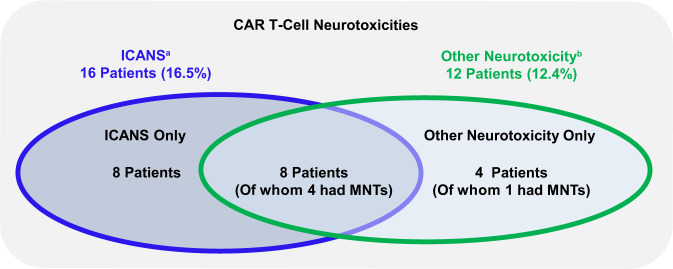
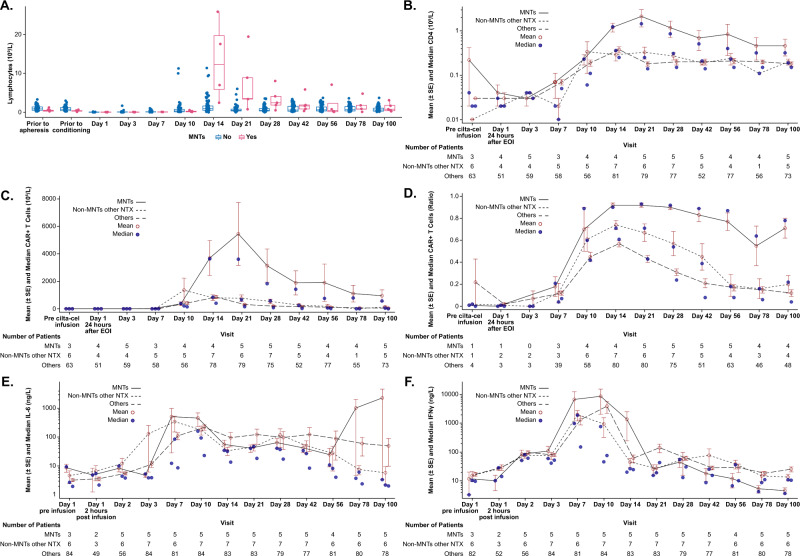
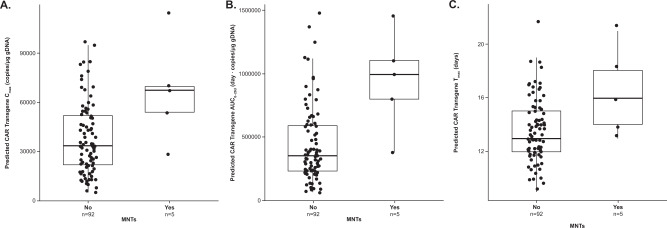
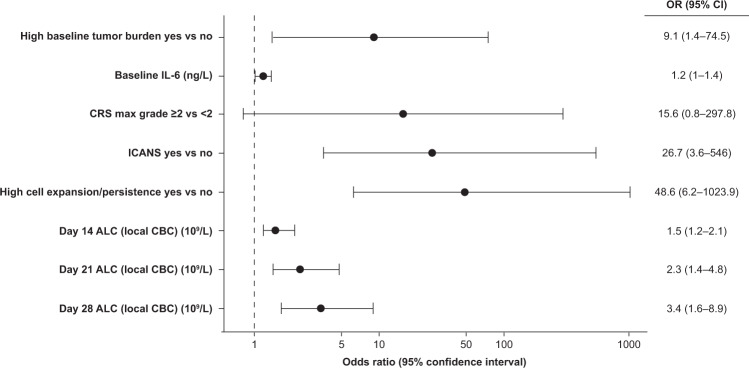
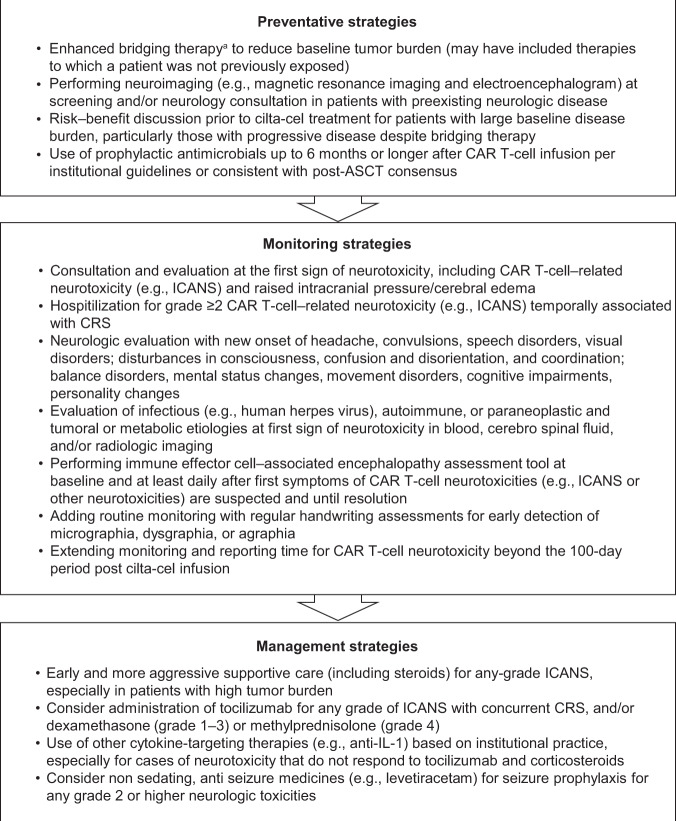
Chimeric antigen receptor (CAR) T-cell therapies are highly effective for multiple myeloma (MM) but their impressive efficacy is associated with treatment-related neurotoxicities in some patients. In CARTITUDE-1, 5% of patients with MM reported movement and neurocognitive treatment-emergent adverse events (MNTs) with ciltacabtagene autoleucel (cilta-cel), a B-cell maturation antigen-targeted CAR T-cell therapy. We assessed the associated factors for MNTs in CARTITUDE-1. Based on common features, patients who experienced MNTs were characterized by the presence of a combination of at least two variables: high tumor burden, grade ≥2 cytokine release syndrome (CRS) or any grade immune effector cell-associated neurotoxicity syndrome (ICANS) after cilta-cel infusion, and high CAR T-cell expansion/persistence. Strategies were implemented across the cilta-cel development program to monitor and manage patients with MNTs, including enhanced bridging therapy to reduce baseline tumor burden, early aggressive treatment of CRS and ICANS, handwriting assessments for early symptom detection, and extended monitoring/reporting time for neurotoxicity beyond 100 days post-infusion. After successful implementation of these strategies, the incidence of MNTs was reduced from 5% to <1% across the cilta-cel program, supporting its favorable benefit–risk profile for treatment of MM.
Overview
The claims and statistics of this paper haven’t been checked yet.
Run the check — free, no account needed. It reads the open-access text and checks the sources it cites.
Integrity signals
Registry
Cites
Statistics
Figures
Verification
Claims the paper makes
The claims and statistics of this paper haven’t been checked yet.
Run the check — free, no account needed. It reads the open-access text and checks the sources it cites.
Claims other papers make about this one
Each is checked against this paper’s own text: does it say what the citing paper says it does?
The cited source says what the claim attributes to it.
In the citing paper
“a difference that may be related to management strategies that were implemented to mitigate this risk. 28”
From Cilta-cel or Standard Care in Lenalidomide-Refractory Multiple Myeloma. (2023) · cites this paper as [28]
Self-check
Percentages, sums and reported differences re-computed from the paper’s own numbers.
The self-check needs the paper’s full text.
Citations
Cites
Axicabtagene Ciloleucel CAR T-Cell Therapy in Refractory Large B-Cell Lymphoma
Neelapu, S. S., Locke, F. L., Bartlett, N. L., Lekakis, L. J., Miklos, D. B., Jacobson, C. A., Braunschweig, I., Oluwole, O. O., Siddiqi, T., Lin, Y., et al. (2017) · New England Journal of Medicine · doi:10.1056/nejmoa1707447 · Cited by 6,030
Tisagenlecleucel in children and young adults with B-cell lymphoblastic leukemia
Maude, S. L., Laetsch, T. W., Buechner, J., Rives, S., Boyer, M., Bittencourt, H., Bader, P., Verneris, M. R., Stefanski, H. E., Myers, G. D., et al. (2018) · New England Journal of Medicine · doi:10.1056/nejmoa1709866 · Cited by 5,735
Tisagenlecleucel in Adult Relapsed or Refractory Diffuse Large B-Cell Lymphoma
Schuster, S. J., Bishop, M. R., Tam, C. S., Waller, E. K., Borchmann, P., McGuirk, J. P., Jäger, U., Jaglowski, S., Andreadis, C., Westin, J. R., et al. (2019) · New England Journal of Medicine · doi:10.1056/nejmoa1804980 · Cited by 4,112
Self-citationLee, D. W., Santomasso, B. D., Locke, F. L., Ghobadi, A., Turtle, C. J., Brudno, J. N., Maus, M. V., Park, J. H., Mead, E., Pavletic, S., et al. (2019) · Biology of Blood and Marrow Transplantation · doi:10.1016/j.bbmt.2018.12.758 · Cited by 3,675
Self-citationIdecabtagene Vicleucel in Relapsed and Refractory Multiple Myeloma.
Munshi, N. C., Anderson, L. D., Shah, N., Madduri, D., Berdeja, J., Lonial, S., Raje, N., Lin, Y., Siegel, D., Oriol, A., et al. (2021) · New England Journal of Medicine · doi:10.1056/nejmoa2024850 · Cited by 2,560
Self-citationChimeric antigen receptor T-cell therapy—assessment and management of toxicities
Neelapu, S. S., Tummala, S., Kebriaei, P., Wierda, W., Gutierrez, C., Locke, F. L., Komanduri, K. V., Lin, Y., Jain, N., Daver, N., et al. (2018) · Nature Reviews Clinical Oncology · doi:10.1038/nrclinonc.2017.148 · Cited by 2,438
KTE-X19 CAR T cell therapy in relapsed or refractory mantle-cell lymphoma
Wang, M., Munoz, J., Goy, A., Locke, F. L., Jacobson, C. A., Hill, B. T., Timmerman, J. M., Holmes, H., Jaglowski, S., Flinn, I. W., et al. (2020) · New England Journal of Medicine · doi:10.1056/nejmoa1914347 · Cited by 1,862
Berdeja, J. G., Madduri, D., Usmani, S. Z., Jakubowiak, A., Agha, M., Cohen, A. D., Stewart, A. K., Hari, P., Htut, M., Lesokhin, A., et al. (2021) · The Lancet · doi:10.1016/s0140-6736(21)00933-8 · Cited by 1,756 · cited 6×
“Detailed baseline characteristics of patients in CARTITUDE-1 have been previously published [12].”
BackgroundInfluentialSelf-citationAnti-BCMA CAR T-cell therapy bb2121 in relapsed or refractory multiple myeloma.
Raje, N., Berdeja, J., Lin, Y., Siegel, D., Jagannath, S., Madduri, D., Liedtke, M., Rosenblatt, J., Maus, M. V., Turka, A., et al. (2019) · New England Journal of Medicine · doi:10.1056/nejmoa1817226 · Cited by 1,730
Self-citationGust, J., Hay, K. A., Hanafi, L.-A., Li, D., Myerson, D., Gonzalez-Cuyar, L. F., Yeung, C., Liles, W. C., Wurfel, M., Lopez, J. A., et al. (2017) · Cancer Discovery · doi:10.1158/2159-8290.cd-17-0698 · Cited by 1,400
Cited by
Sorted by citations
Items 301–308 of 308
Su, S., Yan, S., Wu, J., & Xiao, Y. (2026) · Stem Cell Reviews and Reports · doi:10.1007/s12015-026-11228-z
Patel, C., Cheng, J. F., Zhou, J., Salomao, M. A., Patel, R., McHugh, K. E., Lewis, N., Smith, M., & Liao, X. (2026) · Human Pathology · doi:10.1016/j.humpath.2026.106267
Managing Novel CAR T-Cell Toxicities in Multiple Myeloma.
Ang, K.-K., Lipof, J. J., Kumar, A., Mikkilineni, L., Chung, A., Arora, S., Sayre, P. H., Wolf, J., Chari, A., Martin, T. G., et al. (2026) · Cancer Journal · doi:10.1097/ppo.0000000000000849
Enzephalopathische Syndrome durch Pharmaka, Toxidrome und durch Effekte von Tumortherapien
Hansen, H. C., Huehnchen, P., & Müller‐Jensen, L. (2026) · Springer eBooks · doi:10.1007/978-3-662-72532-0_26
Wang, A. Y.-D., Suen, C. G., Daghlas, I., Kumar, A., Oh, D., Pet, D. B., & Douglas, V. C. (2026) · The Neurohospitalist · doi:10.1177/19418744261496340
Toward the next generation of CAR T cell therapies for cancer
Usta, D., & Mackall, C. L. (2026) · Cancer Cell · doi:10.1016/j.ccell.2026.09.005
Alesefir, W., Hejazi, M., Alashger, B., Abodahab, A., Abdelrazek, M., Abouelnaga, K., Koudeimati, S., Alshibani, A., & Aljohani, L. (2026) · Frontiers in Neurology · doi:10.3389/fneur.2026.1903348
Advancing toxicity prediction in CAR-T cell therapy
Palasciano, A., Bonfanti, S., & Crippa, S. (2026) · Frontiers in Immunology · doi:10.3389/fimmu.2026.1934301
Metadata
- Authors
- Cohen, A. D., Parekh, S., Santomasso, B. D., Gállego Pérez-Larraya, J., van de Donk, N. W. C. J., Arnulf, B., Mateos, M.-V., Lendvai, N., Jackson, C. C., De Braganca, K. C., Schecter, J. M., Marquez, L., Lee, E., Cornax, I., Zudaire, E., Li, C., Olyslager, Y., Madduri, D., Varsos, H., Pacaud, L., Akram, M., Geng, D., Jakubowiak, A., Einsele, H., & Jagannath, S.
- Affiliations
- Abramson Cancer Center (US)
- Memorial Sloan Kettering Cancer Center (US)
- Amsterdam University Medical Centers (NL)
- Hôpital Saint-Louis (FR)
- Janssen Research & Development (United States) (US)
- Janssen (Belgium) (BE)
- Legend Biotech (United States) (US)
- University of Chicago (US)
- Universitätsklinikum Würzburg (DE)
- Corresponding author
- Jagannath, Sundar
- ORCID
- Cohen, Adam D.
- Parekh, Samir
- Santomasso, Bianca D.
- Gállego Pérez-Larraya, Jaime
- van de Donk, Niels W. C. J.
- Arnulf, Bertrand
- Mateos, Maria-Victoria
- Lendvai, Nikoletta
- Jackson, Carolyn C.
- De Braganca, Kevin C.
- Schecter, Jordan M.
- Marquez, Loreta
- Lee, Erin
- Cornax, Ingrid
- Li, Claire
- Madduri, Deepu
- Pacaud, Lida
- Akram, Muhammad
- Geng, Dong
- Jakubowiak, Andrzej
- Einsele, Hermann
- Jagannath, Sundar
- Venue
- Blood Cancer Journal
- Published
- 2022-02-24
- Volume
- 12
- Issue
- 2
- Pages
- 32-32
- ISSN
- 2044-5385 (ISSN-L)
- PMC
- PMC8873238
- OpenAlex
- W4213437837
- Cited by
- 308
- References
- 20
- Citations by year
- 2026: 81 · 2025: 85 · 2024: 70 · 2023: 51 · 2022: 21
- FWCI
- 23.75
- Type
- journal article
- Language
- en
- Open access
- gold
- doi.org
- Locations
- Blood Cancer Journal (publishedVersion, cc-by)
- PubMed Central (publishedVersion, cc-by)
- PubMed (publishedVersion)
- Amsterdam UMC (VU Amsterdam) - Institutional Repository (publishedVersion, other-oa)
- DOAJ (DOAJ: Directory of Open Access Journals) (submittedVersion, cc-by-sa)
- Data Archiving and Networked Services (DANS) (submittedVersion, other-oa)
- Funders
- This study was funded by Janssen Research & Development, LLC and and Legend Biotech, Inc.
- Topics
- Health Sciences › Medicine › Oncology › CAR-T cell therapy research
- Health Sciences › Medicine › Hematology › Multiple Myeloma Research and Treatments
- Life Sciences › Immunology and Microbiology › Immunology › Immunotherapy and Immune Responses
- Keywords
- multiple myeloma, ciltacabtagene autoleucel, cytokine release syndrome, immune effector cell-associated neurotoxicity syndrome, BCMA, CAR-T cell expansion, tumor burden, neurotoxicity management, bridging therapy, handwriting assessment, benefit-risk profile
- MeSH terms
- Receptors, Chimeric Antigen, Humans, Multiple Myeloma, Incidence, Immunotherapy, Adoptive, Neurotoxicity Syndromes
About these checks
Registry, retraction, Cites and statistics results are computed, not judged, with one exception: a printed reference that no index lists is read once by a model before it counts as a citation error. Claims are extracted by a model and kept only when their quote appears verbatim in the text; each cited source is then checked, with a model’s help, for whether it says what the claim relies on. Those verdicts can be wrong — read the claim’s quote and the cited source before relying on one.
Statistics and arithmetic are recomputed, not judged.
Confidence bands are shown only for fields calibrated on our annotated test set. None is calibrated yet, so no band is shown.
What counts as a claim ›How we measure confidence ›How we check this ›
Are you an author, or do you see a problem with this page? Request a review
