

A phase Ib dose-escalation and expansion study of the oral MEK inhibitor pimasertib and PI3K/MTOR inhibitor voxtalisib in patients with advanced solid tumours
Open accessThe DOI matches its Crossref record; 19 of the 19 references it cites were found in a registry or an index.
Abstract
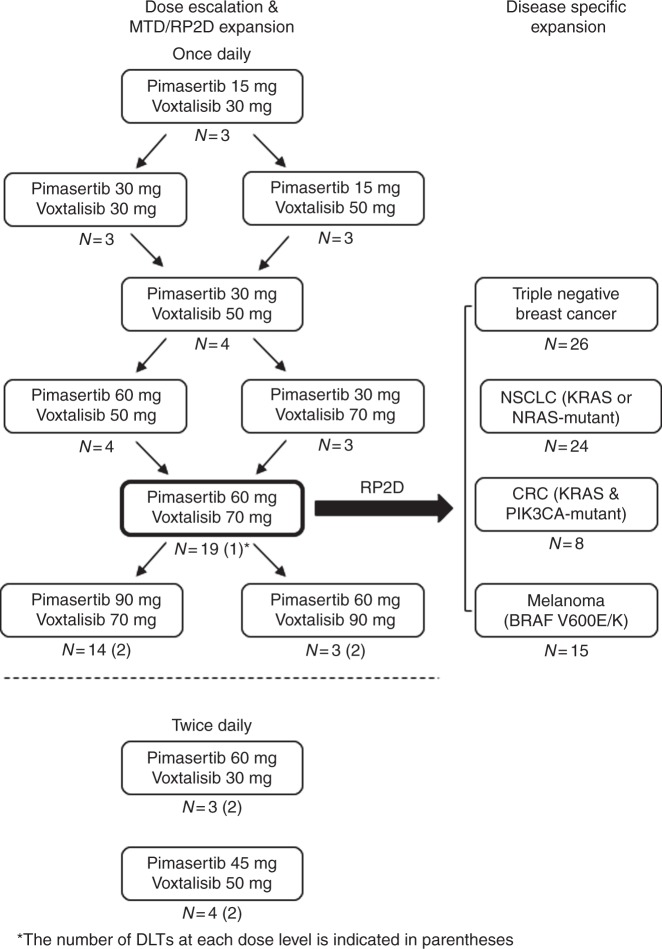
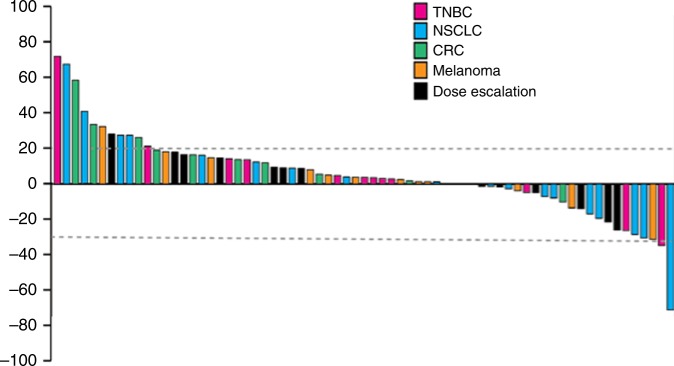
BACKGROUND: This phase Ib study evaluated the safety, maximum-tolerated dose (MTD), pharmacokinetics, pharmacodynamics, and preliminary efficacy of pimasertib (MSC1936369B), a MEK1/2 inhibitor, in combination with voxtalisib (SAR245409), a pan-PI3K and mTORC1/mTORC2 inhibitor, in patients with advanced solid tumours. METHODS: This study included a dose escalation and expansion in patients with select tumour types and alterations in the MAPK or PI3K pathways. A 3 + 3 design was used to determine MTD. Patients were evaluated for adverse events and tumour response. RESULTS: 146 patients were treated, including 63 in dose escalation and 83 in expansion. The MTD was pimasertib 90 mg and voxtalisib 70 mg daily. Based on the safety profile, the recommended phase 2 dose (RP2D) was pimasertib 60 mg and voxtalisib 70 mg. The most frequent treatment-emergent adverse events (TEAEs) were diarrhoea (75%), fatigue (57%), and nausea (50%). Responses included a complete response in one patient (1%), partial response in five (5%), and stable disease in 51 (46%). At the RP2D, 74 patients required dose interruption (73%), 20 required dose reduction (20%), and 26 discontinued treatment due to TEAEs (26%). CONCLUSIONS: The combination of pimasertib and voxtalisib showed poor long-term tolerability and limited anti-tumour activity in patients with advanced solid tumours.
Overview
The claims and statistics of this paper haven’t been checked yet.
Free: it reads the open-access text and checks the first 5 claims that cite a source we can check. Create a free account to check every claim.
Integrity signals
Registry
Cites
Statistics
Figures
Verification
Claims the paper makes
The claims and statistics of this paper haven’t been checked yet.
Free: it reads the open-access text and checks the first 5 claims that cite a source we can check. Create a free account to check every claim.
Claims other papers make about this one
Each is checked against this paper’s own text: does it say what the citing paper says it does?
The source backs part of the claim, not all of it — or backs it for a different population, condition or comparison.
In the citing paper
“Previous strategies combining MEK and AKT inhibition proved to be poorly tolerated and not appropriate for treatment of patients43,44.”
From Combined inhibition of KRASG12C and mTORC1 kinase is synergistic in non-small cell lung cancer (2024) · cites this paper as [43]
Experimental — accuracy not yet measuredThe source backs part of the claim, not all of it — or backs it for a different population, condition or comparison.
In the citing paper
“However, high toxicities of targeting PI3K, AKT or mTOR, in combination with MEK inhibitors, have prevented their approval for use in human patients (81–83).”
From New Horizons in KRAS-Mutant Lung Cancer: Dawn After Darkness (2019) · cites this paper as [83]
Experimental — accuracy not yet measured
Self-check
Percentages, sums and reported differences re-computed from the paper’s own numbers.
The self-check needs the paper’s full text.
Citations
Cites
New response evaluation criteria in solid tumours: revised RECIST guideline (version 1.1)
Eisenhauer, E. A., Therasse, P., Bogaerts, J., Schwartz, L. H., Sargent, D., Ford, R., Dancey, J., Arbuck, S., Gwyther, S., Mooney, M., et al. (2009) · European Journal of Cancer · doi:10.1016/j.ejca.2008.10.026 · Cited by 29,534
Mutations of the BRAF gene in human cancer
Davies, H., Bignell, G. R., Cox, C., Stephens, P., Edkins, S., Clegg, S., Teague, J., Woffendin, H., Garnett, M. J., Bottomley, W., et al. (2002) · Nature · doi:10.1038/nature00766 · Cited by 10,674
AKT/PKB signaling: navigating downstream
Manning, B. D., & Cantley, L. C. (2007) · Cell · doi:10.1016/j.cell.2007.06.009 · Cited by 6,115
Genomic classification of cutaneous melanoma
Akbani, R., Akdemir, K. C., Aksoy, B. A., Albert, M., Ally, A., Amin, S. B., Arachchi, H., Arora, A., Auman, J. T., Ayala, B., et al. (2015) · Cell · doi:10.1016/j.cell.2015.05.044 · Cited by 3,151
Drugging the undruggable RAS: Mission Possible?
Cox, A. D., Fesik, S. W., Kimmelman, A. C., Luo, J., & Der, C. J. (2014) · Nature Reviews Drug Discovery · doi:10.1038/nrd4389 · Cited by 1,997
Targeting the mitogen-activated protein kinase cascade to treat cancer
Sebolt-Leopold, J. S., & Herrera, R. (2004) · Nature Reviews Cancer · doi:10.1038/nrc1503 · Cited by 1,108
The PTEN–PI3K pathway: of feedbacks and cross-talks
Carracedo, A., & Pandolfi, P. P. (2008) · Oncogene · doi:10.1038/onc.2008.247 · Cited by 878
Targeting the PI3K/Akt/mTOR Pathway - Beyond Rapalogs
Markman, B., Dienstmann, R., & Tabernero, J. (2010) · Oncotarget · doi:10.18632/oncotarget.188 · Cited by 355
Bedard, P. L., Tabernero, J., Janku, F., Wainberg, Z. A., Paz-Ares, L., Vansteenkiste, J., Van Cutsem, E., Pérez-García, J., Stathis, A., Britten, C. D., et al. (2015) · Clinical Cancer Research · doi:10.1158/1078-0432.ccr-14-1814 · Cited by 324
Kawaguchi, T., Azuma, K., Sano, M., Kim, S., Kawahara, Y., Sano, Y., Shimodaira, T., Ishibashi, K., Miyaji, T., Basch, E., et al. (2018) · Journal of Patient-Reported Outcomes · doi:10.1186/s41687-017-0022-5 · Cited by 248
Cited by
KRAS Mutation: From Undruggable to Druggable in Cancer
Huang, L., Guo, Z., Wang, F., & Fu, L. (2021) · Signal Transduction and Targeted Therapy · doi:10.1038/s41392-021-00780-4 · Cited by 1,127
Targeting mTOR for cancer therapy
Hua, H., Kong, Q., Zhang, H., Wang, J., Luo, T., & Jiang, Y. (2019) · Journal of Hematology & Oncology · doi:10.1186/s13045-019-0754-1 · Cited by 899
PI3K Inhibitors in Cancer: Clinical Implications and Adverse Effects
Mishra, R., Patel, H., Alanazi, S., Kilroy, M. K., & Garrett, J. T. (2021) · International Journal of Molecular Sciences · doi:10.3390/ijms22073464 · Cited by 281
Targeting the PI3K/AKT/mTOR and RAF/MEK/ERK pathways for cancer therapy
Li, Q., Li, Z., Luo, T., & Shi, H. (2022) · Molecular Biomedicine · doi:10.1186/s43556-022-00110-2 · Cited by 264
Targeting mTOR and Metabolism in Cancer: Lessons and Innovations
Magaway, C., Kim, E., & Jacinto, E. (2019) · Cells · doi:10.3390/cells8121584 · Cited by 225
“In a phase Ib trial of combined everolimus and the oral MEK inhibitor trametinib (GSK1120212) for patients with advanced solid tumors, there was modest activity and poor tolerability [261].”
BackgroundInfluentialMolecular Markers and Targets in Melanoma
Teixido, C., Castillo, P., Martinez-Vila, C., Arance, A., & Alos, L. (2021) · Cells · doi:10.3390/cells10092320 · Cited by 219
PI3K/Akt/mTOR Signaling Pathway as a Target for Colorectal Cancer Treatment
Leiphrakpam, P., & Are, C. (2024) · International Journal of Molecular Sciences · doi:10.3390/ijms25063178 · Cited by 193
“Locally advanced or metastatic solid tumors I Completed NCT01390818 [95] Abbreviations: CRC, colorectal cancer; mCRC, metastatic colorectal cancer; mTOR, mammalian target of rapamycin; PI3K, phosphatidylinositol 3-kinase.”
BackgroundResultTargeting PI3K/AKT/mTOR Signaling Pathway in Pancreatic Cancer: From Molecular to Clinical Aspects
Stanciu, S., Radu, F. I., Ștefani, C., Miricescu, D., Stănescu-Spînu, I.-I., Greabu, M., Totan, A., & Jinga, M. (2022) · International Journal of Molecular Sciences · doi:10.3390/ijms231710132 · Cited by 156
Targeting KRAS Mutant Non-Small-Cell Lung Cancer: Past, Present and Future
Uras, I. Z., Moll, H. P., & Casanova, E. (2020) · International Journal of Molecular Sciences · doi:10.3390/ijms21124325 · Cited by 135
New Horizons in KRAS-Mutant Lung Cancer: Dawn After Darkness
Yang, H., Liang, S.-Q., Schmid, R. A., & Peng, R.-W. (2019) · Frontiers in Oncology · doi:10.3389/fonc.2019.00953 · Cited by 129
The mTORC2 signaling network: targets and cross-talks
Ragupathi, A., Kim, C., & Jacinto, E. (2024) · Biochemical Journal · doi:10.1042/bcj20220325 · Cited by 128
Li, H., Wen, X., Ren, Y., Fan, Z., Zhang, J., He, G., & Fu, L. (2024) · Molecular Cancer · doi:10.1186/s12943-024-02072-1 · Cited by 126
“In combination therapies, 15 with erlotinib (EGFR inhibitor) and MEK inhibitor pimasertib, as well as letrozole lacked significant drug synergism and demonstrated limited clinical efficacy [129, 228, 229].”
BackgroundCurrent State and Future Challenges for PI3K Inhibitors in Cancer Therapy
Sirico, M., D’Angelo, A., Gianni, C., Casadei, C., Merloni, F., & De Giorgi, U. (2023) · Cancers · doi:10.3390/cancers15030703 · Cited by 121
Zhang, Z., Richmond, A. J., & Yan, C. W. (2022) · International Journal of Molecular Sciences · doi:10.3390/ijms23137353 · Cited by 115
“A phase Ib study (NCT01390818) tested MEK inhibitor pimasertib and PI3K/mTOR inhibitor voxtalisib in patients with advanced solid tumors, including TNBC and BRAFV600-mutant melanoma patients who progressed on BRAF inhibitors [32].”
BackgroundStrategies to tackle RAS-mutated metastatic colorectal cancer
Patelli, G., Tosi, F., Amatu, A., Mauri, G., Curaba, A., Patanè, D. A., Pani, A., Scaglione, F., Siena, S., & Sartore-Bianchi, A. (2021) · ESMO Open · doi:10.1016/j.esmoop.2021.100156 · Cited by 86
Guo, C., Chénard-Poirier, M., Roda, D., de Miguel, M., Harris, S. J., Candilejo, I. M., Sriskandarajah, P., Xu, W., Scaranti, M., Constantinidou, A., et al. (2020) · The Lancet Oncology · doi:10.1016/s1470-2045(20)30464-2 · Cited by 78
Novel Emerging Molecular Targets in Non-Small Cell Lung Cancer
Rebuzzi, S. E., Zullo, L., Rossi, G., Grassi, M., Murianni, V., Tagliamento, M., Prelaj, A., Coco, S., Longo, L., Bello, M. G. D., et al. (2021) · International Journal of Molecular Sciences · doi:10.3390/ijms22052625 · Cited by 68
Mechanisms of resistance to mTOR inhibitors
Formisano, L., Napolitano, F., Rosa, R., D’Amato, V., Servetto, A., Marciano, R., De Placido, P., Bianco, C., & Bianco, R. (2020) · Critical Reviews in Oncology/Hematology · doi:10.1016/j.critrevonc.2020.102886 · Cited by 59
Precision drugging of the MAPK pathway in head and neck cancer
Ngan, H.-L., Law, C. H., Choi, Y. C. Y., Chan, J. Y.-S., & Lui, V. W. Y. (2022) · npj Genomic Medicine · doi:10.1038/s41525-022-00293-1 · Cited by 63
Kumarasamy, V. M., Frangou, C. G., Wang, J., Wan, Y., Dynka, A., Rosenheck, H. R., Dey, P., Abel, E. V., Knudsen, E. S., & Witkiewicz, A. K. (2024) · Cancer Research · doi:10.1158/0008-5472.can-23-2504 · Cited by 63
“Multiple targeted therapies have been interrogated that inhibit KRAS-mediated downstream effector pathways in clinical trials, although the therapeutic bene fi ts are limited (58, 59).”
BackgroundCellular Mechanism of Gene Mutations and Potential Therapeutic Targets in Ovarian Cancer
Guo, T., Dong, X., Xie, S., Zhang, L., Zeng, P., & Zhang, L. (2021) · Cancer Management and Research · doi:10.2147/cmar.s292992 · Cited by 63
Therapeutic strategies of different HPV status in Head and Neck Squamous Cell Carcinoma
Sun, Y., Wang, Z., Qiu, S., & Wang, R. (2021) · International Journal of Biological Sciences · doi:10.7150/ijbs.58077 · Cited by 63
“In 2018, novel MEK inhibitor pimasertib and PI3K/mTOR inhibitor voxtalisib also failed due to long-term tolerability and limited anti-tumor activity [103].”
BackgroundRager, T., Eckburg, A., Patel, M., Qiu, R., Gantiwala, S., Dovalovsky, K., Fan, K. D., Lam, K., Roesler, C., Rastogi, A., et al. (2022) · Cancers · doi:10.3390/cancers14153779 · Cited by 60
“Pimasertib (MEK1/2) Voxtalisib (pan-PI3K) Phase Ib [45]”
BackgroundRamanathan, R. K., Von Hoff, D. D., Eskens, F., Blumenschein, G., Richards, D., Genvresse, I., Reschke, S., Granvil, C., Skubala, A., Peña, C., et al. (2020) · Targeted Oncology · doi:10.1007/s11523-020-00714-0 · Cited by 51
“Previous combination studies using oral PI3K and MEK inhibitors have demonstrated antitumor activity, although long-term tolerability is challenging due to frequent dose interruptions and reductions, often due to gastrointestinal toxicities [15, 16].”
BackgroundCaumanns, J. J., van Wijngaarden, A. P., Kol, A., Meersma, G. J., Jalving, M., Bernards, R., van der Zee, A. G. J., Wisman, G. B. A., & de Jong, S. (2019) · Cancer Letters · doi:10.1016/j.canlet.2019.07.004 · Cited by 55
Exploring the mTOR Signalling Pathway and Its Inhibitory Scope in Cancer
Mir, S. A., Dar, A., Alshehri, S. A., Wahab, S., Hamid, L., Almoyad, M. A. A., Ali, T., & Bader, G. N. (2023) · Pharmaceuticals · doi:10.3390/ph16071004 · Cited by 53
Wang, J., Pollard, K., Calizo, A., & Pratilas, C. A. (2021) · Cancer Research · doi:10.1158/0008-5472.can-20-1992 · Cited by 53
“The future of this class of agents, however, remains to be defined, as early human trials have been complicated by toxicity, andmultiple agents in this class to date have not met safety and efficacy endpoints to advance further (48, 49).”
BackgroundLiu, J. F., Gray, K. P., Wright, A. A., Campos, S. M., Konstantinopoulos, P. A., Peralta, A., MacNeill, K., Morrissey, S., Whalen, C., Dillon, D. A. R., et al. (2019) · Gynecologic Oncology · doi:10.1016/j.ygyno.2019.05.003 · Cited by 51
Current Perspectives and Novel Strategies of NRAS-Mutant Melanoma
García‐Álvarez, A., Ortiz, C., & Muñoz‐Couselo, E. (2021) · OncoTargets and Therapy · doi:10.2147/ott.s278095 · Cited by 50
“Absence of clinical efficacy and tolerability concerns led to premature trial termination.(49) Trametinib combination with an AKT inhibitor (GSK2141795) has also been evaluated in a phase II clinical trial including 10 NRAS mutant patients with melanoma.”
BackgroundPádua, D., Figueira, P., Ribeiro, I. C. G., Almeida, R., & Mesquita, P. (2020) · Frontiers in Cell and Developmental Biology · doi:10.3389/fcell.2020.00442 · Cited by 49
Non-BRAF Mutant Melanoma: Molecular Features and Therapeutical Implications
Vanni, I., Tanda, E. T., Dalmasso, B., Pastorino, L., Andreotti, V., Bruno, W., Boutros, A., Spagnolo, F., & Ghiorzo, P. (2020) · Frontiers in Molecular Biosciences · doi:10.3389/fmolb.2020.00172 · Cited by 47
KRAS inhibition in non–small cell lung cancer: Past failures, new findings and upcoming challenges
Passiglia, F., Malapelle, U., Re, M. D., Righi, L., Pagni, F., Furlan, D., Danesi, R., Troncone, G., & Novello, S. (2020) · European Journal of Cancer · doi:10.1016/j.ejca.2020.06.023 · Cited by 47
Huang, X., You, L., Nepovimová, E., Psotka, M., Maliňák, D., Valko, M., Sivák, L., Korábečný, J., Heger, Z., Adam, V., et al. (2023) · Journal of Enzyme Inhibition and Medicinal Chemistry · doi:10.1080/14756366.2023.2237209 · Cited by 46
Bulle, A. S., Liu, P., Seehra, K., Bansod, S., Chen, Y., Zahra, K., Somani, V., Khawar, I. A., Chen, H.-P., Dodhiawala, P. B., et al. (2024) · Nature Communications · doi:10.1038/s41467-024-46811-w · Cited by 45
RAS as a positive predictive biomarker: focus on lung and colorectal cancer patients
Malapelle, U., Passiglia, F., Cremolini, C., Reale, M. L., Pepe, F., Pisapia, P., Avallone, A., Cortinovis, D. L., Stefano, A. D., Fassan, M., et al. (2021) · European Journal of Cancer · doi:10.1016/j.ejca.2021.01.015 · Cited by 44
Combined inhibition of KRASG12C and mTORC1 kinase is synergistic in non-small cell lung cancer
Kitai, H., Choi, P. H., Yang, Y. C., Boyer, J. A., Whaley, A., Pancholi, P., Thant, C., Reiter, J., Chen, K., Markov, V., et al. (2024) · Nature Communications · doi:10.1038/s41467-024-50063-z · Cited by 41
Wylaź, M., Kaczmarska, A., Pajor, D., Hryniewicki, M., Gil, D., & Dulińska-Litewka, J. (2023) · Biomedicine & Pharmacotherapy · doi:10.1016/j.biopha.2023.115676 · Cited by 40
The future of targeted kinase inhibitors in melanoma
Caksa, S., Baqai, U., & Aplin, A. E. (2022) · Pharmacology & Therapeutics · doi:10.1016/j.pharmthera.2022.108200 · Cited by 39
“However, this combination again had poor tolerability and only a 14% response rate in CM patients (Schram et al., 2018).”
BackgroundTargeting RAS mutants in malignancies: successes, failures, and reasons for hope
Yang, H. S., Zhou, X., Fu, D., Le, C., Wang, J., Zhou, Q., Liu, X., Yuan, Y., Ding, K., & Xiao, Q. (2022) · 癌症:英文版 · doi:10.1002/cac2.12377 · Cited by 39
Molecular Targeting of the Phosphoinositide-3-Protein Kinase (PI3K) Pathway across Various Cancers
Shan, K. S., Bonano-Rios, A. M., Theik, N. W. Y., Hussein, A. M., & Blaya, M. (2024) · International Journal of Molecular Sciences · doi:10.3390/ijms25041973 · Cited by 35
“…pan PI3K/mTOR inhibitor and has been studied in HR-positive metastatic breast cancer refractory to AI, R/R NHL, or CLL, with temozolomide in high-grade gliomas, and with pimasertib in advanced solid tumors; however, it has limited activity observed across multiple clinical trials [116,188–191].”
BackgroundWang, W., Guo, H., Yan, X., Pan, X., Wang, X., Rong, Y., Bai, Z., Zhang, L., Wu, Z., Zhao, X., et al. (2025) · Nature Communications · doi:10.1038/s41467-025-63496-x · Cited by 35
Chiarini, F., Evangelisti, C., Lattanzi, G., McCubrey, J. A., & Martelli, A. M. (2019) · Biochimica et Biophysica Acta (BBA) - Molecular Cell Research · doi:10.1016/j.bbamcr.2019.03.013 · Cited by 32
Current Advances and Trends in KRAS Targeted Therapies for Colorectal Cancer
Teo, M. Y. M., Fong, J. Y., Lim, W. M., & In, L. L. A. (2022) · Molecular Cancer Research · doi:10.1158/1541-7786.mcr-21-0248 · Cited by 31
“Another two dual PI3K–mTOR inhibitors DS-7423 and voxtalisib showed disappointing results in the phase I trials (NCT01364844 and NCT01390818) for patients with advanced solid tumor (74, 75).”
BackgroundBansod, S., Dodhiawala, P. B., & Lim, K. (2021) · Cancers · doi:10.3390/cancers13215481 · Cited by 31
Erve, I. V. ’., Wesdorp, N. J., Medina, J. E., Ferreira, L., Leal, A., Huiskens, J., Bolhuis, K., van Waesberghe, J. T. M., Swijnenburg, R., van den Broek, D. A., et al. (2021) · JCO Precision Oncology · doi:10.1200/po.21.00223 · Cited by 30
Chen, Q., Lin, W., Zhou, X.-X., Cao, Z., Feng, X., Gao, Y., & He, J. (2024) · Pharmacological Research · doi:10.1016/j.phrs.2024.107060 · Cited by 26
Duta-Ion, S. G., Juganaru, I. R., Hotinceanu, I. A., Dan, A., Burtavel, L. M., Coman, M. C., Focșa, I. O., Zaruha, A.-G., Codreanu, P. C., Bohîlțea, L. C., et al. (2024) · International Journal of Molecular Sciences · doi:10.3390/ijms252312507 · Cited by 25
Yeo, A. T., Jun, H. J., Appleman, V. A., Zhang, P., Varma, H., Sarkaria, J. N., & Charest, A. (2021) · Oncogene · doi:10.1038/s41388-021-01721-9 · Cited by 25
Tyrakis, P. A., Kampjut, D., Steele, G. F., Lindström, H. J. G., Chirnomas, D., Hopkins, B. D., Goncalves, M. D., Mukherjee, S., Cantley, L. C., & Maddocks, O. D. K. (2025) · British Journal of Cancer · doi:10.1038/s41416-025-03035-z · Cited by 25
Cardiovascular toxicity of PI3Kα inhibitors
Sadasivan, C., Zhabyeyev, P., Labib, D., White, J. A., Paterson, D. I., & Oudit, G. Y. (2020) · Clinical Science · doi:10.1042/cs20200302 · Cited by 25
Inhibition of the PI3K/AKT/mTOR pathway in pancreatic cancer: is it a worthwhile endeavor?
Jarroudi, O. A., Chibani, H., Brahmi, S. A., & Said, A. (2024) · Therapeutic Advances in Medical Oncology · doi:10.1177/17588359241284911 · Cited by 24
Targeting mTOR Kinase for Cancer Treatment: A Comprehensive Review With Clinical Insights
Hossain, M. J., & Hossain, M. A. (2025) · Drug Development Research · doi:10.1002/ddr.70167 · Cited by 22
Ibanez, K. R., Huang, T., & Lee, J.-M. (2024) · Cells · doi:10.3390/cells13121064 · Cited by 23
Siraj, M. A., Jacobs, A. T., & Tan, G. T. (2022) · Chemico-Biological Interactions · doi:10.1016/j.cbi.2022.109916 · Cited by 21
Mouse Models as a Tool for Understanding Progression in BrafV600E-Driven Thyroid Cancers
Landa, I., & Knauf, J. A. (2019) · Endocrinology and Metabolism · doi:10.3803/enm.2019.34.1.11 · Cited by 23
Facile synthesis and anti-proliferative activity evaluation of quinoxaline derivatives
Lin, J., Wang, P., Zhang, Z., Xue, G., Zha, D., Wang, J., Xu, X., & Li, Z. (2020) · Synthetic Communications · doi:10.1080/00397911.2020.1714054 · Cited by 20
Metabolic Interventions in Tumor Immunity: Focus on Dual Pathway Inhibitors
Chen, M., Lan, H., Yao, S., Jin, K., & Chen, Y. (2023) · Cancers · doi:10.3390/cancers15072043 · Cited by 20
Targeting KRAS in NSCLC: Old Failures and New Options for “Non-G12c” Patients
Jacobs, F., Cani, M., Malapelle, U., Novello, S., Napoli, V. M., & Bironzo, P. (2021) · Cancers · doi:10.3390/cancers13246332 · Cited by 19
Lu, J. G., Hu, M., Zhao, Y., Chu, T., Zhang, W., Zhou, Y., Cai, X., Wu, J., Hu, L., Shi, C., et al. (2025) · Signal Transduction and Targeted Therapy · doi:10.1038/s41392-025-02382-w · Cited by 16
“19,40 However, the ef fi cacy of MEK inhibitor Owing to the distinct sets of RTKs activated in different KRAS-mutant NSCLC cells following MEK inhibitor-trametinib treatment, the heterogeneity of this adaptive resistance makes the use of combination therapies with a MEK inhibitor and a single-target…”
Jiménez, D. J., Javed, A., Rubio‐Tomás, T., Seye-Loum, N., & Barceló, C. (2024) · International Journal of Molecular Sciences · doi:10.3390/ijms25052860 · Cited by 17
“Another dual inhibitor for PI3K/mTOR1/C2 is Voxtalisib, which was combined with Primasertib that inhibits MEK, but showed poor tolerance [91].”
BackgroundZhou, X., Xiao, Q., Fu, D., Zhang, H., Tang, Y., He, J., Hu, Y., Kong, X., Teng, F., Liu, X., et al. (2021) · Cancer Biology and Medicine · doi:10.20892/j.issn.2095-3941.2020.0532 · Cited by 16
“However, the striking toxicity of this combinational therapy limited its clinical applicability 31 .”
Wang, Z., Kang, B., Gao, Q., Huang, L., Di, J., Fan, Y., Yu, J., Jiang, B., Gao, F., Wang, D., et al. (2021) · Cancer Science · doi:10.1111/cas.15049 · Cited by 15
Synergistic targeting of the PI3K/mTOR and MAPK/ERK pathways in Merkel cell carcinoma
Temblador, A., Topalis, D., Andreï, G., & Snoeck, R. (2022) · Tumour Virus Research · doi:10.1016/j.tvr.2022.200244 · Cited by 15
“Due to suboptimal dosing schedules, this approach has shown limited longterm tolerability in clinical trials with other types of solid tumors [40].”
BackgroundMelanoma: Pathogenesis and Targeted Therapy
Fu, Y., Liu, J., Mo, Z., Wang, B., Deng, Y., & Jiang, Y. (2026) · MedComm · doi:10.1002/mco2.70566 · Cited by 15
“Similar results were observed in a Phase Ib study of pan-PI3K/mTOR inhibitor combined with MEK inhibitor (NCT01390818: voxtalisib + pimasertib) [ 231 ].”
Kumar, S. U., Varghese, R. P., Preethi, V. A., Doss, C. G. P., & Zayed, H. (2023) · Frontiers in Bioscience-Landmark · doi:10.31083/j.fbl2811288 · Cited by 14
“As a result, several unconventional strategies are being used to target K-Ras, including targeting downstream effector proteins [15], using epigenetic strategies such as telomerase inhibition [16], RNA interference [17], and synthetic lethality approaches like CDK inhibitors [18].”
BackgroundDouble-sided niche regulation in skin stem cell and cancer: mechanisms and clinical applications
Pham, Q. T. T., Kuo, Y., Chang, W., Weng, H.-J., & Huang, Y.-H. (2025) · Molecular Cancer · doi:10.1186/s12943-025-02289-8 · Cited by 13
Emerging serine-threonine kinase inhibitors for treating ovarian cancer
Maoz, A., Ciccone, M. A., Matsuzaki, S., Coleman, R. L., & Matsuo, K. (2019) · Expert Opinion on Emerging Drugs · doi:10.1080/14728214.2019.1696773 · Cited by 12
Structural Insights into the Development of Inhibitors Against Cancer-Specific Mutations of PI3Kα
Liu, X., Chen, Y., Han, W., Chen, Y., Feng, W., Zhou, Q., & Wang, M.-W. (2025) · The Annual Review of Pharmacology and Toxicology · doi:10.1146/annurev-pharmtox-082924-022724 · Cited by 11
Vascular malformations: from genetics to therapeutics
Morin, G., Galasso, I., & Canaud, G. (2025) · EMBO Molecular Medicine · doi:10.1038/s44321-025-00344-x · Cited by 10
“Oncology studies assessing dual MAPK and PI3K α inhibition have frequently reported dose-limiting toxicities, underscoring the need for careful dosing and monitoring (McNeill et al, 2017; Schram et al, 2018; Ramanathan et al, 2020).”
Alsharoh, H., Chiroi, P. A., Isachesku, E., Tanasa, R. A., Pop, O. L., Pîrlog, R., & Berindan‐Neagoe, I. (2024) · Biomedicines · doi:10.3390/biomedicines12071489 · Cited by 9
“Surprisingly, the study reported a response rate of 5% in the NSCLC cohort, which harbored KRAS or NRAS mutations [113].”
BackgroundLi, N., Liu, C., Zhang, W., & Rao, G. (2023) · Current Medicinal Chemistry · doi:10.2174/0109298673258913231019113814 · Cited by 8
Rekowski, J., Guo, C. W., Solovyeva, O., Dimairo, M., Rouhifard, M., Patel, D., Alger, E., Ashby, D., Berlin, J. D., Boix, O., et al. (2025) · EClinicalMedicine · doi:10.1016/j.eclinm.2024.102987 · Cited by 8
Kohtamäki, L. M., Arjama, M., Mäkelä, S., Ianevski, P., Välimäki, K. E., Juteau, S., Ilmonen, S., Ungureanu, D., Kallioniemi, O., Murumägi, A., et al. (2021) · Translational Oncology · doi:10.1016/j.tranon.2021.101290 · Cited by 8
“Combinations of targeted agents may increase efficacy in NRAS-mutant melanoma cell lines [45,46], but despite promising preclinical testing other combinations than BRAFi and MEKi have led to disappointments due to dose-limiting toxicity in phase I trials limiting their use in the clinic [31, 47].”
BackgroundmTORC2: A neglected player in aging regulation
Xu, W., Chen, H., & Xiao, H. (2024) · Journal of Cellular Physiology · doi:10.1002/jcp.31363 · Cited by 7
Phung, C. D., Tran, T. T. T., Yeo, B. Z. J., Prajogo, R. C., Saudjana, E., Yeo, E. Y. M., Gao, C. J., Nguyen, P. H. D., Jayasinghe, M. K., Dang, X. T. T., et al. (2025) · Theranostics · doi:10.7150/thno.105519 · Cited by 7
“Over the past decades, numerous therapeutic strategies have attempted to target KRAS mutants, including direct or indirect approaches encompassed downstream signaling pathways [35], epigenetic pathways [36], or the utilizing synthetic lethality approaches [37].”
Functional Precision in Pancreatic Cancer: Redefining Biomarkers with Patient-Derived Organoids
Chew, C. A. Z., Wun, C. M., Lee, Y. F., Chee, C. E., Ho, K. Y., & Bonney, G. K. (2025) · International Journal of Molecular Sciences · doi:10.3390/ijms26189083 · Cited by 6
“Consequently, therapeutic efforts have focused on indirect inhibition via downstream effectors [27], as well as epigenetic and RNA interference strategies [28,29].”
Foth, M., Kim, W., O’Toole, K. T., Murphy, B., Justo-Garrido, M., Boggaram, S. S., Ghazi, P. C., Brennan, E., Wright, M. I., Shepherd, T., et al. (2026) · Cancer Research · doi:10.1158/0008-5472.can-26-1313 · Cited by 6
Li, A., Huang, H.-T., Huang, H., & Juan, H. (2021) · Computational and Structural Biotechnology Journal · doi:10.1016/j.csbj.2021.07.007 · Cited by 6
Developing PI3K Inhibitors for Respiratory Diseases
Fagone, E., Fruciano, M., Gili, E., Sambataro, G., & Vancheri, C. (2022) · Current topics in microbiology and immunology · doi:10.1007/978-3-031-06566-8_19 · Cited by 6
NRAS mutation in differentiated thyroid cancer
Saha, S., Joshi, A., Noronha, V., Patil, V., Menon, N. S., Singh, A. K., Shetty, O. A., Mittal, N., Chandrani, P., Chougule, A., et al. (2022) · Cancer Research Statistics and Treatment · doi:10.4103/crst.crst_296_22 · Cited by 6
Development and therapeutic potential of DNA-dependent protein kinase inhibitors
Hui, Z., Deng, H., Zhang, X., Garrido, C., Lirussi, F., Ye, X., Xie, T., & Liu, Z. (2024) · Bioorganic Chemistry · doi:10.1016/j.bioorg.2024.107608 · Cited by 5
Бегимбетова, Д., Burska, A. N., Baltabekova, A., Kussainova, A., Kukanova, А., Fazyl, F., Ibragimova, M., Manekenova, K., Макишев, А. К., Bersimbaev, R. I., et al. (2024) · International Journal of Molecular Sciences · doi:10.3390/ijms25052531 · Cited by 4
“Approaches to suppress KRAS by inhibiting its downstream signaling pathways by directly targeting its downstream effectors [7] and the regulation of epigenetic mechanisms [8,9] were not effective.”
BackgroundNew advances in the clinical management of RAS and BRAF mutant colorectal cancer patients
Ruffinelli, J. C., Vivas, C. S., Pamplona, R. S., & Moreno, V. R. (2020) · Expert Review of Gastroenterology & Hepatology · doi:10.1080/17474124.2021.1826305 · Cited by 4
Advances in Targeting KRAS G12C in Gastrointestinal Malignancies: Focus on KRAS G12C Inhibitors
Hoyek, C., Pirozzi, A., Jones, J. M., Rimassa, L., Sonbol, M. B., & Bekaii‐Saab, T. (2024) · touchREVIEWS in Oncology & Haematology · doi:10.17925/ohr.2024.20.2.7 · Cited by 3
Park, I. A., Noh, Y., Min, K., Kim, D., Lee, J., Son, B. K., Kwon, M. J., Han, M., Hur, J. Y., & Pyo, J. (2024) · Journal of Breast Cancer · doi:10.4048/jbc.2024.0107 · Cited by 2
“Voxtalisib is a dual inhibitor of the phosphoinositide 3-kinase (PI3K)/mammalian target of rapamycin (mTOR) pathway, which is crucial for cell growth and survival [52,53].”
Davoudi, Z., Dexheimer, T. S., Coussens, N. P., Silvers, T. E., Fox, R. G., Kemp, S. B., Juneja, P., Morris, J., Hollingshead, M. G., Takebe, N., et al. (2025) · Cancer Research Communications · doi:10.1158/2767-9764.crc-24-0582 · Cited by 2
KRAS-Wild Pancreatic Cancer—More Targets than Treatment Possibilities?
Krupa, K., Fudalej, M. M., Miski, H., Włoszek, E., Szymczak, M., Badowska-Kozakiewicz, A. M., Czerw, A. I., & Deptała, A. (2025) · Cancers · doi:10.3390/cancers17233769 · Cited by 2
Advances in Targeted Therapies and Combination Approaches for Melanoma: A Comprehensive Review
Przestrzelska, M., Ślesicka, I., Zozula, N., Tomczewska, Z., Rykucka, A., Wąs, M., Latała, A., Kiełbasa, J., Kowalczyk, A., & Bil, K. (2024) · Quality in Sport · doi:10.12775/qs.2024.23.54869 · Cited by 2
“Four patients experienced progressive disease, seven had stable disease, and one patient was not evaluated [51].”
BackgroundWang, X., Ding, L., Sun, S., Loo, S. K., Chen, L., Li, T., Wang, M.-T., Pennathur, A., Huang, Y., & Gao, S. (2025) · bioRxiv (Cold Spring Harbor Laboratory) · doi:10.1101/2025.04.23.650349 · Cited by 2
He, G., Jiang, H., Zhang, E., Wan, P., Liu, G., & Ji, Z. (2022) · Cellular and Molecular Biology · doi:10.14715/cmb/2022.68.10.12 · Cited by 1
“It has been determined that mTOR, in its signaling pathway, causes the phosphorylation of the ribosomal protein 70kDa S6 kinase (p70 S6K ), which is necessary for protein synthesis (10, 11).”
BackgroundRamanathan, R. K., Hoff, D. D. V., Eskens, F. A. L. M., Blumenschein, G. R., Richards, D., Genvresse, I., Reschke, S., Granvil, C. P., Skubala, A., Peña, C. E., et al. (2020) · Targeted Oncology · doi:10.1007/s11523-020-00762-6 · Cited by 1
Wang, Z., Kang, B., Gao, Q., Huang, L., Fan, Y., Yu, J., Di, J., Jiang, B., Gao, F., Wang, D., et al. (2021) · Research Square · doi:10.21203/rs.3.rs-230629/v1
Yang, H., Gao, Y., Xu, D., Liang, S., Zhang, Y., Scherz, A., Hall, S. R. R., Forster, S., Berezowska, S., Yao, F., et al. (2022) · SSRN Electronic Journal · doi:10.2139/ssrn.4111073
Targeted therapy and molecular genetics
Westin, S. N., Sood, A. K., & Coleman, R. L. (2022) · Elsevier eBooks · doi:10.1016/b978-0-323-77684-4.00024-6
Targeting Rat Sarcoma Viral Oncogene Homolog for Treatment of Gastrointestinal Cancers
Robinson, H. R., Davis, S. L., & Lieu, C. H. (2023) · Advances in Oncology · doi:10.1016/j.yao.2023.01.011
Aplicação de um modelo para a terapia do cancro colorrectal através exossomas
Fontes, H. J. F. (2023) · Portuguese National Funding Agency for Science, Research and Technology (RCAAP Project by FCT)
Innovative targeted therapies for mosaic RAS-related vascular malformations
Morin, G. (2024) · theses.fr (ABES) · doi:10.70675/88882e5fz1bf9z4dbezae13zba4200ee9598
Benefits and challenges of adding BKM120 to a BI-3406 plus trametinib combination therapy
Schulz, B., Leitner, E., Rabierad, M., Khan, M. I., Ehlers, L., Escobar, H. M., Jaster, R., Vollmar, B., & Zechner, D. (2026) · BMC Cancer · doi:10.1186/s12885-026-16409-0
Pascu, A., Ianole, V., & Danciu, M. (2026) · International Journal of Molecular Sciences · doi:10.3390/ijms27209346
Wang, X., Ding, L., Meng, W., Byrnes, E., Loo, S. K., Sun, S., Chen, L., Li, T., Wang, M.-T., Pennathur, A., et al. (2026) · Science Advances · doi:10.1126/sciadv.aeb9836
“…MEK and AKT inhibition proved to be poorly tolerated in patients with KRAS G12D - mutant NSCLC and not appropriate for treatment of these patients ( 56 , 57 ), combination therapy targeting both pathways not only mitigates resistance but also enhances therapeutic efficacy, un-derscoring its…”
Metadata
- Authors
- Schram, A. M., Gandhi, L., Mita, M. M., Damstrup, L., Campana, F., Hidalgo, M., Grande, E., Hyman, D. M., & Heist, R. S.
- Affiliations
- Memorial Sloan Kettering Cancer Center (US)
- NYU Langone’s Laura and Isaac Perlmutter Cancer Center (US)
- Cedars-Sinai Medical Center (US)
- Merck KGaA, Darmstadt (Germany) (DE)
- Beth Israel Deaconess Medical Center (US)
- Hospital Universitario Ramón y Cajal (ES)
- Massachusetts General Hospital (US)
- Corresponding author
- Schram, Alison M.
- ORCID
- Venue
- British Journal of Cancer
- Published
- 2018-11-14
- Volume
- 119
- Issue
- 12
- Pages
- 1471-1476
- ISSN
- 0007-0920 (ISSN-L)
- 1532-1827
- PMC
- PMC6288157
- OpenAlex
- W2899848123
- Cited by
- 96
- References
- 19
- Citations by year
- 2026: 5 · 2025: 12 · 2024: 19 · 2023: 8 · 2022: 14 · 2021: 19 · 2020: 11 · 2019: 8
- FWCI
- 3.38
- Type
- journal article
- Language
- en
- Open access
- hybrid
- doi.org
- Licence
- cc-by
- creativecommons.org/licenses/by/4.0 (tdm)
- Locations
- British Journal of Cancer (publishedVersion, cc-by)
- Europe PMC (PubMed Central) (publishedVersion, cc-by)
- PubMed Central (publishedVersion, cc-by)
- PubMed (publishedVersion)
- LA Referencia (Red Federada de Repositorios Institucionales de Publicaciones Científicas) (submittedVersion, other-oa)
- Funders
- EMD Serono
- National Cancer Institute (P30CA008748)
- Topics
- Life Sciences › Biochemistry, Genetics and Molecular Biology › Molecular Biology › PI3K/AKT/mTOR signaling in cancer
- Life Sciences › Biochemistry, Genetics and Molecular Biology › Molecular Biology › Melanoma and MAPK Pathways
- Health Sciences › Medicine › Oncology › Advanced Breast Cancer Therapies
- Keywords
- pimasertib, MEK inhibitors, PI3K/mTOR inhibitors, combination therapy, advanced solid tumors, MAPK pathway alterations, PI3K pathway alterations, maximum tolerated dose, pharmacokinetics, pharmacodynamics, safety, antitumour activity, diarrhea
- MeSH terms
- Phosphoinositide-3 Kinase Inhibitors, Adult, Aged, Antineoplastic Combined Chemotherapy Protocols, Female, Humans, Male, Middle Aged, Neoplasms, Niacinamide, Quinoxalines, Sulfonamides, Mitogen-Activated Protein Kinase Kinases, TOR Serine-Threonine Kinases
About these checks
Registry, retraction, Cites and statistics results are computed, not judged, with one exception: a printed reference that no index lists is read once by a model before it counts as a citation error. Claims are extracted by a model and kept only when their quote appears verbatim in the text; each cited source is then checked, with a model’s help, for whether it says what the claim relies on. Those verdicts can be wrong — read the claim’s quote and the cited source before relying on one.
Statistics and arithmetic are recomputed, not judged.
Confidence bands are shown only for fields calibrated on our annotated test set. None is calibrated yet, so no band is shown.
What counts as a claim ›How we measure confidence ›How we check this ›
Are you an author, or do you see a problem with this page? Request a review
Data sources
Bibliographic data: Semantic Scholar, OpenAlex, Crossref.
Contains information from the Semantic Scholar Academic Graph Datasets, made available under the ODC Attribution License (ODC-BY 1.0).
Semantic Scholar’s data is described in: Kinney, R., et al. (2023). The Semantic Scholar Open Data Platform. arXiv:2301.10140.
