

Radiogenomics for predicting p53 status, PD-L1 expression, and prognosis with machine learning in pancreatic cancer
Open accessThe DOI matches its Crossref record; 47 of the 47 references it cites were found in a registry or an index.
Abstract
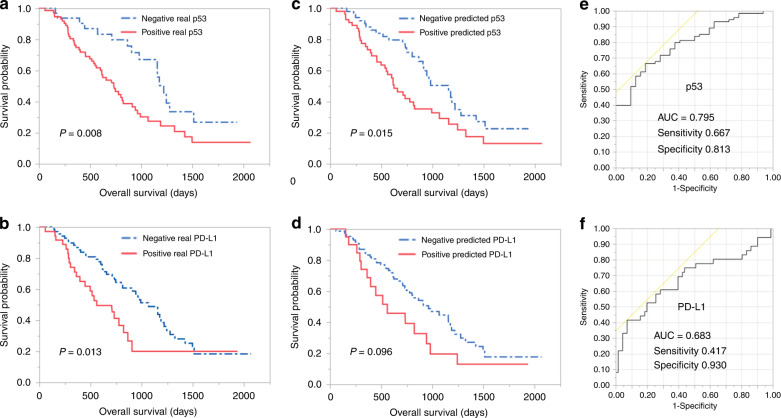
Background: Radiogenomics is an emerging field that integrates “Radiomics” and “Genomics”. In the current study, we aimed to predict the genetic information of pancreatic tumours in a simple, inexpensive, and non-invasive manner, using cancer imaging analysis and radiogenomics. We focused on p53 mutations, which are highly implicated in pancreatic ductal adenocarcinoma (PDAC), and PD-L1, a biomarker for immune checkpoint inhibitor-based therapies. Methods: Overall, 107 patients diagnosed with PDAC were retrospectively examined. The relationship between p53 mutations as well as PD-L1 abnormal expression and clinicopathological factors was investigated using immunohistochemistry. Imaging features (IFs) were extracted from CT scans and were used to create prediction models of p53 and PD-L1 status. Results: We found that p53 and PD-L1 are significant independent prognostic factors (P = 0.008, 0.013, respectively). The area under the curve for p53 and PD-L1 predictive models was 0.795 and 0.683, respectively. Radiogenomics-predicted p53 mutations were significantly associated with poor prognosis (P = 0.015), whereas the predicted abnormal expression of PD-L1 was not significant (P = 0.096). Conclusions: Radiogenomics could predict p53 mutations and in turn the prognosis of PDAC patients. Hence, prediction of genetic information using radiogenomic analysis may aid in the development of precision medicine.
Overview
The claims and statistics of this paper haven’t been checked yet.
Free: it reads the open-access text and checks the first 5 claims that cite a source we can check. Create a free account to check every claim.
Integrity signals
Registry
Cites
Statistics
Figures
Verification
Claims the paper makes
The claims and statistics of this paper haven’t been checked yet.
Free: it reads the open-access text and checks the first 5 claims that cite a source we can check. Create a free account to check every claim.
Claims other papers make about this one
Each is checked against this paper’s own text: does it say what the citing paper says it does?
The source backs part of the claim, not all of it — or backs it for a different population, condition or comparison.
In the citing paper
“With the aid of ML, the radiologist used radiological images (CT, MRI) to detect multiple gene expression profiles in PC, including p53 status and PD-L1 expression 204, FAP expression 205, and ITGAV expression 206.”
From Artificial intelligence in pancreatic cancer (2022) · cites this paper as [204]
Experimental — accuracy not yet measuredThe source backs part of the claim, not all of it — or backs it for a different population, condition or comparison.
In the citing paper
“These genes had been shown to have predictive ability for the prognosis of PC.”
From Artificial intelligence in pancreatic cancer (2022) · cites this paper as [204]
Experimental — accuracy not yet measuredThe cited source says what the claim attributes to it.
In the citing paper
“Due to its excellent computational power, AI was used to analyze PC prognoses, including survival time 204-221, recurrence risk 78,221-224, metastasis 225-230, therapy response 79-81,231-240, etc.”
From Artificial intelligence in pancreatic cancer (2022) · cites this paper as [204]
Self-check
Percentages, sums and reported differences re-computed from the paper’s own numbers.
The self-check needs the paper’s full text.
Citations
Cites
PD-1 and PD-L1 Immune Checkpoint Blockade to Treat Breast Cancer
Hartkopf, A. D., Taran, F.-A., Wallwiener, M., Walter, C. B., Krämer, B., Grischke, E.-M., & Brucker, S. Y. (2016) · Breast Care · doi:10.1159/000453569 · Cited by 30,845
Adverse Renal Effects of Immune Checkpoint Inhibitors: A Narrative Review
Wanchoo, R., Karam, S., Uppal, N. N., Barta, V. S., Deray, G., Devoe, C., Launay-Vacher, V., Jhaveri, K. D., & on behalf of Cancer and Kidney International Network Workgroup on Immune Checkpoint Inhibitors (2017) · American Journal of Nephrology · doi:10.1159/000455014 · Cited by 15,256
Pembrolizumab versus Chemotherapy for PD-L1-Positive Non-Small-Cell Lung Cancer
Reck, M., Rodríguez-Abreu, D., Robinson, A. G., Hui, R., Csőszi, T., Fülöp, A., Gottfried, M., Peled, N., Tafreshi, A., Cuffe, S., et al. (2016) · New England Journal of Medicine · doi:10.1056/nejmoa1606774 · Cited by 10,089
Nivolumab versus docetaxel in advanced nonsquamous non-small-cell lung cancer
Borghaei, H., Paz-Ares, L., Horn, L., Spigel, D. R., Steins, M., Ready, N. E., Chow, L. Q., Vokes, E. E., Felip, E., Holgado, E., et al. (2015) · New England Journal of Medicine · doi:10.1056/nejmoa1507643 · Cited by 9,335
Nivolumab versus Docetaxel in Advanced Squamous-Cell Non–Small-Cell Lung Cancer
Brahmer, J., Reckamp, K. L., Baas, P., Crinò, L., Eberhardt, W. E. E., Poddubskaya, E., Antonia, S., Pluzanski, A., Vokes, E. E., Holgado, E., et al. (2015) · New England Journal of Medicine · doi:10.1056/nejmoa1504627 · Cited by 8,447
Spencer, P. M., Cameron, J. L., & Lin, L. (2000) · Cited by 7,202
Oncology meets immunology: the cancer-immunity cycle.
Chen, D. S., & Mellman, I. (2013) · Immunity · doi:10.1016/j.immuni.2013.07.012 · Cited by 6,929
Mismatch repair deficiency predicts response of solid tumors to PD-1 blockade
Le, D. T., Durham, J. N., Smith, K. N., Wang, H., Bartlett, B. R., Aulakh, L. K., Lu, S., Kemberling, H., Wilt, C., Luber, B. S., et al. (2017) · Science · doi:10.1126/science.aan6733 · Cited by 6,645
Computational Radiomics System to Decode the Radiographic Phenotype
(2017) · doi:10.1158/0008-5472.can-17-0339 · Cited by 6,593
Predictive correlates of response to the anti-PD-L1 antibody MPDL3280A in cancer patients
Herbst, R. S., Soria, J.-C., Kowanetz, M., Fine, G. D., Hamid, O., Gordon, M. S., Sosman, J. A., McDermott, D. F., Powderly, J. D., Gettinger, S. N., et al. (2014) · Nature · doi:10.1038/nature14011 · Cited by 5,231
Cited by
Defining clinically useful biomarkers of immune checkpoint inhibitors in solid tumours
Holder, A. M., Dedeilia, A., Sierra-Davidson, K., Cohen, S., Liu, D., Parikh, A., & Boland, G. M. (2024) · Nature Reviews Cancer · doi:10.1038/s41568-024-00705-7 · Cited by 298
“…, but a multitude of other radiomics predictors of other cancer types such as melanoma 135,145 and breast 146 and gastrointestinal cancers 147–152 have also been identified, with some studies even assessing pan-cancer response analytes 153–155 through the assessment of quantitative…”
Sahu, M., Gupta, R., Ambasta, R. K., & Kumar, P. (2022) · Progress in Molecular Biology and Translational Science · doi:10.1016/bs.pmbts.2022.03.002 · Cited by 188
Wei, L., Niraula, D., Gates, E. D. H., Fu, J., Luo, Y., Nyflot, M. J., Bowen, S. R., El Naqa, I. M., & Cui, S. (2023) · The British Journal of Radiology · doi:10.1259/bjr.20230211 · Cited by 162
“24 Multiomics data along with advanced prognostication, 25–29 and outcome prediction 30,31 can offer possibilities for treatment selection or planning.”
Artificial intelligence in pancreatic cancer
Huang, B., Huang, H., Zhang, S., Zhang, D., Shi, Q., Liu, J., & Guo, J. (2022) · Theranostics · doi:10.7150/thno.77949 · Cited by 142
“Due to its excellent computational power, AI was used to analyze PC prognoses, including survival time [204-221], recurrence risk [78,221-224], metastasis [225-230], therapy response [79-81,231-240], etc.”
MethodIntegrating multi-omics data with EHR for precision medicine using advanced artificial intelligence
Tong, L., Shi, W., Isgut, M., Zhong, Y., Lais, P., Gloster, L., Sun, J., Swain, A., Giuste, F., & Wang, M. D. (2024) · IEEE Reviews in Biomedical Engineering · doi:10.1109/rbme.2023.3324264 · Cited by 130
“Hoshino et al. [110] adopted the previous pipeline [109] to predict the tumor mutation burden of patients with colorectal cancer.”
BackgroundMethod
Metadata
- Authors
- Iwatate, Y., Hoshino, I., Yokota, H., Ishige, F., Itami, M., Mori, Y., Chiba, S., Arimitsu, H., Yanagibashi, H., Nagase, H., & Takayama, W.
- Affiliations
- Chiba Cancer Center (JP)
- Chiba University (JP)
- Corresponding author
- Hoshino, Isamu
- Venue
- British Journal of Cancer
- Published
- 2020-07-21
- Volume
- 123
- Issue
- 8
- Pages
- 1253-1261
- ISSN
- 0007-0920 (ISSN-L)
- 1532-1827
- PMC
- PMC7555500
- OpenAlex
- W3042815543
- Cited by
- 101
- References
- 46
- Citations by year
- 2026: 4 · 2025: 15 · 2024: 20 · 2023: 19 · 2022: 23 · 2021: 19 · 2020: 1
- FWCI
- 7.55
- Type
- journal article
- Language
- en
- Open access
- hybrid
- doi.org
- Licence
- cc-by
- creativecommons.org/licenses/by/4.0 (tdm)
- creativecommons.org/licenses/by/4.0 (vor)
- Locations
- British Journal of Cancer (publishedVersion, cc-by)
- PubMed Central (publishedVersion, cc-by)
- PubMed (publishedVersion)
- Funders
- Japan Society for the Promotion of Science (20K17570)
- Topics
- Health Sciences › Medicine › Radiology, Nuclear Medicine and Imaging › Radiomics and Machine Learning in Medical Imaging
- Health Sciences › Medicine › Oncology › Pancreatic and Hepatic Oncology Research
- Life Sciences › Biochemistry, Genetics and Molecular Biology › Cancer Research › Cancer Genomics and Diagnostics
- Keywords
- radiogenomics, radiomics, pancreatic ductal adenocarcinoma, TP53 mutation, PD-L1 expression, prognostic factors, CT imaging features, immune checkpoint inhibitors, precision medicine
- MeSH terms
- Machine Learning, Imaging Genomics, Aged, Aged, 80 and over, Female, Humans, Immunohistochemistry, Male, Middle Aged, Mutation, Pancreatic Neoplasms, Prognosis, Retrospective Studies, Tomography, X-Ray Computed, Tumor Suppressor Protein p53, Carcinoma, Pancreatic Ductal, B7-H1 Antigen
About these checks
Registry, retraction, Cites and statistics results are computed, not judged, with one exception: a printed reference that no index lists is read once by a model before it counts as a citation error. Claims are extracted by a model and kept only when their quote appears verbatim in the text; each cited source is then checked, with a model’s help, for whether it says what the claim relies on. Those verdicts can be wrong — read the claim’s quote and the cited source before relying on one.
Statistics and arithmetic are recomputed, not judged.
Confidence bands are shown only for fields calibrated on our annotated test set. None is calibrated yet, so no band is shown.
What counts as a claim ›How we measure confidence ›How we check this ›
Are you an author, or do you see a problem with this page? Request a review
How to cite
Cite CoChat for the checks on this page, and the paper for its own findings.
- This page
- CoChat. (2026). Citation check: Radiogenomics for predicting p53 status, PD-L1 expression, and prognosis with machine learning in pancreatic cancer. https://app.cochat.ai/papers/10.1038/s41416-020-0997-1
- The paper
- Iwatate, Y., Hoshino, I., Yokota, H., Ishige, F., Itami, M., Mori, Y., Chiba, S., Arimitsu, H., Yanagibashi, H., Nagase, H., & Takayama, W. (2020). Radiogenomics for predicting p53 status, PD-L1 expression, and prognosis with machine learning in pancreatic cancer. British Journal of Cancer. https://doi.org/10.1038/s41416-020-0997-1
Data sources
Bibliographic data: Semantic Scholar, OpenAlex, Crossref.
Contains information from the Semantic Scholar Academic Graph Datasets, made available under the ODC Attribution License (ODC-BY 1.0).
Semantic Scholar’s data is described in: Kinney, R., et al. (2023). The Semantic Scholar Open Data Platform. arXiv:2301.10140.
