

Automatic detection of image manipulations in the biomedical literature
Open accessThe DOI matches its Crossref record; 6 of the 6 references it cites were found in a registry or an index; 4 of the 11 sources its claims cite were checked for support.
Abstract
Images in scientific papers are used to support the experimental description and the discussion of the findings since several centuries. In the field of biomedical sciences, in particular, the use of images to depict laboratory results is widely diffused, at such a level that one would not err in saying that there is barely any experimental paper devoid of images to document the attained results. With the advent of software for digital image manipulation, however, even photographic reproductions of experimental results may be easily altered by researchers, leading to an increasingly high rate of scientific papers containing unreliable images. In this paper I introduce a software pipeline to detect some of the most diffuse misbehaviours, running two independent tests on a random set of papers and on the full publishing record of a single journal. The results obtained by these two tests support the feasibility of the software approach and imply an alarming level of image manipulation in the published record.
Overview
CoChat Summary
TL;DR
The paper introduces an automated software pipeline to detect image manipulation in biomedical papers and applies it to a random PubMed Central sample and the full 2010–2014 record of *Cell Death and Disease*. It reports suspected manipulation in about 6% of sampled papers and 8.6% of the single journal’s papers, with gel-electrophoresis images especially affected.
Key findings
- In a random PMC sample of 1,364 papers from 451 journals, 78 papers (5.7%) from 46 journals (10.2%) contained at least one suspected image manipulation; the affected journals had an average impact factor of 4.00 (range 0.11–9.13).
- Among flagged papers, 65 (83%) contained at least one manipulated gel-electrophoresis image; among the 299 papers containing at least one gel image, 21.7% had a potential ORI-policy-violating manipulation involving gel images.
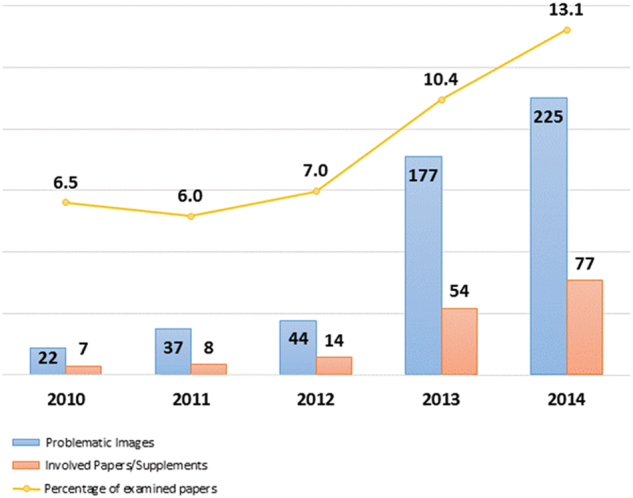
- For *Cell Death and Disease*, 8.6% of 1,546 papers published in 2010–2014 contained manipulated images, with a growing yearly trend exceeding the PMC range in the last two years; 20 papers published in 2014 contained images previously published by the same group.
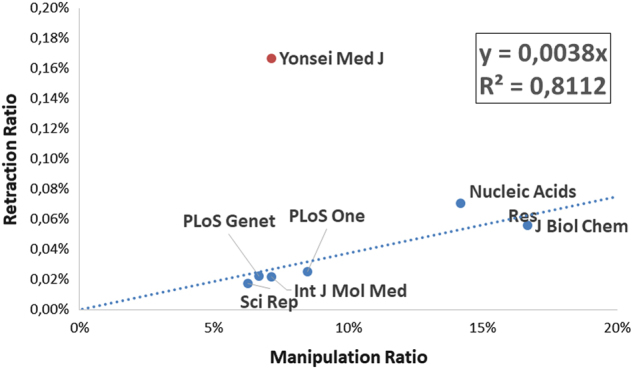
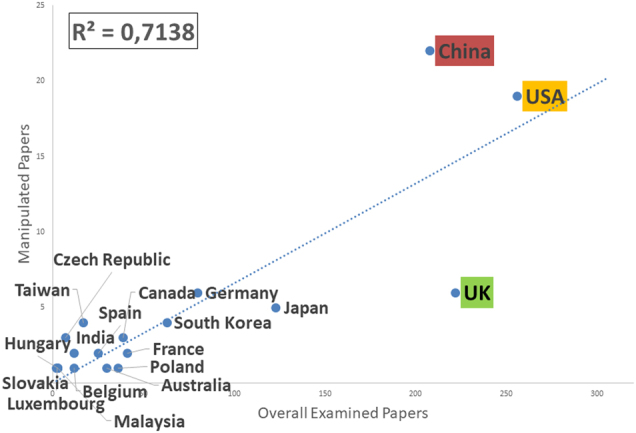
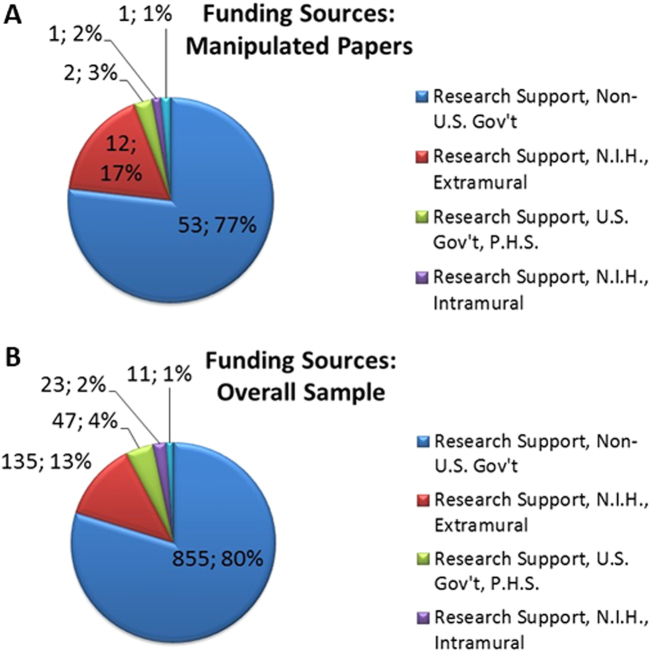
- For 6 of 7 journals examined, image-manipulation rate correlated with retraction rate; retractions totaled 0.38% of papers containing potentially manipulated images, while about 40% of retraction notes detailing reasons reported image problems. China produced more problematic papers than expected and the UK fewer; no preferred funding source was found, and 12 NIH projects producing 12 problematic papers represented a lower-bound value greater than $4,800,000.
Methods
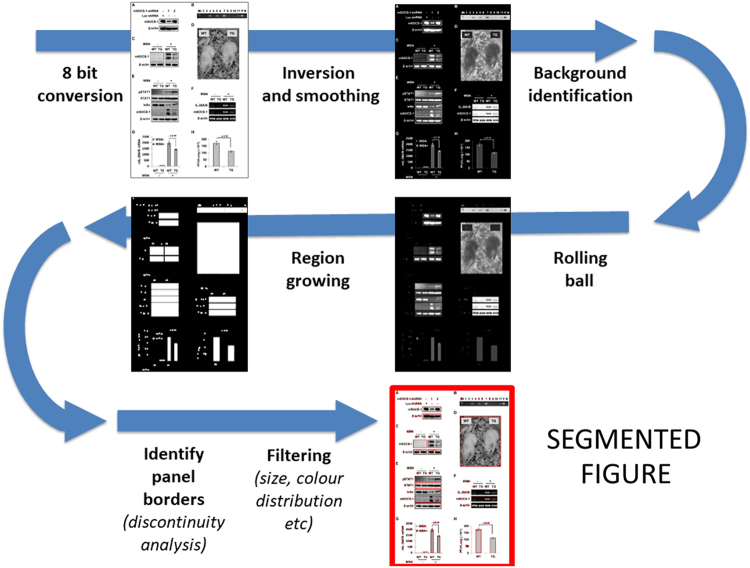
- The automated pipeline used PDF conversion, in-house ImageCutter for panel segmentation, ImageCheck for gel-feature cloning detection, and the commercial “Visual Similarity Duplicate Image Finder Pro” for image reuse with a 95% similarity threshold. Gel spots were flagged if, after alignment and possible 180° rotation/mirroring, pixel-by-pixel intensity subtraction differed by less than 2% of the normalized average area.
- Two tests were run: a random sample of 1,364 open-access papers from PubMed Central released in January 2014 (451 journals, 4,778 extracted images), and the full publishing record of *Cell Death and Disease* for 2010–2014 (1,546 papers).
- Analyses included rates of suspected manipulation, journal-level correlation with retractions, country attribution by corresponding-author institution, and funding-source assessment from PubMed records.
Limitations
- The paper states that the approach is restricted to detecting only a tiny amount of possible data manipulations, that the country result is based on a single month in 2014 and needs confirmation, and that conclusions about *Cell Death and Disease* should be compared with a similar journal that did not increase article numbers.
- Evident from the text: flagged papers are described as “suspected” or “potentially manipulated,” not confirmed misconduct; the duplicate-detection step relies on a commercial tool and a 95% similarity threshold; funding information is partial; and no correlation was found between journal impact factor and manipulation ratio.
Model-written summary. Check it against the paper before relying on it.
Integrity signals
Registry
Cites
Statistics
Figures
Verification
Claims the paper makes
3 Valid · 1 Not valid · 7 Not checked · 32 Own results and interpretations
The cited sources support only part of this claim — read each source’s verdict below.
In the paper
“However, the overall number of papers submitted increased substantially, from about 100 papers in 2010 to more than 1000 in 2014.”
§ Automatic detection of image manipulations in the biomedical literature > Uncovering time trends: investigation of the journal Cell Death and Disease
What the sources say
- Partly supportedcites [9] Melino G 1000 successes as CDDIS reaches 1000 published papers! Cell Death Dis. 2014 5 e1041 10.1038/cddis.2014.15 sourceExperimental — accuracy not yet measured
The main text (page unavailable) describes a burgeoning number of direct submissions to Cell Death & Disease, supporting the claim of growth. It does not give submission totals of about 100 in 2010 or more than 1,000 in 2014: the 1,000 figure refers to papers published cumulatively, while the more-than-100 figure refers to papers previously rejected by Cell Death and Differentiation and published elsewhere. (LLM, conf=0.87)
plain- Asserted: passes — The authors put it forward as true.
- Checkable: passes — It can be checked against evidence.
- Load-bearing: passes — The paper’s conclusions depend on it.
- Based: passes — The paper gives a reason why it holds.
- Partly supported
The cited sources that could be checked couldn’t confirm or dispute this claim.
In the paper
“While for CDDIS we observed a growing trend in image manipulation, from published data it appears that during the same period the acceptance rate slightly decreased (from above 50% to about 40%).9”
§ Automatic detection of image manipulations in the biomedical literature > Uncovering time trends: investigation of the journal Cell Death and Disease
What the sources say
- Could not verifycites [9] Melino G 1000 successes as CDDIS reaches 1000 published papers! Cell Death Dis. 2014 5 e1041 10.1038/cddis.2014.15 sourceExperimental — accuracy not yet measured
The Impact Factor section mentions CDDIS’s “current rate of acceptance” but gives no percentage or earlier rate. Our copy does not establish a decrease from above 50% to about 40% (searched for those figures and an acceptance-rate decline). (LLM, conf=0.72)
hedged- Asserted: passes — The authors put it forward as true.
- Checkable: passes — It can be checked against evidence.
- Load-bearing: unclear — It is unclear whether the paper’s conclusions depend on it.
- Based: passes — The paper gives a reason why it holds.
- Could not verify
A result the paper reports from its own data — it cites no other source for it, so there is none to check. The quote shows it is in the paper.
In the paper
“On average, image problems are reported in about 40% of the retraction notes detailing the reasons for paper withdrawal.”
§ Automatic detection of image manipulations in the biomedical literature > Investigation of a random set of Open Access papers
plain- Asserted: passes — The authors put it forward as true.
- Checkable: passes — It can be checked against evidence.
- Load-bearing: passes — The paper’s conclusions depend on it.
- Based: passes — The paper gives a reason why it holds.
A result the paper reports from its own data — it cites no other source for it, so there is none to check. The quote shows it is in the paper.
In the paper
“Overall, we found 8.6% of papers to contain manipulated images, which is well in the range found for the PubMed Central sample.”
§ Automatic detection of image manipulations in the biomedical literature > Uncovering time trends: investigation of the journal Cell Death and Disease
plain- Asserted: passes — The authors put it forward as true.
- Checkable: passes — It can be checked against evidence.
- Load-bearing: passes — The paper’s conclusions depend on it.
- Based: passes — The paper gives a reason why it holds.
A result the paper reports from its own data — it cites no other source for it, so there is none to check. The quote shows it is in the paper.
In the paper
“Out of the 1364 examined papers, we discovered 78 papers (5.7% of the total) from 46 different journals (10.2% of the total, average IF = 4.00, ranging from 0.11 to 9.13) containing at least one instance of suspected image manipulation.”
- Also stated in: § Conclusions · hedged
“we discovered that about 6% of published papers contain manipulated images”
§ Automatic detection of image manipulations in the biomedical literature > Investigation of a random set of Open Access papers
plain- Asserted: passes — The authors put it forward as true.
- Checkable: passes — It can be checked against evidence.
- Load-bearing: passes — The paper’s conclusions depend on it.
- Based: passes — The paper gives a reason why it holds.
- Also stated in: § Conclusions · hedged
24 more claims
Create a free account to see all 43 claims and every source verdict.
- It may state two separate claims as one. 10
- Probably not a substantial claim. 4
Claims other papers make about this one
Each is checked against this paper’s own text: does it say what the citing paper says it does?
The source backs part of the claim, not all of it — or backs it for a different population, condition or comparison.
In the citing paper
“Secondly, our estimate for potentially fraudulent papers aligns well with recent discoveries.”
From Fraudulent studies are undermining the reliability of systematic reviews: on the prevalence of problematic images in preclinical depression studies (2025) · cites this paper as [46]
Experimental — accuracy not yet measuredThe cited source says what the claim attributes to it.
In the citing paper
“There are few investigations that have employed similar approaches; however, the ones we know of 15,[45][46][47][48] have produced similar estimates for the prevalence of reports featuring problematic images (although we appear to have the dubious honor of having produced one of the highest estimate so far).”
From Fraudulent studies are undermining the reliability of systematic reviews: on the prevalence of problematic images in preclinical depression studies (2025) · cites this paper as [46]
Citations
Cites
Titus, S. L., Wells, J. A., & Rhoades, L. J. (2008) · Nature · doi:10.1038/453980a · Cited by 300
The Prevalence of Inappropriate Image Duplication in Biomedical Research Publications
Bik, E. M., Casadevall, A., & Fang, F. C. (2016) · mBio · doi:10.1128/mbio.00809-16 · Cited by 287 · cited 3×
“This last result might be related to the limited period considered by our analysis (a single month in 2014), and needs to be con fi rmed before trusted; both the higher prevalence measured for China and the lower measured for UK do however agree with recently published data 11 .”
BackgroundResultInfluentialFinancial costs and personal consequences of research misconduct resulting in retracted publications
Stern, A. M., Casadevall, A., Steen, R. G., & Fang, F. C. (2014) · eLife · doi:10.7554/elife.02956 · Cited by 189 · cited 1×
“For example, if we consider that the average value of extramural NIH research projects is above $400,000(7), then the overall value for the 12 NIH projects which produced 12 problematic papers (red portion of the pie in the preceding graph) is greater than $4,800,000, in agreement with an independent estimate that was…”
BackgroundSidereus Nuncius, or The Sidereal Messenger
Galilei, G., & Van Helden, A. (1989) · doi:10.7208/chicago/9780226279046.001.0001 · Cited by 146
Incidence of Data Duplications in a Randomly Selected Pool of Life Science Publications
Oksvold, M. P. (2016) · Science and Engineering Ethics · doi:10.1007/s11948-015-9668-7 · Cited by 20 · cited 1×
“This last fi gure might be compared to the result of recently published independent study 10 , which examined a set of randomly selected papers in basic oncology and found 25% of them containing manipulated gel images.”
Result1000 successes as CDDIS reaches 1000 published papers!
Melino, G. (2014) · Cell Death & Disease · doi:10.1038/cddis.2014.15 · Cited by 1 · cited 1×
“While for CDDIS we observed a growing trend in image manipulation, from published data it appears that during the same period the acceptance rate slightly decreased (from above 50% to about 40%).(9)”
Result
Research works printed but not linked: 3
- Bucci, E. M., Adamo, G., Frandi, A. & Caporale, C. Introducing an unbiased software procedure for image checking in a large research institution. In Extended Abstracts from the 5th World Conference on Research Integrity (Elsevier, Amsterdam, 2017).
- Home - PMC - NCBI. Available at http://www.ncbi.nlm.nih.gov/pmc/ (Accessed 18 May 2014).
- Marcus A Oransky I Can we trust western blots? Lab Times 2012 2 41
Cited by
Responsible Conduct of Research
Shamoo, A. E., & Resnik, D. B. (2022) · doi:10.1093/oso/9780197547090.001.0001 · Cited by 224
Community-developed checklists for publishing images and image analyses
Schmied, C., Nelson, M. S., Avilov, S., Bakker, G., Bertocchi, C., Bischof, J., Boehm, U., Brocher, J., Carvalho, M. T., Chiritescu, C., et al. (2023) · Nature Methods · doi:10.1038/s41592-023-01987-9 · Cited by 120
“, 2018, 2016; Cromey, 2013; CSE, 2012; North, 2006; Rossner and Yamada, 2004), detection of image manipulation (Bucci, 2018; Koppers et al., 2017; Van Noorden, 2022, 2020), appropriate image handling and analysis (Aaron and Chew, 2021; Hammer et al.”
Publishers’ Responsibilities in Promoting Data Quality and Reproducibility
Hrynaszkiewicz, I. (2019) · Handbook of experimental pharmacology · doi:10.1007/164_2019_290 · Cited by 43
“Although less systematically utilised in the editorial process, software for automated detection of image manipulation – a factor in about 40% of retractions in the biomedical literature and thought to affect 6% of published papers – is also available to journals (Bucci 2018).”
MethodWittau, J., & Seifert, R. (2024) · Naunyn-Schmiedeberg s Archives of Pharmacology · doi:10.1007/s00210-024-03272-8 · Cited by 36
Academic Fraud: Solving the Crisis in Modern Academia
Wilson, P. F. (2020) · Exchanges The Interdisciplinary Research Journal · doi:10.31273/eirj.v7i3.546 · Cited by 37
“For instance, Bucci (2018) carried out a meta-analysis of open access papers in the Pubmed database, finding that 6% of the sampled papers had some form of manipulated image.”
Cascio, D., Taormina, V., & Raso, G. (2019) · Applied Sciences · doi:10.3390/app9020307 · Cited by 22
Connectome-based machine learning models are vulnerable to subtle data manipulations
Rosenblatt, M., Rodriguez, R. X., Westwater, M. L., Dai, W., Horien, C. L., Greene, A. S., Constable, R. T., Noble, S., & Scheinost, D. (2023) · Patterns · doi:10.1016/j.patter.2023.100756 · Cited by 20
Experts fail to reliably detect AI-generated histological data
Hartung, J., Reuter, S., Kulow, V. A., Fähling, M., Spreckelsen, C., & Mrowka, R. (2024) · Scientific Reports · doi:10.1038/s41598-024-73913-8 · Cited by 22
Bucci, E. M. (2019) · Cell Death and Disease · doi:10.1038/s41419-019-1450-3 · Cited by 16
Self-citationSchneider, J., Woods, N. D., Proescholdt, R., Fu, Y., & The RISRS Team (2021) · MetArXiv (OSF Preprints) · doi:10.31222/osf.io/ms579 · Cited by 18
The 1-h fraud detection challenge
van der Heyden, M. A. G. (2021) · Naunyn-Schmiedeberg s Archives of Pharmacology · doi:10.1007/s00210-021-02120-3 · Cited by 15
“Using an automatic image manipulation detection setup, Bucci (2018) found that approximately 6% of the papers investigated contained manipulated images, whereas another study found that approximately 23% of a set of papers from basic oncology contained data duplications (Oksvold 2016).”
MethodMascaro, L., & Facer‐Childs, E. R. (2020) · Physiology News · doi:10.36866/pn.118.36 · Cited by 14
Unveiling scientific articles from paper mills with provenance analysis
Cardenuto, J. P., Moreira, D., & Rocha, A. D. R. (2024) · PLoS ONE · doi:10.1371/journal.pone.0312666 · Cited by 24
Benchmarking Scientific Image Forgery Detectors
Cardenuto, J. P., & Rocha, A. D. R. (2022) · Science and Engineering Ethics · doi:10.1007/s11948-022-00391-4 · Cited by 18
“For this, we followed the orientation of Bucci [18] and Bik et al. [4] that report a high image manipulation rate on images from Western Blot techniques and Microscopy imagery.”
MethodCornwall, J., White, R., Pennefather, P. P., Hildebrandt, S., Gregory, J. K., Smith, H. F., Organ, J. M., & Krebs, C. (2025) · Anatomical Sciences Education · doi:10.1002/ase.70002 · Cited by 13
“49 There are many terms used to describe content reproduced from another original illustration, including appropriation, tracing, copying, facsimile, reproducing, altering, and adapting.”
BioFors: A Large Biomedical Image Forensics Dataset
Sabir, E., Nandi, S., AbdAlmageed, W., & Natarajan, P. (2021) · 2021 IEEE/CVF International Conference on Computer Vision (ICCV) · doi:10.1109/iccv48922.2021.01078 · Cited by 12
“Models and frameworks have been proposed for automated detection of biomedical image manipulations [10, 8, 2, 54, 26].”
BackgroundMethodExposing image splicing traces in scientific publications via uncertainty-guided refinement
Lin, X., Tang, W., Wang, H., Liu, Y., Ju, Y., Wang, S., & Yu, Z. (2024) · Patterns · doi:10.1016/j.patter.2024.101038 · Cited by 23
SILA: a system for scientific image analysis
Moreira, D., Cardenuto, J. P., Shao, R., Baireddy, S., Cozzolino, D., Gragnaniello, D., AbdAlmageed, W., Bestagini, P., Tubaro, S., Rocha, A. D. R., et al. (2022) · Scientific Reports · doi:10.1038/s41598-022-21535-3 · Cited by 14
Image manipulation in scholarly publications: are there ways to an automated solution?
Beck, T. S. (2021) · Journal of Documentation · doi:10.1108/jd-06-2021-0113 · Cited by 15
A Quantitative Study of Inappropriate Image Duplication in the Journal Toxicology ReportsPreprint
David, S. (2023) · bioRxiv (Cold Spring Harbor Laboratory) · doi:10.1101/2023.09.03.556099 · Cited by 8
Connectome-based machine learning models are vulnerable to subtle data manipulationsPreprint
Rosenblatt, M., Rodriguez, R. X., Westwater, M. L., Horien, C. L., Greene, A. S., Constable, R. T., Noble, S., & Scheinost, D. (2021) · doi:10.31219/osf.io/ptuwe · Cited by 6
Community-developed checklists for publishing images and image analysisPreprint
Schmied, C., Nelson, M., Avilov, S., et al. (2023) · arXiv (Cornell University) · doi:10.48550/arxiv.2302.07005 · Cited by 6
“, 2018, 2016; Cromey, 2013; CSE, 2012; North, 2006; Rossner and Yamada, 2004), detection of image manipulation (Bucci, 2018; Koppers et al., 2017; Van Noorden, 2022, 2020), appropriate image handling and analysis (Aaron and Chew, 2021; Hammer et al.”
da Silva, J. T. (2020) · Preprints.org · doi:10.20944/preprints201708.0029.v2 · Cited by 6
The Impact on Public Trust of Image Manipulation in Science
López-Cantos, F. (2019) · Informing Science The International Journal of an Emerging Transdiscipline · doi:10.28945/4407 · Cited by 8
Ranking-based sanctions for retraction-afflicted elite researchers
Xu, S. B., & Hu, G. (2025) · Accountability in Research · doi:10.1080/08989621.2025.2549008 · Cited by 5
“These factors may have led to increased post-publication scrutiny, facilitated by tools for detecting image manipulation (Beck 2022; Bucci 2018) and further supported by the commitment of dedicated research integrity sleuths such as Elisabeth Bik (Shen 2020) and Jennifer Byrne (Phillips 2017).”
Toma, C., Padureanu, L., & Toma, B. (2022) · Publications · doi:10.3390/publications10020018 · Cited by 8
A Inteligência Artificial e os desafios da Ciência Forense Digital no século XXI
Padilha, R., Theóphilo, A., Andaló, F., Oliveros, D. A. V., Cardenuto, J. P., Bertocco, G. C., Nascimento, J., Yang, J., & Rocha, A. D. R. (2021) · Estudos Avançados · doi:10.1590/s0103-4014.2021.35101.009 · Cited by 19
Berrío, J. P., & Kalliokoski, O. (2024) · bioRxiv (Cold Spring Harbor Laboratory) · doi:10.1101/2024.02.13.580196 · Cited by 4
Before and After Photoshop: Recursive Fraud in the Age of Digital Reproducibility
Biagioli, M. (2019) · Angewandte Chemie International Edition · doi:10.1002/anie.201908646 · Cited by 4
Berrío, J. P., & Kalliokoski, O. (2025) · FEBS Letters · doi:10.1002/1873-3468.70077 · Cited by 7
Research Misconduct and Medical Journals
Bauchner, H., Steinbrook, R., & Redberg, R. F. (2025) · The Journal of Law Medicine & Ethics · doi:10.1017/jme.2025.35 · Cited by 7
Localization of Synthetic Manipulations in Western Blot Images
Manjunath, A., Negroni, V., Mandelli, S., Moreira, D., & Bestagini, P. (2024) · IEEE International Workshop on Information Forensics and Security · doi:10.1109/wifs61860.2024.10810681 · Cited by 6
“An analysis of the scientific literature revealed that approximately 6% of published papers contain manipulated images [14].”
Unveiling Scientific Articles from Paper Mills with Provenance AnalysisPreprint
Cardenuto, J. P., Moreira, D., & Rocha, A. D. R. (2023) · Research Square · doi:10.21203/rs.3.rs-2791141/v1 · Cited by 3
An exploratory analysis of 4844 withdrawn articles and their retraction notesPreprint
Toma, C., & Padureanu, L. (2021) · bioRxiv (Cold Spring Harbor Laboratory) · doi:10.1101/2021.09.30.462625 · Cited by 3
“%) than the one estimated on a PubMed sample by Bucci (Bucci, 2018), but still significant.”
BackgroundInfluentialRevisiting the Ethical Aspects in Research Publications
Mukherjee, A. (2020) · International Research Journal of Multidisciplinary Scope · doi:10.47857/irjms.2020.v01i01.005 · Cited by 15
López-Cantos, F., & Gasteazi, A. M. (2019) · Perspectivas de la comunicación · doi:10.4067/s0718-48672019000100209 · Cited by 3
Dziech, A., Bogacki, P., & Derkacz, J. (2022) · Sensors · doi:10.3390/s22218106 · Cited by 2
Sivakumar, I., Sivakumar, A., Gadde, P., Buzayan, M. M., Sharan, J., & Kamaraj, B. (2026) · Science Editing · doi:10.6087/kcse.391 · Cited by 1
“One study noted that image-related manipulation has become one of the fastest-growing categories of scientific mis-conduct, reflecting improved detection through post-publica-tion peer review and software-assisted screening methods [16].”
Ethical Aspects of Generative AI in Medicine
Põder, J.-C., & Helgesson, G. (2025) · Integrated science · doi:10.1007/978-3-031-87023-1_12 · Cited by 3
COPE Discussion Document: Artificial intelligence (AI) in decision making
Council COPE (2024) · Science Editor and Publisher · doi:10.24069/sep-23-22 · Cited by 1
Collaboration within Academia and with Industry
Shamoo, A. E., & Resnik, D. B. (2022) · Oxford University Press eBooks · doi:10.1093/oso/9780197547090.003.0004 · Cited by 4
Shamoo, A. E., & Resnik, D. B. (2022) · Oxford University Press eBooks · doi:10.1093/oso/9780197547090.003.0006 · Cited by 1
Shamoo, A. E., & Resnik, D. B. (2022) · Oxford University Press eBooks · doi:10.1093/oso/9780197547090.003.0002 · Cited by 2
Conflicts of Interest and Scientific Objectivity
Shamoo, A. E., & Resnik, D. B. (2022) · Oxford University Press eBooks · doi:10.1093/oso/9780197547090.003.0008 · Cited by 3
Scientific Image Forgery, Journalism, and Public Communication of Science
López-Cantos, F. (2021) · International Journal of Sociotechnology and Knowledge Development · doi:10.4018/ijskd.2021070106 · Cited by 1
Learning to identify image manipulations in scientific publicationsPreprint
Mazaheri, G., Avila, K. U., & Roy–Chowdhury, A. K. (2021) · arXiv (Cornell University) · doi:10.48550/arxiv.2102.01874 · Cited by 6
“Bucci [7] introduce a software pipeline to detect some of the most diffuse misbehaviours.”
MethodAn Exploratory Analysis of 4844 Withdrawn Articles and Their Retraction Notes
Toma, C., & Padureanu, L. (2021) · Open Journal of Social Sciences · doi:10.4236/jss.2021.911028 · Cited by 4
Kane, M. (2020) · Physiology News · doi:10.36866/pn.118.7 · Cited by 1
Sex in studies: The first level of personalisation
Karp, N. A., Katial, R. K., & Thacker, K. S. (2020) · Physiology News · doi:10.36866/pn.118.32 · Cited by 2
Context-aware AI-assisted screening for image duplication in biomedical publicationsPreprint
Guan, C., Wang, Y., Wang, M., Xu, Y., Zhang, Y., Liu, H., & Wan, Y. (2026) · Research Square · doi:10.21203/rs.3.rs-10726784/v1
Governing the Game-Changer: Reimagining Peer Review in the Age of AI
Threadgold, L., Zhou, H., Ragavooloo, S., Stuckey, D. W., & Sayab, M. (2025) · Trends in Scholarly Publishing · doi:10.21124/tsp.2025.109.116
Strengthening Scientific Integrity: Digital Forensics for Biomedical Research Imaging
Cardenuto, J. P., Moreira, D., & Rocha, A. D. R. (2025) · SIBGRAPI Conference on Graphics, Patterns and Images (SIBGRAPI) · doi:10.5753/sibgrapi.est.2025.38268
Strengthening Scientific Integrity: Digital Forensics for Biomedical Research Imaging
Cardenuto, J. P., Moreira, D., & Rocha, A. D. R. (2025) · doi:10.5753/ctd.2025.9167
Digital Banking Transformation: LLMs in Customer Service and Fraud Detection
Manoj, R. J., Boobesh, K., Rajan, A. P., & Saravanan, T. P. (2025) · Lecture notes in networks and systems · doi:10.1007/978-3-031-78940-3_20
A manipulação de imagens em pesquisa científicas
Gonino, C. T. N., & de Araújo, G. M. (2023) · Revista Pesquisa Qualitativa · doi:10.33361/rpq.2023.v.11.n.27.606 · Cited by 1
Shamoo, A. E., & Resnik, D. B. (2022) · Oxford University Press eBooks · doi:10.1093/oso/9780197547090.002.0005
Shamoo, A. E., & Resnik, D. B. (2022) · Oxford University Press eBooks · doi:10.1093/oso/9780197547090.002.0003
The Use of Animals in Research
Shamoo, A. E., & Resnik, D. B. (2022) · Oxford University Press eBooks · doi:10.1093/oso/9780197547090.003.0010
Scientific Research and Ethics
Shamoo, A. E., & Resnik, D. B. (2022) · Oxford University Press eBooks · doi:10.1093/oso/9780197547090.003.0001
Shamoo, A. E., & Resnik, D. B. (2022) · Oxford University Press eBooks · doi:10.1093/oso/9780197547090.003.0005
Data Acquisition and Management
Shamoo, A. E., & Resnik, D. B. (2022) · Oxford University Press eBooks · doi:10.1093/oso/9780197547090.003.0003
Shamoo, A. E., & Resnik, D. B. (2022) · Oxford University Press eBooks · doi:10.1093/oso/9780197547090.003.0013
Mentoring and the Research Environment
Shamoo, A. E., & Resnik, D. B. (2022) · Oxford University Press eBooks · doi:10.1093/oso/9780197547090.003.0009
The Protection of Human Subjects in Research
Shamoo, A. E., & Resnik, D. B. (2022) · Oxford University Press eBooks · doi:10.1093/oso/9780197547090.003.0011
Shamoo, A. E., & Resnik, D. B. (2022) · Oxford University Press eBooks · doi:10.1093/oso/9780197547090.003.0007
Science and Social Responsibility
Shamoo, A. E., & Resnik, D. B. (2022) · Oxford University Press eBooks · doi:10.1093/oso/9780197547090.003.0012
Toma, C., Padureanu, L., & Toma, B. (2022) · bioRxiv (Cold Spring Harbor Laboratory) · doi:10.1101/2022.01.23.477400
“…years, the increased interest in the subject highlighting its unexpected magnitude but also the development of tools that facilitate the detection of image manipulation in scientific articles (Bik et al. 2016; Koppers et al. 2017; Bucci 2018; Bik et al. 2018; Christopher 2018; Sabir et al. 2021).”
BackgroundAddison, T. (2020) · Physiology News · doi:10.36866/pn.118.20
Obituary: David Arthur Jones 1943 – 2020
Degens, H., Sargeant, T., Newham, D. J., McPhee, J. S., & Jackson, M. J. (2020) · Physiology News · doi:10.36866/pn.118.51
An interview with John Cripps, our new external trustee
Turan, J. (2020) · Physiology News · doi:10.36866/pn.118.19
Transformative Agreements and the immediate future of Open Access
Stewart, A. (2020) · Physiology News · doi:10.36866/pn.118.12
The bustling world of hormone dynamics: Endocrinology Theme Lead update
Tissier, P. L., & Wells, T. (2020) · Physiology News · doi:10.36866/pn.118.44
Obituary: Michael Berridge 1938 – 2020
Bootman, M. D., Galione, A., & Taylor, C. W. (2020) · Physiology News · doi:10.36866/pn.118.50
Obituary: Peter Bryan Conrad Matthews 1928 – 2020
Banks, B. (2020) · Physiology News · doi:10.36866/pn.118.49
Ecophysiology and climate change: Shaping our understanding of animal form and function
Trondrud, L. M., & Evans, A. L. (2020) · Physiology News · doi:10.36866/pn.118.26
Editorial: Physiology in the time of coronavirus
Siew, K., & Turan, J. (2020) · Physiology News · doi:10.36866/pn.118.5
The science and art of detecting data manipulation and fraud: An interview with Elisabeth Bik
Turan, J. (2020) · Physiology News · doi:10.36866/pn.118.10
Korus, P., & Memon, N. D. (2020) · International Conference on Learning Representations · Cited by 2
Vor und nach Photoshop: rekursiver Betrug im Zeitalter digitaler Reproduzierbarkeit
Biagioli, M. (2019) · Angewandte Chemie · doi:10.1002/ange.201908646
Metadata
- Authors
- Bucci, E. M.
- Affiliations
- Sbarro Health Research Organization (US)
- Corresponding author
- Bucci, Enrico M.
- ORCID
- Bucci, Enrico M.
- Venue
- Cell Death & Disease
- Published
- 2018-03-14
- Volume
- 9
- Issue
- 3
- Pages
- 400-400
- ISSN
- 2041-4889 (ISSN-L)
- PMC
- PMC5852055
- OpenAlex
- W2791382476
- Cited by
- 76
- References
- 6
- Citations by year
- 2026: 2 · 2025: 9 · 2024: 6 · 2023: 4 · 2022: 21 · 2021: 9 · 2020: 18 · 2019: 7
- FWCI
- 4.25
- Type
- journal article
- Language
- en
- Open access
- gold
- doi.org
- Licence
- cc-by
- creativecommons.org/licenses/by/4.0 (tdm)
- creativecommons.org/licenses/by/4.0 (vor)
- Locations
- Cell Death and Disease (publishedVersion, cc-by)
- PubMed Central (publishedVersion, cc-by)
- PubMed (publishedVersion)
- DOAJ (DOAJ: Directory of Open Access Journals) (submittedVersion)
- Topics
- Physical Sciences › Computer Science › Computer Vision and Pattern Recognition › Digital Media Forensic Detection
- Social Sciences › Education › Academic integrity and plagiarism
- Physical Sciences › Mathematics › Statistics and Probability › Benford’s Law and Fraud Detection
- Keywords
- image forgery detection, biomedical literature, research misconduct, image editing, software pipeline, scholarly publishing
- MeSH terms
- Automation, Image Processing, Computer-Assisted, Publications, Software, Biomedical Research, Open Access Publishing
About these checks
Registry, retraction, Cites and statistics results are computed, not judged, with one exception: a printed reference that no index lists is read once by a model before it counts as a citation error. Claims are extracted by a model and kept only when their quote appears verbatim in the text; each cited source is then checked, with a model’s help, for whether it says what the claim relies on. Those verdicts can be wrong — read the claim’s quote and the cited source before relying on one.
The claim verdicts this report counts are experimental: their accuracy is not yet measured.
A language model drew the claims from the paper on 2026-10-01, under version 3 of the claim definition (model deepseek-v4.1-flash, prompt extract-v3).
A second model labelled each claim on 2026-10-01 (model jev-1.13-20260917, definition revision gold-guideline-v0.2).
Cited sources are checked with a language model’s help (gpt-6-sol).
Statistics and arithmetic are recomputed, not judged.
Confidence bands are shown only for fields calibrated on our annotated test set. None is calibrated yet, so no band is shown.
What counts as a claim ›How we measure confidence ›How we check this ›
Are you an author, or do you see a problem with this page? Request a review
Data sources
Bibliographic data: Semantic Scholar, OpenAlex, Crossref.
Contains information from the Semantic Scholar Academic Graph Datasets, made available under the ODC Attribution License (ODC-BY 1.0).
Semantic Scholar’s data is described in: Kinney, R., et al. (2023). The Semantic Scholar Open Data Platform. arXiv:2301.10140.
