

The DOI matches its Crossref record; 4 of the 4 references it cites were found in a registry or an index.
SNP-mediated lncRNA-ENTPD3-AS1 upregulation suppresses renal cell carcinoma via miR-155/HIF-1α signaling
Abstract
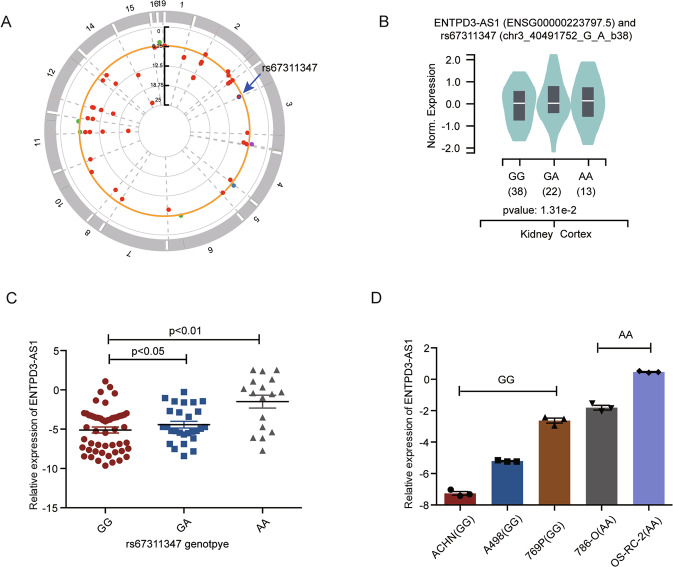
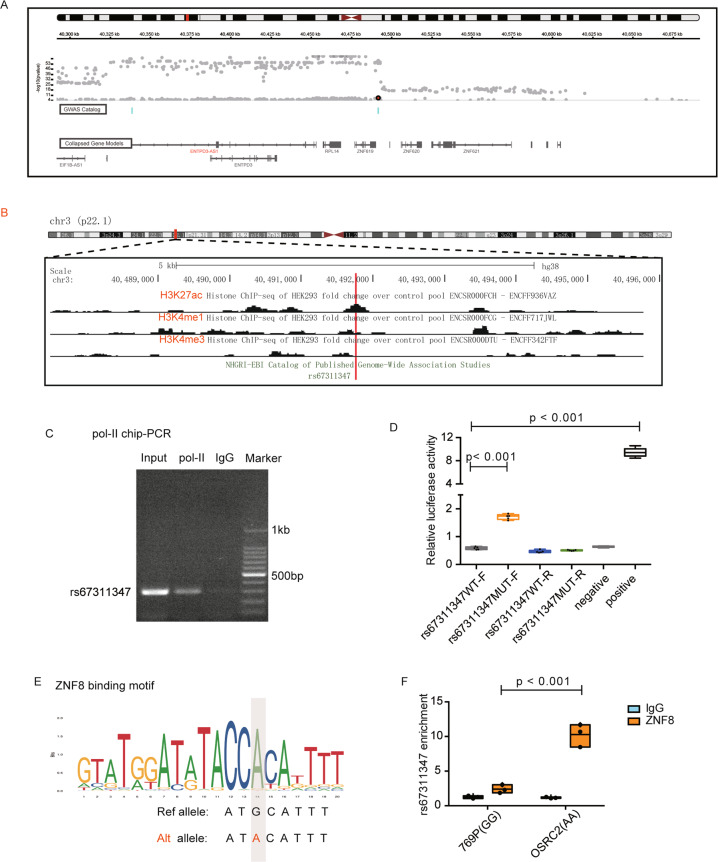
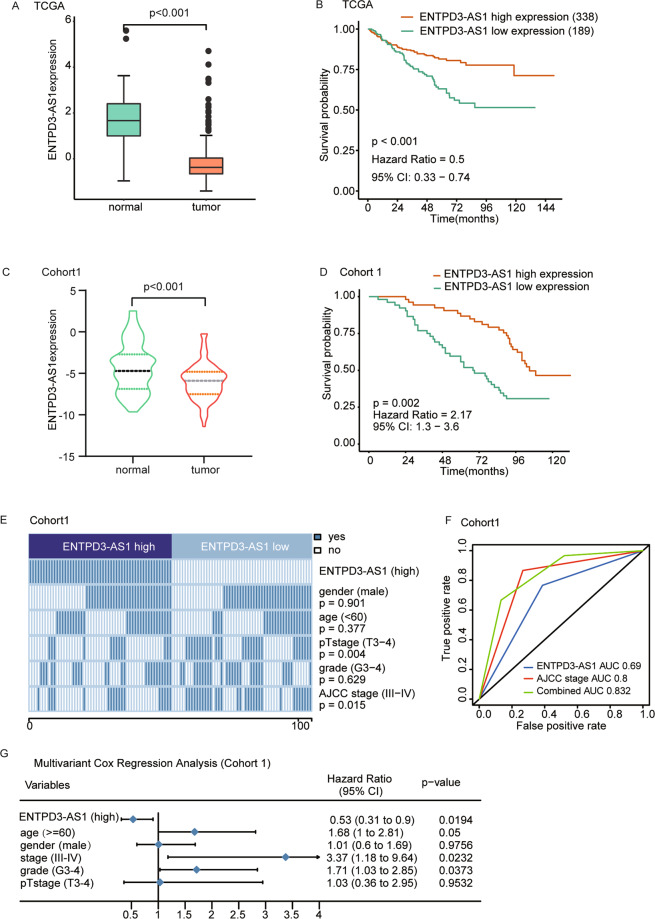
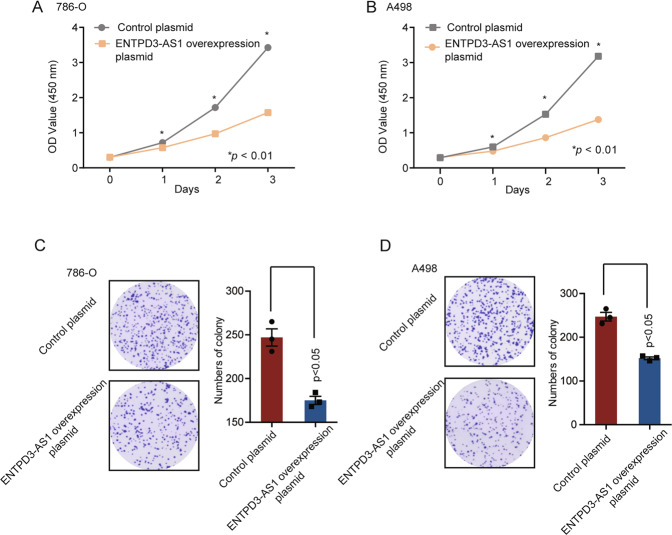
Over the last decade, more than 10 independent SNPs have been discovered to be associated with the risk of renal cell carcinoma among different populations. However, the biological functions of them remain poorly understood. In this study, we performed eQTL analysis, ChIP-PCR, luciferase reporter assay, and Cox regression analysis to identify the functional role and underlying mechanism of rs67311347 in RCC. The ENCORI database, which contains the lncRNA–miRNA–mRNA interactions, was used to explore the possible target miRNA of ENTPD3-AS1. The results showed that the G > A mutation of rs67311347 created a binding motif of ZNF8 and subsequently upregulated ENTPD3-AS1 expression by acting as an enhancer. The TCGA-KIRC and our cohorts both confirmed the downregulation of ENTPD3-AS1 in RCC tissues and demonstrated that increased ENTPD3-AS1 expression was associated with good OS and PFS. Furthermore, ENTPD3-AS1 interacted with miR-155-5p and activated the expression of HIF-1α, which was an important tumor suppressor gene in the development of RCC. The functional experiments revealed that overexpression of ENTPD3-AS1 inhibited cell proliferation in RCC cell lines and the effect could be rescued by knocking down HIF-1α. Our findings reveal that SNP-mediated lncRNA-ENTPD3-AS1 upregulation suppresses renal cell carcinoma via miR-155/HIF-1α signaling.
Overview
The claims and statistics of this paper haven’t been checked yet.
Run the check — free, no account needed. It reads the open-access text and checks the sources it cites.
Integrity signals
Registry
Cites
Statistics
Figures
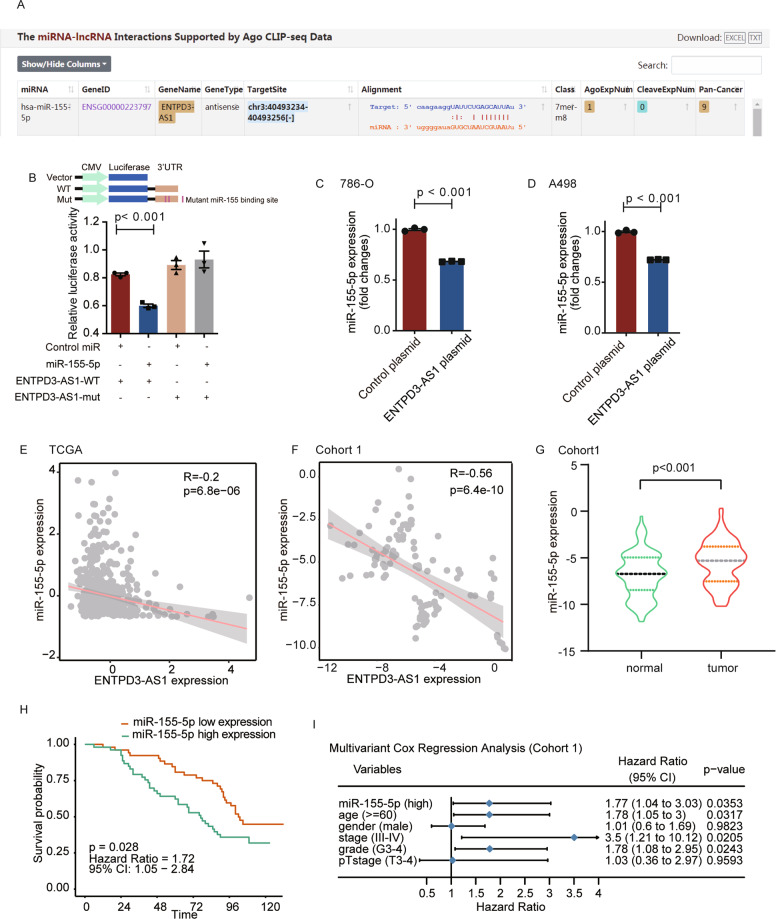
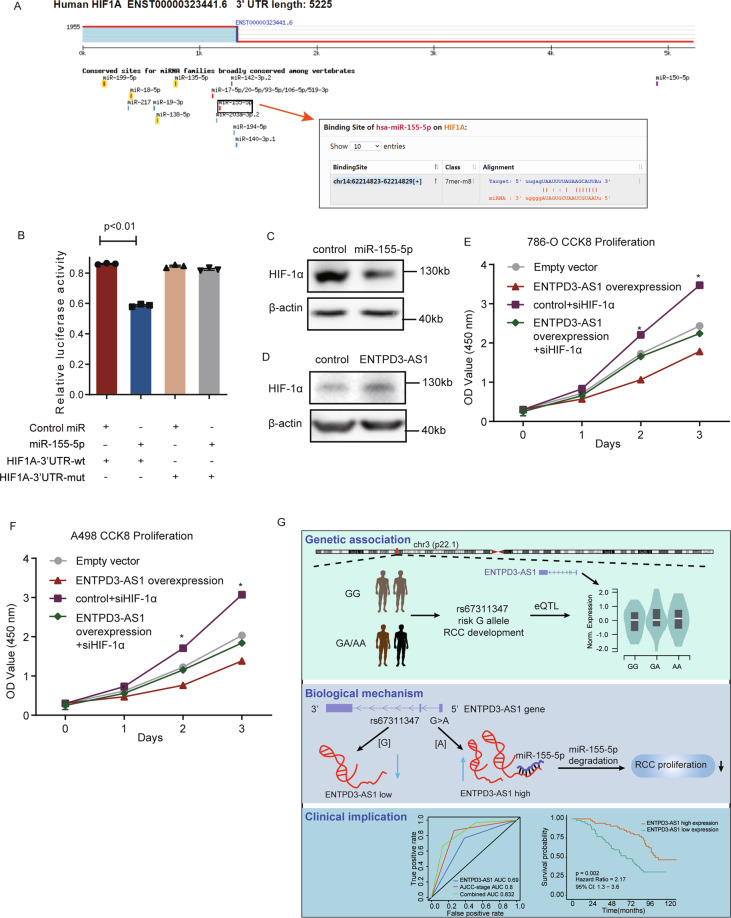
Verification
Claims the paper makes
The claims and statistics of this paper haven’t been checked yet.
Run the check — free, no account needed. It reads the open-access text and checks the sources it cites.
Claims other papers make about this one
Each is checked against this paper’s own text: does it say what the citing paper says it does?
In the citing paper
“Nevertheless, even in conjunction with targeted therapies and immunological treatment for metastatic RCC, the median survival duration remains around 48 months. Persistent issues such as therapeutic resistance and immune-related adverse events (irAEs) continue to challenge treatment effectiveness and patient outcomes [248].”
From Emerging role of exosomes in cancer therapy: progress and challenges (2025) · cites this paper as [248]
Self-check
Percentages, sums and reported differences re-computed from the paper’s own numbers.
The self-check needs the paper’s full text.
Citations
Cites
Nivolumab plus Ipilimumab versus Sunitinib in Advanced Renal-Cell Carcinoma
Motzer, R. J., Tannir, N. M., McDermott, D. F., Arén Frontera, O., Melichar, B., Choueiri, T. K., Plimack, E. R., Barthélémy, P., Porta, C., George, S., et al. (2018) · New England Journal of Medicine · doi:10.1056/nejmoa1712126 · Cited by 4,656
Pembrolizumab plus axitinib versus sunitinib for advanced renal-cell carcinoma
Rini, B. I., Plimack, E. R., Stus, V., Gafanov, R., Hawkins, R., Nosov, D., Pouliot, F., Alekseev, B., Soulières, D., Melichar, B., et al. (2019) · New England Journal of Medicine · doi:10.1056/nejmoa1816714 · Cited by 3,403
Mapping complex disease traits with global gene expression
Cookson, W., Liang, L., Abecasis, G., Moffatt, M., & Lathrop, M. (2009) · Nature Reviews Genetics · doi:10.1038/nrg2537 · Cited by 849
Modulation of long noncoding RNAs by risk SNPs underlying genetic predispositions to prostate cancer
Guo, H., Ahmed, M., Zhang, F., Yao, C. Q., Li, S., Liang, Y., Hua, J., Soares, F., Sun, Y., Langstein, J., et al. (2016) · Nature Genetics · doi:10.1038/ng.3637 · Cited by 226 · cited 1×
“Several studies have also revealed that the disease-associated SNPs might function as a transcriptional enhancer, and interact with transcriptional factors to modulate the expression of target genes [21, 22].”
Background
Research works printed but not linked: 35
- Siegel RL, Miller KD, Fuchs HE, Jemal A. Cancer statistics, 2021. CA Cancer J Clin. 2021;71:7–33. · DOI · Paper page
- Choueiri TK, Motzer RJ, Rini BI, Haanen J, Campbell MT, Venugopal B, et al. Updated efficacy results from the JAVELIN Renal 101 trial: first-line avelumab plus axitinib versus sunitinib in patients with advanced renal cell carcinoma. Ann Oncol. 2020;31:1030–9. · DOI
- Motzer RJ, Penkov K, Haanen J, Rini B, Albiges L, Campbell MT, et al. Avelumab plus axitinib versus sunitinib for advanced renal-cell carcinoma. N Engl J Med. 2019;380:1103–15. · DOI
- Powles T, Plimack ER, Soulières D, Waddell T, Stus V, Gafanov R, et al. Pembrolizumab plus axitinib versus sunitinib monotherapy as first-line treatment of advanced renal cell carcinoma (KEYNOTE-426): extended follow-up from a randomised, open-label, phase 3 trial. Lancet Oncol. 2020;21:1563–73. · DOI · Paper page
- Shuch B, Vourganti S, Ricketts CJ, Middleton L, Peterson J, Merino MJ, et al. Defining early-onset kidney cancer: implications for germline and somatic mutation testing and clinical management. J Clin Oncol. 2014;32:431–7. · DOI
- Hung RJ, Moore L, Boffetta P, Feng BJ, Toro JR, Rothman N, et al. Family history and the risk of kidney cancer: a multicenter case-control study in central Europe. Cancer Epidemiol Biomark Prev. 2007;16:1287–90. · DOI
- Karami S, Schwartz K, Purdue MP, Davis FG, Ruterbusch JJ, Munuo SS, et al. Family history of cancer and renal cell cancer risk in Caucasians and African Americans. Br J Cancer. 2010;102:1676–80. · DOI
- Shuch B, Zhang J. Genetic predisposition to renal cell carcinoma: implications for counseling, testing, screening, and management. J Clin Oncol. 2018;Jco2018792523. · DOI
- Welter D, MacArthur J, Morales J, Burdett T, Hall P, Junkins H, et al. The NHGRI GWAS Catalog, a curated resource of SNP-trait associations. Nucleic Acids Res. 2014;42:D1001–1006. · DOI · Paper page
- Iyer MK, Niknafs YS, Malik R, Singhal U, Sahu A, Hosono Y, et al. The landscape of long noncoding RNAs in the human transcriptome. Nat Genet. 2015;47:199–208. · DOI · Paper page
- Zhang X, Bailey SD, Lupien M. Laying a solid foundation for Manhattan-‘setting the functional basis for the post-GWAS era’. Trends Genet. 2014;30:140–9. · DOI
- Purdue MP, Johansson M, Zelenika D, Toro JR, Scelo G, Moore LE, et al. Genome-wide association study of renal cell carcinoma identifies two susceptibility loci on 2p21 and 11q13.3. Nat Genet. 2011;43:60–65. · DOI
- Schödel J, Bardella C, Sciesielski LK, Brown JM, Pugh CW, Buckle V, et al. Common genetic variants at the 11q13.3 renal cancer susceptibility locus influence binding of HIF to an enhancer of cyclin D1 expression. Nat Genet. 2012;44:s421–422. 420-425 · DOI
- Wu X, Scelo G, Purdue MP, Rothman N, Johansson M, Ye Y, et al. A genome-wide association study identifies a novel susceptibility locus for renal cell carcinoma on 12p11.23. Hum Mol Genet. 2012;21:456–62. · DOI
- Gudmundsson J, Sulem P, Gudbjartsson DF, Masson G, Petursdottir V, Hardarson S, et al. A common variant at 8q24.21 is associated with renal cell cancer. Nat Commun. 2013;4:2776. · DOI
- Grampp S, Platt JL, Lauer V, Salama R, Kranz F, Neumann VK, et al. Genetic variation at the 8q24.21 renal cancer susceptibility locus affects HIF binding to a MYC enhancer. Nat Commun. 2016;7:13183. · DOI
- Scelo G, Purdue MP, Brown KM, Johansson M, Wang Z, Eckel-Passow JE, et al. Genome-wide association study identifies multiple risk loci for renal cell carcinoma. Nat Commun. 2017;8:15724. · DOI
- Hua JT, Ahmed M, Guo H, Zhang Y, Chen S, Soares F, et al. Risk SNP-mediated promoter-enhancer switching drives prostate cancer through lncRNA PCAT19. Cell. 2018;174:564–75. e518 · DOI
- Yu CY, Han JX, Zhang J, Jiang P, Shen C, Guo F, et al. A 16q22.1 variant confers susceptibility to colorectal cancer as a distal regulator of ZFP90. Oncogene. 2020;39:1347–60. · DOI
- Freedman ML, Monteiro AN, Gayther SA, Coetzee GA, Risch A, Plass C, et al. Principles for the post-GWAS functional characterization of cancer risk loci. Nat Genet. 2011;43:513–8. · DOI
- Leung D, Jung I, Rajagopal N, Schmitt A, Selvaraj S, Lee AY, et al. Integrative analysis of haplotype-resolved epigenomes across human tissues. Nature. 2015;518:350–4. · DOI
- Larkin J, Goh XY, Vetter M, Pickering L, Swanton C. Epigenetic regulation in RCC: opportunities for therapeutic intervention? Nat Rev Urol. 2012;9:147–55. · DOI
- Oh JJ, Shivakumar M, Miller J, Verma S, Lee H, Hong SK, et al. An exome-wide rare variant analysis of Korean men identifies three novel genes predisposing to prostate cancer. Sci Rep. 2019;9:17173. · DOI
- Landrum MJ, Lee JM, Riley GR, Jang W, Rubinstein WS, Church DM, et al. ClinVar: public archive of relationships among sequence variation and human phenotype. Nucleic Acids Res. 2014;42:D980–985. · DOI · Paper page
- Dizman N, Philip EJ, Pal SK. Genomic profiling in renal cell carcinoma. Nat Rev Nephrol. 2020;16:435–51. · DOI
- Velickovic M, Delahunt B, Störkel S, Grebem SK. VHL and FHIT locus loss of heterozygosity is common in all renal cancer morphotypes but differs in pattern and prognostic significance. Cancer Res. 2001;61:4815–9.
- Sun TT, He J, Liang Q, Ren LL, Yan TT, Yu TC, et al. LncRNA GClnc1 promotes gastric carcinogenesis and may act as a modular scaffold of WDR5 and KAT2A complexes to specify the histone modification pattern. Cancer Discov. 2016;6:784–801. · DOI
- Zhu X, Tian X, Yu C, Shen C, Yan T, Hong J, et al. A long non-coding RNA signature to improve prognosis prediction of gastric cancer. Mol Cancer. 2016;15:60. · DOI
- Hosseini ES, Meryet-Figuiere M, Sabzalipoor H, Kashani HH, Nikzad H, Asemi Z. Dysregulated expression of long noncoding RNAs in gynecologic cancers. Mol Cancer. 2017;16:107. · DOI
- Salmena L, Poliseno L, Tay Y, Kats L, Pandolfi PP. A ceRNA hypothesis: the Rosetta Stone of a hidden RNA language? Cell. 2011;146:353–8. · DOI · Paper page
- Raval RR, Lau KW, Tran MG, Sowter HM, Mandriota SJ, Li JL, et al. Contrasting properties of hypoxia-inducible factor 1 (HIF-1) and HIF-2 in von Hippel-Lindau-associated renal cell carcinoma. Mol Cell Biol. 2005;25:5675–86. · DOI · Paper page
- Shen C, Beroukhim R, Schumacher SE, Zhou J, Chang M, Signoretti S, et al. Genetic and functional studies implicate HIF1α as a 14q kidney cancer suppressor gene. Cancer Discov. 2011;1:222–35. · DOI · Paper page
- Schödel J, Grampp S, Maher ER, Moch H, Ratcliffe PJ, Russo P, et al. Hypoxia, hypoxia-inducible transcription factors, and renal cancer. Eur Urol. 2016;69:646–57. · DOI
- Gupta RM, Hadaya J, Trehan A, Zekavat SM, Roselli C, Klarin D, et al. A genetic variant associated with five vascular diseases is a distal regulator of endothelin-1 gene expression. Cell. 2017;170:522–33. e515 · DOI · Paper page
- Gao P, Xia JH, Sipeky C, Dong XM, Zhang Q, Yang Y, et al. Biology and clinical implications of the 19q13 aggressive prostate cancer susceptibility locus. Cell. 2018;174:576–89. e518 · DOI
Cited by
Sorted by citations
Emerging role of exosomes in cancer therapy: progress and challenges
Li, J., Wang, J., & Chen, Z. (2025) · Molecular Cancer · doi:10.1186/s12943-024-02215-4 · Cited by 297
Self-citation
Metadata
- Authors
- Wang, J., Zou, Y., Du, B., Li, W., Yu, G., Li, L., Zhou, L., Gu, X., Song, S., Liu, Y., Zhou, W., Xu, B., & Wang, Z.
- Venue
- Cell Death & Disease
- Published
- 2021-07-03
- Volume
- 12
- Issue
- 7
- ISSN
- 2041-4889
- PMC
- PMC8254807
- Cited by
- 51
- References
- 4
- Language
- en
About these checks
Registry, retraction, Cites and statistics results are computed, not judged, with one exception: a printed reference that no index lists is read once by a model before it counts as a citation error. Claims are extracted by a model and kept only when their quote appears verbatim in the text; each cited source is then checked, with a model’s help, for whether it says what the claim relies on. Those verdicts can be wrong — read the claim’s quote and the cited source before relying on one.
Statistics and arithmetic are recomputed, not judged.
Confidence bands are shown only for fields calibrated on our annotated test set. None is calibrated yet, so no band is shown.
What counts as a claim ›How we measure confidence ›How we check this ›
Are you an author, or do you see a problem with this page? Request a review
