

The DOI matches its Crossref record; 40 of the 42 references it cites were found in a registry or an index; none of the 31 sources its claims cite is checked for support yet.
Y-chromosomal analysis of clan structure of Kalmyks, the only European Mongol people, and their relationship to Oirat-Mongols of Inner Asia
Open accessAbstract
Kalmyks, the only Mongolic-speaking population in Europe, live in the southeast of the European Plain, in Russia. They adhere to Buddhism and speak a dialect of the Mongolian language. Historical and linguistic evidence, as well a shared clan names, suggests a common origin with Oirats of western Mongolia; yet, only a limited number of genetic studies have focused on this topic. Here we compare the paternal genetic relationship of Kalmyk clans with ethnographically related groups from Mongolia, Kyrgyzstan and China, within the context of their neighbouring populations. A phylogeny of 37 high-coverage Y-chromosome sequences, together with further genotyping of larger sample sets, reveals that all the Oirat-speaking populations studied here, including Kalmyks, share, as a dominant paternal lineage, Y-chromosomal haplogroup C3c1-M77, which is also present in several geographically distant native Siberian populations. We identify a subset of this clade, C3c1b-F6379, specifically enriched in Kalmyks as well as in Oirat-speaking clans in Inner Asia. This sub-clade coalesces at around 1500 years before present, before the Genghis Khan era, and significantly earlier than the split between Kalmyks and other Oirat speakers about 400 years ago. We also show that split between the dominant hg C variant among Buryats—C3-M407—and that of C3-F6379, took place in the Early Upper Palaeolithic, suggesting an extremely long duration for the dissipation of hg C3-M217 carriers across northern Eurasia, which cuts through today’s major linguistic phyla.
Overview
CoChat Summary
Written by AI from the paper’s full text.
TL;DR
This study uses Y-chromosome genotyping and sequencing to compare Kalmyks, the only Mongolic-speaking population in Europe, with Oirat-Mongols and neighboring groups. It finds that Kalmyks and Mongolian Oirats share a dominant paternal lineage, C3c1-M77, with a Kalmyk/Oirat-enriched sub-clade C3c1b-F6379 dating to ~1.5 KYA, predating the Kalmyk–Oirat split ~400 years ago.
Key findings
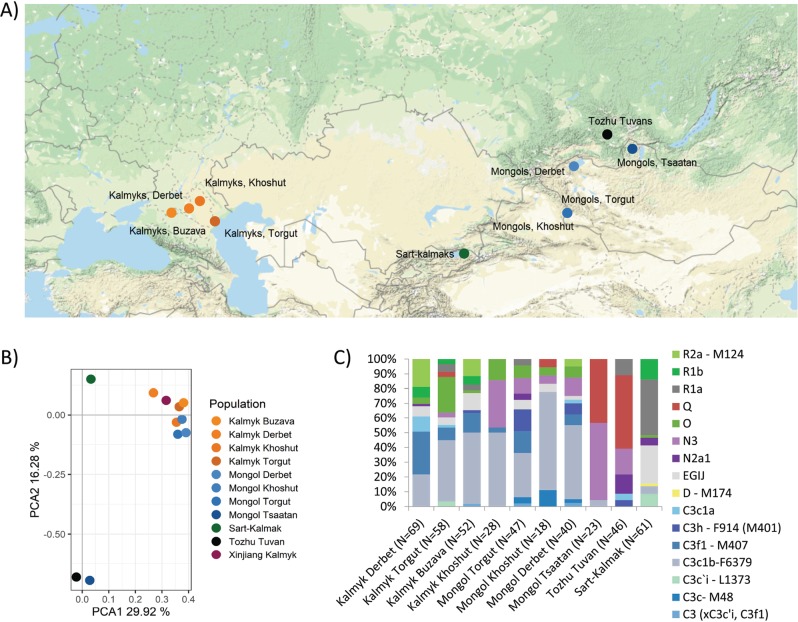
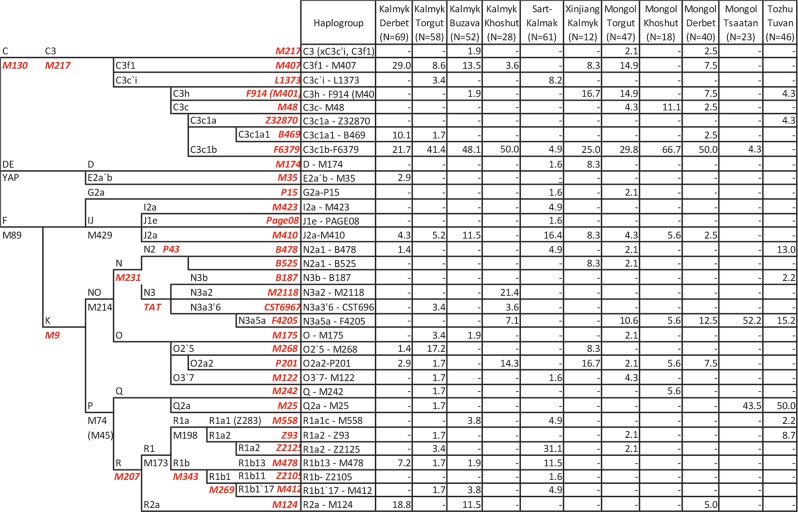
- Among 454 unrelated males, >50% of all studied samples belong to haplogroup C3; excluding Turkic-speaking Tsaatans/Tozhu Tuvans and Oirat-speaking Sart Kalmaks, C3 reaches 62.5% among Kalmyk and Mongolian Oirat subpopulations. The novel C3c1b-F6379 sub-clade comprises 40.3% of male lineages among Kalmyks and Oirats from Mongolia and occurs at minor frequencies among Mongol Tsaatans and Sart Kalmaks.
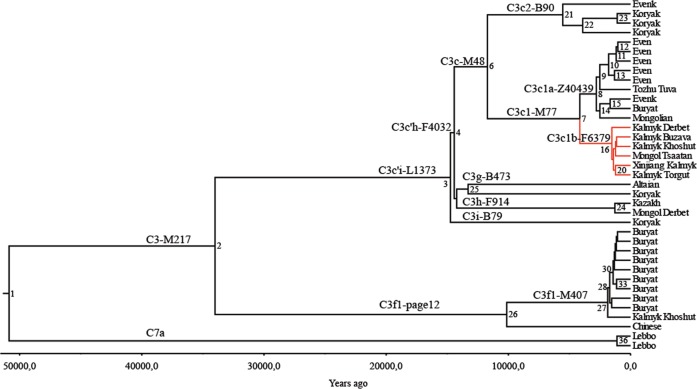
- A phylogeny of 37 high-coverage Y-chromosome sequences identifies C3c1b-F6379 with a TMRCA of ~1.5 KYA (95% HPD 1.1–2.1 KYA), before the Genghis Khan era and earlier than the Kalmyk–other Oirat split ~400 years ago. C3c1-M77 is also present in several geographically distant native Siberian populations.
- Kalmyk sub-groups and Western Mongolian Oirats cluster tightly in PCA; AMOVA shows differentiation among studied groups (FCT = 0.15670, P = 0.00293), while differentiation among geographically distant groups is low and insignificant (FCT = 0.01771, P = 0.13196). Sart Kalmaks show >50% hg R and ~13% hg C3c; Mongolian Tsaatans have ~96% N3a5a-F4205 and Q1a1b-M25; Tozhu Tuvans have N3a5a-F4205 at 15.2% and Q1a1b-M25 at 50.0%.
- Putative Khoshut rulers with possible genealogical links to Genghis Khan’s brother belong to haplogroup C3-M77. The STR network central node expands at 667 ± 155 years, while sequence-based TMRCA is 1076–2011 years; the putative Genghis Khan descendant haplotype is two mutational steps from the central node.
Methods
- Studied 454 unrelated male individuals: Kalmykia Torgut (58), Derbet (69), Buzava (52), Khoshut (28); Western Mongolia Torgut (47), Derbet (40), Khoshut (18), Tsaatan (23); Sart Kalmaks from Kyrgyzstan (61); Kalmyk students from Xinjiang, China (12); and Tozhu Tuvans from Russia (46). Genotyped Y-chromosomal biallelic markers, including newly designed markers F6379, B80, and B469.
- Microsatellite analysis used 23 STRs for 78 samples; a median-joining network for hg C3c1 used 17 Y-STRs from 50 hg C3c1-M77 samples (this study plus published data), with expansion time calculated by rho-statistic and a mutation rate of ~8.6 × 10⁻⁵ per locus per year.
- Whole Y-chromosome sequencing combined 10 novel and 28 published sequences; novel samples were sequenced on Illumina HiSeq 2500 with BigY capture. Variants were mapped/called with BWA-MEM, GATK, and bcftools, yielding 9.2 Mb usable sequence; phylogeny used BEAST v1.7.5 with hg C7a outgroup and hg C calibration age 50,865 years (95% CI 49,191–52,699). PCA, correspondence analysis, Fst, and AMOVA were also performed.
Limitations
- Stated: TMRCA estimates differ between STR network and sequence/BEAST analyses because of different methods and datasets; microsatellite mutation processes are less well understood, and repeat length changes can occur bidirectionally, potentially underestimating times. One newly sequenced sample was excluded from BEAST due to quality issues.
- Stated: reliable patrilineal identification of the Genghis Khan clan requires ancient DNA from archaeologically authentic remains belonging to the imperial family, which have not yet been found.
- Evident: some subgroup sample sizes are small (e.g., Khoshut 18/28, Tsaatan 23, Xinjiang 12), and the study relies on modern Y-chromosome data only; the Figure 1a caption also notes Xinjiang Kalmyk students were left out due to small sample size (<15), despite 12 being listed in the methods.
Model-written summary. Check it against the paper before relying on it.
Integrity signals
Registry
Cites
Statistics
Figures
Verification
Claims the paper makes
37 Own result · 16 Own interpretation · 9 Not checked yet · 8 Sources not found · 4 Check pending · 4 No full text of the sources
A result the paper reports from its own data — it cites no other source for it, so there is none to check. The quote shows it is in the paper.
In the paper
“The AMOVA results confirm the pattern seen on the PC plot (FCT = 0.15670, P = 0.00293) (Supplementary Table S4).”
§ Y-chromosomal analysis of clan structure of Kalmyks, the only European Mongol people, and their relationship to Oirat-Mongols of Inner Asia > Results and discussion
plainstates an association- Asserted: passes — The authors put it forward as true.
- Checkable: passes — It can be checked against evidence.
- Load-bearing: passes — The paper’s conclusions depend on it.
- Based: passes — The paper gives a reason why it holds.
A result the paper reports from its own data — it cites no other source for it, so there is none to check. The quote shows it is in the paper.
In the paper
“The evidence presented here shows that the lineage of the putative Koshut rulers with possible genealogical links to the brother of Genghis belongs to haplogroup C3-M77.”
§ Y-chromosomal analysis of clan structure of Kalmyks, the only European Mongol people, and their relationship to Oirat-Mongols of Inner Asia > Conclusions
boostedstates an association- Asserted: passes — The authors put it forward as true.
- Checkable: passes — It can be checked against evidence.
- Load-bearing: passes — The paper’s conclusions depend on it.
- Based: passes — The paper gives a reason why it holds.
A result the paper reports from its own data — it cites no other source for it, so there is none to check. The quote shows it is in the paper.
In the paper
“Despite isolation by distance for four centuries, the distribution of Y-chromosomal haplogroups among Kalmyk sub-groups and Oirats of Western Mongolia is quite similar (Fig. 1c and Fig. 3).”
§ Y-chromosomal analysis of clan structure of Kalmyks, the only European Mongol people, and their relationship to Oirat-Mongols of Inner Asia > Results and discussion
plain- Asserted: passes — The authors put it forward as true.
- Checkable: passes — It can be checked against evidence.
- Load-bearing: passes — The paper’s conclusions depend on it.
- Based: passes — The paper gives a reason why it holds.
A result the paper reports from its own data — it cites no other source for it, so there is none to check. The quote shows it is in the paper.
In the paper
“For example, haplogroup N occurs in Kalmyk Khoshuts more frequently (32.1%) than in the other studied populations.”
§ Y-chromosomal analysis of clan structure of Kalmyks, the only European Mongol people, and their relationship to Oirat-Mongols of Inner Asia > Results and discussion
plainstates an association- Asserted: passes — The authors put it forward as true.
- Checkable: passes — It can be checked against evidence.
- Load-bearing: unclear — It is unclear whether the paper’s conclusions depend on it.
- Based: passes — The paper gives a reason why it holds.
A result the paper reports from its own data — it cites no other source for it, so there is none to check. The quote shows it is in the paper.
In the paper
“However, it is widespread all over northern Siberia, from Beringian Koryaks to southern Siberian Altaians and Kazakhs (Fig. 2).”
§ Y-chromosomal analysis of clan structure of Kalmyks, the only European Mongol people, and their relationship to Oirat-Mongols of Inner Asia > Conclusions
plain- Asserted: passes — The authors put it forward as true.
- Checkable: passes — It can be checked against evidence.
- Load-bearing: passes — The paper’s conclusions depend on it.
- Based: passes — The paper gives a reason why it holds.
- It may state two separate claims as one. 19
- Probably not a substantial claim. 17
Create a free account to see these claims.
Create a free account to see these assumptions.
42 more claims
Create a free account to see all 78 claims and to verify the 14 references still open.
Self-check
Percentages, sums and reported differences re-computed from the paper’s own numbers.
Each contradiction between two passages listed here was confirmed by an independent check.
Rated minor: it would not touch a result — a value no result rests on, a p-value that stays on the same side of the significance level, or a conflict that is clerical, resolved elsewhere in the paper, or outside its own findings.
In the paper
§ Y-chromosomal analysis of clan structure of Kalmyks, the only European Mongol people, and their relationship to Oirat-Mongols of Inner Asia > Introduction
“Here we study 454 Oirat-speaking individuals from Kalmykia (all 4 ethic groups), Mongolia (4 groups including Torguts and Tsaatans) and Kyrgystan (Sart Kalmaks), together with 28 Tozhu Tuvans from the Russian Federation.”
§ Y-chromosomal analysis of clan structure of Kalmyks, the only European Mongol people, and their relationship to Oirat-Mongols of Inner Asia > Materials and methods > Samples
“We studied a total of 454 unrelated male individuals for Y-chromosome polymorphisms. Included samples were from four sub-populations of Kalmyks from Russian Federation: Torgut (58), Derbet (69), Buzava (52), Khoshut (28); 4 populations from Western Mongolia: Torgut (47), Derbet (40), Khoshut (18), Tsaatan (23); Sart Kalmaks from Kyrgyzstan (61); Kalmyk students from Xinjiang province in China (12); and Tozhu Tuvans from Russian Federation (46)”
Rated minor: it would not touch a result — a value no result rests on, a p-value that stays on the same side of the significance level, or a conflict that is clerical, resolved elsewhere in the paper, or outside its own findings.
In the paper
§ Y-chromosomal analysis of clan structure of Kalmyks, the only European Mongol people, and their relationship to Oirat-Mongols of Inner Asia > Introduction
“together with 28 Tozhu Tuvans from the Russian Federation”
§ Y-chromosomal analysis of clan structure of Kalmyks, the only European Mongol people, and their relationship to Oirat-Mongols of Inner Asia > Materials and methods > Samples
“and Tozhu Tuvans from Russian Federation (46)”
Citations
Cites
The Sequence Alignment/Map format and SAMtools
Li, H., Handsaker, B., Wysoker, A., Fennell, T., Ruan, J., Homer, N., Marth, G., Abecasis, G., Durbin, R., & 1000 Genome Project Data Processing Subgroup (2009) · Bioinformatics · doi:10.1093/bioinformatics/btp352 · Cited by 62,041
Wickham, H. (2016) · Use R! · doi:10.1007/978-3-319-24277-4 · Cited by 34,984
Excoffier, L., & Lischer, H. E. L. (2010) · Molecular Ecology Resources · doi:10.1111/j.1755-0998.2010.02847.x · Cited by 16,266
ggplot2: Elegant Graphics for Data Analysis
Wickham, H. (2009) · doi:10.1007/978-0-387-98141-3 · Cited by 14,447
Median-joining networks for inferring intraspecific phylogenies
Bandelt, H. J., Forster, P., & Rohl, A. (1999) · Molecular Biology and Evolution · doi:10.1093/oxfordjournals.molbev.a026036 · Cited by 11,742
Aligning sequence reads, clone sequences and assembly contigs with BWA-MEMPreprint
Li, H. (2013) · arXiv (Cornell University) · doi:10.48550/arxiv.1303.3997 · Cited by 11,016
Bayesian Phylogenetics with BEAUti and the BEAST 1.7
Drummond, A. J., Suchard, M. A., Xie, D., & Rambaut, A. (2012) · Molecular Biology and Evolution · doi:10.1093/molbev/mss075 · Cited by 10,167
Primer3—new capabilities and interfaces
Untergasser, A., Cutcutache, I., Kõressaar, T., Ye, J., Faircloth, B. C., Remm, M., & Rozen, S. (2012) · Nucleic Acids Research · doi:10.1093/nar/gks596 · Cited by 9,790
Primer-BLAST: A tool to design target-specific primers for polymerase chain reaction
Ye, J., Coulouris, G., Zaretskaya, I., Cutcutache, I., Rozen, S., & Madden, T. (2012) · BMC Bioinformatics · doi:10.1186/1471-2105-13-134 · Cited by 6,503
Relaxed Phylogenetics and Dating with Confidence
Drummond, A. J., Ho, S. Y. W., Phillips, M. J., & Rambaut, A. (2006) · PLoS Biology · doi:10.1371/journal.pbio.0040088 · Cited by 6,463
Research works printed but not linked: 11
- Ashilova DO. Ethnic anthropology of the Kalmyks (in Russian). Elista: Kalmyk Book Publishing House; 1976.
- Khomyakova IA, Balinova NV. Anthropological features of Torghuts and Derbets of Kalmykia and Western Mongolia: a comparative analysis. In: Anthropology Bulletin. Moscow, Russia: Moscow University; 2017, p. 15–32.
- Bitkejeva AN. Kalmyk language in the modern world (sociolinguistic aspect) [in Russian]. Moscow, Russia: Nauka; 2006.
- Bakaeva EP. Tsaatan Kalmyks: towards one problem of origin of the ethnic group and ethymology of the ethnonim [in Russian]. Bull Kalmyk Inst Humanit RAS. 2011;2:68–74.
- Mitirov АG. Oirats – Kalmyks: Ages and generations [in Russian]. Elista, Russia: Kalmyk Publishing House; 1998.
- Batbayar K, Sabitov ZM. The genetic origin of the Turko-Mongols and review of the genetic legacy of the Mongols. Part 1: the Y-chromosomal lineages of Chinggis Khan. Russ J Genet Geneal. 2012;4:1–8.
- Balinova NV. Anthropometric study of sub-ethnic groups of the Kalmyks [in Russian]. Bull Kalmyk Inst Humanit RAS. 2015;21:93–101.
- Balinova NV. The Kalmyks: anthropogenetic portrait [in Russian]. Elista, Russia: ZAOr NPP ‘Dzhangar’; 2010.
- Erdniev UE. The Kalmyks (late 19th – early 20th cc.) [in Russian]. Elista, Russia: Kalmyk Book Publishing House; 1970.
- Suvandii ND, Kuular EM. Ethnic Tuvans in Tsagaan-Nuur Sumon, Mongolia: research issues [in Russian]. New Res Tuva. 2017;1:59–73.
- Kharkov VN. Structure Of Y-Chromosomal Lineages In Siberian Populations [in Russian]. Tomsk, Russia: Siberian Division of Russian Academy of Medical Sciences; 2005.
Cited by
Csáky, V., Gerber, D., Koncz, I., Csiky, G., Mende, B. G., Szeifert, B., Egyed, B., Pamjav, H., Marcsik, A., Molnár, E., et al. (2020) · Scientific Reports · doi:10.1038/s41598-019-57378-8 · Cited by 63
Wu, Q. Y., Cheng, H., Sun, N., Ma, P., Sun, J., Yao, H., Xie, Y., Li, Y., Meng, S., Zhabagin, M. K., et al. (2020) · Journal of Human Genetics · doi:10.1038/s10038-020-0775-1 · Cited by 19
Liu, B., Ma, P., Wang, C., Yan, S. L., Yao, H., Li, Y., Xie, Y., Meng, S., Sun, J., Cai, Y., et al. (2020) · American Journal of Human Biology · doi:10.1002/ajhb.23462 · Cited by 18
Medieval Super-Grandfather founder of Western Kazakh Clans from Haplogroup C2a1a2-M48
Zhabagin, M., Sabitov, Z., Tazhigulova, I., Alborova, I., Agdzhoyan, A., Wei, L.-H., Urasin, V., Koshel, S., Mustafin, K., Akilzhanova, A., et al. (2021) · Journal of Human Genetics · doi:10.1038/s10038-021-00901-5 · Cited by 16
Piro, I., Wiessler, A.-L., Kasaragod, V. B., Sommer, C., Harvey, R. J., Schaefer, N., & Villmann, C. (2021) · Frontiers in Molecular Neuroscience · doi:10.3389/fnmol.2021.745275 · Cited by 14
Metadata
- Authors
- Balinova, N., Post, H., Kushniarevich, A., Flores, R., Karmin, M., Sahakyan, H., Reidla, M., Metspalu, E., Litvinov, S., Dzhaubermezov, M., Akhmetova, V., Khusainova, R., Endicott, P., Khusnutdinova, E., Orlova, K., Bakaeva, E., Khomyakova, I., Spitsina, N., Zinchenko, R., Villems, R., & Rootsi, S.
- Affiliations
- Research Centre for Medical Genetics (RU)
- Estonian Biocentre (EE)
- Institute of Molecular Biology (AM)
- Institute of Biochemistry and Genetics of Ufa Scientific Centre (RU)
- Bashkir State University (RU)
- Muséum national d'Histoire naturelle (FR)
- Russian Academy of Sciences (RU)
- Lomonosov Moscow State University (RU)
- Corresponding author
- Post, Helen
- ORCID
- Venue
- European Journal of Human Genetics
- Published
- 2019-04-11
- Volume
- 27
- Issue
- 9
- Pages
- 1466-1474
- ISSN
- 1018-4813 (ISSN-L)
- 1476-5438
- PMC
- PMC6777519
- OpenAlex
- W2936627707
- Cited by
- 20
- References
- 42
- Citations by year
- 2024: 2 · 2023: 4 · 2022: 1 · 2021: 4 · 2020: 6 · 2019: 3
- FWCI
- 1.80
- Type
- journal article
- Language
- en
- Open access
- hybrid
- doi.org
- Locations
- European Journal of Human Genetics (publishedVersion, cc-by)
- PubMed (publishedVersion)
- PubMed Central (publishedVersion, cc-by)
- Funders
- Eesti Teadusagentuur (PRG243, PUT1339)
- EC | European Regional Development Fund (2014-2020.4.01.16-0771, 2014-2020.4.01.15-0012)
- Ministry of Education and Research | Estonian Research Competency Council (IUT24-1)
- Topics
- Life Sciences › Biochemistry, Genetics and Molecular Biology › Genetics › Forensic and Genetic Research
- Life Sciences › Biochemistry, Genetics and Molecular Biology › Genetics › Genetic diversity and population structure
- Social Sciences › Arts and Humanities › History › Eurasian Exchange Networks
- Keywords
- Kalmyks, Oirats, paternal lineages, clan structure, Inner Asia, Buryats, Y-chromosome phylogeny, Upper Palaeolithic, Mongol origins
- MeSH terms
- Chromosome Mapping, Europe, Genetics, Population, Genotype, Geography, Haplotypes, Humans, Male, Mongolia, Phylogeny, Polymorphism, Genetic, Microsatellite Repeats, Polymorphism, Single Nucleotide, Chromosomes, Human, Y, Asian People
About these checks
Registry, retraction, Cites and statistics results are computed, not judged, with one exception: a printed reference that no index lists is read once by a model before it counts as a citation error. Claims are extracted by a model and kept only when their quote appears verbatim in the text; each cited source is then checked, with a model’s help, for whether it says what the claim relies on. Those verdicts can be wrong — read the claim’s quote and the cited source before relying on one.
A language model drew the claims from the paper on 2026-11-12, under version 3 of the claim definition (model deepseek-v4.1-flash, prompt extract-v3).
A second model labelled each claim on 2026-11-12 (model jev-1.13-20260917, definition revision gold-guideline-v0.2).
Statistics and arithmetic are recomputed, not judged.
Confidence bands are shown only for fields calibrated on our annotated test set. None is calibrated yet, so no band is shown.
What counts as a claim ›How we measure confidence ›How we check this ›
Are you an author, or do you see a problem with this page? Request a review
How to cite
Cite CoChat for the checks on this page, and the paper for its own findings.
- This page
- CoChat. (2026). Citation check: Y-chromosomal analysis of clan structure of Kalmyks, the only European Mongol people, and their relationship to Oirat-Mongols of Inner Asia. https://app.cochat.ai/papers/10.1038/s41431-019-0399-0
- The paper
- Balinova, N., Post, H., Kushniarevich, A., Flores, R., Karmin, M., Sahakyan, H., Reidla, M., Metspalu, E., Litvinov, S., Dzhaubermezov, M., Akhmetova, V., Khusainova, R., Endicott, P., Khusnutdinova, E., Orlova, K., Bakaeva, E., Khomyakova, I., Spitsina, N., Zinchenko, R., . . . Rootsi, S. (2019). Y-chromosomal analysis of clan structure of Kalmyks, the only European Mongol people, and their relationship to Oirat-Mongols of Inner Asia. European Journal of Human Genetics. https://doi.org/10.1038/s41431-019-0399-0
