

The DOI matches its Crossref record; 61 of the 62 references it cites were found in a registry or an index.
CARAMBA: a first-in-human clinical trial with SLAMF7 CAR-T cells prepared by virus-free Sleeping Beauty gene transfer to treat multiple myeloma
Open accessAbstract
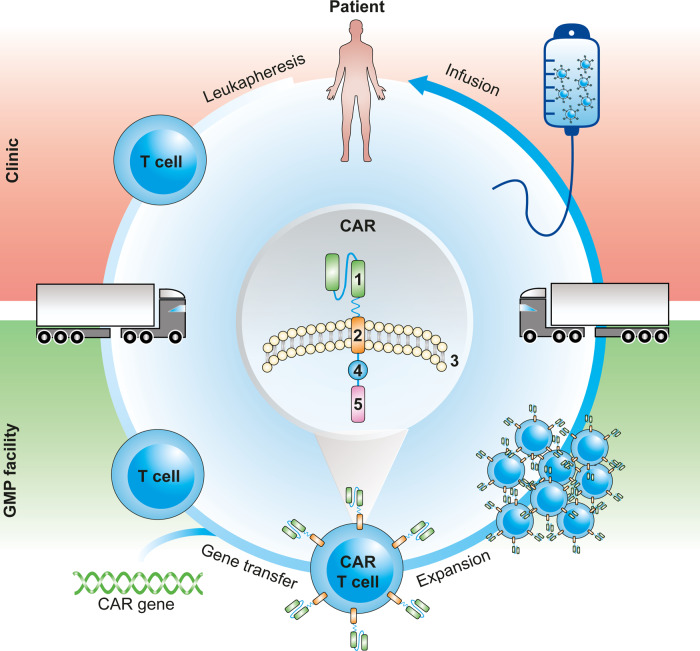
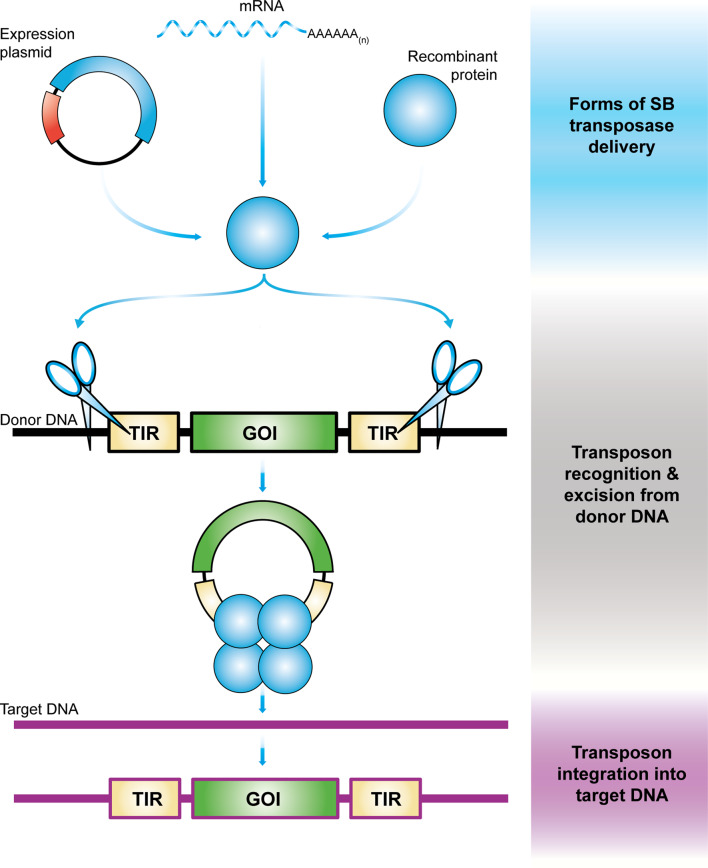
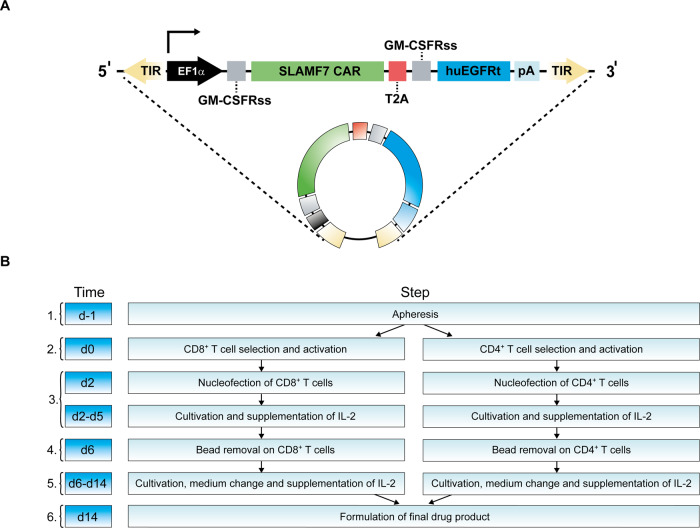
Clinical development of chimeric antigen receptor (CAR)-T-cell therapy has been enabled by advances in synthetic biology, genetic engineering, clinical-grade manufacturing, and complex logistics to distribute the drug product to treatment sites. A key ambition of the CARAMBA project is to provide clinical proof-of-concept for virus-free CAR gene transfer using advanced Sleeping Beauty (SB) transposon technology. SB transposition in CAR-T engineering is attractive due to the high rate of stable CAR gene transfer enabled by optimized hyperactive SB100X transposase and transposon combinations, encoded by mRNA and minicircle DNA, respectively, as preferred vector embodiments. This approach bears the potential to facilitate and expedite vector procurement, CAR-T manufacturing and distribution, and the promise to provide a safe, effective, and economically sustainable treatment. As an exemplary and novel target for SB-based CAR-T cells, the CARAMBA consortium has selected the SLAMF7 antigen in multiple myeloma. SLAMF7 CAR-T cells confer potent and consistent anti-myeloma activity in preclinical assays in vitro and in vivo. The CARAMBA clinical trial (Phase-I/IIA; EudraCT: 2019-001264-30) investigates the feasibility, safety, and anti-myeloma efficacy of autologous SLAMF7 CAR-T cells. CARAMBA is the first clinical trial with virus-free CAR-T cells in Europe, and the first clinical trial that uses advanced SB technology worldwide.
Overview
The claims and statistics of this paper haven’t been checked yet.
Run the check — free, no account needed. It reads the open-access text and checks the sources it cites.
Integrity signals
Registry
Cites
Statistics
Figures
Verification
Claims the paper makes
The claims and statistics of this paper haven’t been checked yet.
Run the check — free, no account needed. It reads the open-access text and checks the sources it cites.
Claims other papers make about this one
Each is checked against this paper’s own text: does it say what the citing paper says it does?
In the citing paper
“SCFA-treatment during CTL manufacturing, which can readily be implemented in clinical-grade GMP manufacturing processes44.”
From Microbial short-chain fatty acids modulate CD8+ T cell responses and improve adoptive immunotherapy for cancer (2021) · cites this paper as [44]
Self-check
Percentages, sums and reported differences re-computed from the paper’s own numbers.
The self-check needs the paper’s full text.
Citations
Cites
The origin and behavior of mutable loci in maize
McClintock, B. (1950) · Proceedings of the National Academy of Sciences · doi:10.1073/pnas.36.6.344 · Cited by 1,752
Anti-BCMA CAR T-cell therapy bb2121 in relapsed or refractory multiple myeloma.
Raje, N., Berdeja, J., Lin, Y., Siegel, D., Jagannath, S., Madduri, D., Liedtke, M., Rosenblatt, J., Maus, M. V., Turka, A., et al. (2019) · New England Journal of Medicine · doi:10.1056/nejmoa1817226 · Cited by 1,730
Ivics, Z., Hackett, P. B., Plasterk, R. H. A., & Izsvák, Z. (1997) · Cell · doi:10.1016/s0092-8674(00)80436-5 · Cited by 1,431
Self-citationKawalekar, O. U., O’Connor, R. S., Fraietta, J. A., Guo, L., McGettigan, S. E., Posey, A. D., Patel, P. R., Guedan, S., Scholler, J., Keith, B., et al. (2016) · Immunity · doi:10.1016/j.immuni.2016.01.021 · Cited by 1,267
Mátés, L., Chuah, M., Belay, E., Jerchow, B., Manoj, N., Acosta‐Sanchez, A., Grzela, D. P., Schmitt, A., Becker, K., Mátrai, J., et al. (2009) · Nature Genetics · doi:10.1038/ng.343 · Cited by 965
Self-citationSommermeyer, D., Hudecek, M., Kosasih, P. L., Gogishvili, T., Maloney, D. G., Turtle, C. J., & Riddell, S. R. (2015) · Leukemia · doi:10.1038/leu.2015.247 · Cited by 888
Self-citationAli, S. A., Shi, V., Marić, I., Wang, M. L., Stroncek, D. F., Rose, J. J., Brudno, J. N., Stetler‐Stevenson, M., Feldman, S. A., Hansen, B. G., et al. (2016) · Blood · doi:10.1182/blood-2016-04-711903 · Cited by 776
Wang, X., Chang, W.-C., Wong, C. W., Colcher, D. M., Sherman, M. A., Ostberg, J. R., Forman, S. J., Riddell, S. R., & Jensen, M. C. (2011) · Blood · doi:10.1182/blood-2011-02-337360 · Cited by 605
CS1, a Potential New Therapeutic Antibody Target for the Treatment of Multiple Myeloma
Hsi, E. D., Steinle, R., Balasa, B., Szmania, S. M., Draksharapu, A., Shum, B. P., Huseni, M. A., Powers, D., Nanisetti, A., Zhang, Y., et al. (2008) · Clinical Cancer Research · doi:10.1158/1078-0432.ccr-07-4246 · Cited by 558
Yant, S. R., Meuse, L. A., Chiu, W. S., Ivics, Z., Izsvák, Z., & Kay, M. A. (2000) · Nature Genetics · doi:10.1038/75568 · Cited by 509
Self-citation
Cited by
Sorted by citations
Luu, M., Riester, Z., Baldrich, A., Reichardt, N., Yuille, S., Busetti, A., Klein, M., Wempe, A., Leister, H., Raifer, H., et al. (2021) · Nature Communications · doi:10.1038/s41467-021-24331-1 · Cited by 771
Self-citationCAR-T Cell Therapy in Hematological Malignancies: Current Opportunities and Challenges
Zhang, X., Zhu, L., Zhang, H., Chen, S., & Xiao, Y. (2022) · Frontiers in Immunology · doi:10.3389/fimmu.2022.927153 · Cited by 460
CAR-T cell manufacturing: Major process parameters and next-generation strategies
Ceja, M. A., Khericha, M., Harris, C. M., Puig-Saus, C., & Chen, Y. Y. (2023) · The Journal of Experimental Medicine · doi:10.1084/jem.20230903 · Cited by 349
Advancements and challenges in developing in vivo CAR T cell therapies for cancer treatment
Bui, T. A., Mei, H., Sang, R., Gallego‐Ortega, D., & Deng, W. (2024) · EBioMedicine · doi:10.1016/j.ebiom.2024.105266 · Cited by 190
CAR-T cell therapy in multiple myeloma: Current limitations and potential strategies
Zhang, X., Zhang, H., Lan, H., Wu, J., & Xiao, Y. (2023) · Frontiers in Immunology · doi:10.3389/fimmu.2023.1101495 · Cited by 181
Metadata
- Authors
- Prommersberger, S., Reiser, M., Beckmann, J., Danhof, S., Amberger, M., Quade-Lyssy, P., Einsele, H., Hudecek, M., Bonig, H., & Ivics, Z.
- Affiliations
- Universitätsklinikum Würzburg (DE)
- Goethe University Frankfurt (DE)
- Paul Ehrlich Institut (DE)
- Corresponding author
- Ivics, Zoltán
- ORCID
- Venue
- Gene Therapy
- Published
- 2021-04-13
- Volume
- 28
- Issue
- 9
- Pages
- 560-571
- ISSN
- 0969-7128 (ISSN-L)
- 1476-5462
- PMC
- PMC8455317
- OpenAlex
- W3154860673
- Cited by
- 182
- References
- 62
- Citations by year
- 2026: 23 · 2025: 38 · 2024: 43 · 2023: 35 · 2022: 28 · 2021: 15
- FWCI
- 11.64
- Type
- journal article
- Language
- en
- Open access
- hybrid
- doi.org
- Locations
- Gene Therapy (publishedVersion, cc-by)
- Europe PMC (PubMed Central) (publishedVersion, other-oa)
- PubMed Central (publishedVersion, cc-by)
- PubMed (publishedVersion)
- Informationszentrum Lebenswissenschaften (ZB MED) (submittedVersion, cc-by)
- Online Publication Service of Würzburg University (Würzburg University) (submittedVersion, cc-by)
- Funders
- EC | Horizon 2020 Framework Programme (754658)
- Topics
- Health Sciences › Medicine › Oncology › CAR-T cell therapy research
- Life Sciences › Biochemistry, Genetics and Molecular Biology › Genetics › Virus-based gene therapy research
- Life Sciences › Immunology and Microbiology › Immunology › Immunotherapy and Immune Responses
- Keywords
- SLAMF7, chimeric antigen receptor T cells, multiple myeloma, Sleeping Beauty transposon, DNA minicircles
- MeSH terms
- Signaling Lymphocytic Activation Molecule Family, Humans, Multiple Myeloma, T-Lymphocytes, Genetic Therapy, Immunotherapy, Adoptive
About these checks
Registry, retraction, Cites and statistics results are computed, not judged, with one exception: a printed reference that no index lists is read once by a model before it counts as a citation error. Claims are extracted by a model and kept only when their quote appears verbatim in the text; each cited source is then checked, with a model’s help, for whether it says what the claim relies on. Those verdicts can be wrong — read the claim’s quote and the cited source before relying on one.
Statistics and arithmetic are recomputed, not judged.
Confidence bands are shown only for fields calibrated on our annotated test set. None is calibrated yet, so no band is shown.
What counts as a claim ›How we measure confidence ›How we check this ›
Are you an author, or do you see a problem with this page? Request a review
