

The DOI matches its Crossref record; the references it cites are not checked yet.
From physics to fixtures to food: current and potential LED efficacy
Open accessAbstract
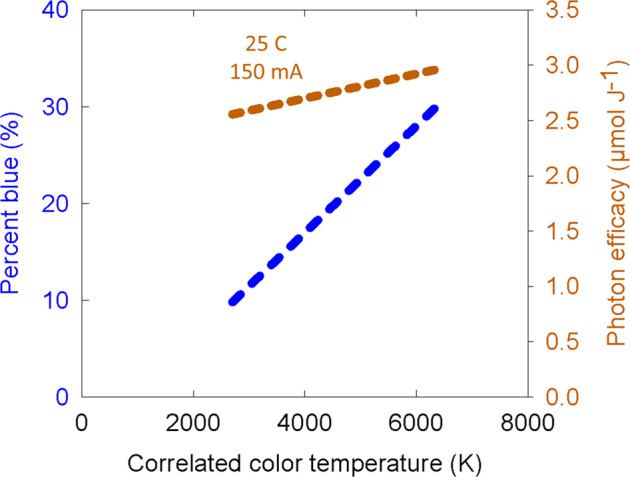
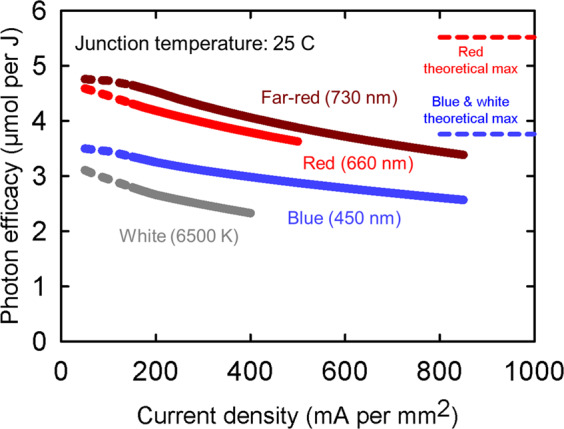
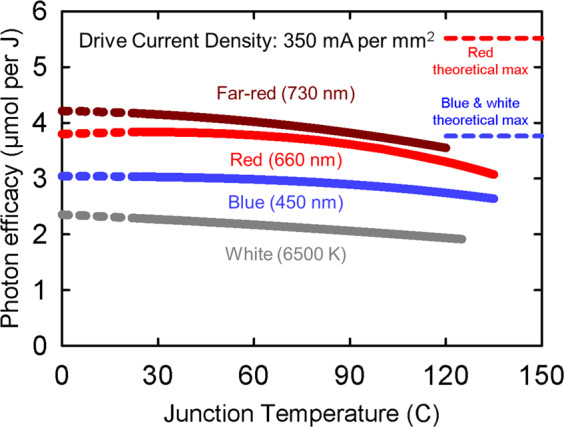
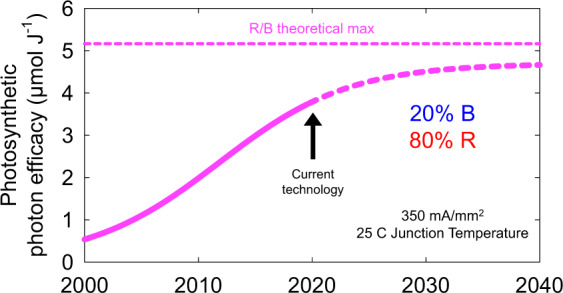
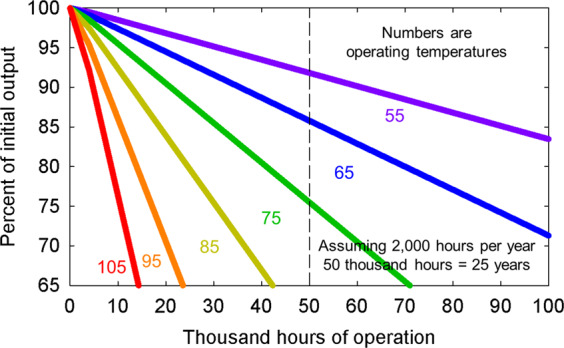
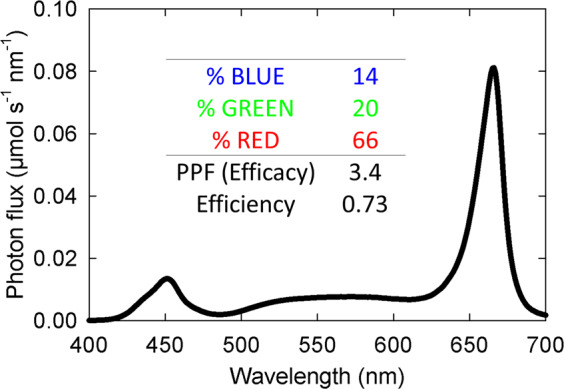
Light-emitting diodes (LEDs) have enabled a historic increase in the conversion of electric energy to photons, but this is approaching a physical limit. The theoretical maximum efficiency occurs when all input energy is converted to energy in photosynthetic photons. Blue LEDs can be 93% efficient, phosphor-converted “whites” 76% efficient, and red LEDs 81% efficient. These improvements open new opportunities for horticultural lighting. Here we review (1) fundamental physics and efficiency of LEDs, (2) the current efficacy of LEDs, (3) the effect of spectral quality on crop yield, and (4) the potential efficacy of horticultural fixtures. Advances in the conversion of photons to yield can be achieved by optimization of spectral effects on plant morphology, which vary among species. Conversely, spectral effects on photosynthesis are remarkably similar across species, but the conventional definition of photosynthetic photons (400–700 nm) may need to be modified. The upper limit of LED fixture efficacy is determined by the LED package efficacy multiplied by four factors inherent to all fixtures: current droop, thermal droop, driver (power supply) inefficiencies, and optical losses. With current LED technology, the calculations indicate efficacy limits of 3.4 µmol J −1 for white + red fixtures, and 4.1 µmol J −1 for blue + red fixtures. Adding optical protection from water and high humidity reduces these values by ~10%. We describe tradeoffs between peak efficacy and cost.
Overview
The claims and statistics of this paper haven’t been checked yet.
Run the check — free, no account needed. It reads the open-access text and checks the sources it cites.
Integrity signals
Registry
Cites
Statistics
Figures
Verification
Claims the paper makes
The claims and statistics of this paper haven’t been checked yet.
Run the check — free, no account needed. It reads the open-access text and checks the sources it cites.
Claims other papers make about this one
Each is checked against this paper’s own text: does it say what the citing paper says it does?
The source backs part of the claim, not all of it — or backs it for a different population, condition or comparison.
In the citing paper
“Such control allows the simulation of a variety of photoperiod regimes, including continuous, pulsed, intermittent, and short-day cycles (Borella et al., 2022; Kusuma et al., 2020).”
From Microalgae biotechnology and its role in sustainable and healthy food design (2025) · cites this paper as Kusuma et al., 2020
Experimental — accuracy not yet measured
Self-check
Percentages, sums and reported differences re-computed from the paper’s own numbers.
The self-check needs the paper’s full text.
Citations
The citation lists are queued
They are fetched later and appear here then.
References 48 · Cited by 283
Research works printed but not linked: 1
- Shchekin, O. LED technology considerations for high luminance sources. DOE SSL R&D Workshop. https://www.energy.gov/sites/prod/files/2017/02/f34/shchekin_considerations_longbeach2017.pdf (2017).
Metadata
- Authors
- Kusuma, P., Pattison, P. M., & Bugbee, B.
- Affiliations
- Utah State University (US)
- Corresponding author
- Bugbee, Bruce
- Venue
- Horticulture Research
- Publisher
- Oxford University Press (OUP)
- Published
- 2020-03-30
- Volume
- 7
- Issue
- 1
- Pages
- 56-56
- ISSN
- 2052-7276 (ISSN-L)
- 2662-6810
- PMC
- PMC7105460
- OpenAlex
- W3013613785
- Cited by
- 283
- References
- 48
- Citations by year
- 2026: 44 · 2025: 59 · 2024: 51 · 2023: 41 · 2022: 34 · 2021: 39 · 2020: 15
- FWCI
- 2.73
- Type
- journal article
- Language
- en
- Open access
- gold
- doi.org
- Locations
- Horticulture Research (publishedVersion, cc-by)
- Europe PMC (PubMed Central) (publishedVersion, cc-by)
- PubMed Central (publishedVersion, cc-by)
- PubMed (publishedVersion)
- OSTI OAI (U.S. Department of Energy Office of Scientific and Technical Information) (submittedVersion)
- Digital Commons - USU (Utah State University) (submittedVersion, cc-by)
- Funders
- Utah Agricultural Experiment Station (9260)
- United States Department of Agriculture | National Institute of Food and Agriculture (2018-51181-28365)
- National Aeronautics and Space Administration (NNX17AJ31G)
- NASA-CUBES: https://cubes.space/
- Topics
- Life Sciences › Agricultural and Biological Sciences › Plant Science › Light effects on plants
- Physical Sciences › Physics and Astronomy › Condensed Matter Physics › GaN-based semiconductor devices and materials
- Life Sciences › Agricultural and Biological Sciences › Plant Science › Greenhouse Technology and Climate Control
- Keywords
- light-emitting diodes, plant growth lighting, light quality, blue LEDs, red LED, phosphor-converted white LEDs, optical loss, crop yield, plant morphology, photosynthesis
About these checks
Registry, retraction, Cites and statistics results are computed, not judged, with one exception: a printed reference that no index lists is read once by a model before it counts as a citation error. Claims are extracted by a model and kept only when their quote appears verbatim in the text; each cited source is then checked, with a model’s help, for whether it says what the claim relies on. Those verdicts can be wrong — read the claim’s quote and the cited source before relying on one.
Statistics and arithmetic are recomputed, not judged.
Confidence bands are shown only for fields calibrated on our annotated test set. None is calibrated yet, so no band is shown.
What counts as a claim ›How we measure confidence ›How we check this ›
Are you an author, or do you see a problem with this page? Request a review
How to cite
Cite CoChat for the checks on this page, and the paper for its own findings.
- This page
- CoChat. (2026). Citation check: From physics to fixtures to food: current and potential LED efficacy. https://app.cochat.ai/papers/10.1038/s41438-020-0283-7
- The paper
- Kusuma, P., Pattison, P. M., & Bugbee, B. (2020). From physics to fixtures to food: current and potential LED efficacy. Horticulture Research. https://doi.org/10.1038/s41438-020-0283-7
