

The DOI matches its Crossref record; 3 of the 3 references it cites were found in a registry or an index.
Topological hybrid silicon microlasers
Abstract
Topological physics provides a robust framework for strategically controlling wave confinement and propagation dynamics. However, current implementations have been restricted to the limited design parameter space defined by passive topological structures. Active systems provide a more general framework where different fundamental symmetry paradigms, such as those arising from non-Hermiticity and nonlinear interaction, can generate a new landscape for topological physics and its applications. Here, we bridge this gap and present an experimental investigation of an active topological photonic system, demonstrating a topological hybrid silicon microlaser array respecting the charge-conjugation symmetry. The created new symmetry features favour the lasing of a protected zero mode, where robust single-mode laser action in the desired state prevails even with intentionally introduced perturbations. The demonstrated microlaser is hybrid implemented on a silicon-on-insulator substrate, and is thereby readily suitable for integrated silicon photonics with applications in optical communication and computing.
Overview
The claims and statistics of this paper haven’t been checked yet.
Run the check — free, no account needed. It reads the open-access text and checks the sources it cites.
Integrity signals
Registry
Cites
Statistics
Figures
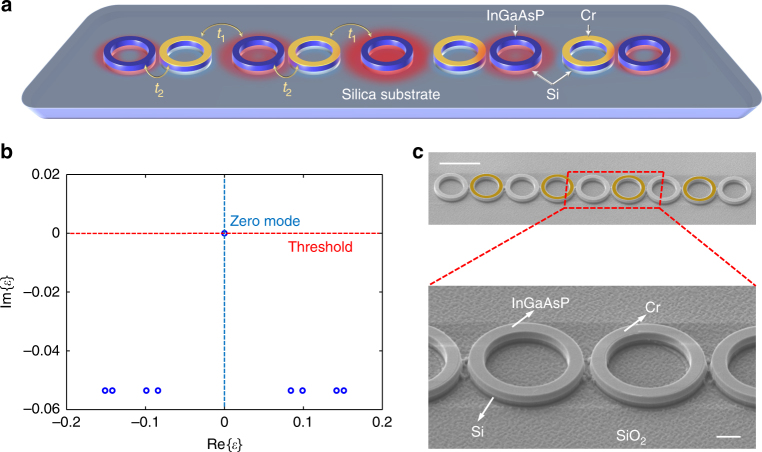
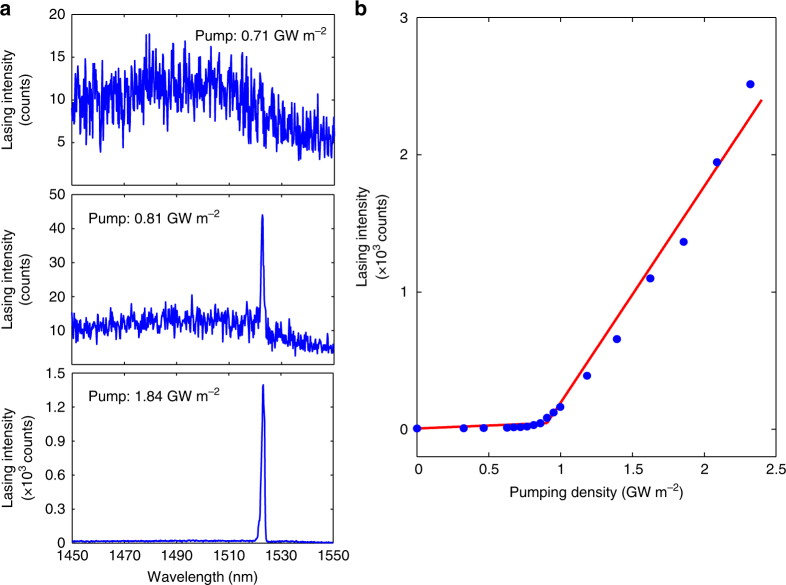
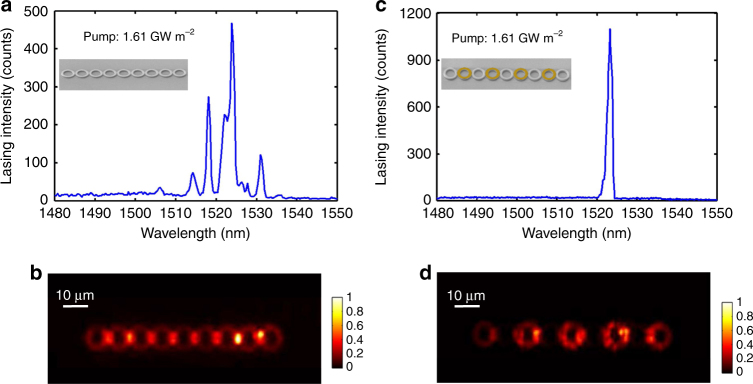
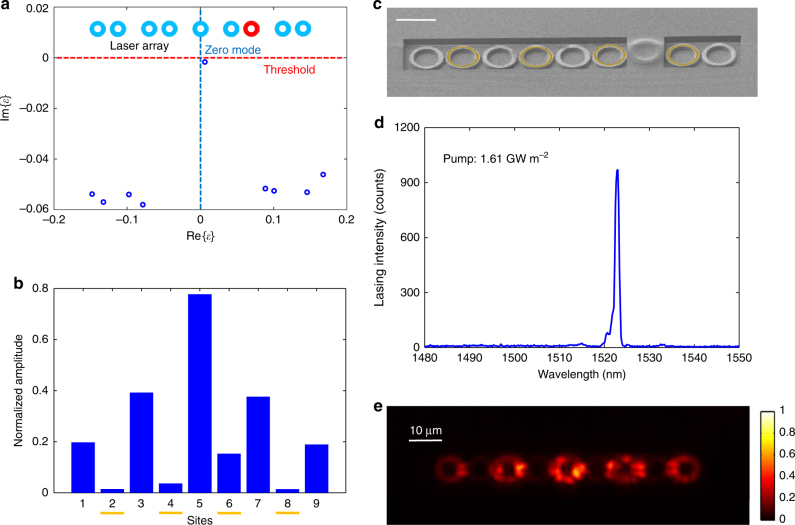
Verification
Claims the paper makes
The claims and statistics of this paper haven’t been checked yet.
Run the check — free, no account needed. It reads the open-access text and checks the sources it cites.
Claims other papers make about this one
Each is checked against this paper’s own text: does it say what the citing paper says it does?
The cited source doesn’t support the claim as written.
In the citing paper
“Lasing in the edge state of the SSH model was recently experimentally observed by St-Jean et al. (2017), Parto et al. (2018), andZhao et al. (2018).”
From Topological photonics (2019) · cites this paper as Zhao et al. (2018)
Checked by a reasoning model — may be wrong.
Experimental — accuracy not yet measured
Self-check
Percentages, sums and reported differences re-computed from the paper’s own numbers.
The self-check needs the paper’s full text.
Citations
Cites
Photonic Floquet topological insulators
Rechtsman, M. C., Zeuner, J. M., Plotnik, Y., Lumer, Y., Podolsky, D., Dreisow, F., Nolte, S., Segev, M., & Szameit, A. (2013) · Nature · doi:10.1038/nature12066 · Cited by 3,332
Observation of unidirectional backscattering-immune topological electromagnetic states
Wang, Z., Chong, Y., Joannopoulos, J. D., & Soljačić, M. (2009) · Nature · doi:10.1038/nature08293 · Cited by 3,123
Observation of a Topological Transition in the Bulk of a Non-Hermitian System
Zeuner, J. M., Rechtsman, M. C., Plotnik, Y., Lumer, Y., Nolte, S., Rudner, M. S., Segev, M., & Szameit, A. (2015) · Physical Review Letters · doi:10.1103/physrevlett.115.040402 · Cited by 730
Research works printed but not linked: 39
- Asbóth, J. K., Oroszlány, L. & Pályi, A. A Short Course on Topological Insulators, Lecture Notes in Physics, Vol. 919 (Springer International Publishing, 2016). · DOI
- Haldane, F. D. M. & Raghu, S. Possible realization of directional optical waveguides in photonic crystals with broken time-reversal symmetry. Phys. Rev. Lett. 100, 013904 (2008). · DOI · Paper page
- Hafezi, M., Demler, E. A., Lukin, M. D. & Taylor, J. M. Robust optical delay lines with topological protection. Nat. Phys. 7, 907–912 (2011). · DOI · Paper page
- Hafezi, M., Mittal, S., Fan, J., Migdall, A. & Taylor, J. M. Imaging topological edge states in silicon photonics. Nat. Photonics 7, 1001–1005 (2013). · DOI · Paper page
- Khanikaev, A. B. et al. Photonic topological insulators. Nat. Mater. 12, 233–239 (2012). · DOI · Paper page
- Sinev, I. S. et al. Mapping plasmonic topological states at the nanoscale. Nanoscale 7, 11904–11908 (2015). · DOI
- Mittal, S. et al. Topologically robust transport of photons in a synthetic gauge field. Phys. Rev. Lett. 113, 087403 (2014). · DOI
- Verbin, M., Zilberberg, O., Lahini, Y., Kraus, Y. E. & Silberberg, Y. Topological pumping over a photonic Fibonacci quasicrystal. Phys. Rev. B 91, 064201 (2015). · DOI · Paper page
- He, C. et al. Acoustic topological insulator and robust one-way sound transport. Nat. Phys. 12, 1124–1129 (2016). · DOI
- Lu, L., Joannopoulos, J. D. & Soljačić, M. Topological photonics. Nat. Photonics 8, 821–829 (2014). · DOI · Paper page
- Wu, Y., Li, C., Ao, Y., Zhao, Y. & Gong, Q. Applications of topological photonics in integrated photonic devices. Adv. Opt. Mater. 5, 1700357 (2017). · DOI
- Pilozzi, L. & Conti, C. Topological lasing in resonant photonic structures. Phys. Rev. B 93, 195317 (2016). · DOI
- Bahari, B. et al. Nonreciprocal lasing in topological cavities of arbitrary geometries. Science 358, 636–640 (2017). · DOI · Paper page
- Bandres, M. A. et al. Topological insulator laser: experiments. Science https://doi.org/10.1126/science.aar4005 (2018). · DOI · Paper page
- Rüter, C. E. et al. Observation of parity-time symmetry in optics. Nat. Phys. 6, 192–195 (2010). · DOI
- Longhi, S. PT-symmetric laser absorber. Phys. Rev. A 82, 031801 (2010). · DOI
- Lin, Z. et al. Unidirectional invisibility induced by PT-symmetric periodic structures. Phys. Rev. Lett. 106, 213901 (2011). · DOI
- Peng, B. et al. Parity-time-symmetric whispering-gallery microcavities. Nat. Phys. 10, 394–398 (2014). · DOI
- Feng, L., Wong, Z. J., Ma, R.-M., Wang, Y. & Zhang, X. Single-mode laser by parity-time symmetry breaking. Science 346, 972–975 (2014). · DOI
- Hodaei, H., Miri, M.-A., Heinrich, M., Christodoulides, D. N. & Khajavikhan, M. Parity-time-symmetric microring lasers. Science 346, 975–978 (2014). · DOI
- Cao, H. & Wiersig, J. Dielectric microcavities: model systems for wave chaos and non-Hermitian physics. Rev. Mod. Phys. 87, 61–111 (2015). · DOI
- Ge, L., Malik, O. & Tureci, H. E. Enhancement of laser power-efficiency by control of spatial hole burning. Nat. Photonics 8, 871–875 (2014). · DOI
- Rudner, M. S. & Levitov, L. S. Topological transition in a non-Hermitian quantum walk. Phys. Rev. Lett. 102, 065703 (2009). · DOI
- Schomerus, H. Topologically protected midgap states in complex photonic lattices. Opt. Lett. 38, 1912–1914 (2013). · DOI
- Poli, C., Bellec, M., Kuhl, U., Mortessagne, F. & Schomerus, H. Selective enhancement of topologically induced interface states in a dielectric resonator chain. Nat. Commun. 6, 6710 (2015). · DOI
- Malzard, S., Poli, C. & Schomerus, H. Topologically protected defect states in open photonic systems with non-Hermitian charge-conjugation and parity-time symmetry. Phys. Rev. Lett. 115, 200402 (2015). · DOI · Paper page
- Weimann, S. et al. Topologically protected bound states in photonic parity-time-symmetric crystals. Nat. Mater. 16, 433–438 (2016). · DOI
- Leykam, D., Bliokh, K. Y., Huang, C., Chong, Y. D. & Nori, F. Edge modes, degeneracies, and topological numbers in non-Hermitian systems. Phys. Rev. Lett. 118, 040401 (2017). · DOI
- Brandstetter, M. et al. Reversing the pump dependence of a laser at an exceptional point. Nat. Commun. 5, 4034 (2014). · DOI
- Peng, B. et al. Loss-induced suppression and revival of lasing. Science 346, 328–332 (2014). · DOI
- Andreasen, J., Vanneste, C., Ge, L. & Cao, H. Effects of spatially nonuniform gain on lasing modes in weakly scattering random systems. Phys. Rev. A 81, 043818 (2010). · DOI
- St-Jean, P. et al. Lasing in topological edge states of a one-dimensional lattice. Nat. Photonics 11, 651–656 (2017). · DOI · Paper page
- Su, W. P., Schrieffer, J. R. & Heeger, A. J. Solitons in polyacetylene. Phys. Rev. Lett. 42, 1698–1701 (1979). · DOI · Paper page
- Ryu, S. & Hatsugai, Y. Topological origin of zero-energy edge states in particle-hole symmetric systems. Phys. Rev. Lett. 89, 077802 (2002). · DOI · Paper page
- Malkova, N., Hromada, I., Wang, X., Bryant, G. & Chen, Z. Observation of optical Shockley-like surface states in photonic superlattices. Opt. Lett. 34, 1633–1635 (2009). · DOI · Paper page
- Atala, M. et al. Direct measurement of the Zak phase in topological Bloch bands. Nat. Phys. 9, 795–800 (2013). · DOI · Paper page
- Sutherland, B. Localization of electronic wave functions due to local topology. Phys. Rev. B 34, 5208–5211 (1986). · DOI
- Parto, M. et al. Complex edge-state phase transitions in 1D topological laser arrays. Preprint at https://arxiv.org/abs/1709.00523 (2017). · DOI
- Longhi, S. Non-Hermitian gauged topological laser arrays. Preprint at https://arxiv.org/abs/1801.00996 (2018). · DOI
Cited by
Sorted by citations
Ozawa, T., Price, H. M., Amo, A., Goldman, N., Hafezi, M., Lu, L., Rechtsman, M. C., Schuster, D., Simon, J., Zilberberg, O., et al. (2019) · Reviews of Modern Physics · doi:10.1103/revmodphys.91.015006 · Cited by 3,722
A second wave of topological phenomena in photonics and acoustics
Zhang, X., Zangeneh-Nejad, F., Chen, Z.-G., Lu, M.-H., & Christensen, J. (2023) · Nature · doi:10.1038/s41586-023-06163-9 · Cited by 240
Topological Insulator Laser Using Valley-Hall Photonic Crystals
Gong, Y., Wong, S., Bennett, A. J., Huffaker, D. L., & Oh, S. S. (2020) · ACS Photonics · doi:10.1021/acsphotonics.0c00521 · Cited by 191
Metadata
- Authors
- Zhao, H., Miao, P., Teimourpour, M. H., Malzard, S., El-Ganainy, R., Schomerus, H., & Feng, L.
- Venue
- Nature Communications
- Published
- 2018-03-07
- Volume
- 9
- Issue
- 1
- ISSN
- 2041-1723
- PMC
- PMC5841408
- Cited by
- 429
- References
- 3
- Language
- en
About these checks
Registry, retraction, Cites and statistics results are computed, not judged, with one exception: a printed reference that no index lists is read once by a model before it counts as a citation error. Claims are extracted by a model and kept only when their quote appears verbatim in the text; each cited source is then checked, with a model’s help, for whether it says what the claim relies on. Those verdicts can be wrong — read the claim’s quote and the cited source before relying on one.
Statistics and arithmetic are recomputed, not judged.
Confidence bands are shown only for fields calibrated on our annotated test set. None is calibrated yet, so no band is shown.
What counts as a claim ›How we measure confidence ›How we check this ›
Are you an author, or do you see a problem with this page? Request a review
