

Formation and radiative forcing of contrail cirrus
Open accessThe DOI matches its Crossref record; 153 of the 153 references it cites were found in a registry or an index.
Abstract
Aircraft-produced contrail cirrus clouds contribute to anthropogenic climate change. Observational data sets and modelling approaches have become available that clarify formation pathways close to the source aircraft and lead to estimates of the global distribution of their microphysical and optical properties. While contrail cirrus enhance the impact of natural clouds on climate, uncertainties remain regarding their properties and lifecycle. Progress in representing aircraft emissions, contrail cirrus and natural cirrus in global climate models together with tighter constraints on the sensitivity of the climate system will help judge efficiencies of and trade-offs between mitigation options.
Overview
The claims and statistics of this paper haven’t been checked yet.
Free: it reads the open-access text and checks the first 5 claims that cite a source we can check. Create a free account to check every claim.
Integrity signals
Registry
Cites
Statistics
Figures
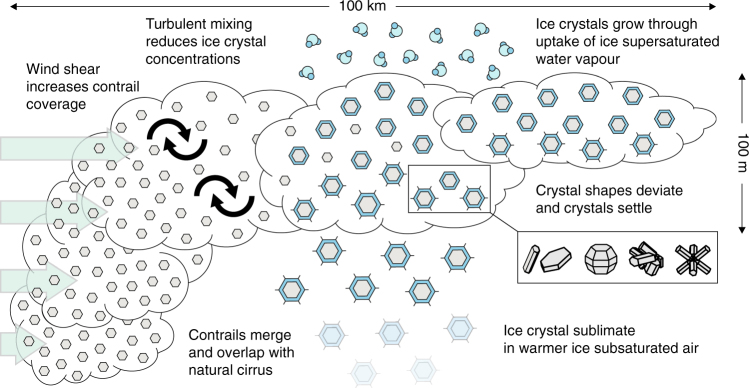
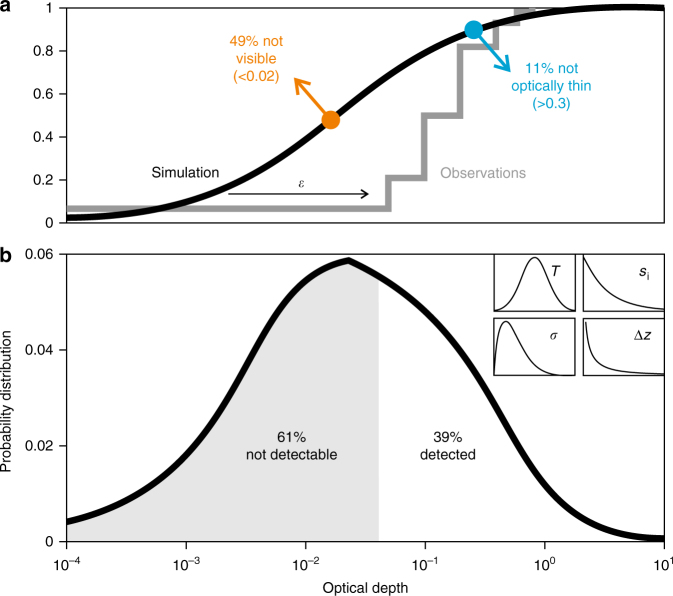
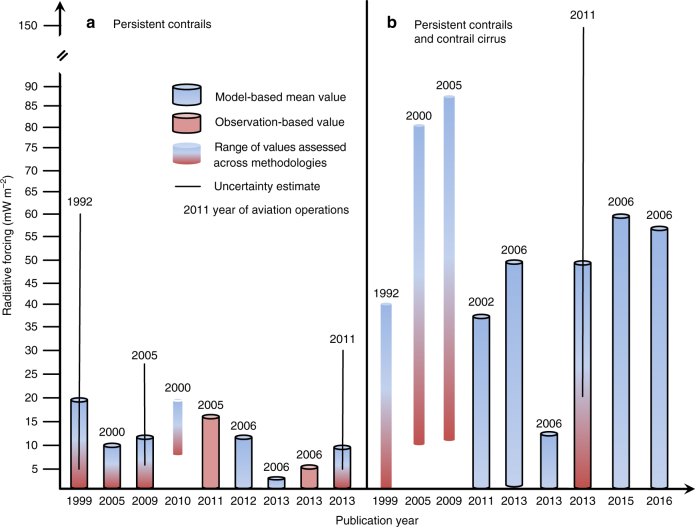
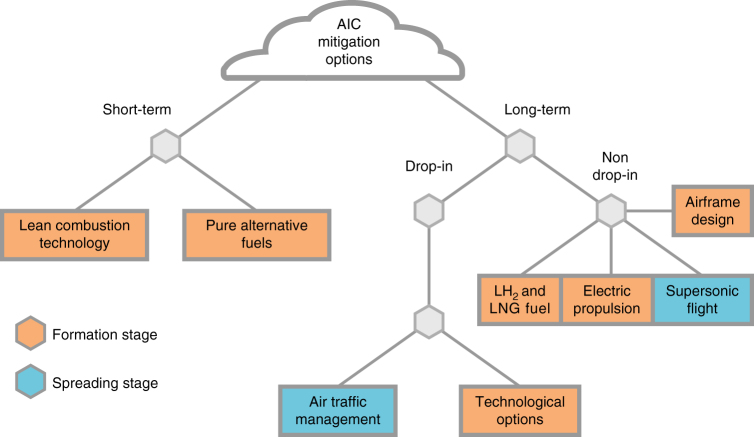
Verification
Claims the paper makes
The claims and statistics of this paper haven’t been checked yet.
Free: it reads the open-access text and checks the first 5 claims that cite a source we can check. Create a free account to check every claim.
Claims other papers make about this one
Each is checked against this paper’s own text: does it say what the citing paper says it does?
The source backs part of the claim, not all of it — or backs it for a different population, condition or comparison.
In the citing paper
“For the Ref2 fuel, the measured nonvolatile particle emission index of (4.9 ± 0.6) × 10 15 soot particles produced per kilogram of Jet A1 fuel burned is toward the upper end of the soot emission levels of the current aircraft fl eet (10 14 -10 16 soot particles per kilogram of fuel burned 5,19,34 ).”
From Cleaner burning aviation fuels can reduce contrail cloudiness (2021) · cites this paper as [19]
Experimental — accuracy not yet measuredThe source backs part of the claim, not all of it — or backs it for a different population, condition or comparison.
In the citing paper
“This fi nding is consistent with theoretical expectations that soot particles regulate the number of contrail ice crystals and that background or small volatile particles do not signi fi cantly contribute to ice crystal formation for the observed conditions of high soot emissions (>10 15 soot particles per kg-fuel) in the sootrich regime and ambient temperatures well below the SAT 19,37 .”
From Cleaner burning aviation fuels can reduce contrail cloudiness (2021) · cites this paper as [19]
Experimental — accuracy not yet measuredThe source backs part of the claim, not all of it — or backs it for a different population, condition or comparison.
In the citing paper
“This occurs because the low soot particle concentrations in the exhaust do not effectively scavenge the sulfur oxidation products and because the volatile aerosol grows to larger sizes at low ambient temperatures 19 .”
From Cleaner burning aviation fuels can reduce contrail cloudiness (2021) · cites this paper as [19]
Experimental — accuracy not yet measuredThe source backs part of the claim, not all of it — or backs it for a different population, condition or comparison.
In the citing paper
“It ' s important to note that the small volatile particles or atmospheric background particles do begin to contribute meaningfully to contrail formation under ' soot-poor ' regimes (<10 13 soot particles per kg of fuel burned) that might result from next-generation hydrogen fuels or lean-burn engine technology.”
From Cleaner burning aviation fuels can reduce contrail cloudiness (2021) · cites this paper as [19]
Experimental — accuracy not yet measuredThe source backs part of the claim, not all of it — or backs it for a different population, condition or comparison.
In the citing paper
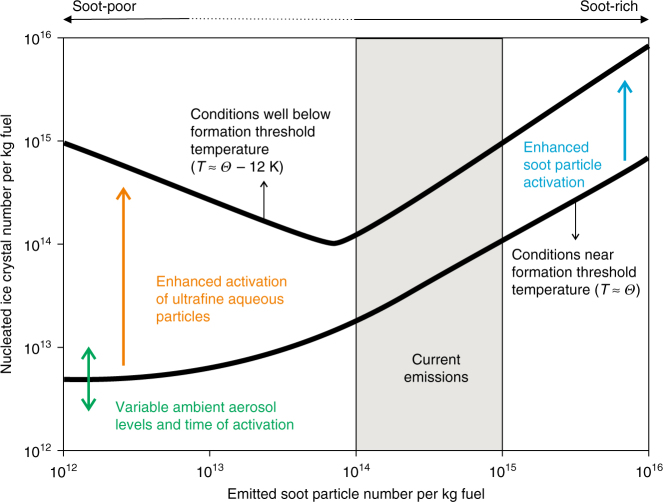
“Also, in the so-called ' soot-rich regime ' exceeding 10 15 kg -1 (see Fig. 4), the soot particles actively scavenge the sulfur oxidation products in the exhaust at the expense of volatile particles 19 .”
From Cleaner burning aviation fuels can reduce contrail cloudiness (2021) · cites this paper as [19]
Experimental — accuracy not yet measured
1 more claim about this paper
Create a free account to see every claim other papers make about this one.
Self-check
Percentages, sums and reported differences re-computed from the paper’s own numbers.
The self-check needs the paper’s full text.
Citations
Cites
A safe operating space for humanity
Rockström, J., Steffen, W., Noone, K., Persson, Å., Chapin, F. S., Lambin, E. F., Lenton, T. M., Scheffer, M., Folke, C., Schellnhuber, H. J., et al. (2009) · Nature · doi:10.1038/461472a · Cited by 13,333
Barker, T., Bashmakov, I., Bernstein, L., Bogner, J., Bösch, P., Dave, R., Davidson, O. R., Fisher, B. S., Grubb, M. J., Gupta, S., et al. (2007) · Wageningen University & Research Publications · Cited by 9,211
Barker, T. J., Bashmakov, I., Bernstein, L., Bogner, J. R., Bosch, P. C., Dave, R., Davidson, O., Fisher, B. S., Grubb, M. J., Gupta, S. K., et al. (2007) · Socio-Environmental Systems Modeling · Cited by 9,160
Bounding the role of black carbon in the climate system: A scientific assessment
Bond, T. C., Doherty, S. J., Fahey, D. W., Forster, P. M., Berntsen, T., DeAngelo, B. J., Flanner, M. G., Ghan, S., Kärcher, B., Koch, D., et al. (2013) · Journal of Geophysical Research: Atmospheres · doi:10.1002/jgrd.50171 · Cited by 6,385
Self-citation(2014) · Climate Change 2013 – The Physical Science Basis · doi:10.1017/cbo9781107415324.016 · Cited by 1,423
Aviation and global climate change in the 21st century
Lee, D. S., Fahey, D. W., Forster, P. M., Newton, P. J., Wit, R. C. N., Lim, L. L., Owen, B., & Sausen, R. (2009) · Atmospheric Environment · doi:10.1016/j.atmosenv.2009.04.024 · Cited by 1,072
An Overview of the Global Historical Climatology Network Temperature Database
Peterson, T. C., & Vose, R. S. (1997) · Bulletin of the American Meteorological Society · doi:10.1175/1520-0477(1997)078<2837:aootgh>2.0.co;2 · Cited by 910
Transport impacts on atmosphere and climate: Aviation
Lee, D. S., Pitari, G., Grewe, V., Gierens, K., Penner, J. E., Petzold, A., Prather, M. J., Schumann, U., Bais, A., & Berntsen, T. (2010) · Atmospheric Environment · doi:10.1016/j.atmosenv.2009.06.005 · Cited by 765
World Meteorological Organization (WMO)
Bekiashev, K. A., & Serebriakov, V. V. (1981) · International Marine Organizations · doi:10.1007/978-94-009-8261-1_47 · Cited by 703
Blunden, J., & Arndt, D. S. (2016) · Bulletin of the American Meteorological Society · doi:10.1175/2016bamsstateoftheclimate.1 · Cited by 504
Research works printed but not linked: 2
- National Research Council. Radiative Forcing of Climate Change —Expanding the Concept and Addressing Uncertainties 207pp (The National Academies Press, Washington, D.C., 2005). ISBN 0-309-09506-9.
- Baughum, S. L., Danilin, M. Y., Miloshevich, L. M. & Heymsfield, A. J. Properties of ice-supersaturated layers based on radiosonde data analysis. In Proceedings of the TAC-2, June 22—25, 169–173 (2009).
Cited by
Items 501–521 of 521
Samohvalov, I., Bryukhanov, I. D., Kuchinskaya, O. I., Pustovalov, K. N., Zhivotenyuk, I. V., Ni, E., Loktyushin, O., Akimov, I., & Romanov, D. (2025) · XXVIII Международный симпозиум «Оптика атмосферы и океана. Физика атмосферы» · doi:10.56820/conferencearticle_685d0aa1250575.49325138
Will, F., Flüthmann, N., & Eschmann, C. (2025) · Proceedings of the Institution of Mechanical Engineers Part G Journal of Aerospace Engineering · doi:10.1177/09544100221108530
Analysis and Modelling of TTL ice crystals based on in-situ light scattering patterns
Mathen, E. R. (2024) · University of Hertfordshire Research Archive (University of Hertfordshire) · doi:10.18745/th.27465
Coudron, L. (2022) · University of Hertfordshire Research Archive (University of Hertfordshire) · doi:10.18745/pb.25867
Analýza současných možností využití alternativních pohonných jednotek v letectví
Kuchař, P. (2021) · DSpace VŠB-TUO (VŠB-TUO)
Analysis of weather-related uncertainties in the formation of persistent contrails
Hekker, A. (. (2024) · Research Repository (Delft University of Technology)
The Classification of Air Pollutants From Aviation Activities
Tymofiiv, V., Koláriková, I., Hovanec, M., Al-Rabeei, S., & Rácek, B. (2025) · Acta Avionica · doi:10.35116/aa.2025.0016
Effect of aromaticity on soot formation: A reactive molecular dynamics study
Sandia National Laboratories (SNL-CA), L., Eyice, D. K., Program, V. T., Wan, K., Manin, J., & Guzman, F. (2025) · OSTI OAI (U.S. Department of Energy Office of Scientific and Technical Information) · doi:10.2172/3018959
Bryukhanov, I. D., Самохвалов, И. В., Loktyushin, O., Ni, E., Doroshkevich, A. A., Zhivotenyuk, I. V., Стыкон, А. П., & Кириллов, Н. С. (2024) · Digital library (repository) of Tomsk State University
Loktyushin, O., Bryukhanov, I. D., & Pustovalov, K. N. (2023) · Digital library (repository) of Tomsk State University
Design and implementation of an airport agent for sustainable flight route planning
Chimenos, M. E. (2026) · UPCommons institutional repository (Universitat Politècnica de Catalunya)
Strengthening dust–cirrus relationships over Central Europe (2001–2025)Preprint
Varga, G., Gresina, F., Gelencsér, A., Csávics, A., & Rostási, Á. (2026) · doi:10.5194/egusphere-2026-3742
Chen, Y., Ng, K. K. H., & Delahaye, D. (2026) · SSRN Electronic Journal · doi:10.2139/ssrn.7152829
Integration of lidar and meteorological data for a comprehensive study of high-level clouds
Bryukhanov, I. D., Kuchinskaia, O., Samokhvalov, I. V., Pustovalov, K. N., Ni, E. V., Zhivotenyuk, I. V., & Doroshkevich, A. A. (2025) · Journal of Optical Technology · doi:10.1364/jot.92.000699
Teo, L. K. (2026) · International journal of high school research · doi:10.36838/ijhsr811.133
Raza, I., Mehmood, A., & Staudacher, S. (2026) · Physics of Fluids · doi:10.1063/5.0350022
Verification of MERRA-2 reanalysis data for the altitude range of high-level cloud formation
Penzin, M., Kuchinskaia, O., Pustovalov, K. N., Ni, E., Bryukhanov, I. D., & Акимов, И. М. (2026) · Russian Physics Journal · doi:10.1007/s11182-026-03745-8
Wang, T., Zhang, F., Peng, R., Yin, Z., & Fang, X. (2026) · SSRN Electronic Journal · doi:10.2139/ssrn.7664842
Lux, O., Rennie, M., & Reitebuch, O. (2026) · doi:10.5194/egusphere-2026-6087
On the role of urban aerosol particles in cirrus cloud formation
Mendoza-Tellez, S., Gao, J., Negrete, E., Shi, J., Xue, J., Gao, K., Wang, B., & Ladino, L. (2026) · Atmospheric Research · doi:10.1016/j.atmosres.2026.109454
Metadata
- Authors
- Kärcher, B.
- Affiliations
- Deutsches Zentrum für Luft- und Raumfahrt e. V. (DLR) (DE)
- Corresponding author
- Kärcher, Bernd
- ORCID
- Kärcher, Bernd
- Venue
- Nature Communications
- Published
- 2018-05-08
- Volume
- 9
- Issue
- 1
- Pages
- 1824-1824
- ISSN
- 2041-1723 (ISSN-L)
- PMC
- PMC5940853
- OpenAlex
- W2800510884
- Cited by
- 377
- References
- 150
- Citations by year
- 2026: 43 · 2025: 81 · 2024: 62 · 2023: 54 · 2022: 47 · 2021: 37 · 2020: 32 · 2019: 15 · 2018: 6
- FWCI
- 2.55
- Type
- journal article
- Language
- en
- Open access
- gold
- doi.org
- Licence
- cc-by
- creativecommons.org/licenses/by/4.0 (tdm)
- creativecommons.org/licenses/by/4.0 (vor)
- Locations
- Nature Communications (publishedVersion, cc-by)
- Europe PMC (PubMed Central) (publishedVersion, cc-by)
- PubMed Central (publishedVersion, cc-by)
- PubMed (publishedVersion)
- elib (German Aerospace Center) (acceptedVersion)
- RePEc: Research Papers in Economics (submittedVersion)
- DOAJ (DOAJ: Directory of Open Access Journals) (submittedVersion, cc-by-sa)
- DOAJ (DOAJ: Directory of Open Access Journals) (submittedVersion)
- Topics
- Physical Sciences › Environmental Science › Global and Planetary Change › Atmospheric aerosols and clouds
- Physical Sciences › Engineering › Aerospace Engineering › Advanced Aircraft Design and Technologies
- Physical Sciences › Earth and Planetary Sciences › Atmospheric Science › Atmospheric Ozone and Climate
- Keywords
- contrail cirrus, radiative forcing, aviation emissions, cloud formation, cirrus clouds, climate change, cloud microphysical properties, cloud optical properties, global climate models
About these checks
Registry, retraction, Cites and statistics results are computed, not judged, with one exception: a printed reference that no index lists is read once by a model before it counts as a citation error. Claims are extracted by a model and kept only when their quote appears verbatim in the text; each cited source is then checked, with a model’s help, for whether it says what the claim relies on. Those verdicts can be wrong — read the claim’s quote and the cited source before relying on one.
Statistics and arithmetic are recomputed, not judged.
Confidence bands are shown only for fields calibrated on our annotated test set. None is calibrated yet, so no band is shown.
What counts as a claim ›How we measure confidence ›How we check this ›
Are you an author, or do you see a problem with this page? Request a review
Data sources
Bibliographic data: Semantic Scholar, OpenAlex, Crossref.
Contains information from the Semantic Scholar Academic Graph Datasets, made available under the ODC Attribution License (ODC-BY 1.0).
Semantic Scholar’s data is described in: Kinney, R., et al. (2023). The Semantic Scholar Open Data Platform. arXiv:2301.10140.
