

Enhancing the performance of pure organic room-temperature phosphorescent luminophores
Open accessThe DOI matches its Crossref record; 90 of the 90 references it cites were found in a registry or an index.
Abstract
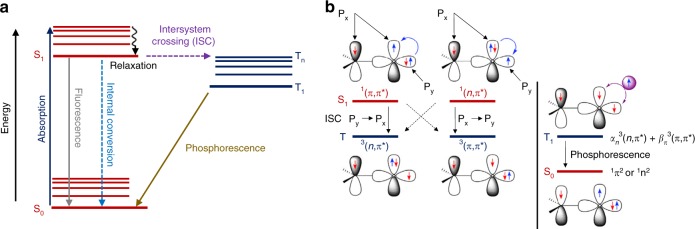
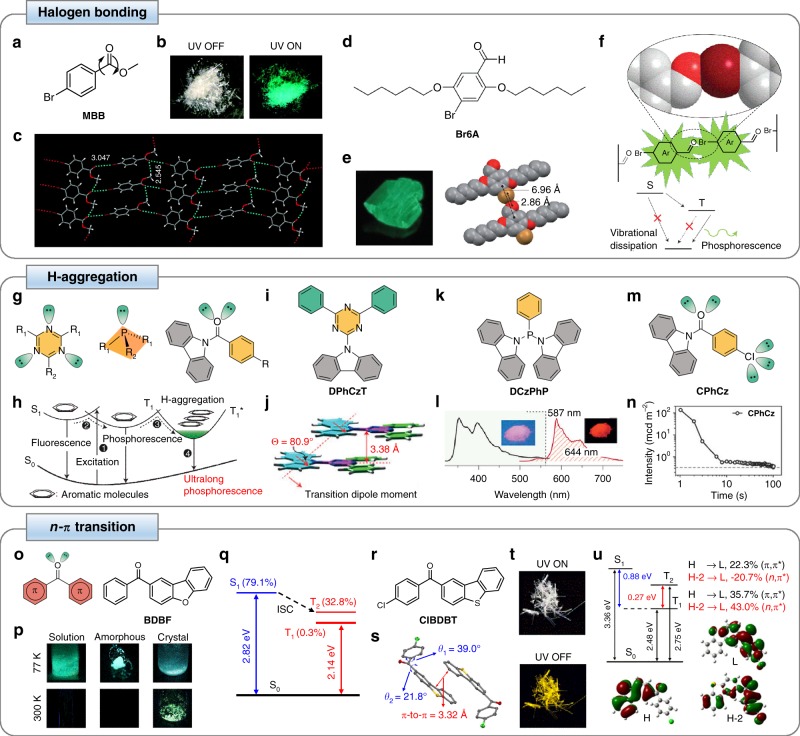
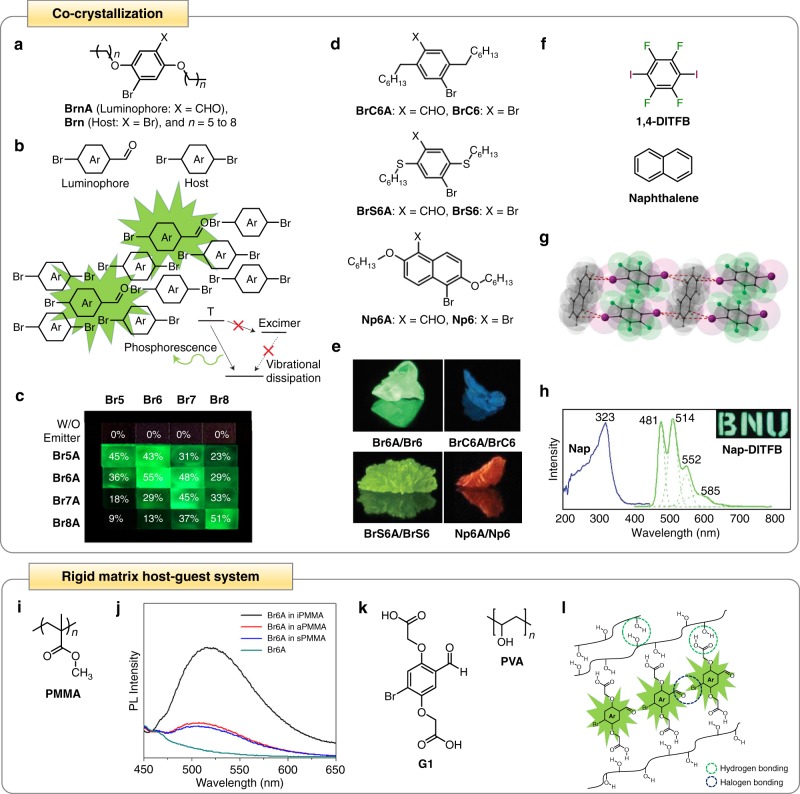
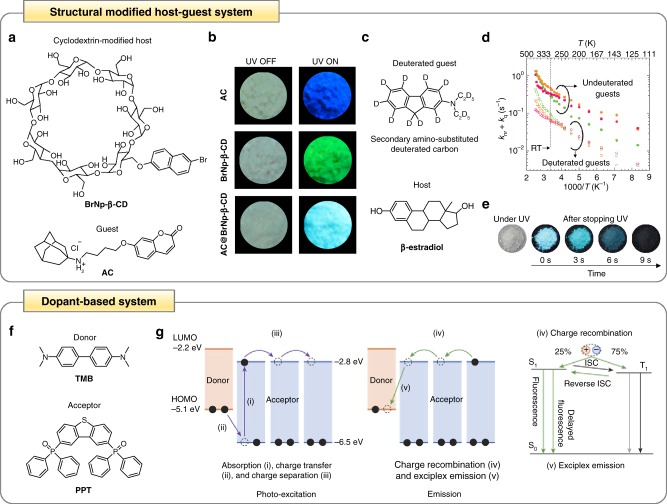
Once considered the exclusive property of metal complexes, the phenomenon of room-temperature phosphorescence (RTP) has been increasingly realized in pure organic luminophores recently. Using precise molecular design and synthetic approaches to modulate their weak spin–orbit coupling, highly active triplet excitons, and ultrafast deactivation, organic luminophores can be endowed with long-lived and bright RTP characteristics. This has sparked intense explorations into organic luminophores with enhanced RTP features for different applications. This Review discusses the fundamental mechanism of RTP in pure organic luminophores, followed by design principles, enhancement strategies, and formulation methods to achieve highly phosphorescent and long-lived organic RTP luminophores even in aqueous media. The current challenges and future directions of this field are also discussed in the summary and outlook.
Overview
The claims and statistics of this paper haven’t been checked yet.
Free: it reads the open-access text and checks the first 5 claims that cite a source we can check. Create a free account to check every claim.
Integrity signals
Registry
Cites
Statistics
Figures
Verification
Claims the paper makes
The claims and statistics of this paper haven’t been checked yet.
Free: it reads the open-access text and checks the first 5 claims that cite a source we can check. Create a free account to check every claim.
Self-check
Percentages, sums and reported differences re-computed from the paper’s own numbers.
The self-check needs the paper’s full text.
Citations
Cites
Highly efficient organic light-emitting diodes from delayed fluorescence
Uoyama, H., Goushi, K., Shizu, K., Nomura, H., & Adachi, C. (2012) · Nature · doi:10.1038/nature11687 · Cited by 8,188
Imaging and Photodynamic Therapy: Mechanisms, Monitoring, and Optimization
Celli, J. P., Spring, B. Q., Rizvi, I., Evans, C. L., Samkoe, K. S., Verma, S., Pogue, B. W., & Hasan, T. (2010) · Chemical Reviews · doi:10.1021/cr900300p · Cited by 2,324
Stabilizing triplet excited states for ultralong organic phosphorescence
An, Z., Zheng, C., Tao, Y., Chen, R., Shi, H., Chen, T., Wang, Z., Li, H., Deng, R., Liu, X., et al. (2015) · Nature Materials · doi:10.1038/nmat4259 · Cited by 1,944
Organic Optoelectronic Materials: Mechanisms and Applications
Ostroverkhova, O. (2016) · Chemical Reviews · doi:10.1021/acs.chemrev.6b00127 · Cited by 1,680
Activating efficient phosphorescence from purely organic materials by crystal design
Bolton, O., Lee, K., Kim, H.-J., Lin, K. Y., & Kim, J. (2011) · Nature Chemistry · doi:10.1038/nchem.984 · Cited by 1,662
Triplet photosensitizers: from molecular design to applications
Zhao, J., Wu, W., Sun, J., & Guo, S. (2013) · Chemical Society Reviews · doi:10.1039/c3cs35531d · Cited by 1,579
Spin—Orbit Coupling and the Radiationless Processes in Nitrogen Heterocyclics
El-Sayed, M. A. (1963) · The Journal of Chemical Physics · doi:10.1063/1.1733610 · Cited by 1,530
Organic long persistent luminescence
Kabe, R., & Adachi, C. (2017) · Nature · doi:10.1038/nature24010 · Cited by 1,248
The Triplet State and Molecular Electronic Processes in Organic Molecules
Lower, S. K., & El-Sayed, M. A. (1966) · Chemical Reviews · doi:10.1021/cr60240a004 · Cited by 1,146
Yang, J., Zhen, X., Wang, B., Gao, X., Ren, Z., Wang, J., Xie, Y., Li, J., Peng, Q., Pu, K., et al. (2018) · Nature Communications · doi:10.1038/s41467-018-03236-6 · Cited by 1,060
Cited by
Items 101–200 of 887
Revisiting Carbazole: Origin, Impurity, and Properties
Chen, C., Chong, K. C., Pan, Y., Qi, G., Xu, S., & Liu, B. (2021) · ACS Materials Letters · doi:10.1021/acsmaterialslett.1c00138 · Cited by 109
Self-citationWang, D., Wu, H., Gong, J., Xiong, Y., Wu, Q., Zhao, Z., Wang, L., Wang, D., & Tang, B. Z. (2022) · Materials Horizons · doi:10.1039/d1mh01829a · Cited by 110
Gao, M., Tian, Y., Li, X., Gong, Y., Fang, M., Yang, J., & Li, Z. (2022) · Angewandte Chemie International Edition · doi:10.1002/anie.202214908 · Cited by 109
Miao, Y., Lin, F., Guo, D., Chen, J., Zhang, K., Wu, T., Huang, H., Chi, Z., & Yang, Z. (2024) · Science Advances · doi:10.1126/sciadv.adk3354 · Cited by 109
Two‐Photon Ionization Induced Stable White Organic Long Persistent Luminescence
Liang, X. Q., Zheng, Y., & Zuo, J. (2021) · Angewandte Chemie International Edition · doi:10.1002/anie.202106472 · Cited by 108
Gao, P., Zhang, K., Ren, D., Liu, H., Zhang, H., Fu, H., Ma, L., & Li, D. (2023) · Advanced Functional Materials · doi:10.1002/adfm.202300105 · Cited by 108
Aggregationsinduzierte Emission: Einblicke auf Aggregatebene
Zhao, Z., Zhang, H., Lam, J. W. Y., & Tang, B. Z. (2020) · Angewandte Chemie · doi:10.1002/ange.201916729 · Cited by 107
Zhang, X., Qian, C., Ma, Z., Fu, X., Li, Z., Jin, H., Chen, M., Jiang, H. Y., & Ma, Z. (2022) · Advanced Science · doi:10.1002/advs.202206482 · Cited by 107
Chen, X., Chen, X. D., Hou, X., Zhang, S., Chen, D., & Li, Q. (2022) · Nanoscale Advances · doi:10.1039/d2na00934j · Cited by 107
Organic Room-Temperature Phosphorescent Materials: From Static to Dynamic
Gu, L., Wang, X. L., Singh, M., Shi, H., Ma, H., An, Z., & Huang, W. (2020) · The Journal of Physical Chemistry Letters · doi:10.1021/acs.jpclett.9b03363 · Cited by 106
Li, J., Li, X., Wang, G., Wang, X., Wu, M., Liu, J., & Zhang, K. (2023) · Nature Communications · doi:10.1038/s41467-023-37662-y · Cited by 106
Wang, S., Wu, D., Yang, S., Lin, Z., & Ling, Q. (2020) · Materials Chemistry Frontiers · doi:10.1039/d0qm00018c · Cited by 105
Photo-stimuli-responsive Organic Room-Temperature Phosphorescent Materials
Sun, H., Shen, S., & Zhu, L. (2022) · ACS Materials Letters · doi:10.1021/acsmaterialslett.2c00392 · Cited by 105
AIE polymers in sensing, imaging and theranostic applications
Hu, R., Yang, X., Qin, A., & Tang, B. Z. (2021) · Materials Chemistry Frontiers · doi:10.1039/d1qm00078k · Cited by 103
Highly Efficient TADF‐Type Organic Afterglow of Long Emission Wavelengths
Pan, Y., Li, J., Wang, X., Sun, Y., Li, J., Wang, B., & Zhang, K. (2021) · Advanced Functional Materials · doi:10.1002/adfm.202110207 · Cited by 103
Ultraviolet phosphorescent carbon nanodots
Song, S.-Y., Liu, K.-K., Cao, Q., Mao, X., Zhao, W., Wang, Y., Liang, Y., Zang, J., Lou, Q., Dong, L. R., et al. (2022) · Light Science & Applications · doi:10.1038/s41377-022-00837-1 · Cited by 103
Poriel, C., & Rault‐Berthelot, J. (2021) · Advanced Functional Materials · doi:10.1002/adfm.202010547 · Cited by 100
Brighten Triplet Excitons of Carbon Nanodots for Multicolor Phosphorescence Films
Cao, Q., Liu, K.-K., Liang, Y., Song, S.-Y., Deng, Y., Mao, X., Wang, Y., Zhao, W., Lou, Q., & Shan, C. (2022) · Nano Letters · doi:10.1021/acs.nanolett.2c00788 · Cited by 100
Afterglow bio-applications by utilizing triplet excited states of organic materials
Fan, Y., Li, Q., & Li, Z. (2023) · Science China Chemistry · doi:10.1007/s11426-023-1790-0 · Cited by 100
Kaschuk, J. J., Haj, Y. A., Rojas, O. J., Miettunen, K., Abitbol, T., & Vapaavuori, J. (2021) · Advanced Materials · doi:10.1002/adma.202104473 · Cited by 99
Zheng, X., Han, Q., Lin, Q., Li, C., Jiang, J., Guo, Q. B., Ye, X., Yuan, W. Z., Liu, Y., & Tao, X. (2022) · Materials Horizons · doi:10.1039/d2mh00998f · Cited by 99
Colorful Triplet Excitons in Carbon Nanodots for Time Delay Lighting
Song, S., Liu, K., Mao, X., Cao, Q., Li, N., Zhao, W., Wang, Y., Liang, Y., Zang, J., Li, X., et al. (2023) · Advanced Materials · doi:10.1002/adma.202212286 · Cited by 99
Solid-State Luminescent Molecular Photoswitches
Wang, X., Xu, B., & Tian, W. (2023) · Accounts of Materials Research · doi:10.1021/accountsmr.2c00158 · Cited by 100
Room-temperature phosphorescence from metal-free polymer-based materials
Gong, Y., Yang, J., Fang, M., & Li, Z. (2021) · Cell Reports Physical Science · doi:10.1016/j.xcrp.2021.100663 · Cited by 98
Stimuli-responsive flexible organic crystals
Wu, W., Chen, K., Wang, T., Wang, N., Huang, X., Zhou, L., Wang, Z., & Hao, H. (2023) · Journal of Materials Chemistry C · doi:10.1039/d2tc04642c · Cited by 97
Polymer–Structure‐Induced Room‐Temperature Phosphorescence of Carbon Dot Materials
Zheng, C., Tao, S., & Yang, B. J. (2023) · Small Structures · doi:10.1002/sstr.202200327 · Cited by 97
Chen, B., Huang, W., & Zhang, G. (2023) · Nature Communications · doi:10.1038/s41467-023-37157-w · Cited by 97
Non-noble-metal-based organic emitters for OLED applications
Chen, D., Li, W., Gan, L., Wang, Z., Li, M., & Su, S. (2020) · Materials Science and Engineering R Reports · doi:10.1016/j.mser.2020.100581 · Cited by 96
Zhu, J., Hu, J., Hu, Q., Zhang, X., Ushakova, E. V., Liu, K.-K., Wang, S., Xu, C., Shan, C., Rogach, A. L., et al. (2021) · Small · doi:10.1002/smll.202105415 · Cited by 97
Gu, J., Yuan, W., Chang, K., Zhong, C. M., Yuan, Y., Li, J., Zhang, Y., Deng, T., Fan, Y., Yuan, L., et al. (2024) · Angewandte Chemie International Edition · doi:10.1002/anie.202415637 · Cited by 96
Han, Z., Li, P., Deng, Y., & Li, H. (2021) · Chemical Engineering Journal · doi:10.1016/j.cej.2021.128999 · Cited by 97
Ruthenium( ii )–arene complexes as anti-metastatic agents, and related techniques
Sonkar, C., Sarkar, S., & Mukhopadhyay, S. (2021) · RSC Medicinal Chemistry · doi:10.1039/d1md00220a · Cited by 96
Sharber, S. A., Mullin, W. J., & Thomas, S. W. (2021) · Chemistry of Materials · doi:10.1021/acs.chemmater.1c01969 · Cited by 94
Li, Q., Zhao, Z., Meng, S. Q., Li, Y., Zhao, Y., Zhang, B., Tang, Z., Tan, J., & Qu, S. (2021) · SmartMat · doi:10.1002/smm2.1075 · Cited by 94
Zhang, X., Chong, K. C., Xie, Z., & Liu, B. (2023) · Angewandte Chemie International Edition · doi:10.1002/anie.202310335 · Cited by 92
Self-citationSubstrate-Responsive Pillar[5]arene-Based Organic Room-Temperature Phosphorescence
Zhu, H., Liu, J., Wu, Y., Wang, L., Zhang, H., Li, Q., Wang, H., Xing, H., Sessler, J. L., & Huang, F. (2023) · Journal of the American Chemical Society · doi:10.1021/jacs.3c00711 · Cited by 92
Dai, W., Zhang, Y., Wu, X., Guo, S., Ma, J., Shi, J., Tong, B., Cai, Z., Xie, H., & Dong, Y. (2021) · CCS Chemistry · doi:10.31635/ccschem.021.202101120 · Cited by 91
Liu, X., Zhang, K., Gao, J., Chen, Y., Tung, C., & Wu, L. (2020) · Angewandte Chemie International Edition · doi:10.1002/anie.202007039 · Cited by 89
Structurally Resemblant Dopants Enhance Organic Room‐Temperature Phosphorescence
Chong, K. C., Chen, C., Zhou, C., Chen, X., Ma, D., Bazan, G. C., Chi, Z., & Liu, B. (2022) · Advanced Materials · doi:10.1002/adma.202201569 · Cited by 89
Self-citationLi, Q., & Li, Z. (2019) · Science China Materials · doi:10.1007/s40843-019-1172-2 · Cited by 88
Xu, L., Zhou, K., Ma, H., Lv, A., Pei, D., Li, G., Zhang, Y., An, Z., Li, A., & He, G. (2020) · ACS Applied Materials & Interfaces · doi:10.1021/acsami.0c04005 · Cited by 89
Self‐Assembled Helical Arrays for the Stabilization of the Triplet State
Nidhankar, A. D., Goudappagouda, G., Kumari, D. S. M., Chaubey, S. K., Nayak, R. A., Gonnade, R. G., Kumar, G. V. P., Krishnan, R., & Babu, S. S. (2020) · Angewandte Chemie International Edition · doi:10.1002/anie.202005105 · Cited by 88
Intriguing Room Temperature Phosphorescence in Crystalline Porous Organic Frameworks
Zhu, Y., Wang, X., & Wu, M. (2023) · Advanced Functional Materials · doi:10.1002/adfm.202308096 · Cited by 89
Fu, P., Yi, S., Pan, M. L., & Su, C. (2023) · Accounts of Materials Research · doi:10.1021/accountsmr.3c00139 · Cited by 89
Yang, Z., Zhang, Z., Sun, Y., Lei, Z., Wang, D., Ma, H., & Tang, B. Z. (2021) · Biomaterials · doi:10.1016/j.biomaterials.2021.120934 · Cited by 85
Crystal Engineering of Room Temperature Phosphorescence in Organic Solids
Hamzehpoor, E., & Perepichka, D. F. (2019) · Angewandte Chemie · doi:10.1002/ange.201913393 · Cited by 85
Huang, Q., Gao, H., Yang, S., Ding, D., Lin, Z., & Ling, Q. (2020) · Nano Research · doi:10.1007/s12274-020-2740-x · Cited by 84
“Purely organic room temperature phosphorescence (RTP) at air has been widely concerned, because it breaks through the traditional understanding of metal-free organic photoelectric materials [1, 2].”
BackgroundWang, P., Zheng, D., Liu, S., Luo, M., Li, J., Shen, S., Li, S., Zhu, L., & Chen, Z. (2020) · Carbon · doi:10.1016/j.carbon.2020.09.060 · Cited by 83
Xie, W., Huang, W., Li, J., He, Z., Huang, G., Li, B. S., & Tang, B. Z. (2023) · Nature Communications · doi:10.1038/s41467-023-43687-0 · Cited by 83
“Organic room temperature phosphorescence (RTP) systems with long lifetime afterglow have been deeply investigated and widely applied in various areas, including organic optoelectronics, chemical biomedicine, optical sensing, and information encryption 1 – 3 .”
Zhang, Q., Wang, S., Xiong, X., Fu, P., Zhang, X., Fan, Y., & Pan, M. L. (2022) · Angewandte Chemie International Edition · doi:10.1002/anie.202205556 · Cited by 82
In Situ Confining Citric Acid‐Derived Carbon Dots for Full‐Color Room‐Temperature Phosphorescence
Ding, Z., Shen, C., Han, J., Zheng, G., Ni, Q., Song, R., Liu, K., Zang, J., Dong, L. R., Lou, Q., et al. (2022) · Small · doi:10.1002/smll.202205916 · Cited by 82
Achieving High Afterglow Brightness in Organic Dopant‐Matrix Systems
Sun, Y., Wang, G., Li, X., Zhou, B., & Zhang, K. (2021) · Advanced Optical Materials · doi:10.1002/adom.202100353 · Cited by 81
Long-lived room temperature phosphorescence of organic–inorganic hybrid systems
Wang, H., Yang, X., Qin, J., & Ma, L. (2021) · Inorganic Chemistry Frontiers · doi:10.1039/d0qi01508c · Cited by 80
Wang, Z., Shen, J., Xu, B., Jiang, Q., Ming, S., Yan, L., Gao, Z., Wang, X., Zhu, C., & Meng, X. (2021) · Advanced Optical Materials · doi:10.1002/adom.202100421 · Cited by 80
Zhu, Y., Guan, Y., Niu, Y., Wang, P., Chen, R., Wang, Y., Wang, P., & Xie, H. (2021) · Advanced Optical Materials · doi:10.1002/adom.202100782 · Cited by 81
Recent progress in ion-regulated organic room-temperature phosphorescence
Dai, W., Jiang, Y., Lei, Y., Huang, X., Sun, P., Shi, J., Tong, B., Yan, D., Cai, Z., & Dong, Y. (2024) · Chemical Science · doi:10.1039/d3sc06931a · Cited by 80
Modulating Tri‐Mode Emission for Single‐Component White Organic Afterglow
Jin, J., Xue, P., Zhang, L., Jiang, H., Wang, W., Yang, Q., Tao, Y., Zheng, C., Chen, R., & Huang, W. (2021) · Angewandte Chemie International Edition · doi:10.1002/anie.202109229 · Cited by 79
Li, X., Li, W., Deng, Z., Ou, X., Gao, F., He, S., Li, X., Qiu, Z., Kwok, R. T. K., Sun, J., et al. (2025) · Journal of the American Chemical Society · doi:10.1021/jacs.4c17142 · Cited by 80
Huang, X., Jin, X., Bai, H., Huang, B., Zhang, X., Zuo, J., Ma, X., Ding, L., Zhou, H., Xue, F., et al. (2025) · Advanced Materials · doi:10.1002/adma.202418335 · Cited by 79
Liu, J., Zhou, X., Tang, X., Tang, Y., Wu, J., Song, Z., Jiang, H., Ma, Y., Li, B., Lu, Y., et al. (2024) · Advanced Functional Materials · doi:10.1002/adfm.202414086 · Cited by 78
Chen, K., Xiong, Y., Wang, D., Pan, Y., Zhao, Z., Wang, D., & Tang, B. Z. (2023) · Advanced Functional Materials · doi:10.1002/adfm.202312883 · Cited by 77
Recent advances in multicolor organic room-temperature phosphorescence
Gan, N., Zou, X., Zhang, Y., Gu, L., & An, Z. (2023) · Applied Physics Reviews · doi:10.1063/5.0140824 · Cited by 76
Polymorphism‐Dependent Organic Room Temperature Phosphorescent Scintillation for X‐Ray Imaging
Dong, M., Lv, A., Zou, X., Gan, N., Peng, C., Ding, M., Wang, X. L., Zhou, Z., Chen, H., Ma, H., et al. (2024) · Advanced Materials · doi:10.1002/adma.202310663 · Cited by 76
Host Surface-Induced Excitation Wavelength-Dependent Organic Afterglow
Man, Z., Lv, Z., Xu, Z., He, J., Liao, Q., Yang, Y. A., Yao, J., & Fu, H. (2023) · Journal of the American Chemical Society · doi:10.1021/jacs.3c03681 · Cited by 75
Chen, J., Chen, X., Cao, L., Deng, H., Chi, Z., & Liu, B. (2022) · Angewandte Chemie International Edition · doi:10.1002/anie.202200343 · Cited by 74
Self-citationBright and Robust Phosphorescence Achieved by Non‐Covalent Clipping
Li, Z., Han, Y., Nie, F., Liu, M., Zhong, H., & Wang, F. (2021) · Angewandte Chemie International Edition · doi:10.1002/anie.202015846 · Cited by 74
Manipulation of Triplet Excited States for Long‐Lived and Efficient Organic Afterglow
Sun, Y., Liu, J., Li, J., Li, X., Wang, X., Wang, G., & Zhang, K. (2021) · Advanced Optical Materials · doi:10.1002/adom.202101909 · Cited by 73
Enhanced Blue Afterglow through Molecular Fusion for Bio‐applications
Su, X., Kong, X., Sun, K., Liu, Q., Pei, Y., Hu, D., Xu, M., Feng, W., & Li, F. (2022) · Angewandte Chemie International Edition · doi:10.1002/anie.202201630 · Cited by 73
Kong, L., Zhu, Y., Sun, S., Li, H., Dong, S., Li, F., Tao, F., Wang, L., & Li, G. (2023) · Chemical Engineering Journal · doi:10.1016/j.cej.2023.143931 · Cited by 73
Qin, W., Ma, J., Zhou, Y., Hu, Q., Zhou, Y., & Liang, G. (2020) · Chemical Engineering Journal · doi:10.1016/j.cej.2020.125934 · Cited by 72
Afterglows from the indolocarbazole families
Jian, M., Song, Z., Chen, X., Zhao, J., Xu, B., & Chi, Z. (2021) · Chemical Engineering Journal · doi:10.1016/j.cej.2021.132346 · Cited by 72
He, M., Ding, C., Guo, H., & Li, Q. (2024) · Responsive Materials · doi:10.1002/rpm.20240014 · Cited by 71
Self-exothermic reaction driven large-scale synthesis of phosphorescent carbon nanodots
Song, S.-Y., Sui, L., Liu, K.-K., Cao, Q., Zhao, W., Liang, Y., Lv, C., Zang, J., Shang, Y., Lou, Q., et al. (2021) · Nano Research · doi:10.1007/s12274-020-3204-z · Cited by 71
Xiao, H. J., Zheng, D., Zhang, L., Xu, L., & Chen, Z. (2023) · Advanced Functional Materials · doi:10.1002/adfm.202214241 · Cited by 70
Jia, Q., Yan, X., Wang, B., Li, J., Xu, W., Shen, Z., Bo, C., Li, Y., & Chen, L. (2023) · Nature Communications · doi:10.1038/s41467-023-39795-6 · Cited by 70
AIE-based energy transfer systems for biosensing, imaging, and therapeutics
He, X., Xiong, L., Huang, Y., Zhao, Z., Wang, Z., Lam, J. W. Y., Kwok, R. T. K., & Tang, B. Z. (2019) · TrAC Trends in Analytical Chemistry · doi:10.1016/j.trac.2019.115743 · Cited by 70
Chen, R., Guan, Y., Wang, H., Zhu, Y., Tan, X., Wang, P., Wang, X., Fan, X., & Xie, H. (2021) · ACS Applied Materials & Interfaces · doi:10.1021/acsami.1c12249 · Cited by 70
Stanitska, M., Volyniuk, D. Y., Minaev, B. F., Ågren, H., & Gražulevičius, J. V. (2024) · Journal of Materials Chemistry C · doi:10.1039/d3tc04514e · Cited by 69
Ma, X., Ye, T., Yang, H., Ling, G., Wang, D., Li, J., Gu, P., Xu, L., Sheng, T., Lin, F., et al. (2024) · Aggregate · doi:10.1002/agt2.579 · Cited by 71
Zou, X., Gan, N., Gao, Y., Gu, L., & Huang, W. (2024) · Angewandte Chemie International Edition · doi:10.1002/anie.202417906 · Cited by 69
Catalyst: Aggregation-Induced Emission—How Far Have We Come, and Where Are We Going Next?
Kenry, K., Tang, B. Z., & Liu, B. (2020) · Chem · doi:10.1016/j.chempr.2020.05.018 · Cited by 69
Self-citationRecent Advances in Impurity‐Induced Room‐Temperature Phosphorescence
Yin, Z., Wu, Z. L., & Liu, B. (2025) · Advanced Materials · doi:10.1002/adma.202506549 · Cited by 69
Self-citationDelayed room temperature phosphorescence enabled by phosphines
Lu, G., Tan, J., Wang, H., Man, Y., Chen, S., Zhang, J., Duan, C., Han, C., & Xu, H. (2024) · Nature Communications · doi:10.1038/s41467-024-47888-z · Cited by 67
“…the limitations of spin-forbidden triplet radiation and collision-induced triplet nonradiation by environmental factors (moisture, oxygen and temperature, etc) 12 – 14 , including crystallization 15 – 17 , self-assembly 18,19 , H-aggregation 20 – 23 , polymerization 24 – 26 and doping 27 – 33 .”
Tani, Y., Terasaki, M., Komura, M., & Ogawa, T. (2019) · Journal of Materials Chemistry C · doi:10.1039/c9tc04176a · Cited by 67
Ashokkumar, P., Adarsh, N., & Klymchenko, A. S. (2020) · Small · doi:10.1002/smll.202002494 · Cited by 67
Color-Tunable Aqueous Room-Temperature Phosphorescence Supramolecular Assembly
Deng, Y., Li, P., Li, J., Sun, D., & Li, H. (2021) · ACS Applied Materials & Interfaces · doi:10.1021/acsami.1c01174 · Cited by 67
Wu, T., Huang, J., & Yan, Y. (2022) · Cell Reports Physical Science · doi:10.1016/j.xcrp.2022.100771 · Cited by 67
Barman, D., Gogoi, R., Narang, K., & Iyer, P. K. (2020) · Frontiers in Chemistry · doi:10.3389/fchem.2020.00483 · Cited by 66
“Subsequently, if the 1EST is sufficiently moderate, or is in the presence of a nonmetallic heavy atom, carbonyl, thioesters, or when assisted by polymer host matrix, both SOC and faster ISC processes were favored, thereby leading to triplet emission at room temperature, called room temperature phosphorescence (RTP), w…”
BackgroundBoosting purely organic room-temperature phosphorescence performance through a host–guest strategy
Li, M., Cai, X., Chen, Z., Liu, K., Qiu, W., Xie, W., Wang, L., & Su, S. (2021) · Chemical Science · doi:10.1039/d1sc03420k · Cited by 65
Stimuli-Responsive Aggregation-Induced Emission (AIE)-Active Polymers for Biomedical Applications
Chowdhury, P., Banerjee, A., Saha, B., Bauri, K., & De, P. (2022) · ACS Biomaterials Science & Engineering · doi:10.1021/acsbiomaterials.2c00656 · Cited by 66
Naphthyl Substituted Impurities Induce Efficient Room Temperature Phosphorescence
Qiao, W., Yao, M., Xu, J., Peng, H., Xia, J., Xie, X., & Li, Z. (2023) · Angewandte Chemie International Edition · doi:10.1002/anie.202315911 · Cited by 65
Sergeant‐and‐Soldier Effect in an Organic Room‐Temperature Phosphorescent Host‐Guest System
Law, A. W. K., Cheung, T. S., Zhang, J., Leung, N. L. C., Kwok, R. T. K., Zhao, Z., Sung, H. H. Y., Williams, I. D., Qiu, Z., Alam, P., et al. (2024) · Advanced Materials · doi:10.1002/adma.202410739 · Cited by 66
Liu, W., Wang, J., Gong, Y., Liao, Q., Dang, Q., Li, Z., & Bo, Z. (2020) · Angewandte Chemie International Edition · doi:10.1002/anie.202008736 · Cited by 64
Ultralong Room-Temperature Phosphorescence of Silicon-Based Pure Organic Crystal for Oxygen Sensing
Guo, W., Chen, Y., Tung, C., & Wu, L. (2021) · CCS Chemistry · doi:10.31635/ccschem.021.202100932 · Cited by 65
Aggregation-Induced Intersystem Crossing: Rational Design for Phosphorescence Manipulation
Zhang, J., Mukamel, S., & Jiang, J. (2020) · The Journal of Physical Chemistry B · doi:10.1021/acs.jpcb.0c00654 · Cited by 63
Feng, S., Huang, Q., Yang, S., Lin, Z., & Ling, Q. (2021) · Chemical Science · doi:10.1039/d1sc04806f · Cited by 63
Li, J., Wang, G., Chen, X., Li, X., Wu, M., Yuan, S., Zou, Y., Wang, X., & Zhang, K. (2022) · Chemistry - A European Journal · doi:10.1002/chem.202200852 · Cited by 63
Yang, B., Yan, S., Zhang, Y., Ban, S., Ma, H., Feng, F., & Huang, W. (2024) · Journal of the American Chemical Society · doi:10.1021/jacs.3c14262 · Cited by 63
Room-temperature phosphorescent transparent wood
Piao, X., Wang, T., Chen, X., Wang, G., Zhai, X., & Zhang, K. (2025) · Nature Communications · doi:10.1038/s41467-025-55990-z · Cited by 63
“The transparency and afterglow property are similar to thatobtainedbyconventionalmethod(SupplementaryFig.32).”
Tian, Y., Gong, Y., Liao, Q., Wang, Y., Ren, J., Fang, M., Yang, J., & Li, Z. (2020) · Cell Reports Physical Science · doi:10.1016/j.xcrp.2020.100052 · Cited by 63
Metadata
- Authors
- Kenry, Chen, C., & Liu, B.
- Affiliations
- National University of Singapore (SG)
- Corresponding author
- Liu, Bin
- Venue
- Nature Communications
- Published
- 2019-05-08
- Volume
- 10
- Issue
- 1
- Pages
- 2111-2111
- ISSN
- 2041-1723 (ISSN-L)
- PMC
- PMC6506551
- OpenAlex
- W2943989073
- Cited by
- 842
- References
- 90
- Citations by year
- 2026: 72 · 2025: 115 · 2024: 149 · 2023: 139 · 2022: 122 · 2021: 139 · 2020: 86 · 2019: 20
- FWCI
- 4.66
- Type
- journal article
- Language
- en
- Open access
- gold
- doi.org
- Licence
- cc-by
- creativecommons.org/licenses/by/4.0 (tdm)
- creativecommons.org/licenses/by/4.0 (vor)
- Locations
- Nature Communications (publishedVersion, cc-by)
- PubMed Central (publishedVersion, cc-by)
- PubMed (publishedVersion)
- National University of Singapore (submittedVersion)
- RePEc: Research Papers in Economics (submittedVersion)
- DOAJ (DOAJ: Directory of Open Access Journals) (submittedVersion, cc-by-sa)
- DOAJ (DOAJ: Directory of Open Access Journals) (submittedVersion)
- eScholarship (California Digital Library) (submittedVersion, cc-by)
- Funders
- National University of Singapore (R279-000-444-281, R279-000-483-281, R279–000–482–133)
- Topics
- Physical Sciences › Materials Science › Materials Chemistry › Luminescence and Fluorescent Materials
- Physical Sciences › Engineering › Electrical and Electronic Engineering › Organic Light-Emitting Diodes Research
- Physical Sciences › Materials Science › Materials Chemistry › Luminescence Properties of Advanced Materials
- Keywords
- room-temperature phosphorescence, organic luminophores, spin-orbit coupling, triplet excitons, phosphorescence lifetime, molecular design, phosphorescent materials
About these checks
Registry, retraction, Cites and statistics results are computed, not judged, with one exception: a printed reference that no index lists is read once by a model before it counts as a citation error. Claims are extracted by a model and kept only when their quote appears verbatim in the text; each cited source is then checked, with a model’s help, for whether it says what the claim relies on. Those verdicts can be wrong — read the claim’s quote and the cited source before relying on one.
Statistics and arithmetic are recomputed, not judged.
Confidence bands are shown only for fields calibrated on our annotated test set. None is calibrated yet, so no band is shown.
What counts as a claim ›How we measure confidence ›How we check this ›
Are you an author, or do you see a problem with this page? Request a review
Data sources
Bibliographic data: Semantic Scholar, OpenAlex, Crossref.
Contains information from the Semantic Scholar Academic Graph Datasets, made available under the ODC Attribution License (ODC-BY 1.0).
Semantic Scholar’s data is described in: Kinney, R., et al. (2023). The Semantic Scholar Open Data Platform. arXiv:2301.10140.
