

The DOI matches its Crossref record; 80 of the 80 references it cites were found in a registry or an index.
Brain somatic mutations observed in Alzheimer’s disease associated with aging and dysregulation of tau phosphorylation
Open accessAbstract
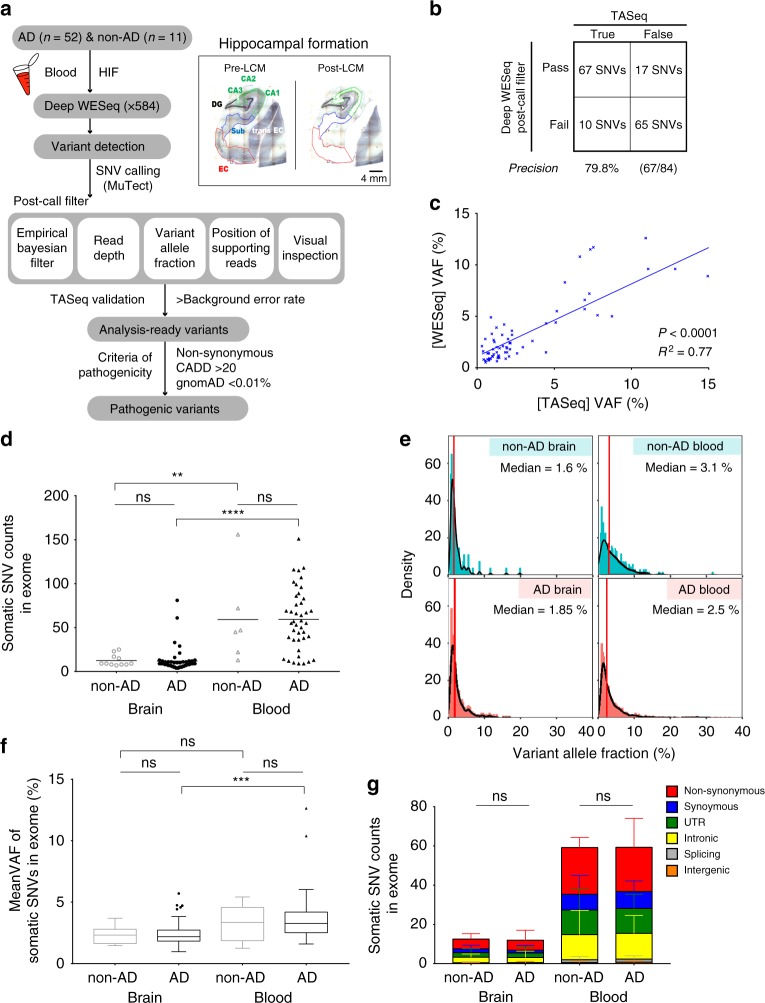
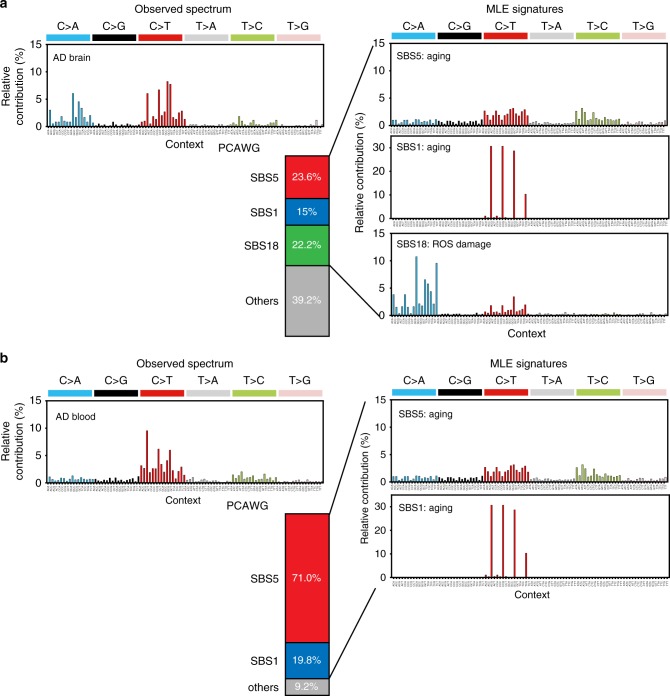
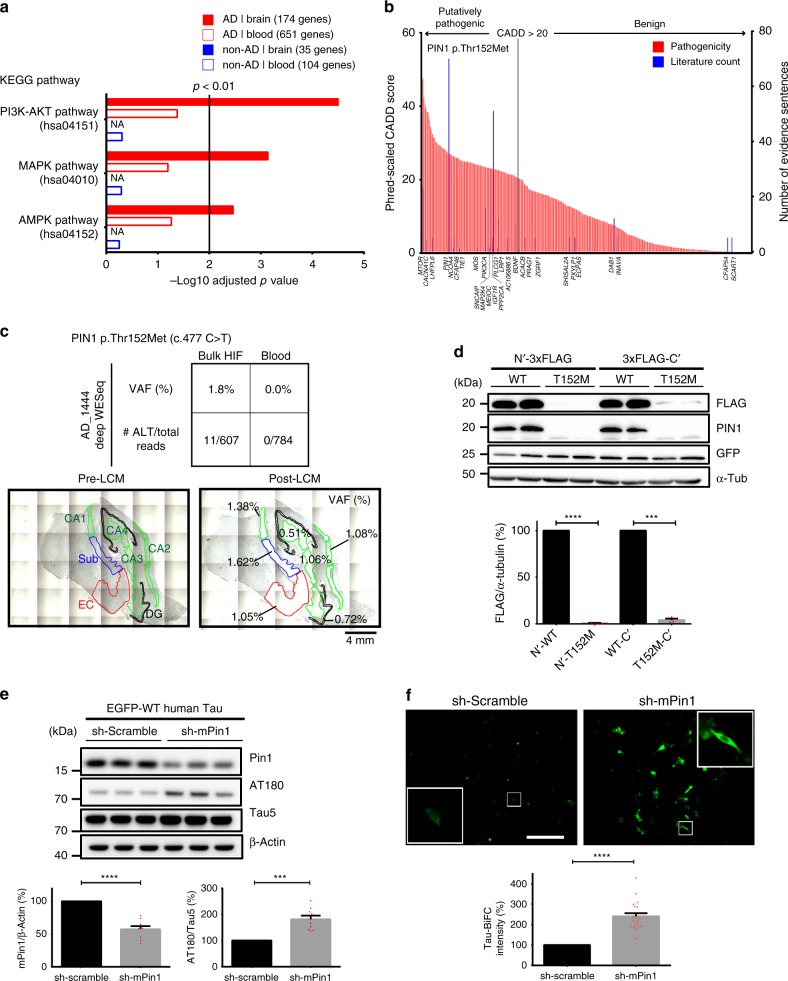
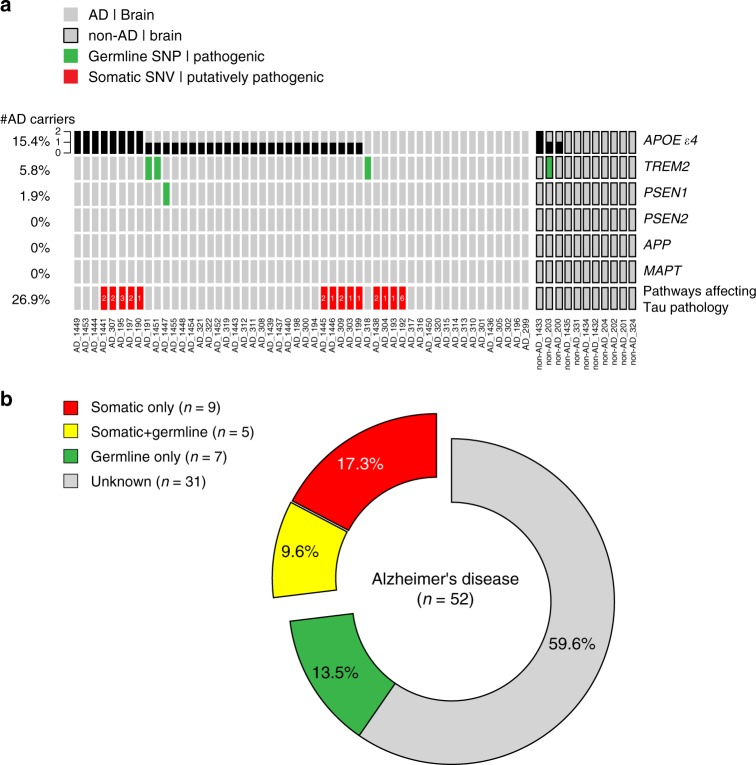
The role of brain somatic mutations in Alzheimer’s disease (AD) is not well understood. Here, we perform deep whole-exome sequencing (average read depth 584×) in 111 postmortem hippocampal formation and matched blood samples from 52 patients with AD and 11 individuals not affected by AD. The number of somatic single nucleotide variations (SNVs) in AD brain specimens increases significantly with aging, and the rate of mutation accumulation in the brain is 4.8-fold slower than that in AD blood. The putatively pathogenic brain somatic mutations identified in 26.9% (14 of 52) of AD individuals are enriched in PI3K-AKT, MAPK, and AMPK pathway genes known to contribute to hyperphosphorylation of tau. We show that a pathogenic brain somatic mutation in PIN1 leads to a loss-of-function mutation. In vitro mimicking of haploinsufficiency of PIN1 aberrantly increases tau phosphorylation and aggregation. This study provides new insights into the genetic architecture underlying the pathogenesis of AD.
Overview
The claims and statistics of this paper haven’t been checked yet.
Run the check — free, no account needed. It reads the open-access text and checks the sources it cites.
Integrity signals
Registry
Cites
Statistics
Figures
Verification
Claims the paper makes
The claims and statistics of this paper haven’t been checked yet.
Run the check — free, no account needed. It reads the open-access text and checks the sources it cites.
Claims other papers make about this one
Each is checked against this paper’s own text: does it say what the citing paper says it does?
In the citing paper
“work has shown that some may underly neurodevelopmental and neurodegenerative disease.”
From Mechanisms of DNA damage-mediated neurotoxicity in neurodegenerative disease (2022) · cites this paper as Park et al, 2019
In the citing paper
“a study performing whole exome sequencing of hippocampal tissue from individuals with Alzheimer’s disease (AD) revealed that somatic single nucleotide variations (SNVs) increase with age and are enriched in genes that regulate tau phosphorylation”
From Mechanisms of DNA damage-mediated neurotoxicity in neurodegenerative disease (2022) · cites this paper as Park et al, 2019
Self-check
Percentages, sums and reported differences re-computed from the paper’s own numbers.
The self-check needs the paper’s full text.
Citations
Cites
Enrichr: a comprehensive gene set enrichment analysis web server 2016 update
Kuleshov, M. V., Jones, M. R., Rouillard, A. D., Fernandez, N. F., Duan, Q., Wang, Z., Koplev, S., Jenkins, S. L., Jagodnik, K. M., Lachmann, A., et al. (2016) · Nucleic Acids Research · doi:10.1093/nar/gkw377 · Cited by 10,799
Signatures of mutational processes in human cancer
Initiative, A. P. C. G., Alexandrov, L. B., ICGC Breast Cancer Consortium, ICGC MMML-Seq Consortium, PedBrain, I., Nik-Zainal, S., Wedge, D. C., Aparicio, S. A. J. R., Behjati, S., Biankin, A. V., et al. (2013) · Nature · doi:10.1038/nature12477 · Cited by 9,660
Analysis of protein-coding genetic variation in 60,706 humans
Exome Aggregation Consortium, Lek, M., Karczewski, K. J., Minikel, E. V., Samocha, K. E., Banks, E., Fennell, T., O’Donnell-Luria, A. H., Ware, J. S., Hill, A. J., et al. (2016) · Nature · doi:10.1038/nature19057 · Cited by 9,587
Sensitive detection of somatic point mutations in impure and heterogeneous cancer samples
Cibulskis, K., Lawrence, M. S., Carter, S. L., Sivachenko, A., Jaffe, D. B., Sougnez, C. L., Gabriel, S., Meyerson, M. M., Lander, E. S., & Getz, G. A. (2013) · Nature Biotechnology · doi:10.1038/nbt.2514 · Cited by 4,965
Goate, A., Chartier-Harlin, M.-C., Mullan, M., Brown, J., Crawford, F., Fidani, L., Giuffra, L., Haynes, A., Irving, N., James, L., et al. (1991) · Nature · doi:10.1038/349704a0 · Cited by 4,659
Cloning of a gene bearing missense mutations in early-onset familial Alzheimer's disease
Sherrington, R., Rogaev, E. I., Liang, Y., Rogaeva, E. A., Levesque, G., Ikeda, M., Chi, H., Lin, C., Li, G., Holman, K., et al. (1995) · Nature · doi:10.1038/375754a0 · Cited by 4,051
CADD: predicting the deleteriousness of variants throughout the human genome
Rentzsch, P., Witten, D., Cooper, G. M., Shendure, J., & Kircher, M. (2019) · Nucleic Acids Research · doi:10.1093/nar/gky1016 · Cited by 3,534
Neuropathological alterations in Alzheimer disease
Serrano-Pozo, A., Frosch, M. P., Masliah, E., & Hyman, B. T. (2011) · Cold Spring Harbor Perspectives in Medicine · doi:10.1101/cshperspect.a006189 · Cited by 3,345
The PI3K Pathway in Human Disease
Fruman, D. A., Chiu, H., Hopkins, B. D., Bagrodia, S., Cantley, L. C., & Abraham, R. T. (2017) · Cell · doi:10.1016/j.cell.2017.07.029 · Cited by 2,749
Candidate gene for the chromosome 1 familial Alzheimer’s disease locus
Levy-Lahad, E., Wasco, W., Poorkaj, P., Romano, D. M., Oshima, J., Pettingell, W. H., Yu, C.-E., Jondro, P. D., Schmidt, S. D., Wang, K., et al. (1995) · Science · doi:10.1126/science.7638622 · Cited by 2,577
Cited by
Sorted by citations
Items 101–155 of 155
Innan, H., Veitia, R. A., & Govindaraju, D. R. (2019) · Human Genetics · doi:10.1007/s00439-019-02067-9 · Cited by 7
Screening for Core Genes Related to Pathogenesis of Alzheimer’s Disease
Yang, L.-X., Qin, Y. H., & Jian, C. (2021) · Frontiers in Cell and Developmental Biology · doi:10.3389/fcell.2021.668738 · Cited by 7
Gozes, I. (2021) · Biological Psychiatry · doi:10.1016/j.biopsych.2021.04.013 · Cited by 6
Amabebe, E., Huang, Z., Jash, S., Krishnan, B., Cheng, S., Nakashima, A., Li, Y., Li, Z., Wang, R., Menon, R., et al. (2024) · Biomedicines · doi:10.3390/biomedicines13010029 · Cited by 6
Ji, S.-L., Wang, W., Ma, S., Zhang, P., Xiang, Z., Liu, G., Wu, J., Wang, K., & Pan, J. (2025) · Talanta · doi:10.1016/j.talanta.2025.129169 · Cited by 5
Kim, I. B., Kim, M.-H., Jung, S., Kim, W. K., Lee, J., Ju, Y. S., Webster, M. J., Kim, J. H., Kim, J., Kim, H. J., et al. (2024) · Experimental & Molecular Medicine · doi:10.1038/s12276-024-01284-1 · Cited by 5
Self-citationVerheijen, B. M. (2019) · Frontiers in Molecular Neuroscience · doi:10.3389/fnmol.2019.00277 · Cited by 5
RetractedBrain somatic mutations as RNA therapeutic targets in neurological disorders
Lee, S., & Lee, J. H. (2022) · Annals of the New York Academy of Sciences · doi:10.1111/nyas.14786 · Cited by 5
Self-citationWasilewska, K., Gambin, T., Rydzanicz, M., Szczałuba, K., & Płoski, R. (2022) · Mutation Research/Reviews in Mutation Research · doi:10.1016/j.mrrev.2022.108426 · Cited by 6
The many connections of UFMylation with Alzheimer’s disease: a comprehensive review
Yan, T., Clarkson, B. D. S., Lou, Z., Springer, W., & Fiesel, F. C. (2025) · Molecular Neurodegeneration · doi:10.1186/s13024-025-00855-8 · Cited by 4
Brain somatic mutations in Alzheimer’s disease: linking genetic mosaicism to neurodegeneration
Li, Z., Zhang, J., Liu, Z., Yu, L., Yang, C., Zhang, L., Xiang, Z., Hu, F., Brazh, N., Shu, K., et al. (2025) · Molecular Neurodegeneration · doi:10.1186/s13024-025-00895-0 · Cited by 6
Increased nucleotide metabolism alleviates Alzheimer’s disease pathology
Yu, Y., Miller, M. B., Huang, A. Y., Tan, B. W. Z., Celardo, I., Leal, N. S., Loh, S. H. Y., & Martins, L. M. (2025) · Cell Death and Disease · doi:10.1038/s41419-025-08066-1 · Cited by 4
Huang, A. Y., Cheng, Y., Ku, J., Zhao, B., Park, J., Kim, D., Choi, J., & Lee, E. A. (2025) · Nucleic Acids Research · doi:10.1093/nar/gkaf1450 · Cited by 4
Self-citationNicodemus, J., Liu, C. S., Ransom, L., Tan, V., Romanow, W. J., Jimenez, N., & Chun, J. J. M. (2025) · Journal of Neuroscience · doi:10.1523/jneurosci.2298-24.2025 · Cited by 5
Reply: Evidence that APP gene copy number changes reflect recombinant vector contaminationPreprint
Lee, M.-H., Liu, C. S., Zhu, Y., Kaeser, G. E., Rivera, R. R., Romanow, W. J., Kihara, Y., & Chun, J. J. M. (2019) · bioRxiv (Cold Spring Harbor Laboratory) · doi:10.1101/730291 · Cited by 4
Zhang, Q., Han, Y., Lam, J. C. K., Bai, R., Gozes, I., & Li, V. O. K. (2023) · medRxiv · doi:10.1101/2023.01.30.23285175 · Cited by 3
Barrio, T., Douet, J., Žáková, D., Eraña, H., Huor, A., Cassard, H., Ramos, O. A., Lugan, S., Aron, N., Péran, P., et al. (2025) · Acta Neuropathologica · doi:10.1007/s00401-025-02903-5 · Cited by 3
Ilyushina, N. A. (2022) · Toxicological Review · doi:10.47470/0869-7922-2022-30-5-271-276 · Cited by 3
Ras, RhoA, and vascular pharmacology in neurodevelopment and aging
Nussinov, R., Jang, H., & Cheng, F. (2024) · Neurochemistry International · doi:10.1016/j.neuint.2024.105883 · Cited by 4
Huang, W. (2022) · Methods in molecular biology · doi:10.1007/978-1-0716-2409-8_4 · Cited by 3
Zhai, Z., Kong, F., Zhu, Z., Dai, J., Cai, J., Xie, D., Shen, Y., Xu, Y., & Sun, T. (2023) · American Journal of Geriatric Psychiatry · doi:10.1016/j.jagp.2023.11.011 · Cited by 4
The alternative proteome in neurobiology
Mohaupt, P., Roucou, X., Delaby, C., Vialaret, J., Lehmann, S., & Hirtz, C. (2022) · Frontiers in Cellular Neuroscience · doi:10.3389/fncel.2022.1019680 · Cited by 4
Evidence that APP gene copy number changes reflect recombinant vector contaminationPreprint
Kim, J., Zhao, B., Huang, A. Y., Miller, M. B., Lodato, M. A., Walsh, C. A., & Lee, E. A. (2019) · bioRxiv (Cold Spring Harbor Laboratory) · doi:10.1101/706788 · Cited by 3
Anandakrishnan, R., Shahidi, R., Dai, A., Antony, V., & Zyvoloski, I. J. (2024) · PLoS ONE · doi:10.1371/journal.pone.0307232 · Cited by 2
Alzheimer’s Disease and Drug Targets
Kumar, A., & Yadav, A. K. (2023) · Springer eBooks · doi:10.1007/978-981-99-6038-5_1 · Cited by 1
Circulating Cell Free DNA and DNA Double-Strand Breakage in Alzheimer’s Disease
Nguyen, M. V. L., Wood, C., Rios, A., Salter, Z., & Reddy, P. H. (2024) · Journal of Alzheimer s Disease Reports · doi:10.3233/adr-240012 · Cited by 2
Zhang, M., Bouland, G. A., Holstege, H., & Reinders, M. (2022) · medRxiv · doi:10.1101/2022.05.25.22275538 · Cited by 1
A microglia clonal inflammatory disorder in Alzheimer’s DiseasePreprint
Vicario, R., Fragkogianni, S., Weber, L., Lazarov, T., Hu, Y., Hayashi, S. Y., Craddock, B. P., Socci, N. D., Alberdi, A., Baako, A., et al. (2024) · eLife · doi:10.7554/elife.96519.2 · Cited by 2
Lee, B., Maeng, S., Seo, Y., Jung, S., Im, S., Choi, H. J., Bae, J. N., & Kim, Y. (2024) · Psychiatry Investigation · doi:10.30773/pi.2024.0178 · Cited by 1
Zheng, J., Peng, D., Liao, Z., Hong, M., Yuan, W., & Huang, D. (2025) · Journal of Holistic Integrative Pharmacy · doi:10.1016/j.jhip.2025.09.005 · Cited by 1
Somatic mutations impose an entropic upper bound on human lifespan
Efimov, E., Fedotov, V., Malaev, L. G., Khrameeva, E. E., & Kriukov, D. V. (2026) · npj Aging · doi:10.1038/s41514-026-00421-6 · Cited by 2
Shahnaee, A., Liu, C. S., Ngo, T., Palmer, C. R., Ziomek, D., Park, C. S., Tan, V. P., Jimenez, N. A., & Chun, J. J. M. (2026) · Communications Biology · doi:10.1038/s42003-026-09759-9 · Cited by 1
How can cancer research be illuminated by brain research (and vice versa)?
Mentis, A. A., Papavassiliou, K. A., Piperi, C., & Papavassiliou, A. G. (2023) · International Journal of Cancer · doi:10.1002/ijc.34682 · Cited by 1
Genomic Tools Used in Molecular Clinical Aging Research
García-Venzor, A., & Mandujano-Tinoco, E. A. (2020) · Springer eBooks · doi:10.1007/978-3-030-40955-5_5 · Cited by 1
Identification of Novel Gene variants in Patients with Alzheimer’s Disease by Whole Exome Sequencing
Xiaodong, P., Murong, Y., Jingjing, X., Pan, Q., Menghao, Y., Jing, X., Lang, C., Ruijie, L., Qinlin, L., Chen, Z., et al. (2020) · Annals of Alzheimer s and Dementia Care · doi:10.17352/aadc.000009 · Cited by 1
Visualization of Defined Gene Sequences in Single Nuclei by DNA In Situ Hybridization (DISH)
Park, C., Kaeser, G. E., & Chun, J. J. M. (2022) · Neuromethods · doi:10.1007/978-1-0716-2357-2_13 · Cited by 1
A microglia clonal inflammatory disorder in Alzheimer’s DiseasePreprint
Vicario, R., Fragkogianni, S., Weber, L., Lazarov, T., Hu, Y., Hayashi, S. Y., Craddock, B. P., Socci, N. D., Alberdi, A., Baako, A., et al. (2024) · eLife · doi:10.7554/elife.96519.1 · Cited by 1
Translational approach to social isolation during a global pandemic: Hippocampal somatic mutationPreprint
Lee, B., Seo, Y., Jung, S., Im, S., Choi, H. J., Bae, J. N., & Kim, Y. (2023) · bioRxiv (Cold Spring Harbor Laboratory) · doi:10.1101/2023.06.06.542200
Blood-based screening panel for lung cancer based on clonal hematopoietic mutationsPreprint
Anandakrishnan, R., Shahidi, R., Dai, A., Antony, V., & Zyvoloski, I. J. (2023) · Research Square · doi:10.21203/rs.3.rs-3266804/v1
Somatic mutations in Alzheimer-associated tetraploid neuronsPreprint
López‐Sánchez, N., Rábano, A., & Frade, J. M. (2024) · medRxiv · doi:10.1101/2024.01.13.24301214
A modeling of complex trait phenotypic variance determinants
Hussain, S. (2024) · PNAS Nexus · doi:10.1093/pnasnexus/pgae472 · Cited by 1
Reece, A. S., & Hulse, G. K. (2025) · Elsevier eBooks · doi:10.1016/b978-0-443-13492-0.00002-5
Stallings, N. R., O’Neal, M. A., Hu, J., Shen, Z.-J., & Malter, J. S. (2024) · Figshare · doi:10.6084/m9.figshare.26628040
Stallings, N. R., O’Neal, M. A., Hu, J., Shen, Z.-J., & Malter, J. S. (2024) · Figshare · doi:10.6084/m9.figshare.26628037
Stallings, N. R., O’Neal, M. A., Hu, J., Shen, Z.-J., & Malter, J. S. (2024) · Figshare · doi:10.6084/m9.figshare.26628046
Stallings, N. R., O’Neal, M. A., Hu, J., Shen, Z.-J., & Malter, J. S. (2024) · Figshare · doi:10.6084/m9.figshare.26628043
Francis, A., Campbell, C., & Gaunt, T. R. (2026) · Bioinformatics Advances · doi:10.1093/bioadv/vbag008
Spatial phosphoproteomics reveals regional phosphorylation features in liver cirrhosis progression
Wu, M., Tao, H., Chen, H., Yan, Q., Zou, Y., Zhou, L., Xu, T., Zheng, X., Wen, C., Zhang, S., et al. (2026) · Journal of Translational Medicine · doi:10.1186/s12967-026-07919-3
Li, X., Meng, L., Niu, Q., Ma, R., Li, Y., Zhou, H., Fu, X., Chen, W., Tang, J., & Xu, S. (2026) · NeuroToxicology · doi:10.1016/j.neuro.2026.103452
Somatic mutations: recent advances in brain aging and neurodegeneration
Oatman, S. R., Huang, A. Y., & Miller, M. B. (2026) · Current Opinion in Genetics & Development · doi:10.1016/j.gde.2026.102519
Strategies for mosaic variant calling in brain disorders
Kang, S., Oh, Y., & Kim, S. (2026) · Current Opinion in Genetics & Development · doi:10.1016/j.gde.2026.102518
Self-citationNikaido-Landry, T., Zhang, Y., & Lim, E. L. (2026) · Philosophical Transactions of the Royal Society B Biological Sciences · doi:10.1098/rstb.2024.0508 · Cited by 1
Somatic mosaicism in the brain: linking development, ageing and neurodegeneration
Zhou, Z., & Walsh, C. A. (2026) · Nature Reviews Neurology · doi:10.1038/s41582-026-01268-x
Alzheimer’s disease: genetic background in the era of next-generation sequencing technologies
Lukyova, L., Zaťková, A., Minařík, J., Holesova, Z., Budiš, J., Kucharík, M., Beneš, V., Gazdarica, J., & Szemes, T. (2026) · Brain Communications · doi:10.1093/braincomms/fcag332
Specific enrichment of somatic single nucleotide variants in Alzheimer-associated tetraploid neurons
López‐Sánchez, N., Rábano, A., & Frade, J. M. (2026) · Frontiers in Molecular Neuroscience · doi:10.3389/fnmol.2026.1929505
Metadata
- Authors
- Park, J. S., Lee, J., Jung, E. S., Kim, M.-H., Kim, I. B., Son, H., Kim, S., Kim, S., Park, Y. M., Mook-Jung, I., Yu, S. J., & Lee, J. H.
- Affiliations
- Korea Advanced Institute of Science and Technology (KR)
- Seoul National University (KR)
- Yonsei University (KR)
- Institute for Basic Science (KR)
- Korea Institute of Science & Technology Information (KR)
- Corresponding author
- Lee, Junehawk
- Yu, Seok Jong
- Lee, Jeong Ho
- ORCID
- Venue
- Nature Communications
- Published
- 2019-07-12
- Volume
- 10
- Issue
- 1
- Pages
- 3090-3090
- ISSN
- 2041-1723 (ISSN-L)
- PMC
- PMC6626023
- OpenAlex
- W2960481741
- Cited by
- 155
- References
- 80
- Citations by year
- 2026: 11 · 2025: 16 · 2024: 25 · 2023: 16 · 2022: 35 · 2021: 18 · 2020: 28 · 2019: 6
- FWCI
- 14.92
- Type
- journal article
- Language
- en
- Open access
- gold
- doi.org
- Locations
- Nature Communications (publishedVersion, cc-by)
- Europe PMC (PubMed Central) (publishedVersion, cc-by)
- PubMed Central (publishedVersion, cc-by)
- PubMed (publishedVersion)
- RePEc: Research Papers in Economics (submittedVersion)
- DOAJ (DOAJ: Directory of Open Access Journals) (submittedVersion)
- DOAJ (DOAJ: Directory of Open Access Journals) (submittedVersion, cc-by-sa)
- Funders
- U.S. Department of Veterans Affairs
- National Multiple Sclerosis Society
- Stanley Medical Research Institute
- Multiple Sclerosis Society
- Korea Institute of Science and Technology
- Korea Institute of Science and Technology Information (K-19-L02-C07, K-19-L02-C07-S01)
- University of California, San Diego
- National Institute of Mental Health
- National Cancer Institute (F32CA090073)
- National Institute of Neurological Disorders and Stroke
- Topics
- Life Sciences › Neuroscience › Cellular and Molecular Neuroscience › Alzheimer's disease research and treatments
- Health Sciences › Medicine › Psychiatry and Mental health › Dementia and Cognitive Impairment Research
- Life Sciences › Biochemistry, Genetics and Molecular Biology › Genetics › Genomics and Rare Diseases
- Keywords
- Alzheimer's disease, somatic mutations, tau phosphorylation, tau hyperphosphorylation, aging, Pin1, haploinsufficiency, loss-of-function mutations, PI3K/Akt signaling, MAPK signaling, AMPK signaling, hippocampus, tau aggregation, postmortem brain
- MeSH terms
- NIMA-Interacting Peptidylprolyl Isomerase, Exome Sequencing, Loss of Function Mutation, Age Factors, Aged, Aged, 80 and over, Aging, Alzheimer Disease, Animals, Female, Hippocampus, Humans, Male, Middle Aged, Neurons, Phosphorylation, Recombinant Proteins, tau Proteins, Polymorphism, Single Nucleotide, Cell Line, Tumor, Mice, Gene Knockdown Techniques, Haploinsufficiency, Mutation Rate, Protein Aggregation, Pathological
About these checks
Registry, retraction, Cites and statistics results are computed, not judged, with one exception: a printed reference that no index lists is read once by a model before it counts as a citation error. Claims are extracted by a model and kept only when their quote appears verbatim in the text; each cited source is then checked, with a model’s help, for whether it says what the claim relies on. Those verdicts can be wrong — read the claim’s quote and the cited source before relying on one.
Statistics and arithmetic are recomputed, not judged.
Confidence bands are shown only for fields calibrated on our annotated test set. None is calibrated yet, so no band is shown.
What counts as a claim ›How we measure confidence ›How we check this ›
Are you an author, or do you see a problem with this page? Request a review
