

A universal standardized method for output capability assessment of nanogenerators
Open accessThe DOI matches its Crossref record; 42 of the 42 references it cites were found in a registry or an index.
Abstract
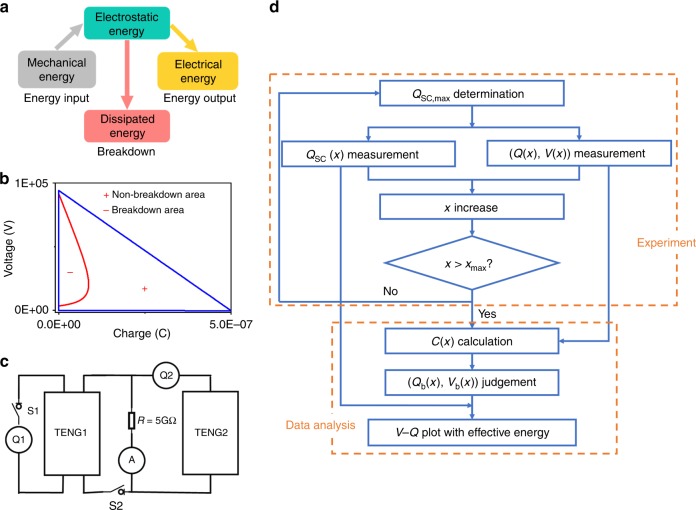
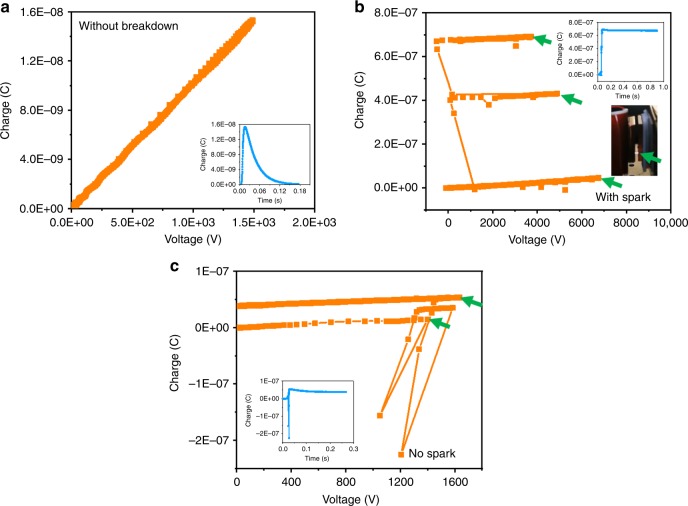
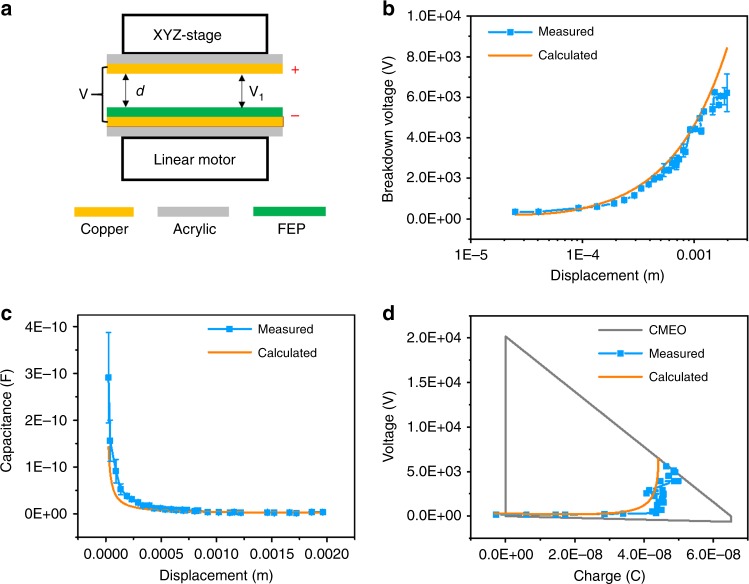
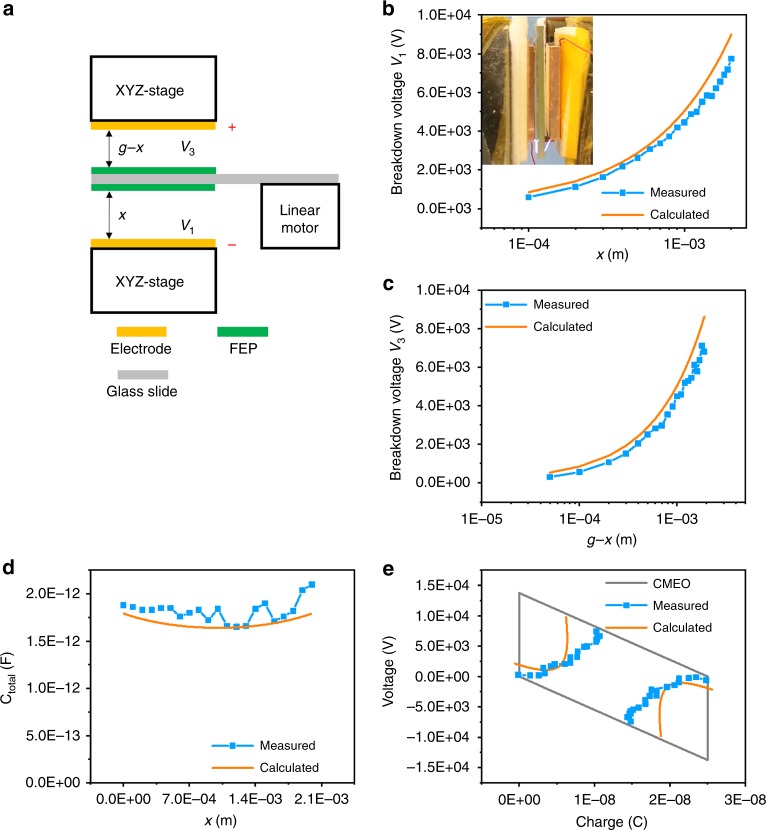
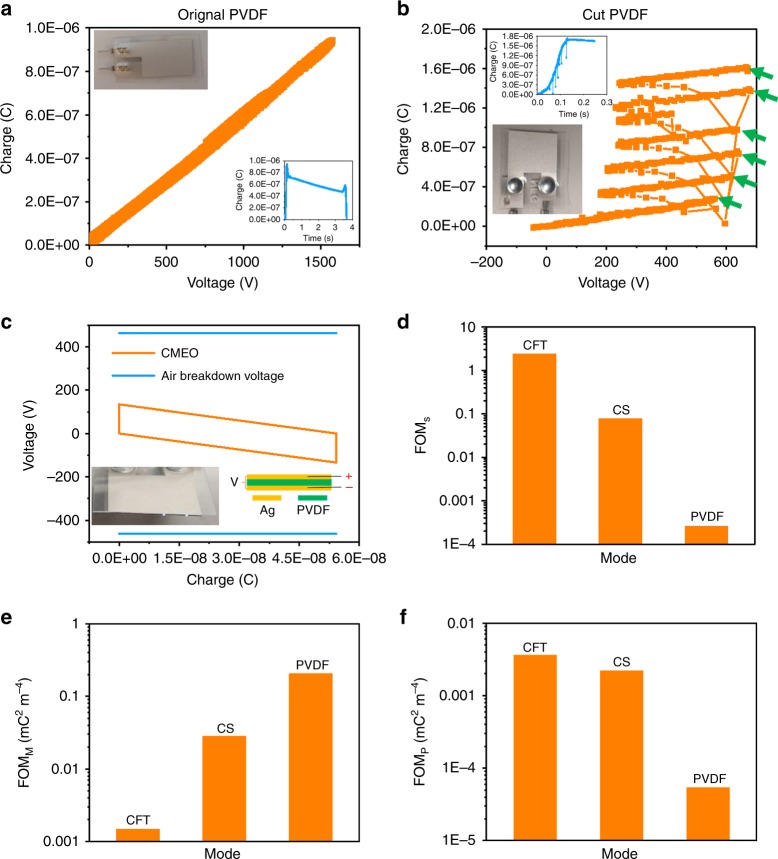
To quantitatively evaluate the output performance of triboelectric nanogenerators, figures of merit have been developed. However, the current figures of merit, without considering the breakdown effect that seriously affects the effective maximized energy output, are limited for application. Meanwhile, a method to evaluate output capability of nanogenerators is needed. Here, a standardized method that considers the breakdown effect is proposed for output capability assessment of nanogenerators. Contact separation and contact freestanding-triboelectric-layer modes triboelectric nanogenerators are used to demonstrate this method, and the effective maximized energy output and revised figures of merit are calculated based on the experimental results. These results are consistent with those theoretically calculated based on Paschen’s law. This method is also conducted to evaluate a film-based piezoelectric nanogenerator, demonstrating its universal applicability for nanogenerators. This study proposes a standardized method for evaluating the effective output capability of nanogenerators, which is crucial for standardized evaluation and application of nanogenerator technologies.
Overview
The claims and statistics of this paper haven’t been checked yet.
Free: it reads the open-access text and checks the first 5 claims that cite a source we can check. Create a free account to check every claim.
Integrity signals
Registry
Cites
Statistics
Figures
Verification
Claims the paper makes
The claims and statistics of this paper haven’t been checked yet.
Free: it reads the open-access text and checks the first 5 claims that cite a source we can check. Create a free account to check every claim.
Claims other papers make about this one
Each is checked against this paper’s own text: does it say what the citing paper says it does?
In the citing paper
“and these tribo-induced charges exhaust very quickly during the discharging process (34), leading to a self-protection mechanism against electrical damage.”
From Self-powered electro-tactile system for virtual tactile experiences (2021) · cites this paper as [34]
Self-check
Percentages, sums and reported differences re-computed from the paper’s own numbers.
The self-check needs the paper’s full text.
Citations
Cites
Flexible triboelectric generator
Fan, F.-R., Tian, Z.-Q., & Lin Wang, Z. (2012) · Nano Energy · doi:10.1016/j.nanoen.2012.01.004 · Cited by 6,705
Wang, Z. L. (2013) · ACS Nano · doi:10.1021/nn404614z · Cited by 3,058
Solar cell efficiency tables (Version 45)
Green, M. A., Emery, K., Hishikawa, Y., Warta, W., & Dunlop, E. D. (2015) · Progress in Photovoltaics: Research and Applications · doi:10.1002/pip.2573 · Cited by 2,440
On Maxwell's displacement current for energy and sensors: the origin of nanogenerators
Wang, Z. L. (2017) · Materials Today · doi:10.1016/j.mattod.2016.12.001 · Cited by 2,083
Theoretical study of contact-mode triboelectric nanogenerators as an effective power source
Niu, S., Wang, S., Lin, L., Liu, Y., Zhou, Y. S., Hu, Y., & Wang, Z. L. (2013) · Energy & Environmental Science · doi:10.1039/c3ee42571a · Cited by 1,956
Theoretical systems of triboelectric nanogenerators
Niu, S., & Wang, Z. L. (2015) · Nano Energy · doi:10.1016/j.nanoen.2014.11.034 · Cited by 1,567
Direct-Write Piezoelectric Polymeric Nanogenerator with High Energy Conversion Efficiency
Chang, C., Tran, V. H., Wang, J., Fuh, Y.-K., & Lin, L. (2010) · Nano Letters · doi:10.1021/nl9040719 · Cited by 1,379
Triboelectric-Generator-Driven Pulse Electrodeposition for Micropatterning
Zhu, G., Pan, C., Guo, W., Chen, C.-Y., Zhou, Y., Yu, R., & Wang, Z. L. (2012) · Nano Letters · doi:10.1021/nl302560k · Cited by 1,059
Wang, S., Xie, Y., Niu, S., Lin, L., & Wang, Z. L. (2014) · Advanced Materials · doi:10.1002/adma.201305303 · Cited by 1,001
Massines, F., Rabehi, A., Decomps, P., Gadri, R. B., Ségur, P., & Mayoux, C. (1998) · Journal of Applied Physics · doi:10.1063/1.367051 · Cited by 955
Research works printed but not linked: 1
- Lieberman, M. A. & Lichtenberg, A. J. Principles of Plasma Discharges and Materials Processing, 2nd edn. (John Wiley & Sons 2008).
Cited by
Items 101–130 of 130
Paudel, T., Pan, C.-T., Chen, C., Tiwari, S., & Dhakal, T. (2026) · International Journal of Smart and Nano Materials · doi:10.1080/19475411.2026.2616024 · Cited by 3
Viesca, F., de Leon, D., Alejandro, K., Ybarra, R., Rahman, M. W., Padilla, V., Vasquez, H., Lozano, K., & Uddin, M. S. G. (2026) · Nano Trends · doi:10.1016/j.nwnano.2026.100200 · Cited by 3
Yüzüak, G. D., ÇETİN, M., & Yuzuak, E. (2023) · Gazi University Journal of Science Part A Engineering and Innovation · doi:10.54287/gujsa.1247152 · Cited by 2
“Artificial forces, including wind and rain (also known as variable forces), or other forces resulting from human activities have the characteristics of being waste and may be recovered to provide electricity (Xia et al., 2019).”
BackgroundZi, Y., Guo, H., Wang, J., Zhang, C., Chen, X., & Zhao, Q. (2025) · Wiley eBooks · doi:10.1002/9783527837908.ch10 · Cited by 1
Self-citationCost-Effective Measurement Techniques for Accurate Characterization of Triboelectric Nanogenerators
Tshimbu, A. M., Zhang, S., Nasiri, H., Zou, T., & Zhang, L. (2025) · International Symposium on Antenna Technology and Applied Electromagnetics · doi:10.1109/antem64578.2025.11114189 · Cited by 1
“However, these methods struggle to account for the impedance mismatch between TENGs and commercial instruments, resulting in significant inaccuracies [11], [12].”
Cu/PTFE triboelectric nanogenerator for Morse code and array information detection
闫, Y. 玉. Y., Qi, Y., & Wang, H. (2025) · Chinese Physics B · doi:10.1088/1674-1056/ae039b · Cited by 1
Zhu, X., Wang, Y., Liu, S., Pang, Y., Wang, Z. L., & Teng, L. (2026) · Nano Energy · doi:10.1016/j.nanoen.2026.111984 · Cited by 1
Edi, K. K., Mazida, I., Nadhifah, F. R., Chitraningrum, N., Farma, R., Su, C., Arifin, A., Sutarsis, Sukarno, R., & Jamaluddin, A. (2026) · Next Materials · doi:10.1016/j.nxmate.2026.102648 · Cited by 1
Tang, R., Hu, Y., Li, K., Yi, X., Yu, Z., Xu, R., Wu, B., Hu, C., Liu, W., Wang, Z. L., et al. (2026) · Energy & Environmental Science · doi:10.1039/d6ee04690h · Cited by 1
Modeling, simulation, and optimization of miniature tribo-electret kinetic energy harvesters
Zhang, H. (2019) · theses.fr (ABES) · doi:10.70675/79183e91z0692z4f8fzb36az24666c7d0ea4 · Cited by 3
Design of Experiments Approach to Triboelectric Materials Testing
Bekker, L. (2023) · OSTI OAI (U.S. Department of Energy Office of Scientific and Technical Information)
Figure of Merit of Triboelectric Nanogenerator
Zi, Y. (2023) · Springer eBooks · doi:10.1007/978-3-031-05722-9_8-1
Self-citationThe Performance Assessment of TiO2/ITO-PET TENG Device
Yüzüak, G. D., & Yuzuak, E. (2023) · Springer proceedings in energy · doi:10.1007/978-3-031-30171-1_44 · Cited by 1
Figure of Merit of Triboelectric Nanogenerator
Zi, Y. (2023) · Springer eBooks · doi:10.1007/978-3-031-28111-2_8
Self-citationField-view model for triboelectric nanogenerator motion superposition analysis
Zheng, H., Haiyang, Y., Wu, C., Wang, Y., Zhao, Y., & Wang, Z. (2023) · Journal of Physics D Applied Physics · doi:10.1088/1361-6463/ad14bd
Uddin, M. J., Viesca, F., de Leon, D., Alejandro, K., Ybarra, R., Padilla, V., Vasquez, H., & Lozano, K. (2024) · SSRN Electronic Journal · doi:10.2139/ssrn.4849174
Zi, Y., Guo, H., Wang, J., Zhang, C., Chen, X., & Zhao, Q. (2025) · Wiley eBooks · doi:10.1002/9783527837908.ch2
Self-citationOutput Promotion by Environment
Zi, Y., Guo, H., Wang, J., Zhang, C., Chen, X., & Zhao, Q. (2025) · Wiley eBooks · doi:10.1002/9783527837908.ch4
Self-citationFigure‐of‐Merit of Triboelectric Nanogenerator
Zi, Y., Guo, H., Wang, J., Zhang, C., Chen, X., & Zhao, Q. (2025) · Wiley eBooks · doi:10.1002/9783527837908.ch3
Self-citationDesign of Experiments Approach to Triboelectic Materials Testing
Bekker, L. (2023) · eScholarship (California Digital Library) · Cited by 1
Shi, W., Zhang, Y., Wang, X., Han, Q., Liu, G., & Cao, Y. (2026) · Nano Energy · doi:10.1016/j.nanoen.2026.111904
Coupling effects and mechanisms of interfacial friction and triboelectrification
Li, M., Zhang, L., Meng, J., Sun, W., & Wang, D. (2026) · Chemical Engineering Journal · doi:10.1016/j.cej.2026.179298
Bioelectronic interfaces for restoring vision pathways
Wang, T., Zhao, B., Du, Y., Wu, S., Jiang, Y., Li, J., Miao, Y., & Shi, Y. (2026) · Materials Today Bio · doi:10.1016/j.mtbio.2026.103652
“(d ) Independent layer mode: A freely moving friction layer interacts with two electrode-backed friction layers, generating charge redistribution and electrical output [49].”
Tshimbu, A. M., Zou, T., & Zhang, L. (2026) · Nano Energy · doi:10.1016/j.nanoen.2026.112357
Ajay Haridas, C. P., Das, P., Naskar, K., & Mondal, T. (2026) · Advanced Science · doi:10.1002/advs.77535
Dev, B., Gharami, M., Newaz, K., & Rahman, M. A. (2026) · RSC Advances · doi:10.1039/d6ra05670a
Development and evaluation of ultraviolet systems to enhance food safety and food security
Jin, Z. (2024) · Illinois Digital Environment for Access to Learning and Scholarship (University of Illinois at Urbana-Champaign)
Kim, M., Lim, H., Oh, S., Ham, J., Park, C., Lee, T., Kim, Y., Sohn, H., Park, H., Cho, J., et al. (2026) · Chemical Engineering Journal · doi:10.1016/j.cej.2026.182913
Chemiresistive Sensors Based on ZnO Nanowires for Toxic Gas Detection
Sinju, K. R., Bhangare, B. K., Patil, S. J., Debnath, A. K., & Ramgir, N. S. (2026) · Indian Institute of Metals series · doi:10.1007/978-981-92-5987-8_9
Sriphan, S., Vittayakorn, W., Maluangnont, T., Hajra, S., Kim, H. J., Pakawanit, P., Charoonsuk, T., & Vittayakorn, N. (2026) · Nano Energy · doi:10.1016/j.nanoen.2026.112508
Metadata
- Authors
- Xia, X., Fu, J., & Zi, Y.
- Affiliations
- Chinese University of Hong Kong (HK)
- Corresponding author
- Zi, Yunlong
- Venue
- Nature Communications
- Published
- 2019-09-27
- Volume
- 10
- Issue
- 1
- Pages
- 4428-4428
- ISSN
- 2041-1723 (ISSN-L)
- PMC
- PMC6765008
- OpenAlex
- W2976452716
- Cited by
- 125
- References
- 42
- Citations by year
- 2026: 13 · 2025: 19 · 2024: 12 · 2023: 22 · 2022: 19 · 2021: 21 · 2020: 17 · 2019: 2
- FWCI
- 5.20
- Type
- journal article
- Language
- en
- Open access
- gold
- doi.org
- Licence
- cc-by
- creativecommons.org/licenses/by/4.0 (tdm)
- creativecommons.org/licenses/by/4.0 (vor)
- Locations
- Nature Communications (publishedVersion, cc-by)
- Europe PMC (PubMed Central) (publishedVersion, cc-by)
- PubMed Central (publishedVersion, cc-by)
- PubMed (publishedVersion)
- RePEc: Research Papers in Economics (submittedVersion)
- DOAJ (DOAJ: Directory of Open Access Journals) (submittedVersion, cc-by-sa)
- DOAJ (DOAJ: Directory of Open Access Journals) (submittedVersion)
- Rare & Special e-Zone (The Hong Kong University of Science and Technology) (submittedVersion)
- Funders
- Innovation and Technology Fund (ITS/085/18)
- CUHK | Shun Hing Institute of Advanced Engineering (RNE-p5-18)
- Chinese University of Hong Kong (4055086)
- Topics
- Physical Sciences › Engineering › Biomedical Engineering › Advanced Sensor and Energy Harvesting Materials
- Physical Sciences › Engineering › Mechanical Engineering › Innovative Energy Harvesting Technologies
- Physical Sciences › Physics and Astronomy › Atomic and Molecular Physics, and Optics › Force Microscopy Techniques and Applications
- Keywords
- triboelectric nanogenerator, figure of merit, Paschen's law, contact separation, piezoelectric nanogenerators, energy output
About these checks
Registry, retraction, Cites and statistics results are computed, not judged, with one exception: a printed reference that no index lists is read once by a model before it counts as a citation error. Claims are extracted by a model and kept only when their quote appears verbatim in the text; each cited source is then checked, with a model’s help, for whether it says what the claim relies on. Those verdicts can be wrong — read the claim’s quote and the cited source before relying on one.
Statistics and arithmetic are recomputed, not judged.
Confidence bands are shown only for fields calibrated on our annotated test set. None is calibrated yet, so no band is shown.
What counts as a claim ›How we measure confidence ›How we check this ›
Are you an author, or do you see a problem with this page? Request a review
Data sources
Bibliographic data: Semantic Scholar, OpenAlex, Crossref.
Contains information from the Semantic Scholar Academic Graph Datasets, made available under the ODC Attribution License (ODC-BY 1.0).
Semantic Scholar’s data is described in: Kinney, R., et al. (2023). The Semantic Scholar Open Data Platform. arXiv:2301.10140.
