

Conductive 2D metal-organic framework for high-performance cathodes in aqueous rechargeable zinc batteries
Open accessThe DOI matches its Crossref record; 55 of the 55 references it cites were found in a registry or an index.
Abstract
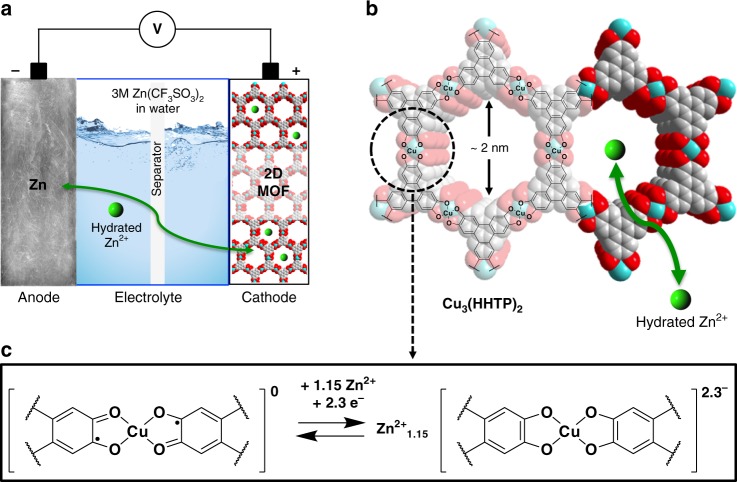
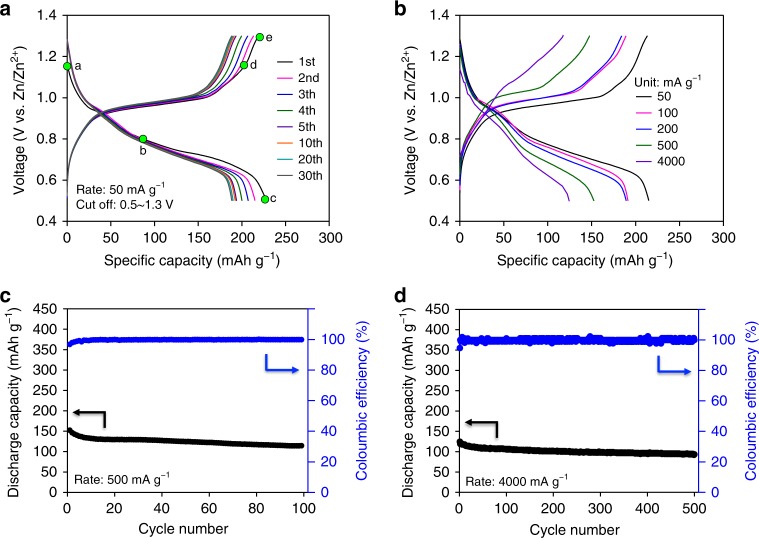
Currently, there is considerable interest in developing advanced rechargeable batteries that boast efficient distribution of electricity and economic feasibility for use in large-scale energy storage systems. Rechargeable aqueous zinc batteries are promising alternatives to lithium-ion batteries in terms of rate performance, cost, and safety. In this investigation, we employ Cu 3 (HHTP) 2 , a two-dimensional (2D) conductive metal-organic framework (MOF) with large one-dimensional channels, as a zinc battery cathode. Owing to its unique structure, hydrated Zn 2+ ions which are inserted directly into the host structure, Cu 3 (HHTP) 2 , allow high diffusion rate and low interfacial resistance which enable the Cu 3 (HHTP) 2 cathode to follow the intercalation pseudocapacitance mechanism. Cu 3 (HHTP) 2 exhibits a high reversible capacity of 228 mAh g −1 at 50 mA g −1 . At a high current density of 4000 mA g −1 (~18 C), 75.0% of the initial capacity is maintained after 500 cycles. These results provide key insights into high-performance, 2D conductive MOF designs for battery electrodes.
Overview
The claims and statistics of this paper haven’t been checked yet.
Free: it reads the open-access text and checks the first 5 claims that cite a source we can check. Create a free account to check every claim.
Integrity signals
Registry
Cites
Statistics
Figures
Verification
Claims the paper makes
The claims and statistics of this paper haven’t been checked yet.
Free: it reads the open-access text and checks the first 5 claims that cite a source we can check. Create a free account to check every claim.
Self-check
Percentages, sums and reported differences re-computed from the paper’s own numbers.
The self-check needs the paper’s full text.
Citations
Cites
Generalized Gradient Approximation Made Simple
Perdew, J. P., Burke, K., & Ernzerhof, M. (1996) · Physical Review Letters · doi:10.1103/physrevlett.77.3865 · Cited by 215,824
Efficient iterative schemes for ab initio total-energy calculations using a plane-wave basis set
Kresse, G., & Furthmüller, J. (1996) · Physical Review B · doi:10.1103/physrevb.54.11169 · Cited by 123,652
Projector augmented-wave method
Blöchl, P. E. (1994) · Physical Review B · doi:10.1103/physrevb.50.17953 · Cited by 92,732
Kresse, G., & Furthmüller, J. (1996) · Computational Materials Science · doi:10.1016/0927-0256(96)00008-0 · Cited by 75,638
Grimme, S., Antony, J., Ehrlich, S., & Krieg, H. (2010) · The Journal of Chemical Physics · doi:10.1063/1.3382344 · Cited by 59,686
VESTA 3 for three-dimensional visualization of crystal, volumetric and morphology data
Momma, K., & Izumi, F. (2011) · Journal of Applied Crystallography · doi:10.1107/s0021889811038970 · Cited by 26,054
Electrical energy storage for the grid: A battery of choices
Dunn, B., Kamath, H., & Tarascon, J.-M. (2011) · Science · doi:10.1126/science.1212741 · Cited by 15,072
Towards greener and more sustainable batteries for electrical energy storage
Larcher, D., & Tarascon, J.-M. (2015) · Nature Chemistry · doi:10.1038/nchem.2085 · Cited by 7,872
Pseudocapacitive Contributions to Electrochemical Energy Storage in TiO2 (Anatase) Nanoparticles
Wang, J., Polleux, J., Lim, J., & Dunn, B. (2007) · The Journal of Physical Chemistry C · doi:10.1021/jp074464w · Cited by 5,333
Electrochemical Energy Storage for Green Grid
Yang, Z., Zhang, J., Kintner-Meyer, M. C. W., Lu, X., Choi, D., Lemmon, J. P., & Liu, J. (2011) · Chemical Reviews · doi:10.1021/cr100290v · Cited by 5,250
Cited by
Items 401–500 of 714
Rochefort, A., Vernisse, L., Herrero, A. C. G., Sánchez‐Sánchez, C., Martín-Gago, J. Á., Chérioux, F., Clair, S., Coraux, J., & Martínez, J. I. (2021) · The Journal of Physical Chemistry C · doi:10.1021/acs.jpcc.1c03976 · Cited by 19
Iqbal, M. Z., Shaheen, M., Siddique, S., Aftab, S., & Wabaidur, S. M. (2023) · Journal of Energy Storage · doi:10.1016/j.est.2023.107361 · Cited by 19
Cui, X., Zhang, Y., Zhang, J., Xie, E., & Fu, J. (2023) · Advanced Materials Technologies · doi:10.1002/admt.202300321 · Cited by 19
An Organic Coordination Manganese Complex as Cathode for High‐Voltage Aqueous Zinc‐metal Battery
Zhang, F., Wang, G., Wu, J., Chi, X., & Liu, Y. (2023) · Angewandte Chemie International Edition · doi:10.1002/anie.202309430 · Cited by 19
Possibilities and challenges of cathode materials for Zn-ion batteries
Rakkesh, R. A., Shalini, S., Tharani, S., Durgalakshmi, D., & Balakumar, S. (2024) · Energy Advances · doi:10.1039/d3ya00638g · Cited by 19
Han, Q., Xiao, H., Zhou, T., Li, B., Liu, Y., Xie, L., Qiu, X., Wu, X., Zhu, L., & Cao, X. (2024) · Rare Metals · doi:10.1007/s12598-024-02671-3 · Cited by 19
“This can be attributed to the exceptional redox activity of the 3D-MnVO electrode and its high stability as a host material to facilitate Zn 2 ? migration [63, 64].”
Iron salicylaldehydate conjugated metal–organic framework for quasi solid-state supercapacitor
Mohammed, A. K., Pandikassala, A., Pena-Sánchez, P., Gaber, S., Canossa, S., Kurian, M., Xavier, G., He, Y., Gándara, F., Kurungot, S., et al. (2024) · Chemical Engineering Journal · doi:10.1016/j.cej.2024.153589 · Cited by 19
A Change of Pace: Record Photoresponse through Spirooxazine Confinement in a Metal–Organic Matrix
Thaggard, G. C., Wilson, G. R., Naik, M. C., Quetel, M. A., Lim, J., Kankanamalage, B. K. P. M., Smith, M. D., & Shustova, N. B. (2024) · Journal of the American Chemical Society · doi:10.1021/jacs.4c10636 · Cited by 19
Sporrer, L., Guo, Q., Li, X., Wrzesińska, A., Reichmayr, F., Fu, S., Wang, H. I., Bonn, M., Li, X., Laval‐Schmidt, P., et al. (2024) · Angewandte Chemie International Edition · doi:10.1002/anie.202418390 · Cited by 19
Wang, Y., Ye, F., Wu, Z., Jiang, L., Zhang, L., & Hu, L. (2021) · ACS Applied Energy Materials · doi:10.1021/acsaem.1c00464 · Cited by 19
Water-resistant redox-active metal–organic framework
Akai, R., Kitajima, S., Okubo, K., Serizawa, N., Nishihara, H., Kasai, H., & Oka, K. (2025) · Nature Communications · doi:10.1038/s41467-025-65849-y · Cited by 18
“Both anode 17 – 22 (further details, see Supplementary Table 3).”
InfluentialAdvancing sustainability: Eco-friendly materials for high-performance zinc-ion batteries
Dong, F., Li, Y., Zhang, Q., Wang, Z., Ni, Z., Li, Y., Xi, B. J., Xiong, S. L., Tian, X., & Feng, J. (2025) · Progress in Materials Science · doi:10.1016/j.pmatsci.2025.101652 · Cited by 18
Cathodic synthesis of a Cu-catecholate metal–organic framework
Li, P., Shi, X., Wu, Y., Song, M., Lai, Y., Yu, H., & Lu, G. M. (2021) · CrystEngComm · doi:10.1039/d0ce01651a · Cited by 19
Liu, Y., Li, Z., Han, Y., Ji, Z., Li, H., Liu, Y., Wei, Y., Chen, C., He, X., & Wu, M. (2023) · ChemSusChem · doi:10.1002/cssc.202202305 · Cited by 20
Synthesis of Electrical Conductive Metal‐Organic Frameworks for Electrochemical Applications
Shah, S. S. A., Nazir, M. A., Mahmood, A., Sohail, M., Rehman, A. U., Tufail, M. K., Najam, T., Javed, M. S., Eldin, S. M., Rahman, M. M., et al. (2023) · The Chemical Record · doi:10.1002/tcr.202300141 · Cited by 18
Chen, Z., Liu, Y., Zhang, Y., Lin, Q., Zhou, Z., Han, W., & Fan, L. (2025) · Journal of Material Science and Technology · doi:10.1016/j.jmst.2025.09.052 · Cited by 17
Asymmetrical Substitution Manipulates Stacking Modes in 2D Conductive MOF Crystals
Liu, Y., Yao, H., Zhang, H., Ma, C., Guo, J., Fan, Y., Chen, H., Wu, X., Yang, L., Huang, X., et al. (2025) · Journal of the American Chemical Society · doi:10.1021/jacs.5c15827 · Cited by 17
Guan, J., Suzuki, H., Kamiya, K., Harada, T., Adachi, R., Tomita, O., Kurokawa, H., Unabara, D., Yonekura, K., Fukui, N., et al. (2026) · Nature Chemistry · doi:10.1038/s41557-026-02133-6 · Cited by 17
“52).”
Fiber Integrated Metal‐Organic Frameworks as Functional Components in Smart Textiles
Eagleton, A. M., Ambrogi, E. K., Miller, S. A., Vereshchuk, N., & Mirica, K. A. (2023) · Angewandte Chemie · doi:10.1002/ange.202309078 · Cited by 17
Liu, X., Yu, M., Liu, J., Wu, S., & Gong, J. (2023) · Small · doi:10.1002/smll.202306159 · Cited by 17
Bai, M., Li, S., Zhang, C., Liu, Y., Wen, Z., & Sun, J. (2024) · Journal of Electroanalytical Chemistry · doi:10.1016/j.jelechem.2024.118104 · Cited by 17
Jin, Y., Yuan, X., Ou, L., Wu, J., Hu, J., Xue, K., & Xiong, X. (2024) · Food Chemistry · doi:10.1016/j.foodchem.2024.139013 · Cited by 17
Acetamide-based deep eutectic solvents as efficient electrolytes for K–MnHCFe//Zn dual-ion batteries
Lin, T., Kumar, M. S., Shen, H., & Lin, J. (2024) · Journal of Power Sources · doi:10.1016/j.jpowsour.2024.234972 · Cited by 17
2D metal-organic framework Cu3(HHTP)2 composite electrode for flexible energy storage applications
Prince, M., Kanathedath, J., Paul, F., Markapudi, P. R., Beg, M., Paterson, L., Desmulliez, M. P. Y., Pillai, S. C., & Manjakkal, L. (2025) · Journal of Power Sources · doi:10.1016/j.jpowsour.2025.236214 · Cited by 17
Chen, J., Zhang, W., Zhang, X., Li, Z., Ma, J., Zhao, L., Jian, W., Chen, S., Yin, J. G., Lin, X., et al. (2022) · ChemSusChem · doi:10.1002/cssc.202200732 · Cited by 17
Recent Progress of Conductive Metal–Organic Frameworks for Electrochemical Energy Storage
Sang, Z., Tong, Y., Hou, F., & Liang, J. (2022) · Transactions of Tianjin University · doi:10.1007/s12209-022-00352-9 · Cited by 17
“Recently, benefitting from the stable coordination structure, excellent electron conductivity, sufficient pores, and adjustable redox actives, c-MOFs have been widely applied as advanced electrodes in supercapacitors and Li/Na/Zn-based batteries [14, 18, 31, 32].”
BackgroundTackling the Challenges of Aqueous Zn‐Ion Batteries via Polymer‐Derived Strategies
Liu, Q., Yu, Z., & Zhang, B. (2023) · Small Methods · doi:10.1002/smtd.202300255 · Cited by 19
Kim, D., Yun, T. G., Lee, J. H., Yoon, K. R., & Kim, K. (2024) · Nanoscale Advances · doi:10.1039/d3na00695f · Cited by 16
“21,42,43 When the surface of ACNFs was decorated with the c-MOF, the XRD di ff raction peaks exhibited a slight shi toward higher 2 q values, indicating a reduction in d -spacing of each crystallographic plane of the c-MOF grown on ACNFs.”
Wang, L., Darù, A., Jangid, B., Chen, J., Jiang, N., Patel, S. N., Gagliardi, L., & Anderson, J. S. (2024) · Journal of the American Chemical Society · doi:10.1021/jacs.4c01860 · Cited by 16
Recent Progress of Low‐Dimensional Metal‐Organic Frameworks for Aqueous Zinc‐Based Batteries
Xing, H., Han, Y., Huang, X., Zhang, C., Lyu, M., Chen, K., & Wang, T. (2024) · Small · doi:10.1002/smll.202402998 · Cited by 16
Liu, W., Yuan, G., Jiang, S., Shi, Y., & Pang, H. (2024) · Chemistry - A European Journal · doi:10.1002/chem.202402747 · Cited by 16
Jesudass, S. C., Surendran, S., Lim, Y., Jo, M., Janani, G., Choi, H., Kwon, G., Jin, K., Park, H., Kim, T., et al. (2024) · Small · doi:10.1002/smll.202406539 · Cited by 16
MOF-based electrode materials for aqueous zinc-ion batteries: design strategy and future challenges
Wang, Y., Pan, T., Zhang, S., Li, Q., & Pang, H. (2025) · Inorganic Chemistry Frontiers · doi:10.1039/d5qi00159e · Cited by 16
Issues and strategies of cathode materials for mild aqueous static zinc-ion batteries
Zhong, W., Zhang, J., Li, Z., Shen, Z., Zhang, S., Wang, X., & Lü, Y. (2023) · Green Chemical Engineering · doi:10.1016/j.gce.2023.01.001 · Cited by 16
Yadav, A., Zhang, S., Benavides, P. A., Zhou, W., & Saha, S. (2023) · Angewandte Chemie International Edition · doi:10.1002/anie.202303819 · Cited by 16
Batch Synthesis of K-Doped α-MnO2 Nanorods as Cathode Materials for Aqueous Zinc-Ion Battery
Yang, Q., Chen, Y., Yang, Y., Xu, T., Yin, L., Zhang, X., Wang, J., Liu, Y., & Li, Y. (2023) · Industrial & Engineering Chemistry Research · doi:10.1021/acs.iecr.3c02245 · Cited by 16
Mohammed, A. K., Hausmann, J. N., Gaber, S., Pena-Sánchez, P., Gándara, F., Laun, K., Zebger, I., Menezes, P. W., & Shetty, D. (2025) · Journal of Colloid and Interface Science · doi:10.1016/j.jcis.2025.137630 · Cited by 15
“Among these, π -d conjugated two-dimensional MOFs (2D-c -MOFs) are known for their optoelectronic properties due to the coordination of vacant d orbitals of metal ions with π orbitals of organic building blocks [2 – 5].”
Salicylaldehydate coordinated two-dimensional-conjugated metal–organic frameworks
Mohammed, A. K., Pena-Sánchez, P., Pandikassala, A., Gaber, S., AlKhoori, A. A., Škorjanc, T., Polychronopoulou, K., Kurungot, S., Gándara, F., & Shetty, D. (2023) · Chemical Communications · doi:10.1039/d2cc06283f · Cited by 15
The progress of cathode materials in aqueous zinc-ion batteries
Zhou, X., Jiang, S., Zhu, S., Xiang, S., Zhang, Z., Xu, X., Xu, Y., Zhou, J., Tan, S., Pan, Z., et al. (2023) · Nanotechnology Reviews · doi:10.1515/ntrev-2023-0122 · Cited by 15
“Nam et al. explored the 2D conductive MOF, Cu 3 (HHTP) 2 (HHTP = 2,3,6,7,10,11-hexahydroxytriphenylene propylene), as a cathode material for AZIBs [153].”
BackgroundZhang, S., Zhang, W., Yadav, A., Baker, J., & Saha, S. (2023) · Inorganic Chemistry · doi:10.1021/acs.inorgchem.3c02647 · Cited by 15
Chang, Z., Zhu, M., Li, Z., Wu, S. S., Yin, S., Sun, Y., & Xu, W. (2024) · Small · doi:10.1002/smll.202400923 · Cited by 15
Ajayi, S. O., Dolla, T. H., Sikeyi, L. L., Akinola, A. O., Maboya, W. K., Liu, X., Makgwane, P. R., & Mathe, M. K. (2024) · Materials Today Sustainability · doi:10.1016/j.mtsust.2024.100899 · Cited by 24
Raising the Redox Potential in a Quinone-Based Positive Organic Cathode via Space Charge Modulation
Wu, Y., Zhao, L., Shen, J., Gu, T., Yang, Y., Ji, S., Zhu, M. H., & Liu, J. (2025) · ACS Energy Letters · doi:10.1021/acsenergylett.4c03283 · Cited by 15
Saeed, M., Sharif, S., Shah, J. H., Afzal, T. T. R., Shahbaz, M., Shehzad, A. M., Shahzad, A., Şahın, O., & Shahzad, S. (2025) · RSC Advances · doi:10.1039/d5ra02060c · Cited by 15
From surface chemistry to ion dynamics: mechanistic roles of MXenes in aqueous zinc-ion batteries
Liu, J., Chen, S., Shang, W., & Zhang, J. (2025) · EES batteries. · doi:10.1039/d5eb00114e · Cited by 15
Zhang, G., Wang, H., Deng, X., Yang, Y. L., Zhang, T., Wang, J., Zeng, H., Wang, C., & Deng, Y. (2020) · Chemical Engineering Journal · doi:10.1016/j.cej.2020.127525 · Cited by 15
Wang, L., Papoular, R. J., Horwitz, N. E., Xie, J., Sarkar, A., Campisi, D., Zhao, N., Cheng, B., Grocke, G. L., Ma, T., et al. (2022) · Angewandte Chemie International Edition · doi:10.1002/anie.202207834 · Cited by 15
Shukla, P., Mishra, A., Manivanna, S., & Mandal, D. (2022) · Nanoarchitectonics · doi:10.37256/nat.3220221272 · Cited by 15
“Transition metal-based MOFs are of low cost and have excellent electrocatalytic activity for practical implementation [27].”
BackgroundNambi, A., Chatzitakis, A., Olsbye, U., Hjelm, J., Zhao, Y., & Kaiser, A. (2024) · Electrochimica Acta · doi:10.1016/j.electacta.2024.144763 · Cited by 14
“In the past two decades, Metal-Organic Frameworks (MOFs) have been widely explored for applications in gas storage [21,22], gas separation using mixed matrix membranes [23], proton conducting material [24], gas sensing [25,26], and energy storage material [27–29].”
BackgroundXiong, J., Li, Q., Li, K., Guo, X. Y., Zhong, M., Wang, R., Chen, Y., Tan, X., Na, B., & Tong, X. (2024) · Journal of Colloid and Interface Science · doi:10.1016/j.jcis.2024.11.177 · Cited by 14
Ambrogi, E. K., Damacet, P., Stolz, R. M., & Mirica, K. A. (2024) · ACS Nano · doi:10.1021/acsnano.4c14018 · Cited by 14
He, H., Guo, B., Liu, Y., Zhang, L., & Huang, W. (2020) · Crystal Growth & Design · doi:10.1021/acs.cgd.0c00690 · Cited by 14
Yan, J., Cui, Y., Xie, M., Yang, G., Bin, D., & Li, D. (2021) · Angewandte Chemie · doi:10.1002/ange.202110373 · Cited by 14
Open-Framework Metal Oxides for Fast and Reversible Hydrated Zinc-Ion Intercalation
Yang, H., Ning, P., Chen, J., Li, Y., He, H., & Cao, H. (2022) · ACS Applied Materials & Interfaces · doi:10.1021/acsami.1c23995 · Cited by 14
Covalent Triazine Frameworks and Porous Carbons: Perspective from an Azulene‐Based Case
Jiang, K., Peng, P., Tranca, D., Tong, G., Ke, C., Lu, C., Hu, J., Liang, H., Li, J., Zhou, S., et al. (2022) · Macromolecular Rapid Communications · doi:10.1002/marc.202200392 · Cited by 16
Zhang, J., Liu, S., Liu, H., Zhou, S., Ding, R., Wei, S., Wang, Z., & Lü, X. (2022) · Journal of Alloys and Compounds · doi:10.1016/j.jallcom.2022.166010 · Cited by 14
Construction of V1.11S2 flower spheres for efficient aqueous Zn-ion batteries
Chen, X., Kong, Q., Wu, X., An, X., Zhang, J., Wang, Q., & Yao, W. (2022) · Journal of Colloid and Interface Science · doi:10.1016/j.jcis.2022.06.110 · Cited by 14
Khatun, A., Yadav, A., Zhang, S., & Saha, S. (2022) · Materials Today Chemistry · doi:10.1016/j.mtchem.2022.100981 · Cited by 14
Liu, M., Qin, M., Fang, G., Liang, S., Wang, X., & Luo, Z. (2023) · Journal of Alloys and Compounds · doi:10.1016/j.jallcom.2023.170455 · Cited by 14
Utilization of 2D materials in aqueous zinc ion batteries for safe energy storage devices
Kim, J.-S., Heo, S.-W., Lee, S. Y., Lim, J. M., Choi, S., Kim, S. W., Mane, V. J., Kim, C., Park, H., Noh, Y. T., et al. (2023) · Nanoscale · doi:10.1039/d3nr03468b · Cited by 14
Self-citationToward Practical Multivalent Ion Batteries with Quinone-Based Organic Cathodes
Hwang, I., Kim, D.-U., Choi, J. W., & Yoo, D. (2023) · ACS Applied Materials & Interfaces · doi:10.1021/acsami.3c11270 · Cited by 14
Fan, C., Wang, L., Xu, C., Wu, R., Li, N., Zhang, D., Zhang, X., Bi, S., & Fan, Y. (2020) · Journal of Solid State Chemistry · doi:10.1016/j.jssc.2020.121445 · Cited by 14
Lv, S., Li, B., Ma, L., Song, S., Ji, Y., Li, Y., Zhu, M., Ma, S., & Lu, S. (2025) · Rare Metals · doi:10.1002/rar2.70045 · Cited by 13
Multifunctional Zeolites in Secondary Batteries
Zhang, K., Wu, F., Li, Y., Shi, J. Z., Feng, X., Wu, C. K., & Bai, Y. (2026) · Chemical Reviews · doi:10.1021/acs.chemrev.5c00626 · Cited by 14
2D Porphyrinic Metal-Organic Frameworks Featuring Rod-Shaped Secondary Building Units
Elliott, R., Ryan, A. A., Aggarwal, A., Zhu, N., Steuber, F. W., Senge, M. O., & Schmitt, W. (2021) · Molecules · doi:10.3390/molecules26102955 · Cited by 13
Li, Y., Guo, Y. H., Luan, D., Gu, X., & Lou, X. W. (2023) · Angewandte Chemie · doi:10.1002/ange.202310847 · Cited by 13
Electrically conductive [Fe 4 S 4 ]-based organometallic polymers
Kadota, K., Chen, T., Gormley, E. L., Hendon, C. H., Dincă, M., & Brozek, C. K. (2023) · Chemical Science · doi:10.1039/d3sc02195e · Cited by 13
De, S., Mouchaham, G., Liu, F., Affram, M., Abeykoon, B., Guillou, N., Jeanneau, E., Grenèche, J., Khrouz, L., Martineau, C., et al. (2023) · Journal of Materials Chemistry A · doi:10.1039/d3ta04490d · Cited by 13
Dontireddy, G. M. R., Suman, S. P., Merino-Gardea, J. L., Chen, T., Dou, J., & Banda, H. (2024) · Chemical Science · doi:10.1039/d4sc02699c · Cited by 13
Semiconducting 2D Copper(I) Framework for Sub-ppb-Level Ammonia Sensing
Pandey, D., Patel, C., Mishra, S., Mukherjee, S., & Raghuvanshi, A. (2024) · ACS Applied Nano Materials · doi:10.1021/acsanm.4c03199 · Cited by 13
Liu, S., Kong, F., Chen, X., Song, E., & Huang, A. (2024) · Advanced Functional Materials · doi:10.1002/adfm.202415328 · Cited by 13
Zhang, M., Xu, T., Liu, W., Zhang, H., Qi, J., Wang, X., Wang, Y., Zhu, L., Liu, K., Wang, J., et al. (2025) · Carbon Energy · doi:10.1002/cey2.70097 · Cited by 13
Yu, S., Lin, W., Huang, X., Jin, X., Yao, S., Wang, B., Zhu, H., & Chen, J. (2021) · Polyhedron · doi:10.1016/j.poly.2021.115278 · Cited by 13
Yang, X., Gao, T., Zhao, R., Wu, Q., Shi, K., She, Z., Lu, S., Xie, Q., & Ruan, Y. (2022) · Energy Technology · doi:10.1002/ente.202200990 · Cited by 13
Shu, Y., Fujimoto, Y., Taniguchi, Y., Miyake, K., Uchida, Y., & Nishiyama, N. (2022) · ACS Applied Energy Materials · doi:10.1021/acsaem.2c01709 · Cited by 13
Cheng, S., Cao, Z., Liu, Y., Zhang, J., Cavallo, L., Xie, E., & Fu, J. (2024) · Energy & Environmental Science · doi:10.1039/d3ee03819j · Cited by 12
2D Conductive Metal–Organic Frameworks for Electrochemical Energy Application
Li, R., Yan, X., & Chen, L. (2024) · Organic Materials · doi:10.1055/s-0044-1786500 · Cited by 12
Ultrafast Self‐Charging in Acid–Base Free Aqueous Rechargeable Zinc–Quinhydrone Batteries
Bariya, S. N., Surana, K., Kapdi, Y. G., Machhi, H. K., Prasad, J., & Soni, S. S. (2024) · Advanced Energy Materials · doi:10.1002/aenm.202401257 · Cited by 12
Souza, P. H., & Orellana, W. (2025) · The Journal of Physical Chemistry C · doi:10.1021/acs.jpcc.4c07540 · Cited by 12
A core–shell Cu 2 O@Cu-MOF for electromagnetic wave absorption and selective shielding
Zong, J., Wang, Z., Wang, M., Shu, J., Cao, W., & Cao, M. (2025) · Nanoscale Horizons · doi:10.1039/d5nh00392j · Cited by 12
Efficient detection of glucose by graphene-based non-enzymatic sensing material based on carbon dot
Zhou, J., Wang, R., Su, W., Zhang, L., Li, A., & Jiao, T. (2022) · Colloids and Surfaces A Physicochemical and Engineering Aspects · doi:10.1016/j.colsurfa.2022.129122 · Cited by 12
Yoon, J. W., Jo, Y., & Lee, J. (2022) · Energy Advances · doi:10.1039/d2ya00008c · Cited by 12
Liu, L., Lin, Z., Shi, Q. W., Tang, J., Li, Z., Tao, Z., & Huang, W. (2022) · Electrochemistry Communications · doi:10.1016/j.elecom.2022.107331 · Cited by 12
Li, Y., Chen, S., Duan, W., Nan, Y., Ding, D., & Xiao, G. (2023) · Energy Technology · doi:10.1002/ente.202300830 · Cited by 12
Momeni, M. R., Zhang, Z., & Shakib, F. A. (2020) · Chemical Communications · doi:10.1039/d0cc07430f · Cited by 12
Stoica, A., Damoc, M., Zaltariov, M., Racleş, C., & Cazacu, M. (2021) · Reactive and Functional Polymers · doi:10.1016/j.reactfunctpolym.2021.105039 · Cited by 12
Sun, J., Zhang, Q., Liu, C., Zhang, A., Hou, L., & Yuan, C. (2024) · Batteries · doi:10.3390/batteries10070222 · Cited by 11
“Raman spectra and the Raman spectra and the corresponding Gaussian fi t curves of PC are shown in Figure S5. corresponding Gaussian fit curves of PC are shown in − 1 Two characteristic peaks at ~1350 and 1582 cm − 1 are observed, corresponding to the D (disordered carbon or defective graphitic…”
BackgroundMethodInfluentialCheng, L., Li, M., Zhang, X., Wang, W., Zhao, L., & Wang, H. (2024) · Green Chemistry · doi:10.1039/d4gc05107f · Cited by 11
Lü, Y., Liu, Q., Pang, X., Tang, C., Yan, Z., Peng, B., & Yu, F. Y. (2025) · Journal of Materials Science · doi:10.1007/s10853-025-10715-x · Cited by 11
“…MOF materials, due to their physicochemical properties such as large specific surface area, easily transferring protons and electrons, thus reducing the energy barrier, have attracted much attention in many fields such as energy storage and conversion, and electrochemical sensing [3, 4].”
Ohkubo, E., Suzuki, M., Aizawa, N., Ikeda, O., Kitajima, S., Koganezawa, T., Ohta, K., Oka, K., Tohnai, N., Tominaga, K., et al. (2025) · Journal of the American Chemical Society · doi:10.1021/jacs.5c09695 · Cited by 11
Sun, J., Yan, Y., Li, Y., Zhou, T., Wang, L. F., & Liu, C. (2025) · Chemical Engineering Journal · doi:10.1016/j.cej.2025.169090 · Cited by 11
Meng, G., Wang, Y., Carraro, F., Liang, W., Roostaeinia, M., Siahrostami, S., Proserpio, D. M., Doonan, C. J., Falcaro, P., Zheng, H., et al. (2021) · Angewandte Chemie · doi:10.1002/ange.202016882 · Cited by 11
Regulating Exposed Facets of Metal‐Organic Frameworks for High‐rate Alkaline Aqueous Zinc Batteries
Yang, S., Lv, H., Wang, Y., Guo, X., Zhao, L., Li, H., & Zhi, C. (2022) · Angewandte Chemie · doi:10.1002/ange.202209794 · Cited by 11
Recent advances in emerging metal–organic and covalent–organic frameworks for zinc-ion batteries
Li, L., Shi, Y., Jia, S., Wang, C., & Zhang, D. (2023) · Journal of Energy Storage · doi:10.1016/j.est.2023.108914 · Cited by 11
Liu, X., Peng, W., Tan, H., Sang, Z., & Liang, J. (2024) · Advanced Energy Materials · doi:10.1002/aenm.202401390 · Cited by 11
A Low‐Symmetry Copper Benzenehexathiol Coordination Polymer with In‐Plane Electrical Anisotropy
Wang, Z., Un, H., Liu, T., Liang, B., Položij, M., Hambsch, M., Pöhls, J. F., Weitz, R. T., Mannsfeld, S. C. B., Kaiser, U. A., et al. (2025) · Angewandte Chemie International Edition · doi:10.1002/anie.202423341 · Cited by 11
Cao, H., Liang, J., & Shen, S. (2022) · Chemical Engineering Journal · doi:10.1016/j.cej.2022.141081 · Cited by 11
Sarıyer, S., Yeşilot, S., Kılıç, N., Ghosh, A., Sel, O., & Demir‐Cakan, R. (2023) · Batteries & Supercaps · doi:10.1002/batt.202200529 · Cited by 11
Du, J., Ren, J., Shu, M., Xu, X., Niu, Z., Shi, W., Si, R., & Cheng, P. (2020) · Angewandte Chemie · doi:10.1002/ange.202013912 · Cited by 11
Gao, S., Ren, Y., Zhang, D., Wu, X., Xie, Y., Sun, L., Li, R., Yang, F., & Hu, W. (2024) · Journal of Materials Chemistry C · doi:10.1039/d4tc00421c · Cited by 10
Metadata
- Authors
- Nam, K. W., Park, S. S., dos Reis, R., Dravid, V. P., Kim, H., Mirkin, C. A., & Stoddart, J. F.
- Affiliations
- Northwestern University (US)
- Korea Basic Science Institute (KR)
- Corresponding author
- Stoddart, J. Fraser
- ORCID
- Venue
- Nature Communications
- Published
- 2019-10-30
- Volume
- 10
- Issue
- 1
- Pages
- 4948-4948
- ISSN
- 2041-1723 (ISSN-L)
- PMC
- PMC6821766
- OpenAlex
- W2982681138
- Semantic Scholar
- 7b877a740b56204a12e92e79ae078b88efb2aca7
- Cited by
- 688
- References
- 55
- Citations by year
- 2026: 61 · 2025: 110 · 2024: 126 · 2023: 119 · 2022: 111 · 2021: 98 · 2020: 63
- FWCI
- 24.44
- Type
- journal article
- Language
- en
- Open access
- gold
- doi.org
- Licence
- cc-by
- creativecommons.org/licenses/by/4.0 (tdm)
- creativecommons.org/licenses/by/4.0 (vor)
- Locations
- Nature Communications (publishedVersion, cc-by)
- PubMed Central (publishedVersion, cc-by)
- PubMed (publishedVersion)
- RePEc: Research Papers in Economics (submittedVersion)
- DOAJ (DOAJ: Directory of Open Access Journals) (submittedVersion, cc-by-sa)
- DOAJ (DOAJ: Directory of Open Access Journals) (submittedVersion)
- KAIST Institutional Repository (KAIST) (submittedVersion)
- Open Access System for Information Sharing (Pohang University of Science and Technology) (submittedVersion)
- Funders
- United States Department of Defense | United States Air Force | AFMC | Air Force Office of Scientific Research (FA9550-17-1-0348)
- National Science Foundation (Grant CHE-1709888)
- United States Department of Defense | United States Air Force | AFMC | Air Force Research Laboratory (FA8650-15-2-5518)
- Northwestern University
- King Abdulaziz City for Science and Technology
- Topics
- Physical Sciences › Engineering › Electrical and Electronic Engineering › Aqueous and Flow Batteries
- Physical Sciences › Chemistry › Inorganic Chemistry › Metal-Organic Frameworks: Synthesis and Applications
- Physical Sciences › Materials Science › Electronic, Optical and Magnetic Materials › Supercapacitor Materials and Fabrication
- Keywords
- aqueous zinc-ion batteries, Cu3(HHTP)2, zinc intercalation, pseudocapacitance, zinc ion diffusion, interfacial resistance, high-rate cycling performance, reversible capacity
About these checks
Registry, retraction, Cites and statistics results are computed, not judged, with one exception: a printed reference that no index lists is read once by a model before it counts as a citation error. Claims are extracted by a model and kept only when their quote appears verbatim in the text; each cited source is then checked, with a model’s help, for whether it says what the claim relies on. Those verdicts can be wrong — read the claim’s quote and the cited source before relying on one.
Statistics and arithmetic are recomputed, not judged.
Confidence bands are shown only for fields calibrated on our annotated test set. None is calibrated yet, so no band is shown.
What counts as a claim ›How we measure confidence ›How we check this ›
Are you an author, or do you see a problem with this page? Request a review
Data sources
Bibliographic data: Semantic Scholar, OpenAlex, Crossref.
Contains information from the Semantic Scholar Academic Graph Datasets, made available under the ODC Attribution License (ODC-BY 1.0).
Semantic Scholar’s data is described in: Kinney, R., et al. (2023). The Semantic Scholar Open Data Platform. arXiv:2301.10140.
