

Observation of an unpaired photonic Dirac point
Open accessThe DOI matches its Crossref record; 57 of the 64 references it cites were found in a registry or an index; 15 of the 25 sources its claims cite were checked for support.
Abstract
At photonic Dirac points, electromagnetic waves are governed by the same equations as two-component massless relativistic fermions. However, photonic Dirac points are known to occur in pairs in "photonic graphene" and other similar photonic crystals, which necessitates special precautions to excite only one valley state. Systems hosting unpaired photonic Dirac points are significantly harder to realize, as they require broken time-reversal symmetry. Here, we report on the observation of an unpaired Dirac point in a planar two-dimensional photonic crystal. The structure incorporates gyromagnetic materials, which break time-reversal symmetry; the unpaired Dirac point occurs when a parity-breaking parameter is fine-tuned to a topological transition between a photonic Chern insulator and a conventional photonic insulator phase. Evidence for the unpaired Dirac point is provided by transmission and field-mapping experiments, including a demonstration of strongly non-reciprocal reflection. This unpaired Dirac point may have applications in valley filters and angular selective photonic devices.
Overview
CoChat Summary
## TL;DR
The paper reports an experimental observation of an unpaired photonic Dirac point in a 2D microwave photonic crystal with broken time-reversal symmetry. The Dirac point appears at a topological phase transition between a photonic Chern insulator and a trivial insulator, and is evidenced by transmission, field mapping, and non-reciprocal reflection measurements.
## Key findings
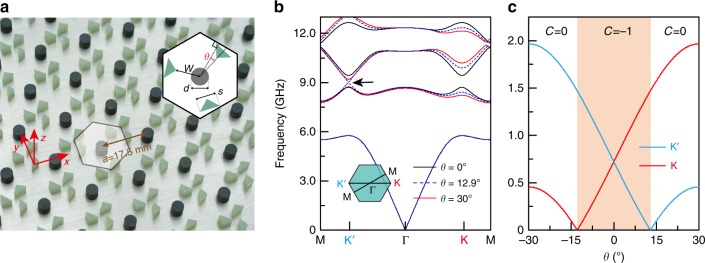
- In the designed 2D triangular-lattice photonic crystal, applying a static magnetic field of B = 0.4 Tesla opens a complete photonic bandgap, and tuning the dielectric-pillar orientation to θ = 12.9° closes the gap at K′ to form an unpaired Dirac point at 9.01 GHz.
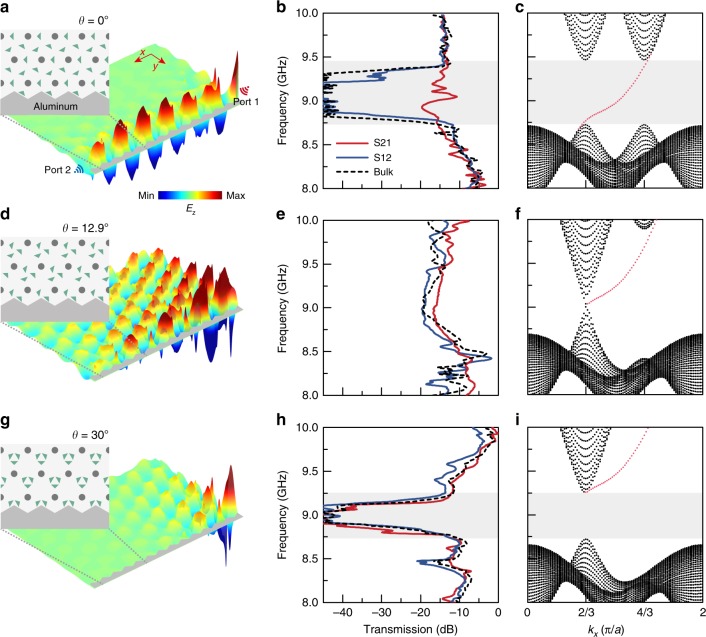
- For θ = 0°, measured edge transmission |S21| is about 30 dB larger than |S12| and the bulk transmission near 9.0 GHz, consistent with a topological bandgap and a unidirectional edge state.
- For θ = 12.9°, edge and bulk transmissions almost overlap and no distinct gap is observed, indicating a gapless bulk state corresponding to the unpaired Dirac point; for θ = 30°, both edge and bulk transmissions are gapped near 9.0 GHz, indicating a trivial bandgap.
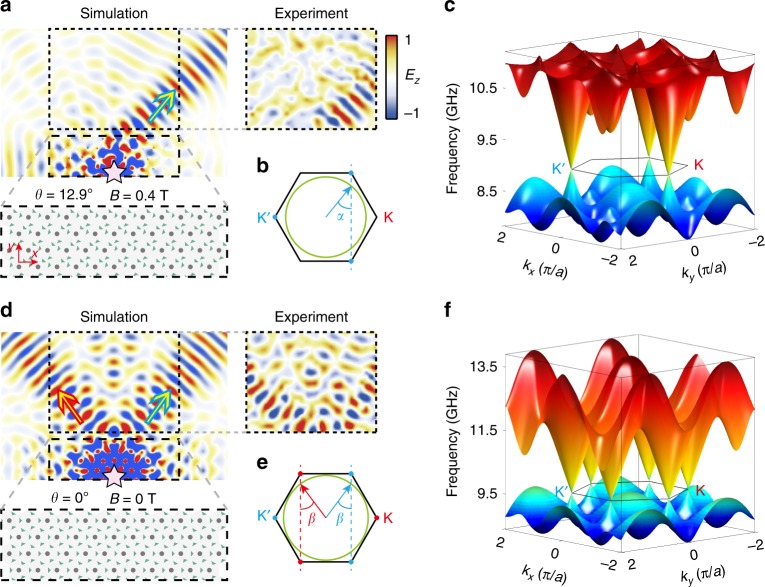
- A source near the Dirac frequency excites only one valley: the paper reports a single-directional refracted beam for θ = 12.9°, B = 0.4 Tesla at 9.05 GHz, whereas the reference case θ = 0°, B = 0 Tesla shows two outgoing beams near 9.76 GHz.
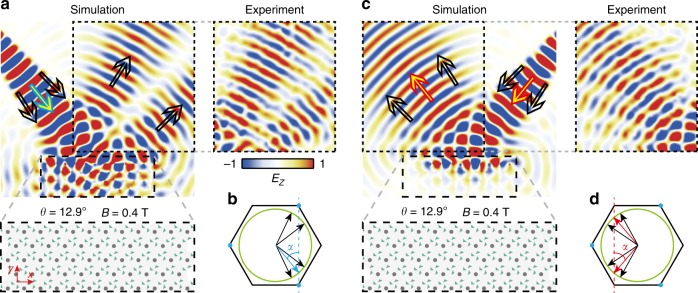
- Non-reciprocal reflection is demonstrated near the Dirac frequency: at 9.05 GHz, reflection is suppressed for one incidence direction at α = 39.1°, while the opposite direction shows strong reflection, with transmission contrast described as approaching 100% versus 0%.
## Methods
- Experimental design: a planar 2D photonic crystal in an air-loaded parallel-plate waveguide, built from a 2D triangular lattice with lattice constant a = 17.5 mm; each unit cell contains a gyromagnetic cylinder and three right-triangular dielectric pillars whose orientation angle θ controls parity breaking.
- Materials and sample: dielectric pillars are FR4 with relative permittivity 4.4 and loss tangent 0.019; the gyromagnetic material is yttrium iron garnet (YIG) with relative permittivity 13.0, dielectric loss tangent 0.0002, saturation magnetization Ms = 1780 Gauss, and ferromagnetic resonance linewidth 35 Oe.
- Analysis: measurements used a vector network analyzer to obtain edge and bulk transmissions and direct field maps; simulations used COMSOL Multiphysics with a 20-cell-wide supercell and included dielectric and magnetic losses.
## Limitations
- The paper states that extending the platform to terahertz or optical frequencies would require suitable gyromagnetic or gyroelectric materials, which are not currently demonstrated here.
- The simulation section notes that the Dirac frequency (9.01 GHz) is far from the YIG resonance frequency (~11.2 GHz at 0.4 Tesla), which the text says makes magnetic loss relatively small; this implies the reported behavior is tied to a specific frequency/material regime.
- Evident from the text: the demonstrated system is a microwave photonic crystal using gyromagnetic materials and a parallel-plate waveguide, so the result is specialized to this geometry and material platform.
Model-written summary. Check it against the paper before relying on it.
Integrity signals
Registry
Cites
Statistics
Figures
Verification
Claims the paper makes
7 Valid · 3 Not valid · 7 Not checked · 36 Own results and interpretations
The cited sources support only part of this claim — read each source’s verdict below.
In the paper
“photonic Dirac points are known to occur in pairs in “photonic graphene” and other similar photonic crystals”
- Also stated in: § Introduction · plain
“Dirac points in graphene1–3 or photonic graphene12 belong to the first type, which occur in lattices with unbroken T. These occur in pairs and are stabilized by a symmetry of the underlying lattice.”
§ Observation of an unpaired photonic Dirac point > Abstract
What the sources say
- Could not verifycites [1] Novoselov KS Two-dimensional gas of massless Dirac fermions in graphene Nature 2005 438 197 200 10.1038/nature04233 16281030 sourceExperimental — accuracy not yet measured
The paper’s discussion of graphene’s Dirac-like spectrum and two carbon sublattices (section “Two-Dimensional Gas of Massless Dirac Fermions in Graphene”; page unavailable) concerns electronic carriers, not photonic crystals. Searches for photonic graphene, photonic crystals, and paired Dirac points found no passage addressing whether photonic Dirac points occur in pairs. (LLM, conf=0.76)
- Partly supportedcites [2] Zhang Y Tan YW Stormer HL Kim P Experimental observation of the quantum Hall effect and Berry’s phase in graphene Nature 2005 438 201 204 10.1038/nature04235 16281031 sourceExperimental — accuracy not yet measured
The discussion of graphene’s band structure (p. 1) places Dirac points at two inequivalent Brillouin-zone corners, supporting the pairing aspect. It concerns electronic graphene, however, and does not establish that photonic Dirac points occur in pairs in photonic graphene or other photonic crystals. (LLM, conf=0.82)
- Could not verifycites [3] Neto AC Guinea F Peres NM Novoselov KS Geim AK The electronic properties of graphene Rev. Mod. Phys. 2009 81 109 162 10.1103/RevModPhys.81.109 sourceExperimental — accuracy not yet measured
The “Dirac fermions” section describes two electronic Dirac points, K and K′, in graphene. Searches for “photonic graphene photonic crystals Dirac points pairs” and “photonic” found no passage addressing whether photonic Dirac points occur in pairs in photonic graphene or similar crystals. (LLM, conf=0.78)
- Partly supportedcites [12] Plotnik Y Observation of unconventional edge states in ‘photonic graphene’ Nat. Mater. 2014 13 57 62 10.1038/nmat3783 24193661 sourceExperimental — accuracy not yet measured
The Fig. 1 caption and main text describe multiple Dirac points at the Brillouin-zone corners of photonic graphene, supporting that part of the claim. Our copy does not state that they occur specifically in pairs or extend that claim to other similar photonic crystals. (LLM, conf=0.83)
boostedstates an association- Asserted: passes — The authors put it forward as true.
- Checkable: passes — It can be checked against evidence.
- Load-bearing: passes — The paper’s conclusions depend on it.
- Based: passes — The paper gives a reason why it holds.
- Also stated in: § Introduction · plain
Every source the paper cites for this claim was checked and supports it.
In the paper
“However, many phenomena associated with unpaired Dirac points, such as one-way Klein tunneling37, are challenging to observe in that platform due to small system sizes, lack of frequency selectivity, and other technical limitations.”
§ Observation of an unpaired photonic Dirac point > Introduction
What the sources say
- Supportedcites [37] Ni X Spin-and valley-polarized one-way Klein tunneling in photonic topological insulators Sci. Adv. 2018 4 eaap8802 10.1126/sciadv.aap8802 29756032 PMC5947977 source
The citation is attached to “one-way Klein tunneling,” which this paper studies directly. The Results section (“One-way Klein tunneling”) describes transmission through a photonic potential barrier, and the robustness section refers to one-way Dirac degeneracies. The citing authors’ explanation of Floquet-platform limitations is not the part identified by this citation. (LLM, conf=0.92)
plainstates a cause- Asserted: passes — The authors put it forward as true.
- Checkable: passes — It can be checked against evidence.
- Load-bearing: passes — The paper’s conclusions depend on it.
- Based: passes — The paper gives a reason why it holds.
- Supported
The paper states this without a source or data behind it here, so there is nothing to check it against. The quote shows it is in the paper.
In the paper
“At the specific value θ = 12.9°, the bandgap at Κ′ closes completely to form a Dirac point at 9.01 GHz.”
§ Observation of an unpaired photonic Dirac point > Results > Design of a 2D PhC with an unpaired Dirac point
states a cause- Asserted: passes — The authors put it forward as true.
- Checkable: passes — It can be checked against evidence.
- Load-bearing: passes — The paper’s conclusions depend on it.
- Based: unclear — It is unclear why the paper says it holds.
A result the paper states — it cites no source for it, so there is none to check. The quote shows it is in the paper.
In the paper
“microwave beams incident from different directions outside the PhC are selectively reflected, depending on the availability of an unpaired Dirac point within the PhC to couple to.”
§ Observation of an unpaired photonic Dirac point > Introduction
plainstates a cause- Asserted: passes — The authors put it forward as true.
- Checkable: passes — It can be checked against evidence.
- Load-bearing: passes — The paper’s conclusions depend on it.
- Based: passes — The paper gives a reason why it holds.
A result the paper reports from its own data — it cites no other source for it, so there is none to check. The quote shows it is in the paper.
In the paper
“Transmission measurements reveal that the closing and re-opening of the band gaps occur at the orientation angle predicted by numerical calculations.”
§ Observation of an unpaired photonic Dirac point > Introduction
plainstates an association- Asserted: passes — The authors put it forward as true.
- Checkable: passes — It can be checked against evidence.
- Load-bearing: passes — The paper’s conclusions depend on it.
- Based: passes — The paper gives a reason why it holds.
20 more claims
Create a free account to see all 53 claims and to verify the 2 references still open.
- Probably not a substantial claim. 9
- It may state two separate claims as one. 20
- The quote only partly states this claim. 1
Citations
Cites
The electronic properties of graphene
Castro Neto, A. H., Guinea, F., Peres, N. M. R., Novoselov, K. S., & Geim, A. K. (2009) · Reviews of Modern Physics · doi:10.1103/revmodphys.81.109 · Cited by 24,803
Two-dimensional gas of massless Dirac fermions in graphene
Novoselov, K. S., Geim, A. K., Morozov, S. V., Jiang, D., Katsnelson, M. I., Grigorieva, I. V., Dubonos, S. V., & Firsov, A. A. (2005) · Nature · doi:10.1038/nature04233 · Cited by 21,611
Experimental observation of the quantum Hall effect and Berry's phase in graphene
Zhang, Y., Tan, Y.-W., Stormer, H. L., & Kim, P. (2005) · Nature · doi:10.1038/nature04235 · Cited by 13,435
Pozar, D. M. (1990) · Cited by 8,690
In situ click chemistry generation of cyclooxygenase-2 inhibitors
Bhardwaj, A., Kaur, J., Wuest, M., & Wuest, F. (2017) · Nature Communications · doi:10.1038/s41467-016-0009-6 · Cited by 7,448
Topological insulators in Bi2Se3, Bi2Te3 and Sb2Te3 with a single Dirac cone on the surface
Zhang, H., Liu, C.-X., Qi, X.-L., Dai, X., Fang, Z., & Zhang, S.-C. (2009) · Nature Physics · doi:10.1038/nphys1270 · Cited by 6,359
Haldane, F. D. M. (1988) · Physical Review Letters · doi:10.1103/physrevlett.61.2015 · Cited by 6,301
Mathew, K. T. (2011) · Cited by 5,701
Topological Insulators in Three Dimensions
Fu, L., Kane, C. L., & Mele, E. J. (2007) · Physical Review Letters · doi:10.1103/physrevlett.98.106803 · Cited by 4,651
Chiral tunnelling and the Klein paradox in graphene
Katsnelson, M. I., Novoselov, K. S., & Geim, A. K. (2006) · Nature Physics · doi:10.1038/nphys384 · Cited by 3,896
Cited by
Recent advances in 2D, 3D and higher-order topological photonics
Kim, M., Jacob, Z., & Rho, J. (2020) · Light: Science & Applications · doi:10.1038/s41377-020-0331-y · Cited by 470
Topological Valley Photonics: Physics and Device Applications
Xue, H., Yang, Y., & Zhang, B. (2021) · Advanced Photonics Research · doi:10.1002/adpr.202100013 · Cited by 167
Self-citationNi, X., Yves, S., Krasnok, A., & Alù, A. (2023) · Chemical Reviews · doi:10.1021/acs.chemrev.2c00800 · Cited by 191
Topological Anderson Insulator in Disordered Photonic Crystals
Liu, G.-G., Yang, Y., Ren, X., Xue, H., Lin, X., Hu, Y.-H., Sun, H.-X., Peng, B., Zhou, P., Chong, Y. D., et al. (2020) · Physical Review Letters · doi:10.1103/physrevlett.125.133603 · Cited by 172
Self-citationA brief review of topological photonics in one, two, and three dimensions
Lan, Z., Chen, M. L. N., Gao, F., Zhang, S., & Sha, W. E. I. (2022) · Reviews in Physics · doi:10.1016/j.revip.2022.100076 · Cited by 160
Observation of Photonic Antichiral Edge States
Zhou, P., Liu, G.-G., Yang, Y., Hu, Y.-H., Ma, S., Xue, H., Wang, Q., Deng, L., & Zhang, B. (2020) · Physical Review Letters · doi:10.1103/physrevlett.125.263603 · Cited by 146
Self-citationHybrid topological photonic crystals
Wang, Y., Wang, H., Li, L., Zhu, W., Fan, L., Lin, Z., Li, F., Zhang, X., Luan, P., Poo, Y., et al. (2023) · Nature Communications · doi:10.1038/s41467-023-40172-6 · Cited by 146
Topological metasurface: from passive toward active and beyond
You, J. W., Lan, Z., Ma, Q., Gao, Z. L., Yang, Y., Gao, F., Xiao, M., & Cui, T. J. (2023) · Photonics Research · doi:10.1364/prj.471905 · Cited by 100
Self-citationAntichiral one-way edge states in a gyromagnetic photonic crystal
Chen, J., Liang, W., & Li, Z. (2020) · Physical review. B./Physical review. B · doi:10.1103/physrevb.101.214102 · Cited by 78
Topological antichiral surface states in a magnetic Weyl photonic crystal
Xi, X., Yan, B., Yang, L., Meng, Y., Zhu, Z., Chen, J., Wang, Z., Zhou, P., Shum, P. P., Yang, Y., et al. (2023) · Nature Communications · doi:10.1038/s41467-023-37710-7 · Cited by 79
Self-citationHan, S. H., Cui, J., Chua, Y., Zeng, Y., Hu, L., Dai, M., Wang, F., Sun, F., Zhu, S., Li, L. H., et al. (2023) · Light Science & Applications · doi:10.1038/s41377-023-01200-8 · Cited by 78
Photonic corner skin modes in non-Hermitian photonic crystals
Zhu, W., & Gong, J. (2023) · Physical review. B./Physical review. B · doi:10.1103/physrevb.108.035406 · Cited by 53
Half-quantized Hall effect and power law decay of edge-current distribution
Zou, J., Fu, B., Wang, H.-W., Hu, Z.-A., & Shen, S.-Q. (2022) · Physical review. B./Physical review. B · doi:10.1103/physrevb.105.l201106 · Cited by 57
Observation of Dirac Hierarchy in Three-Dimensional Acoustic Topological Insulators
Yang, L., Wang, Y., Meng, Y., Zhu, Z., Xi, X., Yan, B., Lin, S., Chen, J., Shi, B.-J., Ge, Y., et al. (2022) · Physical Review Letters · doi:10.1103/physrevlett.129.125502 · Cited by 51
Self-citationPark, H., Gao, W., Zhang, X., & Oh, S. S. (2022) · Nanophotonics · doi:10.1515/nanoph-2021-0692 · Cited by 55
Veselago lensing with Weyl metamaterials
Yang, Y., Bi, Y., Peng, L., Yang, B., Ma, S., Chan, H., Xiang, Y., & Zhang, S. (2021) · Optica · doi:10.1364/optica.406167 · Cited by 34
Self-citationA Short Review of All-Dielectric Topological Photonic Crystals
Wang, H., & Jiang, J. (2022) · Frontiers in Physics · doi:10.3389/fphy.2022.866552 · Cited by 35
Non-Abelian Charged Nodal Links in a Dielectric Photonic Crystal
Park, H., Wong, S., Zhang, X., & Oh, S. S. (2021) · ACS Photonics · doi:10.1021/acsphotonics.1c00876 · Cited by 35
Photonic Dirac cavities with spatially varying mass term
Chen, K., Эдуардович, К. Ф., Smirnova, D. A., Vakulenko, A., Kiriushechkina, S., Volkovskaya, I. I., Guddala, S., Menon, V. M., Alù, A., & Khanikaev, A. B. (2023) · Science Advances · doi:10.1126/sciadv.abq4243 · Cited by 43
Giant nonlocal edge conduction in the axion insulator state of MnBi2Te4
Li, Y., Liu, C., Wang, Y., Lian, Z., Li, S., Li, H., Wu, Y., Lu, H., Zhang, J., & Wang, Y. (2023) · 中国科学通报:英文版 · doi:10.1016/j.scib.2023.05.011 · Cited by 39
Bulk–spatiotemporal vortex correspondence in gyromagnetic zero-index media
Zhang, R.-Y., Cui, X., Zeng, Y.-S., Chen, J., Liu, W., Wang, M., Wang, D., Zhang, Z.-Q., Wang, N., Wu, G., et al. (2025) · Nature · doi:10.1038/s41586-025-08948-6 · Cited by 43
Multiple Brillouin Zone Winding of Topological Chiral Edge States for Slow Light Applications
Chen, F., Xue, H., Pan, Y., Wang, M., Hu, Y., Zhang, L., Chen, Q., Han, S. H., Liu, G., Gao, Z. L., et al. (2024) · Physical Review Letters · doi:10.1103/physrevlett.132.156602 · Cited by 28
Self-citationAltermagnetism-induced parity anomaly in weak topological insulators
Wan, Y.-H., & Sun, Q. (2025) · Physical review. B./Physical review. B · doi:10.1103/physrevb.111.045407 · Cited by 28
Chiral Topological Surface States on a Finite Square Photonic Crystal Bounded by Air
Tasolamprou, A. C., Kafesaki, M., Soukoulis, C. M., Economou, E. N., & Koschny, T. (2021) · Physical Review Applied · doi:10.1103/physrevapplied.16.044011 · Cited by 23
Topological phase transition induced by gain and loss in a photonic Chern insulator
Teo, H. T., Xue, H., & Zhang, B. (2022) · Physical Review A · doi:10.1103/physreva.105.053510 · Cited by 22
Self-citationHan, J., Liang, F., Zhao, Y., Liu, J., Wang, S., Wang, X., Zhao, D., & Wang, B. (2024) · Physical Review Applied · doi:10.1103/physrevapplied.21.014046 · Cited by 24
Reconfigurable Photonic Valley Filter in Hybrid Topological Heterostructures
Zhang, X., Li, S., Lan, Z., Gao, W., & Chen, M. L. N. (2024) · Laser & Photonics Review · doi:10.1002/lpor.202400797 · Cited by 20
Effective medium theory for a photonic pseudospin- 12 system
Wang, N., Zhang, R.-Y., Chan, C. T., & Wang, G. P. (2020) · Physical review. B./Physical review. B · doi:10.1103/physrevb.102.094312 · Cited by 19
Topological phase transitions and Weyl semimetal phases in chiral photonic metamaterials
Han, N., Liu, J., Gao, Y., Zhou, K., & Liu, S. (2022) · New Journal of Physics · doi:10.1088/1367-2630/ac6f78 · Cited by 14
Lan, Z., Chen, Y., An, L., & Su, Z. (2024) · Physical review. B./Physical review. B · doi:10.1103/physrevb.109.045402 · Cited by 16
Realization of a quadrupole topological insulator phase in a gyromagnetic photonic crystal
Zhou, P., Liu, G.-G., Wang, Z., Li, S., Xie, Q., Zhang, Y., Mandal, S., Xi, X., Gao, Z., Deng, L., et al. (2024) · National Science Review · doi:10.1093/nsr/nwae121 · Cited by 21
Self-citationChu, H., Zhang, Y., Luo, J., Xu, C., Xiong, X., Peng, R., Wang, M., & Lai, Y. (2021) · Optics Express · doi:10.1364/oe.427389 · Cited by 15
Coexistence of Chiral and Antichiral Edge States in Photonic Crystals
Wang, H., Xie, B., & Ren, W. (2023) · Laser & Photonics Review · doi:10.1002/lpor.202300764 · Cited by 16
Reconfigurable Light Imaging in Photonic Higher-Order Topological Insulators
Zhang, X., Zhou, Y., Sun, X., Zhang, X., Lu, M.-H., & Chen, Y. (2022) · Nanomaterials · doi:10.3390/nano12050819 · Cited by 14
Ultrafast dynamics of phase and topology in Dirac semiconductors
Kim, Y., & Lee, J. D. (2021) · Materials Today Physics · doi:10.1016/j.mtphys.2021.100525 · Cited by 12
One-Way Valley-Robust Transport in Edge-Tailored Photonic Crystals
Chen, J., Yidong, Z., Yang, S., Shi, F., Li, Z., & Qiu, C. (2025) · Physical Review Letters · doi:10.1103/physrevlett.134.203803 · Cited by 22
Han, N., Liu, J., Gao, Y., Zhou, K., & Liu, S. (2022) · Physical review. B./Physical review. B · doi:10.1103/physrevb.105.235411 · Cited by 11
Observation of Photonic Chern Metal With Bi‐Chiral Edge Propagation
Zhou, Y., Sun, Z., Lai, H., Sun, X., He, C., & Chen, Y. (2024) · Laser & Photonics Review · doi:10.1002/lpor.202400826 · Cited by 10
Fang, Y., Gong, P., & He, S. (2023) · New Journal of Physics · doi:10.1088/1367-2630/acb2e7 · Cited by 8
Dirac–Weyl semimetal in photonic metacrystals
Long, S., Yang, J., Wang, H., Yu, Z., Yang, B., Guo, Q., Xiang, Y., Xia, L., & Zhang, S. (2023) · Optics Letters · doi:10.1364/ol.490001 · Cited by 10
Self-localized topological states in three dimensions
Li, R., Li, P., Jia, Y., & Liu, Y. (2022) · Physical review. B./Physical review. B · doi:10.1103/physrevb.105.l201111 · Cited by 10
Topological edge states in a photonic Floquet insulator with unpaired Dirac cones
Zhong, H., Kartashov, Y. V., Li, Y., Li, M., & Zhang, Y. (2024) · Photonics Research · doi:10.1364/prj.524824 · Cited by 10
Topological properties of C4zT-symmetric semimetals
Zou, J., Fu, B., & Shen, S.-Q. (2024) · Communications Physics · doi:10.1038/s42005-024-01767-7 · Cited by 9
Harpoon-shaped topological photonic crystal for on-chip beam splitter
Guan, Z., Dou, R., Xie, C., Zuo, T., Huang, L., Wen, K., Wang, C., Ye, H., Liu, J., Dong, Z., et al. (2024) · Science China Physics Mechanics and Astronomy · doi:10.1007/s11433-024-2421-3 · Cited by 8
A tunable silicon-on-insulator valley Hall photonic crystal at telecommunication wavelengths
Dong, Z., Xu, F., & Liang, W. (2020) · Europhysics Letters (EPL) · doi:10.1209/0295-5075/131/54002 · Cited by 7
Liu, S., Yang, Y., Shi, L., Wang, E., & Hang, Z. H. (2025) · Photonics Research · doi:10.1364/prj.568411 · Cited by 11
Self-citationHe, L., Ren, Q., You, J. W., Sha, W. E. I., Lan, Z., Zhang, Y., & Yao, J. (2022) · Optik · doi:10.1016/j.ijleo.2022.170323 · Cited by 7
Band-alignment effect in a topological photonic alloy
Qu, T., Wang, M., Chen, J., & Zhang, L. (2024) · Physical review. B./Physical review. B · doi:10.1103/physrevb.110.094206 · Cited by 8
Gupta, N., Srinivasu, S., Kumar, M., Tiwari, A. K., Pal, S. S., Wanare, H., & Ramakrishna, S. A. (2024) · Applied Physics Letters · doi:10.1063/5.0175495 · Cited by 7
Topological photonic quasicrystal alloy
Wang, Z., Xi, X., & Gao, Z. L. (2024) · Applied Physics Letters · doi:10.1063/5.0232244 · Cited by 8
Photonic Weyl semimetals in pseudochiral metamaterials
Chern, R.-L., & Chou, Y. (2022) · Scientific Reports · doi:10.1038/s41598-022-23505-1 · Cited by 5
Photonic topological phases in Tellegen metamaterials
Chern, R.-L., & Chou, Y. (2022) · Optics Express · doi:10.1364/oe.476682 · Cited by 6
Chen, J. G., Liu, W., Wang, J., Li, C., Zhang, R.-Y., Cui, X., Guan, F., Shi, L., Zi, J., & Chan, C. T. (2025) · ACS Photonics · doi:10.1021/acsphotonics.5c00575 · Cited by 9
Perspective: Antichiral magnetic topological photonics
Ji, Z., Chen, J., & Li, Z. (2023) · Journal of Applied Physics · doi:10.1063/5.0144864 · Cited by 8
Highly efficient conversion from classical guided waves to topological chiral edge states
Han, J., Liang, F., Zhao, Y., Ding, X. F., Wang, X., Zhao, D., & Wang, B. (2024) · Chinese Optics Letters · doi:10.3788/col202422.023902 · Cited by 8
Sign freedom of non-abelian topological charges in phononic and photonic topological semimetals
Park, H., & Oh, S. S. (2022) · New Journal of Physics · doi:10.1088/1367-2630/ac6ca3 · Cited by 5
Unconventional Dirac-Weyl semimetal with ultralong surface arc in phononic crystals
Wu, P., Gao, F., Xiao, X., Chen, Z., Peng, Y., & Zhu, X. (2024) · Physical review. B./Physical review. B · doi:10.1103/physrevb.110.094104 · Cited by 7
Chiral Bulk Solitons in Photonic Graphene with Decorated Boundaries
Shen, S., Shang, C., Li, Y., & Zhang, Y. (2024) · Laser & Photonics Review · doi:10.1002/lpor.202401114 · Cited by 6
Experimental Realization of Highly Efficient Beam Combination and Steering via Topological Multimode
Jing, Y., Yang, Y., Long, W., Zhang, T., Wu, D., Wang, J., Xiong, Z., Chen, N., Wang, M., Chan, C. T., et al. (2025) · Laser & Photonics Review · doi:10.1002/lpor.202401157 · Cited by 6
Self-citationNon-reciprocal topological photonics
Wang, Z., Chen, F., Xi, X., Gao, Z. L., & Yang, Y. (2024) · Acta Physica Sinica · doi:10.7498/aps.73.20231850 · Cited by 9
Self-citationCoexistence of Dirac points and nodal chains in photonic metacrystal
Yang, J., Long, S., Wang, H., Yu, Z., Yang, B., Guo, Q., Xiang, Y., Xia, L., & Zhang, S. (2023) · Optics Express · doi:10.1364/oe.489873 · Cited by 2
On-chip mode (de)multiplexer utilizing sandwich valley-topological edge waveguides
Guan, Z., Wen, K., Xie, C., Liu, J., Wang, C., Ye, H., Zhou, X., Dong, Z., Fan, D., & Chen, S. (2025) · APL Photonics · doi:10.1063/5.0245119 · Cited by 5
Qin, Q., Chen, J., Lin, H. Q., Peng, C., & Li, Z. (2022) · Nanomaterials · doi:10.3390/nano12173009 · Cited by 2
Nodal degeneracy of guided modes in uniaxial crystal slabs
Pan, X., Li, H., Dong, W., Zhou, X. R., Xing, K.-A., Hu, C., Wang, G., & Hou, B. (2023) · Frontiers in Physics · doi:10.3389/fphy.2022.1095669 · Cited by 2
Detection of chirality imbalance in photonic Weyl metamaterials with mirror symmetry-breaking
Zhou, X. R., Li, S., Hu, C., Wang, G., & Hou, B. (2023) · Applied Physics Letters · doi:10.1063/5.0161039 · Cited by 2
Observation of type-II and type-III Dirac points in circuit lattices
Wang, W., Ma, Y., Imran, M., Lv, B., He, X.-G., Jia, Y., Tao, H., Liu, Y., & Li, R. (2025) · iScience · doi:10.1016/j.isci.2025.113778 · Cited by 2
Surface potential-adjusted surface states in 3D topological photonic crystals
Park, H., Oh, S. S., & Lee, S. (2024) · Scientific Reports · doi:10.1038/s41598-024-56894-6 · Cited by 3
Coexisting valley and chiral edge states in topological photonic crystals
Liu, J., Li, L., Xu, M., & Poo, Y. (2025) · Optics Express · doi:10.1364/oe.551936 · Cited by 3
Photonic helicoid-like surface states in chiral metamaterials
Chern, R.-L. (2023) · Scientific Reports · doi:10.1038/s41598-023-40926-8 · Cited by 3
Yang, Y., Qiu, H., Bi, K., & Yang, B. (2025) · Nanophotonics · doi:10.1515/nanoph-2025-0083 · Cited by 1
Self-citationXiaohui, X., Yang, X., & Zhi, Y. (2026) · Optics Express · doi:10.1364/oe.587245 · Cited by 1
Liu, Y., Lu, J., Xiong, Z., Wu, F. O., Christodoulides, D. N., Chen, Y., & Jiang, J. (2025) · Physical Review Research · doi:10.1103/physrevresearch.7.013084 · Cited by 1
Dynamics of quantum gas in non-abelian gauge field
Hasan, M. (2021) · DR-NTU (Nanyang Technological University) · doi:10.32657/10356/152148 · Cited by 3
Observation of valley-polarized topological phase transition in surface wave photonic crystals
Li, S., Hu, Y., Zhang, Y., Lu, H., Liang, D., & Zhou, P. (2024) · Optical Materials Express · doi:10.1364/ome.525268 · Cited by 1
Self-citationZhao, Y., Chan, H., Bi, K., Duan, G., Liu, M., Xie, N., & Yang, Y. (2024) · Optics Letters · doi:10.1364/ol.527933 · Cited by 1
Self-citationResearch progress of high-order harmonics in topological insulators
Zhang, J., XiuLan, L., LeYi, Y., & LiangYou, P. (2024) · Zhongguo kexue. Wulixue Lixue Tianwenxue · doi:10.1360/sspma-2024-0418
Inverse design of non-Hermitian skin states in photonic crystals via deep learning
Shi, X., & Hao, R. (2025) · Optics Communications · doi:10.1016/j.optcom.2025.131719
Photonic Dirac cone and topological transition in a moving dielectric slab
潘, X. 昕. P., 李, H. 海. L., 董, W. 为. D., 周, X. 萧. Z., 王, G. 钢. W., & Hou, B. (2023) · Chinese Physics B · doi:10.1088/1674-1056/ace1d7
Tunable Multi-Channel Circulator Based on Valley Topological Photonic Crystals
(2025) · doi:10.2139/ssrn.5387453
Self-citationLattice Deformation Induced Higher-Order Hybrid Topology
Wu, P., Peng, Y., Sun, Q., Ling, M., Deng, W., Zhu, X., & Liu, Z. (2026) · Physical Review Letters · doi:10.1103/4y5t-mh92
Novel topological phases in gyromagnetic photonic crystals
Liu, G.-G. (2023) · DR-NTU (Nanyang Technological University) · doi:10.32657/10356/165931
Self-citationTunable multi-channel circulator based on valley topological photonic crystals
Shi, L., Zhou, P., & Zhao, L. (2026) · International Journal of Modern Physics B · doi:10.1142/s0217979226500980
Self-citationTo a dispersion law of an electromagnetic wave in a medium having a double anisotropy
Sobol, V. R., Silibin, M. V., & Karpinsky, D. V. (2024) · Modern Electronic Materials · doi:10.3897/j.moem.10.127996
Large-area chiral valley waveguide states in hybrid topological photonic crystal heterostructures
He, L., Wang, J., 马利特, Yan, D., Zhai, W., Ren, Q., Lan, Z., & Yao, J. (2026) · Optics Express · doi:10.1364/oe.613843
Study on several novel topological phases in classical wave systems
Xue, H. (2020) · DR-NTU (Nanyang Technological University) · doi:10.32657/10356/145825 · Cited by 1
Self-citationInsulator-free topological photonic multi-lane highways
Cui, X., Zhang, R.-Y., Wang, M., Gao, Z., Chen, X., Zhang, Z.-Q., Lai, Y., & Chan, C. T. (2026) · Nature · doi:10.1038/s41586-026-10817-9 · Cited by 6
Lian, H., Huang, Y., Niu, S., et al. (2026) · Physics Letters A · doi:10.1016/j.physleta.2026.132042
A Hybrid Topological Heterostructure for Communication
Zhang, X., Li, Y., Li, S., & Chen, M. L. N. (2025) · Lecture notes of the Institute for Computer Sciences, Social Informatics and Telecommunications Engineering · doi:10.1007/978-3-031-96146-5_24
Graphene band structure in circuit quantum electrodynamics
Lopes, E., Spohr, V., Saa, A., & Rouxinol, F. P. M. (2026) · Symposium on Microelectronics Technology and Devices · doi:10.1109/sbmicro70495.2026.11684428
Multi-Channel Selective Light Transmission Based on Hybrid Topological Photonic Crystals
Liu, J., Zhang, X., Li, L., Li, F., & Poo, Y. (2024) · IEEE International Conference on Computational Electromagnetics · doi:10.1109/iccem60619.2024.10559051
Hou, J., Liang, H., Gao, G., Shao, T., Wang, Z. G., Liu, G., & Wang, S. (2026) · Photonics · doi:10.3390/photonics13070653
Self-citationFeng, Z., Guo, W., Mu, Y., Yuan, L., Chen, Z., Li, S., Liu, F., Sun, Y., Zeng, Y., Chen, H., et al. (2026) · Applied Physics Reviews · doi:10.1063/5.0342780
Wei, X.-H., Luo, X.-W., Guo, G.-C., & Zhou, Z.-W. (2026) · Physical Review Research · doi:10.1103/vtqw-7yjf · Cited by 2
Metadata
- Authors
- Liu, G.-G., Zhou, P., Yang, Y., Xue, H., Ren, X., Lin, X., Sun, H.-X., Bi, L., Chong, Y., & Zhang, B.
- Affiliations
- Nanyang Technological University (SG)
- University of Electronic Science and Technology of China (CN)
- Jiangsu University (CN)
- Corresponding author
- Yang, Yihao
- Chong, Yidong
- Zhang, Baile
- ORCID
- Venue
- Nature Communications
- Published
- 2020-04-20
- Volume
- 11
- Issue
- 1
- Pages
- 1873-1873
- ISSN
- 2041-1723 (ISSN-L)
- PMC
- PMC7171084
- OpenAlex
- W2972088231
- Semantic Scholar
- e97edc991ec55afb38365d7258c50e9ee22c089d
- Cited by
- 100
- References
- 64
- Citations by year
- 2026: 15 · 2025: 14 · 2024: 23 · 2023: 17 · 2022: 16 · 2021: 8 · 2020: 7
- FWCI
- 4.88
- Type
- journal article
- Language
- en
- Open access
- gold
- doi.org
- Licence
- cc-by
- creativecommons.org/licenses/by/4.0 (tdm)
- creativecommons.org/licenses/by/4.0 (vor)
- Locations
- Nature Communications (publishedVersion, cc-by)
- PubMed Central (publishedVersion, cc-by)
- PubMed (publishedVersion)
- arXiv (Cornell University) (submittedVersion)
- RePEc: Research Papers in Economics (submittedVersion)
- DOAJ (DOAJ: Directory of Open Access Journals) (submittedVersion, cc-by-sa)
- DR-NTU (Nanyang Technological University) (submittedVersion, cc-by)
- arXiv (Cornell University)
- Funders
- National Natural Science Foundation of China (11774137)
- Ministry of Education, India
- National Key Research and Development Program of China (2016YFB1200100)
- Topics
- Physical Sciences › Physics and Astronomy › Condensed Matter Physics › Topological Materials and Phenomena
- Physical Sciences › Physics and Astronomy › Atomic and Molecular Physics, and Optics › Photonic Crystals and Applications
- Physical Sciences › Materials Science › Electronic, Optical and Magnetic Materials › Metamaterials and Metasurfaces Applications
- Keywords
- time-reversal symmetry breaking, gyromagnetic materials, parity symmetry breaking, topological phase transition, valley filter, two-dimensional photonic crystals
About these checks
Registry, retraction, Cites and statistics results are computed, not judged, with one exception: a printed reference that no index lists is read once by a model before it counts as a citation error. Claims are extracted by a model and kept only when their quote appears verbatim in the text; each cited source is then checked, with a model’s help, for whether it says what the claim relies on. Those verdicts can be wrong — read the claim’s quote and the cited source before relying on one.
The claim verdicts this report counts are experimental: their accuracy is not yet measured.
A language model drew the claims from the paper on 2026-10-10, under version 3 of the claim definition (model deepseek-v4.1-flash, prompt extract-v3).
A second model labelled each claim on 2026-10-10 (model jev-1.13-20260917, definition revision gold-guideline-v0.2).
Cited sources are checked with a language model’s help (gpt-6-sol).
Statistics and arithmetic are recomputed, not judged.
Confidence bands are shown only for fields calibrated on our annotated test set. None is calibrated yet, so no band is shown.
What counts as a claim ›How we measure confidence ›How we check this ›
Are you an author, or do you see a problem with this page? Request a review
Data sources
Bibliographic data: Semantic Scholar, OpenAlex, Crossref.
Contains information from the Semantic Scholar Academic Graph Datasets, made available under the ODC Attribution License (ODC-BY 1.0).
Semantic Scholar’s data is described in: Kinney, R., et al. (2023). The Semantic Scholar Open Data Platform. arXiv:2301.10140.
