

Simple descriptor derived from symbolic regression accelerating the discovery of new perovskite catalysts
Open accessThe DOI matches its Crossref record; 36 of the 36 references it cites were found in a registry or an index.
Abstract
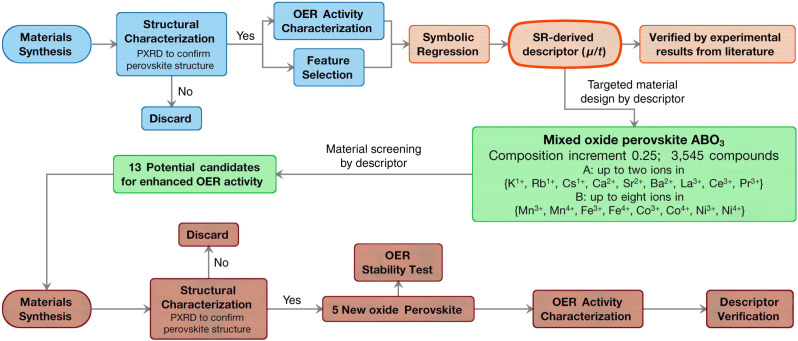
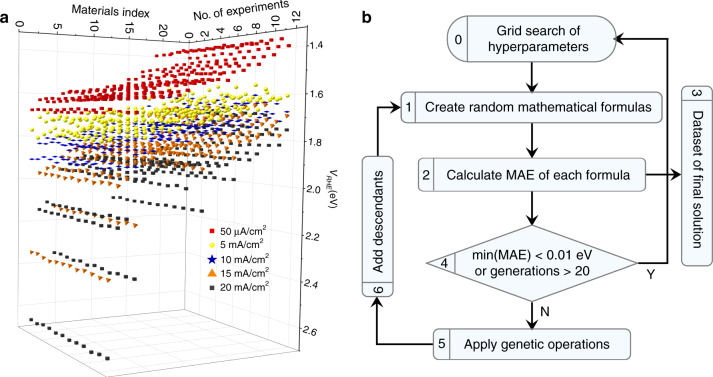
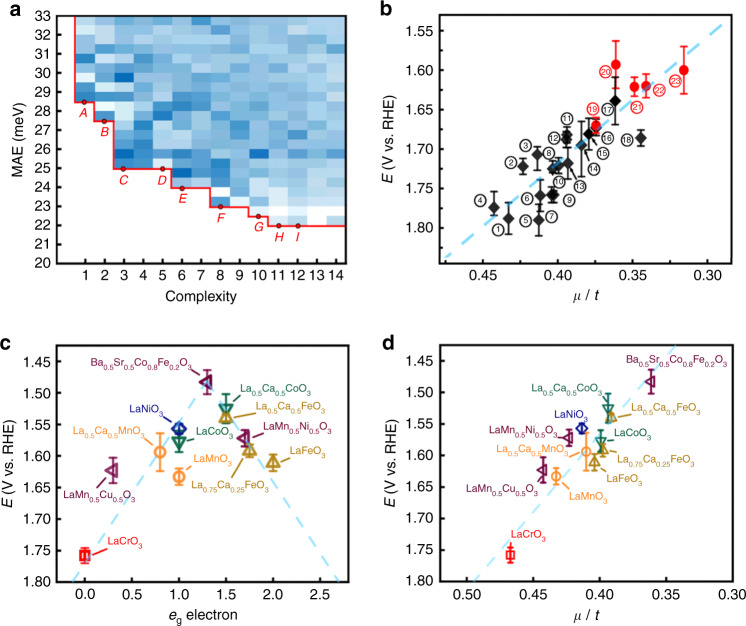
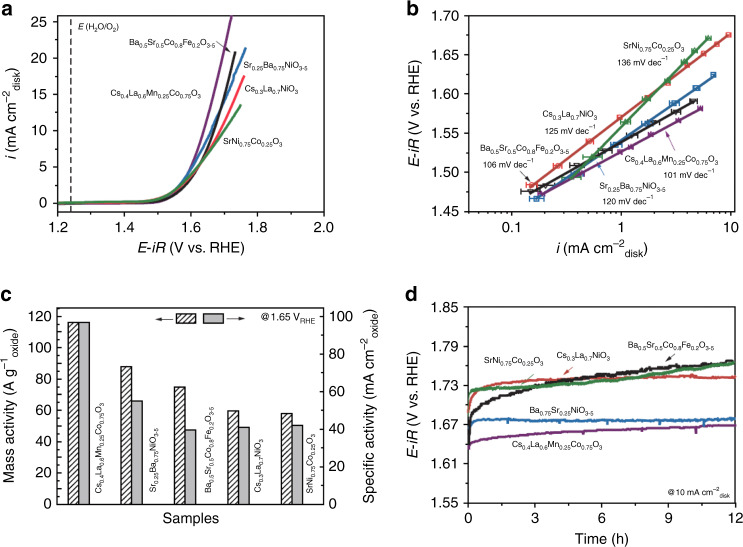
Symbolic regression (SR) is an approach of interpretable machine learning for building mathematical formulas that best fit certain datasets. In this work, SR is used to guide the design of new oxide perovskite catalysts with improved oxygen evolution reaction (OER) activities. A simple descriptor, μ/t, where μ and t are the octahedral and tolerance factors, respectively, is identified, which accelerates the discovery of a series of new oxide perovskite catalysts with improved OER activity. We successfully synthesise five new oxide perovskites and characterise their OER activities. Remarkably, four of them, Cs 0.4 La 0.6 Mn 0.25 Co 0.75 O 3, Cs 0.3 La 0.7 NiO 3, SrNi 0.75 Co 0.25 O 3, and Sr 0.25 Ba 0.75 NiO 3, are among the oxide perovskite catalysts with the highest intrinsic activities. Our results demonstrate the potential of SR for accelerating the data-driven design and discovery of new materials with improved properties.
Overview
The claims and statistics of this paper haven’t been checked yet.
Free: it reads the open-access text and checks the first 5 claims that cite a source we can check. Create a free account to check every claim.
Integrity signals
Registry
Cites
Statistics
Figures
Verification
Claims the paper makes
The claims and statistics of this paper haven’t been checked yet.
Free: it reads the open-access text and checks the first 5 claims that cite a source we can check. Create a free account to check every claim.
Self-check
Percentages, sums and reported differences re-computed from the paper’s own numbers.
The self-check needs the paper’s full text.
Citations
Cites
Combining theory and experiment in electrocatalysis: Insights into materials design
Seh, Z. W., Kibsgaard, J., Dickens, C. F., Chorkendorff, I., Nørskov, J. K., & Jaramillo, T. F. (2017) · Science · doi:10.1126/science.aad4998 · Cited by 12,114
A Perovskite Oxide Optimized for Oxygen Evolution Catalysis from Molecular Orbital Principles
Suntivich, J., May, K. J., Gasteiger, H. A., Goodenough, J. B., & Shao-Horn, Y. (2011) · Science · doi:10.1126/science.1212858 · Cited by 5,441
Universality in Oxygen Evolution Electrocatalysis on Oxide Surfaces
Man, I. C., Su, H., Calle‐Vallejo, F., Hansen, H. A., Martínez, J. I., Inoglu, N. G., Kitchin, J., Jaramillo, T. F., Nørskov, J. K., & Rossmeisl, J. (2011) · ChemCatChem · doi:10.1002/cctc.201000397 · Cited by 4,769
Distilling Free-Form Natural Laws from Experimental Data
Schmidt, M., & Lipson, H. (2009) · Science · doi:10.1126/science.1165893 · Cited by 2,890
Recent advances and applications of machine learning in solid-state materials science
Schmidt, J., Marques, M. R. G., Botti, S., & Marques, M. A. L. (2019) · npj Computational Materials · doi:10.1038/s41524-019-0221-0 · Cited by 2,607
New tolerance factor to predict the stability of perovskite oxides and halides
Bartel, C. J., Sutton, C., Goldsmith, B. R., Ouyang, R., Musgrave, C. B., Ghiringhelli, L. M., & Scheffler, M. (2019) · Science Advances · doi:10.1126/sciadv.aav0693 · Cited by 1,838
Perovskites in catalysis and electrocatalysis
Hwang, J., Rao, R. R., Giordano, L., Katayama, Y., Yu, Y., & Shao-Horn, Y. (2017) · Science · doi:10.1126/science.aam7092 · Cited by 1,799
Wei, C., Rao, R. R., Peng, J., Huang, B., Stephens, I. E. L., Risch, M., Xu, Z. J., & Shao‐Horn, Y. (2019) · Advanced Materials · doi:10.1002/adma.201806296 · Cited by 1,364
The Electrocatalysis of Oxygen Evolution on Perovskites
Bockris, J. O., & Otagawa, T. (1984) · Journal of The Electrochemical Society · doi:10.1149/1.2115565 · Cited by 962
Ouyang, R., Curtarolo, S., Ahmetcik, E., Scheffler, M., & Ghiringhelli, L. M. (2018) · Physical Review Materials · doi:10.1103/physrevmaterials.2.083802 · Cited by 944
Research works printed but not linked: 1
- Lu S Accelerated discovery of stable lead-free hybrid organic-inorganic perovskites via machine learning Nat. Commun. 2018 9 3405 10.1038/s41467-018-05761-w 30143621 PMC6109147 · DOI · Paper page
Cited by
Items 301–376 of 376
Biswas, A., Liu, S., Garg, S., Morshed, M. G., Vakili, H., Ghosh, A. W., & Balachandran, P. V. (2024) · MRS Communications · doi:10.1557/s43579-024-00633-5 · Cited by 4
“[19,29]”
Employing interpretable multi-output machine learning to predict stable perovskites in photovoltaics
Lu, H.-A., Cui, Y., Ma, J., Sun, J., Zou, Q., Wu, Y., Fu, H., Zhong, C., Zhang, L., & Zhou, P. (2025) · Materials Today Communications · doi:10.1016/j.mtcomm.2025.112552 · Cited by 6
Chen, Y., Hu, X., Zhao, J., Wang, Z., Li, J., & Wang, J. (2022) · Advanced Theory and Simulations · doi:10.1002/adts.202200524 · Cited by 4
Online Symbolic Regression with Informative Query
Jin, P., Huang, D., Zhang, R., Hu, X., Nan, Z., Du, Z., Guo, Q., & Chen, Y. (2023) · Proceedings of the AAAI Conference on Artificial Intelligence · doi:10.1609/aaai.v37i4.25641 · Cited by 6
Machine Learning Accelerated Prediction of Self‐Trapped Excitons in Double Halide Perovskites
Chen, B., Chen, R., & Huang, B. (2023) · Advanced Energy and Sustainability Research · doi:10.1002/aesr.202300134 · Cited by 3
Li, C., Huang, Z., Hao, H., Shen, Z., Zhao, G., Xu, B., & Liu, H. (2024) · Journal of Materiomics · doi:10.1016/j.jmat.2024.02.008 · Cited by 6
Zhang, K., Wang, X., & Su, Y. (2025) · Materials Today Communications · doi:10.1016/j.mtcomm.2025.112462 · Cited by 14
Improving Shoreline Forecasting Models with Multi-Objective Genetic ProgrammingPreprint
Najar, M. A., Almar, R., Bergsma, E. W. J., Delvit, J.-M., & Wilson, D. G. (2023) · doi:10.2139/ssrn.4477174 · Cited by 3
SR-KAN: A Kolmogorov–Arnold Network guided symbolic regression framework
Bühler, M. A., & Guillén‐Gosálbez, G. (2026) · Computers & Chemical Engineering · doi:10.1016/j.compchemeng.2026.109721 · Cited by 6
“Applications range from finding kinetic models to reactions [2, 17, 18, 19], designing new catalysts [20] and describing different transport phenomena [21].”
A two-stage symbolic regression method for discovering mathematical formulas
Zeng, Z., Peng, X., Chen, M., & Liu, S. (2025) · Applied Soft Computing · doi:10.1016/j.asoc.2025.114081 · Cited by 2
Zhang, L., Wang, Y., Zhou, Y., & Li, C. (2026) · AI for Science · doi:10.1088/3050-287x/ae6b24 · Cited by 3
Bellini, G., Koch, G., Girgsdies, F., Dong, J., Carey, S. J., Timpe, O., Auffermann, G., Scheffler, M., Schlögl, R., Foppa, L., et al. (2024) · Angewandte Chemie International Edition · doi:10.1002/anie.202417812 · Cited by 6
Logic replicant: a new machine learning algorithm for multiclass classification in small datasets
Corral, P., Centeno, R., & Fresno, V. (2025) · Machine Learning Science and Technology · doi:10.1088/2632-2153/adc86e · Cited by 4
Yan, S., Gu, S., Liu, Y., An, D., Xie, S., Pang, G., Lin, J., & Liang, Y. (2025) · Construction and Building Materials · doi:10.1016/j.conbuildmat.2025.143001 · Cited by 2
Parametric Symbolic Regression for Discovering Unified Crack Growth Models from Diverse Experiments
Wang, C., Zhou, X., Liu, R., & Dong, L. (2025) · AIAA Journal · doi:10.2514/1.j065701 · Cited by 5
Improved Streamline Curvature Method for Prediction of Gas Turbines Performance
Bashi, H., Esfahanian, V., Tavakoli, A., Ansari, M., Izadi, M. J., & Kordi, M. (2023) · Arabian Journal for Science and Engineering · doi:10.1007/s13369-023-08369-5 · Cited by 2
“Symbolic regression is a machine learning approach that uses existing data to obtain an optimal mathematical formula and its associated parameters [48].”
Dahiya, P., & Mandal, T. K. (2024) · New Journal of Chemistry · doi:10.1039/d4nj02899f · Cited by 1
Extraction of physicochemical laws by symbolic regression using a Bayesian information criterion
Yamane, N., Hatakeyama‐Sato, K., Iwasaki, Y., & Igarashi, Y. (2024) · Science and Technology of Advanced Materials Methods · doi:10.1080/27660400.2024.2420658 · Cited by 2
“Iwasaki et al. [10] enhanced this by introducing recursive symbolic regression with cross-validation for optimization, while Weng et al. [11] discovered key relationships in perovskite catalysts using these techniques.”
Hu, A., Zhou, W., Qiu, R., & Li, J. (2025) · Radiation Research · doi:10.1667/rade-24-00213.1 · Cited by 1
“This method has been employed to inform the design of novel catalysts ( 9 ), to derive formulas capable of predicting the concentration of dark matter ( 10 ), and to identify physical equations autonomously ( 11 ).”
Challenges and opportunities of theoretical and computational chemistry in the new era
Li, W., Li, S., & Shen, X. (2025) · Scientia Sinica Chimica · doi:10.1360/ssc-2024-0270 · Cited by 2
Du, J., Liu, R., Cheng, D., Li, Q., & Yu, F. (2025) · The Journal of Supercomputing · doi:10.1007/s11227-025-07162-5 · Cited by 1
“For example, Weng et al. [6] accelerated the discovery of new perovskite catalysts by generating simple descriptors using symbolic regression.”
Efficient Federated Bayesian Optimization with Symbolic Regression Model
Wang, X., Yang, K., Liao, P., Zhang, M., & Jin, Y. (2025) · IEEE Congress on Evolutionary Computation (CEC) · doi:10.1109/cec65147.2025.11042969 · Cited by 2
“…(RMSE) evaluated on the given dataset is commonly used as the loss function: The interpretability and flexibility of SR make it a valuable tool in various fields, including scientific discovery [4] and data analysis [17], [18], where understanding the underlying relationships in data is crucial.”
Bandgap prediction for perovskite materials based on symbolic-neural hybrid modeling
Han, J., Wei, S., Ren, X., Yu, L., Sun, L., Yued, S., Li, W., Wu, M., & Qin, H. (2025) · Materials Today Energy · doi:10.1016/j.mtener.2025.102075 · Cited by 3
Wei, Y., Wang, Y., Chang, Y., Lang, S., Lin, S., & Bao, J. L. (2025) · Catalysis Science & Technology · doi:10.1039/d5cy01066g · Cited by 1
Okada, M., Zhu, W., Amamoto, Y., & Kikuchi, J. (2025) · ACS Materials Letters · doi:10.1021/acsmaterialslett.5c00957 · Cited by 3
Song, Z., Lu, S., Zhou, Q., & Wang, J. (2025) · Acta Physico-Chimica Sinica · doi:10.1016/j.actphy.2025.100213 · Cited by 5
Self-citationInformation mining-assisted fatigue life prediction of aluminum alloys
Lu, X. B., & Ren, J. (2025) · Engineering Fracture Mechanics · doi:10.1016/j.engfracmech.2025.111801 · Cited by 1
Tian, W., Peng, T., Gao, Z., Zhang, H., Sun, X., Zhou, Y., Luo, Z., Ren, G., Cui, H., & Yuan, H. (2026) · Journal of Alloys and Compounds · doi:10.1016/j.jallcom.2026.185983 · Cited by 2
Zhang, L., Huang, S., Wei, Y., Zhang, Z., Gu, Z., & Yang, B. (2026) · Computational and Theoretical Chemistry · doi:10.1016/j.comptc.2026.115713 · Cited by 1
Tian, W., Jia, Z., Peng, T., Wang, Z., Gao, Z., Luo, Z., Sun, X., Zhang, H., Zhou, Y., Feng, R., et al. (2026) · International Journal of Hydrogen Energy · doi:10.1016/j.ijhydene.2026.154072 · Cited by 1
Symbolic regression for defect interactions in 2D materials
Lazarev, M., & Ustyuzhanin, A. (2026) · Materials & Design · doi:10.1016/j.matdes.2026.115706 · Cited by 2
BaTiO 3 ‐Based Materials for Electrocatalytic Water Splitting
Binod Raj, K. C., & Bastakoti, B. P. (2026) · Advanced Materials Interfaces · doi:10.1002/admi.70467 · Cited by 1
“Due to the high energy barriers associated with these bond-breaking and bond-forming steps, OER generally requires a higher overpotential [69].”
Interpretable attention framework for materials property prediction and mechanistic discovery
Xu, P., Bai, B., Jia, L., Yan, J., Tian, M., He, X., & Yang, W. (2026) · Materials & Design · doi:10.1016/j.matdes.2026.116049 · Cited by 2
Octahedral-motif-guided design of optoelectronic semiconductors via interpretable machine learning
Yang, X., Zhao, W., He, X., Fei, W., Sun, Y., Zhao, Y., & Zhang, L. (2026) · Nature Communications · doi:10.1038/s41467-026-75216-0 · Cited by 5
Geng, Z., Wu, D., Zhao, X., Hu, C., Qiu, P., Fu, C., & Liu, J. (2026) · Academia Catalysis · doi:10.20935/acadcatal8457 · Cited by 1
Ma, S., He, H., Cai, Y., Wang, S., Chen, X., Han, Q., Zhang, X., Zhang, P., Wang, S., Wu, W., et al. (2026) · Journal of the American Chemical Society · doi:10.1021/jacs.6c11110 · Cited by 1
A Genetic Algorithm-Based Artificial Network Method for Material Feature Recombination
Guo, J., Liu, Z., Wang, Z., Hu, Y., Wang, J., & Wang, Y. (2021) · IEEE International Conference on Smart Cloud (SmartCloud) · doi:10.1109/smartcloud52277.2021.00032 · Cited by 1
Compositional design of compounds with elements not in training data using supervised learning
He, J., Yin, R., Wang, C., Liu, C., Xue, D., Su, Y., Qiao, L. J., Lookman, T., & Bai, Y. (2024) · Journal of Materiomics · doi:10.1016/j.jmat.2024.06.008 · Cited by 1
Khasawneh, T., & Azzeh, M. (2024) · International Journal of Data Science and Analytics · doi:10.1007/s41060-024-00687-7 · Cited by 2
“It has many practical applications in a variety of industries, from applications in chemistry [54], to the discovery of physical laws [55, 56].”
Universal feature selection for simultaneous interpretability of multitask datasets
Raymond, M., Saldinger, J. C., Elvati, P., & Violi, A. (2026) · Journal of Cheminformatics · doi:10.1186/s13321-025-01096-z · Cited by 1
“Indeed, feature selection and its cousin feature engineering have directly led to novel scientific discoveries [4, 5].”
Machine Learning Prediction of Oer Activity for Pnma Perovskite Via Minimal Structure RelaxationPreprint
Kim, C., Yoon, M., & Lee, J. H. (2024) · SSRN Electronic Journal · doi:10.2139/ssrn.4690003 · Cited by 1
Kinetics of Electrochemical Water Splitting
Deka, S., Jaiswal, M. K., Nath, M. P., & Choudhury, B. (2025) · Wiley eBooks · doi:10.1002/9781394247653.ch2 · Cited by 1
Machine Learning in Solid‐State Chemistry: Heusler Compounds
Gzyl, A. S., Mar, A., & Oliynyk, A. O. (2021) · Wiley eBooks · doi:10.1002/9781119951438.eibc2761
Obtaining and tuning of adsorption energies for reaction intermediates in oxygen electrocatalysis
Zhang, J. (2021) · DR-NTU (Nanyang Technological University) · doi:10.32657/10356/155486 · Cited by 1
Machine learning enabled characterization of charge transport in organic semiconducting devices
Lakshminarayanan, M. (2022) · DR-NTU (Nanyang Technological University) · doi:10.32657/10356/161878
Validation of Extrapolation in Symbolic Regression andIts Application to Perovskite Catalysts
ISODA, T., TAKAHASHI, S., NAKANO, M., Nakajima, Y., & Seino, J. (2023) · Journal of Computer Chemistry Japan · doi:10.2477/jccj.2023-0028
Distributed and Correlation Group-based Sure Independence Screening and Sparsifying Operator
Li, Y., & Lei, Y. (2024) · International Joint Conference on Neural Networks (IJCNN) · doi:10.1109/ijcnn60899.2024.10650611
Bellini, G., Koch, G., Girgsdies, F., Dong, J., Carey, S. J., Timpe, O., Auffermann, G., Scheffler, M., Schlögl, R., Foppa, L., et al. (2024) · Angewandte Chemie · doi:10.1002/ange.202417812
Implement machine learning methods on the compressive strength of cement concrete material
Nguyen, V.-H., Anh, T. D. T., Nguyen, T.-D., Le, B.-A., Tran, B.-V., & Hưng, V. V. (2025) · Transportation research procedia · doi:10.1016/j.trpro.2025.03.158
Logistic regression exploration of host–dopant compatibility in MR-TADF-based OLEDs
Yue, H., HUANG, S. H., Guan, X., Tian, Y., Su, H., Shao, H., Zhang, Q., Guo, R., & Wang, L. (2025) · Optics Letters · doi:10.1364/ol.568492
Liu, Y., Yan, Y., Qiao, L., Meng, Y., Sui, J., Cai, W., & Zheng, X. (2025) · SSRN Electronic Journal · doi:10.2139/ssrn.5340410
Self-citationDifferential Evolution-Enhanced Descriptor Selection for Low-Alloy Steel Performance Prediction
Liu, S., Liu, G., Zhong, K., Qi, J., Cheng, L., & Ai, D. (2025) · Journal of Materials Engineering and Performance · doi:10.1007/s11665-025-11781-7 · Cited by 1
“This advancement is beneficial as it elucidates correlations between material properties and structures, offering novel insights and strategies for material design ( Ref 27-29 27-29 ).”
Solomon, R. A., & Kayode, O. M. (2025) · FUDMA Journal of Sciences · doi:10.33003/fjs-2025-0908-3894 · Cited by 1
Tuning electrocatalytic activity via Mn doping in Ca 2 Fe 2 O 5 for OER and ORR applications
Khan, H., Kar, A., & Ganguli, A. K. (2025) · New Journal of Chemistry · doi:10.1039/d5nj02854j
RF-spectrum-based noise characterization of pulsed lasers using artificial intelligence models
Silva, L. C. B., Martins, G. R., Rocha, H. R. O., Silva, J. A. L., Segatto, M. E. V., & Castellani, C. E. S. (2025) · Journal of the Optical Society of America B · doi:10.1364/josab.574797
Takegawa, S., Tobita, H., Igarashi, Y., Oaki, Y., & Kato, T. (2025) · Nanoscale · doi:10.1039/d5nr04714e
Lamouadene, H., Kassaoui, M. E., Benyoussef, M., Yadari, M. E., Kenz, A. E., & Benyoussef, A. (2026) · Materials Chemistry and Physics · doi:10.1016/j.matchemphys.2026.132062 · Cited by 1
Modeling residential building heating and cooling loads with interpretable symbolic regression
Öztürk, Z., & Cengiz, M. A. (2026) · Energy Reports · doi:10.1016/j.egyr.2026.109080 · Cited by 1
Lu, J., Bi, X., & Qu, Z. (2026) · Journal of Energy Storage · doi:10.1016/j.est.2026.122319 · Cited by 1
Cheng, G., Zhou, K., Gong, X.-G., & Yin, W. (2026) · AI for Science · doi:10.1088/3050-287x/ae70c4 · Cited by 1
“Although high-throughput first-principles calculations [4–7], crystal structure prediction (CSP) methods [8–12], and machine learning (ML) methods [3, 13–15] have advanced rapidly, efficiently exploring the vast and complex materials space landscape remains difficult.”
Self-citationKay, H., & Zhang, D. (2026) · Journal of Chemical Information and Modeling · doi:10.1021/acs.jcim.5c03032
Li, H., Huang, K., Chen, W., & Dong, P. (2026) · Chemical Engineering Science · doi:10.1016/j.ces.2026.124493
Lv, Y., Tang, X., & Dai, S. (2026) · Nano Letters · doi:10.1021/acs.nanolett.6c02101
Wang, G., Zou, S., Lai, S., Zhang, S., Zhang, Y., Jiang, B., Shi, Y., Wen, G., Hou, H., Ren, B., et al. (2026) · Chemical Science · doi:10.1039/d6sc04398d
Fang, M., Li, J., Nan, Z., Xiao, W., Min, G., & Wang, L. (2026) · Progress in Nuclear Energy · doi:10.1016/j.pnucene.2026.106549
Dual-site La/Ni substitution stabilizes cubic perovskite SrCoO 3− δ for efficient oxygen evolution
Zhang, D., Mei, J., Wu, H., Dong, J., Ji, S., Xu, C., Dong, K., & Yu, L. (2026) · Dalton Transactions · doi:10.1039/d6dt01759b
Symbolic regression enables coarse-grained model discovery of intracellular signalling dynamicsPreprint
Pomereu, T. D., & Fröhlich, F. (2026) · bioRxiv (Cold Spring Harbor Laboratory) · doi:10.64898/2026.08.20.745973 · Cited by 1
“Across physics, chemistry and engineering, SR has recovered both known laws from classic systems 37,40,41 and novel models from experimental data 42,43 .”
High‐Entropy Perovskites for Oxygen Evolution Reaction: Progress, Challenges, and Prospects
Jia, J., & Yang, L. (2026) · Advanced Functional Materials · doi:10.1002/adfm.77623
Mumtaz, S., Rodney, J. D., Ratnaji, T., & Kim, B. C. (2026) · Coordination Chemistry Reviews · doi:10.1016/j.ccr.2026.218431
Minhas, H., Sharma, R. K., & Pathak, B. (2026) · ACS Applied Materials & Interfaces · doi:10.1021/acsami.6c10770
Wang, Y., zheng, K., Liu, C., Song, W., Zhang, Q., & Han, Z. (2026) · Engineering Applications of Computational Fluid Mechanics · doi:10.1080/19942060.2026.2728948
Tang, H., Xiong, J., Shen, B., Zhang, J., & Chen, S. (2026) · International Journal of Refractory Metals and Hard Materials · doi:10.1016/j.ijrmhm.2026.108126
Meeladi, G., Zhu, H., Ahmad, I., Wu, C., Shah, M. H., Iqbal, M. S., Jia, S., Chen, S., Li, T., Shang, J., et al. (2026) · Surfaces and Interfaces · doi:10.1016/j.surfin.2026.110648
Tang, D., Li, R., Lei, Z., Mao, Q., Das, R., Zhu, B., Gao, Y., & Qi, R. (2026) · Journal of Materials Informatics · doi:10.20517/jmi.2026.63
Hu, X. B., Deng, J., Yan, J., Wang, W., Chen, Y., Song, H., Qiang, F., Zhang, L., Wang, J., & Wang, K. (2026) · Materials & Design · doi:10.1016/j.matdes.2026.117230
Vedanarayanan, M., Pitchai, C., Chen, C., Kumar, U., & Heng-Jui, L. (2026) · Artificial Intelligence Chemistry · doi:10.1016/j.aichem.2026.100136
Metadata
- Authors
- Weng, B., Song, Z., Zhu, R., Yan, Q., Sun, Q., Grice, C. G., Yan, Y., & Yin, W.-J.
- Affiliations
- Central South University (CN)
- Soochow University (CN)
- Hunan University (CN)
- University of Toledo (US)
- Corresponding author
- Yan, Yanfa
- Yin, Wan-Jian
- Venue
- Nature Communications
- Published
- 2020-07-14
- Volume
- 11
- Issue
- 1
- Pages
- 3513-3513
- ISSN
- 2041-1723 (ISSN-L)
- PMC
- PMC7360597
- OpenAlex
- W3042344738
- Cited by
- 376
- References
- 35
- Citations by year
- 2026: 45 · 2025: 94 · 2024: 66 · 2023: 72 · 2022: 62 · 2021: 35 · 2020: 2
- FWCI
- 8.45
- Type
- journal article
- Language
- en
- Open access
- gold
- doi.org
- Licence
- cc-by
- creativecommons.org/licenses/by/4.0 (tdm)
- creativecommons.org/licenses/by/4.0 (vor)
- Locations
- Nature Communications (publishedVersion, cc-by)
- PubMed Central (publishedVersion, cc-by)
- PubMed (publishedVersion)
- OSTI OAI (U.S. Department of Energy Office of Scientific and Technical Information) (submittedVersion)
- RePEc: Research Papers in Economics (submittedVersion)
- DOAJ (DOAJ: Directory of Open Access Journals) (submittedVersion, cc-by-sa)
- Funders
- National Natural Science Foundation of China (11674237, 11974257)
- Topics
- Physical Sciences › Energy › Renewable Energy, Sustainability and the Environment › Electrocatalysts for Energy Conversion
- Physical Sciences › Materials Science › Materials Chemistry › Machine Learning in Materials Science
- Physical Sciences › Energy › Renewable Energy, Sustainability and the Environment › CO2 Reduction Techniques and Catalysts
- Keywords
- symbolic regression, perovskite catalysts, oxygen evolution reaction, catalyst discovery, molecular descriptors, tolerance factor, octahedral distortion, perovskite oxides, data-driven materials design
About these checks
Registry, retraction, Cites and statistics results are computed, not judged, with one exception: a printed reference that no index lists is read once by a model before it counts as a citation error. Claims are extracted by a model and kept only when their quote appears verbatim in the text; each cited source is then checked, with a model’s help, for whether it says what the claim relies on. Those verdicts can be wrong — read the claim’s quote and the cited source before relying on one.
Statistics and arithmetic are recomputed, not judged.
Confidence bands are shown only for fields calibrated on our annotated test set. None is calibrated yet, so no band is shown.
What counts as a claim ›How we measure confidence ›How we check this ›
Are you an author, or do you see a problem with this page? Request a review
Data sources
Bibliographic data: Semantic Scholar, OpenAlex, Crossref.
Contains information from the Semantic Scholar Academic Graph Datasets, made available under the ODC Attribution License (ODC-BY 1.0).
Semantic Scholar’s data is described in: Kinney, R., et al. (2023). The Semantic Scholar Open Data Platform. arXiv:2301.10140.
