

The DOI matches its Crossref record; 58 of the 61 references it cites were found in a registry or an index.
Ultrafast terahertz magnetometry
Open accessAbstract
A material’s magnetic state and its dynamics are of great fundamental research interest and are also at the core of a wide plethora of modern technologies. However, reliable access to magnetization dynamics in materials and devices on the technologically relevant ultrafast timescale, and under realistic device-operation conditions, remains a challenge. Here, we demonstrate a method of ultrafast terahertz (THz) magnetometry, which gives direct access to the (sub-)picosecond magnetization dynamics even in encapsulated materials or devices in a contact-free fashion, in a fully calibrated manner, and under ambient conditions. As a showcase for this powerful method, we measure the ultrafast magnetization dynamics in a laser-excited encapsulated iron film. Our measurements reveal and disentangle distinct contributions originating from (i) incoherent hot-magnon-driven magnetization quenching and (ii) coherent acoustically-driven modulation of the exchange interaction in iron, paving the way to technologies utilizing ultrafast heat-free control of magnetism. High sensitivity and relative ease of experimental arrangement highlight the promise of ultrafast THz magnetometry for both fundamental studies and the technological applications of magnetism.
Overview
The claims and statistics of this paper haven’t been checked yet.
Run the check — free, no account needed. It reads the open-access text and checks the sources it cites.
Integrity signals
Registry
Cites
Statistics
Figures
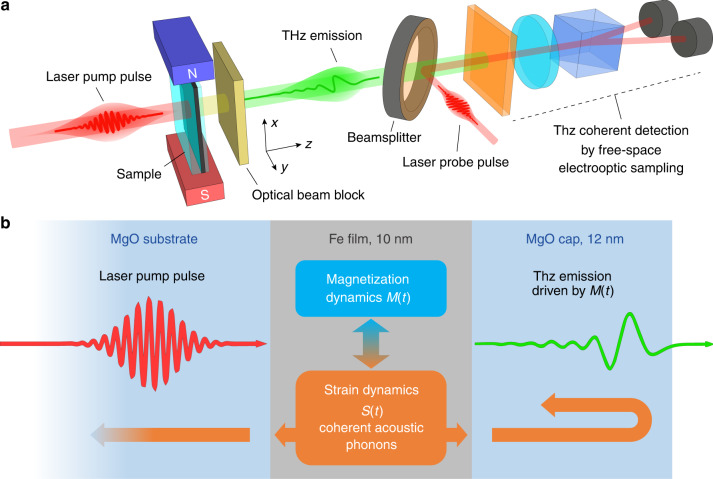
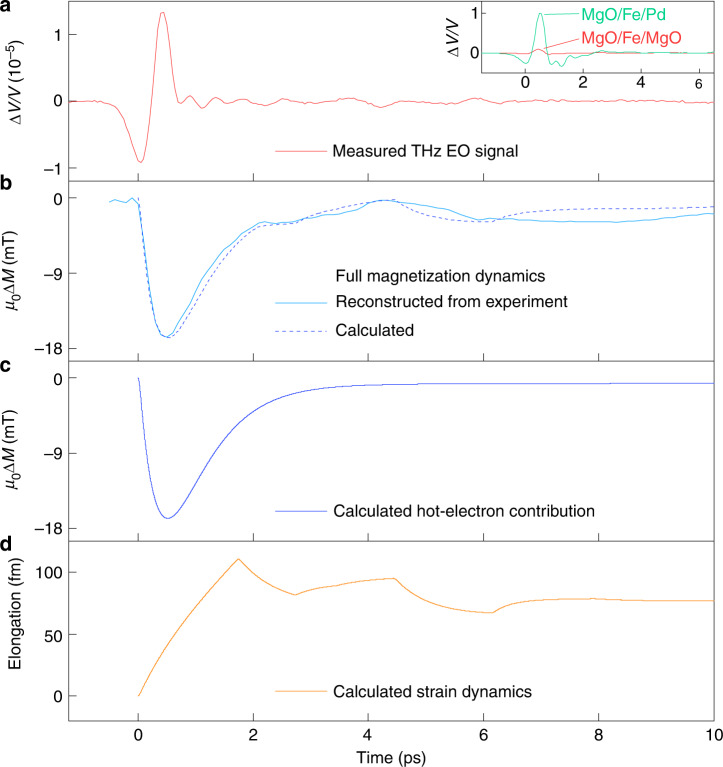
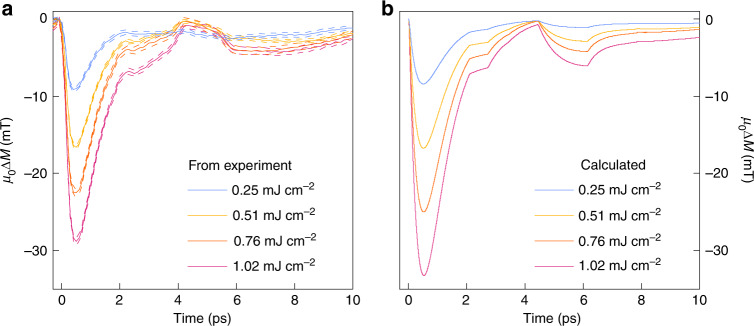
Verification
Claims the paper makes
The claims and statistics of this paper haven’t been checked yet.
Run the check — free, no account needed. It reads the open-access text and checks the sources it cites.
Claims other papers make about this one
Each is checked against this paper’s own text: does it say what the citing paper says it does?
The cited source says what the claim attributes to it.
In the citing paper
“THz emission spectroscopy has emerged as a potentially valuable contact-free probe of magnetization dynamics in a variety of materials122.”
From Ultrafast terahertz emission from emerging symmetry-broken materials (2023) · cites this paper as [122]
The cited source says what the claim attributes to it.
In the citing paper
“when a thin FM metallic film is combined with a non-magnetic (NM) layer in a heterostructure configuration, the THz emission intensity is dramatically enhanced, far beyond what is expected from demagnetization in the magnetic layer alone53,122.”
From Ultrafast terahertz emission from emerging symmetry-broken materials (2023) · cites this paper as [122]
Self-check
Percentages, sums and reported differences re-computed from the paper’s own numbers.
The self-check needs the paper’s full text.
Citations
Cites
(2020) · Princeton University Press eBooks · doi:10.2307/j.ctv131bv37.5 · Cited by 22,595
Magnetic Domain-Wall Racetrack Memory
Parkin, S., Hayashi, M., & Thomas, L. (2008) · Science · doi:10.1126/science.1145799 · Cited by 4,668
Chumak, A. V., Vasyuchka, V. I., Serga, A. A., & Hillebrands, B. (2015) · Nature Physics · doi:10.1038/nphys3347 · Cited by 2,653
The emergence of spin electronics in data storage
Chappert, C., FERT, A., & Dau, F. N. V. (2007) · Nature Materials · doi:10.1038/nmat2024 · Cited by 2,563
Ultrafast Spin Dynamics in Ferromagnetic Nickel
Beaurepaire, E., Merle, J.-C., Daunois, A., & Bigot, J.-Y. (1996) · Physical Review Letters · doi:10.1103/physrevlett.76.4250 · Cited by 2,457
Self-citationOptical constants of transition metals: Ti, V, Cr, Mn, Fe, Co, Ni, and Pd
Johnson, P., & Christy, R. (1974) · Physical review. B, Solid state · doi:10.1103/physrevb.9.5056 · Cited by 1,795
Explaining the paradoxical diversity of ultrafast laser-induced demagnetization
Koopmans, B., Malinowski, G., Dalla Longa, F., Steiauf, D., Fähnle, M., Roth, T., Cinchetti, M., & Aeschlimann, M. (2010) · Nature Materials · doi:10.1038/nmat2593 · Cited by 957
Efficient metallic spintronic emitters of ultrabroadband terahertz radiation
Seifert, T., Jaiswal, S., Martens, U., Hannegan, J., Braun, L., Maldonado, P., Freimuth, F., Kronenberg, A., Henrizi, J., Radu, I., et al. (2016) · Nature Photonics · doi:10.1038/nphoton.2016.91 · Cited by 944
Self-citationLong-distance transport of magnon spin information in a magnetic insulator at room temperature
Cornelissen, L. J., Liu, J., Duine, R. A., Youssef, J. B., & van Wees, B. J. (2015) · Nature Physics · doi:10.1038/nphys3465 · Cited by 861
Superdiffusive Spin Transport as a Mechanism of Ultrafast Demagnetization
Battiato, M., Carva, K., & Oppeneer, P. M. (2010) · Physical Review Letters · doi:10.1103/physrevlett.105.027203 · Cited by 807
Self-citationMagnetism: from fundamentals to nanoscale dynamics
(2007) · Choice Reviews Online · doi:10.5860/choice.44-4514 · Cited by 751
Terahertz spin current pulses controlled by magnetic heterostructures
Kampfrath, T., Battiato, M., Maldonado, P., Eilers, G., Nötzold, J., Mährlein, S., Zbarsky, V., Freimuth, F., Mokrousov, Y., Blügel, S., et al. (2013) · Nature Nanotechnology · doi:10.1038/nnano.2013.43 · Cited by 714
Self-citationFundamentals of Semiconductors
Yu, P. Y., & Cardona, M. (2005) · Graduate texts in physics · doi:10.1007/b137661 · Cited by 615
The magnetization of pure iron and nickel
Crangle, J., & Goodman, G. (1971) · Proceedings of the Royal Society of London A Mathematical and Physical Sciences · doi:10.1098/rspa.1971.0044 · Cited by 514
Electro-optic detection of terahertz radiation
Gallot, G., & Grischkowsky, D. (1999) · Journal of the Optical Society of America B · doi:10.1364/josab.16.001204 · Cited by 433
Tuning the properties of magnetic nanowires
Sun, L., Hao, Y., Chien, C. L., & Searson, P. C. (2005) · IBM Journal of Research and Development · doi:10.1147/rd.491.0079 · Cited by 395
Perspective: Ultrafast magnetism and THz spintronics
Walowski, J., & Münzenberg, M. (2016) · Journal of Applied Physics · doi:10.1063/1.4958846 · Cited by 391
Inverse Spin Hall Effect in a Ferromagnetic Metal
Miao, B. F., Huang, S. Y., Qu, D., & Chien, C. L. (2013) · Physical Review Letters · doi:10.1103/physrevlett.111.066602 · Cited by 349
Coherent terahertz emission from ferromagnetic films excited by femtosecond laser pulses
Beaurepaire, E., Turner, G. M., Harrel, S. M., Beard, M. C., Bigot, J.-Y., & Schmuttenmaer, C. A. (2004) · Applied Physics Letters · doi:10.1063/1.1737467 · Cited by 305
Self-citationCinchetti, M., Heimer, K., Wüstenberg, J., Andreyev, O., Bauer, M., Lach, S., Ziegler, C., Gao, Y., & Aeschlimann, M. (2008) · Nature Materials · doi:10.1038/nmat2334 · Cited by 293
Ultrafast Transport of Laser-Excited Spin-Polarized Carriers in Au/Fe/MgO(001)
Melnikov, A. V., Razdolski, I., Wehling, T. O., Papaioannou, E. T., Владимирович, Р. В., Fumagalli, P., Aktsipetrov, O. A., Lichtenstein, A. I., & Bovensiepen, U. (2011) · Physical Review Letters · doi:10.1103/physrevlett.107.076601 · Cited by 276
High‐Performance THz Emitters Based on Ferromagnetic/Nonmagnetic Heterostructures
Wu, Y., Elyasi, M., Qiu, X., Chen, M., Liu, Y., Ke, L., & Yang, H. (2016) · Advanced Materials · doi:10.1002/adma.201603031 · Cited by 274
Femtosecond control of electric currents in metallic ferromagnetic heterostructures
Huisman, T. J., Mikhaylovskiy, R. V., Costa, J. D., Freimuth, F., Paz, E., Ventura, J., Freitas, P. P., Blügel, S., Mokrousov, Y., Rasing, T., et al. (2016) · Nature Nanotechnology · doi:10.1038/nnano.2015.331 · Cited by 267
Ultrafast nonequilibrium stress generation in gold and silver
Wright, O. B. (1994) · Physical review. B, Condensed matter · doi:10.1103/physrevb.49.9985 · Cited by 232
The ultrafast Einstein–de Haas effect
Dornes, C., Acremann, Y., Savoini, M., Kubli, M., Neugebauer, M. J., Abreu, E., Huber, L., Lantz, G., Vaz, C. A. F., Lemke, H. T., et al. (2018) · Nature · doi:10.1038/s41586-018-0822-7 · Cited by 229
Yamaguchi, K., Nakajima, M., & Suemoto, T. (2010) · Physical Review Letters · doi:10.1103/physrevlett.105.237201 · Cited by 204
Thermodynamic picture of ultrafast charge transport in graphene
Mics, Z., Tielrooij, K., Parvez, K., Jensen, S. A., Ivanov, I., Feng, X., Müllen, K., Bonn, M., & Turchinovich, D. (2015) · Nature Communications · doi:10.1038/ncomms8655 · Cited by 196
Self-citationCarva, K., Battiato, M., & Oppeneer, P. M. (2011) · Physical Review Letters · doi:10.1103/physrevlett.107.207201 · Cited by 186
Self-citationUltrafast Magnetoacoustics in Nickel Films
Kim, J.-W., Vomir, M., & Bigot, J. ‐. (2012) · Physical Review Letters · doi:10.1103/physrevlett.109.166601 · Cited by 174
Zhukov, V. P., Chulkov, E. V., & Echenique, P. M. (2006) · Physical Review B · doi:10.1103/physrevb.73.125105 · Cited by 163
Band structure evolution during the ultrafast ferromagnetic-paramagnetic phase transition in cobalt
Eich, S., Plötzing, M., Rollinger, M., Emmerich, S., Adam, R., Chen, C., Kapteyn, H. C., Murnane, M. M., Pluciński, Ł., Steil, D., et al. (2017) · Science Advances · doi:10.1126/sciadv.1602094 · Cited by 160
Observation of Dicke cooperativity in magnetic interactions
Li, X., Bamba, M., Yuan, N., Zhang, Q., Zhao, Y., Xiang, M., Xu, K., Jin, Z., Ren, W., Ma, G., et al. (2018) · Science · doi:10.1126/science.aat5162 · Cited by 148
Self-citationDissecting spin-phonon equilibration in ferrimagnetic insulators by ultrafast lattice excitation
Maehrlein, S. F., Radu, I., Maldonado, P., Paarmann, A., Gensch, M., Kalashnikova, A. M., Писарев, Р. В., Wolf, M., Oppeneer, P. M., Barker, J., et al. (2018) · Science Advances · doi:10.1126/sciadv.aar5164 · Cited by 138
Self-citationAccessing the fundamentals of magnetotransport in metals with terahertz probes
Jin, Z., Tkach, A., Casper, F., Spetter, V., Grimm, H., Thomas, A., Kampfrath, T., Bonn, M., Kläui, M., & Turchinovich, D. (2015) · Nature Physics · doi:10.1038/nphys3384 · Cited by 136
Self-citationWeber, M., Koch, R., & Rieder, K. H. (1994) · Physical Review Letters · doi:10.1103/physrevlett.73.1166 · Cited by 134
Ultrafast Magnon Generation in an Fe Film on Cu(100)
Schmidt, A. B., Pickel, M. D., Donath, M., Buczek, P., Ernst, A., Zhukov, V. P., Echenique, P. M., Sandratskii, L. M., Chulkov, E. V., & Weinelt, M. (2010) · Physical Review Letters · doi:10.1103/physrevlett.105.197401 · Cited by 126
Terahertz emission via ultrashort-pulse excitation of magnetic metal films
Hilton, D., Averitt, R. D., Meserole, C. A., Fisher, G. L., Funk, D. J., Thompson, J. D., & Taylor, A. J. (2004) · Optics Letters · doi:10.1364/ol.29.001805 · Cited by 124
Theory of out-of-equilibrium ultrafast relaxation dynamics in metals
Maldonado, P., Carva, K., Flammer, M., & Oppeneer, P. M. (2017) · Physical review. B./Physical review. B · doi:10.1103/physrevb.96.174439 · Cited by 120
Self-citationSeifert, T. S., Tran, N. M., Gueckstock, O., Rouzegar, S. M., Nadvornik, L., Jaiswal, S., Jakob, G., Temnov, V. V., Münzenberg, M., Wolf, M., et al. (2018) · Journal of Physics D Applied Physics · doi:10.1088/1361-6463/aad536 · Cited by 120
Self-citationFaure, J., van Tilborg, J., Kaindl, R. A., & Leemans, W. P. (2004) · Optical and Quantum Electronics · doi:10.1023/b:oqel.0000039617.85129.c2 · Cited by 116
Microscopic Origin of Heisenberg and Non-Heisenberg Exchange Interactions in Ferromagnetic bcc Fe
Kvashnin, Y. O., Cardias, R., Szilva, A., Marco, I. D., Katsnelson, M. I., Lichtenstein, A. I., Nordström, L., Klautau, A. B., & Eriksson, O. (2016) · Physical Review Letters · doi:10.1103/physrevlett.116.217202 · Cited by 102
Turgut, E., Zusin, D. H., Legut, D., Carva, K., Knut, R., Shaw, J. M., Chen, C., Tao, Z., Nembach, H. T., Silva, T. J., et al. (2016) · Physical review. B./Physical review. B · doi:10.1103/physrevb.94.220408 · Cited by 101
Self-citationTöws, W., & Pastor, G. M. (2015) · Physical Review Letters · doi:10.1103/physrevlett.115.217204 · Cited by 94
Jin, Z., Mics, Z., Ma, G., Cheng, Z., Bonn, M., & Turchinovich, D. (2013) · Physical Review B · doi:10.1103/physrevb.87.094422 · Cited by 84
Self-citationLength-Scale Dependent Phonon Interactions
Shindé, S. L., & Srivastava, G. P. (2013) · Topics in applied physics · doi:10.1007/978-1-4614-8651-0 · Cited by 79
Wieczorek, J., Eschenlohr, A., Weidtmann, B., Rösner, M., Bergeard, N., Tarasevitch, A. P., Wehling, T. O., & Bovensiepen, U. (2015) · Physical Review B · doi:10.1103/physrevb.92.174410 · Cited by 76
Femtosecond formation dynamics of the spin Seebeck effect revealed by terahertz spectroscopy
Seifert, T. S., Jaiswal, S., Barker, J., Weber, S. T., Razdolski, I., Cramer, J., Gueckstock, O., Maehrlein, S. F., Nádvorník, L., Watanabe, S., et al. (2018) · White Rose Research Online (University of Leeds, The University of Sheffield, University of York) · doi:10.17169/refubium-769 · Cited by 72
Self-citationHuisman, T. J., Mikhaylovskiy, R. V., Tsukamoto, A., Rasing, T., & Kimel, A. V. (2015) · Physical Review B · doi:10.1103/physrevb.92.104419 · Cited by 67
Density-dependent electron scattering in photoexcited GaAs in strongly diffusive regime
Mics, Z., D'Angio, A., Jensen, S. A., Bonn, M., & Turchinovich, D. (2013) · Applied Physics Letters · doi:10.1063/1.4810756 · Cited by 63
Self-citationGeneration mechanism of terahertz coherent acoustic phonons in Fe
Henighan, T., Trigo, M., Bonetti, S., Granitzka, P. W., Higley, D. J., Chen, Z., Jiang, M. P., Kukreja, R., Gray, A. X., Reid, A. H., et al. (2016) · Physical review. B./Physical review. B · doi:10.1103/physrevb.93.220301 · Cited by 63
Self-citationRazdolski, I., Alekhin, A., Martens, U., Bürstel, D., Diesing, D., Münzenberg, M., Bovensiepen, U., & Melnikov, A. V. (2017) · Journal of Physics Condensed Matter · doi:10.1088/1361-648x/aa63c6 · Cited by 62
Exchange interaction function for spin-lattice coupling in bcc iron
Wang, H., Ma, P.-W., & Woo, C. H. (2010) · Physical Review B · doi:10.1103/physrevb.82.144304 · Cited by 54
van Capel, P. J. S., Turchinovich, D., Porte, H. P., Lahmann, S., Rossow, U., Hangleiter, A., & Dijkhuis, J. I. (2011) · Physical Review B · doi:10.1103/physrevb.84.085317 · Cited by 32
Self-citationKink far below the Fermi level reveals new electron-magnon scattering channel in Fe
Młyńczak, E., Müller, M. C. T. D., Gospodarič, P., Heider, T., Aguilera, I., Bihlmayer, G., Gehlmann, M., Jugovac, M., Zamborlini, G., Tusche, C., et al. (2019) · Nature Communications · doi:10.1038/s41467-019-08445-1 · Cited by 29
Finite-size effects in ultrafast remagnetization dynamics of FePt
Willig, L., von Reppert, A., Deb, M., Ganss, F., Hellwig, O., & Bargheer, M. (2019) · Physical review. B./Physical review. B · doi:10.1103/physrevb.100.224408 · Cited by 14
Turchinovich, D., D'Angelo, F., & Bonn, M. (2017) · Applied Physics Letters · doi:10.1063/1.4978648 · Cited by 12
Self-citationMicroscopic theory of ultrafast out-of-equilibrium magnon-phonon dynamics in insulators
Maldonado, P., & Kvashnin, Y. O. (2019) · Physical review. B./Physical review. B · doi:10.1103/physrevb.100.014430 · Cited by 12
Self-citationSpecial issue on ultrafast magnetism
Eschenlohr, A., & Bovensiepen, U. (2017) · Journal of Physics Condensed Matter · doi:10.1088/1361-648x/aa9e69 · Cited by 6
Cited by
Sorted by citations
THz spintronic emitters: a review on achievements and future challenges
Papaioannou, E. T., & Beigang, R. (2020) · Nanophotonics · doi:10.1515/nanoph-2020-0563 · Cited by 175
Seifert, T. S., Go, D., Hayashi, H., Rouzegar, R., Freimuth, F., Ando, K., Mokrousov, Y., & Kampfrath, T. (2023) · Nature Nanotechnology · doi:10.1038/s41565-023-01470-8 · Cited by 135
Self-citationSpintronic sources of ultrashort terahertz electromagnetic pulses
Seifert, T. S., Cheng, L., Wei, Z., Kampfrath, T., & Qi, J. (2022) · Applied Physics Letters · doi:10.1063/5.0080357 · Cited by 134
Self-citationBroadband Spintronic Terahertz Source with Peak Electric Fields Exceeding 1.5 MV/cm
Rouzegar, R., Chekhov, A. L., Behovits, Y., Serrano, B. R., Syskaki, M. A., Lambert, C., Engel, D. W., Martens, U., Münzenberg, M., Wolf, M., et al. (2023) · Physical Review Applied · doi:10.1103/physrevapplied.19.034018 · Cited by 115
Self-citationRouzegar, R., Brandt, L., Nádvorník, L., Reiss, D. A., Chekhov, A. L., Gueckstock, O., In, C., Wolf, M., Seifert, T. S., Brouwer, P. W., et al. (2022) · Physical review. B./Physical review. B · doi:10.1103/physrevb.106.144427 · Cited by 102
Self-citation
Metadata
- Authors
- Zhang, W., Maldonado, P., Jin, Z., Seifert, T. S., Arabski, J., Schmerber, G., Beaurepaire, E., Bonn, M., Kampfrath, T., Oppeneer, P. M., & Turchinovich, D.
- Affiliations
- Bielefeld University (DE)
- Uppsala University (SE)
- University of Shanghai for Science and Technology (CN)
- ETH Zurich (CH)
- Centre National de la Recherche Scientifique (FR)
- Max Planck Institute for Polymer Research (DE)
- Freie Universität Berlin (DE)
- Corresponding author
- Turchinovich, Dmitry
- ORCID
- Venue
- Nature Communications
- Published
- 2020-08-25
- Volume
- 11
- Issue
- 1
- Pages
- 4247-4247
- ISSN
- 2041-1723 (ISSN-L)
- PMC
- PMC7447779
- OpenAlex
- W3080725279
- Cited by
- 110
- References
- 61
- Citations by year
- 2026: 7 · 2025: 21 · 2024: 15 · 2023: 27 · 2022: 22 · 2021: 17 · 2020: 1
- FWCI
- 6.76
- Type
- journal article
- Language
- en
- Open access
- gold
- doi.org
- Locations
- Nature Communications (publishedVersion, cc-by)
- PubMed Central (publishedVersion, cc-by)
- PubMed (publishedVersion)
- Refubium (Universitätsbibliothek der Freien Universität Berlin) (submittedVersion, cc-by)
- Uppsala University Publications (Uppsala University) (submittedVersion, other-oa)
- HAL (submittedVersion)
- RePEc: Research Papers in Economics (submittedVersion)
- DOAJ (DOAJ: Directory of Open Access Journals) (submittedVersion, cc-by-sa)
- Publikationen an der Universität Bielefeld (Universität Bielefeld) (submittedVersion, cc-by)
- MPG.PuRe (Max Planck Society) (submittedVersion, other-oa)
- Repository for Publications and Research Data (ETH Zurich) (submittedVersion, cc-by)
- Universitätsbibliothek der FU Berlin Hochschulschriftenstelle u. Dokumentenserver (cc-by)
- ETH Zürich Research Collection (cc-by)
- Funders
- Chinese Scholarship Council
- Vetenskapsrådet
- Knut och Alice Wallenbergs Stiftelse (2015.0060)
- Swedish National Infrastructure for Computing
- Deutsche Forschungsgemeinschaft (278162697 – SFB 1242)
- Topics
- Physical Sciences › Physics and Astronomy › Condensed Matter Physics › Magnetic properties of thin films
- Physical Sciences › Engineering › Electrical and Electronic Engineering › Terahertz technology and applications
- Physical Sciences › Physics and Astronomy › Condensed Matter Physics › Advanced Condensed Matter Physics
- Keywords
- magnetization dynamics, iron films, non-contact measurement
About these checks
Registry, retraction, Cites and statistics results are computed, not judged, with one exception: a printed reference that no index lists is read once by a model before it counts as a citation error. Claims are extracted by a model and kept only when their quote appears verbatim in the text; each cited source is then checked, with a model’s help, for whether it says what the claim relies on. Those verdicts can be wrong — read the claim’s quote and the cited source before relying on one.
Statistics and arithmetic are recomputed, not judged.
Confidence bands are shown only for fields calibrated on our annotated test set. None is calibrated yet, so no band is shown.
What counts as a claim ›How we measure confidence ›How we check this ›
Are you an author, or do you see a problem with this page? Request a review
