

The DOI matches its Crossref record; 61 of the 63 references it cites were found in a registry or an index.
Gut microbiome-related effects of berberine and probiotics on type 2 diabetes (the PREMOTE study)
Open accessAbstract
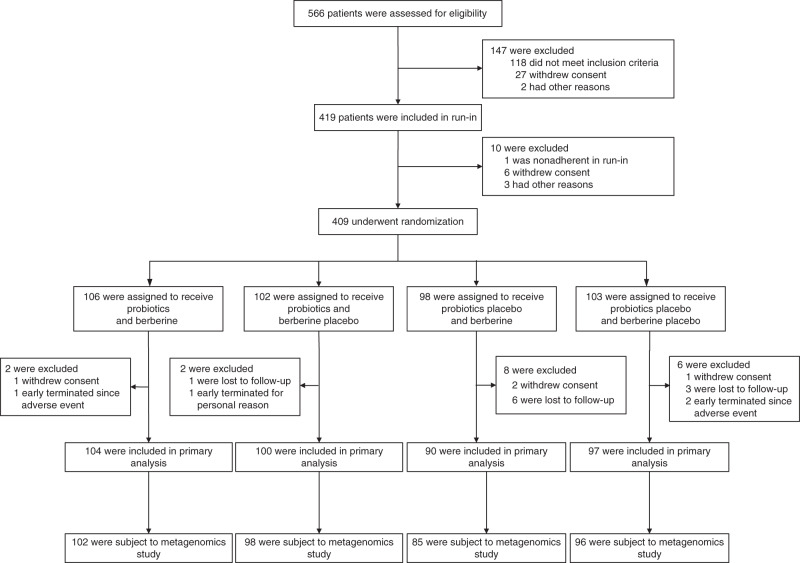
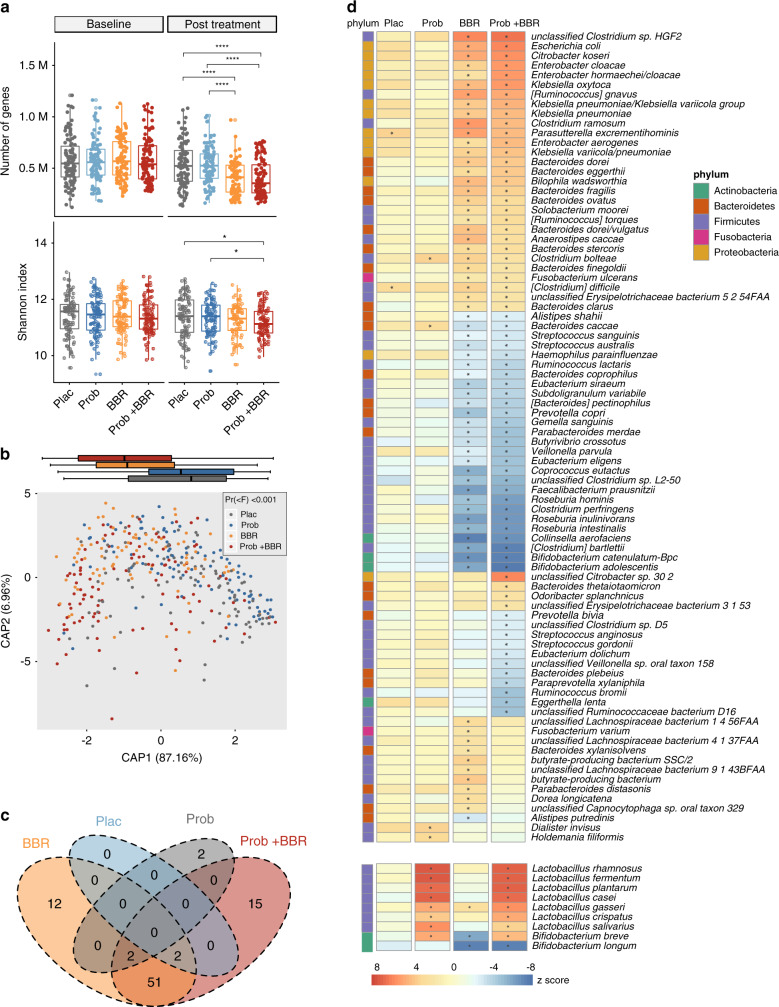
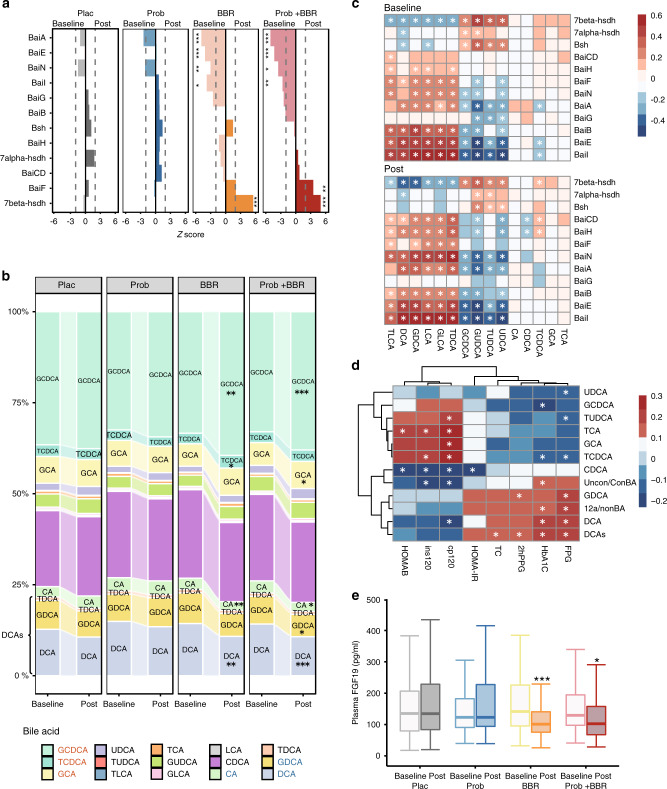
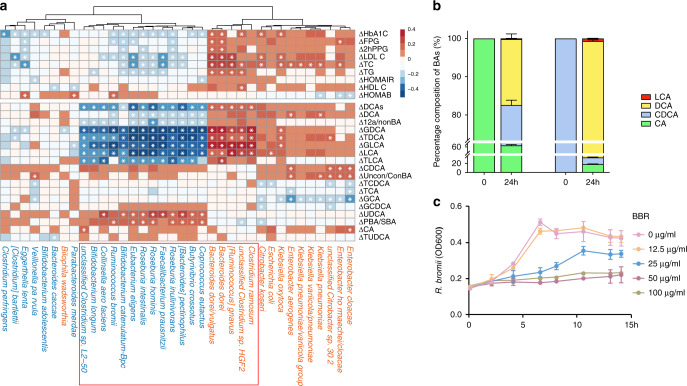
Human gut microbiome is a promising target for managing type 2 diabetes (T2D). Measures altering gut microbiota like oral intake of probiotics or berberine (BBR), a bacteriostatic agent, merit metabolic homoeostasis. We hence conducted a randomized, double-blind, placebo-controlled trial with newly diagnosed T2D patients from 20 centres in China. Four-hundred-nine eligible participants were enroled, randomly assigned (1:1:1:1) and completed a 12-week treatment of either BBR-alone, probiotics+BBR, probiotics-alone, or placebo, after a one-week run-in of gentamycin pretreatment. The changes in glycated haemoglobin, as the primary outcome, in the probiotics+BBR (least-squares mean [95% CI], -1.04[-1.19, -0.89]%) and BBR-alone group (-0.99[-1.16, -0.83]%) were significantly greater than that in the placebo and probiotics-alone groups (-0.59[-0.75, -0.44]%, -0.53[-0.68, -0.37]%, P < 0.001). BBR treatment induced more gastrointestinal side effects. Further metagenomics and metabolomic studies found that the hypoglycaemic effect of BBR is mediated by the inhibition of DCA biotransformation by Ruminococcus bromii. Therefore, our study reports a human microbial related mechanism underlying the antidiabetic effect of BBR on T2D. (Clinicaltrial.gov Identifier: NCT02861261).
Overview
The claims and statistics of this paper haven’t been checked yet.
Run the check — free, no account needed. It reads the open-access text and checks the sources it cites.
Integrity signals
Registry
Cites
Statistics
Figures
Verification
Claims the paper makes
The claims and statistics of this paper haven’t been checked yet.
Run the check — free, no account needed. It reads the open-access text and checks the sources it cites.
Claims other papers make about this one
Each is checked against this paper’s own text: does it say what the citing paper says it does?
The check wasn’t confident either way, so it gives no verdict — never disputed.
In the citing paper
“the microbiome in turn biotransforms it into better-absorbed forms [43,66,102].”
From Berberine-Drug Interactions: Mechanisms, Clinical Relevance and Risk Stratification-A Narrative Review (2026) · cites this paper as [102]
Experimental — accuracy not yet measuredIn the citing paper
“Additionally, evidence has shown that berberine regulates the gut microbiota as well [14, 15], which is closely associated with systematic inflammation that adds to the progression of T2DM.”
From The Effect of Berberine on Metabolic Profiles in Type 2 Diabetic Patients: A Systematic Review and Meta‐Analysis of Randomized Controlled Trials (2021) · cites this paper as [15]
Self-check
Percentages, sums and reported differences re-computed from the paper’s own numbers.
The self-check needs the paper’s full text.
Citations
Cites
An obesity-associated gut microbiome with increased capacity for energy harvest
Turnbaugh, P. J., Ley, R. E., Mahowald, M. A., Magrini, V., Mardis, E. R., & Gordon, J. I. (2006) · Nature · doi:10.1038/nature05414 · Cited by 12,444
A metagenome-wide association study of gut microbiota in type 2 diabetes
Qin, J., Li, Y., Cai, Z., Li, S., Zhu, J., Zhang, F., Liang, S., Zhang, W., Guan, Y., Shen, D., et al. (2012) · Nature · doi:10.1038/nature11450 · Cited by 6,762
Self-citationSkyline: an open source document editor for creating and analyzing targeted proteomics experiments
MacLean, B., Tomazela, D. M., Shulman, N., Chambers, M., Finney, G. L., Frewen, B., Kern, R., Tabb, D. L., Liebler, D. C., & MacCoss, M. J. (2010) · Bioinformatics · doi:10.1093/bioinformatics/btq054 · Cited by 4,697
Gut Microbiota from Twins Discordant for Obesity Modulate Metabolism in Mice
Ridaura, V. K., Faith, J. J., Rey, F. E., Cheng, J., Duncan, A. E., Kau, A. L., Griffin, N. W., Lombard, V., Henrissat, B., Bain, J. R., et al. (2013) · Science · doi:10.1126/science.1241214 · Cited by 3,788
Inflammaging: a new immune–metabolic viewpoint for age-related diseases
Franceschi, C., Garagnani, P., Parini, P., Giuliani, C., & Santoro, A. (2018) · Nature Reviews Endocrinology · doi:10.1038/s41574-018-0059-4 · Cited by 3,586
Dynamics and Stabilization of the Human Gut Microbiome during the First Year of Life
Bäckhed, F., Roswall, J., Peng, Y., Feng, Q., Jia, H., Kovatcheva-Datchary, P., Li, Y., Xia, Y., Xie, H., Zhong, H., et al. (2015) · Cell Host & Microbe · doi:10.1016/j.chom.2015.04.004 · Cited by 3,315
Self-citationGut metagenome in European women with normal, impaired and diabetic glucose control
Karlsson, F. H., Tremaroli, V., Nookaew, I., Bergström, G., Behre, C. J., Fagerberg, B., Nielsen, J., & Bäckhed, F. (2013) · Nature · doi:10.1038/nature12198 · Cited by 3,115
Bile salt biotransformations by human intestinal bacteria
Ridlon, J. M., Kang, D.-J., & Hylemon, P. B. (2006) · Journal of Lipid Research · doi:10.1194/jlr.r500013-jlr200 · Cited by 2,829
Prevalence and Control of Diabetes in Chinese Adults
Xu, Y. (2013) · JAMA · doi:10.1001/jama.2013.168118 · Cited by 2,710
Sayin, S. I., Wahlström, A., Felin, J., Jäntti, S., Marschall, H.-U., Bamberg, K., Angelin, B., Hyötyläinen, T., Orešič, M., & Bäckhed, F. (2013) · Cell Metabolism · doi:10.1016/j.cmet.2013.01.003 · Cited by 2,331
Cited by
Sorted by citations
Aging and aging-related diseases: from molecular mechanisms to interventions and treatments
Guo, J., Huang, X., Dou, L., Yan, M., Shen, T., Tang, W., & Li, J. (2022) · Signal Transduction and Targeted Therapy · doi:10.1038/s41392-022-01251-0 · Cited by 1,976
Self-citationZhu, Y., Ouyang, Z., Du, H., Wang, M., Wang, J., Sun, H., Kong, L., Xu, Q., Ma, H., & Sun, Y. (2022) · Acta Pharmaceutica Sinica B · doi:10.1016/j.apsb.2022.08.022 · Cited by 429
Self-citationProbiotics, prebiotics, and postbiotics in health and disease
Ji, J., Jin, W., Liu, S., Jiao, Z., & Li, X. (2023) · MedComm · doi:10.1002/mco2.420 · Cited by 449
Self-citationResistant starch intake facilitates weight loss in humans by reshaping the gut microbiota
Li, H., Zhang, L., Li, J., Wu, Q., Qian, L., He, J., Ni, Y., Kovatcheva‐Datchary, P., Yuan, R. R., Liu, S., et al. (2024) · Nature Metabolism · doi:10.1038/s42255-024-00988-y · Cited by 280
Self-citationMontassier, E., Valdés-Mas, R., Batard, E., Zmora, N., Dori-Bachash, M., Suez, J., & Elinav, E. (2021) · Nature Microbiology · doi:10.1038/s41564-021-00920-0 · Cited by 256
Metadata
- Authors
- Zhang, Y., Gu, Y., Ren, H., Wang, S., Zhong, H., Zhao, X., Ma, J., Gu, X., Xue, Y., Huang, S., Yang, J., Chen, L., Chen, G., Qu, S., Liang, J., Qin, L., Huang, Q., Peng, Y., Li, Q., Wang, X., Kong, P., Hou, G., Gao, M., Shi, Z., Li, X., Qiu, Y., Zou, Y., Yang, H., Wang, J., Xu, G., Lai, S., Li, J., Ning, G., & Wang, W.
- Affiliations
- Shanghai Jiao Tong University (CN)
- BGI Group (China) (CN)
- Dalian Institute of Chemical Physics (CN)
- First Affiliated Hospital of Wenzhou Medical University (CN)
- Nanfang Hospital (CN)
- Minhang District Central Hospital (CN)
- Qilu Hospital of Shandong University (CN)
- Fujian Provincial Hospital (CN)
- Tongji University (CN)
- Xuzhou Central Hospital (CN)
- Second Military Medical University (CN)
- Johns Hopkins University (US)
- Corresponding author
- Li, Junhua
- Wang, Weiqing
- ORCID
- Zhang, Yifei
- Gu, Yanyun
- Ren, Huahui
- Wang, Shujie
- Zhong, Huanzi
- Zhao, Xinjie
- Ma, Jing
- Gu, Xuejiang
- Xue, Yaoming
- Huang, Shan
- Yang, Jialin
- Chen, Li
- Qu, Shen
- Liang, Jun
- Qin, Li
- Huang, Qin
- Peng, Yongde
- Li, Qi
- Wang, Xiaolin
- Hou, Guixue
- Gao, Mengyu
- Shi, Zhun
- Li, Xuelin
- Qiu, Yixuan
- Zou, Yuanqiang
- Yang, Huanming
- Wang, Jian
- Xu, Guowang
- Lai, Shenghan
- Li, Junhua
- Ning, Guang
- Wang, Weiqing
- Venue
- Nature Communications
- Published
- 2020-10-06
- Volume
- 11
- Issue
- 1
- Pages
- 5015-5015
- ISSN
- 2041-1723 (ISSN-L)
- PMC
- PMC7538905
- OpenAlex
- W3092484485
- Cited by
- 380
- References
- 63
- Citations by year
- 2026: 44 · 2025: 68 · 2024: 63 · 2023: 84 · 2022: 72 · 2021: 48 · 2020: 1
- FWCI
- 31.32
- Type
- journal article
- Language
- en
- Open access
- gold
- doi.org
- Locations
- Nature Communications (publishedVersion, cc-by)
- PubMed Central (publishedVersion, cc-by)
- PubMed (publishedVersion)
- RePEc: Research Papers in Economics (submittedVersion)
- DOAJ (DOAJ: Directory of Open Access Journals) (submittedVersion, cc-by-sa)
- Funders
- National Natural Science Foundation of China (81,870,555, 91857205, 2016YFC0901200, 2018YFC1313804, 81930021)
- Sun Yat-sen University
- Government of Jiangsu Province
- Huazhong University of Science and Technology
- Science and Technology Commission of Shanghai Municipality
- Government of Jiangxi Province
- Tongji University
- Zhejiang University
- Shanghai Jiao Tong University
- Second Military Medical University
- Peking University
- Nanjing University
- Southern Medical University
- Nanfang Hospital
- Shanghai General Hospital
- Fujian Provincial Hospital
- Ruijin Hospital
- Wuhan Union Hospital
- School of Medicine, Shanghai Jiao Tong University
- Tongji Medical College, Huazhong University of Science and Technology
- Topics
- Health Sciences › Medicine › Pharmacology (medical) › Berberine and alkaloids research
- Life Sciences › Biochemistry, Genetics and Molecular Biology › Molecular Biology › Gut microbiota and health
- Life Sciences › Agricultural and Biological Sciences › Food Science › Probiotics and Fermented Foods
- Keywords
- berberine, probiotics, type 2 diabetes, gut microbiota, HbA1c, Ruminococcus bromii, metagenomics, metabolomics, antidiabetic mechanism, newly diagnosed diabetes, gastrointestinal adverse effects
- MeSH terms
- Gastrointestinal Microbiome, Berberine, Diabetes Mellitus, Type 2, Female, Glycated Hemoglobin, Humans, Hypoglycemic Agents, Male, Middle Aged, Placebos, Treatment Outcome, Probiotics, Metagenome
About these checks
Registry, retraction, Cites and statistics results are computed, not judged, with one exception: a printed reference that no index lists is read once by a model before it counts as a citation error. Claims are extracted by a model and kept only when their quote appears verbatim in the text; each cited source is then checked, with a model’s help, for whether it says what the claim relies on. Those verdicts can be wrong — read the claim’s quote and the cited source before relying on one.
Statistics and arithmetic are recomputed, not judged.
Confidence bands are shown only for fields calibrated on our annotated test set. None is calibrated yet, so no band is shown.
What counts as a claim ›How we measure confidence ›How we check this ›
Are you an author, or do you see a problem with this page? Request a review
