

The DOI matches its Crossref record; 57 of the 57 references it cites were found in a registry or an index.
Pretreatment neutrophil-to-lymphocyte ratio and mutational burden as biomarkers of tumor response to immune checkpoint inhibitors
Open accessAbstract
Treatment with immune checkpoint inhibitors (ICI) has demonstrated clinical benefit for a wide range of cancer types. Because only a subset of patients experience clinical benefit, there is a strong need for biomarkers that are easily accessible across diverse practice settings. Here, in a retrospective cohort study of 1714 patients with 16 different cancer types treated with ICI, we show that higher neutrophil-to-lymphocyte ratio (NLR) is significantly associated with poorer overall and progression-free survival, and lower rates of response and clinical benefit, after ICI therapy across multiple cancer types. Combining NLR with tumor mutational burden (TMB), the probability of benefit from ICI is significantly higher (OR = 3.22; 95% CI, 2.26-4.58; P < 0.001) in the NLR low/TMB high group compared to the NLR high/TMB low group. NLR is a suitable candidate for a cost-effective and widely accessible biomarker, and can be combined with TMB for additional predictive capacity.
Overview
The claims and statistics of this paper haven’t been checked yet.
Run the check — free, no account needed. It reads the open-access text and checks the sources it cites.
Integrity signals
Registry
Cites
Statistics
Figures
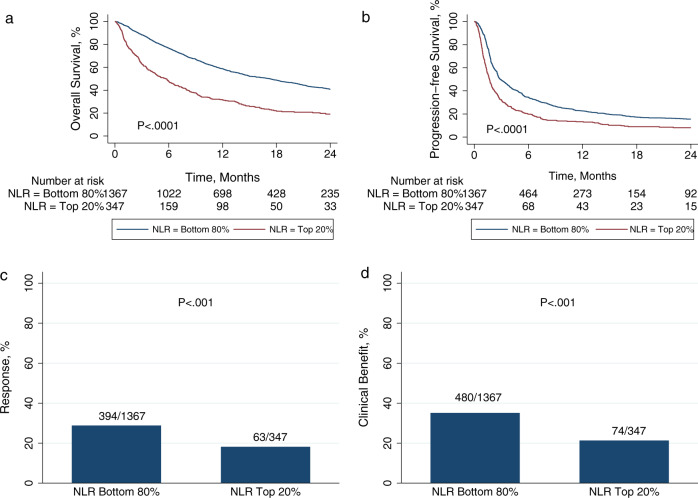
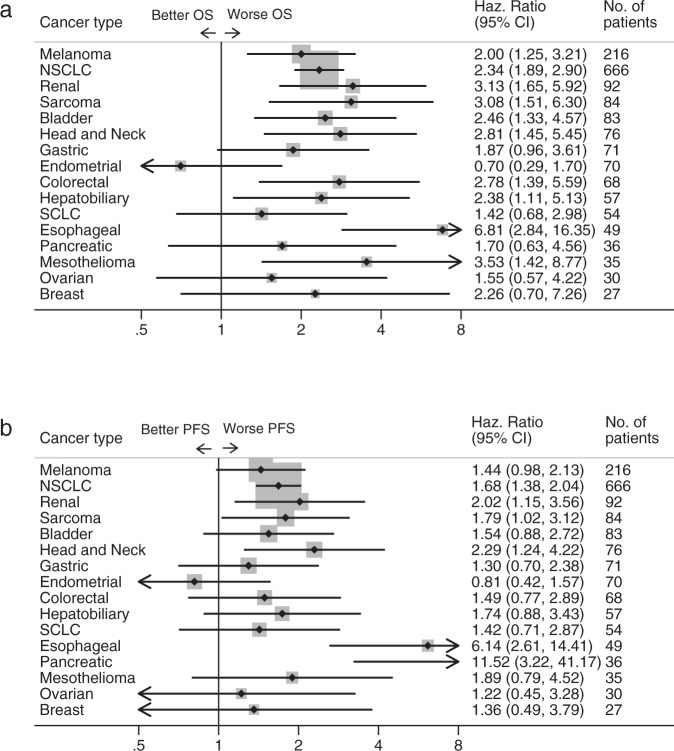
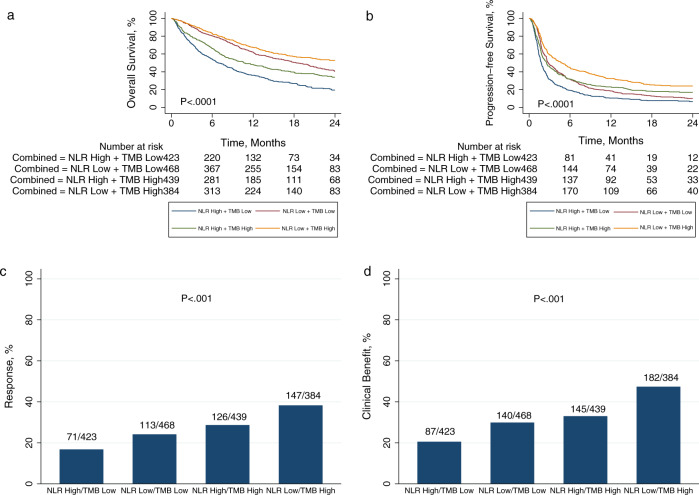
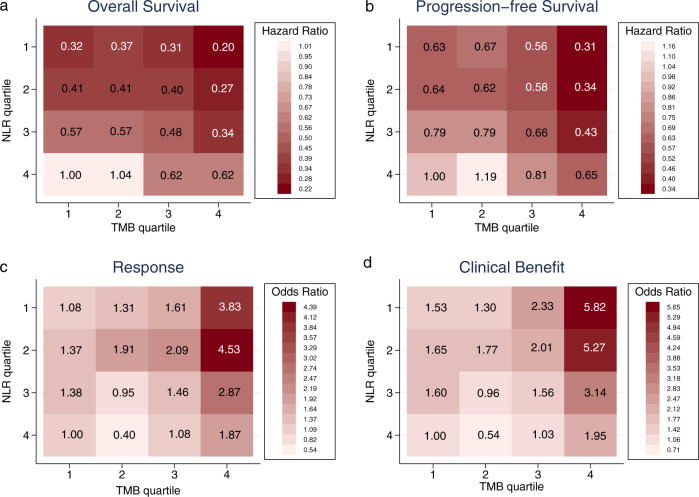
Verification
Claims the paper makes
The claims and statistics of this paper haven’t been checked yet.
Run the check — free, no account needed. It reads the open-access text and checks the sources it cites.
Claims other papers make about this one
Each is checked against this paper’s own text: does it say what the citing paper says it does?
In the citing paper
“Consistent with published studies in multiple settings21–24, PD-1-treated patients with melanoma with a high NLR had poorer survival (OS/PFS) than those with a low NLR.”
From Intestinal microbiota signatures of clinical response and immune-related adverse events in melanoma patients treated with anti-PD-1 (2022) · cites this paper as [22]
Self-check
Percentages, sums and reported differences re-computed from the paper’s own numbers.
The self-check needs the paper’s full text.
Citations
Cites
Hallmarks of Cancer: The Next Generation
Hanahan, D., & Weinberg, R. A. (2011) · Cell · doi:10.1016/j.cell.2011.02.013 · Cited by 66,590
New response evaluation criteria in solid tumours: revised RECIST guideline (version 1.1)
Eisenhauer, E. A., Therasse, P., Bogaerts, J., Schwartz, L. H., Sargent, D., Ford, R., Dancey, J., Arbuck, S., Gwyther, S., Mooney, M., et al. (2009) · European Journal of Cancer · doi:10.1016/j.ejca.2008.10.026 · Cited by 29,534
PD-1 Blockade in Tumors with Mismatch-Repair Deficiency
Le, D. T., Uram, J. N., Wang, H., Bartlett, B. R., Kemberling, H., Eyring, A. D., Skora, A. D., Luber, B. S., Azad, N. S., Laheru, D., et al. (2015) · New England Journal of Medicine · doi:10.1056/nejmoa1500596 · Cited by 9,377
Mismatch repair deficiency predicts response of solid tumors to PD-1 blockade
Le, D. T., Durham, J. N., Smith, K. N., Wang, H., Bartlett, B. R., Aulakh, L. K., Lu, S., Kemberling, H., Wilt, C., Luber, B. S., et al. (2017) · Science · doi:10.1126/science.aan6733 · Cited by 6,645
The immune contexture in human tumours: impact on clinical outcome
Fridman, W. H., Pagès, F., Sautès-Fridman, C., & Galon, J. (2012) · Nature reviews. Cancer · doi:10.1038/nrc3245 · Cited by 4,981
Tumor mutational load predicts survival after immunotherapy across multiple cancer types
Samstein, R. M., Lee, C.-H., Shoushtari, A. N., Hellmann, M. D., Shen, R., Janjigian, Y. Y., Barron, D. A., Zehir, A., Jordan, E. J., Omuro, A., et al. (2019) · Nature Genetics · doi:10.1038/s41588-018-0312-8 · Cited by 4,071
Self-citationTempleton, A. J., McNamara, M. G., Šeruga, B., Vera-Badillo, F. E., Aneja, P., Ocaña, A., Leibowitz-Amit, R., Sonpavde, G., Knox, J. J., Tran, B., et al. (2014) · JNCI: Journal of the National Cancer Institute · doi:10.1093/jnci/dju124 · Cited by 2,829
Pan-tumor genomic biomarkers for PD-1 checkpoint blockade–based immunotherapy
Cristescu, R., Mogg, R., Ayers, M., Albright, A., Murphy, E., Yearley, J., Sher, X., Liu, X. Q., Lu, H., Nebozhyn, M., et al. (2018) · Science · doi:10.1126/science.aar3593 · Cited by 2,301
The evolving landscape of biomarkers for checkpoint inhibitor immunotherapy
Havel, J. J., Chowell, D., & Chan, T. A. (2019) · Nature Reviews Cancer · doi:10.1038/s41568-019-0116-x · Cited by 2,286
Self-citationMemorial Sloan Kettering-Integrated Mutation Profiling of Actionable Cancer Targets (MSK-IMPACT)
Cheng, D. T., Mitchell, T. N., Zehir, A., Shah, R. H., Benayed, R., Syed, A., Chandramohan, R., Liu, Z. Y., Won, H. H., Scott, S. N., et al. (2015) · The Journal of Molecular Diagnostics · doi:10.1016/j.jmoldx.2014.12.006 · Cited by 2,119
Self-citation
Research works printed but not linked: 1
- Amin, M. B. et al. AJCC Cancer Staging Manual (Springer, 2017).
Cited by
Sorted by citations
Cancer biomarkers: Emerging trends and clinical implications for personalized treatment
Passaro, A., Bakir, M. A., Hamilton, E. G., Diehn, M., André, F., Roy‐Chowdhuri, S., Mountzios, G., Wistuba, I. I., Swanton, C., & Peters, S. (2024) · Cell · doi:10.1016/j.cell.2024.02.041 · Cited by 726
McCulloch, J. A., Davar, D., Rodrigues, R. R., Badger, J. H., Fang, J. R., Cole, A. M., Balaji, A. K., Vetizou, M., Prescott, S. M., Fernandes, M. R., et al. (2022) · Nature Medicine · doi:10.1038/s41591-022-01698-2 · Cited by 472
Improved prediction of immune checkpoint blockade efficacy across multiple cancer types
Chowell, D., Yoo, S., Valero, C., Pastore, A., Krishna, C., Lee, M., Hoen, D. R., Shi, H., Kelly, D. W., Patel, N., et al. (2021) · Nature Biotechnology · doi:10.1038/s41587-021-01070-8 · Cited by 275
Self-citationTMB or not TMB as a biomarker: That is the question
Addeo, A., Friedlaender, A., Banna, G. L., & Weiss, G. J. (2021) · Critical Reviews in Oncology/Hematology · doi:10.1016/j.critrevonc.2021.103374 · Cited by 224
Immune Checkpoint Inhibitor Therapy in Oncology
Tan, S., Day, D., Nicholls, S. J., & Segelov, E. (2022) · JACC CardioOncology · doi:10.1016/j.jaccao.2022.09.004 · Cited by 219
Metadata
- Authors
- Valero, C., Lee, M., Hoen, D., Weiss, K., Kelly, D. W., Adusumilli, P. S., Paik, P. K., Plitas, G., Ladanyi, M., Postow, M. A., Ariyan, C. E., Shoushtari, A. N., Balachandran, V. P., Hakimi, A. A., Crago, A. M., Long Roche, K. C., Smith, J. J., Ganly, I., Wong, R. J., Patel, S. G., Shah, J. P., Lee, N. Y., Riaz, N., Wang, J., Zehir, A., Berger, M. F., Chan, T. A., Seshan, V. E., & Morris, L. G. T.
- Affiliations
- Memorial Sloan Kettering Cancer Center (US)
- Corresponding author
- Chan, Timothy A.
- Seshan, Venkatraman E.
- Morris, Luc G. T.
- ORCID
- Valero, Cristina
- Lee, Mark
- Weiss, Kate
- Kelly, Daniel W.
- Adusumilli, Prasad S.
- Paik, Paul K.
- Plitas, George
- Ladanyi, Marc
- Postow, Michael A.
- Ariyan, Charlotte E.
- Shoushtari, Alexander N.
- Balachandran, Vinod P.
- Hakimi, A. Ari
- Crago, Aimee M.
- Smith, J. Joshua
- Ganly, Ian
- Wong, Richard J.
- Patel, Snehal G.
- Shah, Jatin P.
- Lee, Nancy Y.
- Riaz, Nadeem
- Wang, Jingming
- Zehir, Ahmet
- Berger, Michael F.
- Chan, Timothy A.
- Seshan, Venkatraman E.
- Morris, Luc G. T.
- Venue
- Nature Communications
- Published
- 2021-02-01
- Volume
- 12
- Issue
- 1
- Pages
- 729-729
- ISSN
- 2041-1723 (ISSN-L)
- PMC
- PMC7851155
- OpenAlex
- W3127371144
- Cited by
- 441
- References
- 57
- Citations by year
- 2026: 53 · 2025: 74 · 2024: 116 · 2023: 92 · 2022: 80 · 2021: 26
- FWCI
- 28.60
- Type
- journal article
- Language
- en
- Open access
- gold
- doi.org
- Locations
- Nature Communications (publishedVersion, cc-by)
- Europe PMC (PubMed Central) (publishedVersion, other-oa)
- PubMed Central (publishedVersion, cc-by)
- PubMed (publishedVersion)
- RePEc: Research Papers in Economics (submittedVersion)
- DOAJ (DOAJ: Directory of Open Access Journals) (submittedVersion, cc-by-sa)
- Funders
- Fundación Alfonso Martín Escudero (N/A)
- U.S. Department of Health & Human Services | NIH | National Cancer Institute (R01 CA205426, R35 CA232097)
- Topics
- Health Sciences › Medicine › Oncology › Cancer Immunotherapy and Biomarkers
- Health Sciences › Medicine › Oncology › Inflammatory Biomarkers in Disease Prognosis
- Life Sciences › Biochemistry, Genetics and Molecular Biology › Cancer Research › Ferroptosis and cancer prognosis
- Keywords
- immune checkpoint inhibitors, neutrophil-to-lymphocyte ratio, tumor mutational burden, predictive biomarkers, tumor response, overall survival, progression-free survival, cancer immunotherapy, prognostic factors
- MeSH terms
- Progression-Free Survival, Immune Checkpoint Inhibitors, Aged, Female, Follow-Up Studies, Humans, Lymphocytes, Male, Middle Aged, Neoplasms, Neutrophils, Predictive Value of Tests, Retrospective Studies, Lymphocyte Count, Drug Resistance, Neoplasm, Mutation Rate
About these checks
Registry, retraction, Cites and statistics results are computed, not judged, with one exception: a printed reference that no index lists is read once by a model before it counts as a citation error. Claims are extracted by a model and kept only when their quote appears verbatim in the text; each cited source is then checked, with a model’s help, for whether it says what the claim relies on. Those verdicts can be wrong — read the claim’s quote and the cited source before relying on one.
Statistics and arithmetic are recomputed, not judged.
Confidence bands are shown only for fields calibrated on our annotated test set. None is calibrated yet, so no band is shown.
What counts as a claim ›How we measure confidence ›How we check this ›
Are you an author, or do you see a problem with this page? Request a review
