

The DOI matches its Crossref record; 59 of the 59 references it cites were found in a registry or an index.
Thermochromic aggregation-induced dual phosphorescence via temperature-dependent sp3-linked donor-acceptor electronic coupling
Open accessPublished version of a preprint
Abstract
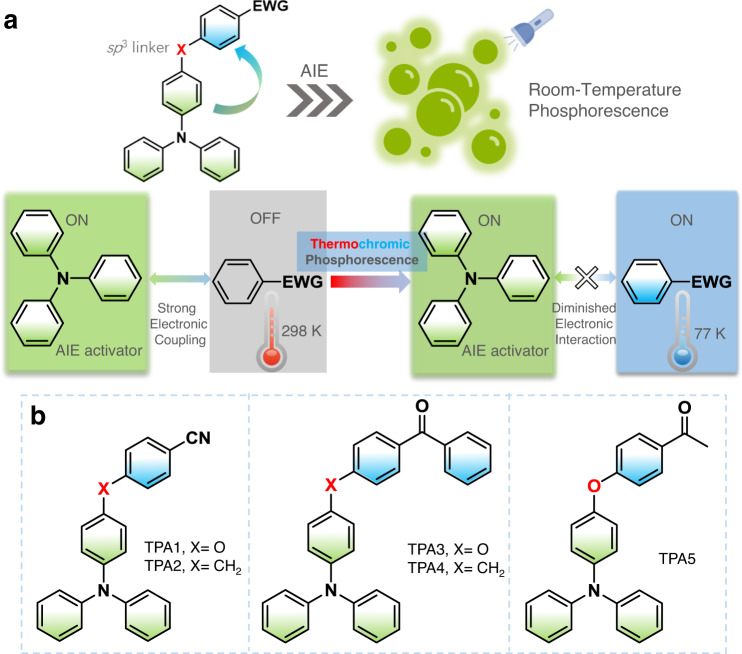
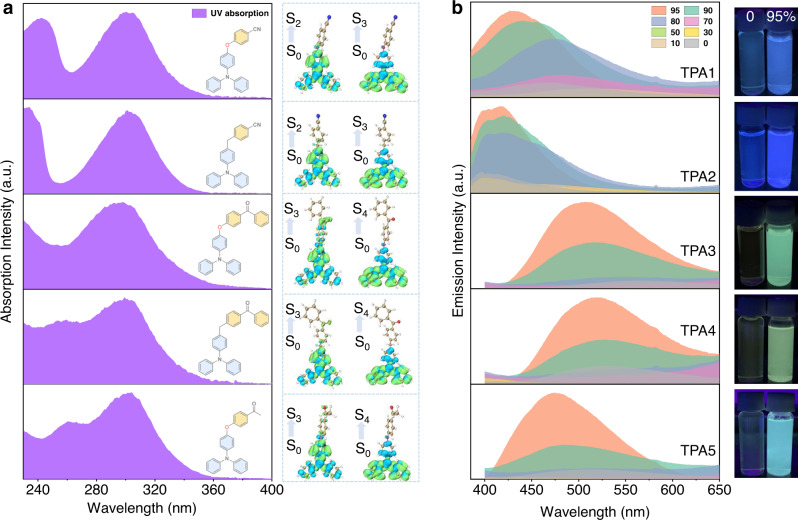
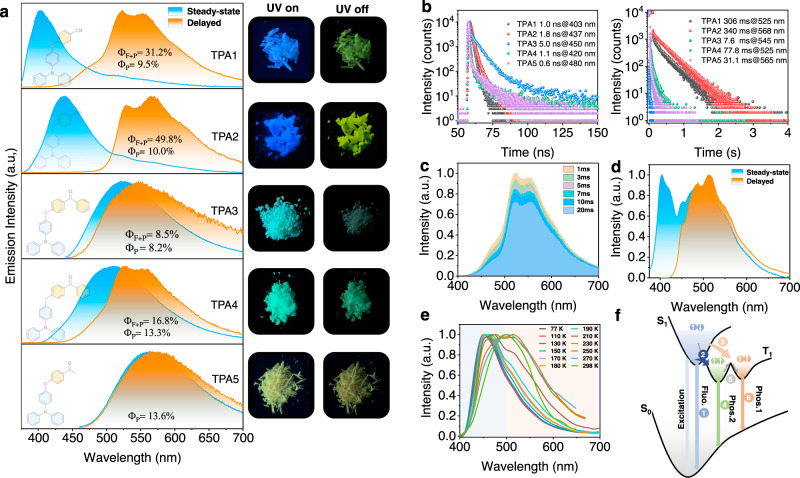
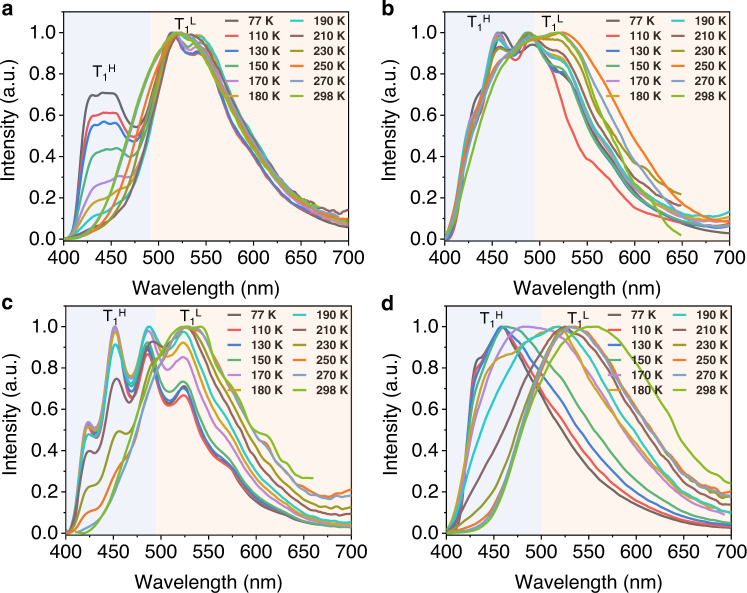
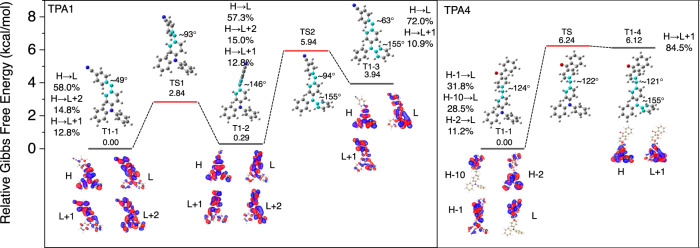
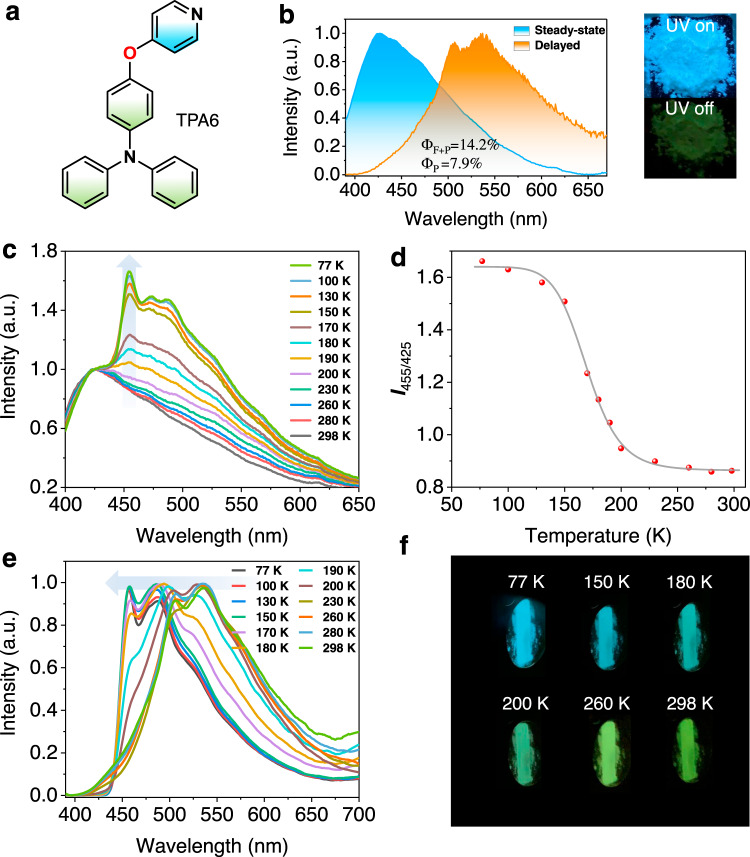
Aggregation-induced emission (AIE) has proven to be a viable strategy to achieve highly efficient room temperature phosphorescence (RTP) in bulk by restricting molecular motions. Here, we show that by utilizing triphenylamine (TPA) as an electronic donor that connects to an acceptor via an sp 3 linker, six TPA-based AIE-active RTP luminophores were obtained. Distinct dual phosphorescence bands emitting from largely localized donor and acceptor triplet emitting states could be recorded at lowered temperatures; at room temperature, only a merged RTP band is present. Theoretical investigations reveal that the two temperature-dependent phosphorescence bands both originate from local/global minima from the lowest triplet excited state (T 1 ). The reported molecular construct serves as an intermediary case between a fully conjugated donor-acceptor system and a donor/acceptor binary mix, which may provide important clues on the design and control of high-freedom molecular systems with complex excited-state dynamics.
Overview
The claims and statistics of this paper haven’t been checked yet.
Run the check — free, no account needed. It reads the open-access text and checks the sources it cites.
Integrity signals
Registry
Cites
Statistics
Figures
Verification
Claims the paper makes
The claims and statistics of this paper haven’t been checked yet.
Run the check — free, no account needed. It reads the open-access text and checks the sources it cites.
Self-check
Percentages, sums and reported differences re-computed from the paper’s own numbers.
The self-check needs the paper’s full text.
Citations
Cites
Multiwfn: A multifunctional wavefunction analyzer
Lu, T., & Chen, F. (2011) · Journal of Computational Chemistry · doi:10.1002/jcc.22885 · Cited by 45,997
OLEX2 : a complete structure solution, refinement and analysis program
Dolomanov, O. V., Bourhis, L. J., Gildea, R. J., Howard, J. A. K., & Puschmann, H. (2009) · Journal of Applied Crystallography · doi:10.1107/s0021889808042726 · Cited by 32,811
SHELXT – Integrated space-group and crystal-structure determination
Sheldrick, G. M. (2015) · Acta Crystallographica Section A Foundations and Advances · doi:10.1107/s2053273314026370 · Cited by 29,831
Quantum Mechanical Continuum Solvation Models
Tomasi, J., Mennucci, B., & Cammi, R. (2005) · Chemical Reviews · doi:10.1021/cr9904009 · Cited by 17,112
Aggregation-induced emission of 1-methyl-1,2,3,4,5-pentaphenylsilole
Luo, J., Xie, Z., Lam, J. W. Y., Cheng, L., Tang, B. Z., Chen, H., Qiu, C., Kwok, H. S., Zhan, X., Liu, Y., et al. (2001) · Chemical Communications · doi:10.1039/b105159h · Cited by 8,358
Purely Organic Thermally Activated Delayed Fluorescence Materials for Organic Light‐Emitting Diodes
Wong, M. Y., & Zysman‐Colman, E. (2017) · Advanced Materials · doi:10.1002/adma.201605444 · Cited by 2,076
Stabilizing triplet excited states for ultralong organic phosphorescence
An, Z., Zheng, C., Tao, Y., Chen, R., Shi, H., Chen, T., Wang, Z., Li, H., Deng, R., Liu, X., et al. (2015) · Nature Materials · doi:10.1038/nmat4259 · Cited by 1,956
Assessment of a long-range corrected hybrid functional
Vydrov, O. A., & Scuseria, G. E. (2006) · The Journal of Chemical Physics · doi:10.1063/1.2409292 · Cited by 1,811
Activating efficient phosphorescence from purely organic materials by crystal design
Bolton, O., Lee, K., Kim, H.-J., Lin, K. Y., & Kim, J. (2011) · Nature Chemistry · doi:10.1038/nchem.984 · Cited by 1,662
Organic long persistent luminescence
Kabe, R., & Adachi, C. (2017) · Nature · doi:10.1038/nature24010 · Cited by 1,260
Cited by
Sorted by citations
Yang, X. Y., Waterhouse, G. I. N., Lu, S., & Yu, J. (2023) · Chemical Society Reviews · doi:10.1039/d2cs00993e · Cited by 479
Xiao, F., Gao, H., Lei, Y., Dai, W., Liu, M., Zheng, X., Cai, Z., Huang, X., Wu, H., & Ding, D. (2022) · Nature Communications · doi:10.1038/s41467-021-27914-0 · Cited by 482
Yan, Z., Lin, X., Sun, S., Ma, X., & Tian, H. (2021) · Angewandte Chemie International Edition · doi:10.1002/anie.202108025 · Cited by 319
Peng, H., Xie, G., Cao, Y., Zhang, L., Yan, X., Zhang, X., Miao, S., Tao, Y., Li, H., Zheng, C., et al. (2022) · Science Advances · doi:10.1126/sciadv.abk2925 · Cited by 298
Stimuli-fluorochromic smart organic materials
Huang, Y., Ning, L., Zhang, X., Zhou, Q., Gong, Q., & Zhang, Q. (2024) · Chemical Society Reviews · doi:10.1039/d2cs00976e · Cited by 285
Nie, F., Wang, K., & Yan, D. (2023) · Nature Communications · doi:10.1038/s41467-023-37331-0 · Cited by 220
Zhang, X., Cheng, Y., You, J., Zhang, J., Yin, C., & Zhang, J. P. (2022) · Nature Communications · doi:10.1038/s41467-022-28759-x · Cited by 204
Song, J., Ma, L., Sun, S., Tian, H., & Ma, X. (2022) · Angewandte Chemie International Edition · doi:10.1002/anie.202206157 · Cited by 168
Twofold rigidity activates ultralong organic high-temperature phosphorescence
Chen, K., Zhang, Y., Lei, Y., Dai, W., Liu, M., Cai, Z., Wu, H., Huang, X., & Ma, X. (2024) · Nature Communications · doi:10.1038/s41467-024-45678-1 · Cited by 177
Chang, B., Chen, J., Bao, J., Sun, T., & Cheng, Z. (2023) · Chemical Reviews · doi:10.1021/acs.chemrev.3c00401 · Cited by 155
Chen, Z., Chen, X., Ma, D., Mao, Z., Zhao, J., & Chi, Z. (2023) · Journal of the American Chemical Society · doi:10.1021/jacs.3c04725 · Cited by 143
Nie, F., & Yan, D. (2023) · Angewandte Chemie International Edition · doi:10.1002/anie.202302751 · Cited by 141
Feng, D., Mu, Y., Li, J., Han, S. D., Li, J., Sun, H., Pan, M. L., Hu, J., & Wang, G. (2023) · Advanced Functional Materials · doi:10.1002/adfm.202305796 · Cited by 132
Multicolor hyperafterglow from isolated fluorescence chromophores
Zhang, X., Zeng, M., Zhang, Y., Zhang, C., Gao, Z., He, F., Xue, X., Li, H., Li, P., Xie, G., et al. (2023) · Nature Communications · doi:10.1038/s41467-023-36105-y · Cited by 124
Barman, D., Narang, K., Parui, R., Zehra, N., Khatun, M. N., Adil, L. R., & Iyer, P. K. (2022) · Aggregate · doi:10.1002/agt2.172 · Cited by 113
From single molecule to molecular aggregation science
Gu, J., Li, Z., & Li, Q. (2022) · Coordination Chemistry Reviews · doi:10.1016/j.ccr.2022.214872 · Cited by 108
Si, C., Wang, T., Gupta, A. K., Cordes, D. B., Slawin, A. M. Z., Siegel, J. S., & Zysman‐Colman, E. (2023) · Angewandte Chemie International Edition · doi:10.1002/anie.202309718 · Cited by 104
Self-citationZhang, X., Qian, C., Ma, Z., Fu, X., Li, Z., Jin, H., Chen, M., Jiang, H. Y., & Ma, Z. (2022) · Advanced Science · doi:10.1002/advs.202206482 · Cited by 102
Conjugation-Modulated Excitonic Coupling Brightens Multiple Triplet Excited States
Wang, T., Gupta, A. K., Wu, S., Slawin, A. M. Z., & Zysman‐Colman, E. (2023) · Journal of the American Chemical Society · doi:10.1021/jacs.2c12320 · Cited by 103
Self-citationXu, W., Chen, Y., Lu, Y., Qin, Y., Zhang, H., Xu, X., & Liu, Y. (2021) · Angewandte Chemie International Edition · doi:10.1002/anie.202115265 · Cited by 94
Abnormal thermally-stimulated dynamic organic phosphorescence
Wang, H., Ma, H., Gan, N., Qin, K., Song, Z., Lv, A., Wang, K., Ye, W., Yao, X., Zhou, C., et al. (2024) · Nature Communications · doi:10.1038/s41467-024-45811-0 · Cited by 91
Hackney, H. E., & Perepichka, D. F. (2021) · Aggregate · doi:10.1002/agt2.123 · Cited by 84
Influence of Isomerism on Radioluminescence of Purely Organic Phosphorescence Scintillators
Dong, C., Wang, X. L., Gong, W., Ma, W., Zhang, M., Li, J., Zhang, Y., Zhou, Z., Yang, Z., Qu, S., et al. (2021) · Angewandte Chemie International Edition · doi:10.1002/anie.202109802 · Cited by 75
Recent advances in multicolor organic room-temperature phosphorescence
Gan, N., Zou, X., Zhang, Y., Gu, L., & An, Z. (2023) · Applied Physics Reviews · doi:10.1063/5.0140824 · Cited by 75
Recent advances in metal-free phosphorescent materials for organic light-emitting diodes
Zhou, Z., Xie, X., Sun, Z., Wang, X. L., An, Z., & Huang, W. (2023) · Journal of Materials Chemistry C · doi:10.1039/d2tc05256c · Cited by 72
He, M., Ding, C., Guo, H., & Li, Q. (2024) · Responsive Materials · doi:10.1002/rpm.20240014 · Cited by 71
Ma, X., Ye, T., Yang, H., Ling, G., Wang, D., Li, J., Gu, P., Xu, L., Sheng, T., Lin, F., et al. (2024) · Aggregate · doi:10.1002/agt2.579 · Cited by 68
Boosting purely organic room-temperature phosphorescence performance through a host–guest strategy
Li, M., Cai, X., Chen, Z., Liu, K., Qiu, W., Xie, W., Wang, L., & Su, S. (2021) · Chemical Science · doi:10.1039/d1sc03420k · Cited by 64
Shi, Y., Zeng, Y., Kucheryavy, P., Yin, X., Zhang, K., Meng, G., Chen, J.-F., Zhu, Q., Wang, N., Zheng, X., et al. (2022) · Angewandte Chemie International Edition · doi:10.1002/anie.202213615 · Cited by 64
Suppressing molecular motions: A pathway to enhanced organic room-temperature phosphorescence
Li, C., Wu, M., Zhao, Z., Lam, J. W. Y., Xu, B., & Tang, B. Z. (2025) · Chem · doi:10.1016/j.chempr.2025.102654 · Cited by 70
Wang, T., De, J., Wu, S., Gupta, A. K., & Zysman‐Colman, E. (2022) · Angewandte Chemie International Edition · doi:10.1002/anie.202206681 · Cited by 59
Self-citationRecent Advances in Impurity‐Induced Room‐Temperature Phosphorescence
Yin, Z., Wu, Z. L., & Liu, B. (2025) · Advanced Materials · doi:10.1002/adma.202506549 · Cited by 64
Yao, X., Li, Y., Shi, H., Yu, Z., Wu, B., Zhou, Z., Zhou, C., Zheng, X., Tang, M., Wang, X. L., et al. (2024) · Nature Communications · doi:10.1038/s41467-024-48856-3 · Cited by 57
External Heavy-Atom Activated Phosphorescence of Organic Luminophores in a Rigid Fluid Matrix
Yan, Z., & Ma, X. (2022) · ACS Materials Letters · doi:10.1021/acsmaterialslett.2c01020 · Cited by 50
Bai, J., Han, L., Liu, Y., Bu, L., Hu, S., Ma, J., Li, Z., Chen, M., Ma, Z., & Ma, Z. (2024) · Advanced Functional Materials · doi:10.1002/adfm.202411496 · Cited by 46
Xu, L. (2024) · Coordination Chemistry Reviews · doi:10.1016/j.ccr.2024.215701 · Cited by 45
The El-Sayed’s rule analogy enables long-lived room temperature phosphorescence in twisted biphenyls
Wu, B., Su, H., Cheng, A., Zhang, X., Wang, T., & Zhang, G. (2023) · Cell Reports Physical Science · doi:10.1016/j.xcrp.2022.101245 · Cited by 43
Self-citationCai, X., Zhong, W., Deng, Z., Lin, Y., Tang, Z., Zhang, X., Zhang, J., Wang, W., Huang, S., Zhao, Z., et al. (2023) · Chemical Engineering Journal · doi:10.1016/j.cej.2023.143353 · Cited by 38
Datta, S., & Xu, J. (2023) · ACS Applied Bio Materials · doi:10.1021/acsabm.3c00677 · Cited by 38
Dey, S. S., Hasan, M., Shukla, A., Acharya, N., Upadhyay, M., Lo, S., Namdas, E. B., & Ray, D. (2022) · The Journal of Physical Chemistry C · doi:10.1021/acs.jpcc.2c00512 · Cited by 37
Yu, Q., Zhang, J., Lam, J. W. Y., Yang, D. F., Sun, J., & Tang, B. Z. (2023) · ACS Materials Letters · doi:10.1021/acsmaterialslett.3c00819 · Cited by 37
Wang, C., Gong, X., Li, J., Chen, Y., Li, B., Zhang, L., & Fu, S. (2022) · Chemical Engineering Journal · doi:10.1016/j.cej.2022.136444 · Cited by 36
Evoking ultra-long molecular room temperature phosphorescence of pure carbazole derivatives
Zhang, Y., Sun, Q., Chen, J., Cui, S., Zhang, H., Xue, S., & Yang, W. (2022) · Chemical Engineering Journal · doi:10.1016/j.cej.2022.137458 · Cited by 34
Yan, Z., Lin, X., Sun, S., Ma, X., & Tian, H. (2021) · Angewandte Chemie · doi:10.1002/ange.202108025 · Cited by 32
Room-temperature phosphorescence of a supercooled liquid: kinetic stabilisation by desymmetrisation
Komura, M., Ogawa, T., & Tani, Y. (2021) · Chemical Science · doi:10.1039/d1sc03800a · Cited by 30
Barman, D., Annadhasan, M., Chandrasekar, R., & Iyer, P. K. (2022) · Chemical Science · doi:10.1039/d2sc02172b · Cited by 29
Xu, S., Wu, L., Wang, X., & Hu, H. (2023) · TrAC Trends in Analytical Chemistry · doi:10.1016/j.trac.2023.117356 · Cited by 28
Prevalent Room-Temperature Phosphorescence in Natural Nuts
Yang, R., Su, H., Song, J., Xie, C., Chen, B., Li, X., Jiang, J., Zhang, X., Luo, Y., Zhang, X., et al. (2025) · Journal of the American Chemical Society · doi:10.1021/jacs.5c10814 · Cited by 28
Smart Responsive Organic Emitters: Intrinsic Mechanisms and Versatile Applications
Yu, Y., Liu, C., Fan, J., Li, Y., Li, J., Li, X., & Lai, W. (2024) · Advanced Optical Materials · doi:10.1002/adom.202302935 · Cited by 28
Wang, Z., Qu, L., Gao, L., Zheng, X. P., Zheng, Y. Q., Zhu, Y., Xia, J., Zhang, Y., Wang, C., Li, Y., et al. (2022) · Advanced Optical Materials · doi:10.1002/adom.202200481 · Cited by 28
Kalita, K. J., Mondal, S., Reddy, C. M., & Vijayaraghavan, R. K. (2023) · Chemistry of Materials · doi:10.1021/acs.chemmater.2c03399 · Cited by 27
Chatterjee, A., Chatterjee, J., Sappati, S., Sheikh, T., Umesh, R. M., Ambhore, M. D., Lahiri, M., & Hazra, P. (2021) · The Journal of Physical Chemistry B · doi:10.1021/acs.jpcb.1c08126 · Cited by 26
Wang, M., Chen, X., Li, G., Zhang, F., Ji, X., Ma, Z., Pan, G., Jia, M., Liu, Y., Tian, Y., et al. (2024) · Laser & Photonics Review · doi:10.1002/lpor.202400752 · Cited by 25
Gao, H., Ding, B., Wang, C., & Ma, X. (2021) · Journal of Materials Chemistry C · doi:10.1039/d1tc03740d · Cited by 25
Chen, J., Wei, Z., Shan, Y., Chen, S., Wu, Z. L., Liu, S., Zhang, J., Chen, X. S., & Liu, B. (2025) · Advanced Materials · doi:10.1002/adma.202418795 · Cited by 24
Aromatic Electrophilic Directing for Fluorescence and Room-Temperature Phosphorescence Modulation
Nie, X., Su, H., Wang, T., Miao, H., Chen, B., & Zhang, G. (2021) · The Journal of Physical Chemistry Letters · doi:10.1021/acs.jpclett.1c00520 · Cited by 23
Self-citationKushwaha, A. K., Kumar, Y., Kumar, S., & Singh, R. S. (2022) · Journal of Luminescence · doi:10.1016/j.jlumin.2022.119072 · Cited by 21
Gao, H., Zhang, T., Lei, Y., Jiao, D., Yu, B., Yuan, W. Z., Ji, J., Jin, Q., & Ding, D. (2024) · Angewandte Chemie International Edition · doi:10.1002/anie.202406651 · Cited by 21
Ferraro, V., Baggio, F., Castro, J., & Bortoluzzi, M. (2022) · European Journal of Inorganic Chemistry · doi:10.1002/ejic.202200119 · Cited by 21
Jia, S., Yuan, H., & Hu, R. (2022) · Biomaterials Science · doi:10.1039/d2bm00864e · Cited by 22
Wang, L., Jia, Y., Wang, J., Xia, X., & Wang, C. (2025) · Analytical Chemistry · doi:10.1021/acs.analchem.5c01978 · Cited by 20
Luo, X., Chen, L., Liu, B., Yang, Z., Wei, L., Yuan, Z., Wen, Y., Mu, Y., Huo, Y., Zhang, H., et al. (2022) · Journal of Materials Chemistry C · doi:10.1039/d2tc02789e · Cited by 20
Nakagawa, T., Ishino, S., Inamori, D., Masai, H., & Terao, J. (2023) · ACS Macro Letters · doi:10.1021/acsmacrolett.3c00196 · Cited by 20
Shi, Y. J., Derasp, J. S., Maschmeyer, T., & Hein, J. E. (2024) · Nature Communications · doi:10.1038/s41467-024-49681-4 · Cited by 19
Near‐Infrared Room‐Temperature Phosphorescence from Monocyclic Luminophores
Yan, Z., Yin, C., Tian, H., & Ma, X. (2024) · Angewandte Chemie International Edition · doi:10.1002/anie.202417397 · Cited by 19
High-Temperature Dynamic Organic Phosphorescence Based On Cyclodextrins Supramolecular Assemblies
Chen, Y., Xu, Z., Yu, M., & Fu, H. (2025) · ACS Applied Materials & Interfaces · doi:10.1021/acsami.5c01735 · Cited by 19
Colorful ultralong room-temperature phosphorescence in dual-ligand metal-organic framework
Liu, S., Lin, Y., & Yan, D. (2022) · Chinese Chemical Letters · doi:10.1016/j.cclet.2022.107952 · Cited by 19
Jena, S., Behera, S. K., Eyyathiyil, J., Kitahara, M., Imai, Y., & Thilagar, P. (2023) · Advanced Optical Materials · doi:10.1002/adom.202300923 · Cited by 19
Dey, S. S., Pal, A. K., Upadhyay, M., Datta, A., & Ray, D. (2023) · The Journal of Physical Chemistry B · doi:10.1021/acs.jpcb.3c06274 · Cited by 19
Nie, X., Wang, T., Huang, W., Su, H., Chen, B., Zhang, X., & Zhang, G. (2021) · Journal of Materials Chemistry C · doi:10.1039/d1tc04156h · Cited by 18
Self-citationWu, Z. L., Dinkelbach, F., Kerner, F., Friedrich, A., Ji, L., Stepanenko, V., Würthner, F., Marian, C. M., & Marder, T. B. (2022) · Chemistry - A European Journal · doi:10.1002/chem.202200525 · Cited by 16
Influence of Isomerism on Radioluminescence of Purely Organic Phosphorescence Scintillators
Dong, C., Wang, X. L., Gong, W., Ma, W., Zhang, M., Li, J., Zhang, Y., Zhou, Z., Yang, Z., Qu, S., et al. (2021) · Angewandte Chemie · doi:10.1002/ange.202109802 · Cited by 17
Song, J., Ma, L., Sun, S., Tian, H., & Ma, X. (2022) · Angewandte Chemie · doi:10.1002/ange.202206157 · Cited by 15
Turn-on stimuli-responsive switch: strategies for activating a new fluorescence channel by pressure
Wan, Y., Li, B., Liu, Y., Wang, D., Zhu, L., Li, Q., Yin, H., Liu, C., Jin, M., Gao, J., et al. (2023) · Optics Express · doi:10.1364/oe.481432 · Cited by 15
Accessing blue-room-temperature phosphorescence from pyridine-fused extended coumarins
Karmakar, S., Deka, R., Dey, S. S., & Ray, D. (2023) · Journal of Luminescence · doi:10.1016/j.jlumin.2023.120029 · Cited by 15
Kuang, J., Wang, L., Yin, Y., Shen, W., Liu, C., Lee, H. K., & Tang, S. N. (2023) · Analytical Chemistry · doi:10.1021/acs.analchem.2c05462 · Cited by 14
Nie, F., & Yan, D. (2023) · Angewandte Chemie · doi:10.1002/ange.202302751 · Cited by 14
Li, J., Xing, G., Wu, J., Zhang, Y., Wei, J., Liu, S., Ma, Y., & Zhao, Q. (2023) · Laser & Photonics Review · doi:10.1002/lpor.202300704 · Cited by 14
Deka, R., Dey, S. S., Upadhyay, M., Chawla, S., & Ray, D. (2024) · The Journal of Physical Chemistry A · doi:10.1021/acs.jpca.3c06877 · Cited by 14
Yu, Q., Sung, H. H. Y., Gao, F., Williams, I. D., Lam, J. W. Y., Sun, J., & Tang, B. Z. (2024) · Angewandte Chemie International Edition · doi:10.1002/anie.202401261 · Cited by 16
Xu, W., Chen, Y., Lu, Y., Qin, Y., Zhang, H., Xu, X., & Liu, Y. (2021) · Angewandte Chemie · doi:10.1002/ange.202115265 · Cited by 15
Nongthombam, G. S., Barman, D., & Iyer, P. K. (2024) · ACS Applied Bio Materials · doi:10.1021/acsabm.3c01262 · Cited by 13
Intracellularly manipulable aggregation of the aggregation-induced emission luminogens
Wang, W., Xin, Z., Liu, D., Liu, Y. U., Liu, Y. U., Qiu, Z., Zhang, J., Alam, P., Cai, X., Zhao, Z., et al. (2024) · Biosensors and Bioelectronics · doi:10.1016/j.bios.2024.116800 · Cited by 13
Cappello, D., Buguis, F. L., Boyle, P. D., & Gilroy, J. B. (2022) · ChemPhotoChem · doi:10.1002/cptc.202200131 · Cited by 12
Wang, B., Li, Y., Zhang, C., Sun, S., He, W., Wang, D., Cao, H., & Yang, Z. (2024) · New Journal of Chemistry · doi:10.1039/d4nj00510d · Cited by 11
Gao, Z., Cao, T., Hu, B., Chen, L., Li, H., Wang, C., & Guo, C. (2025) · Journal of Colloid and Interface Science · doi:10.1016/j.jcis.2025.01.158 · Cited by 11
Thermochromic Afterglow from Benzene‐1,4‐Diboronic Acid‐Doped Co‐crystals
Kawaguchi, K., Sugawara, N., Ito, M., & Kubo, Y. (2024) · Chemistry - A European Journal · doi:10.1002/chem.202303924 · Cited by 11
Si, C., Wang, T., Gupta, A. K., Cordes, D. B., Slawin, A. M. Z., Siegel, J. S., & Zysman‐Colman, E. (2023) · Angewandte Chemie · doi:10.1002/ange.202309718 · Cited by 11
Self-citationWang, L., Yao, Z., Pan, R., Wang, T., Zhang, J., Wang, D., Liu, C. X., Shen, W., & Tang, S. N. (2024) · Biosensors and Bioelectronics · doi:10.1016/j.bios.2024.116581 · Cited by 10
Self-citationYao, H., Yang, F., Hu, J., Cao, W., Qin, S., Wei, T., Shi, B., & Lin, Q. (2024) · Chinese Chemical Letters · doi:10.1016/j.cclet.2024.110375 · Cited by 10
Upadhyay, M., Deka, R., & Ray, D. (2024) · The Journal of Physical Chemistry Letters · doi:10.1021/acs.jpclett.4c00495 · Cited by 10
Liu, Z., Song, Z., & Sun, X. (2024) · Journal of Chemical Theory and Computation · doi:10.1021/acs.jctc.4c00010 · Cited by 10
Self-citationLiu, Y., Liu, X., Tian, Y., Ran, R., Du, C., Wang, Y., Ma, N., Li, R., Chai, X., Dong, X., et al. (2024) · Materials Today Chemistry · doi:10.1016/j.mtchem.2024.102241 · Cited by 9
Liu, F., Liu, J., Gong, J., Lin, R., Qiu, S., Liu, Z., Li, C., Meng, M., Li, S., Tu, M., et al. (2024) · Smart Molecules · doi:10.1002/smo.20240039 · Cited by 9
Sun, Y., Qu, H., Zhang, J., Duan, X., & Zhang, X.-K. (2022) · Tetrahedron · doi:10.1016/j.tet.2022.132692 · Cited by 9
Wang, T., De, J., Wu, S., Gupta, A. K., & Zysman‐Colman, E. (2022) · Angewandte Chemie · doi:10.1002/ange.202206681 · Cited by 11
Self-citationBenavides, P. A., Gordillo, M. A., Thibodeaux, E., Yadav, A., Johnson, E., Sachdeva, R., & Saha, S. (2023) · ACS Applied Materials & Interfaces · doi:10.1021/acsami.3c15959 · Cited by 9
Organic Hollow Microstructures with Room Temperature Phosphorescence
Wang, J., Shen, J., Zhang, S., Gao, Y., Song, Z., Yin, C., Lu, S. W., Ye, W., Liu, K., Ma, H., et al. (2022) · Advanced Optical Materials · doi:10.1002/adom.202200985 · Cited by 9
Mesomerism induced temperature-dependent multicomponent phosphorescence emissions in ClBDBT
Qu, Z., Guo, Y., Zhang, J., & Zhou, Z. (2023) · Chemical Science · doi:10.1039/d3sc03963c · Cited by 8
Yang, L., Zhao, E., Wang, G., Yu, X., & Gu, X. (2024) · ACS Applied Materials & Interfaces · doi:10.1021/acsami.4c02332 · Cited by 8
Metadata
- Authors
- Wang, T., Hu, Z., Nie, X., Huang, L., Hui, M., Sun, X., & Zhang, G.
- Affiliations
- University of Science and Technology of China (CN)
- New York University Shanghai (CN)
- Corresponding author
- Sun, Xiang
- Zhang, Guoqing
- Venue
- Nature Communications
- Published
- 2021-03-01
- Volume
- 12
- Issue
- 1
- Pages
- 1364-1364
- ISSN
- 2041-1723 (ISSN-L)
- PMC
- PMC7921125
- OpenAlex
- W3135232583
- Cited by
- 151
- References
- 59
- Citations by year
- 2026: 17 · 2025: 19 · 2024: 34 · 2023: 33 · 2022: 32 · 2021: 16
- FWCI
- 8.73
- Type
- journal article
- Language
- en
- Open access
- gold
- doi.org
- Locations
- Nature Communications (publishedVersion, cc-by)
- ChemRxiv (acceptedVersion, cc-by-nc-nd)
- PubMed Central (publishedVersion, cc-by)
- PubMed (publishedVersion)
- RePEc: Research Papers in Economics (submittedVersion)
- DOAJ (DOAJ: Directory of Open Access Journals) (submittedVersion, cc-by-sa)
- Figshare (submittedVersion, cc-by-nc-nd)
- Funders
- National Natural Science Foundation of China (21975238)
- Topics
- Physical Sciences › Materials Science › Materials Chemistry › Luminescence and Fluorescent Materials
- Physical Sciences › Engineering › Electrical and Electronic Engineering › Organic Light-Emitting Diodes Research
- Physical Sciences › Chemistry › Physical and Theoretical Chemistry › Photochemistry and Electron Transfer Studies
- Keywords
- aggregation-induced emission, room-temperature phosphorescence, thermochromism, triphenylamine, triplet state, excited-state dynamics, donor-acceptor systems, molecular aggregation
About these checks
Registry, retraction, Cites and statistics results are computed, not judged, with one exception: a printed reference that no index lists is read once by a model before it counts as a citation error. Claims are extracted by a model and kept only when their quote appears verbatim in the text; each cited source is then checked, with a model’s help, for whether it says what the claim relies on. Those verdicts can be wrong — read the claim’s quote and the cited source before relying on one.
Statistics and arithmetic are recomputed, not judged.
Confidence bands are shown only for fields calibrated on our annotated test set. None is calibrated yet, so no band is shown.
What counts as a claim ›How we measure confidence ›How we check this ›
Are you an author, or do you see a problem with this page? Request a review
