

Predictive performance of international COVID-19 mortality forecasting models
Open accessPublished version of a preprint
The DOI matches its Crossref record; 21 of the 21 references it cites were found in a registry or an index.
Abstract
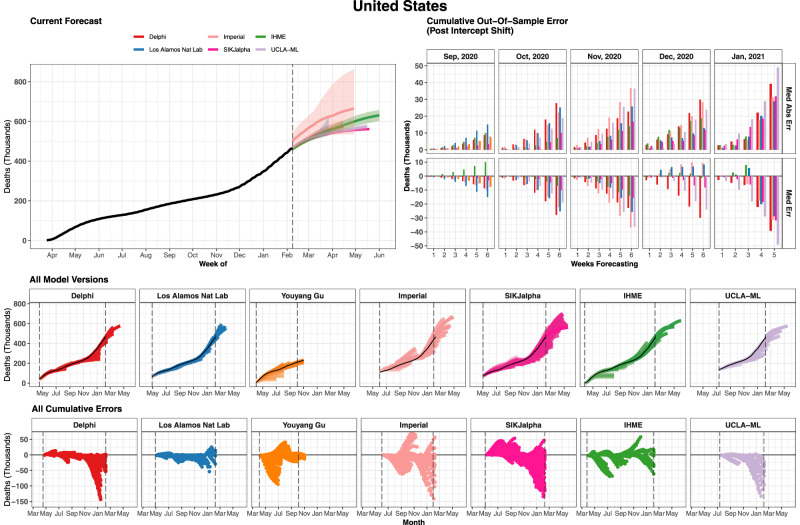
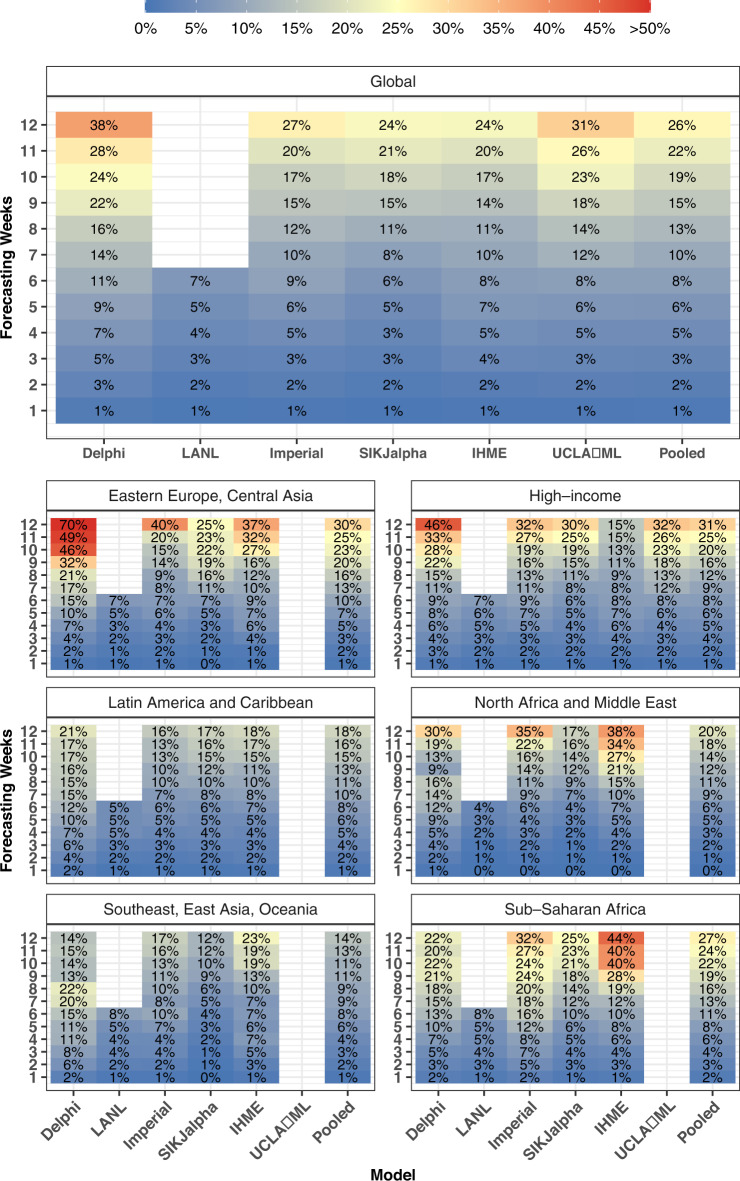
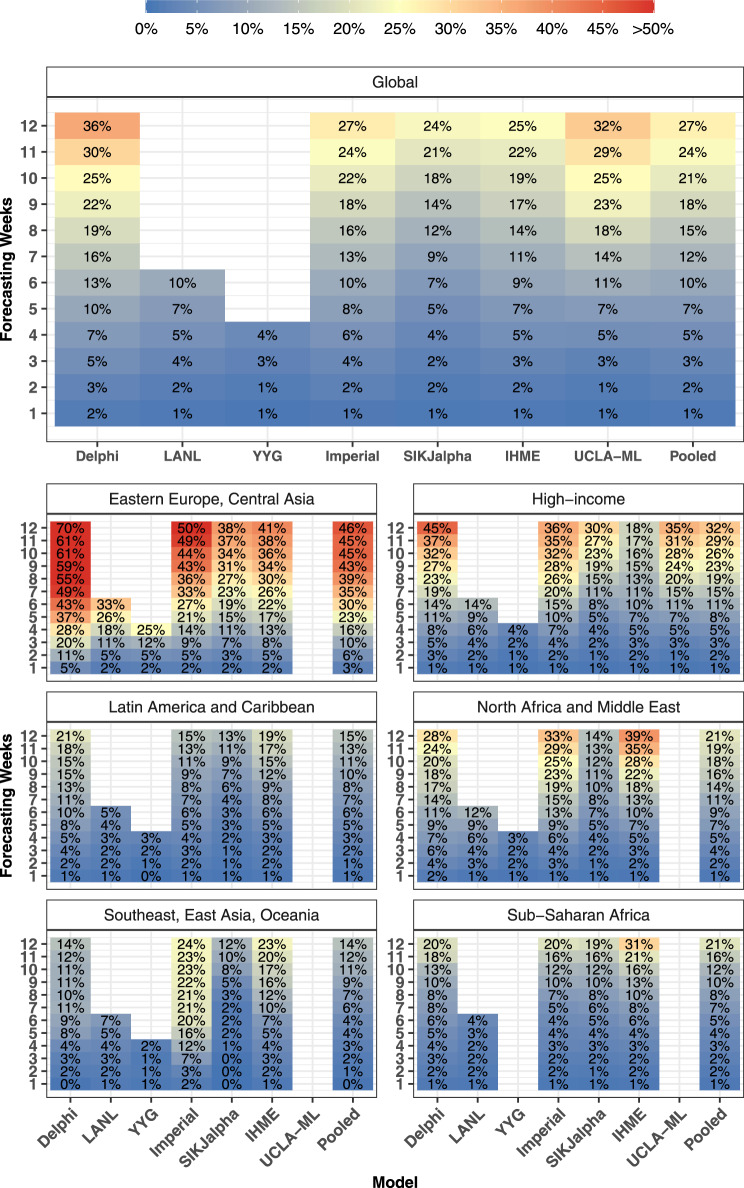
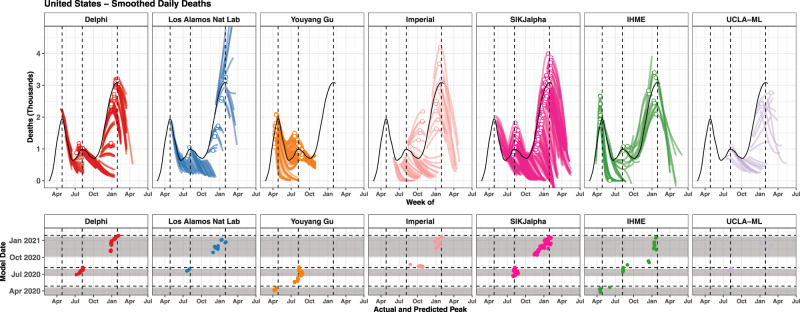
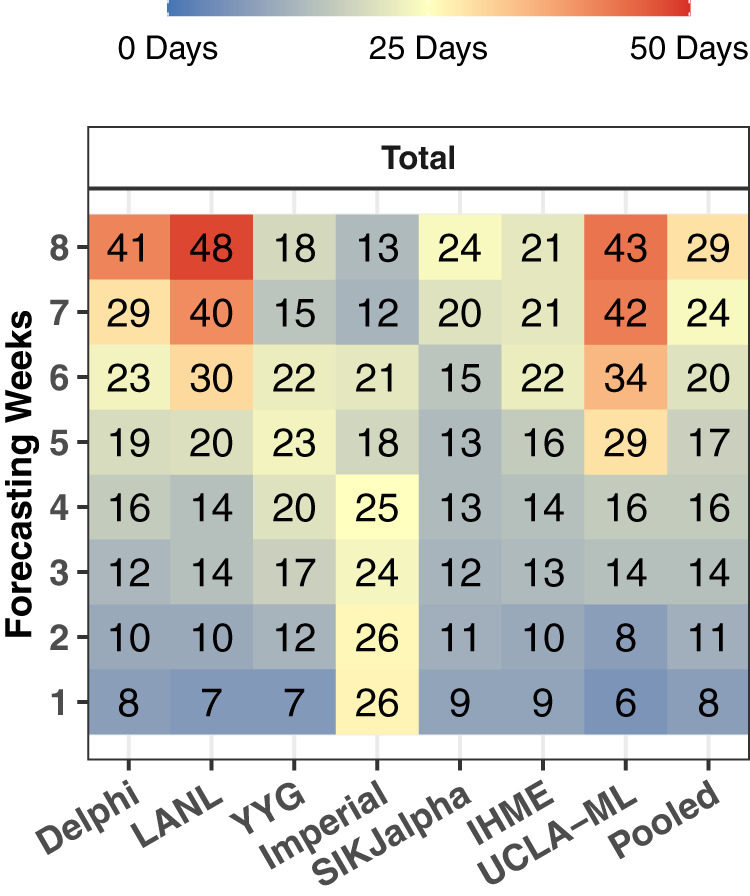
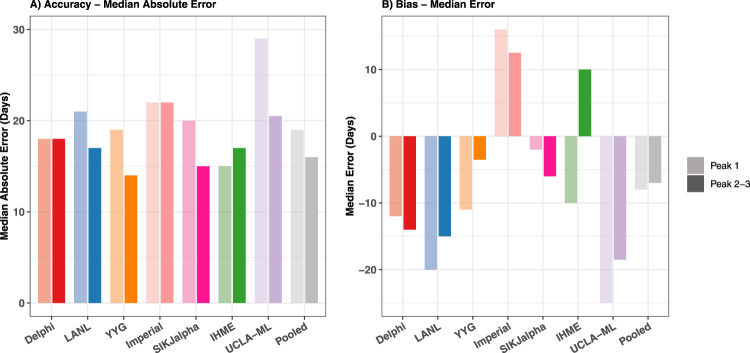
Forecasts and alternative scenarios of COVID-19 mortality have been critical inputs for pandemic response efforts, and decision-makers need information about predictive performance. We screen n = 386 public COVID-19 forecasting models, identifying n = 7 that are global in scope and provide public, date-versioned forecasts. We examine their predictive performance for mortality by weeks of extrapolation, world region, and estimation month. We additionally assess prediction of the timing of peak daily mortality. Globally, models released in October show a median absolute percent error (MAPE) of 7 to 13% at six weeks, reflecting surprisingly good performance despite the complexities of modelling human behavioural responses and government interventions. Median absolute error for peak timing increased from 8 days at one week of forecasting to 29 days at eight weeks and is similar for first and subsequent peaks. The framework and public codebase ( https://github.com/pyliu47/covidcompare ) can be used to compare predictions and evaluate predictive performance going forward.
Overview
The claims and statistics of this paper haven’t been checked yet.
Free: it reads the open-access text and checks the first 5 claims that cite a source we can check. Create a free account to check every claim.
Integrity signals
Registry
Cites
Statistics
Figures
Verification
Claims the paper makes
The claims and statistics of this paper haven’t been checked yet.
Free: it reads the open-access text and checks the first 5 claims that cite a source we can check. Create a free account to check every claim.
Claims other papers make about this one
Each is checked against this paper’s own text: does it say what the citing paper says it does?
The source backs part of the claim, not all of it — or backs it for a different population, condition or comparison.
In the citing paper
“The Reffective over time is also a crucial input into future forecasts of COVID-19.4”
From Estimating global, regional, and national daily and cumulative infections with SARS-CoV-2 through Nov 14, 2021: a statistical analysis (2022) · cites this paper as [4]
Experimental — accuracy not yet measuredThe source backs part of the claim, not all of it — or backs it for a different population, condition or comparison.
In the citing paper
“reported deaths represent only a partial count of total death tolls from the COVID-19 pandemic”
From Estimating excess mortality due to the COVID-19 pandemic: a systematic analysis of COVID-19-related mortality, 2020–21 (2022) · cites this paper as [1]
Experimental — accuracy not yet measuredThe source backs part of the claim, not all of it — or backs it for a different population, condition or comparison.
In the citing paper
“the reliability of reported deaths varies greatly between locations and over time”
From Estimating excess mortality due to the COVID-19 pandemic: a systematic analysis of COVID-19-related mortality, 2020–21 (2022) · cites this paper as [1]
Experimental — accuracy not yet measured
Self-check
Percentages, sums and reported differences re-computed from the paper’s own numbers.
The self-check needs the paper’s full text.
Citations
Cites
Viner, R. M., Russell, S. J., Croker, H., Packer, J., Ward, J., Stansfield, C., Mytton, O., Bonell, C., & Booy, R. (2020) · The Lancet Child & Adolescent Health · doi:10.1016/s2352-4642(20)30095-x · Cited by 2,213
Ranney, M. L., Griffeth, V., & Jha, A. K. (2020) · New England Journal of Medicine · doi:10.1056/nejmp2006141 · Cited by 2,018 · cited 1×
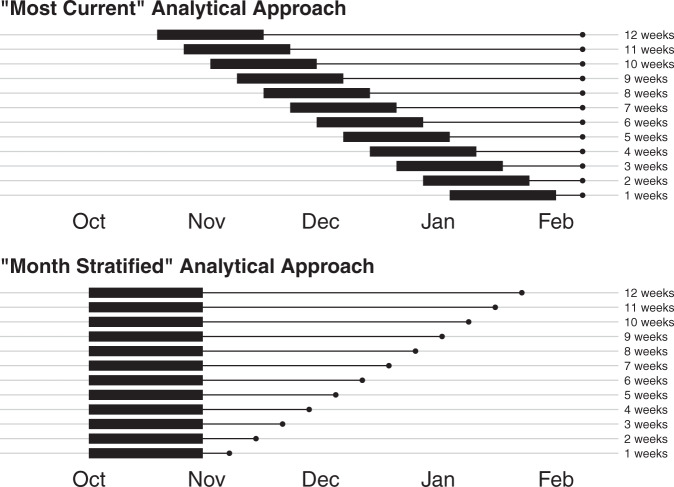
“Models were excluded from consideration if they did not (1) produce estimates for at least five different countries, (2) did not extrapolate at least 4 weeks out from the time of estimation, (3) did not estimate mortality, (4) did not provide downloadable, publicly available results or (5) did not provide date-version…”
BackgroundDicker, D., Nguyen, G., Abate, D., Abate, K. H., Abay, S. M., Abbafati, C., Abbasi, N., Abbastabar, H., Abd-Allah, F., Abdela, J., et al. (2018) · The Lancet · doi:10.1016/s0140-6736(18)31891-9 · Cited by 1,209
Out-of-sample tests of forecasting accuracy: an analysis and review
Tashman, L. J. (2000) · International Journal of Forecasting · doi:10.1016/s0169-2070(00)00065-0 · Cited by 1,021 · cited 1×
“Out-of-sample predictive validation — checking how well past versions of forecasting models predict subsequently observed trends — provides insight into future model performance 9 .”
BackgroundWhat Will Be the Economic Impact of COVID-19 in the US? Rough Estimates of Disease Scenarios
Atkeson, A. (2020) · National Bureau of Economic Research · doi:10.3386/w26867 · Cited by 888
Modeling COVID-19 scenarios for the United States
IHME COVID-19 Forecasting Team, Reiner, R. C., Barber, R. M., Collins, J. K., Zheng, P., Adolph, C., Albright, J., Antony, C. M., Aravkin, A. Y., Bachmeier, S. D., et al. (2021) · Nature Medicine · doi:10.1038/s41591-020-1132-9 · Cited by 556 · cited 1×
“This model, referred to as the IHME-MS SEIR model, is the basis for recently published work on US State level scenarios of COVID-249 19 projections in the fall and winter of 2020/2021 23 and was still in use at the time of this publication.”
MethodSelf-citationWeinberger, D. M., Chen, J., Cohen, T., Crawford, F. W., Mostashari, F., Olson, D., Pitzer, V. E., Reich, N. G., Russi, M., Simonsen, L., et al. (2020) · JAMA Internal Medicine · doi:10.1001/jamainternmed.2020.3391 · Cited by 485
IHME COVID-19 health service utilization forecasting team, & Murray, C. J. (2020) · medRxiv · doi:10.1101/2020.03.27.20043752 · Cited by 417 · cited 3×
“Examples include prospectively managing or moving resources between regions such as hospital beds, ICU beds, ventilators, masks and other personal-protective equipment, as well as decisions about social distancing measures, stay-at-home orders, and closing schools, universities and workplaces 1,7 .”
BackgroundInfluentialSelf-citationCramer, E. Y., Ray, E. L., Lopez, V. K., Bracher, J., Brennen, A., Castro Rivadeneira, A. J., Gerding, A., Gneiting, T., House, K. H., Huang, Y., et al. (2022) · Proceedings of the National Academy of Sciences · doi:10.1073/pnas.2113561119 · Cited by 309
Self-citationJentsch, P. C., Anand, M., & Bauch, C. T. (2021) · The Lancet Infectious Diseases · doi:10.1016/s1473-3099(21)00057-8 · Cited by 232
Cited by
Wang, H., Paulson, K. R., Pease, S. A., Watson, S., Comfort, H., Zheng, P., Aravkin, A. Y., Bisignano, C., Barber, R. M., Alam, T., et al. (2022) · The Lancet · doi:10.1016/s0140-6736(21)02796-3 · Cited by 2,069
Self-citationFindings from the Global Burden of Disease Study 2021
Murray, C. J. L. (2024) · The Lancet · doi:10.1016/s0140-6736(24)00769-4 · Cited by 1,057
Self-citationThe Global Burden of Disease Study at 30 years
Murray, C. J. L. (2022) · Nature Medicine · doi:10.1038/s41591-022-01990-1 · Cited by 856
Self-citationAge groups that sustain resurging COVID-19 epidemics in the United States
Monod, M., Blenkinsop, A., Xi, X., Hebert, D., Bershan, S., Tietze, S., Baguelin, M., Bradley, V. C., Chen, Y., Coupland, H., et al. (2021) · Science · doi:10.1126/science.abe8372 · Cited by 331
Cramer, E. Y., Ray, E. L., Lopez, V. K., Bracher, J., Brennen, A., Castro Rivadeneira, A. J., Gerding, A., Gneiting, T., House, K. H., Huang, Y., et al. (2022) · Proceedings of the National Academy of Sciences · doi:10.1073/pnas.2113561119 · Cited by 309
Self-citationBarber, R. M., Sorensen, R. J. D., Pigott, D. M., Bisignano, C., Carter, A., Amlag, J. O., Collins, J. K., Abbafati, C., Adolph, C., Allorant, A., et al. (2022) · The Lancet · doi:10.1016/s0140-6736(22)00484-6 · Cited by 298
Self-citationPublic mobility data enables COVID-19 forecasting and management at local and global scales
Ilin, C., Annan-Phan, S., Tai, X. H., Mehra, S., Hsiang, S., & Blumenstock, J. E. (2021) · Scientific Reports · doi:10.1038/s41598-021-92892-8 · Cited by 153
Predictive performance of multi-model ensemble forecasts of COVID-19 across European nations
Sherratt, K., Gruson, H., Grah, R., Johnson, H., Niehus, R., Prasse, B., Sandmann, F., Deuschel, J., Wolffram, D., Abbott, S., et al. (2023) · eLife · doi:10.7554/elife.81916 · Cited by 154
Charoenwong, B., Kowaleski, Z. T., Kwan, A. P., & Sutherland, A. (2024) · Journal of Financial Economics · doi:10.1016/j.jfineco.2024.103792 · Cited by 120
Follow *the* science? On the marginal role of the social sciences in the COVID-19 pandemic
Lohse, S., & Canali, S. (2021) · European Journal for Philosophy of Science · doi:10.1007/s13194-021-00416-y · Cited by 85
Real-time pandemic surveillance using hospital admissions and mobility data
Fox, S. J., Lachmann, M., Tec, M., Pasco, R. F., Woody, S., Du, Z., Wang, X., Ingle, T. A., Javan, E. M., Dahan, M., et al. (2022) · Proceedings of the National Academy of Sciences · doi:10.1073/pnas.2111870119 · Cited by 72
“One possible explanation is unmodeled feedback from the system (Austin) to the model, as suggested in prior COVID-19 forecasting studies (95).”
MethodLucas, B., Vahedi, B., & Karimzadeh, M. (2022) · International Journal of Data Science and Analytics · doi:10.1007/s41060-021-00295-9 · Cited by 68
“The majority of the forecasting surrounding the spread of COVID-19 has been produced using compartmental models from epidemiology, in particular SEIR models [31,41,84, 107].”
Epidemiology, not geopolitics, should guide COVID-19 vaccine donations
Bollyky, T. J., Murray, C. J. L., & Reiner, R. C. (2021) · The Lancet · doi:10.1016/s0140-6736(21)01323-4 · Cited by 45
Self-citationArtificial intelligence for COVID-19: battling the pandemic with computational intelligence
Xu, Z., Su, C., Xiao, Y., & Wang, F. (2021) · Intelligent Medicine · doi:10.1016/j.imed.2021.09.001 · Cited by 54
Computational applications of extended SIR models: A review focused on airborne pandemics
Lazebnik, T. (2023) · Ecological Modelling · doi:10.1016/j.ecolmodel.2023.110422 · Cited by 55
Zahid, M. N., & Perna, S. (2021) · International Journal of Environmental Research and Public Health · doi:10.3390/ijerph18105350 · Cited by 42
Aragão, D. P., de Oliveira, E. V., Bezerra, A. A., dos Santos, D. H., da Silva, A. G., Pereira, I. G., Piscitelli, P., Miani, A., Distante, C., Cuno, J. J. S., et al. (2021) · Environmental Research · doi:10.1016/j.envres.2021.112348 · Cited by 24
“A final but not last study (Friedman et al., 2021) compares 386 public global forecast models for COVID-19 mortality.”
Wang, L., Yin, Z., Puppala, M., Ezeana, C. F., Wong, K., He, T., Gotur, D. B., & Wong, S. T. C. (2021) · IEEE Journal of Biomedical and Health Informatics · doi:10.1109/jbhi.2021.3139773 · Cited by 22
Pandemics, policy, and pluralism: A Feyerabend-inspired perspective on COVID-19
Bschir, K., & Lohse, S. (2022) · Synthese · doi:10.1007/s11229-022-03923-4 · Cited by 28
Predictive performance of multi-model ensemble forecasts of COVID-19 across European nationsPreprint
Sherratt, K., Gruson, H., Grah, R., Johnson, H., Niehus, R., Prasse, B., Sandmann, F., Deuschel, J., Wolffram, D., Abbott, S., et al. (2022) · medRxiv · doi:10.1101/2022.06.16.22276024 · Cited by 21
Simulation of COVID-19 Propagation Scenarios in the Madrid Metropolitan Area
Singh, D. E., Marinescu, M.-C., Guzmán-Merino, M., Durán, C., Delgado‐Sanz, C., Gómez‐Barroso, D., & Carretero, J. (2021) · Frontiers in Public Health · doi:10.3389/fpubh.2021.636023 · Cited by 21
The success rate of online illicit drug transactions during a global pandemic
Bergeron, A., Décary-Hêtu, D., Giommoni, L., & Villeneuve-Dubuc, M.-P. (2021) · International Journal of Drug Policy · doi:10.1016/j.drugpo.2021.103452 · Cited by 23
Trend estimation and short-term forecasting of COVID-19 cases and deaths worldwide
Krymova, E., Béjar, B., Thanou, D., Sun, T., Manetti, E., Lee, G., Namigai, K., Choirat, C., Flahault, A., & Obozinski, G. (2022) · Proceedings of the National Academy of Sciences · doi:10.1073/pnas.2112656119 · Cited by 27
Berke, A., Doorley, R., Alonso, L., Arroyo, V., Pons, M., & Larson, K. (2022) · PLoS ONE · doi:10.1371/journal.pone.0264860 · Cited by 16
“Testing: Median absolute percentage error (MAPE) over cumulative estimates has 283 been used in a recent framework to evaluate and compare COVID-19 models [46], where 284 the errors incorporate an intercept shift.”
InfluentialModeling the evolution of SARS-CoV-2 under non-pharmaceutical interventions and testing
Gurevich, Y., Ram, Y., & Hadany, L. (2022) · Evolution Medicine and Public Health · doi:10.1093/emph/eoac013 · Cited by 12
An algebraic framework for structured epidemic modelling
Libkind, S., Baas, A., Halter, M., Patterson, E., & Fairbanks, J. (2022) · Philosophical Transactions of the Royal Society A Mathematical Physical and Engineering Sciences · doi:10.1098/rsta.2021.0309 · Cited by 37
“In April 2020, just two months after the first confirmed US cases of COVID-19, the IHME was comparing different epidemiological models according to the accuracy of their forecasts [1].”
MethodKhosrowi, D. (2023) · Philosophy of the Social Sciences · doi:10.1177/00483931231172455 · Cited by 13
Landscape‐Scale Epidemiological Dynamics of SARS‐CoV‐2 in White‐Tailed Deer
Hewitt, J., Wilson‐Henjum, G., Collins, D. T., Linder, T. J., Lenoch, J. B., Heale, J. D., Quintanal, C., Pleszewski, R., McBride, D. S., Bowman, A. S., et al. (2024) · Transboundary and Emerging Diseases · doi:10.1155/2024/7589509 · Cited by 13
“Human SARS-CoV-2 mortality can be predicted reasonably well, which suggests reporting biases for mortality rates may be consistent across time and space, especially as compared to case counts that strongly depend on testing rates [25].”
BackgroundChowell, G., & Skums, P. (2024) · Physics of Life Reviews · doi:10.1016/j.plrev.2024.10.011 · Cited by 17
Gu, X., Mukherjee, B., Das, S., & Datta, J. (2020) · medRxiv · doi:10.1101/2020.12.10.20247361 · Cited by 14
“[11]) as are carefully done simulation studies where the ‘ground truth’ is known.”
The variations of SIkJalpha model for COVID-19 forecasting and scenario projections
Srivastava, A. (2023) · Epidemics · doi:10.1016/j.epidem.2023.100729 · Cited by 12
“For country-level death forecasts over multiple countries, our forecasts performed the best in terms of median absolute percentage error [29] among 7 models that fit the inclusion criteria among 386 models analyzed.”
MethodPredicting and preventing COVID-19 outbreaks in indoor environments: an agent-based modeling study
Reveil, M., & Chen, Y.-H. (2022) · Scientific Reports · doi:10.1038/s41598-022-18284-8 · Cited by 16
Forecasting and modeling of the COVID-19 pandemic in the USA with a timed intervention model
Hachtel, G. D., Stack, J. D., & Hachtel, J. A. (2022) · Scientific Reports · doi:10.1038/s41598-022-07487-8 · Cited by 10
The disutility of compartmental model forecasts during the COVID-19 pandemic
Sudhakar, T., Bhansali, A., Walkington, J., & Puelz, D. (2024) · Frontiers in Epidemiology · doi:10.3389/fepid.2024.1389617 · Cited by 10
“When tested against other forecasting models for predictive accuracy, this third IHME model exhibited the best performance (out of seven models) (18).”
MethodVallée, A., Faranda, D., & Arutkin, M. (2023) · Scientific Reports · doi:10.1038/s41598-023-30014-2 · Cited by 14
Delayed epidemic peak caused by infection and recovery rate fluctuations
Arutkin, M., Faranda, D., Alberti, T., & Vallée, A. (2021) · Chaos An Interdisciplinary Journal of Nonlinear Science · doi:10.1063/5.0067625 · Cited by 8
Xu, H., Berres, A., Thakur, G. M., Sanyal, J., & Chinthavali, S. (2021) · Journal of Biomedical Informatics · doi:10.1016/j.jbi.2021.103941 · Cited by 10
A retrospective assessment of COVID-19 model performance in the USA
Colonna, K. J., Nane, G. F., Choma, E. F., Cooke, R. M., & Evans, J. S. (2022) · Royal Society Open Science · doi:10.1098/rsos.220021 · Cited by 8
“A predictive measure based on the log of accuracy ratio [21], that considers the ratio between the predicted and true value, has been shown to overcome MAPE’s drawbacks [20].”
BackgroundInfluentialPredicting subnational incidence of COVID-19 cases and deaths in EU countries
Robert, A., Chapman, L. A. C., Grah, R., Niehus, R., Sandmann, F., Prasse, B., Funk, S., & Kucharski, A. J. (2024) · BMC Infectious Diseases · doi:10.1186/s12879-024-08986-x · Cited by 9
“Time series models and spatiotemporal statistical models, on the other hand, have been used extensively and successfully to forecast future incidence at national and subnational levels (6,7,17).”
BackgroundUnder-Reporting of SARS-CoV-2 Infections in 27 Countries, 2020–2022Preprint
Mustapha, M. M., Togo, K., Volkman, H. R., Yang, J., Yehoshua, A., Fusco, M. D., McLaughlin, J. M., & Nguyen, J. (2024) · SSRN Electronic Journal · doi:10.2139/ssrn.5014145 · Cited by 9
Bulut, T., & Top, M. (2023) · Public Health · doi:10.1016/j.puhe.2023.05.013 · Cited by 9
Ortmann, J. (2025) · European Journal for Philosophy of Science · doi:10.1007/s13194-025-00651-7 · Cited by 13
“Naturally, the usefulness of these models has widely been considered to be attached to their predictive performance (e.g. Friedman et al., 2021).”
InfluentialSamoilenko, S. V., & Osei-Bryson, K.-M. (2021) · Expert Systems with Applications · doi:10.1016/j.eswa.2021.116385 · Cited by 6
Analyzing historical and future acute neurosurgical demand using an AI-enabled predictive dashboard
Pandit, A. S., Jalal, A. H. B., Toma, A. K., & Nachev, P. (2022) · Scientific Reports · doi:10.1038/s41598-022-11607-9 · Cited by 11
“Advanced predictive visualizations are currently being employed to aid with the Covid-19 pandemic response effort (https:// covid 19. healt hdata. org 28 ) and have the significant advantage of presenting results in ‘real-time’, which means that the models iteratively update as more data is accrued.”
MethodShin, H. H., Ayala, C. S., Pérez-Estigarribia, P. E., Grillo, S. A., Segovia-Cabrera, L., García-Torres, M., Gaona, C. F., Irala, S., Pedrozo, M. E., Sequera, G., et al. (2021) · Applied Sciences · doi:10.3390/app11209726 · Cited by 8
“org/, accessed on 20 May 2021) [35] which serves as a reference for multiple governments and agencies.”
BackgroundResultMajeed, B., Li, A., Peng, J., & Lin, Y. (2022) · Frontiers in Public Health · doi:10.3389/fpubh.2021.809877 · Cited by 7
“(25) compares the accuracy of different forecasting models for COVID-19 to point out that there are many challenges in accurately predicting the spread of COVID-19.”
BackgroundResultInfluentialInference on the dynamics of COVID-19 in the United States
Bhattacharjee, S., Liao, S., Paul, D., & Chaudhuri, S. (2022) · Scientific Reports · doi:10.1038/s41598-021-04494-z · Cited by 8
A simple model for the total number of SARS-CoV-2 infections on a national level
Blanco, N., Stafford, K. A., Lavoie, M., Brandenburg, A., Górna, M. W., & Merski, M. (2021) · Epidemiology and Infection · doi:10.1017/s0950268821000649 · Cited by 9
Decision Intelligence for Nationwide Ventilator Allocation During the COVID-19 Pandemic
Xu, J., & Sen, S. (2021) · SN Computer Science · doi:10.1007/s42979-021-00810-6 · Cited by 5
Validation framework for epidemiological models with application to COVID-19 models
Dautel, K. A., Agyingi, E. O., & Pathmanathan, P. (2023) · PLoS Computational Biology · doi:10.1371/journal.pcbi.1010968 · Cited by 6
“[31] which considers releases systematically and Carnegie Mellon University Delphi Group [33] which validates the limited weekly four-week ahead predictions provided to the CDC.”
BackgroundMethodInfluentialChanging readiness to mitigate SARS-CoV-2 steered long-term epidemic and social trajectories
Wirtz, K. (2021) · Scientific Reports · doi:10.1038/s41598-021-93248-y · Cited by 7
Reiner, R. C., Collins, J. K., anon Forecasting Team, & Murray, C. J. L. (2022) · SSRN Electronic Journal · doi:10.2139/ssrn.4126660 · Cited by 8
Self-citationCOVID-19 in Italy: Is the Mortality Analysis a Way to Estimate How the Epidemic Lasts?
Boselli, P. M., & Soriano, J. M. (2023) · Biology · doi:10.3390/biology12040584 · Cited by 4
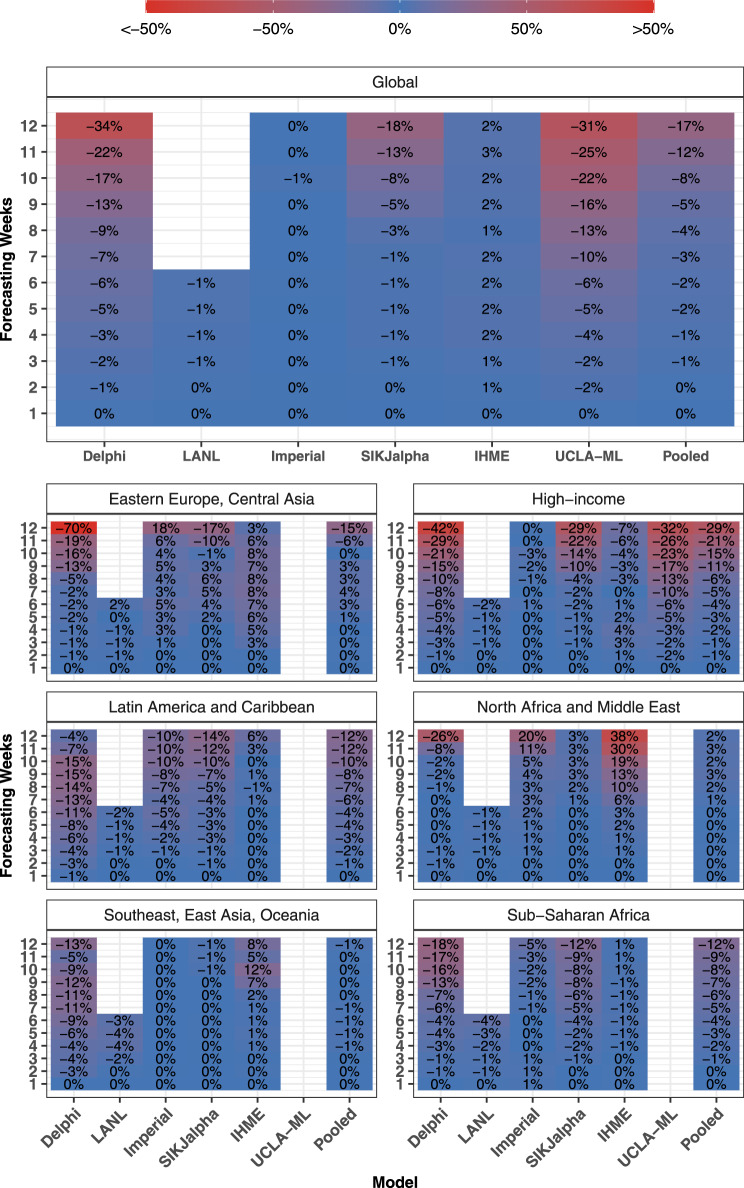
“[10] demonstrated that three models, including Delphi [11], LANL [12], and UCLA-ML [13] from October underestimated mortality, obtaining median percent errors of −9.”
BackgroundMethodLiu, D., & Sopasakis, A. (2024) · Heliyon · doi:10.1016/j.heliyon.2024.e38276 · Cited by 7
“The median absolute percent errors (MAPE) [73], provided below, are another common metric used to explore differences between predicted and actual infections, ) .”
BackgroundResultInfluentialEstimating Exposure Risk to Guide Behaviour During the SARS-COV2 Pandemic
Smyth, B. (2021) · Frontiers in Digital Health · doi:10.3389/fdgth.2021.655745 · Cited by 4
van Zoest, V., Varotsis, G., Menzel, U., Wigren, A., Kennedy, B., Martinell, M., & Fall, T. (2022) · Scientific Reports · doi:10.1038/s41598-022-19155-y · Cited by 9
Measuring the impact of COVID-19
Burns, K. F., & Horney, J. A. (2022) · Elsevier eBooks · doi:10.1016/b978-0-323-98810-0.00010-7 · Cited by 4
Massey, A., Boennec, C., Restrepo‐Ortiz, C. X., Blanchet, C., Alizon, S., & Sofonea, M. T. (2024) · PLoS Computational Biology · doi:10.1371/journal.pcbi.1012124 · Cited by 6
White, L., van Basshuysen, P., & Frisch, M. (2022) · Philosophy of Medicine · doi:10.5195/philmed.2022.85 · Cited by 24
Naumov, A., Александрович, М. И., Serenko, A., Sboev, A. G., & Борисович, Р. Р. (2021) · Procedia Computer Science · doi:10.1016/j.procs.2021.10.028 · Cited by 7
RegTechPreprint
Charoenwong, B., Kowaleski, Z. T., Kwan, A. P., & Sutherland, A. (2022) · SSRN Electronic Journal · doi:10.2139/ssrn.4000016 · Cited by 4
A novel model based on graph kernel and S-R score in visibility graph for time series forecasting
Xu, Y., & Kang, B. (2025) · Physica A Statistical Mechanics and its Applications · doi:10.1016/j.physa.2025.130756 · Cited by 2
Does Democracy Save Lives? Modeling Effects of Political Institutions on COVID‐19 Mortality
Kim, E. H. (2025) · Social Science Quarterly · doi:10.1111/ssqu.70073 · Cited by 3
A Multivariate Deep Learning Model with Coupled Human Intervention Factors for COVID-19 Forecasting
Qu, Z., Zhang, B., & Wang, H. (2023) · Systems · doi:10.3390/systems11040201 · Cited by 3
Evaluation of concordance in estimation of excess mortality due to COVID‐19 pandemic
Verma, V., Nath, D. C., & Khan, H. T. A. (2023) · Journal of Evaluation in Clinical Practice · doi:10.1111/jep.13866 · Cited by 3
Stevanović, A., & Santric-Milicevic, M. M. (2021) · Srpski medicinski casopis Lekarske komore · doi:10.5937/smclk2-33796 · Cited by 4
Liang, C., Lyu, T., Weissman, S., Daering, N., Olatosi, B., Hikmet, N., & Li, X. (2023) · Research Square · doi:10.21203/rs.3.rs-3213502/v1 · Cited by 3
Lazebnik, T. (2025) · Engineering Applications of Artificial Intelligence · doi:10.1016/j.engappai.2025.113619 · Cited by 3
Risk factors for COVID-19 mortality in hospitalized patients in Bolivia
Limachi-Choque, J., Guitián, J., Leyns, C., Guzmán-Rivero, M., & Rodríguez, D. E. (2023) · IJID Regions · doi:10.1016/j.ijregi.2023.10.002 · Cited by 3
“Excess mortality, the most widely accepted metric of mortality since it does not depend on the availability and use of tests, has been highest in Eastern Europe, the Caucasus region of Asia, and South America [1–3] .”
BackgroundTulchinsky, A. Y., Lin, G., Hamilton, A., Kipshidze, N. N., & Klein, E. Y. (2024) · Epidemics · doi:10.1016/j.epidem.2024.100799 · Cited by 2
Uppalaiah, B., Reddy, D. M., Rajalakshmi, K., Vignesh, P., Govindan, V., & Donganont, S. (2025) · Results in Engineering · doi:10.1016/j.rineng.2025.105092 · Cited by 2
Mora, M., Fen, W., Phillips-Wren, G. E., & Torres, G. C. L. (2022) · Intelligent Decision Technologies · doi:10.3233/idt-210117 · Cited by 2
“[41] of public global forecast models showed an error of 7–13% at six weeks, a surprisingly good result given the complexities of modeling and giving impetus to efforts to pursue these types of models.”
Framework Development Using Data Mining Techniques to Predict Mortality Risk during Pandemic
Chakraborty, D., & Anwar, M. M. (2022) · Journal of Computer and Communications · doi:10.4236/jcc.2022.108002 · Cited by 2
Robust Decision Making in Health Policy: Applications to COVID-19 and Colorectal Cancer
de Lima, P. N. (2022) · RAND Corporation eBooks · doi:10.7249/rgsda2531-1 · Cited by 2
A deconvolution approach to modelling surges in COVID-19 cases and deaths
Melnyk, A., Kozarov, L., & Wachsmann‐Hogiu, S. (2022) · Scientific Reports · doi:10.1038/s41598-023-29198-4 · Cited by 2
Evolutionary optimization of policy responses to COVID-19 pandemic via surrogate models
Tayarani-N., M.-H. (2024) · Applied Soft Computing · doi:10.1016/j.asoc.2024.111359 · Cited by 3
Long COVID: epidemiology and clinical impact
Soriano, J. B., Ledo, P. R., & Ancochea, J. (2024) · European Respiratory Society eBooks · doi:10.1183/2312508x.10021323 · Cited by 3
Lawson, A. B., & Xin, Y. (2024) · Frontiers in Epidemiology · doi:10.3389/fepid.2024.1403212 · Cited by 1
Williams, D., Wang, L., Weber, A. M., Lu, M., Starcevich, K., Cook, D. M., Tam, T.-Y., & Yang, W. (2025) · International Journal of Disaster Risk Reduction · doi:10.1016/j.ijdrr.2025.105630 · Cited by 1
Tazi, A. (2025) · médecine/sciences · doi:10.1051/medsci/2025129 · Cited by 1
Ferreira, R. S., Colnago, M., & Casaca, W. C. D. O. (2025) · BMC Infectious Diseases · doi:10.1186/s12879-025-12366-4 · Cited by 2
“Consequently, numerical instability is minimal, allowing us to retain MAPE for its intuitive percentage interpretation and consistency with prior studies [34, 45, 66, 69, 70], while complementing it with NRMSE and NMAE to provide a more robust, scale-independent assessment of forecasting error.”
Integrated disease model considering mutation-induced infection waves with COVID-19 cases
Baek, S., Cho, H. J., Lee, S., Yoo, M., Kwon, D., Lee, K., Kim, Y., & Kim, C. (2026) · PLoS ONE · doi:10.1371/journal.pone.0341667 · Cited by 1
A Multilevel Biosensor-Based Epidemic Simulation Model for COVID-19
Balkus, S. V., Fang, H., Rumbut, J., Moormann, A. M., & Boyer, E. W. (2021) · IEEE Internet of Things Journal · doi:10.1109/jiot.2021.3127804 · Cited by 1
Le COVID-19, un révélateur de l’accroissement des inégalités socio-territoriales en Bolivie
Hardy, S. (2023) · L’Espace géographique · doi:10.3917/eg.512.0107 · Cited by 1
International COVID-19 mortality forecast visualization: covidcompare.io
Akre, S., Liu, P. Y., Friedman, J. R., & Bui, A. A. T. (2021) · JAMIA Open · doi:10.1093/jamiaopen/ooab113 · Cited by 3
“Source data Projected COVID-19 mortality from 6 international forecasting models, recorded ground truth mortality, and historical model errors are captured and preprocessed as described in Friedman et al.7 The data are uploaded to an SQL database used by our visualization tool, covidcompare.io.”
MethodSelf-citationCuschieri, S., Grech, S., & Grech, V. (2022) · Frontiers in Public Health · doi:10.3389/fpubh.2022.1018505 · Cited by 1
“Mortality is a useful measure to assess the magnitude of the pandemic as well as act as a tracking tool of the pandemic’s impact on the population (20).”
BackgroundCOVID-19 MORTALITY CASES IN KUBANG PASU DISTRICT
Itam, M. F., Ibrahim, M. Z., Ismail, K. S. K., Ismail, M. I., & Yusof, M. A. M. (2022) · Malaysian Journal of Public Health Medicine · doi:10.37268/mjphm/vol.22/no.3/art.1675 · Cited by 1
Post Hoc Evaluation of Probabilistic Model Forecasts: A COVID-19 Case StudyPreprint
Colonna, K. J., Cooke, R. M., & Evans, J. S. (2020) · medRxiv · doi:10.1101/2020.12.09.20246157 · Cited by 2
A Quantitative Evaluation of COVID-19 Epidemiological ModelsPreprint
Yogurtcu, O. N., Messan, M. R., Gerkin, R. C., Belov, A. A., Yang, H., Forshee, R. A., & Chow, C. C. (2021) · medRxiv · doi:10.1101/2021.02.06.21251276 · Cited by 1
Lucas, B., Vahedi, B., & Karimzadeh, M. (2021) · arXiv (Cornell University) · Cited by 1
Verheyden, J. G. L., Mudogo, C. N., & Jacquet, W. (2026) · medRxiv · doi:10.64898/2026.07.28.26359159 · Cited by 3
Pourmalek, F. (2021) · Research Square · doi:10.21203/rs.3.rs-768714/v1
“Similar work: The “covidcompare” tool [18] provides graph visualization of latest estimates of daily and total deaths from international and periodically updating COVID-19 models for countries of the world and US states, along with historical forecasts and model performance, based on IHME’s “Predictive performance of…”
BackgroundMethodResultInfluentialWhen I use a word . . . . Examining the efficiency paradox
Aronson, J. K. (2021) · BMJ · doi:10.1136/bmj.n2856
Scitovski, R., Sabo, K., & Ungar, Š. (2022) · Scientific Reports · doi:10.1038/s41598-022-08795-9
Pourmalek, F. (2022) · BMC Research Notes · doi:10.1186/s13104-022-06020-4
Melnyk, A., Kozarov, L., & Wachsmann‐Hogiu, S. (2022) · SSRN Electronic Journal · doi:10.2139/ssrn.4191112
Assessing SARS-CoV-2-related mortality rate in Russian regions, based on the econometric model
Stepanov, V. S. (2022) · Russian Journal of Infection and Immunity · doi:10.15789/2220-7619-asr-1846
Korochanskaya, N. V., Durleshter, V. M., Gabriel, S. A., Kovalevskaya, O. V. K., Серикова, С. Н., & Basenko, M. A. (2022) · Russian Journal of Gastroenterology Hepatology Coloproctology · doi:10.22416/1382-4376-2022-32-3-12-17
Assessing the Severity of COVID-19 in the United States
Gao, K., Tasneem, S., & Khoshgoftaar, T. M. (2023) · Springer series in reliability engineering · doi:10.1007/978-3-031-21232-1_6
Hidden Costs of the COVID-19 Pandemic Response
Young, S. G. (2023) · International Journal of Environmental Research and Public Health · doi:10.3390/ijerph20085476 · Cited by 9
Metadata
- Authors
- Friedman, J., Liu, P., Troeger, C. E., Carter, A., Reiner, R. C., Barber, R. M., Collins, J., Lim, S. S., Pigott, D. M., Vos, T., Hay, S. I., Murray, C. J. L., & Gakidou, E.
- Affiliations
- University of California, Los Angeles (US)
- University of Washington (US)
- Corresponding author
- Gakidou, Emmanuela
- ORCID
- Venue
- Nature Communications
- Published
- 2021-05-10
- Volume
- 12
- Issue
- 1
- Pages
- 2609-2609
- ISSN
- 2041-1723 (ISSN-L)
- PMC
- PMC8110547
- OpenAlex
- W3163299620
- Semantic Scholar
- 0212a9118520a0b02665ef35afe3b762059865cf
- Cited by
- 118
- References
- 18
- Citations by year
- 2026: 8 · 2025: 14 · 2024: 16 · 2023: 18 · 2022: 33 · 2021: 27
- FWCI
- 9.09
- Type
- journal article
- Language
- en
- Open access
- gold
- doi.org
- Licence
- cc-by
- creativecommons.org/licenses/by/4.0 (tdm)
- creativecommons.org/licenses/by/4.0 (vor)
- Locations
- Nature Communications (publishedVersion, cc-by)
- PubMed Central (publishedVersion, cc-by)
- PubMed (publishedVersion)
- DOAJ (DOAJ: Directory of Open Access Journals) (submittedVersion, cc-by-sa)
- Funders
- Bill and Melinda Gates Foundation (OPP1152504)
- Topics
- Physical Sciences › Mathematics › Modeling and Simulation › COVID-19 epidemiological studies
- Health Sciences › Medicine › Epidemiology › Data-Driven Disease Surveillance
- Social Sciences › Demography › Insurance, Mortality, Demography, Risk Management
- Keywords
- COVID-19 pandemic, mortality forecasting, prediction model evaluation, predictive performance, pandemic response, forecasting model comparison, state intervention
- MeSH terms
- COVID-19, SARS-CoV-2, Forecasting, Humans, Time Factors, Models, Statistical
About these checks
Registry, retraction, Cites and statistics results are computed, not judged, with one exception: a printed reference that no index lists is read once by a model before it counts as a citation error. Claims are extracted by a model and kept only when their quote appears verbatim in the text; each cited source is then checked, with a model’s help, for whether it says what the claim relies on. Those verdicts can be wrong — read the claim’s quote and the cited source before relying on one.
Statistics and arithmetic are recomputed, not judged.
Confidence bands are shown only for fields calibrated on our annotated test set. None is calibrated yet, so no band is shown.
What counts as a claim ›How we measure confidence ›How we check this ›
Are you an author, or do you see a problem with this page? Request a review
Data sources
Bibliographic data: Semantic Scholar, OpenAlex, Crossref.
Contains information from the Semantic Scholar Academic Graph Datasets, made available under the ODC Attribution License (ODC-BY 1.0).
Semantic Scholar’s data is described in: Kinney, R., et al. (2023). The Semantic Scholar Open Data Platform. arXiv:2301.10140.
