

Increased risk of near term global warming due to a recent AMOC weakening
Open accessThe DOI matches its Crossref record; 56 of the 56 references it cites were found in a registry or an index.
Abstract
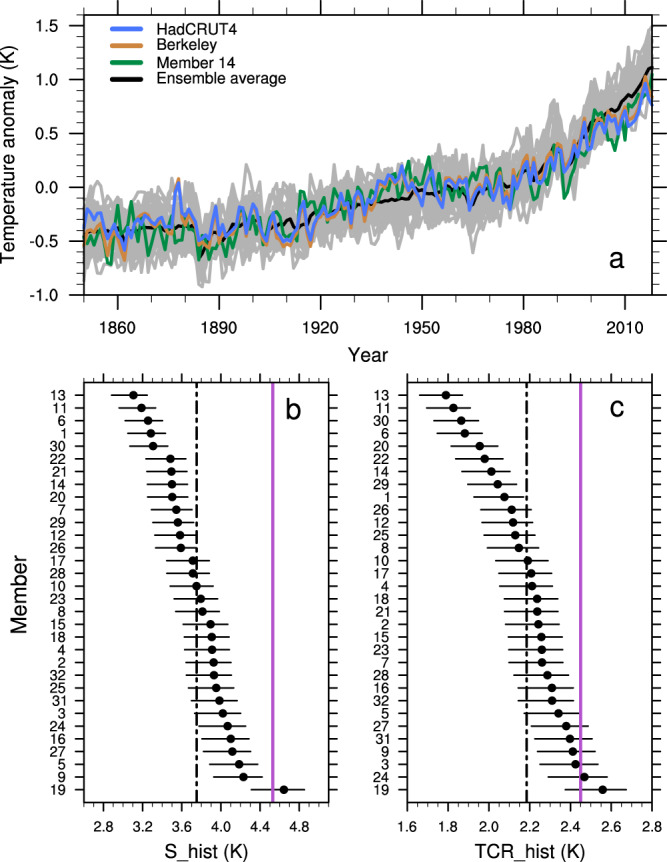
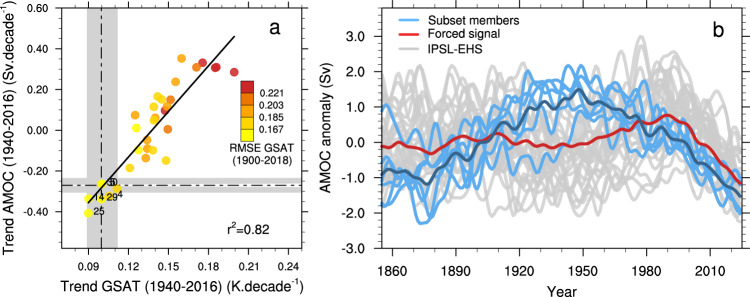
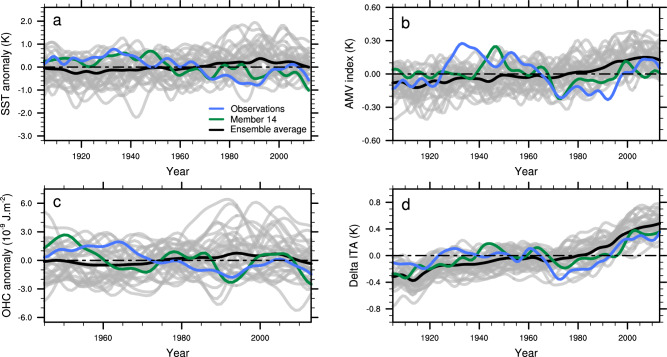
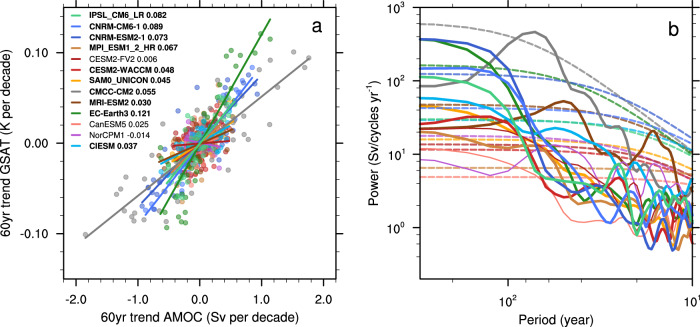
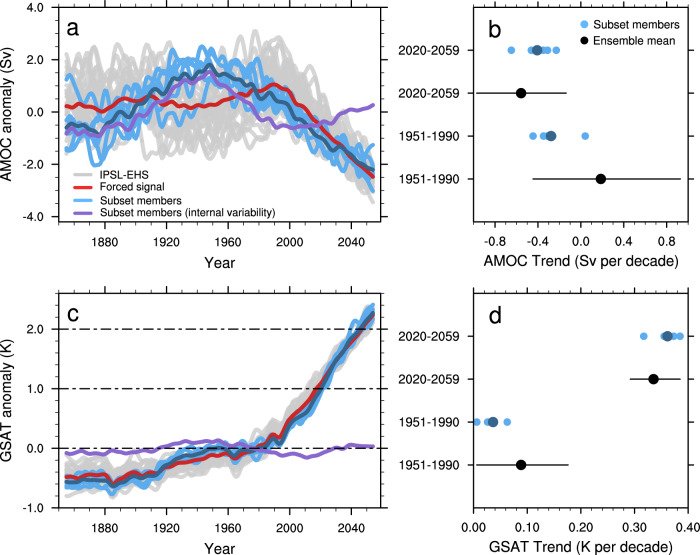
Some of the new generation CMIP6 models are characterised by a strong temperature increase in response to increasing greenhouse gases concentration 1. At first glance, these models seem less consistent with the temperature warming observed over the last decades. Here, we investigate this issue through the prism of low-frequency internal variability by comparing with observations an ensemble of 32 historical simulations performed with the IPSL-CM6A-LR model, characterized by a rather large climate sensitivity. We show that members with the smallest rates of global warming over the past 6-7 decades are also those with a large internally-driven weakening of the Atlantic Meridional Overturning Circulation (AMOC). This subset of members also matches several AMOC observational fingerprints, which are in line with such a weakening. This suggests that internal variability from the Atlantic Ocean may have dampened the magnitude of global warming over the historical era. Taking into account this AMOC weakening over the past decades means that it will be harder to avoid crossing the 2 °C warming threshold.
Overview
The claims and statistics of this paper haven’t been checked yet.
Free: it reads the open-access text and checks the first 5 claims that cite a source we can check. Create a free account to check every claim.
Integrity signals
Registry
Cites
Statistics
Figures
Verification
Claims the paper makes
The claims and statistics of this paper haven’t been checked yet.
Free: it reads the open-access text and checks the first 5 claims that cite a source we can check. Create a free account to check every claim.
Claims other papers make about this one
Each is checked against this paper’s own text: does it say what the citing paper says it does?
The source backs part of the claim, not all of it — or backs it for a different population, condition or comparison.
In the citing paper
“note that this global mean SST fluctuates by about 0.2 K on centennial time scales in IPSL-6A (39)”
From Toward machine-assisted tuning avoiding the underestimation of uncertainty in climate change projections (2023) · cites this paper as [39]
Experimental — accuracy not yet measuredThe source backs part of the claim, not all of it — or backs it for a different population, condition or comparison.
In the citing paper
“However, 5 among the 33 members of an ensemble of historical simulations with this IPSL-6A version (that differed only by their initial state) showed climate trends over the 20th century compatible with observations”
From Toward machine-assisted tuning avoiding the underestimation of uncertainty in climate change projections (2023) · cites this paper as [39]
Experimental — accuracy not yet measuredThe cited source says what the claim attributes to it.
In the citing paper
“This uncertainty quantification should also take into account the contribution of the multi-decadal internal climate variability which could significantly contribute to the recent climate trends (39).”
From Toward machine-assisted tuning avoiding the underestimation of uncertainty in climate change projections (2023) · cites this paper as [39]
Self-check
Percentages, sums and reported differences re-computed from the paper’s own numbers.
The self-check needs the paper’s full text.
Citations
Cites
Eyring, V., Bony, S., Meehl, G. A., Senior, C. A., Stevens, B., Stouffer, R. J., & Taylor, K. E. (2016) · Geoscientific Model Development · doi:10.5194/gmd-9-1937-2016 · Cited by 11,981
Huang, B., Thorne, P. W., Banzon, V. F., Boyer, T., Chepurin, G., Lawrimore, J. H., Menne, M. J., Smith, T. M., Vose, R. S., & Zhang, H.-M. (2017) · Journal of Climate · doi:10.1175/jcli-d-16-0836.1 · Cited by 3,230
Enfield, D. B., Mestas‐Nuñez, A. M., & Trimble, P. J. (2001) · Geophysical Research Letters · doi:10.1029/2000gl012745 · Cited by 2,936
Presentation and Evaluation of the IPSL‐CM6A‐LR Climate Model
Boucher, O., Servonnat, J., Albright, A. L., Aumont, O., Balkanski, Y., Bastrikov, V., Bekki, S., Bonnet, R., Bony, S., Bopp, L., et al. (2020) · Journal of Advances in Modeling Earth Systems · doi:10.1029/2019ms002010 · Cited by 1,694
Self-citationAn oscillation in the global climate system of period 65–70 years
Schlesinger, M. E., & Ramankutty, N. (1994) · Nature · doi:10.1038/367723a0 · Cited by 1,550
An Assessment of Earth's Climate Sensitivity Using Multiple Lines of Evidence
Sherwood, S. C., Webb, M. J., Annan, J. D., Armour, K. C., Forster, P. M., Hargreaves, J. C., Hegerl, G., Klein, S. A., Marvel, K. D., Rohling, E. J., et al. (2020) · Reviews of Geophysics · doi:10.1029/2019rg000678 · Cited by 1,254
A North Atlantic Climate Pacemaker for the Centuries
Kerr, R. A. (2000) · Science · doi:10.1126/science.288.5473.1984 · Cited by 1,093
(2019) · doi:10.5194/gmd-12-1443-2019 · Cited by 1,093
Observed fingerprint of a weakening Atlantic Ocean overturning circulation
Caesar, L., Rahmstorf, S., Robinson, A., Feulner, G., & Saba, V. (2018) · Nature · doi:10.1038/s41586-018-0006-5 · Cited by 1,078
A new method for diagnosing radiative forcing and climate sensitivity
Gregory, J. M., Ingram, W. J., Palmer, M. A., Jones, G. S., Stott, P. A., Thorpe, R. B., Lowe, J. A., Johns, T. C., & Williams, K. D. (2004) · Geophysical Research Letters · doi:10.1029/2003gl018747 · Cited by 1,075
Cited by
Cheng, L., von Schuckmann, K., Abraham, J. P., Trenberth, K. E., Mann, M. E., Zanna, L., England, M. H., Zika, J. D., Fasullo, J. T., Yu, Y., et al. (2022) · Nature Reviews Earth & Environment · doi:10.1038/s43017-022-00345-1 · Cited by 312
“A key role for changes in upper-ocean salinity driven by both the surface freshwater flux and winds has been identified, with consequences for both the patterns and magnitudes of warming in coming decades 208,209 .”
Nisbet, E. G., Manning, M., Dlugokencky, E. J., Michel, S., Lan, X., Röckmann, T., van der Gon, H. D., Schmitt, J. H. M. M., Palmer, P. I., Dyonisius, M., et al. (2023) · Global Biogeochemical Cycles · doi:10.1029/2023gb007875 · Cited by 177
“In recent years, there has been marked weakening of the Atlantic Meridional Overturning Circulation (AMOC), in particular since 2005 (Bonnet et al., 2021; Ditlevsen & Ditlevsen, 2023; WMO, 2023).”
BackgroundSmith, D. M., Gillett, N. P., Simpson, I. R., Athanasiadis, P., Baehr, J., Bethke, I., Bilge, T., Bonnet, R., Boucher, O., Findell, K. L., et al. (2022) · Frontiers in Climate · doi:10.3389/fclim.2022.955414 · Cited by 107
“Moreover, many multi-annual to decadal changes in climate may occur through a combination of external forcing and internal variability (e.g., Huang et al., 2020; Bonnet et al., 2021; Wu et al., 2021) complicating the separation of forcing’s from the natural variability in observed changes.”
BackgroundSelf-citationAMOC Recent and Future Trends: A Crucial Role for Oceanic Resolution and Greenland Melting?
Swingedouw, D., Houssais, M., Herbaut, C., Blaizot, A., Devilliers, M., & Deshayes, J. (2022) · Frontiers in Climate · doi:10.3389/fclim.2022.838310 · Cited by 96
“Bonnet et al. (2021) also showed that it can strongly affect the AMOC fate and the attribution of any on-going changes. In this respect, the use of high-resolution climate models clearly limits the ability to analyze the physics behind this internal variability properly. Thus, there are clearly pros and cons regarding…”
BackgroundMethodInfluentialSelf-citationRobson, J. I., Menary, M. B., Sutton, R. T., Mecking, J., Gregory, J. M., Jones, C., Sinha, B., Stevens, D. P., & Wilcox, L. J. (2022) · Journal of Climate · doi:10.1175/jcli-d-22-0124.1 · Cited by 86
“by large GHG-forced changes (Menary et al. 2020). Future work could address these questions through computation of surface water mass transformations across the SPNA in models in order to understand the relative role of surface density fluxes as opposed to surface density anomalies in driving anomalous transformations…”
Polysaccharide-reinforced amyloid fibril hydrogels and aerogels
Usuelli, M., Germerdonk, T., Cao, Y., Peydayesh, M., Bagnani, M., Handschin, S., Nyström, G., & Mezzenga, R. (2021) · Nanoscale · doi:10.1039/d1nr03133c · Cited by 62
Amyloid fibril-based membranes for PFAS removal from water
Jin, T., Peydayesh, M., Joerss, H., Zhou, J., Bolisetty, S., & Mezzenga, R. (2021) · Environmental Science Water Research & Technology · doi:10.1039/d1ew00373a · Cited by 76
Meccia, V. L., Fuentes‐Franco, R., Davini, P., Bellomo, K., Fabiano, F., Yang, S., & von Hardenberg, J. (2022) · Climate Dynamics · doi:10.1007/s00382-022-06534-4 · Cited by 58
“Moreover, the AMOC variability on the centennial timescale is thought to play a role in masking some of the anthropogenic effects of climate change over the coming years (Bonnet et al. 2021; Latif et al. 2022).”
Hourdin, F., Ferster, B., Deshayes, J., Mignot, J., Musat, I., & Williamson, D. (2023) · Science Advances · doi:10.1126/sciadv.adf2758 · Cited by 49
“2 K on centennial time scales in IPSL-6A (39)].”
BackgroundMethodResultInfluentialSelf-citationThe “teapot in a city”: A paradigm shift in urban climate modeling
Villefranque, N., Hourdin, F., d’Alençon, L., Blanco, S., Boucher, O., Caliot, C., Coustet, C., Dauchet, J., El-Hafi, M., Eymet, V., et al. (2022) · Science Advances · doi:10.1126/sciadv.abp8934 · Cited by 54
“Outputs of an ensemble of global climate simulations of 250 years each are used, available at a frequency of 3 hours (71).”
BackgroundMethodSelf-citationCan we trust projections of AMOC weakening based on climate models that cannot reproduce the past?
McCarthy, G., & Caesar, L. (2023) · Philosophical Transactions of the Royal Society A Mathematical Physical and Engineering Sciences · doi:10.1098/rsta.2022.0193 · Cited by 50
“Bonnet et al. [46] found that those model runs that fit the evolution of global mean temperature most accurately showed a declining AMOC over the twentieth century.”
BackgroundResultInfluentialStrategies and reaction systems for solar-driven CO2 reduction by water
Bian, J., Zhang, Z., Liu, Y., Chen, E., Tang, J., & Jing, L. (2022) · Carbon Neutrality · doi:10.1007/s43979-022-00006-8 · Cited by 37
“1 °C higher than that in the end of the nineteenth century [2].”
BackgroundHuman Rights and Large-Scale Carbon Dioxide Removal: Potential Limits to BECCS and DACCS Deployment
Günther, P., & Ekardt, F. (2022) · Land · doi:10.3390/land11122153 · Cited by 53
“However, seven years after the states agreed on a common objective in Paris, little has happened regarding the effective reduction of greenhouse gas (GHG) emissions [2–4].”
BackgroundRapid sea ice changes in the future Barents Sea
Rieke, O., Årthun, M., & Dörr, J. S. (2023) · The Cryosphere · doi:10.5194/tc-17-1445-2023 · Cited by 45
Li, L., Wang, B., Feng, P., Jägermeyr, J., Asseng, S., Müller, C., Macadam, I., Liu, D. L., Waters, C., Zhang, Y., et al. (2023) · Communications Earth & Environment · doi:10.1038/s43247-023-01016-9 · Cited by 34
“This can be attributed to the fact that these two GCMs exhibit a higher equilibrium climate sensitivity (ECS) 32,33 , which leads to expected large yield losses by some climate-sensitive crop models.”
BackgroundInfluentialConvergence of CO2 emissions in OECD countries
Lee, J., Yücel, A. G., & Islam, M. T. (2022) · Sustainable Technology and Entrepreneurship · doi:10.1016/j.stae.2022.100029 · Cited by 40
Li, Y., & Yang, H. (2022) · Journal of Climate · doi:10.1175/jcli-d-21-0685.1 · Cited by 28
“This study suggests that the Atlantic Ocean has an intrinsic 36 multi-centennial mode, which may help us understand this class of variability identified in 37 paleoclimatic proxy data.”
BackgroundInfluentialCMIP6 simulations with the compact Earth system model OSCAR v3.1
Quilcaille, Y., Gasser, T., Ciais, P., & Boucher, O. (2023) · Geoscientific model development · doi:10.5194/gmd-16-1129-2023 · Cited by 28
Self-citationFernandez, K. X., Fischer, C., Vu, J., Gheblawi, M., Wang, W., Gottschalk, S., Iturrioz, X., Llorens‐Cortés, C., Oudit, G. Y., & Vederas, J. C. (2021) · RSC Medicinal Chemistry · doi:10.1039/d1md00120e · Cited by 22
Mehling, O., Bellomo, K., & von Hardenberg, J. (2024) · Geophysical Research Letters · doi:10.1029/2024gl110791 · Cited by 30
“Centennial‐scale AMOC variability has been studied less extensively than the neighboring multidecadal timescales (Buckley & Marshall, 2016), but might still imprint on the climate at human timescales (e.g., Bonnet et al., 2021; Kelson et al., 2022).”
dos Santos, T. P., Shimizu, M. H., Nascimento, R. A., Venancio, I. M., Campos, M. D. C., Portilho-Ramos, R. C., Ballalai, J. M., Lessa, D. V. D. O., Crivellari, S., Nagai, R. H., et al. (2022) · Quaternary Science Reviews · doi:10.1016/j.quascirev.2022.107557 · Cited by 26
What Causes Anthropogenic Ocean Warming to Emerge from Internal Variability in a Coupled Model?
Silvy, Y., Sallée, J., Guilyardi, É., Mignot, J., & Rousset, C. (2022) · Journal of Climate · doi:10.1175/jcli-d-22-0074.1 · Cited by 20
Self-citationAsymmetric Sea Surface Salinity Response to Global Warming: “Fresh Gets Fresher but Salty Hesitates”
Douville, H., & Cheng, L. (2024) · Geophysical Research Letters · doi:10.1029/2023gl107944 · Cited by 19
“These results may be consistent with a tropical Pacific forcing of a positive AMOC response via tropical‐extratropical teleconnections (Orihuela‐Pinto et al., 2023), associated with a global cooling (Bonnet et al., 2021) and a transient tropical SST pattern (e.g., Andrews et al., 2022).”
Present-day North Atlantic salinity constrains future warming of the Northern Hemisphere
Park, I., Yeh, S., Cai, W., Wang, G., Min, S., & Lee, S. (2023) · Nature Climate Change · doi:10.1038/s41558-023-01728-y · Cited by 22
Observational constraints project a ~50% AMOC weakening by the end of this century
Portmann, V., Swingedouw, D., Khattab, O., & Marie Chavent, A. (2026) · Science Advances · doi:10.1126/sciadv.adx4298 · Cited by 15
“(i) The poor leave- one-out performance when using time trends may indicate that the anthropogenic forcing signal on the AMOC is still too weak to identify a robust emergent relationship and is likely obscured by internal variability, consistent with recent publications [e.g., ( 57 )].”
Self-citationWang, H., Zuo, Z., Qiao, L., Zhang, K., Sun, C. J., Xiao, D., Lin, Z., Bu, L., & Zhang, R. (2022) · npj Climate and Atmospheric Science · doi:10.1038/s41612-022-00307-w · Cited by 16
Liné, A., Cassou, C., Msadek, R., & Parey, S. (2024) · npj Climate and Atmospheric Science · doi:10.1038/s41612-024-00759-2 · Cited by 14
“At near-term, super-imposed interannual to multidecadal internal variability will continue to either mask or accentuate the effect of human-caused AMOC slowdown, independentlyontheSSPscenarios 52 ,liketoday 53,54 .”
European Summer Wet-Bulb Temperature: Spatiotemporal Variations and Potential Drivers
Ma, Q., Chen, Y., & Ionita-Scholz, M. (2024) · Journal of Climate · doi:10.1175/jcli-d-23-0420.1 · Cited by 16
Park, I., Yeh, S., Dewitte, B., Wang, G., Kirtman, B. P., & An, S. (2024) · Earth s Future · doi:10.1029/2023ef004146 · Cited by 13
“A slowdown of the AMOC, combined with the warming hole, could dampen the observed global warming rate in recent decades (Bonnet et al., 2021).”
BackgroundA wireless optoelectronic skin patch for light delivery and thermal monitoring
Kim, H., Jin, Y., Achavananthadith, S., Lin, R., & Ho, J. S. (2021) · iScience · doi:10.1016/j.isci.2021.103284 · Cited by 9
Ferster, B. S., Borchert, L., Mignot, J., Menary, M. B., Cassou, C., & Fedorov, A. V. (2023) · npj Climate and Atmospheric Science · doi:10.1038/s41612-023-00489-x · Cited by 11
Self-citationOcean response to a century of observation-based freshwater forcing around Greenland in EC-Earth3
Devilliers, M., Yang, S., Drews, A., Schmith, T., & Olsen, S. M. (2024) · Climate Dynamics · doi:10.1007/s00382-024-07142-0 · Cited by 11
“Moreover, as the AMOC response has a large spread in the last CMIP6 (Bellomo et al. 2021; Gong et al. 2022), there is an emerging need to constrain the AMOC response in future climate predictions (Bonnet et al. 2021).”
Opportunities for Earth Observation to Inform Risk Management for Ocean Tipping Points
Wood, R., Baker, J., Beaugrand, G., Boutin, J., Conversi, A., Donner, R. V., Frenger, I., Goberville, É., Hayashida, H., Koeve, W., et al. (2024) · Surveys in Geophysics · doi:10.1007/s10712-024-09859-3 · Cited by 12
Self-citationSchillinger, M., Ellerhoff, B. M., Scheichl, R., & Rehfeld, K. (2022) · Chaos An Interdisciplinary Journal of Nonlinear Science · doi:10.1063/5.0106123 · Cited by 13
On the role of AMOC weakening in shaping wintertime Euro-Atlantic atmospheric circulation
Vacca, A. V., Bellomo, K., Fabiano, F., & von Hardenberg, J. (2025) · Climate Dynamics · doi:10.1007/s00382-025-07747-z · Cited by 5
“One limitation of this study is that it does not explicitly account for internal variability in the Atlantic Ocean, which can significantly influence the atmospheric response simulated by climate models (Bonnet et al. 2021).”
Bonnet, R., Boucher, O., Vrac, M., & Jin, X. (2022) · Environmental Research Climate · doi:10.1088/2752-5295/ac6adc · Cited by 5
Self-citationCoquereau, A., Sévellec, F., Huck, T., Hirschi, J., & Jamet, Q. (2026) · Earth System Dynamics · doi:10.5194/esd-17-209-2026 · Cited by 6
Ndiaye, C. D., Mohíno, E., Mignot, J., & Sall, S. M. (2022) · Journal of Climate · doi:10.1175/jcli-d-21-0585.1 · Cited by 7
Self-citationCarbon cycle and climate feedbacks under CO 2 and non-CO 2 overshoot pathways
Melnikova, I., Ciais, P., Tanaka, K., Shiogama, H., Tachiiri, K., Yokohata, T., & Boucher, O. (2025) · Earth System Dynamics · doi:10.5194/esd-16-257-2025 · Cited by 7
“Atmospheric methane removal meth-ods have also been discussed in some studies (Boucher and Folberth, 2010; Jackson et al., 2021; Mundra and Lockley, 2023), but they are still in their infancy.”
Self-citationAMOC weakening modulates global warming impacts on precipitation over Brazil
Vilela, I., Luca, P. D., Koseki, S., da Silva, T. M., Veleda, D., & Keenlyside, N. S. (2025) · npj Climate and Atmospheric Science · doi:10.1038/s41612-025-01248-w · Cited by 9
ClimLoco1.0: CLimate variable confidence Interval of Multivariate Linear Observational COnstraint
Portmann, V., Chavent, M., & Swingedouw, D. (2025) · Geoscientific model development · doi:10.5194/gmd-18-9015-2025 · Cited by 8
Self-citationZhang, Q., Ito, T., & Bracco, A. (2024) · Frontiers in Marine Science · doi:10.3389/fmars.2024.1304193 · Cited by 5
A multi-model analysis of the decadal prediction skill for the North Atlantic ocean heat content
Carmo-Costa, T., Bilbao, R., Robson, J. I., Teles-Machado, A., & Ortega, P. (2025) · Earth System Dynamics · doi:10.5194/esd-16-1001-2025 · Cited by 4
Constraining CMIP6 simulations for Atlantic Water in the Arctic using an AMOC-SST index
Devilliers, M., Olsen, S. M., Langehaug, H. R., Guo, C., Mahmood, R., Tian, T., & Yang, S. (2025) · Frontiers in Climate · doi:10.3389/fclim.2025.1550772 · Cited by 4
Song, X., Liu, H., Li, C., Wang, M., Hu, H., Cao, Z., Jashenko, R. V., & Ji, R. (2025) · Entomological Research · doi:10.1111/1748-5967.70064 · Cited by 3
“Climate change is an important factor influencing changes in species distribution (Bonnet et al. 2021; Poniatowski et al. 2020).”
No critical slowing down in the Atlantic Overturning Circulation in historical CMIP6 simulations
Ben‐Yami, M., Blaschke, L. L., Bathiany, S., & Boers, N. (2026) · PLOS Climate · doi:10.1371/journal.pclm.0000781 · Cited by 2
“In addition, we find that no model ASSTI truly matches the way the observed ASSTI changes over time, meaning that studies using the ASSTI as an emergent constraint should be careful to investigate the effect different higher order statistics may have on their results [36,37].”
Michel, S., Dijkstra, H. A., Guardamagna, F., Jacques-Dumas, V., van Westen, R. M., & von der Heydt, A. S. (2023) · Research Square · doi:10.21203/rs.3.rs-3377545/v1 · Cited by 2
AMOC response to historical freshwater increase
Devilliers, M., Swingedouw, D., Martin, T., Mankoff, K. D., Schiller‐Weiss, I., Mignot, J., Olsen, S. M., & Deshayes, J. (2026) · Nature Geoscience · doi:10.1038/s41561-026-02028-8 · Cited by 1
“Other processes may be considered to explain a weakening, with internal variability being a serious candidate 14,15 .”
Self-citationDiodato, N., Rubinetti, S., & Bellocchi, G. (2024) · Hydrological Sciences Journal · doi:10.1080/02626667.2024.2427356 · Cited by 1
“In fact, this discrepancy persists in CMIP6 models, showing less consistency with observed temperature trends over previous decades (Bonnet et al .”
Bonnet, R., Vrac, M., Boucher, O., & Jin, X. (2023) · doi:10.5194/egusphere-egu23-6529 · Cited by 2
Self-citationQuilcaille, Y., Gasser, T., Ciais, P., et al. (2022) · Geoscientific model development · doi:10.5194/gmd-2021-412-rc1
Quilcaille, Y., Gasser, T., Ciais, P., et al. (2022) · Geoscientific model development · doi:10.5194/gmd-2021-412-rc2
Quilcaille, Y., Gasser, T., Ciais, P., et al. (2022) · Geoscientific model development · doi:10.5194/gmd-2021-412-ec1
Quilcaille, Y. (2022) · Geoscientific model development · doi:10.5194/gmd-2021-412-ac2
Quilcaille, Y. (2022) · Geoscientific model development · doi:10.5194/gmd-2021-412-ac1
Quilcaille, Y. (2022) · Geoscientific model development · doi:10.5194/gmd-2021-412-ac3
Quilcaille, Y., Gasser, T., Ciais, P., et al. (2022) · Geoscientific model development · doi:10.5194/gmd-2021-412-ec2
Manuscript responding to referees' comments: submitted to Global Biogeochemical CyclesPreprint
Nisbet, E. G. (2023) · doi:10.22541/essoar.168652299.92368253/v1 · Cited by 1
Multi-annual variability of a new proxy-constrained modeled AMOC from 1450–1780 CEPreprint
Samakinwa, E., Raible, C. C., Hand, R., Friedman, A. R., & Brönnimann, S. (2023) · doi:10.5194/cp-2023-67
Ogaki, S., Takeda, Y., Nagashima, H., Suzuki, Y., Sawahashi, R., Ito, F., Yoshida, H., & Nakamura, T. (2025) · IEEE Underwater Technology (UT) · doi:10.1109/ut61067.2025.10947391
“The weakening of the AMOC is known to have significant impacts on global climate and ecosystems [9][10].”
Hysteresis in ocean export production owing to CO2 forcing
Wie, J., & Moon, B. (2025) · Scientific Reports · doi:10.1038/s41598-025-15521-8
“1a, b) 23,24 .”
旋转层结情况下对流不稳定过程的参数化及其在AMOC数值模拟中的应用
曹, 茜., 董, 昌., 陆, 晓., Choy, L. K. S. K. T., 胡, 逍., 高, 晓., 王, 海., & 廖, 光. (2025) · SCIENTIA SINICA Terrae · doi:10.1360/n072024-0373
Cao, Q., Dong, C., Lu, X., Sian, K. T. C. L. K., Hu, X., Gao, X., Wang, H., & Liao, G. (2025) · Science China Earth Sciences · doi:10.1007/s11430-024-1667-0
“Therefore, the weakening of the AMOC can result in reduced heat transport to the ocean interior, causing more heat retention at the ocean surface and contributing to warming (Chen and Tung, 2018; Bonnet et al., 2021).”
Silvy, Y. (2022) · theses.fr (ABES) · doi:10.70675/1a8eb178z071cz446czb676z15c767115d3f · Cited by 4
Evaluation of two versions of the IPSL-EPOC decadal prediction systems
Swingedouw, D., Reiter, R., Mignot, J., Gastineau, G., Torres, O., & Alkama, R. (2026) · Frontiers in Climate · doi:10.3389/fclim.2026.1803256 · Cited by 3
Self-citationBonnet, R., Boé, J., Sánchez-Gómez, E., & Cassou, C. (2026) · Earth System Dynamics · doi:10.5194/esd-17-1299-2026 · Cited by 1
Self-citation
Metadata
- Authors
- Bonnet, R., Swingedouw, D., Gastineau, G., Boucher, O., Deshayes, J., Hourdin, F., Mignot, J., Servonnat, J., & Sima, A.
- Affiliations
- Centre National de la Recherche Scientifique (FR)
- Corresponding author
- Bonnet, Rémy
- ORCID
- Venue
- Nature Communications
- Published
- 2021-10-20
- Volume
- 12
- Issue
- 1
- Pages
- 6108-6108
- ISSN
- 2041-1723 (ISSN-L)
- PMC
- PMC8528826
- OpenAlex
- W3205980127
- Cited by
- 68
- References
- 56
- Citations by year
- 2026: 6 · 2025: 11 · 2024: 9 · 2023: 14 · 2022: 24 · 2021: 4
- FWCI
- 5.23
- Type
- journal article
- Language
- en
- Open access
- gold
- doi.org
- Licence
- cc-by
- creativecommons.org/licenses/by/4.0 (tdm)
- creativecommons.org/licenses/by/4.0 (vor)
- Locations
- Nature Communications (publishedVersion, cc-by)
- PubMed Central (publishedVersion, cc-by)
- PubMed (publishedVersion)
- HAL (submittedVersion, cc-by)
- RePEc: Research Papers in Economics (submittedVersion)
- DOAJ (DOAJ: Directory of Open Access Journals) (submittedVersion, cc-by-sa)
- Funders
- EC | Horizon 2020 Framework Programme (820829)
- Topics
- Physical Sciences › Environmental Science › Global and Planetary Change › Climate variability and models
- Physical Sciences › Earth and Planetary Sciences › Oceanography › Oceanographic and Atmospheric Processes
- Physical Sciences › Earth and Planetary Sciences › Atmospheric Science › Geology and Paleoclimatology Research
- Keywords
- Atlantic meridional overturning circulation, AMOC weakening, global warming, climate sensitivity, historical climate simulation, IPSL-CM6A-LR
About these checks
Registry, retraction, Cites and statistics results are computed, not judged, with one exception: a printed reference that no index lists is read once by a model before it counts as a citation error. Claims are extracted by a model and kept only when their quote appears verbatim in the text; each cited source is then checked, with a model’s help, for whether it says what the claim relies on. Those verdicts can be wrong — read the claim’s quote and the cited source before relying on one.
Statistics and arithmetic are recomputed, not judged.
Confidence bands are shown only for fields calibrated on our annotated test set. None is calibrated yet, so no band is shown.
What counts as a claim ›How we measure confidence ›How we check this ›
Are you an author, or do you see a problem with this page? Request a review
Data sources
Bibliographic data: Semantic Scholar, OpenAlex, Crossref.
Contains information from the Semantic Scholar Academic Graph Datasets, made available under the ODC Attribution License (ODC-BY 1.0).
Semantic Scholar’s data is described in: Kinney, R., et al. (2023). The Semantic Scholar Open Data Platform. arXiv:2301.10140.
