

Ultrasound-activated ciliary bands for microrobotic systems inspired by starfish
Open accessPublished version of a preprint
The DOI matches its Crossref record; 65 of the 68 references it cites were found in a registry or an index.
Abstract
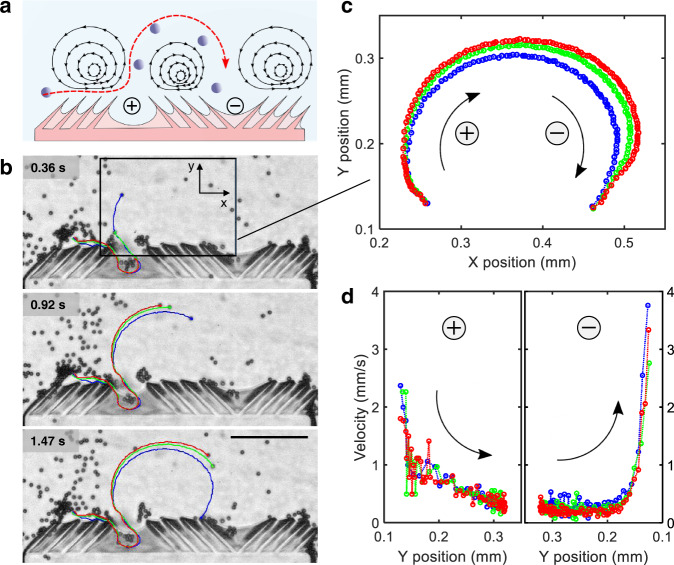
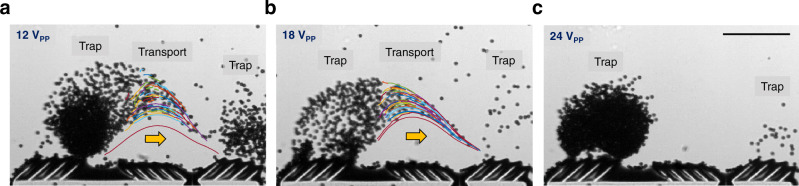
Cilia are short, hair-like appendages ubiquitous in various biological systems, which have evolved to manipulate and gather food in liquids at regimes where viscosity dominates inertia. Inspired by these natural systems, synthetic cilia have been developed and utilized in microfluidics and microrobotics to achieve functionalities such as propulsion, liquid pumping and mixing, and particle manipulation. Here, we demonstrate ultrasound-activated synthetic ciliary bands that mimic the natural arrangements of ciliary bands on the surface of starfish larva. Our system leverages nonlinear acoustics at microscales to drive bulk fluid motion via acoustically actuated small-amplitude oscillations of synthetic cilia. By arranging the planar ciliary bands angled towards (+) or away (−) from each other, we achieve bulk fluid motion akin to a flow source or sink. We further combine these flow characteristics with a physical principle to circumvent the scallop theorem and realize acoustic-based propulsion at microscales. Finally, inspired by the feeding mechanism of a starfish larva, we demonstrate an analogous microparticle trap by arranging + and − ciliary bands adjacent to each other.
Overview
The claims and statistics of this paper haven’t been checked yet.
Free: it reads the open-access text and checks the first 5 claims that cite a source we can check. Create a free account to check every claim.
Integrity signals
Registry
Cites
Statistics
Figures
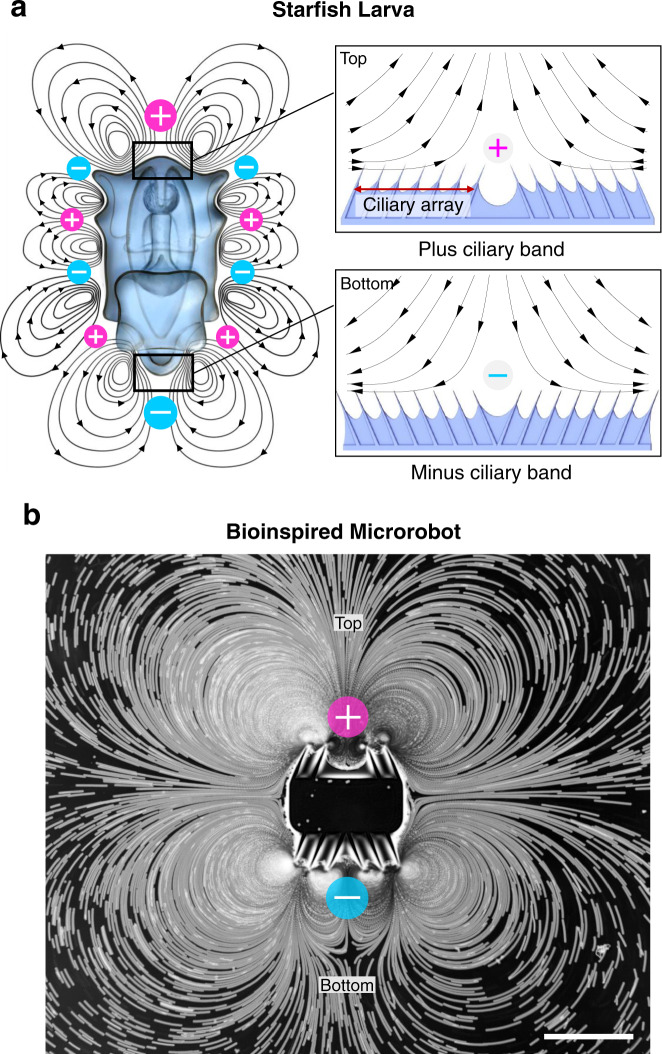
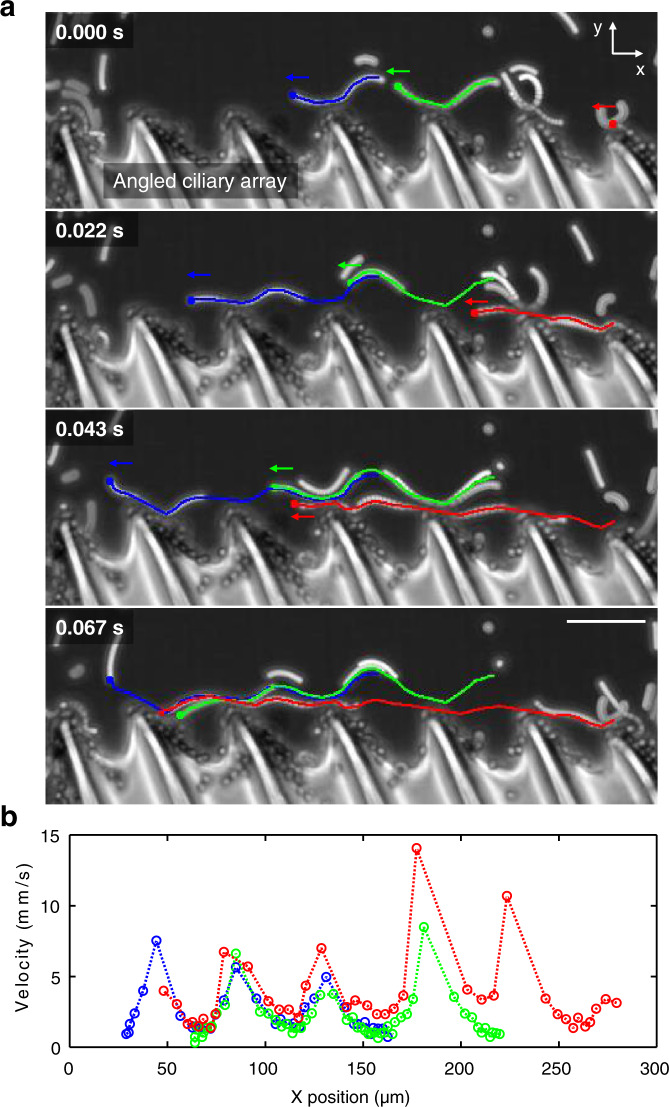
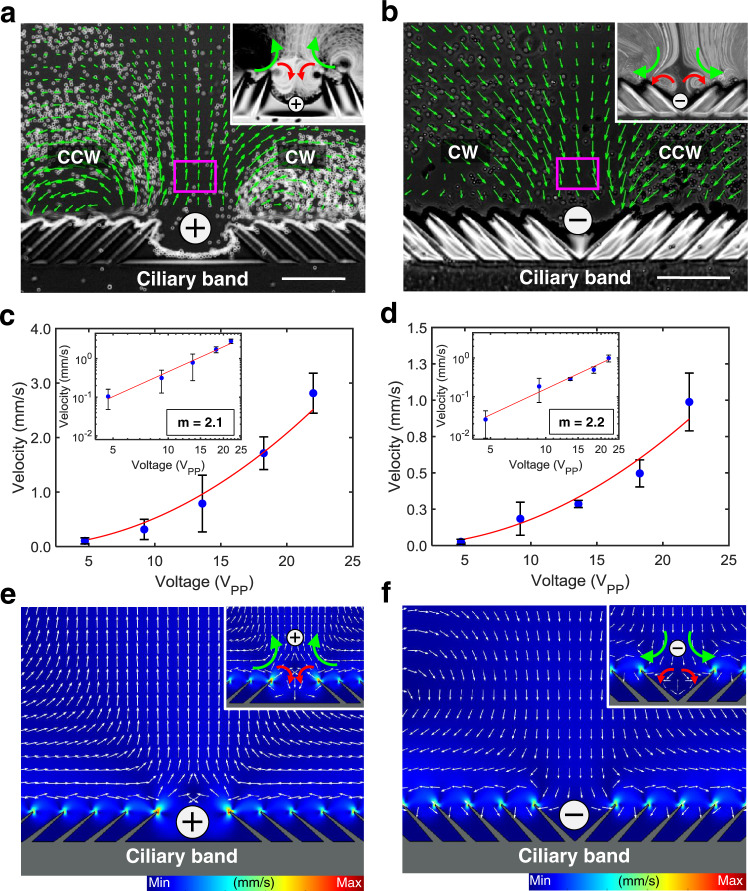
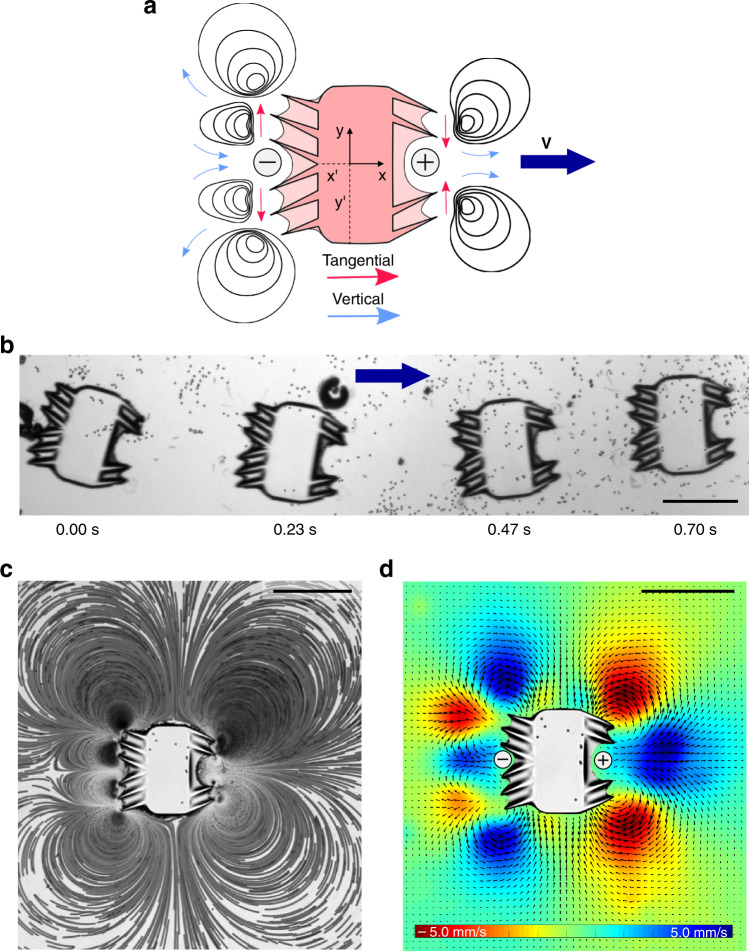
Verification
Claims the paper makes
The claims and statistics of this paper haven’t been checked yet.
Free: it reads the open-access text and checks the first 5 claims that cite a source we can check. Create a free account to check every claim.
Claims other papers make about this one
Each is checked against this paper’s own text: does it say what the citing paper says it does?
The source backs part of the claim, not all of it — or backs it for a different population, condition or comparison.
In the citing paper
“However, they still face limitations in autonomy, chemical sensing/processing integration, and independence from external control, which restrict operational effectiveness in vivo (Dillinger et al., 2021; Yang et al., 2022; Li et al., 2023).”
From Wetware network-based AI: a chemical approach to embodied cognition for robotics and artificial intelligence (2026) · cites this paper as Dillinger et al., 2021
Experimental — accuracy not yet measured
Self-check
Percentages, sums and reported differences re-computed from the paper’s own numbers.
The self-check needs the paper’s full text.
Citations
Cites
NIH Image to ImageJ: 25 years of image analysis
Schneider, C. A., Rasband, W. S., & Eliceiri, K. W. (2012) · Nature Methods · doi:10.1038/nmeth.2089 · Cited by 64,638
Schlichting, H., & Gersten, K. (2000) · Springer eBooks · doi:10.1007/978-3-642-85829-1 · Cited by 18,700
In situ click chemistry generation of cyclooxygenase-2 inhibitors
Bhardwaj, A., Kaur, J., Wuest, M., & Wuest, F. (2017) · Nature Communications · doi:10.1038/s41467-016-0009-6 · Cited by 7,448
U1 snRNP regulates cancer cell migration and invasion in vitro
Oh, J.-M., Venters, C. C., Di, C., Pinto, A. M., Wan, L., Younis, I., Cai, Z., Arai, C., So, B. R., Duan, J., et al. (2020) · Nature Communications · doi:10.1038/s41467-019-13993-7 · Cited by 7,157
Purcell, E. M. (1977) · American Journal of Physics · doi:10.1119/1.10903 · Cited by 4,360
PIVlab – Towards User-friendly, Affordable and Accurate Digital Particle Image Velocimetry in MATLAB
Thielicke, W., & Stamhuis, E. J. (2014) · Journal of Open Research Software · doi:10.5334/jors.bl · Cited by 2,391
Small-scale soft-bodied robot with multimodal locomotion
Hu, W., Lum, G. Z., Mastrangeli, M., & Sitti, M. (2018) · Nature · doi:10.1038/nature25443 · Cited by 2,372
Artificial bacterial flagella: Fabrication and magnetic control
Zhang, L., Abbott, J. J., Dong, L., Kratochvil, B. E., Bell, D., & Nelson, B. J. (2009) · Applied Physics Letters · doi:10.1063/1.3079655 · Cited by 1,199
Chemically Powered Micro‐ and Nanomotors
Sánchez, S., Soler, L., & Katuri, J. (2015) · Angewandte Chemie International Edition · doi:10.1002/anie.201406096 · Cited by 1,011
Palagi, S., Mark, A. G., Reigh, S. Y., Melde, K., Qiu, T., Zeng, H., Parmeggiani, C., Martella, D., Sanchez-Castillo, A., Kapernaum, N., et al. (2016) · Nature Materials · doi:10.1038/nmat4569 · Cited by 977
Cited by
Items 101–150 of 150
Mimicking Life: Autonomous Oscillating Artificial Cilia Driven by Chemical Power
Chakrovorty, R. S., Ashqer, Y. S., & Ahmed, S. (2025) · Advanced Intelligent Systems · doi:10.1002/aisy.202501095 · Cited by 3
Reconfigurable Acoustofluidic Microvortices for Selective Microcargo Delivery
Wang, L., Wu, Y., Tang, Y., Wei, H., Lyu, T., Zhang, X., & Huang, T. (2026) · Advanced Science · doi:10.1002/advs.202521612 · Cited by 4
A Review on Biomimetic Cilia Microrobots: Driving Methods, Application and Research Prospects
Jing, Z., Cai, G., Pan, Y., & Yuan, Y. (2023) · Current Nanoscience · doi:10.2174/0115734137268436231023071009 · Cited by 3
Li, Y., Zhao, R., & Meng, J. (2024) · Chinese Journal of Chemistry · doi:10.1002/cjoc.202401006 · Cited by 3
Liu, B., Lu, Y., Wu, R., Gao, G., Chen, S., & Yang, J. (2025) · Sensors and Actuators A Physical · doi:10.1016/j.sna.2025.116840 · Cited by 3
Attanasi, R., Zoppello, M., & Napoli, G. (2024) · Physical review. E · doi:10.1103/physreve.109.024601 · Cited by 3
A mechanical model for a type of vibro-bot
Meng, J.-M., Guo, J., & Shui, L. (2024) · Archive of Applied Mechanics · doi:10.1007/s00419-024-02617-2 · Cited by 3
Evaluating impedance boundary conditions to model interfacial dynamics in acoustofluidics
Kshetri, K. G., & Nama, N. (2024) · Physics of Fluids · doi:10.1063/5.0225930 · Cited by 3
Self-citationSerpenBot, a Laser Driven Locomotive Microrobot for Dry Environments using Learning Control
Zhong, Y., Alqatamin, M., Sherehiy, A., Zhang, R., Hudibi, M. A., Taghavi, N., & Popa, D. O. (2022) · International Conference on Manipulation, Automation and Robotics at Small Scales (MARSS) · doi:10.1109/marss55884.2022.9870255 · Cited by 3
“Acoustic actuation is another method utilized in a study [6,7] focused on the robot which motion is controlled by tuning the frequency of the ultrasound energy.”
BackgroundMethodDamiano, L., Fleres, A., Roli, A., & Stano, P. (2026) · Frontiers in Robotics and AI · doi:10.3389/frobt.2025.1694338 · Cited by 2
“However, they still face limitations in autonomy, chemical sensing/processing integration, and independence from external control, which restrict operational effectiveness in vivo (Dillinger et al., 2021; Yang et al., 2022; Li et al., 2023).”
Das, P. K., Çoğal, G. Ç., Öksüz, A. U., & Bhethanabotla, V. R. (2024) · Sensors and Actuators A Physical · doi:10.1016/j.sna.2025.116601 · Cited by 2
An acoustically actuated hydrogel shape-morphing micromachine
Xiao, Y., Zhao, X. H., Ma, L., Wang, Y., Mao, G., Zhang, J., Fang, B., & Hao, N. (2025) · Sensors and Actuators B Chemical · doi:10.1016/j.snb.2025.138720 · Cited by 2
Zhang, Z., Koch, M., & Ahmed, D. (2024) · Proceedings - IEEE International Conference on Robotics and Automation/Proceedings · doi:10.1109/icra57147.2024.10611503 · Cited by 2
“Acoustic techniques such as the acoustic traveling wave [1] – [3], acoustic standing wave [4] – [6], acoustic streaming [7], [8], acoustic tweezer [9], [10], and surface acoustic wave [11], [12] are widely utilized, portable, and multifunctional tools that can be employed for various manipulations…”
BackgroundSelf-citationBubbles Acting as Micro End‐Effectors for Dexterous Manipulation and Sensing in Aqueous Environment
Xu, Z., & Xu, Q. (2024) · Advanced Intelligent Systems · doi:10.1002/aisy.202400486 · Cited by 2
Learning control of a laser-driven locomotive microrobot for dry environments
Zhong, Y., Alqatamin, M., Sherehiy, A., Zhang, R., Hudibi, M. A., Chowdhury, S. S., Tofangchi, A., & Popa, D. O. (2022) · Journal of Micro-Bio Robotics · doi:10.1007/s12213-023-00162-9 · Cited by 2
“Acoustic actuation is another method utilized in recent studies [17, 18] focused on motion control by tuning the frequency of the ultrasound.”
MethodZombie diatoms: acoustically powered diatom frustule bio-templated microswimmers
Ozkan, M. C., McNeill, J. M., & Mallouk, T. E. (2024) · Soft Matter · doi:10.1039/d4sm00943f · Cited by 1
Xu, L., Zeng, F., Zhang, Z., & Yu, T. (2026) · Journal of Colloid and Interface Science · doi:10.1016/j.jcis.2026.140746 · Cited by 1
Size-dependent particle patterning in the Fresnel region of standing surface acoustic wave tweezers
Shen, L., Moomaw, A., & Tian, Z. (2026) · Physical Review Applied · doi:10.1103/gh5v-zdbl · Cited by 1
Basic Theories and Physics of Acoustic Technologies
Kshetri, K. G., & Nama, N. (2023) · Wiley eBooks · doi:10.1002/9783527841325.ch2 · Cited by 2
Self-citationDillinger, C., Amado, P. J., Obrist, D., Burkhard, F. C., Clavica, F., & Ahmed, D. (2024) · Continence · doi:10.1016/j.cont.2024.101594 · Cited by 1
Self-citationZhang, X., Matsuo, R., Yahano, Y., Nishida, J., Namura, K., & Suzuki, M. (2025) · Small · doi:10.1002/smll.202408979 · Cited by 1
Introduction to Untethered Miniature Soft Robots
Zhang, L., Zhang, J., Xia, N., & Dong, Y. (2023) · Wiley eBooks · doi:10.1002/9783527840915.ch1
Microfluidics of ciliated surfaces : biomimetic approach of the mucociliary clearance in the lungs
Rouach, S. (2023) · theses.fr (ABES) · doi:10.70675/bce4bb0ezd4f1z45f8z9ddfza14a876efc74
Magnetic Localization Methods for Miniaturized Agents
Li, Y. (2024) · University of Groningen research database (University of Groningen / Centre for Information Technology) · doi:10.33612/diss.1087992187
Programable Magnetic Driven Quantum Dot Microplates for Optical Information Encryption
Li, F., Huang, Z., Li, J., Yu, B., Li, J., & Li, Z. (2024) · International Conference on Electronic Packaging Technology (ICEPT) · doi:10.1109/icept63120.2024.10668446
“Traditional materials and control methods for optical information applications encompass thermochromic materials, structural colors, humidity-responsive color changes [5-12], etc. Control methods include magnetic, electrical, pH, and ultrasound-based approaches [13-16], etc.”
BackgroundProgrammable Assembly and Steering of Microbubble Droplets using UltrasoundPreprint
Fonseca, A. D. C., Kshetri, K. G., Boev, D., Irniger, N., Nama, N., & Ahmed, D. (2025) · bioRxiv (Cold Spring Harbor Laboratory) · doi:10.1101/2025.01.08.631861
Self-citationZhang, K., Fan, Z., Wang, H., Gao, J., Diao, J., & Xu, Z. H. (2025) · Physics of Fluids · doi:10.1063/5.0275264
Li, Y., He, T., Xu, J., Chen, X., & Li, B. (2025) · Wiley eBooks · doi:10.1002/9781394313945.ch13
Bioinspired Geometry-Encoded Rheotactic Navigation of Sound-Driven MicrorobotsPreprint
Sun, C., Paskert, A., Deng, Y., Medany, M., Wittkowski, R., & Ahmed, D. (2025) · bioRxiv (Cold Spring Harbor Laboratory) · doi:10.1101/2025.08.31.673395
“…microrobots often depend on high-intensity or wavelength-specific illumination, which suffers from limited tissue penetration and line-of-sight constraints 26,27 ; and acoustic microrobots typically operate at fixed frequencies, limiting their adaptability to dynamic environments 32,34 .”
Self-citationMicrofluidic Pumping of Artificial Microcilia Via Asymmetric Beating of Cardiomyocytes
Cao, Z., Liu, Y., Sai, H., Tang, Y., Lv, P., Huang, J., Duan, H., & Huang, T. (2025) · Advanced Functional Materials · doi:10.1002/adfm.202517931
Kshetri, K. G., Bhalla, A. P. S., & Nama, N. (2026) · Journal of Computational Physics · doi:10.1016/j.jcp.2025.114635
Self-citationDrug loading and drive control of magnetic microsphere robot
仕奇, S. 马. M., Zhang, J., & Xu, L. (2025) · Journal of Micromechanics and Microengineering · doi:10.1088/1361-6439/ae1cd2
“They can be mainly categorized into chemical field drive [10], magnetic field drive [11, 12], light field drive [13, 14], ultrasonic drive [15, 16], and electric field drive [17, 18].”
Acoustic-Actuated Robotic End-Effector for Open-Environment Microfluidics Manipulation
Li, Y., Miao, C., Du, X., Huang, Q., Arai, T., & Zhang, Z. (2025) · IEEE International Conference on Cyborg and Bionic Systems (CBS) · doi:10.1109/cbs65871.2025.11267681
“The integration of desktop robotic systems with advanced technologies, such as computer vision, machine learning, and artificial intelligence, holds significant potential for laboratory automation [11 – 16].”
Weng, P.-W., Liu, C.-H., Jheng, P.-R., Chiang, C.-C., Chen, Y.-T., Rethi, L., Hsieh, Y. S. Y., & Chuang, A. E.-Y. (2024) · Figshare · doi:10.6084/m9.figshare.26758745
Acoustic lens–based actuators for precise and contactless microparticle manipulation
Nguyen, V. H., Cao, H. X., Jung, D., Park, J.-O., & Kang, B. (2026) · Journal of Micromechanics and Microengineering · doi:10.1088/1361-6439/ae3aad
“…uses ultrasonic waves to stimulate the oscillations of bubbles (Marmottant and Hilgenfeldt 2004, Ahmed et al 2015, Mahkam et al 2023) or shape-edged geometries (Ahmed et al 2016, Kaynak et al 2017, Dillinger et al 2021), thereby inducing streaming flow that indirectly actuates microrobot motion.”
Microstreaming induced by a micro-cantilever vibrating elliptically in a viscous fluid
Ghesquiere, J., Modler, G. K., Mollaei, S., Guérin, D., Matar, O. B., Bruus, H., Baudoin, M., & Cleve, S. (2026) · Journal of Fluid Mechanics · doi:10.1017/jfm.2025.10927
Loganathan, D., Yan, T. O., & Chen, C. L. P. (2026) · IEEE International Conference on Micro Electro Mechanical Systems (MEMS) · doi:10.1109/mems64181.2026.11419437
Multi-Agent Modelling and Deformation Analysis for a Magnetic Artificial Cilium
Yu, S., Ning, Z., & Chen, G. (2026) · Journal of Systems Science and Complexity · doi:10.1007/s11424-026-5006-1
A DNA-inspired magnetic millimeter-scale swimmer with double conical chains
Zhang, K., Fan, Z., Diao, J., Wang, L., Wang, H., Rong, W., & He, C. (2026) · Applied Physics Letters · doi:10.1063/5.0316981
Bioinspired milliscale near-boundary undulatory motion for fluid transport and adhesive locomotion
Liu, S., Zheng, Y., Zhu, K., Li, X., Zhang, R., Ma, K., Guan, J., Sitti, M., Wen, L., & Ren, Z. (2026) · Science Advances · doi:10.1126/sciadv.aea2598
Ren, Z., Deng, H., Zhang, Y., Lu, J., Cao, X., Xu, Y., & Chen, Z. (2026) · Chemical Engineering Journal · doi:10.1016/j.cej.2026.178747
Micro-nanorobots for environmental remediation and monitoring: a state-of-the-art review
Yang, Y., & Zhuang, S. (2026) · Separation and Purification Technology · doi:10.1016/j.seppur.2026.139549
高育龙, Liu, F., & Li, G. (2026) · Micromachines · doi:10.3390/mi17080973
“…ciliary architecture of starfish larvae, Dillinger et al. harnessed micro-scale nonlinear acoustic effects to induce small-amplitude oscillations of artificial cilia, giving rise to source-like bulk fluid motion as well as microrobot actuation and microparticle capture (in vitro validation) [40].”
An Acoustically Actuated Micro-clamprobot
Xiao, Y., & Zhang, J. (2026) · International Conference on Manipulation, Automation and Robotics at Small Scales (MARSS) · doi:10.1109/marss70227.2026.11655684
“However, the acoustic field induces oscillation of the AMCR tail, so the Reynolds number Re f associated with tail vibration must be considered in this work [14].”
Das, S., Venkatakrishnan, K., Pandey, A., & Malik, P. K. (2026) · Journal of Field Robotics · doi:10.1002/rob.70342
Micro/Nanoscale Acoustic Manipulation: From Particle Control to Autonomous Microswimmers
Chu, J., Zhang, L., Wang, X., Li, W., & Liu, Y. (2026) · Advanced Science · doi:10.1002/advs.77557
Actuation, sensing, and integration in soft robotics: principles, progress, and future trends
Bu, X., Yao, S., Zhang, C., Gao, S., Lin, Y., Zhang, Q., Tian, Y., Li, L., & Jin, T. (2026) · Intelligence & Robotics · doi:10.20517/ir.2026.31
Chemically Powered High-Aspect-Ratio Cilia with Tunable Biomimetic Motion
Uddin, M. B., Ashqer, Y. S., & Ahmed, S. (2026) · ACS Omega · doi:10.1021/acsomega.6c05578
Habitat‐Specific Design Strategies for Untethered Soft Robots
Li, S., Miao, Z., Wong, T., & Li, T. (2026) · Advanced Science · doi:10.1002/advs.78287
“Dillinger et al. showed that ultrasound-activated ciliary bands could generate source-and sink-like streaming fields for microparticle transport and trapping without direct mechanical gripping (Figure 4E,F ) [ 157 ].”
Bioinspired Artificial Cilia and Applications
Zhu, B., Wang, Q., Han, L., Wang, Y., Wei, X., & Gu, Z. (2026) · Advanced Materials · doi:10.1002/adma.75464
Metadata
- Authors
- Dillinger, C., Nama, N., & Ahmed, D.
- Affiliations
- ETH Zurich (CH)
- University of Nebraska–Lincoln (US)
- Corresponding author
- Ahmed, Daniel
- Venue
- Nature Communications
- Published
- 2021-11-09
- Volume
- 12
- Issue
- 1
- Pages
- 6455-6455
- ISSN
- 2041-1723 (ISSN-L)
- PMC
- PMC8578555
- OpenAlex
- W3211683863
- Semantic Scholar
- 5d7be80aac2b2e0356d2247d7681e68da8532449
- Cited by
- 149
- References
- 68
- Citations by year
- 2026: 22 · 2025: 31 · 2024: 33 · 2023: 41 · 2022: 22
- FWCI
- 10.09
- Type
- journal article
- Language
- en
- Open access
- gold
- doi.org
- Licence
- cc-by
- creativecommons.org/licenses/by/4.0 (tdm)
- creativecommons.org/licenses/by/4.0 (vor)
- Locations
- Nature Communications (publishedVersion, cc-by)
- Research Square (acceptedVersion, cc-by)
- PubMed Central (publishedVersion, cc-by)
- PubMed (publishedVersion)
- Lincoln (University of Nebraska) (submittedVersion)
- RePEc: Research Papers in Economics (submittedVersion)
- DOAJ (DOAJ: Directory of Open Access Journals) (submittedVersion, cc-by-sa)
- Repository for Publications and Research Data (ETH Zurich) (submittedVersion, cc-by)
- ETH Zürich Research Collection (cc-by)
- Funders
- European Commission (HORIZON2020, 853309)
- Topics
- Physical Sciences › Physics and Astronomy › Condensed Matter Physics › Micro and Nano Robotics
- Physical Sciences › Engineering › Biomedical Engineering › Microfluidic and Bio-sensing Technologies
- Physical Sciences › Physics and Astronomy › Acoustics and Ultrasonics › Acoustic Wave Phenomena Research
- Keywords
- ciliary bands, microrobots, nonlinear acoustics, acoustic propulsion, scallop theorem, microparticle trapping
- MeSH terms
- Animals, Cilia, Starfish, Viscosity, Biomimetics, Microfluidics
About these checks
Registry, retraction, Cites and statistics results are computed, not judged, with one exception: a printed reference that no index lists is read once by a model before it counts as a citation error. Claims are extracted by a model and kept only when their quote appears verbatim in the text; each cited source is then checked, with a model’s help, for whether it says what the claim relies on. Those verdicts can be wrong — read the claim’s quote and the cited source before relying on one.
Statistics and arithmetic are recomputed, not judged.
Confidence bands are shown only for fields calibrated on our annotated test set. None is calibrated yet, so no band is shown.
What counts as a claim ›How we measure confidence ›How we check this ›
Are you an author, or do you see a problem with this page? Request a review
Data sources
Bibliographic data: Semantic Scholar, OpenAlex, Crossref.
Contains information from the Semantic Scholar Academic Graph Datasets, made available under the ODC Attribution License (ODC-BY 1.0).
Semantic Scholar’s data is described in: Kinney, R., et al. (2023). The Semantic Scholar Open Data Platform. arXiv:2301.10140.
