

The DOI matches its Crossref record; 73 of the 75 references it cites were found in a registry or an index, and 2 are not checked yet.
Active learning of reactive Bayesian force fields applied to heterogeneous catalysis dynamics of H/Pt
Open accessPublished version of a preprint
Abstract
Atomistic modeling of chemically reactive systems has so far relied on either expensive ab initio methods or bond-order force fields requiring arduous parametrization. Here, we describe a Bayesian active learning framework for autonomous “on-the-fly” training of fast and accurate reactive many-body force fields during molecular dynamics simulations. At each time-step, predictive uncertainties of a sparse Gaussian process are evaluated to automatically determine whether additional ab initio training data are needed. We introduce a general method for mapping trained kernel models onto equivalent polynomial models whose prediction cost is much lower and independent of the training set size. As a demonstration, we perform direct two-phase simulations of heterogeneous H 2 turnover on the Pt(111) catalyst surface at chemical accuracy. The model trains itself in three days and performs at twice the speed of a ReaxFF model, while maintaining much higher fidelity to DFT and excellent agreement with experiment.
Overview
The claims and statistics of this paper haven’t been checked yet.
Run the check — free, no account needed. It reads the open-access text and checks the sources it cites.
Integrity signals
Registry
Cites
Statistics
Figures
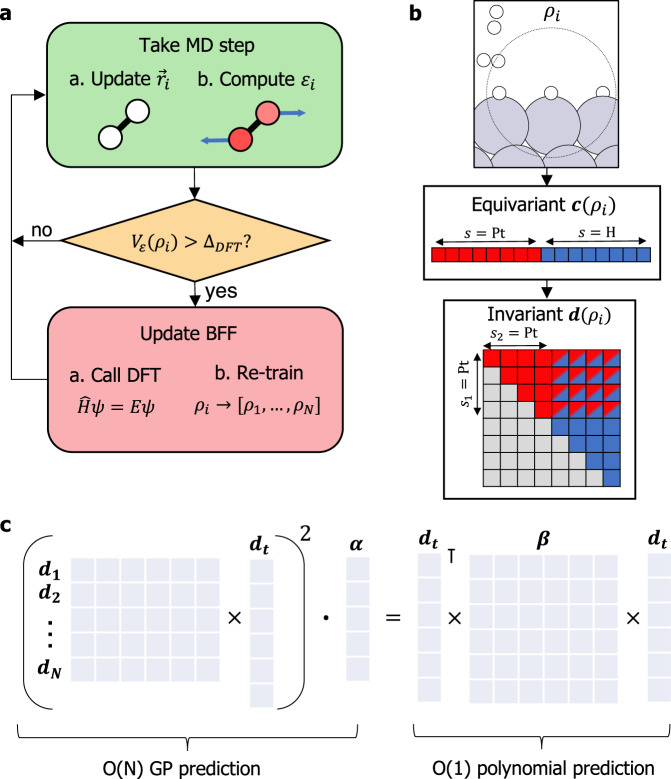
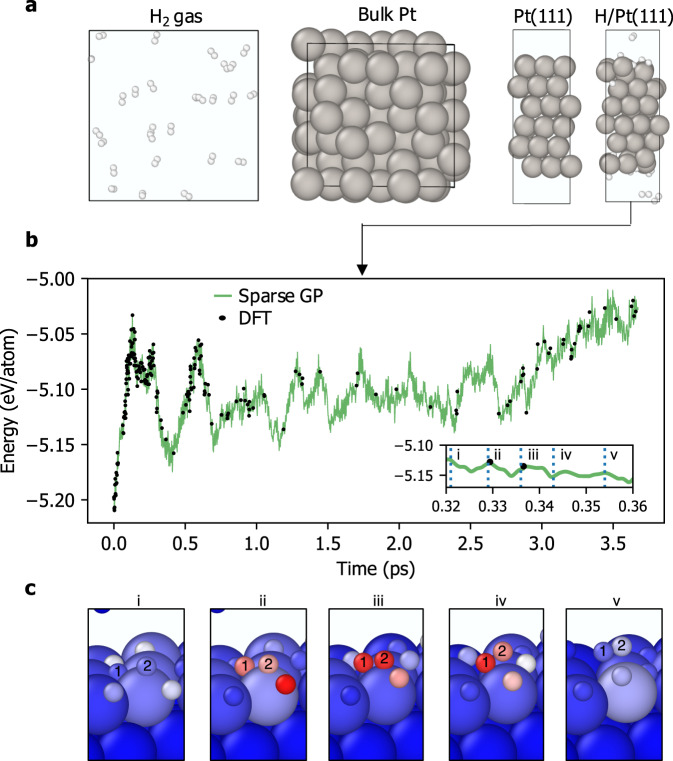
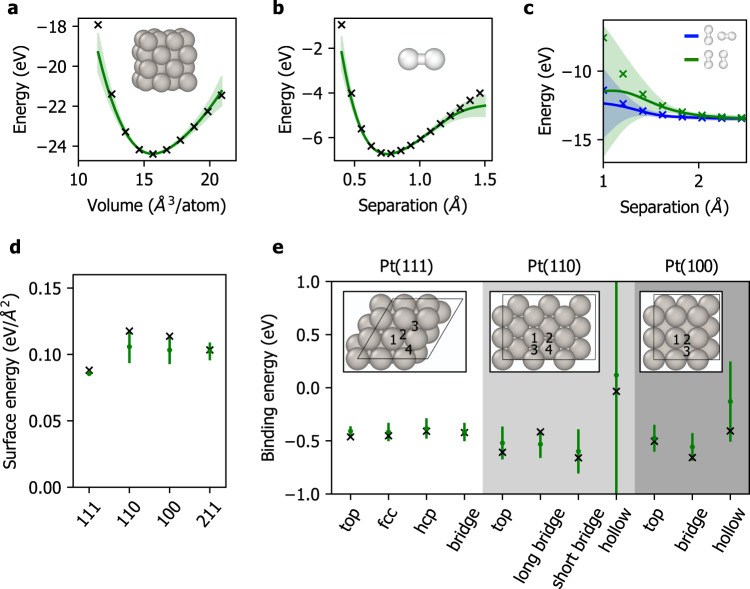
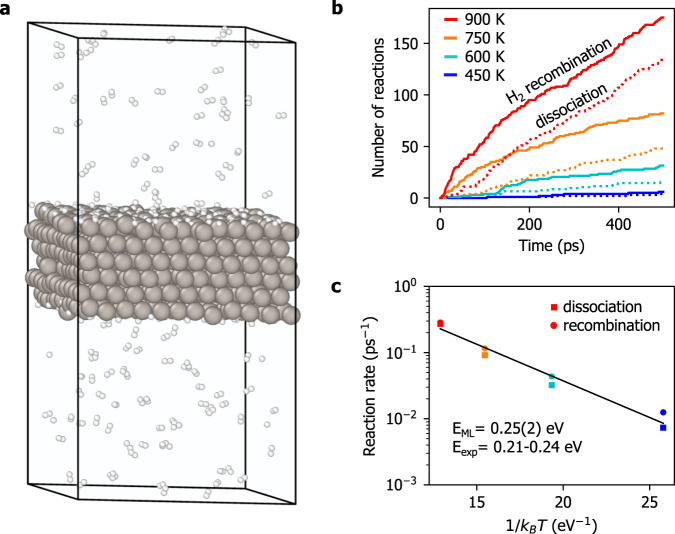
Verification
Claims the paper makes
The claims and statistics of this paper haven’t been checked yet.
Run the check — free, no account needed. It reads the open-access text and checks the sources it cites.
Claims other papers make about this one
Each is checked against this paper’s own text: does it say what the citing paper says it does?
The cited source says what the claim attributes to it.
In the citing paper
“A standard tool for accelerating the reactive sampling in zeolite-water systems, and thus reaching experimentally relevant timescale or realistic levels of model complexity is the class of reactive analytical potentials, for example, ReaxFF19. However, due to their fixed functional form, these potentials have limited transferability to systems with different chemical composition20.”
From A reactive neural network framework for water-loaded acidic zeolites (2024) · cites this paper as [20]
Self-check
Percentages, sums and reported differences re-computed from the paper’s own numbers.
The self-check needs the paper’s full text.
Citations
Cites
Generalized Gradient Approximation Made Simple
Perdew, J. P., Burke, K., & Ernzerhof, M. (1996) · Physical Review Letters · doi:10.1103/physrevlett.77.3865 · Cited by 215,824
Fast Parallel Algorithms for Short-Range Molecular Dynamics
Plimpton, S. (1995) · Journal of Computational Physics · doi:10.1006/jcph.1995.1039 · Cited by 44,721
Development and testing of a general amber force field
Wang, J.-M., Wolf, R., Caldwell, J., Kollman, P., & Case, D. (2004) · Journal of Computational Chemistry · doi:10.1002/jcc.20035 · Cited by 18,318
Vanommeslaeghe, K., Hatcher, E., Acharya, C., Kundu, S. C., Zhong, S., Shim, J. Y., Darian, E., Guvench, O., Lopes, P. E. M., Vorobyov, I. V., et al. (2009) · Journal of Computational Chemistry · doi:10.1002/jcc.21367 · Cited by 7,637
U1 snRNP regulates cancer cell migration and invasion in vitro
Oh, J.-M., Venters, C. C., Di, C., Pinto, A. M., Wan, L., Younis, I., Cai, Z., Arai, C., So, B. R., Duan, J., et al. (2020) · Nature Communications · doi:10.1038/s41467-019-13993-7 · Cited by 7,157
ReaxFF: A Reactive Force Field for Hydrocarbons
van Duin, A. V., Dasgupta, S., Lorant, F., & Goddard, W. (2001) · The Journal of Physical Chemistry A · doi:10.1021/jp004368u · Cited by 6,104
Generalized Neural-Network Representation of High-Dimensional Potential-Energy Surfaces
Behler, J., & Parrinello, M. (2007) · Physical Review Letters · doi:10.1103/physrevlett.98.146401 · Cited by 5,010
The atomic simulation environment—a Python library for working with atoms
Larsen, A. H., Mortensen, J. J., Blomqvist, J., Castelli, I. E., Christensen, R., Dułak, M., Friis, J., Groves, M. N., Hammer, B., Hargus, C., et al. (2017) · Journal of Physics Condensed Matter · doi:10.1088/1361-648x/aa680e · Cited by 4,790
Coupled-cluster theory in quantum chemistry
Bartlett, R. J., & Musiał, M. (2007) · Reviews of Modern Physics · doi:10.1103/revmodphys.79.291 · Cited by 3,343
Gaussian Approximation Potentials: The Accuracy of Quantum Mechanics, without the Electrons
Bartók, A. P., Payne, M. C., Kondor, R., & Csányi, G. (2010) · Physical Review Letters · doi:10.1103/physrevlett.104.136403 · Cited by 3,242
On representing chemical environments
Bartók, A. P., Kondor, R., & Csányi, G. (2013) · Physical Review B · doi:10.1103/physrevb.87.184115 · Cited by 2,572
The ReaxFF reactive force-field: development, applications and future directions
Senftle, T. P., Hong, S., Islam, M. M., Kylasa, S. B., Zheng, Y., Shin, Y. K., Junkermeier, C., Engel-Herbert, R., Janik, M. J., Aktulga, H. M., et al. (2016) · npj Computational Materials · doi:10.1038/npjcompumats.2015.11 · Cited by 2,363
SchNet – A deep learning architecture for molecules and materials
Schütt, K. T., Sauceda, H. E., Kindermans, P.-J., Tkatchenko, A., & Müller, K.-R. (2018) · The Journal of Chemical Physics · doi:10.1063/1.5019779 · Cited by 2,217
Ab initio molecular dynamics for liquid metals
Kresse, G. (1995) · Journal of Non-Crystalline Solids · doi:10.1016/0022-3093(95)00355-x · Cited by 2,160
The resurgence of covalent drugs
Singh, J., Petter, R. C., Baillie, T. A., & Whitty, A. (2011) · Nature Reviews Drug Discovery · doi:10.1038/nrd3410 · Cited by 1,873
A Unifying View of Sparse Approximate Gaussian Process Regression
Quiñonero-Candela, J., & Rasmussen, C. E. (2005) · doi:10.5555/1046920.1194909 · Cited by 1,708
Moment Tensor Potentials: A Class of Systematically Improvable Interatomic Potentials
Shapeev, A. V. (2016) · Multiscale Modeling and Simulation · doi:10.1137/15m1054183 · Cited by 1,506
Thompson, A. P., Swiler, L. P., Trott, C. R., Foiles, S. M., & Tucker, G. J. (2014) · Journal of Computational Physics · doi:10.1016/j.jcp.2014.12.018 · Cited by 1,122
Parallel reactive molecular dynamics: Numerical methods and algorithmic techniques
Aktulga, H. M., Fogarty, J. C., Pandit, S. A., & Grama, A. Y. (2011) · Parallel Computing · doi:10.1016/j.parco.2011.08.005 · Cited by 1,081
Atomic cluster expansion for accurate and transferable interatomic potentials
Drautz, R. (2019) · Physical review. B./Physical review. B · doi:10.1103/physrevb.99.014104 · Cited by 1,056
Assessing the performance of recent density functionals for bulk solids
Csonka, G. I., Perdew, J. P., Ruzsinszky, A., Philipsen, P., Lebègue∥, S., Paier, J. A., Vydrov, O. A., & Ángyán, J. G. (2009) · Physical Review B · doi:10.1103/physrevb.79.155107 · Cited by 1,037
Less is more: Sampling chemical space with active learning
Smith, J. S., Nebgen, B., Lubbers, N., Isayev, O., & Roitberg, A. E. (2018) · The Journal of Chemical Physics · doi:10.1063/1.5023802 · Cited by 811
Behler, J. (2017) · Angewandte Chemie International Edition · doi:10.1002/anie.201703114 · Cited by 713
Active learning of linearly parametrized interatomic potentials
Podryabinkin, E. V., & Shapeev, A. V. (2017) · Computational Materials Science · doi:10.1016/j.commatsci.2017.08.031 · Cited by 704
Machine learning based interatomic potential for amorphous carbon
Deringer, V. L., & Cśanyi, G. (2017) · Physical review. B./Physical review. B · doi:10.1103/physrevb.95.094203 · Cited by 696
Adsorption of hydrogen on a Pt(111) surface
Christmann, K., Ertl, G., & Pignet, T. (1976) · Surface Science · doi:10.1016/0039-6028(76)90232-6 · Cited by 683
On-the-fly machine learning force field generation: Application to melting points
Jinnouchi, R., Karsai, F., & Kresse, G. (2019) · Physical review. B./Physical review. B · doi:10.1103/physrevb.100.014105 · Cited by 680
Jinnouchi, R., Lahnsteiner, J., Karsai, F., Kresse, G., & Bokdam, M. (2019) · Physical Review Letters · doi:10.1103/physrevlett.122.225701 · Cited by 635
Molecular Dynamics with On-the-Fly Machine Learning of Quantum-Mechanical Forces
Li, Z., Kermode, J. R., & Vita, A. D. (2015) · Physical Review Letters · doi:10.1103/physrevlett.114.096405 · Cited by 628
Active learning of uniformly accurate interatomic potentials for materials simulation
Zhang, L., Lin, D.-Y., Wang, H., Car, R., & Weinan, E. (2019) · Physical Review Materials · doi:10.1103/physrevmaterials.3.023804 · Cited by 623
Wellendorff, J., Silbaugh, T. L., Pintos, D. G., Nørskov, J. K., Bligaard, T., Studt, F., & Campbell, C. T. (2015) · Surface Science · doi:10.1016/j.susc.2015.03.023 · Cited by 584
Heterogeneous Catalysis: A Central Science for a Sustainable Future
Friend, C. M., & Xu, B. (2017) · Accounts of Chemical Research · doi:10.1021/acs.accounts.6b00510 · Cited by 529
Machine Learning a General-Purpose Interatomic Potential for Silicon
Bartók, A. P., Kermode, J. R., Bernstein, N., & Cśanyi, G. (2018) · Physical Review X · doi:10.1103/physrevx.8.041048 · Cited by 514
On-the-fly active learning of interpretable Bayesian force fields for atomistic rare events
Vandermause, J., Torrisi, S. B., Batzner, S., Xie, Y., Sun, L., Kolpak, A. M., & Kozinsky, B. (2020) · npj Computational Materials · doi:10.1038/s41524-020-0283-z · Cited by 459
Self-citationSurface and Subsurface Hydrogen: Adsorption Properties on Transition Metals and Near-Surface Alloys
Greeley, J., & Mavrikakis, M. (2005) · The Journal of Physical Chemistry B · doi:10.1021/jp046540q · Cited by 435
Computational aspects of many-body potentials
Plimpton, S. J., & Thompson, A. P. (2012) · MRS Bulletin · doi:10.1557/mrs.2012.96 · Cited by 352
Origins of structural and electronic transitions in disordered silicon
Deringer, V. L., Bernstein, N., Cśanyi, G., Mahmoud, C. B., Ceriotti, M., Wilson, M., Drabold, D. A., & Elliott, S. R. (2021) · Nature · doi:10.1038/s41586-020-03072-z · Cited by 338
High-dimensional neural network potentials for metal surfaces: A prototype study for copper
Artrith, N., & Behler, J. (2012) · Physical Review B · doi:10.1103/physrevb.85.045439 · Cited by 326
Zeng, J., Cao, L., Xu, M., Zhu, T., & Zhang, J. Z. H. (2020) · Nature Communications · doi:10.1038/s41467-020-19497-z · Cited by 293
Luneau, M., Lim, J. S., Patel, D. A., Sykes, E. C. H., Friend, C. M., & Sautet, P. (2020) · Chemical Reviews · doi:10.1021/acs.chemrev.0c00582 · Cited by 290
Self-citationsGDML: Constructing accurate and data efficient molecular force fields using machine learning
Chmiela, S., Sauceda, H. E., Poltavsky, I., Müller, K., & Tkatchenko, A. (2019) · Computer Physics Communications · doi:10.1016/j.cpc.2019.02.007 · Cited by 256
Theoretical prediction of high melting temperature for a Mo–Ru–Ta–W HCP multiprincipal element alloy
Hong, Q., Schroers, J., Hofmann, D. C., Stefano Curtarolo, A., Asta, M., & van de Walle, A. (2021) · npj Computational Materials · doi:10.1038/s41524-020-00473-6 · Cited by 249
Extending the accuracy of the SNAP interatomic potential form
Wood, M. A., & Thompson, A. P. (2018) · The Journal of Chemical Physics · doi:10.1063/1.5017641 · Cited by 241
On-the-Fly Active Learning of Interatomic Potentials for Large-Scale Atomistic Simulations
Jinnouchi, R., Miwa, K., Karsai, F., Kresse, G., & Asahi, R. (2020) · The Journal of Physical Chemistry Letters · doi:10.1021/acs.jpclett.0c01061 · Cited by 213
De novo exploration and self-guided learning of potential-energy surfaces
Bernstein, N., Cśanyi, G., & Deringer, V. L. (2019) · npj Computational Materials · doi:10.1038/s41524-019-0236-6 · Cited by 203
Machine-learned interatomic potentials by active learning: amorphous and liquid hafnium dioxide
Sivaraman, G., Krishnamoorthy, A. N., Baur, M., Holm, C., Stan, M., Csányi, G., Benmore, C., & Vázquez-Mayagoitia, Á. (2020) · npj Computational Materials · doi:10.1038/s41524-020-00367-7 · Cited by 194
Molecular adsorption at Pt(111). How accurate are DFT functionals?
Gautier, S., Steinmann, S., Michel, C., Fleurat-Lessard, P., & Sautet, P. (2015) · Physical Chemistry, Chemical Physics - PCCP · doi:10.1039/c5cp04534g · Cited by 190
Yang, M., Bonati, L., Polino, D., & Parrinello, M. (2021) · Catalysis Today · doi:10.1016/j.cattod.2021.03.018 · Cited by 182
Quantum and classical dynamics of reactive scattering of H 2 from metal surfaces
Kroes, G., & Dı́az, C. (2015) · Chemical Society Reviews · doi:10.1039/c5cs00336a · Cited by 168
Machine-learned interatomic potentials by active learning: amorphous and liquid hafnium dioxide
Sivaraman, G., Krishnamoorthy, A. N., Baur, M., Holm, C., Stan, M., Cśanyi, G., Benmore, C. J., & Vázquez‐Mayagoitia, Á. (2019) · Cambridge University Engineering Department Publications Database · doi:10.17863/cam.55408 · Cited by 165
Park, C. W., Kornbluth, M., Vandermause, J., Wolverton, C. M., Kozinsky, B., & Mailoa, J. P. (2021) · npj Computational Materials · doi:10.1038/s41524-021-00543-3 · Cited by 159
Self-citationEfficient nonparametric n -body force fields from machine learning
Glielmo, A., Zeni, C., & Vita, A. D. (2018) · Physical review. B./Physical review. B · doi:10.1103/physrevb.97.184307 · Cited by 143
Handley, C. M., Hawe, G. I., Kell, D. B., & Popelier, P. L. A. (2009) · Physical Chemistry Chemical Physics · doi:10.1039/b905748j · Cited by 142
Hydrogen storage in carbon nanostructures via spillover
Pyle, D., Gray, E. M., & Webb, C. J. (2016) · International Journal of Hydrogen Energy · doi:10.1016/j.ijhydene.2016.08.061 · Cited by 141
A systematic DFT study of hydrogen diffusion on transition metal surfaces
Kristinsdóttir, L., & Skúlason, E. (2012) · Surface Science · doi:10.1016/j.susc.2012.04.028 · Cited by 140
Atomic cluster expansion: Completeness, efficiency and stability
Dusson, G., Bachmayr, M., Cśanyi, G., Drautz, R., Etter, S., van der Oord, C., & Ortner, C. (2022) · Journal of Computational Physics · doi:10.1016/j.jcp.2022.110946 · Cited by 139
Understanding Probabilistic Sparse Gaussian Process ApproximationsPreprint
Bauer, M., van der Wilk, M., & Rasmussen, C. E. (2016) · arXiv (Cornell University) · doi:10.48550/arxiv.1606.04820 · Cited by 123
A transferable active-learning strategy for reactive molecular force fields
Young, T. A., Johnston-Wood, T., Deringer, V. L., & Duarte, F. (2021) · Chemical Science · doi:10.1039/d1sc01825f · Cited by 92
Hajibabaei, A., Myung, C. W., & Kim, K. S. (2021) · Physical review. B./Physical review. B · doi:10.1103/physrevb.103.214102 · Cited by 83
Montano, M. O., Bratlie, K. M., Salmerón, M., & Somorjai, G. A. (2006) · Journal of the American Chemical Society · doi:10.1021/ja063703a · Cited by 79
Graham, A. P., Menzel, A., & Toennies, J. P. (1999) · The Journal of Chemical Physics · doi:10.1063/1.479427 · Cited by 77
Lim, J. S., Vandermause, J., Spronsen, M. A. V., Musaelian, A., Xie, Y., Sun, L., O'Connor, C. R., Egle, T., Molinari, N., Florian, J., et al. (2020) · Journal of the American Chemical Society · doi:10.1021/jacs.0c06401 · Cited by 73
Self-citationXie, Y., Vandermause, J., Sun, L., Cepellotti, A., & Kozinsky, B. (2021) · npj Computational Materials · doi:10.1038/s41524-021-00510-y · Cited by 72
Self-citationGai, L., Shin, Y. K., Raju, M., van Duin, A. C. T., & Raman, S. (2016) · The Journal of Physical Chemistry C · doi:10.1021/acs.jpcc.6b01064 · Cited by 56
Stable and Efficient Gaussian Process Calculations
Foster, L. V., Waagen, A., Aijaz, N., Hurley, M., Luis, A., Rinsky, J., Satyavolu, C. J., Way, M. J., Gazis, P. R., & Srivastava, A. N. (2009) · Cited by 56
Mailoa, J. P., Kornbluth, M., Batzner, S., Samsonidze, G. G., Lam, S., Vandermause, J., Ablitt, C., Molinari, N., & Kozinsky, B. (2019) · Nature Machine Intelligence · doi:10.1038/s42256-019-0098-0 · Cited by 53
Self-citationMachine Learning Estimates of Natural Product Conformational Energies
Rupp, M., Bauer, M. R., Wilcken, R., Lange, A., Reutlinger, M., Boeckler, F. M., & Schneider, G. (2014) · PLoS Computational Biology · doi:10.1371/journal.pcbi.1003400 · Cited by 44
Affinity and Selectivity Assessment of Covalent Inhibitors by Free Energy Calculations
Mihalovits, L. M., Ferenczy, G. G., & Keserű, G. M. (2020) · Journal of Chemical Information and Modeling · doi:10.1021/acs.jcim.0c00834 · Cited by 44
Chen, B. W. J., & Mavrikakis, M. (2019) · Catalysis Science & Technology · doi:10.1039/c9cy02338k · Cited by 35
On the dynamics of H2 adsorption on the Pt(111) surface
Kraus, P., & Frank, I. (2017) · International Journal of Quantum Chemistry · doi:10.1002/qua.25407 · Cited by 13
Ahmed, F., Nagumo, R., Miura, R., Suzuki, A., Tsuboi, H., Hatakeyama, N., Endou, A., Takaba, H., Kubo, M., & Miyamoto, A. (2011) · Applied Surface Science · doi:10.1016/j.apsusc.2011.07.028 · Cited by 8
Yang, M., Bonati, L., Polino, D., & Parrinello, M. (2020) · arXiv (Cornell University) · doi:10.48550/arxiv.2011.11455 · Cited by 6
Hajibabaei, A., Myung, C. W., & Kim, K. S. (2020) · arXiv (Cornell University) · Cited by 3
A Molecular Dynamics Study for Dissociation of H2 Molecule on Pt(111) Surface
Tokumasu, T. (2012) · Advanced materials research · doi:10.4028/scientific5/amr.452-453.1144 · Cited by 1
A Transferable Active-Learning Strategy for Reactive Molecular Force FieldsPreprint
Young, T., Johnston-Wood, T., Deringer, V. L., & Duarte, F. (2021) · ChemRxiv · doi:10.26434/chemrxiv.13856123 · Cited by 1
Research works printed but not linked: 1
- Bishop, C. M. Pattern Recognition and Machine Learning (Springer, 2006).
Cited by
Sorted by citations
Learning local equivariant representations for large-scale atomistic dynamics
Musaelian, A., Batzner, S., Johansson, A., Sun, L., Owen, C. J., Kornbluth, M., & Kozinsky, B. (2023) · Nature Communications · doi:10.1038/s41467-023-36329-y · Cited by 847
Self-citationA practical guide to machine learning interatomic potentials – Status and future
Jacobs, R. M., Morgan, D. D., Attarian, S., Meng, J., Shen, C., Wu, Z., Xie, C. Y., Yang, J. H., Artrith, N., Blaiszik, B. J., et al. (2025) · Current Opinion in Solid State and Materials Science · doi:10.1016/j.cossms.2025.101214 · Cited by 275
Self-citationBenavides-Hernández, J., & Dumeignil, F. (2024) · ACS Catalysis · doi:10.1021/acscatal.3c06293 · Cited by 217
Machine Learning Potentials for Heterogeneous Catalysis
Omranpour, A., Elsner, J., Lausch, K. N., & Behler, J. (2025) · ACS Catalysis · doi:10.1021/acscatal.4c06717 · Cited by 124
Hyperactive learning for data-driven interatomic potentials
van der Oord, C., Sachs, M., Kovács, D. P., Ortner, C., & Cśanyi, G. (2023) · npj Computational Materials · doi:10.1038/s41524-023-01104-6 · Cited by 125
Metadata
- Authors
- Vandermause, J., Xie, Y., Lim, J. S., Owen, C. J., & Kozinsky, B.
- Affiliations
- Harvard University (US)
- Corresponding author
- Vandermause, Jonathan
- Kozinsky, Boris
- Venue
- Nature Communications
- Published
- 2022-09-02
- Volume
- 13
- Issue
- 1
- Pages
- 5183-5183
- ISSN
- 2041-1723 (ISSN-L)
- PMC
- PMC9440250
- OpenAlex
- W4294316513
- Cited by
- 147
- References
- 73
- Citations by year
- 2026: 25 · 2025: 45 · 2024: 41 · 2023: 32 · 2022: 3
- FWCI
- 8.50
- Type
- journal article
- Language
- en
- Open access
- gold
- doi.org
- Locations
- Nature Communications (publishedVersion, cc-by)
- Research Square (acceptedVersion, cc-by)
- PubMed Central (publishedVersion, cc-by)
- PubMed (publishedVersion)
- arXiv (Cornell University) (submittedVersion)
- RePEc: Research Papers in Economics (submittedVersion)
- DOAJ (DOAJ: Directory of Open Access Journals) (submittedVersion, cc-by-sa)
- OSTI OAI (U.S. Department of Energy Office of Scientific and Technical Information) (submittedVersion)
- arXiv (Cornell University)
- Funders
- Robert Bosch
- National Science Foundation (1808162, DGE1745303)
- U.S. Department of Energy (DE-SC0020128, DE-SC0012573)
- Topics
- Physical Sciences › Materials Science › Materials Chemistry › Machine Learning in Materials Science
- Physical Sciences › Physics and Astronomy › Atomic and Molecular Physics, and Optics › Advanced Chemical Physics Studies
- Physical Sciences › Physics and Astronomy › Statistical and Nonlinear Physics › Model Reduction and Neural Networks
- Keywords
- reactive force field, Bayesian active learning, heterogeneous catalysis, polynomial surrogate models
About these checks
Registry, retraction, Cites and statistics results are computed, not judged, with one exception: a printed reference that no index lists is read once by a model before it counts as a citation error. Claims are extracted by a model and kept only when their quote appears verbatim in the text; each cited source is then checked, with a model’s help, for whether it says what the claim relies on. Those verdicts can be wrong — read the claim’s quote and the cited source before relying on one.
Statistics and arithmetic are recomputed, not judged.
Confidence bands are shown only for fields calibrated on our annotated test set. None is calibrated yet, so no band is shown.
What counts as a claim ›How we measure confidence ›How we check this ›
Are you an author, or do you see a problem with this page? Request a review
