

Versatile self-assembled electrospun micropyramid arrays for high-performance on-skin devices with minimal sensory interference
Open accessThe DOI matches its Crossref record; 64 of the 64 references it cites were found in a registry or an index.
Abstract
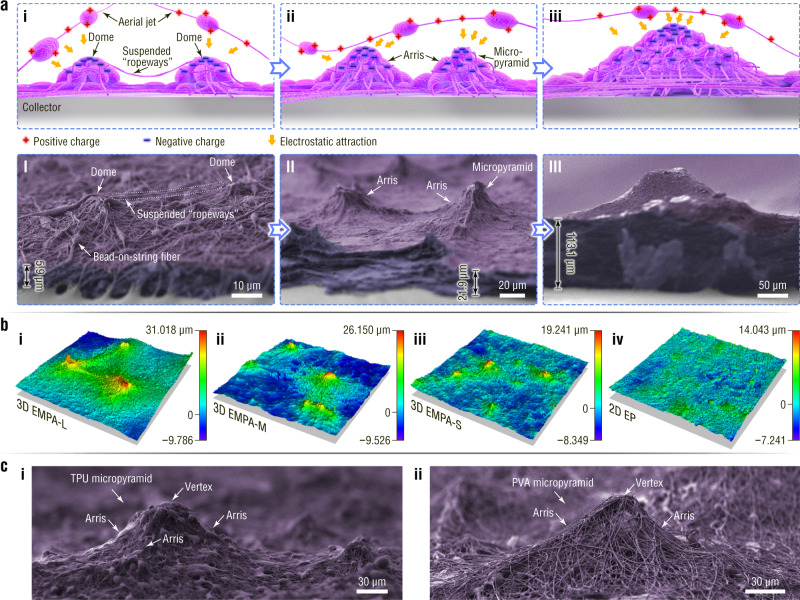
On-skin devices that show both high performance and imperceptibility are desired for physiological information detection, individual protection, and bioenergy conversion with minimal sensory interference. Herein, versatile electrospun micropyramid arrays (EMPAs) combined with ultrathin, ultralight, gas-permeable structures are developed through a self-assembly technology based on wet heterostructured electrified jets to endow various on-skin devices with both superior performance and imperceptibility. The designable self-assembly allows structural and material optimization of EMPAs for on-skin devices applied in daytime radiative cooling, pressure sensing, and bioenergy harvesting. A temperature drop of ~4 °C is obtained via an EMPA-based radiative cooling fabric under a solar intensity of 1 kW m–2. Moreover, detection of an ultraweak fingertip pulse for health diagnosis during monitoring of natural finger manipulation over a wide frequency range is realized by an EMPA piezocapacitive-triboelectric hybrid sensor, which has high sensitivity (19 kPa−1), ultralow detection limit (0.05 Pa), and ultrafast response (≤0.8 ms). Additionally, EMPA nanogenerators with high triboelectric and piezoelectric outputs achieve reliable biomechanical energy harvesting. The flexible self-assembly of EMPAs exhibits immense potential in superb individual healthcare and excellent human-machine interaction in an interference-free and comfortable manner.
Overview
The claims and statistics of this paper haven’t been checked yet.
Free: it reads the open-access text and checks the first 5 claims that cite a source we can check. Create a free account to check every claim.
Integrity signals
Registry
Cites
Statistics
Figures



Verification
Claims the paper makes
The claims and statistics of this paper haven’t been checked yet.
Free: it reads the open-access text and checks the first 5 claims that cite a source we can check. Create a free account to check every claim.
Claims other papers make about this one
Each is checked against this paper’s own text: does it say what the citing paper says it does?
The source backs part of the claim, not all of it — or backs it for a different population, condition or comparison.
In the citing paper
“These sensors can be directly applied to the skin or clothing to detect and transmit signals related to limb movement, body temperature, and sweat composition, enabling real-time monitoring and analysis of health, physical activity, and environmental information [23,202].”
From Design Strategies and Emerging Applications of Perovskite-Based Sensors (2025) · cites this paper as [23]
Experimental — accuracy not yet measured
Self-check
Percentages, sums and reported differences re-computed from the paper’s own numbers.
The self-check needs the paper’s full text.
Citations
Cites
Highly sensitive flexible pressure sensors with microstructured rubber dielectric layers
Mannsfeld, S. C. B., Tee, B. C.-K., Stoltenberg, R. M., Chen, C. V. H.-H., Barman, S., Muir, B. V. O., Sokolov, A. N., Reese, C., & Bao, Z. (2010) · Nature Materials · doi:10.1038/nmat2834 · Cited by 3,291
The effect of processing variables on the morphology of electrospun nanofibers and textiles
Deitzel, J. M., Kleinmeyer, J., Harris, D., & Beck Tan, N. C. (2001) · Polymer · doi:10.1016/s0032-3861(00)00250-0 · Cited by 2,915
An ultra-lightweight design for imperceptible plastic electronics
Kaltenbrunner, M., Sekitani, T., Reeder, J., Yokota, T., Kuribara, K., Tokuhara, T., Drack, M., Schwödiauer, R., Graz, I., Bauer-Gogonea, S., et al. (2013) · Nature · doi:10.1038/nature12314 · Cited by 2,485
Hierarchically porous polymer coatings for highly efficient passive daytime radiative cooling
Mandal, J., Fu, Y., Overvig, A. C., Jia, M., Sun, K., Shi, N. N., Zhou, H., Xiao, X., Yu, N., & Yang, Y. (2018) · Science · doi:10.1126/science.aat9513 · Cited by 2,211
Fan, F.-R., Lin, L., Zhu, G., Wu, W., Zhang, R., & Wang, Z. L. (2012) · Nano Letters · doi:10.1021/nl300988z · Cited by 1,985
Theoretical study of contact-mode triboelectric nanogenerators as an effective power source
Niu, S., Wang, S., Lin, L., Liu, Y., Zhou, Y. S., Hu, Y., & Wang, Z. L. (2013) · Energy & Environmental Science · doi:10.1039/c3ee42571a · Cited by 1,956
Heart rate variability as an index of regulated emotional responding
Appelhans, B. M., & Luecken, L. J. (2006) · Review of General Psychology · doi:10.1037/1089-2680.10.3.229 · Cited by 1,893
A radiative cooling structural material
Li, T., Zhai, Y., He, S., Gan, W., Wei, Z., Heidarinejad, M., Dalgo, D., Mi, R., Zhao, X., Song, J., et al. (2019) · Science · doi:10.1126/science.aau9101 · Cited by 1,614
Pan, L., Chortos, A., Yu, G., Wang, Y., Isaacson, S., Allen, R., Shi, Y., Dauskardt, R., & Bao, Z. (2014) · Nature Communications · doi:10.1038/ncomms4002 · Cited by 1,519 · cited 14×
“Moreover, a black cotton- The universe –270 °C Atmospheric window Sun EMPA ba c 58 °C 28 °C 28 °C 58 °C Skin 3D EMPA-L Black fabric Fabric d 0 250 500 750 1000 1250 1500 1750 2000 -4.0 -3.5 -3.0 -2.5 -2.0 -1.5 -1.0 -0.5 0.0 So la ri nt en si ty of 1 kW m 2 Te m pe ra tu re Di ffe re nc e [° C] Time [s] 3D EMPA-L 3D EM…”
BackgroundInfluentialSelf-citationChoong, C., Shim, M., Lee, B., Jeon, S., Ko, D., Kang, T., Bae, J., Lee, S. H., Byun, K., Im, J., et al. (2014) · Advanced Materials · doi:10.1002/adma.201305182 · Cited by 1,252
Research works printed but not linked: 1
- Koshy, A. & Koshy, G. M. The potential of physiological monitoring technologies in esports. I. J. Esports. 1, 1–11 (2020).
Cited by
Ji, D., Lin, Y., Guo, X., Ramasubramanian, B., Wang, R., Radacsi, N., Jose, R., Qin, X., & Ramakrishna, S. (2024) · Nature Reviews Methods Primers · doi:10.1038/s43586-023-00278-z · Cited by 756
“As a result, they have potential in individual health care and human–machine interaction 273 .”
Porous Conductive Textiles for Wearable Electronics
Ding, Y., Jiang, J., Wu, Y., Zhang, Y., Zhou, J., Zhang, Y., Huang, Q., & Zheng, Z. (2024) · Chemical Reviews · doi:10.1021/acs.chemrev.3c00507 · Cited by 269
Shi, J., Dai, Y., Cheng, Y., Xie, S., Li, G., Liu, Y., Wang, J., Zhang, R., Bai, N., Cai, M., et al. (2023) · Science Advances · doi:10.1126/sciadv.adf8831 · Cited by 243
Zhu, L., Tian, L., Jiang, S., Han, L., Liang, Y., Li, Q., & Chen, S. (2023) · Chemical Society Reviews · doi:10.1039/d3cs00500c · Cited by 240
Self-citationChen, Y., Zhang, X., & Lu, C. (2024) · Chemical Science · doi:10.1039/d4sc05166a · Cited by 188
“Over the years, researchers have focused on successfully introducing various micro-geometric structures into the piezoelectric materials, including micro-pyramids, 31,147,155,163 micro-pillars, 164 micro-ribbons, 30 and wavy, 165 hemispherical 148,153 and biomimetic structures.”
Influential
Metadata
- Authors
- Zhang, J.-H., Li, Z., Xu, J., Li, J., Yan, K., Cheng, W., Xin, M., Zhu, T., Du, J., Chen, S., An, X., Zhou, Z., Cheng, L., Ying, S., Zhang, J., Gao, X., Zhang, Q., Jia, X., Shi, Y., & Pan, L.
- Affiliations
- Collaborative Innovation Center of Advanced Microstructures (CN)
- Hohai University (CN)
- Shanxi Provincial People’s Hospital (CN)
- Nanjing University (CN)
- Inner Mongolia University of Science and Technology (CN)
- Corresponding author
- Shi, Yi
- Pan, Lijia
- ORCID
- Venue
- Nature Communications
- Published
- 2022-10-03
- Volume
- 13
- Issue
- 1
- Pages
- 5839-5839
- ISSN
- 2041-1723 (ISSN-L)
- PMC
- PMC9530173
- OpenAlex
- W4300594156
- Cited by
- 239
- References
- 64
- Citations by year
- 2026: 36 · 2025: 81 · 2024: 64 · 2023: 54 · 2022: 4
- FWCI
- 14.75
- Type
- journal article
- Language
- en
- Open access
- gold
- doi.org
- Licence
- cc-by
- creativecommons.org/licenses/by/4.0 (tdm)
- creativecommons.org/licenses/by/4.0 (vor)
- Locations
- Nature Communications (publishedVersion, cc-by)
- PubMed Central (publishedVersion, cc-by)
- PubMed (publishedVersion)
- RePEc: Research Papers in Economics (submittedVersion)
- DOAJ (DOAJ: Directory of Open Access Journals) (submittedVersion, cc-by-sa)
- Funders
- National Natural Science Foundation of China (61825403, 61,921,005, 2021YFA1401103, 61674078)
- Government of Jiangsu Province
- Zhejiang Ocean University
- Hohai University (B220203014)
- Priority Academic Program Development of Jiangsu Higher Education Institutions
- National Key Research and Development Program of China (2021YFA1401103, 61825403, 61674078, 61921005)
- Topics
- Physical Sciences › Engineering › Biomedical Engineering › Advanced Sensor and Energy Harvesting Materials
- Physical Sciences › Materials Science › Biomaterials › Electrospun Nanofibers in Biomedical Applications
- Physical Sciences › Engineering › Civil and Structural Engineering › Thermal Radiation and Cooling Technologies
- Keywords
- self-assembly, pressure sensing, nanogenerators, bioenergy harvesting, wearable sensors, human-machine interaction
- MeSH terms
- Wearable Electronic Devices, Fingers, Humans, Skin, Textiles
About these checks
Registry, retraction, Cites and statistics results are computed, not judged, with one exception: a printed reference that no index lists is read once by a model before it counts as a citation error. Claims are extracted by a model and kept only when their quote appears verbatim in the text; each cited source is then checked, with a model’s help, for whether it says what the claim relies on. Those verdicts can be wrong — read the claim’s quote and the cited source before relying on one.
Statistics and arithmetic are recomputed, not judged.
Confidence bands are shown only for fields calibrated on our annotated test set. None is calibrated yet, so no band is shown.
What counts as a claim ›How we measure confidence ›How we check this ›
Are you an author, or do you see a problem with this page? Request a review
How to cite
Cite CoChat for the checks on this page, and the paper for its own findings.
- This page
- CoChat. (2026). Citation check: Versatile self-assembled electrospun micropyramid arrays for high-performance on-skin devices with minimal sensory interference. https://app.cochat.ai/papers/10.1038/s41467-022-33454-y
- The paper
- Zhang, J.-H., Li, Z., Xu, J., Li, J., Yan, K., Cheng, W., Xin, M., Zhu, T., Du, J., Chen, S., An, X., Zhou, Z., Cheng, L., Ying, S., Zhang, J., Gao, X., Zhang, Q., Jia, X., Shi, Y., & Pan, L. (2022). Versatile self-assembled electrospun micropyramid arrays for high-performance on-skin devices with minimal sensory interference. Nature Communications. https://doi.org/10.1038/s41467-022-33454-y
Data sources
Bibliographic data: Semantic Scholar, OpenAlex, Crossref.
Contains information from the Semantic Scholar Academic Graph Datasets, made available under the ODC Attribution License (ODC-BY 1.0).
Semantic Scholar’s data is described in: Kinney, R., et al. (2023). The Semantic Scholar Open Data Platform. arXiv:2301.10140.
