

No evidence of worsening Arctic springtime ozone losses over the 21st century
Open accessThe DOI matches its Crossref record; 26 of the 26 references it cites were found in a registry or an index.
Abstract
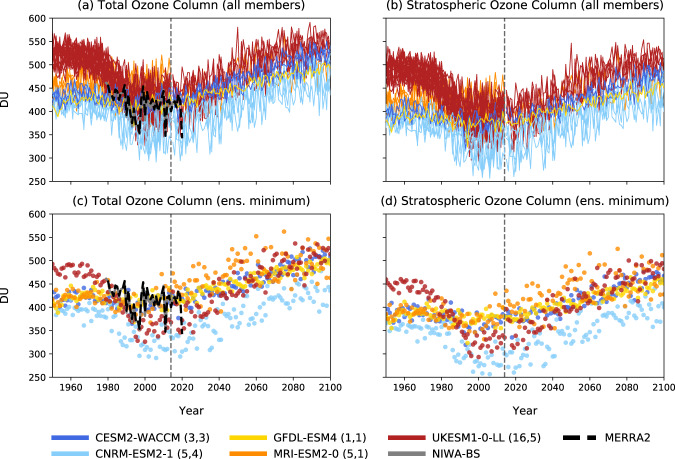
The Montreal Protocol, now ratified by all 198 members of the United Nations, has proven highly effective at mitigating ozone loss and protecting the ozone later. However, a recent paper 1 in this journal claims that large Arctic springtime ozone losses—driven by chemical processes—could persist or even worsen until the end of this century as a consequence of increasing levels of carbon dioxide. Here we show that such a claim is at odds with the extant literature on the subject, including the latest and most sophisticated modelling studies, which robustly indicate how increased levels of carbon dioxide cause higher, not lower, ozone levels. Hence the alarmist message of that paper is inconsistent with the current understanding of past and future ozone trends.
Overview
The claims and statistics of this paper haven’t been checked yet.
Free: it reads the open-access text and checks the first 5 claims that cite a source we can check. Create a free account to check every claim.
Integrity signals
Registry
Cites
Statistics
Figures
Verification
Claims the paper makes
The claims and statistics of this paper haven’t been checked yet.
Free: it reads the open-access text and checks the first 5 claims that cite a source we can check. Create a free account to check every claim.
Self-check
Percentages, sums and reported differences re-computed from the paper’s own numbers.
The self-check needs the paper’s full text.
Citations
Cites
The Modern-Era Retrospective Analysis for Research and Applications, Version 2 (MERRA-2)
Gelaro, R., McCarty, W., Suárez, M. J., Todling, R., Molod, A., Takacs, L., Randles, C. A., Darmenov, A., Bosilovich, M. G., Reichle, R., et al. (2017) · Journal of Climate · doi:10.1175/jcli-d-16-0758.1 · Cited by 9,010
Large losses of total ozone in Antarctica reveal seasonal ClOx/NOx interaction
Farman, J. C., Gardiner, B. G., & Shanklin, J. D. (1985) · Nature · doi:10.1038/315207a0 · Cited by 3,520
Stratospheric ozone depletion: A review of concepts and history
Solomon, S. (1999) · Reviews of Geophysics · doi:10.1029/1999rg900008 · Cited by 2,008
On the depletion of Antarctic ozone
Solomon, S., Garcia, R. R., Rowland, F. S., & Wuebbles, D. J. (1986) · Nature · doi:10.1038/321755a0 · Cited by 1,558
Emergence of healing in the Antarctic ozone layer
Solomon, S., Ivy, D. J., Kinnison, D., Mills, M. J., Neely, R. R., & Schmidt, A. (2016) · Science · doi:10.1126/science.aae0061 · Cited by 734
Unprecedented Arctic ozone loss in 2011
Manney, G. L., Santee, M. L., Rex, M., Livesey, N. J., Pitts, M. C., Veefkind, P., Nash, E. R., Wohltmann, I., Lehmann, R., Froidevaux, L., et al. (2011) · Nature · doi:10.1038/nature10556 · Cited by 639
Arctic ozone loss and climate change
Rex, M., Salawitch, R. J., von der Gathen, P., Harris, N. R. P., Chipperfield, M. P., & Naujokat, B. (2004) · Geophysical Research Letters · doi:10.1029/2003gl018844 · Cited by 347
Multimodel projections of stratospheric ozone in the 21st century
Eyring, V., Waugh, D. W., Bodeker, G. E., Cordero, E., Akiyoshi, H., Austin, J., Beagley, S. R., Boville, B. A., Braesicke, P., Brühl, C., et al. (2007) · Journal of Geophysical Research: Atmospheres · doi:10.1029/2006jd008332 · Cited by 330
Long‐term ozone changes and associated climate impacts in CMIP5 simulations
Eyring, V., Arblaster, J. M., Cionni, I., Sedláček, J., Perlwitz, J., Young, P. J., Bekki, S., Bergmann, D., Cameron‐Smith, P., Collins, W. J., et al. (2013) · Journal of Geophysical Research: Atmospheres · doi:10.1002/jgrd.50316 · Cited by 324
Montzka, S. A., Butler, J. H., Myers, R. C., Thompson, T. M., Swanson, T. H., Clarke, A. D., Lock, L. T., & Elkins, J. W. (1996) · Science · doi:10.1126/science.272.5266.1318 · Cited by 321
Cited by
Neale, P. J., Hylander, S., Banaszak, A. T., Häder, D.-P., Rose, K. C., Vione, D., Wängberg, S.-Å., Jansen, M. A. K., Busquets, R., Andersen, M. P. S., et al. (2025) · Photochemical & Photobiological Sciences · doi:10.1007/s43630-025-00687-x · Cited by 32
“This finding was challenged in a study by Polvani et al. [14] who found, based on chemistry-climate models with interactive ozone chemistry, that Arctic ozone depletion will lessen over this period.”
Self-citationWeakening of springtime Arctic ozone depletion with climate change
Friedel, M., Chiodo, G., Sukhodolov, T., Keeble, J., Peter, T., Seeber, S., Stenke, A., Akiyoshi, H., Rozanov, E., Plummer, D., et al. (2023) · Atmospheric Chemistry and Physics · doi:10.5194/acp-23-10235-2023 · Cited by 18
“This result has sparked much discussion on the reliability of simulated stratospheric ozone and the accuracy of methodologies used to derive Arctic ozone minima (Polvani et al., 2023; von der Gathen et al., 2023).”
MethodSelf-citationOlejnik, A., Jóźwiak, H., Gancewski, M., Sánchez, E. Q., Dawes, R., & Wcisło, P. (2023) · The Journal of Chemical Physics · doi:10.1063/5.0169968 · Cited by 12
Reply to: No evidence of worsening Arctic springtime ozone losses over the 21st century
von der Gathen, P., Kivi, R., Wohltmann, I., Salawitch, R. J., & Rex, M. (2023) · Nature Communications · doi:10.1038/s41467-023-37135-2 · Cited by 6
“Reply to: No evidence of worsening Arctic springtime ozone losses over the 21st century Peter von der Gathen 1 , Rigel Kivi 2, Ingo Wohltmann 1, Ross J. Salawitch 3 & Markus Rex 1,4 REPLYING TO L. M. Polvani et al. Nature Communications https://doi.org/10.1038/ s41467-023-37134-3 (2023) Long-term declines in the thick…”
BackgroundInfluentialKumar, A., Karami, K., & Jacobi, C. (2025) · Climate Dynamics · doi:10.1007/s00382-025-07889-0 · Cited by 7
“This approach has also been emphasized by Gathen et al. (2021 ), Gathen et al. ( 2023 ), Polvani et al. (2023).”
Kumar, A., Karami, K., Jacobi, C., & Mehrdad, S. (2025) · Journal of Atmospheric and Solar-Terrestrial Physics · doi:10.1016/j.jastp.2025.106538 · Cited by 3
Kumar, A., Mandal, J., Mehrdad, S., & Jacobi, C. (2025) · Scientific Reports · doi:10.1038/s41598-025-24379-9 · Cited by 3
Are springtime Arctic ozone columns predictable from wintertime conditions?
Rieder, H. E., Kult-Herdin, J., Polvani, L. M., Solomon, S., & Kuchař, A. (2025) · Frontiers in Earth Science · doi:10.3389/feart.2025.1610651 · Cited by 1
“Another potential predictor for Arctic ozone abundances is eddy heat flux (EHF) at 100 hPa, which has been widely utilized to characterize wave influence on the vortex state and the Brewer-Dobson Circulation and thus ozone transport (e.g., Weber et al., 2011; Friedel et al., 2023).”
Self-citationVargin, P. N., Tsvetkova, N. D., Chubarova, N., Rozanov, E., Smyshlyaev, S. P., & Владимирович, Г. В. (2026) · Atmosphere · doi:10.3390/atmos17070674
“The conclusions of [29] were criticized by Polvani et al. [31], who argue that, despite the decrease in stratospheric temperatures, all climate models of CMIP5 show an increase in both global and Arctic ozone by the end of the 21st century due to the reduction in ODS concentrations.”
Čížková, K., Láska, K., Tichopád, D., Staněk, M., von Löwis, S., Metelka, L., & Stráník, M. (2026) · Theoretical and Applied Climatology · doi:10.1007/s00704-026-06683-0
“…and the uncertain future impacts of global climate change (compare, e.g., Pommereau et al. 2018 ; von der Gathen et al. 2021; and the following discussion including Polvani et al. 2023; and Friedel et al. 2023), TCO monitoring is still of great importance in the northern polar and subpolar regions.”
Influential
Metadata
- Authors
- Polvani, L. M., Keeble, J., Banerjee, A., Checa-Garcia, R., Chiodo, G., Rieder, H. E., & Rosenlof, K. H.
- Affiliations
- Lamont-Doherty Earth Observatory (US)
- University of Cambridge (GB)
- National Oceanic and Atmospheric Administration (US)
- ETH Zurich (CH)
- BOKU University (AT)
- Corresponding author
- Polvani, L. M.
- Venue
- Nature Communications
- Published
- 2023-03-24
- Volume
- 14
- Issue
- 1
- Pages
- 1608-1608
- ISSN
- 2041-1723 (ISSN-L)
- PMC
- PMC10039004
- OpenAlex
- W4360853959
- Cited by
- 10
- References
- 26
- Citations by year
- 2026: 2 · 2025: 5 · 2023: 3
- FWCI
- 1.10
- Type
- journal article
- Language
- en
- Open access
- gold
- doi.org
- Licence
- cc-by
- creativecommons.org/licenses/by/4.0 (tdm)
- creativecommons.org/licenses/by/4.0 (vor)
- Locations
- Nature Communications (publishedVersion, cc-by)
- PubMed Central (publishedVersion, cc-by)
- PubMed (publishedVersion)
- Apollo (University of Cambridge) (submittedVersion, cc-by)
- RePEc: Research Papers in Economics (submittedVersion)
- DOAJ (DOAJ: Directory of Open Access Journals) (submittedVersion, cc-by-sa)
- Lancaster EPrints (Lancaster University) (submittedVersion)
- NOAA Institutional Repository (submittedVersion, cc-by)
- Repository for Publications and Research Data (ETH Zurich) (submittedVersion, cc-by)
- Apollo
- Apollo (cc-by)
- ETH Zürich Research Collection
- Funders
- National Science Foundation (1914569)
- Topics
- Physical Sciences › Earth and Planetary Sciences › Atmospheric Science › Atmospheric Ozone and Climate
- Physical Sciences › Earth and Planetary Sciences › Atmospheric Science › Atmospheric chemistry and aerosols
- Physical Sciences › Environmental Science › Global and Planetary Change › Climate variability and models
- Keywords
- Montreal Protocol, carbon dioxide, ozone trends, stratospheric ozone, ozone recovery, chemical ozone loss
About these checks
Registry, retraction, Cites and statistics results are computed, not judged, with one exception: a printed reference that no index lists is read once by a model before it counts as a citation error. Claims are extracted by a model and kept only when their quote appears verbatim in the text; each cited source is then checked, with a model’s help, for whether it says what the claim relies on. Those verdicts can be wrong — read the claim’s quote and the cited source before relying on one.
Statistics and arithmetic are recomputed, not judged.
Confidence bands are shown only for fields calibrated on our annotated test set. None is calibrated yet, so no band is shown.
What counts as a claim ›How we measure confidence ›How we check this ›
Are you an author, or do you see a problem with this page? Request a review
Data sources
Bibliographic data: Semantic Scholar, OpenAlex, Crossref.
Contains information from the Semantic Scholar Academic Graph Datasets, made available under the ODC Attribution License (ODC-BY 1.0).
Semantic Scholar’s data is described in: Kinney, R., et al. (2023). The Semantic Scholar Open Data Platform. arXiv:2301.10140.
