

The DOI matches its Crossref record; 57 of the 57 references it cites were found in a registry or an index.
Robust automated backbone triple resonance NMR assignments of proteins using Bayesian-based simulated annealing
Open accessPublished version of a preprint
Abstract
Assignment of resonances of nuclear magnetic resonance (NMR) spectra to specific atoms within a protein remains a labor-intensive and challenging task. Automation of the assignment process often remains a bottleneck in the exploitation of solution NMR spectroscopy for the study of protein structure-dynamics-function relationships. We present an approach to the assignment of backbone triple resonance spectra of proteins. A Bayesian statistical analysis of predicted and observed chemical shifts is used in conjunction with inter-spin connectivities provided by triple resonance spectroscopy to calculate a pseudo-energy potential that drives a simulated annealing search for the most optimal set of resonance assignments. Termed Bayesian Assisted Assignments by Simulated Annealing (BARASA), a C++ program implementation is tested against systems ranging in size to over 450 amino acids including examples of intrinsically disordered proteins. BARASA is fast, robust, accommodates incomplete and incorrect information, and outperforms current algorithms – especially in cases of sparse data and is sufficiently fast to allow for real-time evaluation during data acquisition.
Overview
The claims and statistics of this paper haven’t been checked yet.
Run the check — free, no account needed. It reads the open-access text and checks the sources it cites.
Integrity signals
Registry
Cites
Statistics
Figures
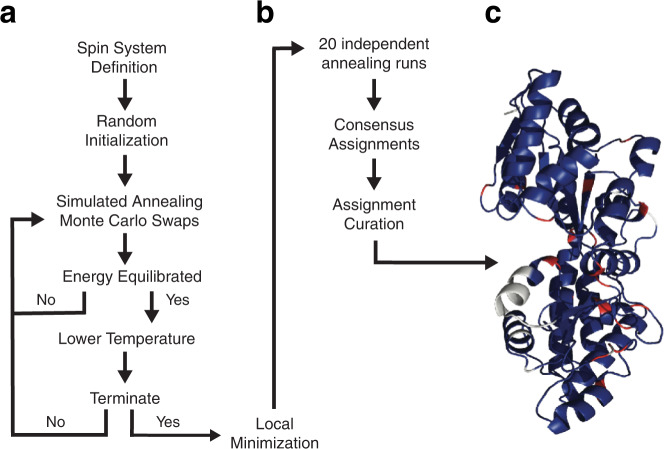
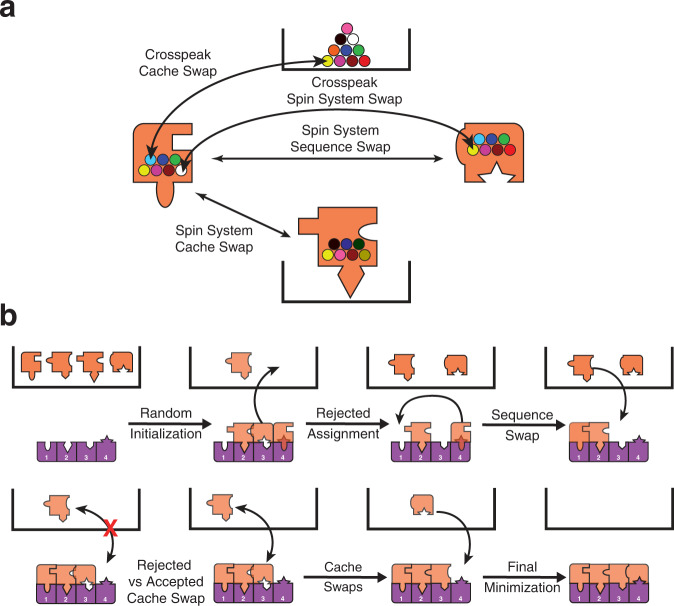
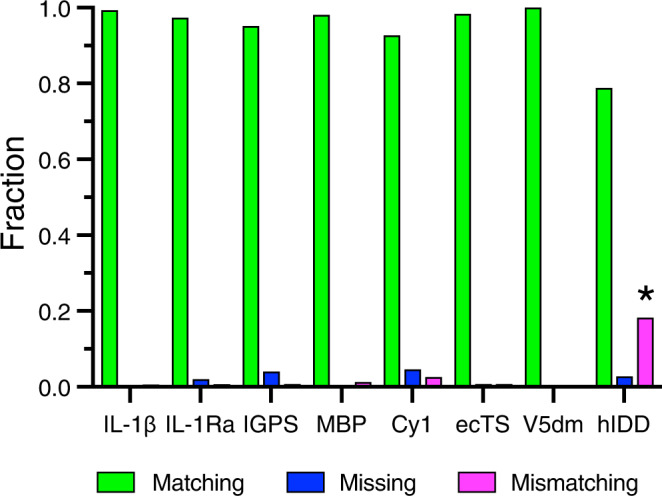
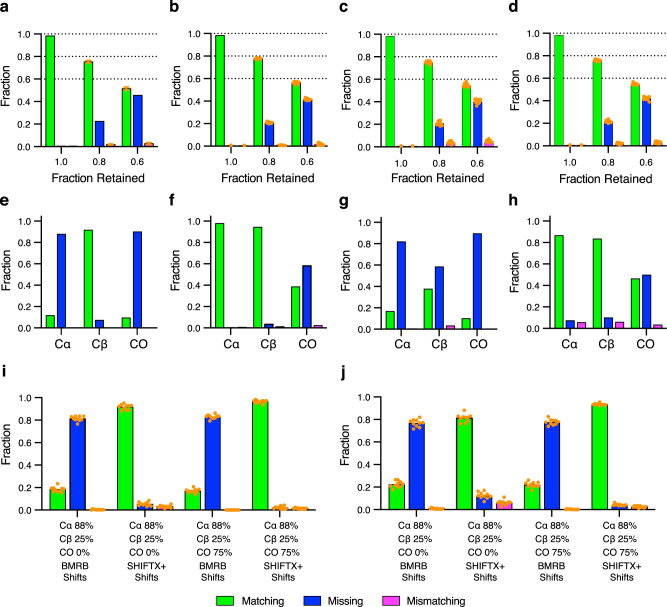
Verification
Claims the paper makes
The claims and statistics of this paper haven’t been checked yet.
Run the check — free, no account needed. It reads the open-access text and checks the sources it cites.
Self-check
Percentages, sums and reported differences re-computed from the paper’s own numbers.
The self-check needs the paper’s full text.
Citations
Cites
Optimization by Simulated Annealing
Kirkpatrick, S., Gelatt, C. D., & Vecchi, M. P. (1983) · Science · doi:10.1126/science.220.4598.671 · Cited by 45,134
Highly accurate protein structure prediction with AlphaFold
Jumper, J., Evans, R., Pritzel, A., Green, T., Figurnov, M., Ronneberger, O., Tunyasuvunakool, K., Bates, R., Žídek, A., Potapenko, A., et al. (2021) · Nature · doi:10.1038/s41586-021-03819-2 · Cited by 43,764
Berman, H. M. (2000) · Nucleic Acids Research · doi:10.1093/nar/28.1.235 · Cited by 40,196
Equation of State Calculations by Fast Computing Machines
Metropolis, N., Rosenbluth, A. W., Rosenbluth, M. N., Teller, A. H., & Teller, E. (1953) · The Journal of Chemical Physics · doi:10.1063/1.1699114 · Cited by 37,192
NMRPipe: A multidimensional spectral processing system based on UNIX pipes
Delaglio, F., Grzesiek, S., Vuister, G., Zhu, G., Pfeifer, J., & Bax, A. (1995) · Journal of Biomolecular NMR · doi:10.1007/bf00197809 · Cited by 15,965
Pervushin, K. V., Riek, R., Wider, G., & Kurt Wüthrich, A. (1997) · Proceedings of the National Academy of Sciences · doi:10.1073/pnas.94.23.12366 · Cited by 2,450
NMRFAM-SPARKY: enhanced software for biomolecular NMR spectroscopy
Lee, W., Tonelli, M., & Markley, J. L. (2014) · Bioinformatics · doi:10.1093/bioinformatics/btu830 · Cited by 2,045
Tjandra, N., & Bax, A. (1997) · Science · doi:10.1126/science.278.5340.1111 · Cited by 1,733
Sattler, M. (1999) · Progress in Nuclear Magnetic Resonance Spectroscopy · doi:10.1016/s0079-6565(98)00025-9 · Cited by 1,721
Ulrich, E. L., Akutsu, H., Doreleijers, J. F., Harano, Y., Ioannidis, Y., Lin, J. C., Livny, M., Mading, S., Maziuk, D., Miller, Z., et al. (2007) · Nucleic Acids Research · doi:10.1093/nar/gkm957 · Cited by 1,472
Grzesiek, S., & Bax, A. (1992) · Journal of the American Chemical Society · doi:10.1021/ja00042a003 · Cited by 1,029
Ikura, M., Kay, L. E., & Bax, A. (1990) · Biochemistry · doi:10.1021/bi00471a022 · Cited by 922
Wittekind, M. G., & Mueller, L. J. (1993) · Journal of Magnetic Resonance Series B · doi:10.1006/jmrb.1993.1033 · Cited by 863
SHIFTX2: significantly improved protein chemical shift prediction
Han, B., Liu, Y., Ginzinger, S. W., & Wishart, D. S. (2011) · Journal of Biomolecular NMR · doi:10.1007/s10858-011-9478-4 · Cited by 671
THE USE OF2H,13C,15N MULTIDIMENSIONAL NMR GTO STUDY THE STRUCTURE AND DYNAMICS OF PROTEINS
Gardner, K. H., & Kay, L. E. (1998) · Annual Review of Biophysics and Biomolecular Structure · doi:10.1146/annurev.biophys.27.1.357 · Cited by 598
Sequential resonance assignments in protein 1H nuclear magnetic resonance spectra
Billeter, M., Braun, W. A., & Wüthrich, K. (1982) · Journal of Molecular Biology · doi:10.1016/0022-2836(82)90008-0 · Cited by 582
Wüthrich, K., Wider, G., Wagner, G. H., & Braun, W. A. (1982) · Journal of Molecular Biology · doi:10.1016/0022-2836(82)90007-9 · Cited by 576
Shen, Y., & Bax, A. (2010) · Journal of Biomolecular NMR · doi:10.1007/s10858-010-9433-9 · Cited by 552
NMRbox: A Resource for Biomolecular NMR Computation
Maciejewski, M. W., Schuyler, A. D., Gryk, M. R., Moraru, I. I., Romero, P. R., Ulrich, E. L., Eghbalnia, H. R., Livny, M., Delaglio, F., & Hoch, J. C. (2017) · Biophysical Journal · doi:10.1016/j.bpj.2017.03.011 · Cited by 518
Hyberts, S. G., Milbradt, A. G., Wagner, A. B., Arthanari, H., & Wagner, G. (2012) · Journal of Biomolecular NMR · doi:10.1007/s10858-012-9611-z · Cited by 450
Bax, A., & Ikura, M. (1991) · Journal of Biomolecular NMR · doi:10.1007/bf01874573 · Cited by 340
Random coil chemical shift for intrinsically disordered proteins: effects of temperature and pH
Kjaergaard, M., Brander, S., & Poulsen, F. M. (2011) · Journal of Biomolecular NMR · doi:10.1007/s10858-011-9472-x · Cited by 313
Automated analysis of protein NMR assignments using methods from artificial intelligence
Zimmerman, D. E., Kulikowski, C. A., Huang, Y., Feng, W., Tashiro, M., Shimotakahara, S., Chien, C.-Y., Powers, R., & Montelione, G. T. (1997) · Journal of Molecular Biology · doi:10.1006/jmbi.1997.1052 · Cited by 306
Kjaergaard, M., & Poulsen, F. M. (2011) · Journal of Biomolecular NMR · doi:10.1007/s10858-011-9508-2 · Cited by 297
GPCR drug discovery: integrating solution NMR data with crystal and cryo-EM structures
Shimada, I., Ueda, T., Kofuku, Y., Eddy, M. T., & Wüthrich, K. (2018) · Nature Reviews Drug Discovery · doi:10.1038/nrd.2018.180 · Cited by 291
Clubb, R. T., Thanabal, V., & Wagner, G. H. (1992) · Journal of Magnetic Resonance (1969) · doi:10.1016/0022-2364(92)90252-3 · Cited by 287
Chemical exchange in biomacromolecules: Past, present, and future
Palmer, A. G. (2014) · Journal of Magnetic Resonance · doi:10.1016/j.jmr.2014.01.008 · Cited by 263
Clore, G. M., & Gronenborn, A. M. (1991) · Progress in Nuclear Magnetic Resonance Spectroscopy · doi:10.1016/0079-6565(91)80002-j · Cited by 244
NMR spectroscopy captures the essential role of dynamics in regulating biomolecular function
Alderson, T. R., & Kay, L. E. (2021) · Cell · doi:10.1016/j.cell.2020.12.034 · Cited by 224
A New Algorithm for Reliable and General NMR Resonance Assignment
Schmidt, E. Y., & Güntert, P. (2012) · Journal of the American Chemical Society · doi:10.1021/ja305091n · Cited by 205
Main-chain-directed strategy for the assignment of proton NMR spectra of proteins
Englander, S. W., & Wand, A. J. (1987) · Biochemistry · doi:10.1021/bi00393a001 · Cited by 189
Self-citationDriscoll, P. C., Clore, G. M., Marion, D., Wingfield, P. T., & Gronenborn, A. M. (1990) · Biochemistry · doi:10.1021/bi00466a018 · Cited by 168
Moseley, H., Monleón, D., & Montelione, G. T. (2001) · Methods in enzymology on CD-ROM/Methods in enzymology · doi:10.1016/s0076-6879(01)39311-4 · Cited by 162
Camacho‐Zarco, A. R., Schnapka, V., Guseva, S., Abyzov, A., Adamski, W., Milles, S., Jensen, M. R., Žídek, L., Salvi, N., & Blackledge, M. J. (2022) · Chemical Reviews · doi:10.1021/acs.chemrev.1c01023 · Cited by 159
Gardner, K. H., Zhang, X., Gehring, K., & Kay, L. E. (1998) · Journal of the American Chemical Society · doi:10.1021/ja982019w · Cited by 150
Stefano, D. L. D., & Wand, A. J. (1987) · Biochemistry · doi:10.1021/bi00397a012 · Cited by 142
Self-citationSequential individual resonance assignments in the 1H‐NMR spectra of polypeptides and proteins
Wüthrich, K. (1983) · Biopolymers · doi:10.1002/bip.360220121 · Cited by 102
Automated Analysis of Protein NMR Assignments and Structures
Baran, M., Huang, Y. J., Moseley, H., & Montelione, G. T. (2004) · Chemical Reviews · doi:10.1021/cr030408p · Cited by 95
MONTE: An automated Monte Carlo based approach to nuclear magnetic resonance assignment of proteins
Hitchens, T. K., Lukin, J. A., Zhan, Y., McCallum, S. A., & Rule, G. S. (2003) · Journal of Biomolecular NMR · doi:10.1023/a:1021975923026 · Cited by 80
Practical aspects of NMR signal assignment in larger and challenging proteins
Frueh, D. P. (2013) · Progress in Nuclear Magnetic Resonance Spectroscopy · doi:10.1016/j.pnmrs.2013.12.001 · Cited by 77
Camacho‐Zarco, A. R., Kalayil, S., Maurin, D., Salvi, N., Delaforge, E., Milles, S., Jensen, M. R., Hart, D. J., Cusack, S., & Blackledge, M. J. (2020) · Nature Communications · doi:10.1038/s41467-020-17407-x · Cited by 72
I-PINE web server: an integrative probabilistic NMR assignment system for proteins
Lee, W., Bahrami, A., Dashti, H., Eghbalnia, H. R., Tonelli, M., Westler, W. M., & Markley, J. L. (2019) · Journal of Biomolecular NMR · doi:10.1007/s10858-019-00255-3 · Cited by 67
Automatic Assignment of Methyl-NMR Spectra of Supramolecular Machines Using Graph Theory
Pritišanac, I., Degiacomi, M. T., Alderson, T. R., Carneiro, M. G., Eiso, A. B., Siegal, G., & Baldwin, A. J. (2017) · Journal of the American Chemical Society · doi:10.1021/jacs.6b11358 · Cited by 61
Automatic methyl assignment in large proteins by the MAGIC algorithm
Monneau, Y. R., Rossi, P., Bhaumik, A., Huang, C., Jiang, Y., Saleh, T., Xie, T., Xing, Q., & Kalodimos, C. G. (2017) · Journal of Biomolecular NMR · doi:10.1007/s10858-017-0149-y · Cited by 56
Chao, F.-A., Kim, J., Xia, Y., et al. (2014) · Journal of Magnetic Resonance · doi:10.1016/j.jmr.2014.04.012 · Cited by 49
Backbone-independent NMR resonance assignments of methyl probes in large proteins
Nerli, S., Paula, V. S. D., McShan, A. C., & Sgourakis, N. G. (2021) · Nature Communications · doi:10.1038/s41467-021-20984-0 · Cited by 48
MAP-XSII: an improved program for the automatic assignment of methyl resonances in large proteins
Xu, Y., & Matthews, S. (2013) · Journal of Biomolecular NMR · doi:10.1007/s10858-012-9700-z · Cited by 46
Automatic structure-based NMR methyl resonance assignment in large proteins
Pritišanac, I., Würz, J. M., Alderson, T. R., & Güntert, P. (2019) · Nature Communications · doi:10.1038/s41467-019-12837-8 · Cited by 46
PACSY, a relational database management system for protein structure and chemical shift analysis
Lee, W., Yu, W., Kim, S., et al. (2012) · Journal of Biomolecular NMR · doi:10.1007/s10858-012-9660-3 · Cited by 41
Solution NMR views of dynamical ordering of biomacromolecules
Ikeya, T., Ban, D., Lee, D., Ito, Y., Kato, K., & Griesinger, C. (2017) · Biochimica et Biophysica Acta (BBA) - General Subjects · doi:10.1016/j.bbagen.2017.08.020 · Cited by 38
Salmon, L., & Blackledge, M. J. (2015) · Reports on Progress in Physics · doi:10.1088/0034-4885/78/12/126601 · Cited by 28
Wand, A. J., & Nelson, S. J. (1991) · Biophysical Journal · doi:10.1016/s0006-3495(91)82325-6 · Cited by 27
Self-citationImplementation of the main chain directed assignment strategy. Computer assisted approach
Nelson, S. J., Schneider, D. M., & Wand, A. J. (1991) · Biophysical Journal · doi:10.1016/s0006-3495(91)82326-8 · Cited by 24
Self-citationYang, Y., & Igumenova, T. I. (2013) · PLoS ONE · doi:10.1371/journal.pone.0065699 · Cited by 18
Global protein dynamics as communication sensors in peptide synthetase domains
Mishra, S. H., Kancherla, A. K., Marincin, K. A., Bouvignies, G., Nerli, S., Sgourakis, N. G., Dowling, D., & Frueh, D. P. (2022) · Science Advances · doi:10.1126/sciadv.abn6549 · Cited by 14
Sapienza, P. J., & Lee, A. L. (2013) · Biomolecular NMR Assignments · doi:10.1007/s12104-013-9482-6 · Cited by 9
Global Dynamics as Communication Sensors in Peptide Synthetase Cyclization DomainsPreprint
Mishra, S. H., Kancherla, A. K., Marincin, K. A., Bouvignies, G., Nerli, S., Sgourakis, N. G., Dowling, D., & Frueh, D. P. (2021) · bioRxiv (Cold Spring Harbor Laboratory) · doi:10.1101/2021.10.06.461881 · Cited by 3
Research works printed but not linked: 2
- Montelione, G. T. & Wagner, G. Conformation-independent sequential NMR connections in polypeptides by H1-C13-N15 triple-resonance experiments. J. Magn. Reson. 87, 183–188 (1990).
- Grzesiek, S. & Bax, A. Improved 3D triple-resonance NMR techniques applied to a 31 kDa protein. J. Magn. Reson. 96, 432–440 (1992).
Metadata
- Authors
- Bishop, A. C., Torres-Montalvo, G., Kotaru, S., Mimun, K., & Wand, A. J.
- Affiliations
- Texas A&M University (US)
- University of Pennsylvania (US)
- Corresponding author
- Wand, A. Joshua
- Venue
- Nature Communications
- Published
- 2023-03-21
- Volume
- 14
- Issue
- 1
- Pages
- 1556-1556
- ISSN
- 2041-1723 (ISSN-L)
- PMC
- PMC10030768
- OpenAlex
- W4328126951
- Cited by
- 16
- References
- 57
- Citations by year
- 2026: 4 · 2025: 4 · 2024: 7 · 2023: 1
- FWCI
- 1.48
- Type
- journal article
- Language
- en
- Open access
- gold
- doi.org
- Licence
- cc-by
- creativecommons.org/licenses/by/4.0 (tdm)
- creativecommons.org/licenses/by/4.0 (vor)
- Locations
- Nature Communications (publishedVersion, cc-by)
- Research Square (acceptedVersion, cc-by)
- PubMed Central (publishedVersion, cc-by)
- PubMed (publishedVersion)
- RePEc: Research Papers in Economics (submittedVersion)
- DOAJ (DOAJ: Directory of Open Access Journals) (submittedVersion, cc-by-sa)
- Funders
- Cancer Prevention and Research Institute of Texas (RP210043)
- G. Harold and Leila Y. Mathers Foundation (MF-1809-00155)
- Texas A and M University (n/a)
- U.S. Department of Health & Human Services | National Institutes of Health (R01 GM129076)
- Topics
- Physical Sciences › Chemistry › Spectroscopy › Advanced NMR Techniques and Applications
- Life Sciences › Biochemistry, Genetics and Molecular Biology › Molecular Biology › Protein Structure and Dynamics
- Physical Sciences › Chemistry › Spectroscopy › Molecular spectroscopy and chirality
- Keywords
- chemical shift prediction, intrinsically disordered proteins, protein structure determination, data sparsity
- MeSH terms
- Algorithms, Amino Acids, Bayes Theorem, Magnetic Resonance Spectroscopy, Proteins, Nuclear Magnetic Resonance, Biomolecular
About these checks
Registry, retraction, Cites and statistics results are computed, not judged, with one exception: a printed reference that no index lists is read once by a model before it counts as a citation error. Claims are extracted by a model and kept only when their quote appears verbatim in the text; each cited source is then checked, with a model’s help, for whether it says what the claim relies on. Those verdicts can be wrong — read the claim’s quote and the cited source before relying on one.
Statistics and arithmetic are recomputed, not judged.
Confidence bands are shown only for fields calibrated on our annotated test set. None is calibrated yet, so no band is shown.
What counts as a claim ›How we measure confidence ›How we check this ›
Are you an author, or do you see a problem with this page? Request a review
Data sources
Bibliographic data: Semantic Scholar, OpenAlex, Crossref.
Contains information from the Semantic Scholar Academic Graph Datasets, made available under the ODC Attribution License (ODC-BY 1.0).
Semantic Scholar’s data is described in: Kinney, R., et al. (2023). The Semantic Scholar Open Data Platform. arXiv:2301.10140.
