

Cumulative effect of PM2.5 components is larger than the effect of PM2.5 mass on child health in India
Open accessThe DOI matches its Crossref record; 38 of the 38 references it cites were found in a registry or an index.
Abstract
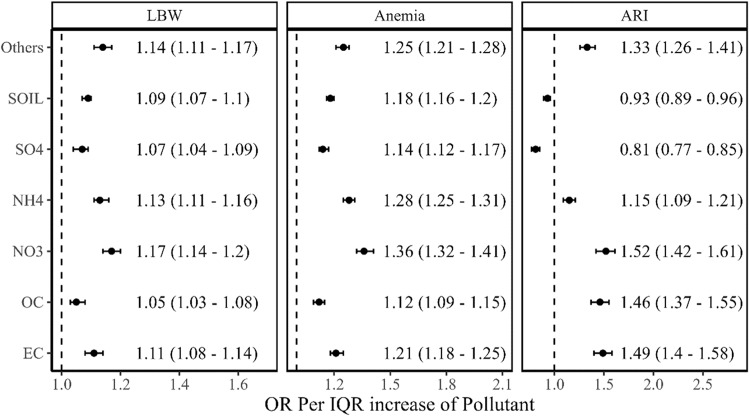
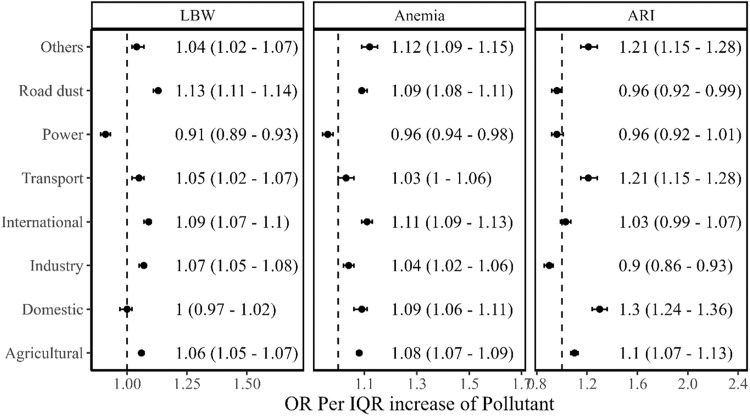
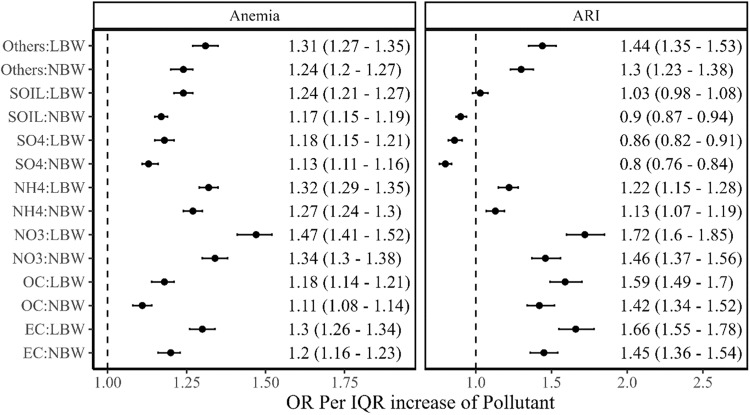
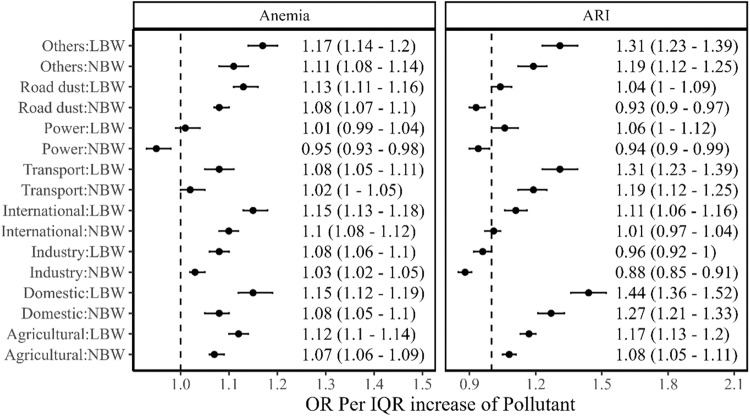
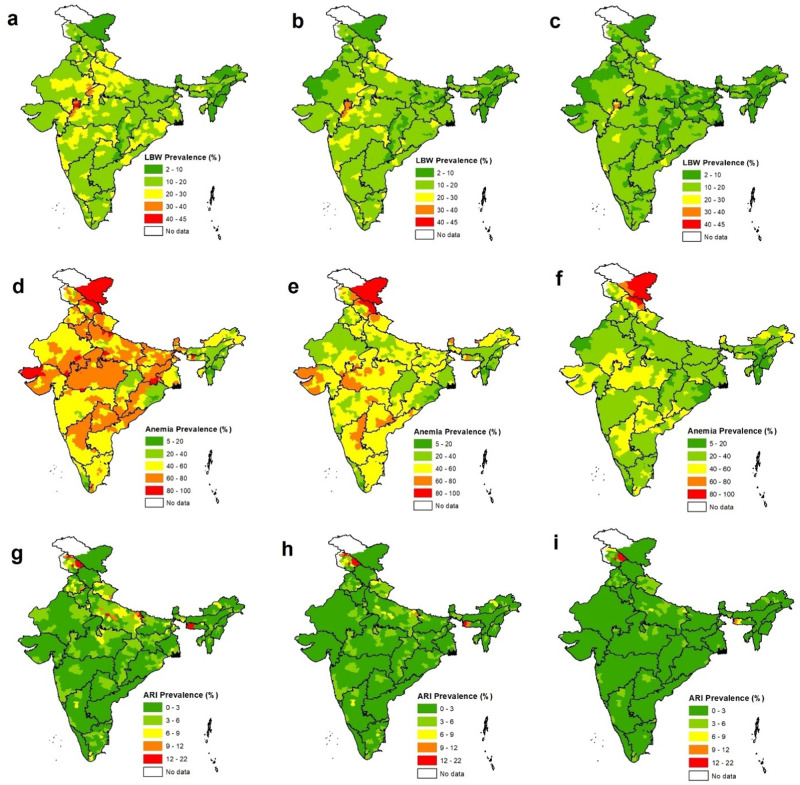
While studies on ambient fine particulate matter (PM 2.5) exposure effect on child health are available, the differential effects, if any, of exposure to PM 2.5 species are unexplored in lower and middle-income countries. Using multiple logistic regression, we showed that for every 10 μg m−3 increase in PM 2.5 exposure, anaemia, acute respiratory infection, and low birth weight prevalence increase by 10% (95% uncertainty interval, UI: 9–11), 11% (8–13), and 5% (4–6), respectively, among children in India. NO 3-, elemental carbon, and NH 4+ were more associated with the three health outcomes than other PM 2.5 species. We found that the total PM 2.5 mass as a surrogate marker for air pollution exposure could substantially underestimate the true composite impact of different components of PM 2.5. Our findings provide key indigenous evidence to prioritize control strategies for reducing exposure to more toxic species for greater child health benefits in India.
Overview
The claims and statistics of this paper haven’t been checked yet.
Free: it reads the open-access text and checks the first 5 claims that cite a source we can check. Create a free account to check every claim.
Integrity signals
Registry
Cites
Statistics
Figures
Verification
Claims the paper makes
The claims and statistics of this paper haven’t been checked yet.
Free: it reads the open-access text and checks the first 5 claims that cite a source we can check. Create a free account to check every claim.
Claims other papers make about this one
Each is checked against this paper’s own text: does it say what the citing paper says it does?
The cited source says what the claim attributes to it.
In the citing paper
“More in-depth analysis suggested the cumulative effect of exposure to constituent components of PM2.5 contributed to a 50% increased likelihood of anemia while the standard measurement of PM2.5 exposure, total PM2.5 mass, increased anemia odds by only 10%, suggesting that there is an additive effect of exposure to different types and sources of PM2.5 [76].”
From Environmental Contaminants, Iron Deficiency, and Iron‐Deficiency Anemia: A Review of the Literature (2025) · cites this paper as [76]
The cited source says what the claim attributes to it.
In the citing paper
“several researchers postulate that chronic exposure to polluted air leads to sustained systemic inflammation [66, 74, 76].”
From Environmental Contaminants, Iron Deficiency, and Iron‐Deficiency Anemia: A Review of the Literature (2025) · cites this paper as [76]
The cited source says what the claim attributes to it.
In the citing paper
“Ambient air pollution, typically measured at the ecological level, accounts for 15 of the included articles, all of which found an increased ID/IDA prevalence or at least one biomarker of ID/IDA related to at least component of ambient air pollution [65–73, 76, 77].”
From Environmental Contaminants, Iron Deficiency, and Iron‐Deficiency Anemia: A Review of the Literature (2025) · cites this paper as [76]
Self-check
Percentages, sums and reported differences re-computed from the paper’s own numbers.
The self-check needs the paper’s full text.
Citations
Cites
Cohen, A. J., Brauer, M., Burnett, R., Anderson, H. R., Frostad, J., Estep, K., Balakrishnan, K., Brunekreef, B., Dandona, L., Dandona, R., et al. (2017) · The Lancet · doi:10.1016/s0140-6736(17)30505-6 · Cited by 6,583
Balakrishnan, K., Dey, S., Gupta, T., Dhaliwal, R. S., Brauer, M., Cohen, A. J., Stanaway, J. D., Beig, G., Joshi, T. K., Aggarwal, A. N., et al. (2019) · The Lancet Planetary Health · doi:10.1016/s2542-5196(18)30261-4 · Cited by 936
Self-citationNational Ambient Air Quality Standards
Brunner, C. R. (1985) · Hazardous Air Emissions from Incineration · doi:10.1007/978-1-4613-2539-0_3 · Cited by 594
International Institute for Population Sciences (IIPS)
(2020) · The Grants Register 2021 · doi:10.1057/978-1-349-95988-4_500 · Cited by 423
Pope, D. P., Mishra, V., Thompson, L., Siddiqui, A. R., Rehfuess, E. A., Weber, M., & Bruce, N. G. (2010) · Epidemiologic Reviews · doi:10.1093/epirev/mxq005 · Cited by 388
Klepac, P., Locatelli, I., Korošec, S., Künzli, N., & Kukec, A. (2018) · Environmental Research · doi:10.1016/j.envres.2018.07.008 · Cited by 336
Saenen, N. D., Martens, D. S., Neven, K. Y., Alfano, R., Bové, H., Janssen, B. G., Roels, H. A., Plusquin, M., Vrijens, K., & Nawrot, T. S. (2019) · Clinical Epigenetics · doi:10.1186/s13148-019-0688-z · Cited by 267 · cited 1×
“Oxidative stressand placental in fl ammation mayimpair transplacental nutrient and oxygen exchange in the placenta, preventing enough nutrients and oxygen from reaching the foetus at the right time during gestationandimpactingfoetalgrowth 27,28 .”
Sun, X., Luo, X., Zhao, C., Zhang, B., Tao, J., Yang, Z., Ma, W., & Liu, T. (2016) · Environmental Pollution · doi:10.1016/j.envpol.2015.12.022 · Cited by 233
Hepcidin and Anemia: A Tight Relationship
Pagani, A., Nai, A., Silvestri, L., & Camaschella, C. (2019) · Frontiers in Physiology · doi:10.3389/fphys.2019.01294 · Cited by 223
Impact of ambient PM2.5 on adverse birth outcome and potential molecular mechanism
Li, Z., Tang, Y., Song, X., Lazar, L., Li, Z., & Zhao, J. (2019) · Ecotoxicology and Environmental Safety · doi:10.1016/j.ecoenv.2018.10.109 · Cited by 193
Pro-Inflammatory Cytokine-Mediated Anemia: Regarding Molecular Mechanisms of Erythropoiesis
Morceau, F., Dicato, M., & Diederich, M. (2009) · Mediators of Inflammation · doi:10.1155/2009/405016 · Cited by 178
Garçon, G., Dagher, Z., Zerimech, F., Ledoux, F., Courcot, D., Aboukaïs, A., Puskaric, E., & Shirali, P. (2005) · Toxicology in Vitro · doi:10.1016/j.tiv.2005.09.012 · Cited by 163
Hemoglobin Point-of-Care Testing: The HemoCue System
Sanchis-Gomar, F., Cortell-Ballester, J., Pareja-Galeano, H., Banfi, G., & Lippi, G. (2013) · SLAS Technology · doi:10.1177/2211068212457560 · Cited by 158
Lelieveld, J., Haines, A., & Pozzer, A. (2018) · The Lancet Planetary Health · doi:10.1016/s2542-5196(18)30147-5 · Cited by 153
Dey, S., Purohit, B., Balyan, P., Dixit, K. K., Bali, K., Kumar, A., Imam, F., Chowdhury, S., Ganguly, D., Gargava, P., et al. (2020) · Remote Sensing · doi:10.3390/rs12233872 · Cited by 147
Self-citationBalakrishnan, K., Cohen, A., & Smith, K. R. (2014) · Environmental Health Perspectives · doi:10.1289/ehp.1307822 · Cited by 122
Wang, Z., Peng, J., Liu, P., Duan, Y., Huang, S., Wen, Y. R., Liao, Y., Li, H., Yan, S., Cheng, J., et al. (2020) · Environmental Health · doi:10.1186/s12940-019-0557-4 · Cited by 120
Determinants of Childhood Anemia in India
Onyeneho, N. G., Ozumba, B. C., & Subramanian, S. V. (2019) · Scientific Reports · doi:10.1038/s41598-019-52793-3 · Cited by 118
Determinants of low birth weight in India: An investigation from the National Family Health Survey
Khan, N., Mozumdar, A., & Kaur, S. (2019) · American Journal of Human Biology · doi:10.1002/ajhb.23355 · Cited by 96
Mishra, V., Smith, K. R., & Retherford, R. D. (2005) · Population and Environment · doi:10.1007/s11111-005-0005-y · Cited by 88
Karimi, B., & Shokrinezhad, B. (2020) · Atmospheric Pollution Research · doi:10.1016/j.apr.2020.02.006 · Cited by 82
Spears, D., Dey, S., Chowdhury, S., Scovronick, N., Vyas, S., & Apte, J. (2019) · Environmental Health · doi:10.1186/s12940-019-0501-7 · Cited by 81
Self-citationSwaminathan, S., Ghosh, S., Varghese, J. S., Sachdev, H. S., Kurpad, A. V., & Thomas, T. S. (2019) · Journal of Nutrition · doi:10.1093/jn/nxz009 · Cited by 68
Self-citationDas, A., Habib, G., Vivekanandan, P., & Kumar, A. (2020) · Chemosphere · doi:10.1016/j.chemosphere.2020.128305 · Cited by 64
Cordova, J. E. D., Tapia, V., Apestegui, V. V., Ibargüen, L. O., Vu, B. N., Steenland, K., & Gonzales, G. F. (2020) · Environmental Health · doi:10.1186/s12940-020-0564-5 · Cited by 62
Mehta, U., Dey, S., Chowdhury, S., Ghosh, S., Hart, J. E., & Kurpad, A. (2021) · Environmental Epidemiology · doi:10.1097/ee9.0000000000000125 · Cited by 62 · cited 1×
“Some studies have reported a signi fi cant positive association between anaemia and PM 2.5 among U5 children, but not much has been reported with PM 2.5 constituents 16,17 .”
InfluentialSelf-citationWang, L., Xiang, X., Mi, B., Song, H., Dong, M., Zhang, S., Bi, Y., Zhao, Y., Li, Q., Zhang, Q., et al. (2018) · Journal of Public Health · doi:10.1093/pubmed/fdy137 · Cited by 58
Air Pollution Over India: Causal Factors for the High Pollution with Implications for Mitigation
Singh, N., Agarwal, S., Sharma, S., Chatani, S., & Ramanathan, V. (2021) · ACS Earth and Space Chemistry · doi:10.1021/acsearthspacechem.1c00170 · Cited by 53
Self-citationAssociation between Acute Exposure to PM2.5 Chemical Species and Mortality in Megacity Delhi, India
Joshi, P., Dey, S., Ghosh, S., Jain, S., & Sharma, S. K. (2022) · Environmental Science & Technology · doi:10.1021/acs.est.1c06864 · Cited by 53
Self-citationThe Impact of Oxidative Stress of Environmental Origin on the Onset of Placental Diseases
Ruano, C. S. M., Miralles, F., Méhats, C., & Vaiman, D. (2022) · Antioxidants · doi:10.3390/antiox11010106 · Cited by 52
Reducing the burden of anaemia in Indian women of reproductive age with clean-air targets
Chaudhary, E., Dey, S., Ghosh, S., Sharma, S., Singh, N., Agarwal, S., Tibrewal, K., Venkataraman, C., Kurpad, A. V., Cohen, A., et al. (2022) · Nature Sustainability · doi:10.1038/s41893-022-00944-2 · Cited by 51
Self-citationGirotra, S., Mohan, N., Malik, M., Roy, S., & Basu, S. (2023) · Cureus · doi:10.7759/cureus.36717 · Cited by 42
Larson, P. S., Espira, L. M., Glenn, B. E., Larson, M. C., Crowe, C. S., Jang, S., & O’Neill, M. S. (2022) · International Journal of Environmental Research and Public Health · doi:10.3390/ijerph19052525 · Cited by 41
Varghese, J. S., & Muhammad, T. (2023) · BMC Pulmonary Medicine · doi:10.1186/s12890-023-02487-4 · Cited by 36
Goyal, N., & Canning, D. (2021) · Environmental Research Letters · doi:10.1088/1748-9326/abf18e · Cited by 30
Amegbor, P. M. (2022) · Science of The Total Environment · doi:10.1016/j.scitotenv.2022.154957 · Cited by 28 · cited 1×
“Some studies have reported a signi fi cant positive association between anaemia and PM 2.5 among U5 children, but not much has been reported with PM 2.5 constituents 16,17 .”
InfluentialLow birth weight and PM2.5 in Puerto Rico
Kirwa, K., Rios-McConnell, R. E., Manjourides, J., Cordero, J. F., Alshawabekeh, A., & Suh, H. H. (2019) · Environmental Epidemiology · doi:10.1097/ee9.0000000000000058 · Cited by 16
Child health Outcome codes and dataset
Chaudhary, E. (2023) · Figshare · doi:10.6084/m9.figshare.23513757 · Cited by 1
Self-citation
Cited by
Gao, Q., Gan, J., Wang, P., Huang, Y., Zhang, D., & Yu, W. (2024) · Exploration · doi:10.1002/exp.20240012 · Cited by 88
Assessing AQI of air pollution crisis 2024 in Delhi: its health risks and nationwide impact
Bhuyan, A., Bordoloi, T., Debnath, R., Ikbal, A. M. A., Debnath, B., & Singh, W. S. (2025) · Discover Atmosphere · doi:10.1007/s44292-025-00041-x · Cited by 37
Cui, F., Zheng, L., Zhang, J., Tang, L., Ma, Y., Li, D., Wang, J., Xing, M., Xie, J., Yang, J., et al. (2024) · European Journal of Heart Failure · doi:10.1002/ejhf.3486 · Cited by 30
Wu, H., Liu, J., Conway, E. C., Zhan, N., Zheng, L., Sun, S., & Li, J. (2024) · The Science of The Total Environment · doi:10.1016/j.scitotenv.2024.174228 · Cited by 24
Lu, Z., Liu, C., Chen, Y.-J., Chen, Y., Lei, X., Cai, L.-J., Zhou, H., Chang, H., Zhu, M., Wang, Y., et al. (2024) · Environmental Science & Technology · doi:10.1021/acs.est.4c00074 · Cited by 19
Metadata
- Authors
- Chaudhary, E., George, F., Saji, A., Dey, S., Ghosh, S., Thomas, T., Kurpad, A. V., Sharma, S., Singh, N., Agarwal, S., & Mehta, U.
- Affiliations
- Indian Institute of Technology Delhi (IN)
- St. John's Research Institute (IN)
- St.John's Medical College Hospital (IN)
- Energy and Resources Institute (IN)
- Harvard University (US)
- Corresponding author
- Dey, Sagnik
- Ghosh, Santu
- ORCID
- Venue
- Nature Communications
- Published
- 2023-10-31
- Volume
- 14
- Issue
- 1
- Pages
- 6955-6955
- ISSN
- 2041-1723 (ISSN-L)
- PMC
- PMC10618175
- OpenAlex
- W4388069574
- Cited by
- 92
- References
- 38
- Citations by year
- 2026: 36 · 2025: 37 · 2024: 18 · 2023: 1
- FWCI
- 10.52
- Type
- journal article
- Language
- en
- Open access
- gold
- doi.org
- Licence
- cc-by
- creativecommons.org/licenses/by/4.0 (tdm)
- creativecommons.org/licenses/by/4.0 (vor)
- Locations
- Nature Communications (publishedVersion, cc-by)
- PubMed Central (publishedVersion, cc-by)
- PubMed (publishedVersion)
- RePEc: Research Papers in Economics (submittedVersion)
- DOAJ (DOAJ: Directory of Open Access Journals) (submittedVersion, cc-by-sa)
- Funders
- DST | Science and Engineering Research Board (SPR/2020/000212)
- Topics
- Physical Sciences › Environmental Science › Health, Toxicology and Mutagenesis › Air Quality and Health Impacts
- Physical Sciences › Earth and Planetary Sciences › Atmospheric Science › Atmospheric chemistry and aerosols
- Physical Sciences › Environmental Science › Pollution › Energy and Environment Impacts
- Keywords
- PM2.5, child health, anemia, acute respiratory infections, low birth weight, nitrate, elemental carbon, ammonium, air pollution exposure, India
- MeSH terms
- Child Health, Air Pollutants, Air Pollution, Child, Environmental Exposure, Humans, India, Particulate Matter
About these checks
Registry, retraction, Cites and statistics results are computed, not judged, with one exception: a printed reference that no index lists is read once by a model before it counts as a citation error. Claims are extracted by a model and kept only when their quote appears verbatim in the text; each cited source is then checked, with a model’s help, for whether it says what the claim relies on. Those verdicts can be wrong — read the claim’s quote and the cited source before relying on one.
Statistics and arithmetic are recomputed, not judged.
Confidence bands are shown only for fields calibrated on our annotated test set. None is calibrated yet, so no band is shown.
What counts as a claim ›How we measure confidence ›How we check this ›
Are you an author, or do you see a problem with this page? Request a review
Data sources
Bibliographic data: Semantic Scholar, OpenAlex, Crossref.
Contains information from the Semantic Scholar Academic Graph Datasets, made available under the ODC Attribution License (ODC-BY 1.0).
Semantic Scholar’s data is described in: Kinney, R., et al. (2023). The Semantic Scholar Open Data Platform. arXiv:2301.10140.
