

Solar-driven membrane separation for direct lithium extraction from artificial salt-lake brine
Open accessPublished version of a preprint
The DOI matches its Crossref record; 61 of the 61 references it cites were found in a registry or an index; 2 of the 21 sources its claims cite were checked for support.
Abstract
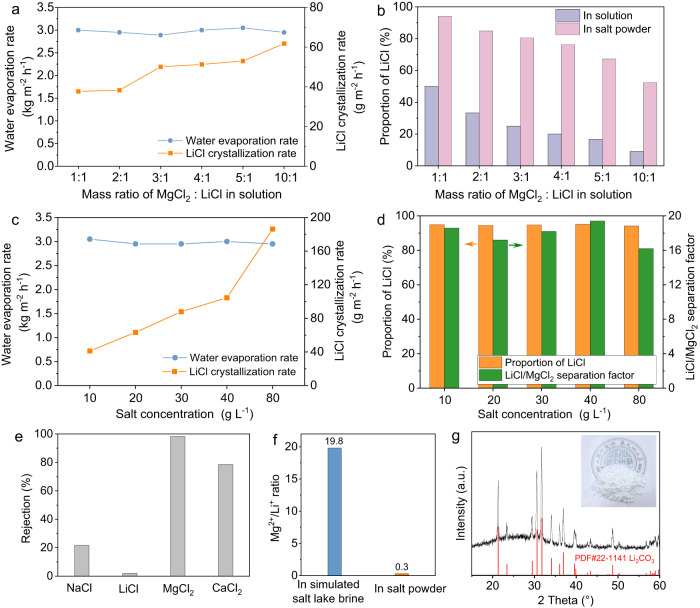
The demand for lithium extraction from salt-lake brines is increasing to address the lithium supply shortage. Nanofiltration separation technology with high Mg 2+ /Li + separation efficiency has shown great potential for lithium extraction. However, it usually requires diluting the brine with a large quantity of freshwater and only yields Li + -enriched solution. Inspired by the process of selective ion uptake and salt secretion in mangroves, we report here the direct extraction of lithium from salt-lake brines by utilizing the synergistic effect of ion separation membrane and solar-driven evaporator. The ion separation membrane-based solar evaporator is a multilayer structure consisting of an upper photothermal layer to evaporate water, a hydrophilic porous membrane in the middle to generate capillary pressure as the driving force for water transport, and an ultrathin ion separation membrane at the bottom to allow Li + to pass through and block other multivalent ions. This process exhibits excellent lithium extraction capability. When treating artificial salt-lake brine with salt concentration as high as 348.4 g L −1 , the Mg 2+ /Li + ratio is reduced by 66 times (from 19.8 to 0.3). This research combines ion separation with solar-driven evaporation to directly obtain LiCl powder, providing an efficient and sustainable approach for lithium extraction.
Overview
CoChat Summary
## TL;DR
This paper presents a solar-driven, membrane-based evaporator inspired by mangroves to directly extract lithium as solid LiCl/Li2CO3 from salt-lake brines. In simulated salt-lake brine at 348.4 g L−1 total salt, it reduced the Mg2+/Li+ ratio from 19.8 to 0.3, a 66-fold reduction.
## Key findings
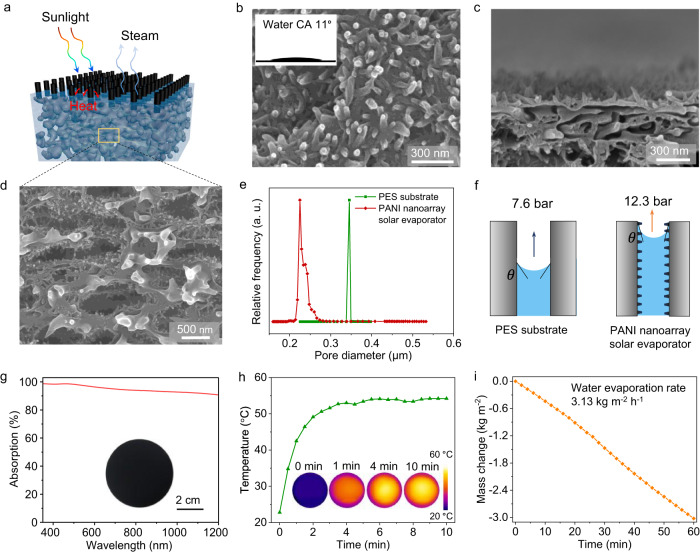
- The PANI nanoarrays solar evaporator reached a visible-range light absorption of up to 96% and a water evaporation rate of 3.13 kg m−2 h−1 under 3 sun illumination.
- The PA membrane’s crosslinking degree increased from 70.6% to 78.3% as TMC concentration increased from 1 to 4 mg mL−1, while mean pore size decreased from 0.63 to 0.57 nm.
- In cross-flow filtration at 4.0 bar, the PA membranes rejected MgCl2 by 95.1%, 96.1%, and 96.9% for PA-1, PA-2, and PA-4, respectively, while LiCl rejection was 59.1%–61.3%.
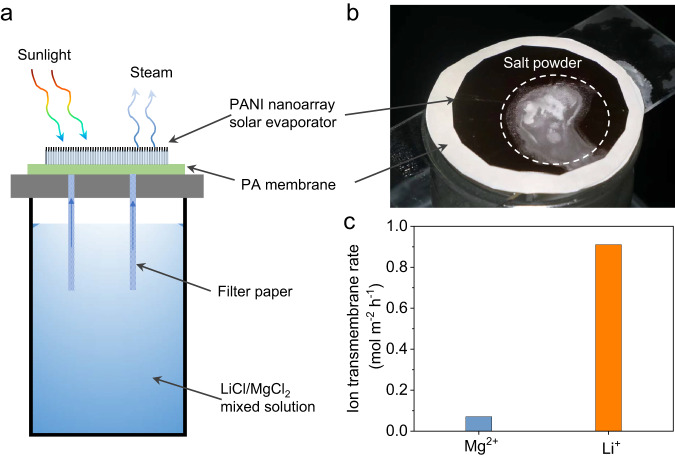
- During solar-driven extraction from simulated salt-lake brine, the system achieved 2.2 kg m−2 h−1 water evaporation and 480 g m−2 h−1 salt crystallization; the collected salt powder contained 2.3% LiCl, and the final Li2CO3 purity was around 99%.
## Methods
- The device combined a PANI nanoarrays photothermal layer, a hydrophilic PES macroporous membrane for capillary water transport, and an ultrathin PA ion-separation membrane for Li+/Mg2+ selectivity.
- PA membranes were fabricated by interfacial polymerization of PIP and TMC on a SWCNTs film supported by PES, with TMC concentration varied at 1, 2, and 4 mg mL−1.
- Solar-driven lithium extraction was tested under a solar simulator at 25.0 ± 0.5 °C and 40 ± 5% RH using LiCl/MgCl2 mixtures and a simulated Uyuni salar brine containing 268.0 g L−1 NaCl, 5.1 g L−1 LiCl, 66.1 g L−1 MgCl2, and 9.2 g L−1 CaCl2.
## Limitations
- The paper states that the device was tested on artificial/simulated brines, not natural salt-lake brines, so real-brine performance is not demonstrated in the provided text.
- The text makes evident that the study relies heavily on controlled indoor solar-simulator conditions and only includes a brief outdoor test; long-term field durability and large-scale deployment remain not fully established (evident from the text).
- Not stated in the paper.
Model-written summary. Check it against the paper before relying on it.
Integrity signals
Registry
Cites
Statistics
Figures
Verification
Claims the paper makes
2 Valid · 0 Not valid · 5 Not checked · 47 Own results and interpretations
The cited sources support only part of this claim — read each source’s verdict below.
In the paper
“nanofiltration (NF) membrane separation15–17 is considered one of the most efficient methods for extracting lithium from brine.”
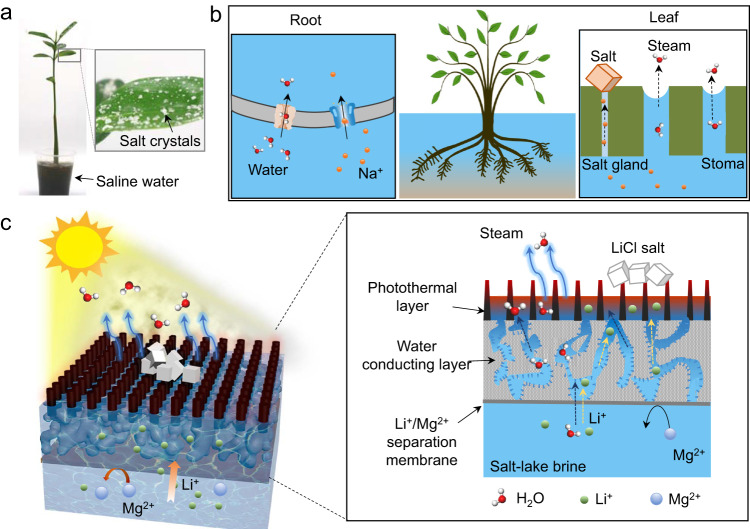
§ Solar-driven membrane separation for direct lithium extraction from artificial salt-lake brine > Introduction Lithium, one of the most valuable resources, has found its way into various industries, ranging from ceramics, glass, pharmaceuticals, and nuclear to the booming lithium battery technology1–4. The rapid growth in lithium consumption, spurred by the expansion of the lithium battery market in recent years, has made it crucial to source lithium from various channels5–10. Lithium sourcing from salt-lake brines accounts for ≈70% of recoverable lithium on land11. It has become a vital supply route to ensure the healthy development of the lithium battery market. However, lithium extraction from salt-lake brines is challenging because of the high concentration of competing ions, like Mg2+. Compared to conventional ion separation technologies such as ion exchange12, electrodialysis13, and solvent extraction14, nanofiltration (NF) membrane separation15–17 is considered one of the most efficient methods for extracting lithium from brine. The combination of size sieving and Donnan exclusion in NF membranes offers an ideal option for achieving effective monovalent/divalent ion separation, particularly for Li+/Mg2+ separation18–22. To enhance the performance of Li+ separation, various investigations have been carried out, including developing innovative NF membrane materials and optimizing the membrane structure and surface properties23–26. Despite significant advancements in the separation of Mg2+ and Li+ using NF membrane processes, highly concentrated brines generate a high osmotic pressure difference across the NF membrane, requiring high applied pressure that may exceed the mechanical strength of the membrane module. Therefore, the conventional NF process typically involves the 10–20 times dilution of high-concentration brine with a large quantity of freshwater in the pre-treatment stage14,27,28. Moreover, NF membrane separation processes solely yield Li+-enriched solutions, necessitating further concentration to obtain solid lithium products, which requires energy-intensive processes like thermal distillation or high-pressure reverse osmosis to obtain the Li+-enriched solution with the required concentration. Hence, innovative material and separation process design is required to achieve more efficient and cost-effective Mg/Li separation. Interfacial solar evaporation, a sustainable and cost-effective technology for clean water production, harnesses solar energy and concentrates generated heat to facilitate water evaporation29–36. Additionally, this approach offers a promising avenue for salt resource recovery from seawater and brines37–40. During evaporation, salt ions become concentrated and eventually precipitate out. Selective ion uptake and transport driven by interfacial solar evaporation are common processes in plants. For instance, mangrove is a type of salt-tolerant tree that thrives in tropical and subtropical coastal regions (Fig. 1a)41,42. Mangroves can regulate the uptake and release of ions to adapt to the saline or brackish environment43. When provided with optimal sunlight and temperature, the stomata in leaves open, causing water molecules to be released into the atmosphere as vapor. This process is followed by water flow towards the stomata, effectively replacing the evaporated water molecules while ensuring the continuous upward flow of water and ions toward the leaves44,45. To survive in seawater, ion pumps and channels in cell membranes selectively transport ions through mangrove roots (Fig. 1b)46,47. Additionally, salt glands located in leaves enable mangroves to directly secrete salt out of their systems (inset in Fig. 1a), further aiding their ability to survive in saline environments48,49. Inspired by the process of selective ion uptake and salt secretion in mangroves, we utilize the synergistic effect of ion separation membrane and solar-driven evaporator to direct extraction of lithium chloride (LiCl) powder from salt-lake brines. Figure 1c illustrates the structure of the membrane-based solar-driven evaporator, composed of three functional layers. To realize a high photothermal conversion efficiency, vertically aligned polyaniline (PANI) nanofiber array was selected as the upper photothermal layer owing to its sunlight absorption capacity. In the middle, a hydrophilic poly(ether sulfone) (PES) macroporous membrane with interconnected water-conducting channels generates capillary pressures serving as the driving force for water transport. At the bottom is an ultrathin polyamide (PA) ion separation membrane allowing Li+ to pass through and block other multivalent ions, like Ca2+ and Mg2+. When treating a LiCl/MgCl2 mixed solution, water and Li+ ions trans through the PA membrane to reach the photothermal layer under capillary pressure. As water continually evaporates, solid LiCl powders can be collected directly on the surface of the evaporator. This ion separation membrane-based solar evaporator maintains a stable lithium enrichment even when processing high-concentration salt solutions. This study demonstrates the amazing capability of lithium enrichment. It provides an effective way to directly obtain high-purity lithium from salt-lake brines only using sustainable energy.
What the sources say
- Not checked — no full text of the sourcecites [15] Park SH Lithium recovery from artificial brine using energy-efficient membrane distillation and nanofiltration J. Membr. Sci. 2020 598 117683 10.1016/j.memsci.2019.117683 source
- Partly supportedcites [16] Lu D Constructing a selective blocked-nanolayer on nanofiltration membrane via surface-charge inversion for promoting Li+ permselectivity over Mg2+ J. Membr. Sci. 2021 635 119504 10.1016/j.memsci.2021.119504 sourceExperimental — accuracy not yet measured
The Introduction of Lu et al. (2021) treats NF as a candidate technology for this purpose — 'Nanofiltration (NF) is a promising pressure-driven membrane separation technology, and is possible to separate electrolyte solutions based on ion valence and hydrated ionic radius' — and the Abstract frames Li+/Mg2+ separation by NF as 'a decisive step for achieving high-grade lithium extraction from salt-lake brines'. That supports NF being relevant/considered for lithium extraction from brine, but our copy nowhere ranks it as 'one of the most efficient methods'; on the contrary the Abstract states 'polymer nanofiltration membranes suffer from low lithium selectivity and are hindered by complicated preparation and miniaturized scales', and the Introduction only says traditional technologies have 'high costs but low recovery' without comparing NF's efficiency. The superlative 'most efficient' is therefore not attributable to this source. (LLM, conf=0.70)
- Not checked — no full text of the sourcecites [17] Peng H Zhao Q A nano-heterogeneous membrane for efficient separation of lithium from high magnesium/lithium ratio brine Adv. Funct. Mater. 2021 31 2009430 10.1002/adfm.202009430 source
plain- Asserted: passes — The authors put it forward as true.
- Checkable: passes — It can be checked against evidence.
- Load-bearing: passes — The paper’s conclusions depend on it.
- Based: passes — The paper gives a reason why it holds.
A result the paper reports from its own data — it cites no other source for it, so there is none to check. The quote shows it is in the paper.
In the paper
“When treating artificial salt-lake brine with salt concentration as high as 348.4 g L−1, the Mg2+/Li+ ratio is reduced by 66 times (from 19.8 to 0.3).”
- Also stated in: § Solar-driven lithium extraction · plain
“The mass ratio of Mg2+/Li+ in the salt powders collected on the surface of the PANI nanoarrays solar evaporator was 0.3. This is a significant decrease compared to the simulated salt-lake brine, with a reduction of 66 times”
§ Solar-driven membrane separation for direct lithium extraction from artificial salt-lake brine > Abstract
plainstates a causeSingle case- Asserted: passes — The authors put it forward as true.
- Checkable: passes — It can be checked against evidence.
- Load-bearing: passes — The paper’s conclusions depend on it.
- Based: passes — The paper gives a reason why it holds.
- Also stated in: § Solar-driven lithium extraction · plain
A result the paper states — it cites no source for it, so there is none to check. The quote shows it is in the paper.
In the paper
“the LiCl crystallization rate increased from 37.3 to 61.8 g m−2 h−1 with the increase of Mg2+/Li+ ratio”
§ Solar-driven membrane separation for direct lithium extraction from artificial salt-lake brine > Results and discussion > Solar-driven lithium extraction
plainstates a cause- Asserted: passes — The authors put it forward as true.
- Checkable: passes — It can be checked against evidence.
- Load-bearing: passes — The paper’s conclusions depend on it.
- Based: passes — The paper gives a reason why it holds.
A result the paper reports from its own data — it cites no other source for it, so there is none to check. The quote shows it is in the paper.
In the paper
“Water evaporation rates were measured at 3.13 kg m−2 h−1 under 3 sun illumination by recording the weight loss”
§ Solar-driven membrane separation for direct lithium extraction from artificial salt-lake brine > Results and discussion > Fabrication and characterization of PANI nanoarrays solar evaporator
plain- Asserted: passes — The authors put it forward as true.
- Checkable: passes — It can be checked against evidence.
- Load-bearing: passes — The paper’s conclusions depend on it.
- Based: passes — The paper gives a reason why it holds.
A result the paper reports from its own data — it cites no other source for it, so there is none to check. The quote shows it is in the paper.
In the paper
“the mean pore size was 0.63, 0.61, and 0.57 nm for PA-1, PA-2, and PA-4, respectively”
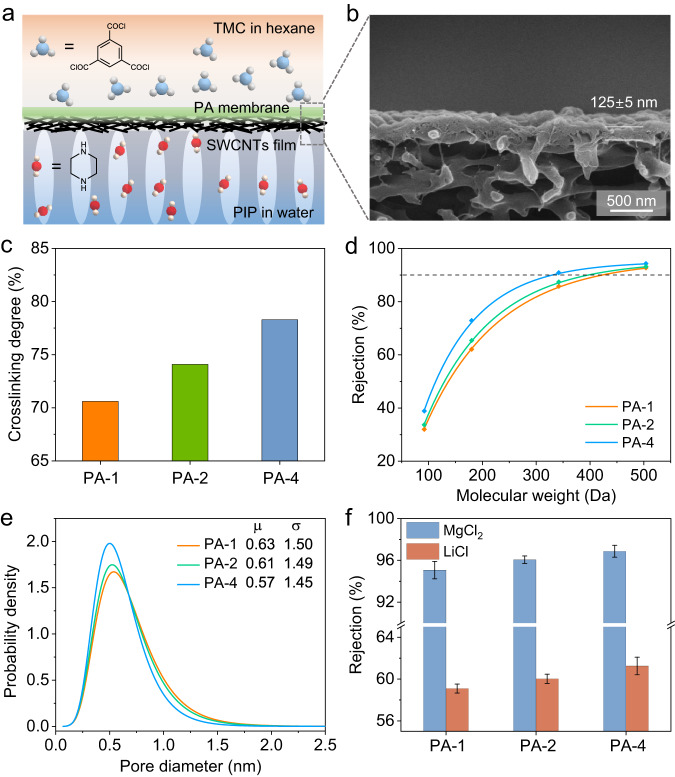
§ Solar-driven membrane separation for direct lithium extraction from artificial salt-lake brine > Results and discussion > Li+/Mg2+ separation performance of PA membrane A membrane with high mono-/di-valent ion separation performance is highly required to extract lithium from brine effectively. State-of-the-art mono-/di-valent ion separation membranes are based on a thin film composite design, which deposits a PA selective layer, formed by interfacial polymerization between piperazine (PIP) and trimesoyl chloride (TMC), on the top of porous substrate. We have previously reported that deposition of a thin layer of single-walled carbon nanotubes (SWCNTs) film on macroporous PES membrane greatly improves the quality of the obtained PA layer thanks to the high porosity, smoothness, and narrowly distributed pores of the SWCNT film53. Following previous studies24,53, PA membranes were fabricated on the surface of SWCNTs film via interfacial polymerization (Fig. 3a). Firstly, a thin SWCNT film was prepared through vacuum-filtrating a certain amount of SWCNTs dispersion onto a PES membrane with pore size of ~0.2 μm. The surface SEM image of SWCNTs film shows that a network porous structure was formed from interconnected carbon nanotubes with a high porosity (Supplementary Fig. 2a). Then a typical interfacial polymerization process was conducted on the surface of SWCNT film, in which PIP and TMC reacted at water-hexane interface to form the PA layer. A smooth PA layer was formed after the interfacial polymerization process using 2 mg mL−1 TMC and 10 mg mL−1 PIP solutions (Supplementary Fig. 2b). The cross-sectional SEM image shows a bilayer structure with a thickness of 125 ± 5 nm (Fig. 3b). The crosslinking degree of the resultant PA membrane reflects the efficiency of the interfacial reaction and determines the effective pore size. To study the effect of pore size on Li+/Mg2+ separation, the crosslinking degree of the PA layer was tuned by changing the TMC concentrations of 1, 2, to 4 mg mL−1 during the interfacial polymerization process. The obtained membrane was denoted as PA-X, X representing the TMC concentration used in the interfacial polymerization process. The chemical composition of obtained PA layers was analyzed by X-ray photoelectron spectroscopy (XPS) (Supplementary Fig. 3). In the C1s XPS spectra, four peaks were detected, which were ascribed to O = C–O (centered at 288.5 eV), O = C–N (centered at 287.7 eV), C–N (centered at 286.0 eV), and C–C (centered at 284.8 eV) in the PA layer, further confirming the formation of the polyamide structure24. The O = C–N group was derived from the reaction between the acyl chloride in TMC monomers and secondary amine in PIP monomers. The O = C–O group can be attributed to the carboxyl acid group formed by the hydrolysis of the unreacted acylchloride group. With the TMC concentration increasing from 1 to 2 and 4 mg mL−1, the O = C–N content gradually increased from 6.35% to 6.48%, and 7.26%. The O = C–O content decreased from 2.85% to 2.45% and 1.95% (Supplementary Table 1). The crosslinking degrees of PA layers were calculated based on the O/N elemental ratio from the XPS spectra. As shown in Fig. 3c, the crosslinking degrees of PA-1, PA-2, and PA-4 were 70.6%, 74.1%, and 78.3%, respectively. These results indicate that the increase in the TMC concentration could improve the crosslinking degree of the PA layer during the PIP-TMC interfacial polymerization process. The molecular weight cut-off (MWCO) and pore size distribution of the PA membranes were calculated using neutral organic molecules as probes (detailed information see Supplementary Methods). As shown in Fig. 3d, the MWCO of the PA membrane decreased from 422 Da to 309 Da by increasing the TMC concentration from 1 to 4 mg mL−1. According to the function fitting of the corresponding pore model, the mean pore size was 0.63, 0.61, and 0.57 nm for PA-1, PA-2, and PA-4, respectively (Fig. 3e). This result indicates that the effective pore size of the PA layer decreased with the increase of the crosslinking degree. The performance of the PA membrane was evaluated by experimenting with a cross-flow filtration with transmembrane pressure of 4.0 bar. The rejections to MgCl2 (1.0 g L−1) were 95.1%, 96.1%, and 96.9% for PA-1, PA-2, and PA-4, respectively. The rejection of LiCl (1.0 g L−1) slightly increased from 59.1% to 61.3% with the increase of crosslinking degree. These results are reasonable when compared to the hydrated ion diameter and hydration energy of Li+ and Mg2+. The hydrated Mg2+ diameter was 0.86 nm, larger than most of pores in the PA membrane. As Mg2+ enters PA membrane, the energy required to strip water from the hydration shell of Mg2+ is 437.4 kcal mol−154. In contrast, the hydrated Li+ diameter is 0.76 nm, whereas the energy required to strip water from the hydration shell of Li+ is 113.5 kcal mol−1. Therefore, the PA membrane demonstrated a higher rejection rate to Mg2+ than Li+.
plain- Asserted: passes — The authors put it forward as true.
- Checkable: passes — It can be checked against evidence.
- Load-bearing: passes — The paper’s conclusions depend on it.
- Based: passes — The paper gives a reason why it holds.
31 more claims
Create a free account to see all 54 claims and to verify the 1 reference still open.
- Probably not a substantial claim. 5
- It may state two separate claims as one. 14
Citations
Cites
Issues and challenges facing rechargeable lithium batteries
Tarascon, J.-M., & Armand, M. (2001) · Nature · doi:10.1038/35104644 · Cited by 21,130
Phenomenological Theory of Ion Solvation. Effective Radii of Hydrated Ions
Nightingale, E. R. (1959) · The Journal of Physical Chemistry · doi:10.1021/j150579a011 · Cited by 3,505
Solar-driven interfacial evaporation
Tao, P., Ni, G., Song, C., Shang, W., Wu, J., Zhu, J., Chen, G., & Deng, T. (2018) · Nature Energy · doi:10.1038/s41560-018-0260-7 · Cited by 2,380 · cited 1×
“Interfacial solar evaporation, a sustainable and cost-effective technology for clean water production, harnesses solar energy and concentrates generated heat to facilitate water evaporation 29 – 36 .”
Highly efficient solar vapour generation via hierarchically nanostructured gels
Zhao, F., Zhou, X., Shi, Y., Qian, X., Alexander, M., Zhao, X., Mendez, S., Yang, R., Qu, L., & Yu, G. (2018) · Nature Nanotechnology · doi:10.1038/s41565-018-0097-z · Cited by 2,089
Materials for solar-powered water evaporation
Zhao, F., Guo, Y., Zhou, X., Shi, W., & Yu, G. (2020) · Nature Reviews Materials · doi:10.1038/s41578-020-0182-4 · Cited by 1,541
Structural basis of water-specific transport through the AQP1 water channel
Sui, H., Han, B.-G., Lee, J. K., Walian, P., & Jap, B. K. (2001) · Nature · doi:10.1038/414872a · Cited by 1,166 · cited 1×
“1b) 46,47 .”
Liang, Y., Zhu, Y., Liu, C., Lee, K.-R., Hung, W.-S., Wang, Z., Li, Y., Elimelech, M., Jin, J., & Lin, S. (2020) · Nature Communications · doi:10.1038/s41467-020-15771-2 · Cited by 895
Self-citationNanoparticle-templated nanofiltration membranes for ultrahigh performance desalination
Wang, Z., Wang, Z., Lin, S., Jin, H., Gao, S., Zhu, Y., & Jin, J. (2018) · Nature Communications · doi:10.1038/s41467-018-04467-3 · Cited by 805
Self-citationWu, L., Dong, Z., Cai, Z., Ganapathy, T., Fang, N. X., Li, C., Yu, C., Zhang, Y., & Song, Y. (2020) · Nature Communications · doi:10.1038/s41467-020-14366-1 · Cited by 803
Nanofiber Formation in the Chemical Polymerization of Aniline: A Mechanistic Study
Huang, J., & Kaner, R. B. (2004) · Angewandte Chemie International Edition · doi:10.1002/anie.200460616 · Cited by 756 · cited 1×
“Nano fi bers were formed through a polymerization process of aniline monomers using ammonium persulfate 50,51 .”
Cited by
Items 101–200 of 278
Lim, H. W., & Lee, S. J. (2024) · Chemical Engineering Journal · doi:10.1016/j.cej.2024.158234 · Cited by 14
Lai, X. P., Xu, W., Gou, Y., Zhang, H., Huang, J., Cai, W., & Lai, Y. (2025) · Advanced Functional Materials · doi:10.1002/adfm.202514394 · Cited by 20
Lithium extraction by extractant confined in Pickering emulsion
Li, E., Li, Z., Xia, Q., Zhang, F., Liang, Z., Xu, Z., Gao, G., Li, H., & Cheng, F. (2025) · Nature Communications · doi:10.1038/s41467-025-62927-z · Cited by 17
“…of ions has been added as follow: Line 295-300: the orientation of water molecules in hydration shell of ions will be disrupted by the interfacial electric field and the water dipoles align with the electric filed, leading to diminishment of ion-water interaction and partial dehydration of ions.”
Nanoconfined MXene/Cellulose Membranes for Selective Lithium Extraction from Brines and Black Mass
Yang, K., Wang, Q., Nikolaev, K. G., Wang, Q., Moskalenko, I. V., Zhang, S., Qiu, X., Timashev, E. O., Скорб, Е. В., Novoselov, K. S., et al. (2025) · ACS Nano · doi:10.1021/acsnano.5c08653 · Cited by 15
Self-citationYang, F., Yong, M. S., Li, Z., Yang, Z., & Zhang, X. (2025) · Water Research · doi:10.1016/j.watres.2025.123678 · Cited by 14
Photothermal-driven micromotor for enhanced lithium extraction from salt-lake brines
Ding, S., Xing, W., Chen, L., Fu, L., Zhang, X., Luo, Z., Li, Q., Qin, M., Gong, J., Qu, J., et al. (2025) · Chemical Engineering Journal · doi:10.1016/j.cej.2025.167728 · Cited by 18
Wang, R., Sheng, M., Liu, X., Wang, Q., Wang, Z., & Wang, L. A. (2025) · Environmental Science & Technology · doi:10.1021/acs.est.5c13571 · Cited by 20
Chen, J., Yu, J., & Lin, S. (2025) · AIChE Journal · doi:10.1002/aic.18795 · Cited by 17
Dynamic Behavior of Liquids on Superspreading Surfaces: From Essential Mechanisms to Applications
Dai, L., Xu, Z., & Tian, Y. (2025) · ACS Nano · doi:10.1021/acsnano.4c18380 · Cited by 13
Li+ coordinator Cyclen in layer-by-layer nanofiltration membranes for Li+/Mg2+ separation
Liu, B., Chen, J., Luo, J., Yuan, Q., Han, Y., Xue, N., Zhu, J., & He, T. (2025) · Desalination · doi:10.1016/j.desal.2025.119220 · Cited by 16
Photocuring technology strengthens thermal localization of interfacial solar-driven evaporator
Ma, J., Du, J., Zhang, H., et al. (2025) · Chemical Engineering Journal · doi:10.1016/j.cej.2025.161235 · Cited by 12
Men, L., Luo, B. J., Shi, M., Guo, H., Feng, S., Chen, J., Zhang, J., & Zhou, Y. (2025) · ACS Sustainable Chemistry & Engineering · doi:10.1021/acssuschemeng.5c03923 · Cited by 12
Li, J., Zhu, B., Qiao, H., Xu, Z., Wang, Z., Hu, Y., Zhang, H., Jiang, H., Li, W., Wang, Y., et al. (2026) · Carbon Neutralization · doi:10.1002/cnl2.70154 · Cited by 16
Nature-Inspired Engineering Separation Materials and Devices
Huang, Y., Song, Y., & Wang, S. (2025) · ACS Nano · doi:10.1021/acsnano.4c17912 · Cited by 12
Liu, Y., Yang, Y., Liu, B., Zhao, Q., Shen, Y., Qiang, M., Ma, Y., & Que, W. (2025) · Desalination · doi:10.1016/j.desal.2025.118854 · Cited by 12
Liu, B., Yang, Y., Zhou, M., Wang, T., Liu, Y., Shen, Y., Zhao, Q., He, X., Ma, Y., & Que, W. (2025) · Small · doi:10.1002/smll.202505347 · Cited by 20
Yu, Z., Hai, C., Li, Y., Li, X., Sun, H., Zhou, Y., Li, L., Yu, X., He, W., & Zeng, Y. (2025) · Desalination · doi:10.1016/j.desal.2025.119125 · Cited by 12
Solar interfacial evaporators: from regulatory mechanisms to emerging applications
Yanlin, Z. H. A. O., Teng, J., Wang, Z., Ren, Z., Xu, W., Wu, S., Zhao, J., Gao, L., Avramidis, S., & Chi, X. (2025) · Renewable and Sustainable Energy Reviews · doi:10.1016/j.rser.2025.116670 · Cited by 14
Han, S. A., Kim, H., Son, J., Ha, J., & Jo, C. (2026) · Chemical Engineering Journal · doi:10.1016/j.cej.2026.173831 · Cited by 16
Li, L., Ge, F., Jiang, Y., An, Z., Li, N., Zhang, Z., Liu, H., Li, J., & Liang, D. (2024) · Sustainability · doi:10.3390/su17010121 · Cited by 13
Li, Y., Yu, J., Xie, M., Shuai, Y., Ge, Q., & Wang, Z. (2025) · Advanced Functional Materials · doi:10.1002/adfm.202507331 · Cited by 10
Purity metric for evaluating Li+/Mg2+ separation performance of nanofiltration membranes
He, R., Li, W., Zhu, J., & He, T. (2024) · Desalination and Water Treatment · doi:10.1016/j.dwt.2024.100944 · Cited by 11
Zhu, W., Xu, W., Liu, D., He, L., & Zhao, Z. (2025) · Desalination · doi:10.1016/j.desal.2025.118764 · Cited by 10
Liu, K., Xiang, Y., Xia, Y., Wen, D., Chen, X., Lu, L., Luo, Y., Zeng, G., & Yi, S. (2025) · Desalination · doi:10.1016/j.desal.2025.119362 · Cited by 11
Theory-guided design of high-efficiency lithium extraction system for high Mg/Li ratio brines
Chen, Q., Qian, C., & Zhou, S. (2025) · Desalination · doi:10.1016/j.desal.2025.119454 · Cited by 10
Self-floating Janus hydrovoltaics for sustainable electricity generation
Liu, Z., Xu, J., Chen, T., Liu, X., Liu, X., & Liu, G. (2024) · Journal of Power Sources · doi:10.1016/j.jpowsour.2024.235934 · Cited by 9
Shan, W., Cao, G., Gu, T., Liu, X., Sun, D., Fu, R., Liu, Z., Jiang, C., & Xu, T. (2024) · AIChE Journal · doi:10.1002/aic.18675 · Cited by 12
Transport of penetrants in polymeric materials
Chen, C., Mei, B., Schweizer, K. S., Evans, C. M., & Braun, P. V. (2024) · Polymer International · doi:10.1002/pi.6733 · Cited by 9
Geng, X., Zhang, J., Xia, B., Guan, Y., Meng, Q., Jiang, Z., Zhang, Y., Sharma, B. P., Liang, Y., Yang, L., et al. (2025) · AIChE Journal · doi:10.1002/aic.18704 · Cited by 10
Continuous flow extraction of lithium from brine using silica-coated LMO beads
Su, J., Fan, Q., Hu, X., Sun, Y., Lin, J., Xu, J., Pan, B., & Lu, Z. (2025) · Materials Advances · doi:10.1039/d4ma01100g · Cited by 10
Wang, J., Li, L., Li, L., et al. (2025) · Journal of Membrane Science · doi:10.1016/j.memsci.2025.124203 · Cited by 9
Exploring Electrochemical Lithium Extraction: From System Architectures to Practical Challenges
Gu, C., Wu, Z., Zhao, Y., Zhang, Q., Luo, Z., & Wang, L. (2025) · Advanced Sustainable Systems · doi:10.1002/adsu.202500617 · Cited by 10
Huo, J., Hai, C., Sun, Y., Dong, S., Ma, L., He, X., Xu, Q., & Zhou, Y. (2025) · Energy & environment materials · doi:10.1002/eem2.70134 · Cited by 11
Direct lithium extraction using Australian spodumene refinery residue: a waste to value approach
Asif, A. H., Li, C., Lim, H., Sharma, R., & Sun, H. (2025) · Resources Conservation and Recycling · doi:10.1016/j.resconrec.2025.108574 · Cited by 10
Wang, L., Wang, L., Xue, S., He, L., Wang, X., & Lv, Y. (2025) · Journal of Water Process Engineering · doi:10.1016/j.jwpe.2025.108600 · Cited by 8
Yang, Y., Yang, P., Song, D., He, J., Guo, H. M., Gan, M., & Fan, X. (2025) · Green and Smart Mining Engineering · doi:10.1016/j.gsme.2025.09.007 · Cited by 9
Feng, Y., Feng, D., Sun, X., Liu, Z., Li, W., & Wang, P. (2025) · ACS Sustainable Chemistry & Engineering · doi:10.1021/acssuschemeng.5c03739 · Cited by 7
Bai, X., Sun, Y., He, R., et al. (2024) · Chemical Engineering Journal · doi:10.1016/j.cej.2024.157219 · Cited by 7
Zhang, X., Li, Y., Chen, B., Sadowski, G., Held, C., & Yu, G. (2025) · Chemical Engineering Science · doi:10.1016/j.ces.2025.121285 · Cited by 11
Solar-thermal gradient-driven evaporation for enhanced fractional crystallization
Deng, S., Zhang, W., Gao, Y., Duan, X., Cao, Y., Zhu, Z., & Hu, C. (2025) · Desalination · doi:10.1016/j.desal.2025.118888 · Cited by 8
A novel method for salt separation-crystallization and water recovery via photothermal evaporation
Ran, Y., Liu, L., & Bao, Y. (2025) · Journal of Water Process Engineering · doi:10.1016/j.jwpe.2025.107877 · Cited by 8
Song, C., & Jin, Y. (2025) · International Journal of Biological Macromolecules · doi:10.1016/j.ijbiomac.2025.144704 · Cited by 9
Welding Pollen‐Based Solar Evaporator for Clean Water Production
Geng, W., Zhang, H., Lei, W., Zhao, X., & Chen, C. (2024) · Small · doi:10.1002/smll.202408576 · Cited by 7
Yang, D., Xu, P., Xiang, Q., Xue, W., & Liao, N. (2025) · Journal of Membrane Science · doi:10.1016/j.memsci.2025.123777 · Cited by 6
Preparation of magnesium phosphate cement by salt lake magnesium slag and its hydration process
Zheng, W., Dong, J., Li, B., Li, Y., Wang, Q., Wen, J. L., & Chang, C. (2025) · Chinese Journal of Chemical Engineering · doi:10.1016/j.cjche.2025.05.007 · Cited by 9
Zhu, Z., Zhang, P., Zhang, P., et al. (2025) · Chemical Engineering Science · doi:10.1016/j.ces.2025.122066 · Cited by 6
Solar-enhanced lithium extraction from brines: strategies and applications
Xing, S., Li, J., Gao, H., Guo, Z., Wang, L., Wang, J., Zhang, P., & Ji, Z. (2025) · Chemical Communications · doi:10.1039/d5cc03440j · Cited by 6
Zhang, X., Zhao, K., Zhang, Y., Zhang, Y., Zhao, G., Wang, P., Chen, S., Hu, Y., Yuan, B., Hu, P., et al. (2025) · Journal of Membrane Science · doi:10.1016/j.memsci.2025.125002 · Cited by 8
Wu, W., Chen, Z., Wang, H., An, X., Cao, L., Gao, J., & Chen, Y. (2025) · Separation and Purification Technology · doi:10.1016/j.seppur.2025.136655 · Cited by 11
Bioinspired hydrogels for selective adsorption of heavy metals from high-salinity wastewater
Zheng, C., Sun, K., Xu, B., et al. (2025) · Separation and Purification Technology · doi:10.1016/j.seppur.2025.136722 · Cited by 6
Ge, H., Fang, Z., Feng, X., Mu, L., (593781), X. L., & Zhang, Z. (2026) · Applied Energy · doi:10.1016/j.apenergy.2026.127516 · Cited by 9
Liu, Y., Lian, Y., Chen, J., BaQais, A., Wang, C., Chen, J., Lin, C., Wang, C., He, Z., Liu, B., et al. (2026) · Science Advances · doi:10.1126/sciadv.aeb2604 · Cited by 6
“In addition to achieving ZLD, thermal-driven interfacial evaporation is also designed for selective crystallization, which holds great promise for extraction of valuable salt resources from diverse water bodies ( 33 – 35 ).”
Tao, J., Chen, X., Liao, Y., Zhang, J., Huang, Z., Liu, Y., Ren, L., Niu, S., Yu, S., & Wu, J. I. A. H. U. I. (2026) · Advanced bionics. · doi:10.1016/j.abs.2026.07.001 · Cited by 7
Yang, B., Zhang, Y., Wang, L., Cheng, H., & Cui, L. (2024) · Separation and Purification Technology · doi:10.1016/j.seppur.2024.128947 · Cited by 8
Ultraviolet-water-induced angstrom-sized channels in membrane for precise ion sieving
Cheng, Y., Meng, B., Yao, H., Shi, H., Liu, G., Chen, G., Liu, G., Jin, W., & Xu, N. (2025) · National Science Review · doi:10.1093/nsr/nwaf404 · Cited by 5
“Membrane-based separation techniques have been applied to extract mineral resources such as U and Li from saltwater resources [9 ,10 ], a process with broad applications in the fields of nuclear fission and rechargeable Li-ion batteries [11 –13 ].”
Hu, L., Liao, J., Wang, H., et al. (2025) · Desalination · doi:10.1016/j.desal.2025.119543 · Cited by 5
Efficient cation separation based on humidity control and adsorption
Liang, J., Chen, X., Li, C., Zhang, Y., Feng, J., Wu, C., Yang, Y., Xue, N., Zhang, X., Yang, Y., et al. (2025) · Nature Communications · doi:10.1038/s41467-025-65607-0 · Cited by 6
Huang, M., Chen, Y., Zeng, Q., Bao, Y., Liu, S., & Liu, L. (2025) · Chemical Engineering Journal · doi:10.1016/j.cej.2025.171193 · Cited by 9
Biguanide-functionalized nanofiltration membranes for high-efficient Mg2+/Li+ separation
Huang, J., Wang, H., Li, X., Zhang, Y., Chen, W., Wu, J., Lijun, M., & Huang, M. (2025) · Separation and Purification Technology · doi:10.1016/j.seppur.2025.136504 · Cited by 5
Wang, Y., Li, R., Han, S., Jing, Y., Gao, X., Liu, Y., Ren, Z., & Zhou, Z. (2026) · Desalination · doi:10.1016/j.desal.2026.119852 · Cited by 5
Kong, Y., Liao, X., Zhang, X., Zhou, J., Yang, Q., Yang, B., Cui, H., Liu, Q., Gao, Y., & Wang, J. (2026) · Coordination Chemistry Reviews · doi:10.1016/j.ccr.2026.217732 · Cited by 7
Chen, Y., Niu, Y., Chand, H., Huang, L., & Zhang, C. (2026) · Chemical Engineering Journal · doi:10.1016/j.cej.2026.174895 · Cited by 7
Waste per- and polyfluoroalkyl substance-assisted flash fluorination for lithium recovery from brine
Cheng, Y., Lathem, A., Scotland, P., Liu, Q., Chen, J., Silva, K. J., Xie, T., Li, B., Chung, Y., Nour, R. S. A., et al. (2026) · Nature Water · doi:10.1038/s44221-026-00593-1 · Cited by 5
High-temperature solar-thermal steam generation: materials, system design and applications
Xu, Y., Yang, Q., Ma, S., Zhang, Q., Jiang, M., Fu, B., Song, C., Shang, W., Tao, P., & Deng, T. (2026) · Energy & Environmental Science · doi:10.1039/d6ee00346j · Cited by 6
A dual membrane-adsorption evaporator for solar-powered lithium extraction from complex brines
Eskafi, A. F., Jiang, W., Urban, J. J., & Mi, B. (2026) · Science Advances · doi:10.1126/sciadv.aed0975 · Cited by 9
“Membrane-driven solar systems using selective nanofiltration membranes have also been reported ( 38 – 40 ).”
Enrichment of lithium ions for battery application by electrolysis through a nanoporous membrane
Srishti, S., Raj, S. S., Vani, B., Atkar, A., Sridhar, S., & Mala, M. M. (2024) · Journal of Power Sources · doi:10.1016/j.jpowsour.2024.235748 · Cited by 5
Zhang, X., Zhang, X., Xia, S., et al. (2025) · Colloids and Surfaces A Physicochemical and Engineering Aspects · doi:10.1016/j.colsurfa.2025.136199 · Cited by 5
Feng, C., Gao, L., Yan, P., Ren, Y.-H., Gao, H., Xu, B., Zhang, W., & Meng, H. (2025) · Separation and Purification Technology · doi:10.1016/j.seppur.2025.133140 · Cited by 8
Geng, W., Cheng, C., Ge, B., Xu, Y., Liu, Y., Ye, X., Huang, C., Lei, W., Wang, Y., Sun, D., et al. (2025) · Advanced Membranes · doi:10.1016/j.advmem.2025.100159 · Cited by 9
Lu, X., Gao, X., Chen, B., et al. (2025) · Journal of Membrane Science · doi:10.1016/j.memsci.2025.124397 · Cited by 5
Fabrication of ultra-permeable micelle-based isoporous membranes
Cheng, F., Shen, H., Yue, M., Yu, H., & Qiu, X. (2025) · Journal of Membrane Science · doi:10.1016/j.memsci.2025.124213 · Cited by 4
Solar Interfacial Evaporation Toward Multifunctional Water‐Energy Nexus Systems
Yang, H., Xue, Z., Mashhadian, A., Luo, T., Yan, J., Cen, K., Xiong, G., & Bo, Z. (2025) · Advanced Engineering Materials · doi:10.1002/adem.202500874 · Cited by 4
Metal‐Hydroxide‐Porphin Framework Membrane for Almost Perfectly Selective Li + Retention
Jian, M., Ma, T., Wang, Z., Ding, X., Gao, H., Pan, S., Wang, B., Yang, L., Jiang, L., & Gao, J. X. (2025) · Angewandte Chemie International Edition · doi:10.1002/anie.202515502 · Cited by 6
Self-citationBraided Ion Sieve with Confined Photothermal Enhancement for Sustainable Lithium Extraction
Feng, X., Ge, C., Yan, Y., Song, S., Huang, S., Zhang, X., Xiang, X., Liu, X., Xu, D., & Fang, J. H. (2025) · ACS Sustainable Chemistry & Engineering · doi:10.1021/acssuschemeng.5c08672 · Cited by 4
Separation of lithium from magnesium in salt lake brine via ammonium carbonate precipitation
Li, J., Zhang, G., Li, G., Yan, Y., He, J., & Zhang, Y. (2025) · Minerals Engineering · doi:10.1016/j.mineng.2025.110010 · Cited by 5
Entropy-driven lithium capture in a hierarchical carbon-enhanced ion-sieve hydrogel
Krishnan, M. R., & Alsharaeh, E. H. (2026) · Chemical Engineering Journal · doi:10.1016/j.cej.2026.173507 · Cited by 4
Chen, M., Gao, J., Li, X., et al. (2026) · Desalination · doi:10.1016/j.desal.2026.119976 · Cited by 4
Wang, Z., Zhang, Y., Chen, M., Wang, L., Shen, J., Senin, P. V., Bian, T., & Zhu, X. (2026) · Chemical Engineering Journal · doi:10.1016/j.cej.2026.174609 · Cited by 8
Jiang, L., Chen, L. Y., Wang, D., Liu, L., Cai, R., Cao, C., Zhang, J., & Gan, F. (2026) · Journal of Membrane Science · doi:10.1016/j.memsci.2026.125383 · Cited by 4
Self-citationSolar-driven multilayer membranes enable high selectivity and energy-efficient lithium extraction
Liu, G., Li, H., Fang, C., Wan, L., & Zhu, L. (2026) · Journal of Membrane Science · doi:10.1016/j.memsci.2026.125488 · Cited by 4
Jia, Z., Chang, M., Zhang, X., et al. (2026) · Water Research · doi:10.1016/j.watres.2026.126509 · Cited by 4
Zhang, Y., Yang, L., Li, J., et al. (2024) · Chemical Engineering Journal · doi:10.1016/j.cej.2024.155095 · Cited by 4
High-efficiency lithium-ion sieves synthesized via hydrothermal-roasting method
Song, L., Wei, Y., Li, B., & Shao, S. X. (2025) · Materials Chemistry and Physics · doi:10.1016/j.matchemphys.2025.130920 · Cited by 5
Ren, Y., Zhao, D., Zhou, F., Gong, Z., Wang, D., Xi, Y., Wu, Z., Yang, L., Fu, Y., & Chen, F. (2025) · Separation and Purification Technology · doi:10.1016/j.seppur.2025.133965 · Cited by 7
Huang, D., Ge, X., Chen, Q., Fei, S., Li, Q., Ge, L., & Xu, T. (2025) · Science China Materials · doi:10.1007/s40843-025-3591-6 · Cited by 5
Lu, Z., Mu, X., Luo, H., Wang, Y., Zhang, F., Wang, X., Zhou, J., & Miao, L. (2025) · Materials Today Energy · doi:10.1016/j.mtener.2025.102036 · Cited by 11
Vilayatteri, M. A., Meragawi, S. E., Mahofa, E. P., et al. (2025) · Nano Letters · doi:10.1021/acs.nanolett.5c04013 · Cited by 3
Zakari, R. S. B., & Giwa, A. (2026) · Separation and Purification Technology · doi:10.1016/j.seppur.2026.136917 · Cited by 6
Yan, W., Zheng, Z., Hu, Y., & Chen, G. (2026) · Desalination · doi:10.1016/j.desal.2026.119902 · Cited by 3
Wang, Y., Wang, R., Xu, D., Tian, M., Chen, L., & Han, Z. (2026) · Analytical Chemistry · doi:10.1021/acs.analchem.5c07406 · Cited by 5
Yuan, Q., Liu, B., Chen, J., Xu, Y., Zhang, Y.-B., Zhu, J., & He, T. (2026) · Desalination · doi:10.1016/j.desal.2026.119995 · Cited by 3
Jing, M., Zhu, H., Chang, S., Sun, R., Jin, S., Wu, H., & Sun, Z. (2026) · ACS Applied Materials & Interfaces · doi:10.1021/acsami.6c00376 · Cited by 4
Huang, T., Sun, P., Yong, R., Wang, Y., Zhao, Y., Huang, C., Zhou, W. L., Ding, L., Guo, L., Wang, X., et al. (2026) · Green Energy & Environment · doi:10.1016/j.gee.2026.03.019 · Cited by 4
An, L., Wang, P., Wang, A., Liu, L., Yu, H., Chen, X., Zhao, Y., Yang, D., Wang, A., Ma, J., et al. (2025) · Environmental Science & Technology · doi:10.1021/acs.est.5c06309 · Cited by 5
Electrochemical Li+ Enrichment of Mixed-Cation Brines with Antiselective Polymer Membranes
Baird, M. A., Kingsbury, R., Wang, Y., Zhu, C., Chen, G., Klivansky, L. M., Whittaker, M., & Helms, B. A. (2025) · ACS Energy Letters · doi:10.1021/acsenergylett.5c01120 · Cited by 3
Alkali cation extraction from salt lake by selective membranes based on two-dimensional materials
Zhang, Q., Hao, Y., Zhao, M., & Zhou, K. (2025) · Journal of environmental chemical engineering · doi:10.1016/j.jece.2025.117265 · Cited by 3
Li, Y., Hou, J. Y., Guo, J. M., Soodamani, P., Li, Y., Yang, Z., Zhu, Y., Zhu, C., & Zheng, Q. (2025) · Separation and Purification Technology · doi:10.1016/j.seppur.2025.136460 · Cited by 5
Tian, L., Sun, Y., Chen, Y., et al. (2025) · Separation and Purification Technology · doi:10.1016/j.seppur.2025.136683 · Cited by 2
Wu, Y., Wei, Y., Guo, X., Yang, H., Liu, T., Hu, H., Yang, G., Luo, X., & Yang, L. (2026) · Resources Conservation and Recycling · doi:10.1016/j.resconrec.2026.108780 · Cited by 2
In situ micro–nano bubbles for enhanced and regenerative lithium extraction from salt lake brines
Yang, J., Jiang, H., Jiang, H., Li, Y., Zhang, K., Zhang, S., Zheng, F., Mei, Y., Luo, X., & Liu, Y. (2026) · Water Research · doi:10.1016/j.watres.2026.125690 · Cited by 2
Self-citation
Metadata
- Authors
- Zhang, S., Wei, X., Cao, X., Peng, M., Wang, M., Jiang, L., & Jin, J.
- Affiliations
- Soochow University (CN)
- Chinese Academy of Sciences (CN)
- Corresponding author
- Jiang, Lin
- Jin, Jian
- Venue
- Nature Communications
- Published
- 2024-01-03
- Volume
- 15
- Issue
- 1
- Pages
- 238-238
- ISSN
- 2041-1723 (ISSN-L)
- PMC
- PMC10764783
- OpenAlex
- W4390572234
- Semantic Scholar
- f590d9aff3012242f9362b5f5de02305a98ef839
- Cited by
- 288
- References
- 56
- Citations by year
- 2026: 98 · 2025: 134 · 2024: 56
- FWCI
- 19.14
- Type
- journal article
- Language
- en
- Open access
- gold
- doi.org
- Licence
- cc-by
- creativecommons.org/licenses/by/4.0 (tdm)
- creativecommons.org/licenses/by/4.0 (vor)
- Locations
- Nature Communications (publishedVersion, cc-by)
- Research Square (acceptedVersion, cc-by)
- PubMed Central (publishedVersion, cc-by)
- PubMed (publishedVersion)
- RePEc: Research Papers in Economics (submittedVersion)
- DOAJ (DOAJ: Directory of Open Access Journals) (submittedVersion, cc-by-sa)
- Funders
- National Natural Science Foundation of China (21988102, 22208229, 22072104)
- Topics
- Physical Sciences › Energy › Renewable Energy, Sustainability and the Environment › Solar-Powered Water Purification Methods
- Physical Sciences › Environmental Science › Water Science and Technology › Membrane Separation Technologies
- Physical Sciences › Chemical Engineering › Filtration and Separation › Membrane-based Ion Separation Techniques
- Keywords
- lithium recovery, salt lake brine, solar evaporation, nanofiltration membranes, Li+/Mg2+ separation, capillary pressure
About these checks
Registry, retraction, Cites and statistics results are computed, not judged, with one exception: a printed reference that no index lists is read once by a model before it counts as a citation error. Claims are extracted by a model and kept only when their quote appears verbatim in the text; each cited source is then checked, with a model’s help, for whether it says what the claim relies on. Those verdicts can be wrong — read the claim’s quote and the cited source before relying on one.
The claim verdicts this report counts are experimental: their accuracy is not yet measured.
A language model drew the claims from the paper on 2026-10-10, under version 3 of the claim definition (model deepseek-v4.1-flash, prompt extract-v3).
A second model labelled each claim on 2026-10-10 (model jev-1.13-20260917, definition revision gold-guideline-v0.2).
Cited sources are checked with a language model’s help (qwen3.8-omni-flash).
Statistics and arithmetic are recomputed, not judged.
Confidence bands are shown only for fields calibrated on our annotated test set. None is calibrated yet, so no band is shown.
What counts as a claim ›How we measure confidence ›How we check this ›
Are you an author, or do you see a problem with this page? Request a review
Data sources
Bibliographic data: Semantic Scholar, OpenAlex, Crossref.
Contains information from the Semantic Scholar Academic Graph Datasets, made available under the ODC Attribution License (ODC-BY 1.0).
Semantic Scholar’s data is described in: Kinney, R., et al. (2023). The Semantic Scholar Open Data Platform. arXiv:2301.10140.
