

The DOI matches its Crossref record; 37 of the 37 references it cites were found in a registry or an index.
Lanthanide-regulating Ru-O covalency optimizes acidic oxygen evolution electrocatalysis
Open accessAbstract
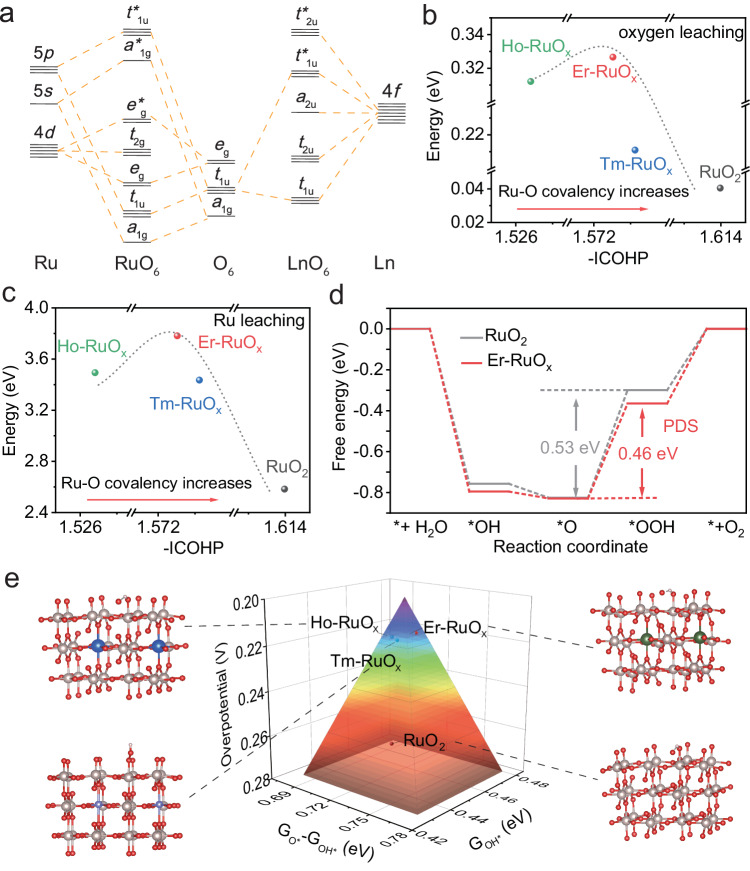
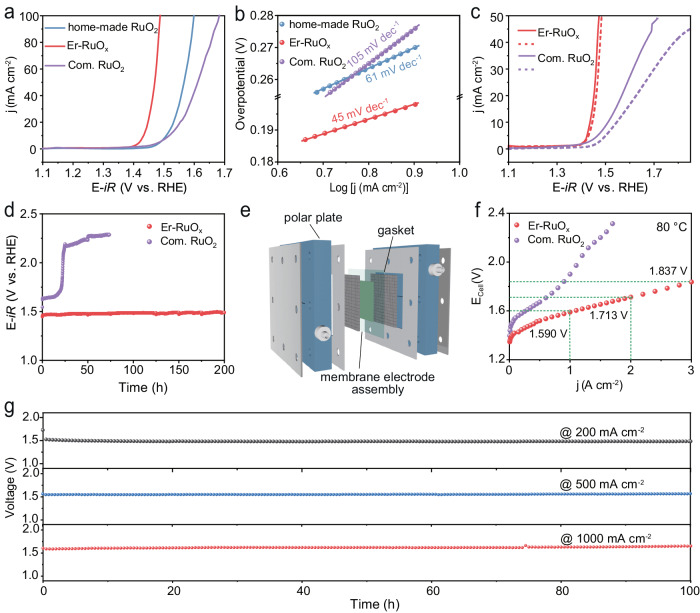
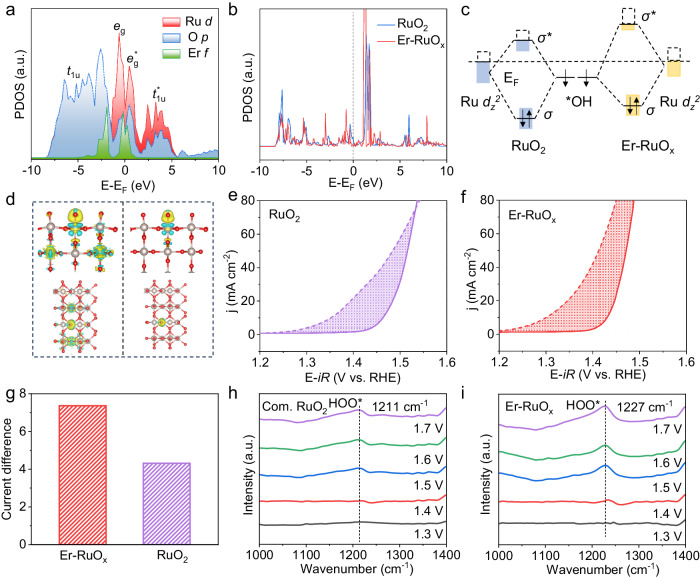
Precisely modulating the Ru-O covalency in RuO x for enhanced stability in proton exchange membrane water electrolysis is highly desired. However, transition metals with d -valence electrons, which were doped into or alloyed with RuO x , are inherently susceptible to the influence of coordination environment, making it challenging to modulate the Ru-O covalency in a precise and continuous manner. Here, we first deduce that the introduction of lanthanide with gradually changing electronic configurations can continuously modulate the Ru-O covalency owing to the shielding effect of 5 s /5 p orbitals. Theoretical calculations confirm that the durability of Ln-RuO x following a volcanic trend as a function of Ru-O covalency. Among various Ln-RuO x , Er-RuO x is identified as the optimal catalyst and possesses a stability 35.5 times higher than that of RuO 2 . Particularly, the Er-RuO x -based device requires only 1.837 V to reach 3 A cm −2 and shows a long-term stability at 500 mA cm −2 for 100 h with a degradation rate of mere 37 μV h −1 .
Overview
The claims and statistics of this paper haven’t been checked yet.
Run the check — free, no account needed. It reads the open-access text and checks the sources it cites.
Integrity signals
Registry
Cites
Statistics
Figures
Verification
Claims the paper makes
The claims and statistics of this paper haven’t been checked yet.
Run the check — free, no account needed. It reads the open-access text and checks the sources it cites.
Claims other papers make about this one
Each is checked against this paper’s own text: does it say what the citing paper says it does?
The check wasn’t confident either way, so it gives no verdict — never disputed.
In the citing paper
“metal Ru has a high charge density, leading to excessive adsorption of reaction intermediates during the HER and ORR.”
From Interface strain engineering of a Ru–RuO x /graphene aerogel composite boosts HER, OER and ORR applications (2026) · cites this paper as [17]
Experimental — accuracy not yet measured
Self-check
Percentages, sums and reported differences re-computed from the paper’s own numbers.
The self-check needs the paper’s full text.
Citations
Cites
Generalized Gradient Approximation Made Simple
Perdew, J. P., Burke, K., & Ernzerhof, M. (1996) · Physical Review Letters · doi:10.1103/physrevlett.77.3865 · Cited by 215,824
Efficient iterative schemes for ab initio total-energy calculations using a plane-wave basis set
Kresse, G., & Furthmüller, J. (1996) · Physical Review B · doi:10.1103/physrevb.54.11169 · Cited by 123,652
Combining theory and experiment in electrocatalysis: Insights into materials design
Seh, Z. W., Kibsgaard, J., Dickens, C. F., Chorkendorff, I., Nørskov, J. K., & Jaramillo, T. F. (2017) · Science · doi:10.1126/science.aad4998 · Cited by 12,114
Chen, F.-Y., Wu, Z.-Y., Adler, Z., & Wang, H. (2021) · Joule · doi:10.1016/j.joule.2021.05.005 · Cited by 1,284
Yao, Y., Hu, S., Chen, W., Huang, Z., Wei, W.-C., Yao, T., Liu, R., Zang, K., Wang, X., Wu, G., et al. (2019) · Nature Catalysis · doi:10.1038/s41929-019-0246-2 · Cited by 1,228
Wu, Z.-Y., Chen, F.-Y., Li, B., Yu, S.-W., Finfrock, Y. Z., Meira, D. M., Yan, Q.-Q., Zhu, P., Chen, M.-X., Song, T.-W., et al. (2023) · Nature Materials · doi:10.1038/s41563-022-01380-5 · Cited by 1,004
La- and Mn-doped cobalt spinel oxygen evolution catalyst for proton exchange membrane electrolysis
Chong, L., Gao, G., Wen, J., Li, H., Xu, H., Green, Z., Sugar, J. D., Kropf, A. J., Xu, W., Lin, X., et al. (2023) · Science · doi:10.1126/science.ade1499 · Cited by 837
Recent advances in proton exchange membrane water electrolysis
Liu, R., Xu, Z., Li, F., Chen, F., Yu, J., Yan, Y. P., Chen, Y., & Xia, B. Y. (2023) · Chemical Society Reviews · doi:10.1039/d2cs00681b · Cited by 737
Cao, L., Luo, Q., Chen, J., Wang, L., Lin, Y., Wang, H., Liu, X., Shen, X., Zhang, W., Liu, W., et al. (2019) · Nature Communications · doi:10.1038/s41467-019-12886-z · Cited by 709
Zagalskaya, A., & Alexandrov, V. (2020) · ACS Catalysis · doi:10.1021/acscatal.9b05544 · Cited by 684
Cited by
Sorted by citations
Rong, C., Huang, X., Arandiyan, H., Shao, Z., Wang, Y., & Chen, Y. (2025) · Advanced Materials · doi:10.1002/adma.202416362 · Cited by 355
Deng, L., Chen, H., Hung, S., Zhang, Y., Yu, H., Chen, H., Li, L., & Peng, S. (2024) · Journal of the American Chemical Society · doi:10.1021/jacs.4c14529 · Cited by 298
Self-citationJi, Q., Tang, B., Zhang, X., Wang, C., Tan, H., Zhao, J., Liu, R., Sun, M., Liu, H., Jiang, C., et al. (2024) · Nature Communications · doi:10.1038/s41467-024-52471-7 · Cited by 183
Wang, X., Hu, J., Lu, T., Wang, H., Sun, D., Tang, Y., Li, H., & Fu, G. (2024) · Angewandte Chemie International Edition · doi:10.1002/anie.202415306 · Cited by 166
Wang, C., Wu, X., Sun, H., Xu, Z., Xu, C., Wang, X., Li, M., Wang, Y., Tang, Y., Jiang, J., et al. (2025) · Energy & Environmental Science · doi:10.1039/d5ee00281h · Cited by 158
Metadata
- Authors
- Li, L., Zhang, G., Zhou, C., Lv, F., Tan, Y., Han, Y., Luo, H., Wang, D., Liu, Y., Shang, C., Zeng, L., Huang, Q., Zeng, R., Ye, N., Luo, M., & Guo, S.
- Affiliations
- Peking University (CN)
- Kunming University of Science and Technology (CN)
- Corresponding author
- Guo, Shaojun
- ORCID
- Venue
- Nature Communications
- Published
- 2024-06-11
- Volume
- 15
- Issue
- 1
- Pages
- 4974-4974
- ISSN
- 2041-1723 (ISSN-L)
- PMC
- PMC11166638
- OpenAlex
- W4399539823
- Cited by
- 368
- References
- 37
- Citations by year
- 2026: 121 · 2025: 206 · 2024: 41
- FWCI
- 24.53
- Type
- journal article
- Language
- en
- Open access
- gold
- doi.org
- Locations
- Nature Communications (publishedVersion, cc-by)
- PubMed Central (publishedVersion, cc-by)
- PubMed (publishedVersion)
- RePEc: Research Papers in Economics (submittedVersion)
- DOAJ (DOAJ: Directory of Open Access Journals) (submittedVersion)
- Funders
- Salt Science Research Foundation (BL14W1)
- National Natural Science Foundation of China (52261135633, 52303363, 22105007, 22309004, 52333010, 22205010, 52025133)
- China Postdoctoral Science Foundation (2022M710187, 2020M670018, 2023M730051, 2023M730029, 2022M720225)
- China National Petroleum Corporation (2021DQ02-1002)
- Peking University (2021DQ02-1002)
- National Postdoctoral Program for Innovative Talents (BX20220009)
- Beijing Synchrotron Radiation Facility (BL14W1)
- Topics
- Physical Sciences › Energy › Renewable Energy, Sustainability and the Environment › Electrocatalysts for Energy Conversion
- Physical Sciences › Engineering › Electrical and Electronic Engineering › Fuel Cells and Related Materials
- Physical Sciences › Energy › Renewable Energy, Sustainability and the Environment › CO2 Reduction Techniques and Catalysts
- Keywords
- lanthanide doping, acidic oxygen evolution reaction, proton exchange membrane water electrolysis, catalyst stability, coordination environment, volcano plot, electrocatalyst degradation
About these checks
Registry, retraction, Cites and statistics results are computed, not judged, with one exception: a printed reference that no index lists is read once by a model before it counts as a citation error. Claims are extracted by a model and kept only when their quote appears verbatim in the text; each cited source is then checked, with a model’s help, for whether it says what the claim relies on. Those verdicts can be wrong — read the claim’s quote and the cited source before relying on one.
Statistics and arithmetic are recomputed, not judged.
Confidence bands are shown only for fields calibrated on our annotated test set. None is calibrated yet, so no band is shown.
What counts as a claim ›How we measure confidence ›How we check this ›
Are you an author, or do you see a problem with this page? Request a review
