

Exome sequencing of 457 autism families recruited online provides evidence for autism risk genes
Open accessPublished version of a preprint
The DOI matches its Crossref record; 120 of the 120 references it cites were found in a registry or an index; 12 of the 37 sources its claims cite were checked for support.
Abstract
Autism spectrum disorder (ASD) is a genetically heterogeneous condition, caused by a combination of rare de novo and inherited variants as well as common variants in at least several hundred genes. However, significantly larger sample sizes are needed to identify the complete set of genetic risk factors. We conducted a pilot study for SPARK (SPARKForAutism.org) of 457 families with ASD, all consented online. Whole exome sequencing (WES) and genotyping data were generated for each family using DNA from saliva. We identified variants in genes and loci that are clinically recognized causes or significant contributors to ASD in 10.4% of families without previous genetic findings. In addition, we identified variants that are possibly associated with ASD in an additional 3.4% of families. A meta-analysis using the TADA framework at a false discovery rate (FDR) of 0.1 provides statistical support for 26 ASD risk genes. While most of these genes are already known ASD risk genes, BRSK2 has the strongest statistical support and reaches genome-wide significance as a risk gene for ASD ( p -value = 2.3e−06). Future studies leveraging the thousands of individuals with ASD who have enrolled in SPARK are likely to further clarify the genetic risk factors associated with ASD as well as allow accelerate ASD research that incorporates genetic etiology.
Overview
CoChat Summary
TL;DR
This SPARK pilot exome-sequencing study of 457 online-recruited autism families found returnable ASD-related genetic findings in 10.4% of families without prior genetic findings and possible ASD-associated variants in an additional 3.4%. A TADA meta-analysis with published trios supported 26 ASD risk genes at FDR ≤ 0.1, with BRSK2 reaching genome-wide significance.
Key findings
- In 444 families without prior genetic findings, deleterious variants in known ASD risk genes/loci were identified in 50 families (10.4%); possible ASD-associated variants were found in an additional 14 individuals (3.4%). Thirteen self-reported genetic diagnoses were confirmed and served as positive controls.
- De novo analysis identified 647 rare coding/splice SNVs and indels (1.4/offspring), including 85 LGD and 390 missense variants. The dnLGD frequency was 0.18/offspring, 1.76-fold above baseline expectation (p = 1.2 × 10⁻⁶); de novo D-mis variants with CADD ≥25 were enriched 1.28-fold (p = 6.6 × 10⁻⁴), and those with MPC ≥2 were enriched 1.88-fold (p = 9.9 × 10⁻⁴).
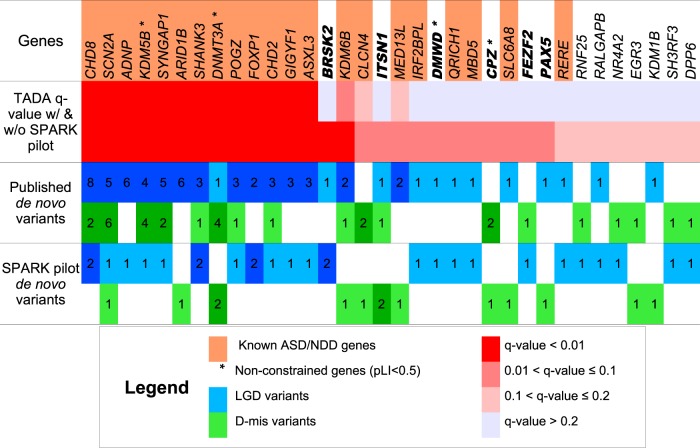
- TADA meta-analysis of 4773 published ASD trios plus 465 SPARK trios identified 67 genes at FDR ≤ 0.1; 26 also had a damaging variant in SPARK. Six genes reached FDR ≤ 0.1 only after SPARK inclusion: BRSK2, ITSN1, PAX5, FEZF2, DMWD, and CPZ. BRSK2 had the strongest support and reached genome-wide significance (p = 2.3 × 10⁻⁶; FDR q = 0.0015).
- CNV analysis found 273 rare CNVs in 206 affected offspring, including 253 inherited CNVs (0.544/affected offspring; average 194 kb) and 20 de novo CNVs (0.043/affected offspring; average 1.6 Mb). Six CNVs mapped to 16p11.2, and four occurred at BP4-BP5 in 0.9% of affected offspring. Mosaic analysis identified 65 likely mosaic mutations (0.142/offspring), about 10% (65/652) of total de novo SNVs.
Methods
- SPARK pilot recruited 457 families with ASD online under a centralized IRB; 1379 individuals were characterized, including 418 simplex and 39 multiplex families. DNA came from saliva; exome capture used VCRome plus PKv2 and sequencing used Illumina HiSeq 100 bp paired-end reads, with Illumina HumanCoreExome 550K SNP genotyping.
- De novo SNV/indel calls were generated independently by UW, SF, and CUMC and combined by consensus; inherited singleton LGD variants, mosaic SNVs, CNVs, and aneuploidies were called with separate pipelines. CNVs were integrated from exome read-depth and SNP microarray data.
- Main analyses included burden testing against a published mutation-rate model using Poisson tests, TADA meta-analysis with published ASD trios, and functional/network analyses using forecASD, STRING, Gene Ontology, BrainSpan laminar expression, and single-cell expression data.
Limitations
- Stated in the paper: the pilot sample size was limited; the study was underpowered to detect statistically significant sex differences in burden; mosaic calls were too few to evaluate mosaic mutation burden; DMWD may be a false positive because it is not constrained (pLI = 0); larger samples are needed to identify lower-penetrance inherited risk genes.
- Stated in the paper: diagnostic yield may increase as more SPARK individuals are studied and additional risk factors are identified; some variants were interpreted as possible contributors and would be returned only if genes become established.
- Evident from the text: phenotypes were largely parent-reported online rather than clinically confirmed for all participants; over 80% of participants were predicted to have European ancestry, limiting generalizability; no incidental findings unrelated to ASD were searched for; platform differences may cause some CNVs to be missed.
Model-written summary. Check it against the paper before relying on it.
Integrity signals
Registry
Cites
Statistics
Figures
Verification
Claims the paper makes
8 Valid · 0 Not valid · 18 Not checked · 107 Own results and interpretations
The sources with a verdict support this claim; the rest weren’t checked yet, have no full text we could read, or their verdicts aren’t rated yet.
In the paper
“We also demonstrated that the genetic architecture in this self-reported cohort is similar to published, clinically confirmed ASD cohorts.3,4,7”
§ Exome sequencing of 457 autism families recruited online provides evidence for autism risk genes > Introduction
What the sources say
- Supportedcites [3] Iossifov I The contribution of de novo coding mutations to autism spectrum disorder Nature 2014 515 216 221 10.1038/nature13908 25363768 PMC4313871 source
The Methods (Sample collection) describe the Simons Simplex Collection as assembled at clinical centers with detailed, standardized phenotypic analysis. The Introduction and Results describe this paper’s analysis of genetic vulnerability to ASD in that cohort. It therefore serves as an example of a published, clinically characterized ASD cohort; the comparison with SPARK is the citing authors’ own conclusion. (LLM, conf=0.88)
- Not checked yetcites [4] RK CY Whole genome sequencing resource identifies 18 new candidate genes for autism spectrum disorder Nat. Neurosci. 2017 20 602 611 10.1038/nn.4524 28263302 PMC5501701 source
- Supportedcites [7] De Rubeis S Synaptic, transcriptional and chromatin genes disrupted in autism Nature 2014 515 209 215 10.1038/nature13772 25363760 PMC4402723 source
The Abstract reports genetic findings from 3,871 autism cases, and the Conclusions describe their pattern of de novo and inherited risk variation. This paper therefore supplies a published ASD cohort for comparison; the statement that SPARK is similar is the citing authors’ own conclusion, not a finding attributed to this 2014 source. (LLM, conf=0.86)
boostedn = 457- Asserted: passes — The authors put it forward as true.
- Checkable: passes — It can be checked against evidence.
- Load-bearing: passes — The paper’s conclusions depend on it.
- Based: passes — The paper gives a reason why it holds.
- Rests on an assumption not shown here.
- Supported
The cited sources support only part of this claim — read each source’s verdict below.
In the paper
“Variants in constrained genes (pLI ≥ 0.5)12 explain most of the burden of dnLGD variants and de novo D-mis variants (defined by an MPC score ≥2) in the affected offspring in our study”
§ Exome sequencing of 457 autism families recruited online provides evidence for autism risk genes > Results > Variant discovery
What the sources say
- Partly supportedcites [12] Lek M Analysis of protein-coding genetic variation in 60,706 humans Nature 2016 536 285 291 10.1038/nature19057 27535533 PMC5018207 sourceExperimental — accuracy not yet measured
Our copy is the origin of the pLI gene-constraint metric (Inferring variant deleteriousness and gene constraint, p. null): 'This metric—the probability of being loss-of-function (LoF) intolerant (pLI)—separates genes of sufficient length into LoF intolerant (pLI ≥ 0.9, n = 3,230) or LoF tolerant (pLI ≤ 0.1, n = 10,374) categories', and it confirms LoF-intolerant genes include virtually all known severe haploinsufficient disease genes (Fig. 3b). However, the paper nowhere uses a pLI ≥ 0.5 cut-off to define 'constrained genes' (searched: pLI 0.5, intermediate threshold), and it does not address de novo LGD (dnLGD) variants, de novo damage missense variants, an MPC (missense pathogenicity class) score ≥ 2, or burden in affected offspring — ExAC is a population reference-database study, and MPC is not defined in our copy. So the metric itself is correctly attributed, while the ≥0.5 threshold and the offspring-burden statement are not supported by this source. (LLM, conf=0.78)
plainstates an association- Asserted: passes — The authors put it forward as true.
- Checkable: passes — It can be checked against evidence.
- Load-bearing: passes — The paper’s conclusions depend on it.
- Based: passes — The paper gives a reason why it holds.
- Partly supported
Every source the paper cites for this claim was checked and supports it.
In the paper
“the frequency of dnLGD variants in the 465 affected offspring in SPARK (0.18/offspring) is 1.76-fold higher than the baseline expectation calculated by a previously published mutation rate model9 (p-value = 1.2 × 10⁻⁶ by one-sided exact Poisson test)”
§ Exome sequencing of 457 autism families recruited online provides evidence for autism risk genes > Results > Variant discovery
What the sources say
- Supportedcites [9] Samocha KE A framework for the interpretation of de novo mutation in human disease Nat. Genet. 2014 46 944 950 10.1038/ng.3050 25086666 PMC4222185 source
The citation is attached only to 'a previously published mutation rate model' used to calculate the baseline expectation; the SPARK cohort size, the 0.18/offspring observed frequency, the 1.76-fold ratio and the p = 1.2×10⁻⁶ Poisson test are the citing study's own results, not attributed here. Our copy establishes Samocha et al. (2014) as exactly that model: 'Basis of the mutational model' (p. 3) describes gene-specific probabilities of synonymous, missense, nonsense, essential splice site and frameshift mutation yielding an expected exome rate of 1.67×10⁻⁸, and 'Mutational model' (p. 10) gives the absolute per-gene expectation via a genome-wide rate of 1.2×10⁻⁸ per bp per generation. The framework is then applied to compute expected LoF events per exome versus observed cases (Figure 2/Table 3, pp. 16 and 19: expected 0.09 LoF per exome against 0.13 observed, p = 2.05×10⁻⁷), i.e. it supplies the baseline expectation of de novo LoF variants the citing sentence invokes. (LLM, conf=0.85)
plainstates an association- Asserted: passes — The authors put it forward as true.
- Checkable: passes — It can be checked against evidence.
- Load-bearing: passes — The paper’s conclusions depend on it.
- Based: passes — The paper gives a reason why it holds.
- Supported
The cited sources support only part of this claim — read each source’s verdict below.
In the paper
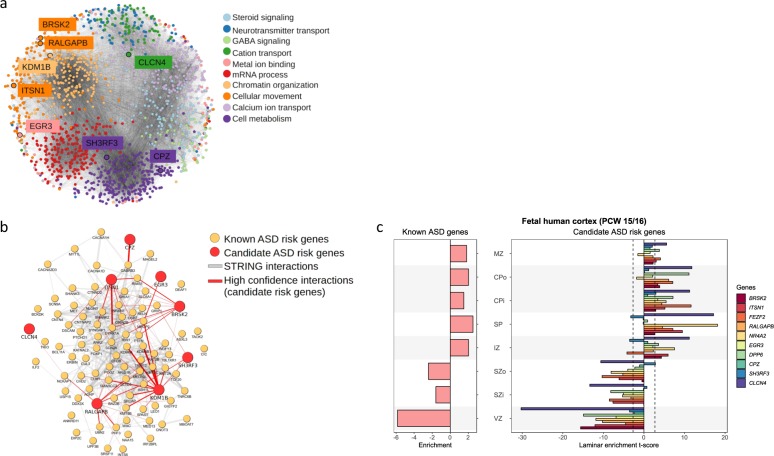
“mRNA translation of BRSK2, ITSN1, and RALGAPB in neurons is predicted to be regulated by FMR1 protein.35”
§ Exome sequencing of 457 autism families recruited online provides evidence for autism risk genes > Results > Genes with a higher mutational burden
What the sources say
- Partly supportedcites [35] Darnell JC FMRP stalls ribosomal translocation on mRNAs linked to synaptic function and autism Cell 2011 146 247 261 10.1016/j.cell.2011.06.013 21784246 PMC3232425 sourceExperimental — accuracy not yet measured
The Results section (‘Identity and functions encoded by FMRP target transcripts’; page not supplied) identifies FMRP-bound mRNAs in mouse brain, and the Discussion describes FMRP regulation of their translation. But no passage in our copy identifies BRSK2, ITSN1, or RALGAPB as targets; searches for all three names found no match. The proposed regulation of these specific mRNAs is therefore not established by the available text. (LLM, conf=0.84)
hedgedstates a possible cause- Asserted: passes — The authors put it forward as true.
- Checkable: passes — It can be checked against evidence.
- Load-bearing: unclear — It is unclear whether the paper’s conclusions depend on it.
- Based: passes — The paper gives a reason why it holds.
- Partly supported
The sources with a verdict support this claim; the rest weren’t checked yet, have no full text we could read, or their verdicts aren’t rated yet.
In the paper
“Recent studies have reported additional individuals with ASD and/or NDD with de novo damaging variants in these genes including BRSK2,27 PAX5,4,28 NR4A2,29,30 RALGAPB,7,31,32 and DPP6.5,33,34”
§ Exome sequencing of 457 autism families recruited online provides evidence for autism risk genes > Results > Genes with a higher mutational burden
What the sources say
- Supportedcites [27] Hiatt SM Deleterious Variation in BRSK2 Associates with a Neurodevelopmental Disorder Am. J. Hum. Genet 2019 104 701 708 10.1016/j.ajhg.2019.02.002 30879638 PMC6451696 source
The paper reports nine individuals with developmental delay and/or intellectual disability and likely damaging BRSK2 variants; most also had autism (p. 2). It states that the variants arose de novo in all six individuals whose parents were available for testing (p. 3). The citation is attached to BRSK2, not to the other genes listed in the sentence. (LLM, conf=0.94)
- Not checked yetcites [4] RK CY Whole genome sequencing resource identifies 18 new candidate genes for autism spectrum disorder Nat. Neurosci. 2017 20 602 611 10.1038/nn.4524 28263302 PMC5501701 source
- Supportedcites [28] O’Roak BJ Recurrent de novo mutations implicate novel genes underlying simplex autism risk Nat. Commun. 2014 5 5595 10.1038/ncomms6595 25418537 PMC4249945 source
This citation is attached to PAX5, not to the other genes in the sentence. Table 1 reports three de novo PAX5 mutations in ASD probands—two classified as severe and one as missense—and the Discussion describes the PAX5 carriers as having ASD. (LLM, conf=0.92)
plainstates an association- Asserted: passes — The authors put it forward as true.
- Checkable: passes — It can be checked against evidence.
- Load-bearing: unclear — It is unclear whether the paper’s conclusions depend on it.
- Based: passes — The paper gives a reason why it holds.
- Supported
58 more claims · 1 with their cited sources checked
Create a free account to see all 133 claims and to verify the 25 references still open.
- Probably not a substantial claim. 38
- It may state two separate claims as one. 45
Claims other papers make about this one
Each is checked against this paper’s own text: does it say what the citing paper says it does?
The check wasn’t confident either way, so it gives no verdict — never disputed.
In the citing paper
“This default classifier had high accuracy (AUC = 0.997) for detecting a truth-set of orthogonally validated de novo SNVs and indels from SSC57.”
From A phenotypic spectrum of autism is attributable to the combined effects of rare variants, polygenic risk and sex (2022) · cites this paper as [57]
Experimental — accuracy not yet measured
Self-check
Percentages, sums and reported differences re-computed from the paper’s own numbers.
Each contradiction between two passages listed here was confirmed by an independent check.
Rated minor: it would not touch a result — a value no result rests on, a p-value that stays on the same side of the significance level, or a conflict that is clerical, resolved elsewhere in the paper, or outside its own findings.
In the paper
§ Exome sequencing of 457 autism families recruited online provides evidence for autism risk genes > Results > Variant discovery
“Of the 465 offspring affected with ASD, 25.6% also reported intellectual disability (Table 1).”
§ Exome sequencing of 457 autism families recruited online provides evidence for autism risk genes > Results > Variant discovery
“| Affected male offspring | 376 | 4.8 | 12.9 (8.4) | 1.5–44.6 | 22% (78/356) | 13% (46/356) | 7% (25/356) | 30% (106/356) | | Affected female offspring | 89 | 5.6 | 12.8 (7.3) | 1.9–29.8 | 33% (28/84) | 10% (8/84) | 13% (11/84) | 23% (19/84) |”
Rated minor: it would not touch a result — a value no result rests on, a p-value that stays on the same side of the significance level, or a conflict that is clerical, resolved elsewhere in the paper, or outside its own findings.
In the paper
§ Exome sequencing of 457 autism families recruited online provides evidence for autism risk genes > Results > Genes with a higher mutational burden
“we identified 34 genes (Fig. 1), of which 21 have a known role in ASD or NDDs.”
§ Exome sequencing of 457 autism families recruited online provides evidence for autism risk genes > Results > Genes with a higher mutational burden
“A total of 34 genes with at least one de novo damaging variant observed in SPARK pilot trios achieve an FDR ≤ 0.2 after meta-analysis with published trios (total n = 5238). Fourteen genes are not classified as known ASD or NDD genes.”
Citations
Cites
The Sequence Alignment/Map format and SAMtools
Li, H., Handsaker, B., Wysoker, A., Fennell, T., Ruan, J., Homer, N., Marth, G., Abecasis, G., Durbin, R., & 1000 Genome Project Data Processing Subgroup (2009) · Bioinformatics · doi:10.1093/bioinformatics/btp352 · Cited by 62,041
Self-citationFast and accurate short read alignment with Burrows-Wheeler transform
Li, H., & Durbin, R. (2009) · Bioinformatics · doi:10.1093/bioinformatics/btp324 · Cited by 58,607
Self-citationCytoscape: A software Environment for integrated models of biomolecular interaction networks
Shannon, P., Markiel, A., Ozier, O., Baliga, N. S., Wang, J. T., Ramage, D., Amin, N., Schwikowski, B., & Ideker, T. (2003) · Genome Research · doi:10.1101/gr.1239303 · Cited by 51,888
Self-citationGene Ontology: tool for the unification of biology
Ashburner, M., Ball, C. A., Blake, J. A., Botstein, D., Butler, H., Cherry, J. M., Davis, A. P., Dolinski, K., Dwight, S. S., Eppig, J. T., et al. (2000) · Nature Genetics · doi:10.1038/75556 · Cited by 43,206
PLINK: a tool set for whole-genome association and population-based linkage analyses.
Purcell, S., Neale, B., Todd-Brown, K., Thomas, L., Ferreira, M. A. R., Bender, D., Maller, J., Sklar, P., de Bakker, P. I. W., Daly, M. J., et al. (2007) · The American Journal of Human Genetics · doi:10.1086/519795 · Cited by 34,089
Richards, S., Aziz, N., Bale, S., Bick, D., Das, S., Gastier-Foster, J., Grody, W. W., Hegde, M., Lyon, E., Spector, E., et al. (2015) · Genetics in Medicine · doi:10.1038/gim.2015.30 · Cited by 32,594
The Genome Analysis Toolkit: A MapReduce framework for analyzing next-generation DNA sequencing data
McKenna, A., Hanna, M., Banks, E., Sivachenko, A., Cibulskis, K., Kernytsky, A., Garimella, K., Altshuler, D., Gabriel, S., Daly, M., et al. (2010) · Genome Research · doi:10.1101/gr.107524.110 · Cited by 27,895
ANNOVAR: functional annotation of genetic variants from high-throughput sequencing data
Wang, K., Li, M., & Hakonarson, H. (2010) · Nucleic Acids Research · doi:10.1093/nar/gkq603 · Cited by 14,621
Cingolani, P., Platts, A., Wang, L. L., Coon, M., Nguyen, T., Wang, L., Land, S. J., Lu, X., & Ruden, D. M. (2012) · Fly · doi:10.4161/fly.19695 · Cited by 11,816
A framework for variation discovery and genotyping using next-generation DNA sequencing data
DePristo, M. A., Banks, E., Poplin, R., Garimella, K. V., Maguire, J. R., Hartl, C., Philippakis, A. A., del Angel, G., Rivas, M. A., Hanna, M., et al. (2011) · Nature Genetics · doi:10.1038/ng.806 · Cited by 11,456
Cited by
Items 201–273 of 273
Rare variants in 45 genes account for 25% of cases with NDDs in 415 pediatric patientsPreprint
Aspromonte, M. C., Conte, A. D., Polli, R., Baldo, D., Benedicenti, F., Bettella, E., Bigoni, S., Boni, S., Ciaccio, C., D’Arrigo, S., et al. (2023) · Research Square · doi:10.21203/rs.3.rs-3139796/v1 · Cited by 2
Zahiri, J., Mirzaie, M., Duan, K., Xiao, Y., Aamodt, C., Yang, X., Nazari, S., Andreason, C., Lopez, L., Barnes, C. C., et al. (2024) · medRxiv · doi:10.1101/2024.09.17.24313857 · Cited by 2
Self-citationPham, K., Malachowski, T., Zhou, L., Kim, J. H., Chuanbin, S., & Phillips‐Cremins, J. E. (2025) · bioRxiv (Cold Spring Harbor Laboratory) · doi:10.1101/2025.03.19.644148 · Cited by 2
Influence of De novo mutation in autism
Arumugam, V., Sanjeev, A. M. A., Kathirvel, B., & Kaviya, M. (2020) · Biomedical and Biotechnology Research Journal (BBRJ) · doi:10.4103/bbrj.bbrj_63_20 · Cited by 1
(2024) · Frontiers research topics · doi:10.3389/978-2-8325-4411-2 · Cited by 1
Genomics of psychiatric disorders
Ryan, N., Ormond, C., Brady, P., Heron, E. A., & Corvin, A. P. (2024) · Elsevier eBooks · doi:10.1016/b978-0-323-99417-0.00027-6 · Cited by 1
Monogenic defects in Russian children with autism spectrum disorders
Suspitsin, E. N., Malysheva, K. S., Laptiev, S. A., Sharonova, O. S., Abuzova, A. S., Kuznitsyna, A. A., Мелашенко, Т. В., Efremova, O. V., Korzun, P. R., Binnatova, J. O., et al. (2025) · World Journal of Clinical Pediatrics · doi:10.5409/wjcp.v14.i4.108733 · Cited by 1
Genetic Traces in Autism Spectrum Disorders: A Whole Exome Sequencing Study from Türkiye
Kayhan, G., Ozaslan, A., İşeri, E., Güney, E., Kazan, H. H., Büyüktaşkın, D., Mulayim, M. F., Ergün, M. A., & PERÇİN, F. E. (2026) · Genes · doi:10.3390/genes17020249 · Cited by 1
Ortega, L. D., Sturm, A., Krushena, M. M., & Gulsrud, A. C. (2026) · Journal of Neurodevelopmental Disorders · doi:10.1186/s11689-026-09704-1 · Cited by 1
Self-citationBrudno, R., Askayo, D., Khair, D., Shayevitch, R., Keydar, I., Zmudjak-Olevson, M., Lev-Maor, G., Zavolan, M., Elkon, R., & Ast, G. (2026) · Genome biology · doi:10.1186/s13059-026-04084-0 · Cited by 2
Further characterization of the BRSK2-associated neurodevelopmental disorder
Singhal, P., Hsieh, T., Ehmke, N., Bacchelli, E., Viggiano, M., Maestrini, E., Visconti, P., Posar, A., Scaduto, M. C., Vaisfeld, A., et al. (2026) · European Journal of Human Genetics · doi:10.1038/s41431-026-02195-7 · Cited by 1
Wickramasekara, R. N., Lookian, P. P., Ngo, J., Shibata, A., & Stessman, H. A. F. (2020) · Reports — Medical Cases Images and Videos · doi:10.3390/reports3040031 · Cited by 1
Liang, N., Li, T., & Deng, Y. (2025) · Frontiers in Genetics · doi:10.3389/fgene.2025.1590292 · Cited by 1
Yuan, B., Wang, M., Wu, X., Cheng, P., Zhang, R., Zhang, R., Yu, S., Du, Y., Zhang, J., Wang, X., et al. (2022) · Research Square · doi:10.21203/rs.3.rs-729083/v2 · Cited by 1
The Genotype and Phenotypes in Families (GPF) platform manages the large and complex data at SFARIPreprint
Chorbadjiev, L., Cokol, M., Weinstein, Z., Shi, K. Y., Fleisch, C., Dimitrov, N., Mladenov, S., Xu, S., Hall, J., Ford, S., et al. (2024) · bioRxiv (Cold Spring Harbor Laboratory) · doi:10.1101/2024.02.08.579330 · Cited by 1
Self-citationImpact of intragenic NRXN1 deletions on early cortical developmentPreprint
Polit, L. D., Gatford, N. J. F., Carneiro, T. N. R., Nagy, R., Higgs, V., Consortia, A., Massrali, A., Paul, A., Fasolino, M., Zhou, Z., et al. (2024) · bioRxiv (Cold Spring Harbor Laboratory) · doi:10.1101/2024.08.26.609494 · Cited by 1
Genomic dissection of sleep archetypes in a large autism cohortPreprint
Brueggeman, L., Pottschmidt, N. R., Koomar, T., Thomas, T., & Michaelson, J. J. (2025) · medRxiv · doi:10.1101/2025.04.04.25325272 · Cited by 1
Self-citationApport du séquençage d'exome pour le diagnostic et le traitement des maladies complexes
Jacob, A. (2020) · theses.fr (ABES) · doi:10.70675/867c4f59zac67z45c8z821ez3513ef63ba7c · Cited by 1
Tan, Q., Xie, J., Snyder, L. G., Chen, R., Yang, L., Chen, F., Trost, B., Fernandez, B., Chiang, C. W.-K., Mancuso, N., et al. (2026) · doi:10.64898/2026.10.19.26365670
“Copy number variant (CNV) analyses for the SPARK cohort were restricted to autosomal rare CNVs called from whole-exome sequencing (WES) data via XHMM by the SFARI team [37, 38].”
Self-citationUtilisation and outcomes of treatment in Autism Spectrum Disorder
Houghton, R. (2021) · Research Publications (Maastricht University) · doi:10.26481/dis.20210304rh
Computational Analysis of Non-CpG DNA Methylation in the Mammalian Nervous System
Wu, D. Y. (2021) · Open Scholarship Institutional Repository (Washington University in St. Louis) · doi:10.7936/09e6-w233
Diagnosis of genetic and metabolic conditions
Tan, Q. K. ‐. (2022) · Elsevier eBooks · doi:10.1016/b978-0-12-818872-9.00065-0
Identifying genomic risk factors for neurodevelopmental disorders using machine learning
Brueggeman, L., Bassuk, A. G., Williams, A. J., Smith, R., Michaelson, J. J., & Braun, T. A. (2022) · doi:10.17077/etd.006360
Self-citationObiajulu, J. U., Kuang, R., He, L., Zhong, G., Hagen, J., Shu, C., Chung, W., & Shen, Y. (2023) · Research Square · doi:10.21203/rs.3.rs-1910518/v3
Self-citationZhang, Y., Lu, Q., Ye, Y., Huang, K., Liu, W., Wu, Y., Zhong, X., Li, B., Yu, Z., Travers, B. G., et al. (2021) · Figshare · doi:10.6084/m9.figshare.16584360
Self-citationChapter 2. Psychiatric Assessment and Treatment
Ferretti, C. J., Taylor, B. P., Frankini, C., & Hollander, E. (2022) · American Psychiatric Association Publishing eBooks · doi:10.1176/appi.books.9781615379521.lg02
Bridging Biology and Behavior in Autism - Innovations in Research and Practice
Carotenuto, M., & Costanza, C. (2025) · IntechOpen eBooks · doi:10.5772/intechopen.1006440
Effect of draxin manipulation on BTBR mouse brain and behavior
Blau, A. (2020) · Scholars Archive - University at Albany (University at Albany, State University of New York) · doi:10.54014/pfxg-99pj
Bajaj, S., Gandhi, S., Geetha, T. S., Venkata, M., Chitre, A., Sagi, N., Agrawal, N., Shah, S., Deo, R., Pai, S., et al. (2025) · Journal of Human Genetics · doi:10.1038/s10038-025-01368-4
Self-citationLiang, S.-F., Yang, M. W. O., Huang, H.-T., Lo, R. Y., Chompoopong, S., Chen, C., & Liu, I. Y. (2025) · Neurotherapeutics · doi:10.1016/j.neurot.2025.e00761
The Role of Copy Number Variations in Autism Spectrum Disorders and Genetic Approaches
Bilgeç, N. (2025) · IntechOpen eBooks · doi:10.5772/intechopen.1010383
Tan, T. T., Dogan, Y. C., Durmuşalioğlu, E. A., Yilmaz, Z. B., Tan, M. E., Atık, T., Çoğulu, Ö., & Işık, E. (2025) · International Journal of Developmental Disabilities · doi:10.1080/20473869.2025.2552735
Contribution of genetic variants to orofacial clefts in African populations
Awotoye, W. O. (2024) · Iowa Research Online (The University of Iowa) · doi:10.25820/etd.006558
Wang, L., Zhang, Y., Li, K., Wang, Z., Wang, X., Li, B., Zhao, G., Fang, Z., Ling, Z., Luo, T., et al. (2020) · Figshare · doi:10.6084/m9.figshare.13059481
Zhu, N., Świetlik, E. M., Welch, C. L., Pauciulo, M. W., Hagen, J. J., Zhou, X., Guo, Y., Karten, J., Pandya, D., Tilly, T., et al. (2021) · Figshare · doi:10.6084/m9.figshare.14569987
Self-citationRao, S., Sadybekov, A., DeWitt, D. C., Lipka, J., Katritch, V., & Herring, B. E. (2024) · Figshare · doi:10.6084/m9.figshare.25530313
Additional file 5 of Exploratory analysis of L1 retrotransposons expression in autism
Spirito, G., Filosi, M., Domenici, E., Mangoni, D., Gustincich, S., & Sanges, R. (2024) · Figshare · doi:10.6084/m9.figshare.26600515
Zhang, Y., Lu, Q., Ye, Y., Huang, K., Liu, W., Wu, Y., Zhong, X., Li, B., Yu, Z., Travers, B. G., et al. (2021) · Figshare · doi:10.6084/m9.figshare.16584354
Self-citationAdditional file 3 of Exploratory analysis of L1 retrotransposons expression in autism
Spirito, G., Filosi, M., Domenici, E., Mangoni, D., Gustincich, S., & Sanges, R. (2024) · Figshare · doi:10.6084/m9.figshare.26600509
Additional file 1 of Exploratory analysis of L1 retrotransposons expression in autism
Spirito, G., Filosi, M., Domenici, E., Mangoni, D., Gustincich, S., & Sanges, R. (2024) · Figshare · doi:10.6084/m9.figshare.26600503
Additional file 4 of Exploratory analysis of L1 retrotransposons expression in autism
Spirito, G., Filosi, M., Domenici, E., Mangoni, D., Gustincich, S., & Sanges, R. (2024) · Figshare · doi:10.6084/m9.figshare.26600512
Zhang, Y., Lu, Q., Ye, Y., Huang, K., Liu, W., Wu, Y., Zhong, X., Li, B., Yu, Z., Travers, B. G., et al. (2021) · Figshare · doi:10.6084/m9.figshare.16584363
Self-citationMcKenna, B. G., Huang, Y., Vervier, K., Hofammann, D., Cafferata, M., Al-Momani, S. I., Lowenthal, F., Zhang, A., Koh, J.-Y., Thenuwara, S., et al. (2021) · Figshare · doi:10.6084/m9.figshare.14759823
Self-citationAdditional file 2 of Exploratory analysis of L1 retrotransposons expression in autism
Spirito, G., Filosi, M., Domenici, E., Mangoni, D., Gustincich, S., & Sanges, R. (2024) · Figshare · doi:10.6084/m9.figshare.26600506
Additional file 6 of Exploratory analysis of L1 retrotransposons expression in autism
Spirito, G., Filosi, M., Domenici, E., Mangoni, D., Gustincich, S., & Sanges, R. (2024) · Figshare · doi:10.6084/m9.figshare.26600518
Zhu, N., Świetlik, E. M., Welch, C. L., Pauciulo, M. W., Hagen, J. J., Zhou, X., Guo, Y., Karten, J., Pandya, D., Tilly, T., et al. (2021) · Figshare · doi:10.6084/m9.figshare.14569990
Self-citationZhang, Y., Lu, Q., Ye, Y., Huang, K., Liu, W., Wu, Y., Zhong, X., Li, B., Yu, Z., Travers, B. G., et al. (2021) · Figshare · doi:10.6084/m9.figshare.16584357
Self-citationBioinformatic approach for identifying and correcting artifacts in diploid genome assemblies
고병준 (2023) · Seoul National University Open Repository (Seoul National University)
Drozd, C. J. (2023) · UWM Digital Commons (University of Wisconsin–Milwaukee)
Analiza eksoma pri slovenskih otrocih z motnjami avtističnega spektra
Rihar, N. (2024) · Repository of the University of Ljubljana (University of Ljubljana)
Deng, J., Li, Y., Hu, M., Hu, C., Lin, J., Li, Q., Xu, X., & Liu, C. (2026) · International Journal of Molecular Sciences · doi:10.3390/ijms27020858
Ortega, L. D., Krushena, M. M., Gulsrud, A. C., & Sturm, A. (2026) · Research Square · doi:10.21203/rs.3.rs-8408759/v1
Self-citationOrtega, L. D. (2026) · OSF Preprints (OSF Preprints) · doi:10.17605/osf.io/9dgkw
The role of mitochondria in autism: an analysis of mitochondrial dysfunction in ASD
Colff, R. V. D. (2022) · Open University of Cape Town (University of Cape Town)
RameshRaju, M. K., Parambath, S. V., Srividhya, D., Shankarappa, B. M., Basappa, R. N., & Murthy, A. S. N. (2026) · Journal of Molecular Neuroscience · doi:10.1007/s12031-026-02542-9
Luo, L., Gao, X., Pang, T., Pang, K., Wang, T., Guo, H., Yang, L., & Chang, S. (2026) · Journal of Translational Medicine · doi:10.1186/s12967-026-08364-y
Self-citationBroader autism phenotype, the default mode network, and brain entropy: A network-level hypothesis
Dubey, S., Sarkhel, S., Sengupta, S., Dubey, M. J., Ghosh, R., & Benito‐León, J. (2026) · Research in Neurodiversity · doi:10.1016/j.rin.2026.100044
Sharma, A., Naskar, A., Joshi, A., Priya Stella Mary, I., Vinay, K., & R, S. E. P. P. A. (2026) · International Conference on Integrated Intelligence and Communication Systems (ICIICS) · doi:10.1109/iciics67880.2026.11483518
Lee, D. H., Park, E. G., Kim, W. R., Lee, Y. L., Jeong, H.-S., Roh, H.-Y., Jeong, G.-R., Hwang, S., Hong, J., Kim, M. J., et al. (2026) · Scientific Reports · doi:10.1038/s41598-026-59907-8
de Hoyos, L., Schlag, F., Jahagirdar, S., Corfield, E. C., Allegrini, A. G., Admiraal, D., de Zeeuw, E. L., Nolte, I. M., Llonga, N., Neumann, A., et al. (2026) · Nature Human Behaviour · doi:10.1038/s41562-026-02551-z · Cited by 1
Bayesian Factor Analysis for Binary and Ordinal Phenotypes with MissingnessPreprint
Shashaank, N., & Knowles, D. A. (2026) · bioRxiv (Cold Spring Harbor Laboratory) · doi:10.64898/2026.07.15.733660
Pini, N., Shuffrey, L. C., Sparks, K. C. O., Marin, A. T., D'Amato, C., Dambreville, R., Hu, Y., Siegel, R. N., Brown, H. R., Azad, G. F., et al. (2026) · Pediatric Research · doi:10.1038/s41390-026-05204-z
Self-citation自閉スペクトラム症の生物学的再定義とニューロダイバーシティに基づく支援方略:「スペクトラム」から「サブタイプ」への転換
翔平, 廣. (2026) · Institutional Repositories DataBase (IRDB) · doi:10.18898/0002001008
Hawkins, N. A., Echevarria-Cooper, D. M., Corbett, E. E., Thompson, C. H., Ribera, D. J. I., Thompson, E. C., Adney, S. K., George, A. L., & Kearney, J. A. (2026) · Neurobiology of Disease · doi:10.1016/j.nbd.2026.107675
Early-childhood temperament trajectories map onto transdiagnostic psychiatric risk
Kopál, J., Bakken, N. R., Parekh, P., Shadrin, A. A., Jaholkowski, P. P., Ystaas, L., Parker, N., Smeland, O. B., Tissink, E., Sønderby, I. E., et al. (2026) · Molecular Psychiatry · doi:10.1038/s41380-026-03881-0
Hennick, K. M. (2026) · eScholarship (California Digital Library)
Sex moderates the association between self-reported autism and cognitive reflection
Bègue, L., Tien, I. S., Somers, T. Y., & Lacroix, A. (2026) · Research in Autism · doi:10.1016/j.reia.2026.203010
CANONICO, M. F. (2026) · Cineca Institutional Research Information System (Tor Vergata University) · doi:10.58015/franzese-canonico-mariacristina_phd2026-09-30
Castillo, B. A. B. (2023) · Repositorio Institucional Académico , Sistema de Bibliotecas Universidad Andrés Bello (UNAB) (Universidad Andrés Bello (UNAB))
Nunnally, A. D., Factor, R. S., Sturm, A., Soorya, L. V., Wainer, A., Taylor, S., Ponzini, M., Abbeduto, L., & Gulsrud, A. C. (2023) · doi:10.3389/fnbeh.2023.1102516.s001
Self-citationSantos, J. X., Rasga, C., Marques, A. R., Martiniano, H., Asif, M., Vilela, J., Oliveira, G., Sousa, L., Nunes, A., & Vicente, A. M. (2022) · doi:10.3389/fnins.2022.862315.s001
Deng, J., Wang, Y., Hu, M., Lin, J., Li, Q., Liu, C., & Xu, X. (2022) · doi:10.3389/fnmol.2022.904935.s001
Metadata
- Authors
- Feliciano, P., Zhou, X., Astrovskaya, I., Turner, T. N., Wang, T., Brueggeman, L., Barnard, R., Hsieh, A., Snyder, L. G., Muzny, D. M., Sabo, A., The SPARK Consortium, Abbeduto, L., Acampado, J., Ace, A. J., Albright, C., Alessandri, M., Amaral, D. G., Amatya, A., Annett, R. D., Arriaga, I., Bahl, E., Balasubramanian, A., Bardett, N., Bashar, A., Beaudet, A., Beeson, L., Bernier, R. A., Berry-Kravis, E., Booker, S., Brewster, S. J., Brooks, E., Butler, M. E., Butter, E. M., Callahan, K., Camba, A., Carpenter, S., Carriero, N., Cartner, L. A., Chatha, A. S., Chin, W., Clark, R. D., Cohen, C., Courchesne, E., Cubells, J. F., Currin, M. H., Daniels, A. M., DeMarco, L., Dennis, M. Y., Dichter, G. S., Ding, Y., Dinh, H., Doan, R., Doddapaneni, H., Eldred, S., Eng, C., Erickson, C. A., Esler, A., Fatemi, A., J. Fischer, G., Fisk, I., Fombonne, E. J., Fox, E. A., Francis, S., Friedman, S. L., Ganesan, S., Garrett, M., Gazestani, V., Geisheker, M. R., Gerdts, J. A., Geschwind, D. H., Goin-Kochel, R. P., Griswold, A. J., Grosvenor, L. P., Gruber, A. J., Gulsrud, A. C., Gunderson, J., Gutierrez, A., Hale, M. N., Haley, M., Hall, J. B., Hamer, K. E., Han, B., Hanna, N., Harkins, C., Harris, N., Hauf, B., Hayes, C., Hepburn, S. L., Herbert, L. M., Heyman, M., Phillips, B. A., Horner, S., Hu, J., Huang-Storms, L. Y., Hutter, H., Istephanous, D., Jacob, S., Jensen, W., Jones, M., Jordy, M., Juarez, A. P., Kanne, S., Kaplan, H. E., Kent, M., Kitaygorodsky, A., Koomar, T., Korchina, V., Krentz, A. D., Schneider, H. L., Lamarche, E., Landa, R. J., Lash, A. E., Law, J. K., Lawson, N., Layman, K., Lechniak, H., Lee, S., Lee, S. J., Coury, D. L., Martin, C. L., Li, D., Li, H., Lillie, N., Liu, X., Lord, C., Mallardi, M. D., Manning, P., Manoharan, J., Marini, R., Marzano, G., Mason, A., Matthews, E. T., McCracken, J. T., McKenzie, A. P., Momin, Z., Morrier, M. J., Murali, S., Myers, V. J., Neely, J., Nessner, C., Nicholson, A., O’Brien, K., O’Connor, E., Ochoa-Lubinoff, C., Orobio, J., Ousley, O. Y., Pacheco, L. D., Pandey, J., Paolicelli, A. M., Pawlowski, K. G., Pierce, K. L., Piven, J., Plate, S., Popp, M., Pramparo, T., Prock, L. M., Qi, H., Qiu, S., Rachubinski, A. L., Rajbhandari, K., Rana, R., Remington, R., Rice, C. E., Rigby, C., Robertson, B. E., Roeder, K., Rosenberg, C. R., Russo-Ponsaran, N., Ruzzo, E., Sahin, M., Salomatov, A., Sandhu, S., Santangelo, S., Sarver, D. E., Scherr, J., Schultz, R. T., Schweers, K. A., Shah, S., Shaikh, T., Shocklee, A. D., Simon, L., Simon, A. R., Singh, V., Skinner, S., Smith, K., Smith, C. J., Soorya, L. V., Soucy, A., Stephens, A. N., Stock, C. M., Sutcliffe, J. S., Swanson, A., Tafolla, M., Takahashi, N., Thomas, T., Thomas, C., Thompson, S., Tjernagel, J., Van Metre, B., Veenstra-Vanderweele, J., Vernoia, B. M., Wallace, J., Walston, C. H., Wang, J., Warren, Z., Wasserburg, L., White, L. C., White, S., Wodka, E. L., Xu, S., Yang, W. S., Yinger, M., Yu, T., Zang, L., Zaydens, H., Zhang, H., Zhao, H., Gibbs, R. A., Eichler, E. E., O’Roak, B. J., Michaelson, J. J., Volfovsky, N., Shen, Y., & Chung, W. K.
- Affiliations
- Simons Foundation (US)
- University of Mississippi Medical Center (US)
- University of California, Los Angeles (US)
- University of Iowa (US)
- Nationwide Children's Hospital (US)
- University of Miami (US)
- Baylor College of Medicine (US)
- Rush University Medical Center (US)
- University of Washington (US)
- Cincinnati Children's Hospital Medical Center (US)
- Boston Children's Hospital (US)
- Kennedy Krieger Institute (US)
- Emory University (US)
- University of North Carolina at Chapel Hill (US)
- Children's Hospital of Philadelphia (US)
- University of Minnesota (US)
- Manitoba Harm Reduction Network (CA)
- Oregon Health & Science University (US)
- University of California San Diego (US)
- Colorado State University (US)
- University of Missouri (US)
- Autism & Developmental Medicine Institute (US)
- Weill Cornell Medicine (US)
- University of Colorado Anschutz (US)
- Maine Medical Center Research Institute (US)
- Columbia University Irving Medical Center (US)
- Greenwood Genetic Center (US)
- Southwest Autism Research & Resource Center (US)
- Howard Hughes Medical Institute (US)
- Columbia University (US)
- Vanderbilt University Medical Center (US)
- ORCID
- Zhou, Xueya
- Astrovskaya, Irina
- Turner, Tychele N.
- Hsieh, Alexander
- Snyder, LeeAnne Green
- Abbeduto, Leonard
- Alessandri, Michael
- Annett, Robert D.
- Bahl, Ethan
- Beaudet, Arthur
- Bernier, Raphael A.
- Brewster, Stephanie J.
- Butter, Eric M.
- Courchesne, Eric
- Cubells, Joseph F.
- Dennis, Megan Y.
- Dichter, Gabriel S.
- Doan, Ryan
- Doddapaneni, HarshaVardhan
- Erickson, Craig A.
- Esler, Amy
- Fatemi, Ali
- Fombonne, Eric J.
- Gazestani, Vahid
- Geisheker, Madeleine R.
- Gerdts, Jennifer A.
- Geschwind, Daniel H.
- Grosvenor, Luke P.
- Gruber, Angela J.
- Gulsrud, Amanda C.
- Gunderson, Jaclyn
- Gutierrez, Anibal
- Hale, Melissa N.
- Hall, Jacob B.
- Han, Bing
- Hanna, Nathan
- Hepburn, Susan L.
- Kanne, Stephen
- Koomar, Tanner
- Korchina, Viktoriya
- Landa, Rebecca J.
- Lash, Alex E.
- Coury, Daniel Lee
- Martin, Christa Lese
- Lillie, Natasha
- Lord, Catherine
- McCracken, James T.
- Momin, Zeineen
- Morrier, Michael J.
- Murali, Shwetha
- Ousley, Opal Y.
- Pawlowski, Katherine G.
- Pierce, Karen L.
- Piven, Joseph
- Plate, Samantha
- Pramparo, Tiziano
- Rachubinski, Angela L.
- Rice, Catherine E.
- Rosenberg, Cordelia R.
- Ruzzo, Elizabeth
- Sahin, Mustafa
- Sarver, Dustin E.
- Simon, Andrea R.
- Singh, Vini
- Soorya, Latha V.
- Soucy, Aubrie
- Tafolla, Maira
- Takahashi, Nicole
- Veenstra-Vanderweele, Jeremy
- Wang, Jiayao
- Warren, Zachary
- White, Loran Casey
- Wodka, Ericka L.
- Yu, Timothy
- Zhang, Haicang
- Eichler, Evan E.
- O’Roak, Brian J.
- Michaelson, Jacob J.
- Shen, Yufeng
- Venue
- npj Genomic Medicine
- Published
- 2019-08-23
- Volume
- 4
- Issue
- 1
- Pages
- 19-19
- ISSN
- 2056-7944 (ISSN-L)
- PMC
- PMC6707204
- OpenAlex
- W2969366465
- Semantic Scholar
- 301714d09e6e46f7d18bbf37433c894515f1c68a
- Cited by
- 247
- References
- 118
- Citations by year
- 2026: 25 · 2025: 25 · 2024: 36 · 2023: 25 · 2022: 43 · 2021: 60 · 2020: 31 · 2019: 2
- FWCI
- 19.90
- Type
- journal article
- Language
- en
- Open access
- gold
- doi.org
- Licence
- cc-by
- creativecommons.org/licenses/by/4.0 (tdm)
- creativecommons.org/licenses/by/4.0 (vor)
- Locations
- npj Genomic Medicine (publishedVersion, cc-by)
- bioRxiv (Cold Spring Harbor Laboratory) (acceptedVersion, cc-by-nc-nd)
- PubMed Central (publishedVersion, cc-by)
- PubMed (publishedVersion)
- DOAJ (DOAJ: Directory of Open Access Journals) (submittedVersion)
- eScholarship (California Digital Library) (submittedVersion, cc-by)
- Funders
- Simons Foundation (SFARI #608045)
- U.S. Department of Health & Human Services | NIH | National Institute of Mental Health (R01MH101221, 1K99MH117165)
- U.S. Department of Health & Human Services | NIH | Center for Scientific Review (MH105527, DC014489)
- Howard Hughes Medical Institute
- U.S. Department of Health & Human Services | National Institutes of Health (1K99MH117165, MH105527, DC014489)
- Topics
- Life Sciences › Neuroscience › Cognitive Neuroscience › Autism Spectrum Disorder Research
- Life Sciences › Biochemistry, Genetics and Molecular Biology › Genetics › Genetics and Neurodevelopmental Disorders
- Life Sciences › Biochemistry, Genetics and Molecular Biology › Genetics › Genomics and Rare Diseases
- Keywords
- autism spectrum disorder, risk genes, exome sequencing, de novo mutations, inherited mutations, BRSK2, genetic heterogeneity, saliva genotyping
About these checks
Registry, retraction, Cites and statistics results are computed, not judged, with one exception: a printed reference that no index lists is read once by a model before it counts as a citation error. Claims are extracted by a model and kept only when their quote appears verbatim in the text; each cited source is then checked, with a model’s help, for whether it says what the claim relies on. Those verdicts can be wrong — read the claim’s quote and the cited source before relying on one.
The claim verdicts this report counts are experimental: their accuracy is not yet measured.
A language model drew the claims from the paper on 2026-10-05, under version 3 of the claim definition (model deepseek-v4.1-flash, prompt extract-v3).
A second model labelled each claim on 2026-10-05 (model jev-1.13-20260917, definition revision gold-guideline-v0.2).
Cited sources are checked with a language model’s help (gpt-6-sol and qwen3.8-omni-flash).
Statistics and arithmetic are recomputed, not judged.
Confidence bands are shown only for fields calibrated on our annotated test set. None is calibrated yet, so no band is shown.
What counts as a claim ›How we measure confidence ›How we check this ›
Are you an author, or do you see a problem with this page? Request a review
Data sources
Bibliographic data: Semantic Scholar, OpenAlex, Crossref.
Contains information from the Semantic Scholar Academic Graph Datasets, made available under the ODC Attribution License (ODC-BY 1.0).
Semantic Scholar’s data is described in: Kinney, R., et al. (2023). The Semantic Scholar Open Data Platform. arXiv:2301.10140.
