

Dopamine promotes head direction plasticity during orienting movements
Open accessThe DOI matches its Crossref record; 90 of the 90 references it cites were found in a registry or an index.
Abstract
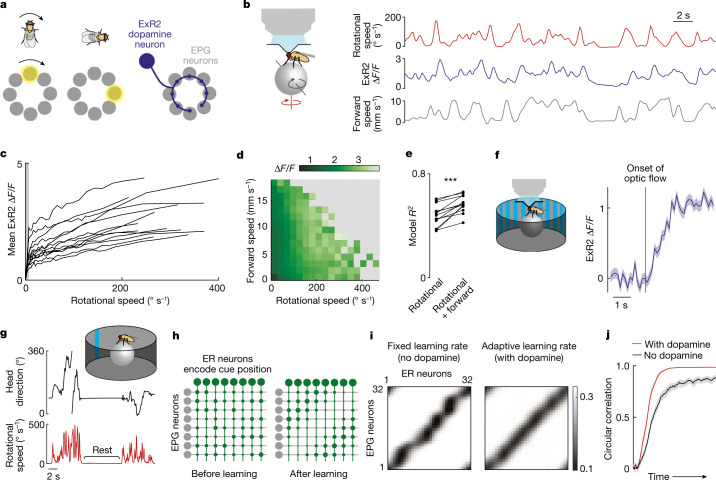
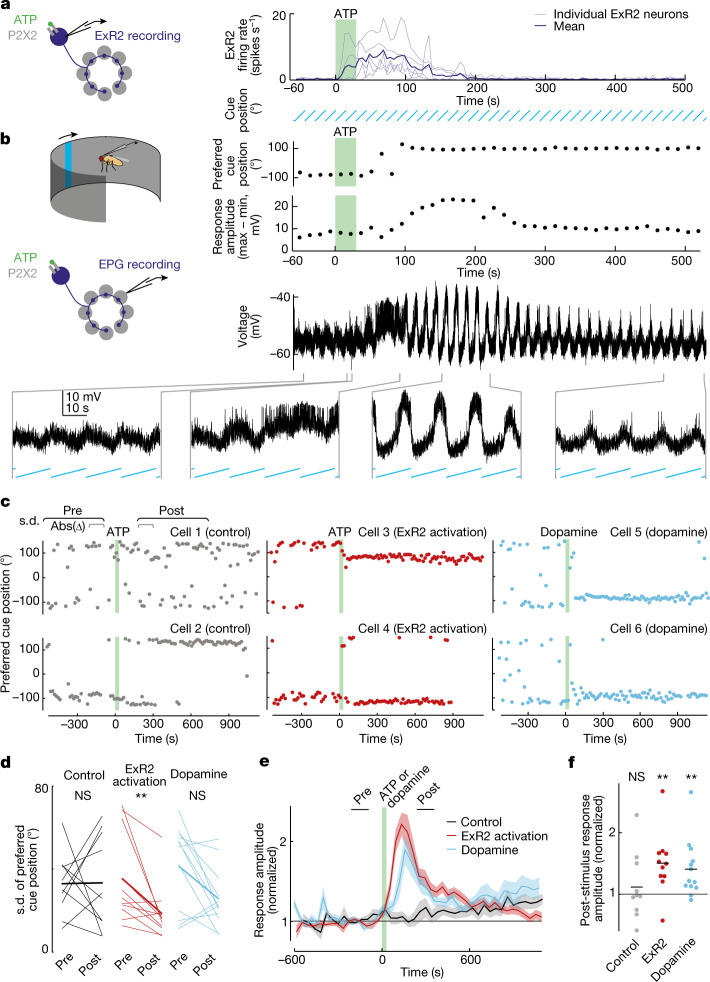
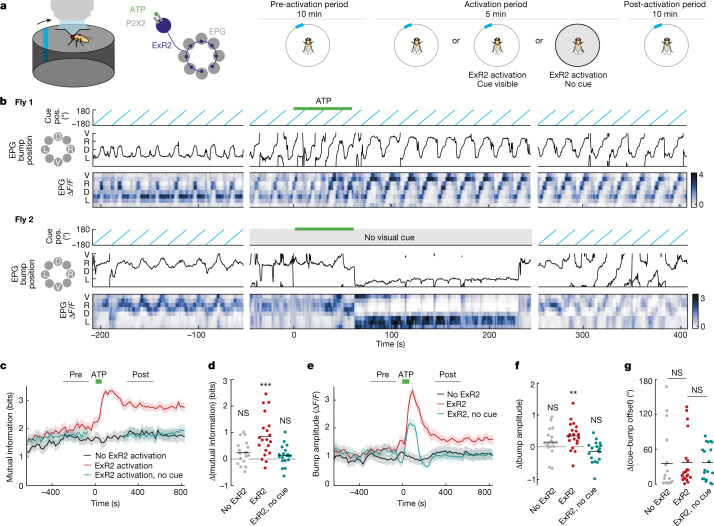
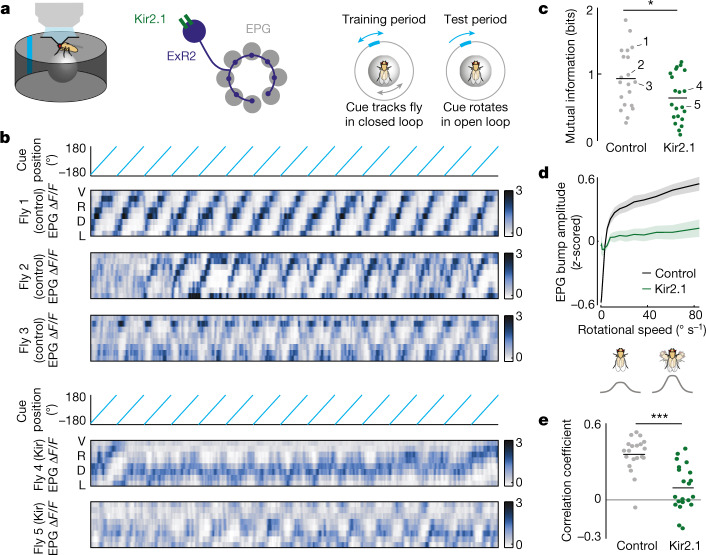
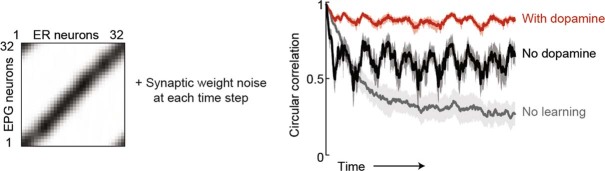
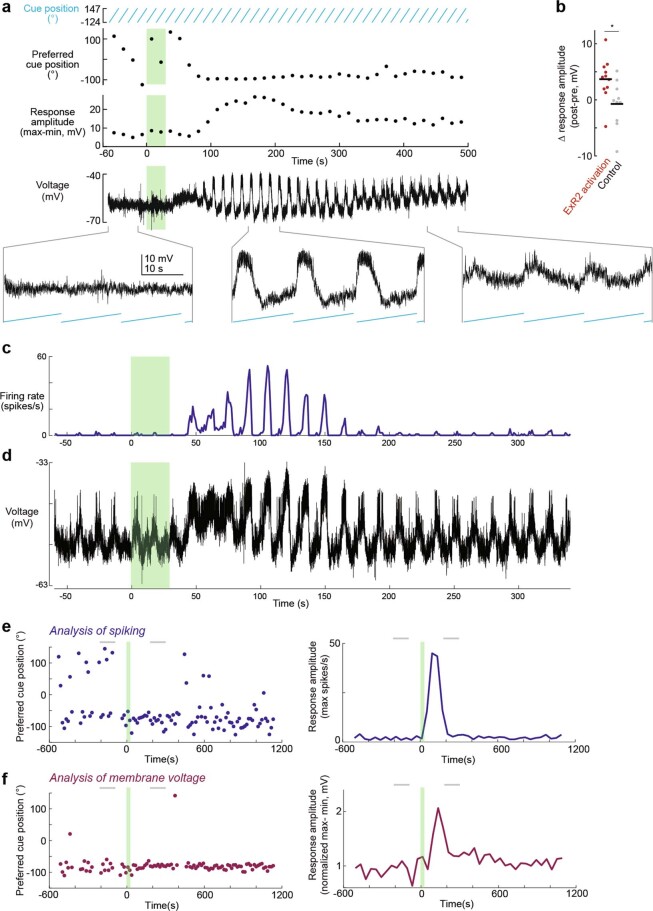
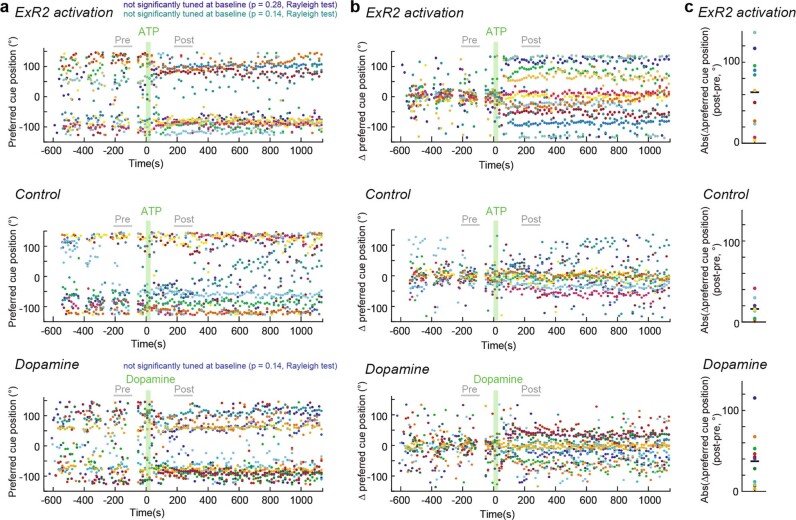
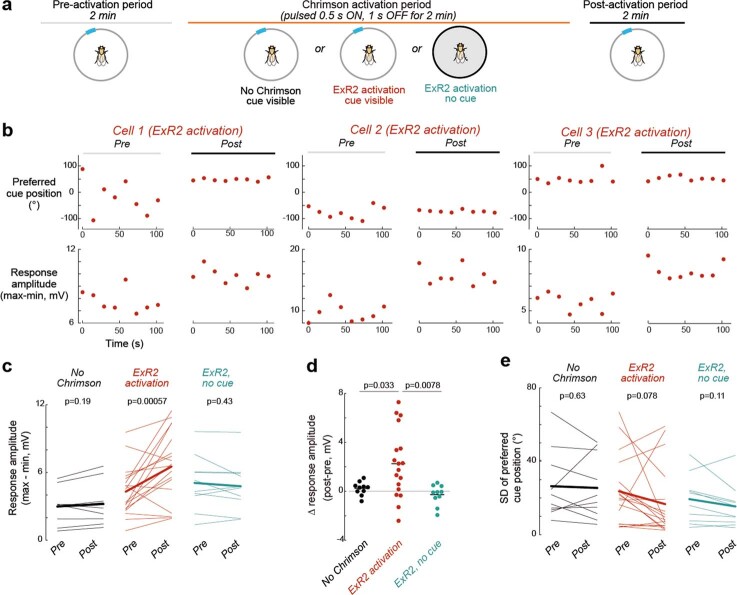
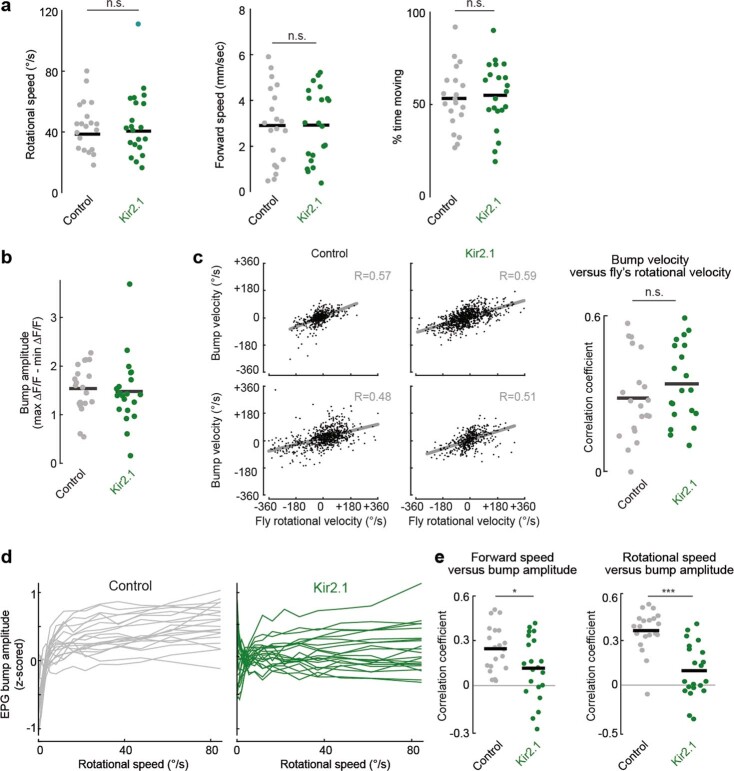
In neural networks that store information in their connection weights, there is a tradeoff between sensitivity and stability 1,2 . Connections must be plastic to incorporate new information, but if they are too plastic, stored information can be corrupted. A potential solution is to allow plasticity only during epochs when task-specific information is rich, on the basis of a ‘when-to-learn’ signal 3 . We reasoned that dopamine provides a when-to-learn signal that allows the brain’s spatial maps to update when new spatial information is available—that is, when an animal is moving. Here we show that the dopamine neurons innervating the Drosophila head direction network are specifically active when the fly turns to change its head direction. Moreover, their activity scales with moment-to-moment fluctuations in rotational speed. Pairing dopamine release with a visual cue persistently strengthens the cue’s influence on head direction cells. Conversely, inhibiting these dopamine neurons decreases the influence of the cue. This mechanism should accelerate learning during moments when orienting movements are providing a rich stream of head direction information, allowing learning rates to be low at other times to protect stored information. Our results show how spatial learning in the brain can be compressed into discrete epochs in which high learning rates are matched to high rates of information intake.
Overview
The claims and statistics of this paper haven’t been checked yet.
Free: it reads the open-access text and checks the first 5 claims that cite a source we can check. Create a free account to check every claim.
Integrity signals
Registry
Cites
Statistics
Figures
Verification
Claims the paper makes
The claims and statistics of this paper haven’t been checked yet.
Free: it reads the open-access text and checks the first 5 claims that cite a source we can check. Create a free account to check every claim.
Claims other papers make about this one
Each is checked against this paper’s own text: does it say what the citing paper says it does?
The source backs part of the claim, not all of it — or backs it for a different population, condition or comparison.
In the citing paper
“Learning without experiencing any rotation does not generate a diagonal connection pattern and clearly does not approximate the vector sum (figure 4c); rotation is required to form useful connections (see [21]).”
From A model of cue integration as vector summation in the insect brain (2023) · cites this paper as [21]
Experimental — accuracy not yet measuredThe source backs part of the claim, not all of it — or backs it for a different population, condition or comparison.
In the citing paper
“The insect head direction circuit, specifically the EB, has been previously suggested to house a flexible multimodal compass [13,21].”
From A model of cue integration as vector summation in the insect brain (2023) · cites this paper as [21]
Experimental — accuracy not yet measuredThe source backs part of the claim, not all of it — or backs it for a different population, condition or comparison.
In the citing paper
“We show here that such plasticity does not interfere with the vector summation properties of the circuit provided the learning is structured by being linked to periods of increased angular velocity [21,28].”
From A model of cue integration as vector summation in the insect brain (2023) · cites this paper as [21]
Experimental — accuracy not yet measuredThe cited source says what the claim attributes to it.
In the citing paper
“Angular velocity appears to be the signal that regulates plasticity between the ring neurons and E-PG neurons [21] (also modelled by [28]).”
From A model of cue integration as vector summation in the insect brain (2023) · cites this paper as [21]
The cited source says what the claim attributes to it.
In the citing paper
“Each R neuron connects to all E-PGs [13,19] and these connections are plastic, enabling flexible remapping of the outside world onto the compass neurons [16,20,21].”
From A model of cue integration as vector summation in the insect brain (2023) · cites this paper as [21]
3 more claims about this paper
Create a free account to see every claim other papers make about this one.
Self-check
Percentages, sums and reported differences re-computed from the paper’s own numbers.
The self-check needs the paper’s full text.
Citations
Cites
Learning representations by back-propagating errors
Rumelhart, D. E., Hinton, G. E., & Williams, R. J. (1986) · Nature · doi:10.1038/323533a0 · Cited by 31,892
Catastrophic Interference in Connectionist Networks: The Sequential Learning Problem
McCloskey, M., & Cohen, N. J. (1989) · Psychology of Learning and Motivation · doi:10.1016/s0079-7421(08)60536-8 · Cited by 3,770
Kraskov, A., Stögbauer, H., & Grassberger, P. (2004) · Physical Review E · doi:10.1103/physreve.69.066138 · Cited by 3,512
CircStat : A MATLAB Toolbox for Circular Statistics
Berens, P. (2009) · Journal of Statistical Software · doi:10.18637/jss.v031.i10 · Cited by 3,099
Independent optical excitation of distinct neural populations
Klapoetke, N. C., Murata, Y., Kim, S. S., Pulver, S. R., Birdsey-Benson, A., Cho, Y. K., Morimoto, T. K., Chuong, A. S., Carpenter, E. J., Tian, Z., et al. (2014) · Nature Methods · doi:10.1038/nmeth.2836 · Cited by 2,344
A GAL4-Driver Line Resource for Drosophila Neurobiology
Jenett, A., Rubin, G. M., Ngo, T.-T. B., Shepherd, D., Murphy, C., Dionne, H., Pfeiffer, B. D., Cavallaro, A., Hall, D., Jeter, J., et al. (2012) · Cell Reports · doi:10.1016/j.celrep.2012.09.011 · Cited by 1,449 · cited 1×
“Rubin Gal4 and LexA lines ( P{R60D05-Gal4}attP2 , P{R38A11-LexA}attP40, P{R75B10-LexA} attP40 and P{R75B10-Gal4}attP2 ) were obtained from the Bloomington Drosophila Stock Center (BDSC); the general methods for constructing these lines have previously been published 60,62,63 .”
Two types of dopamine neuron distinctly convey positive and negative motivational signals
Matsumoto, M., & Hikosaka, O. (2009) · Nature · doi:10.1038/nature08028 · Cited by 1,378
Neuron-type-specific signals for reward and punishment in the ventral tegmental area
Cohen, J. Y., Haesler, S., Vong, L., Lowell, B. B., & Uchida, N. (2012) · Nature · doi:10.1038/nature10754 · Cited by 1,318
High-performance calcium sensors for imaging activity in neuronal populations and microcompartments
Dana, H., Sun, Y., Mohar, B., Hulse, B. K., Kerlin, A. M., Hasseman, J. P., Tsegaye, G., Tsang, A., Wong, A., Patel, R., et al. (2019) · Nature Methods · doi:10.1038/s41592-019-0435-6 · Cited by 1,182
Refinement of Tools for Targeted Gene Expression in Drosophila
Pfeiffer, B. D., Ngo, T.-T. B., Hibbard, K. L., Murphy, C., Jenett, A., Truman, J. W., & Rubin, G. M. (2010) · Genetics · doi:10.1534/genetics.110.119917 · Cited by 1,153
Research works printed but not linked: 1
- Gao, S., Ver Steeg, G. & Galstyan, A. Efficient estimation of mutual information for strongly dependent variables. In Proc. 18th International Conference on Artificial Intelligence and Statistics Vol. 38 (eds Lebanon, G. & Vishwanathan, S. V. N.) 277–286 (PMLR, 2015).
Cited by
Neural heterogeneity controls computations in spiking neural networks
Gast, R., Solla, S. A., & Kennedy, A. (2024) · Proceedings of the National Academy of Sciences · doi:10.1073/pnas.2311885121 · Cited by 125
Transforming a head direction signal into a goal-oriented steering command
Westeinde, E. A., Kellogg, E., Dawson, P. M., Lu, J., Hamburg, L., Midler, B., Druckmann, S., & Wilson, R. I. (2022) · doi:10.1101/2022.11.10.516039 · Cited by 85
Self-citationTransforming a head direction signal into a goal-oriented steering command
Westeinde, E. A., Kellogg, E., Dawson, P. M., Lu, J., Hamburg, L., Midler, B., Druckmann, S., & Wilson, R. I. (2024) · Nature · doi:10.1038/s41586-024-07039-2 · Cited by 85
Self-citationOpponent control of reinforcement by striatal dopamine and serotonin
Pinto, D. F. C., Pomrenze, M. B., Guo, M. Y., Touponse, G. C., Chen, A. P. F., Bentzley, B. S., Eshel, N., & Malenka, R. C. (2024) · Nature · doi:10.1038/s41586-024-08412-x · Cited by 63
One-shot entorhinal maps enable flexible navigation in novel environments
Wen, J. H., Sorscher, B., Jones, E. A. A., Ganguli, S., & Giocomo, L. M. (2024) · Nature · doi:10.1038/s41586-024-08034-3 · Cited by 54
A neural circuit architecture for rapid learning in goal-directed navigation
Dan, C., Hulse, B. K., Kappagantula, R., Jayaraman, V., & Hermundstad, A. M. (2024) · Neuron · doi:10.1016/j.neuron.2024.04.036 · Cited by 51
A neural circuit architecture for rapid behavioral flexibility in goal-directed navigation
Dan, C., Hulse, B. K., Kappagantula, R., Jayaraman, V., & Hermundstad, A. M. (2021) · doi:10.1101/2021.08.18.456004 · Cited by 51
“…synapses (filled red circles in EB) onto compass neurons (black) that are idealized as only receiving input in the EB and sending outputs to the PB. Neuromodulatory neurons whose activity carries the fly’s motor state—in our model, the fly’s angular velocity [70]—project throughout the EB and BU.”
BackgroundAimon, S., Cheng, K. Y., Gjorgjieva, J., & Grunwald Kadow, I. C. (2023) · eLife · doi:10.7554/elife.85202 · Cited by 48
Kandimalla, P., Omoto, J. J., Hong, E. J., & Hartenstein, V. (2023) · Journal of Comparative Physiology A · doi:10.1007/s00359-023-01616-y · Cited by 41
Wind gates olfaction-driven search states in free flight
Stupski, S. D., & van Breugel, F. (2024) · Current Biology · doi:10.1016/j.cub.2024.07.009 · Cited by 41
Neural circuits for goal-directed navigation across species
Basu, J., & Nagel, K. I. (2024) · Trends in Neurosciences · doi:10.1016/j.tins.2024.09.005 · Cited by 40
The neuroethology of ant navigation
Collett, T. S., Graham, P., & Heinze, S. (2025) · Current Biology · doi:10.1016/j.cub.2024.12.034 · Cited by 42
Neural networks for navigation: From connections to computations
Wilson, R. I. (2023) · Annual Review of Neuroscience · doi:10.1146/annurev-neuro-110920-032645 · Cited by 38
Self-citationDuration between rewards controls the rate of behavioral and dopaminergic learning
Burke, D. A., Taylor, A., Jeong, H., Lee, S., Zsembik, L. C. P., Wu, B., Floeder, J. R., Naik, G. A., Chen, R., & Namboodiri, V. M. K. (2026) · Nature Neuroscience · doi:10.1038/s41593-026-02206-2 · Cited by 30
A competitive disinhibitory network for robust optic flow processing in Drosophila
Erginkaya, M., Cruz, T. L., Brotas, M., Marques, A., Steck, K., Nern, A., Torrão, F., Varela, N., Bock, D. D., Reiser, M. B., et al. (2025) · Nature Neuroscience · doi:10.1038/s41593-025-01948-9 · Cited by 29
Emergent spatial goals in an integrative model of the insect central complex
Goulard, R., Heinze, S., & Webb, B. H. (2023) · PLoS Computational Biology · doi:10.1371/journal.pcbi.1011480 · Cited by 27
Hulse, B. K., Stanoev, A., Turner‐Evans, D. B., Seelig, J. D., & Jayaraman, V. (2023) · bioRxiv (Cold Spring Harbor Laboratory) · doi:10.1101/2023.09.25.559373 · Cited by 25
Suárez-Grimalt, R., Kadow, I. C. G., & Scheunemann, L. (2024) · Learning & Memory · doi:10.1101/lm.053918.124 · Cited by 22
Multilevel visuomotor control of locomotion in Drosophila
Cruz, T. L., & Chiappe, M. E. (2023) · Current Opinion in Neurobiology · doi:10.1016/j.conb.2023.102774 · Cited by 21
Awaji, B. H., Kamruzzaman, M. M., Althuniabt, A., Aqeel, I., Khormi, I. M., Gopalsamy, M., & Allimuthu, U. (2023) · Wireless Networks · doi:10.1007/s11276-023-03534-y · Cited by 19
Integration of optic flow into the sky compass network in the brain of the desert locust
Zittrell, F., Pabst, K., Carlomagno, E., Rosner, R., Pegel, U., Endres, D., & Homberg, U. (2023) · Frontiers in Neural Circuits · doi:10.3389/fncir.2023.1111310 · Cited by 18
Freas, C. A., & Cheng, K. (2025) · Animal Behaviour · doi:10.1016/j.anbehav.2025.123125 · Cited by 15
The influence of stimulus history on directional coding in the monarch butterfly brain
Beetz, M. J., & el Jundi, B. (2023) · Journal of Comparative Physiology A · doi:10.1007/s00359-023-01633-x · Cited by 14
Ginsenoside Rg1 alleviates chronic stress-induced depression in rats by targeting Cx43-YAP axis
Wang, H., Zheng, R., Ai, Q., Yang, S.-W., Yang, X., Chen, A., Yan, Q., Xu, Y., Zhang, Z., Xing, J., et al. (2025) · Acta Pharmacologica Sinica · doi:10.1038/s41401-025-01515-9 · Cited by 14
Multimodal cue integration and learning in a neural representation of head direction
Basnak, M. A., Kutschireiter, A., Okubo, T. S., Chen, A., Gorelik, P., Drugowitsch, J., & Wilson, R. I. (2025) · Nature Neuroscience · doi:10.1038/s41593-024-01823-z · Cited by 13
“The pattern of connection weights from sensory cells onto HD cells can change during spatial learning according to a Hebbian learning rule, allowing this system to learn the pattern of visual cues in the current environment 22–24 (Fig.”
Self-citationA model of cue integration as vector summation in the insect brain
Mitchell, R., Shaverdian, S., Dacke, M., & Webb, B. (2023) · Proceedings of the Royal Society B: Biological Sciences · doi:10.1098/rspb.2023.0767 · Cited by 13
Circuits for self-motion estimation and walking control in Drosophila
Chiappe, M. E. (2023) · Current Opinion in Neurobiology · doi:10.1016/j.conb.2023.102748 · Cited by 11
Building and integrating brain-wide maps of nervous system function in invertebrates
Kramer, T. S., & Flavell, S. W. (2024) · Current Opinion in Neurobiology · doi:10.1016/j.conb.2024.102868 · Cited by 10
Discovering and exploiting active sensing motifs for estimation with empirical observabilityPreprint
Cellini, B., Boyacıoğlu, B., Stupski, S. D., & van Breugel, F. (2024) · bioRxiv (Cold Spring Harbor Laboratory) · doi:10.1101/2024.11.04.621976 · Cited by 9
A historical perspective on the insect central complex: Anatomy, development, and function
Gillet, V., Kluge, J., & Patel, R. N. (2025) · Molecular Psychology Brain Behavior and Society · doi:10.12688/molpsychol.17564.3 · Cited by 9
Monarch butterflies memorize the spatial location of a food source
Konnerth, M. M., Foster, J. J., el Jundi, B., Spaethe, J., & Beetz, M. J. (2023) · Proceedings of the Royal Society B Biological Sciences · doi:10.1098/rspb.2023.1574 · Cited by 9
Neuronal circuit mechanisms of competitive interaction between action-based and coincidence learning
Rozenfeld, E., & Parnas, M. (2024) · Science Advances · doi:10.1126/sciadv.adq3016 · Cited by 8
A split attractor design for rapidly writing a navigational goal
Lanz, A. J., Kathman, N. D., Hao, E., Ermentrout, B., & Nagel, K. I. (2026) · Nature · doi:10.1038/s41586-026-11144-9 · Cited by 8
“But why?” Dopamine and causal learning
Namboodiri, V. M. K. (2024) · Current Opinion in Behavioral Sciences · doi:10.1016/j.cobeha.2024.101443 · Cited by 8
A cell type in the visual system that receives feedback about limb movement
Hartman, A. K., Collie, M. F., Kellogg, E. J., Jin, C., Holtz, S. L., & Wilson, R. I. (2025) · Current Biology · doi:10.1016/j.cub.2025.06.055 · Cited by 6
Self-citationSpeed of learning depends on turning
Taisz, I., & Jefferis, G. S. X. E. (2022) · Nature · doi:10.1038/d41586-022-03681-w · Cited by 6
Octopamine instructs head direction plasticityPreprint
Plitt, M. H., Turner‐Evans, D. B., Co, J. C., Layden, A. E., Eddison, M., Ray, R. P., Jayaraman, V., & Fisher, Y. E. (2025) · bioRxiv (Cold Spring Harbor Laboratory) · doi:10.64898/2025.12.11.693783 · Cited by 5
Self-citationStentiford, R., Knight, J. C., Nowotny, T., Philippides, A. O., & Graham, P. (2024) · PLoS Computational Biology · doi:10.1371/journal.pcbi.1011913 · Cited by 4
Dopamine promotes motor programs underlying substrate tunneling in larval Drosophila
MacLeod, J., Ying, B. X., Zwart, M., & Pulver, S. R. (2026) · Journal of Neurophysiology · doi:10.1152/jn.00469.2025 · Cited by 4
Head direction and the evolutionary origins of spatial representation
Sayre, M. E., Narendra, A., Heinze, S., & Barron, A. B. (2026) · Trends in Neurosciences · doi:10.1016/j.tins.2026.04.001 · Cited by 3
Functional Logic of a Cognitive Brain System for Navigation
Maimon, G., & Abbott, L. F. (2026) · Annual Review of Neuroscience · doi:10.1146/annurev-neuro-112723-062711 · Cited by 3
Richevaux, L., Lim, D., Nassar, M., Rodrigues, L. D., Mauthe, C., Cohen, I., Sol‐Foulon, N., & Fricker, D. (2025) · eLife · doi:10.7554/elife.92443.3 · Cited by 3
Richevaux, L., Lim, D., Nassar, M., Rodrigues, L. D., Mauthe, C., Cohen, I., Sol‐Foulon, N., & Fricker, D. (2023) · eLife · doi:10.7554/elife.92443.1 · Cited by 3
Jiang, B., Ding, L., Chen, K., Huang, Q., Han, X., Jin, Z., Cao, L., Zhang, J., Li, Q., Xue, C., et al. (2024) · Brain Structure and Function · doi:10.1007/s00429-024-02863-8 · Cited by 3
Flexible circuits for visually guided flight control in Drosophila
Schnell, B. (2026) · Trends in Neurosciences · doi:10.1016/j.tins.2025.12.005 · Cited by 2
A dopamine circuit regulates locomotor initiation and persistence in DrosophilaPreprint
Wen, X., Connors, K. E., Snell, C. C., McGrath, R., Mehta, A., & Hattori, D. (2025) · bioRxiv (Cold Spring Harbor Laboratory) · doi:10.1101/2025.11.18.689052 · Cited by 2
Hernandez, J. S., Le, N., Oramas, R., Azanchi, R., Mei, N. J., Long, A. T., Robertson, M. R., Cook, O. M., Dacks, A. M., & Kaun, K. R. (2025) · Journal of Experimental Biology · doi:10.1242/jeb.251074 · Cited by 2
A multi-ring shifter network computes head direction in zebrafish
Mei, S., Lavian, H., Wu, Y. K., Stemmler, M., Portugues, R., & Herz, A. V. M. (2026) · Current Biology · doi:10.1016/j.cub.2026.05.054 · Cited by 2
Richevaux, L., Lim, D., Nassar, M., Rodrigues, L. D., Mauthe, C., Cohen, I., Sol‐Foulon, N., & Fricker, D. (2025) · eLife · doi:10.7554/elife.92443 · Cited by 2
Recent social experience alters song behavior in Drosophila
Roemschied, F. A., Ireland, E. C., Calhoun, A. J., Choi, M., Ahmed, O. M., & Murthy, M. (2026) · Current Biology · doi:10.1016/j.cub.2026.02.003 · Cited by 1
State-dependent spatial maps for navigation
Mark, L., & Giocomo, L. M. (2026) · Trends in Cognitive Sciences · doi:10.1016/j.tics.2026.01.009 · Cited by 1
Theoretical and Practical Neuroscience Tools for Neurosurgery
Beffara, B., Veyrie, M., Desmurget, M., Mottolèse, C., Szathmári, A., Rocco, F. D., Cristofori, I., & Beuriat, P.-A. (2025) · Advances and technical standards in neurosurgery · doi:10.1007/978-3-031-90762-3_11 · Cited by 1
The neurobiology of bee dance communication
Webb, B. H. (2026) · Current Opinion in Neurobiology · doi:10.1016/j.conb.2026.103176 · Cited by 1
Lateralized dopaminergic neuron activity encodes goal-directed turningPreprint
Miriyala, A., & Waddell, S. (2026) · bioRxiv (Cold Spring Harbor Laboratory) · doi:10.64898/2026.09.23.753763 · Cited by 1
Kajtor, M., Billes, V., Király, B., Karkusova, P., Kovács, T., Stabb, H., Sviatkó, K., Vizi, A., Ujvári, E., Balázsfi, D., et al. (2025) · eLife · doi:10.7554/elife.90905 · Cited by 1
Kajtor, M., Billes, V., Király, B., Karkusova, P., Kovács, T., Stabb, H., Sviatkó, K., Vizi, A., Ujvári, E., Balázsfi, D., et al. (2025) · eLife · doi:10.1101/2023.08.29.555311 · Cited by 1
Liao, C.-C., Chang, N., Liu, Y., & Lo, C. (2025) · bioRxiv (Cold Spring Harbor Laboratory) · doi:10.1101/2025.10.19.683286 · Cited by 1
Wang, R., Liu, X., Wang, X., Zhou, X., Jin, J., Wang, H., Liu, Z., Ma, R., & Yin, T. (2026) · IEEE Transactions on Neural Systems and Rehabilitation Engineering · doi:10.1109/tnsre.2026.3664390 · Cited by 1
A framework for constructing insect steering circuits
Mitchell, R., & Webb, B. H. (2026) · PLoS Computational Biology · doi:10.1371/journal.pcbi.1014009 · Cited by 1
Richevaux, L., Lim, D., Nassar, M., Rodrigues, L. D., Mauthe, C., Cohen, I., Sol‐Foulon, N., & Fricker, D. (2025) · eLife · doi:10.7554/elife.92443.2 · Cited by 1
Hunger states modulate aggression via opposing dopamine pathways
Wang, J., Lv, Q., Gao, Y., Yang, Y., Ning, J., Chen, D., Wang, W., Zhang, X., Li, Z., Shao, Y., et al. (2026) · Nature Communications · doi:10.1038/s41467-026-76608-y · Cited by 1
Discovering and exploiting active sensing motifs for estimationPreprint
Cellini, B., Boyacıoğlu, B., Lopez, A. P., & van Breugel, F. (2025) · arXiv (Cornell University) · doi:10.48550/arxiv.2511.08766 · Cited by 1
Object manipulation and affordance learning in DrosophilaPreprint
Durrieu, M., Dall’Osto, D., Lam, T. K. C., Ríos, V. L., & Ramdya, P. P. (2026) · bioRxiv (Cold Spring Harbor Laboratory) · doi:10.64898/2026.04.28.721021 · Cited by 1
Discussions on Neuroscience of Decision-Making
Hou, Y. (2025) · Psychomachina · doi:10.59388/pm00357
A historical perspective on the insect central complex: Anatomy, development, and function
Gillet, V., Kluge, J., & Patel, R. N. (2023) · Molecular Psychology Brain Behavior and Society · doi:10.12688/molpsychol.17564.1
Flies evolved a gyrocompass to maintain navigational accuracy during rapid flight maneuversPreprint
Ros, I. G., Wang, R., Omoto, J. J., Dickson, W. B., & Dickinson, M. H. (2026) · bioRxiv (Cold Spring Harbor Laboratory) · doi:10.64898/2026.08.18.744964
A robot model of compass cue calibration in the insect brainPreprint
Mitchell, R., Dacke, M., & Webb, B. H. (2026) · bioRxiv (Cold Spring Harbor Laboratory) · doi:10.64898/2026.06.25.734539
Normative approaches to neural coding and behavior
Hermundstad, A. M. (2024) · SciPost Physics Lecture Notes · doi:10.21468/scipostphyslectnotes.83
Kajtor, M., Billes, V., Király, B., Karkusova, P., Kovács, T., Stabb, H., Sviatkó, K., Vizi, A., Ujvári, E., Balázsfi, D., et al. (2025) · eLife · doi:10.7554/elife.90905.2
Spatiotemporal dynamics of locomotor decisions in Drosophila melanogasterPreprint
Lebovich, L., Alisch, T., Redhead, E. S., Parker, M. O., Loewenstein, Y., Couzin, I. D., & de Bivort, B. L. (2024) · bioRxiv (Cold Spring Harbor Laboratory) · doi:10.1101/2024.09.04.611038
Multi-timescale learning signals in Drosophila dopaminergic neuronsPreprint
Choi, W., Srinivasan, S., & Grover, D. (2026) · bioRxiv (Cold Spring Harbor Laboratory) · doi:10.64898/2026.06.08.729969
Kajtor, M., Billes, V., Király, B., Stabb, H., Sviatkó, K., Ujvári, E., Balázsfi, D., Seidenbecher, S. E., Kvitsiani, D., Vellai, T., et al. (2024) · eLife · doi:10.7554/elife.90905.1
Shifts in neural tuning systematically alter sensorimotor learning abilityPreprint
Hayashi, T., Takiyama, K., Smith, M. A., & Nozaki, D. (2024) · bioRxiv (Cold Spring Harbor Laboratory) · doi:10.1101/2024.07.29.605715
Dopamine modulates density-dependent behavioral phase transition in Spodoptera litura larvae
Wen, L., Jin, T., Yuan, H., Lan, M., Liu, B., Zhang, Z., Hu, Q., Rao, X., & Yu, X. (2026) · Journal of Integrative Agriculture · doi:10.1016/j.jia.2026.05.020
Report on scipost_202401_00027v1
(2024) · SciPost Physics Lecture Notes · doi:10.21468/scipost.report.8735
Investigating multiscale behavioral variability in larval zebrafish navigation
Sridhar, G. (2024) · theses.fr (ABES) · doi:10.70675/8a038b39z9460z4809z9ca4zbdf2193284df
Motivation to work for amino acids requires acute dopaminergic activityPreprint
Black, P. M., Stapleton, K. T., Lam, G., Rodan, A. R., & Rothenfluh, A. (2026) · bioRxiv (Cold Spring Harbor Laboratory) · doi:10.64898/2026.10.13.758662
Stentiford, R., Knight, J. C., Nowotny, T., Philippides, A., & Graham, P. (2024) · doi:10.1371/journal.pcbi.1011913.r001
Sharma, Y. D. (2026) · Research Square · doi:10.21203/rs.3.rs-11441921/v1
Metadata
- Authors
- Fisher, Y. E., Marquis, M., D’Alessandro, I., & Wilson, R. I.
- Affiliations
- Harvard University (US)
- Corresponding author
- Wilson, Rachel I.
- Venue
- Nature
- Published
- 2022-11-30
- Volume
- 612
- Issue
- 7939
- Pages
- 316-322
- ISSN
- 0028-0836 (ISSN-L)
- 1476-4687
- PMC
- PMC9729112
- OpenAlex
- W4310483820
- Cited by
- 67
- References
- 82
- Citations by year
- 2026: 13 · 2025: 17 · 2024: 21 · 2023: 15 · 2022: 1
- FWCI
- 6.96
- Type
- journal article
- Language
- en
- Update notices
- correction (2023-05-24)
- Open access
- hybrid
- doi.org
- Licence
- cc-by
- creativecommons.org/licenses/by/4.0 (tdm)
- creativecommons.org/licenses/by/4.0 (vor)
- Locations
- Nature (publishedVersion, cc-by)
- PubMed Central (publishedVersion, cc-by)
- PubMed (publishedVersion)
- Funders
- Howard Hughes Medical Institute (P30 NS072030)
- National Institutes of Health (NS072030, P40OD018537)
- National Institute on Deafness and Other Communication Disorders (F31DC016471)
- National Institute of Neurological Disorders and Stroke (P30NS072030, U19NS104655, R01NS129647)
- Topics
- Life Sciences › Neuroscience › Cognitive Neuroscience › Memory and Neural Mechanisms
- Life Sciences › Neuroscience › Cellular and Molecular Neuroscience › Neurobiology and Insect Physiology Research
- Life Sciences › Neuroscience › Cellular and Molecular Neuroscience › Neurotransmitter Receptor Influence on Behavior
- Keywords
- dopamine, head direction cells, Drosophila, spatial learning, plasticity, spatial maps, rotational speed, learning rate
- MeSH terms
- Dopamine
About these checks
Registry, retraction, Cites and statistics results are computed, not judged, with one exception: a printed reference that no index lists is read once by a model before it counts as a citation error. Claims are extracted by a model and kept only when their quote appears verbatim in the text; each cited source is then checked, with a model’s help, for whether it says what the claim relies on. Those verdicts can be wrong — read the claim’s quote and the cited source before relying on one.
Statistics and arithmetic are recomputed, not judged.
Confidence bands are shown only for fields calibrated on our annotated test set. None is calibrated yet, so no band is shown.
What counts as a claim ›How we measure confidence ›How we check this ›
Are you an author, or do you see a problem with this page? Request a review
Data sources
Bibliographic data: Semantic Scholar, OpenAlex, Crossref.
Contains information from the Semantic Scholar Academic Graph Datasets, made available under the ODC Attribution License (ODC-BY 1.0).
Semantic Scholar’s data is described in: Kinney, R., et al. (2023). The Semantic Scholar Open Data Platform. arXiv:2301.10140.
