

Future emergence of new ecosystems caused by glacial retreat
Open accessPublished version of a preprint
The DOI matches its Crossref record; 105 of the 106 references it cites were found in a registry or an index; 28 of the 82 sources its claims cite were checked for support.
Abstract
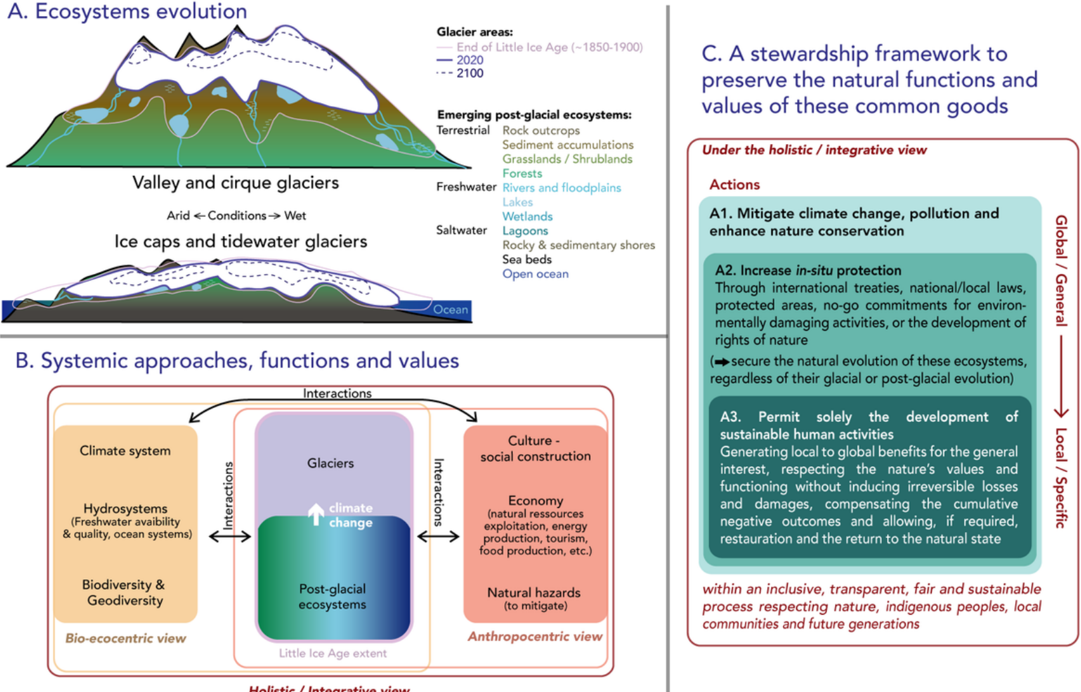
Glacier shrinkage and the development of post-glacial ecosystems related to anthropogenic climate change are some of the fastest ongoing ecosystem shifts, with marked ecological and societal cascading consequences^ 1 – 6 . Yet, no complete spatial analysis exists, to our knowledge, to quantify or anticipate this important changeover^ 7 , 8 . Here we show that by 2100, the decline of all glaciers outside the Antarctic and Greenland ice sheets may produce new terrestrial, marine and freshwater ecosystems over an area ranging from the size of Nepal (149,000 ± 55,000 km^2) to that of Finland (339,000 ± 99,000 km^2). Our analysis shows that the loss of glacier area will range from 22 ± 8% to 51 ± 15%, depending on the climate scenario. In deglaciated areas, the emerging ecosystems will be characterized by extreme to mild ecological conditions, offering refuge for cold-adapted species or favouring primary productivity and generalist species. Exploring the future of glacierized areas highlights the importance of glaciers and emerging post-glacial ecosystems in the face of climate change, biodiversity loss and freshwater scarcity. We find that less than half of glacial areas are located in protected areas. Echoing the recent United Nations resolution declaring 2025 as the International Year of Glaciers’ Preservation^ 9 and the Global Biodiversity Framework^ 10 , we emphasize the need to urgently and simultaneously enhance climate-change mitigation and the in situ protection of these ecosystems to secure their existence, functioning and values. By 2100, the decline of all glaciers outside the Antarctic and Greenland ice sheets will produce new terrestrial, marine and freshwater ecosystems, posing both challenges and opportunities for conservation.
Overview
CoChat Summary
TL;DR
The paper models global glacier retreat outside Antarctica and Greenland through 2100 and quantifies the emerging deglaciated ecosystems under different emission scenarios. It finds large new terrestrial, freshwater, and marine areas, mostly outside protected areas, and calls for urgent climate mitigation plus in-situ protection.
Key findings
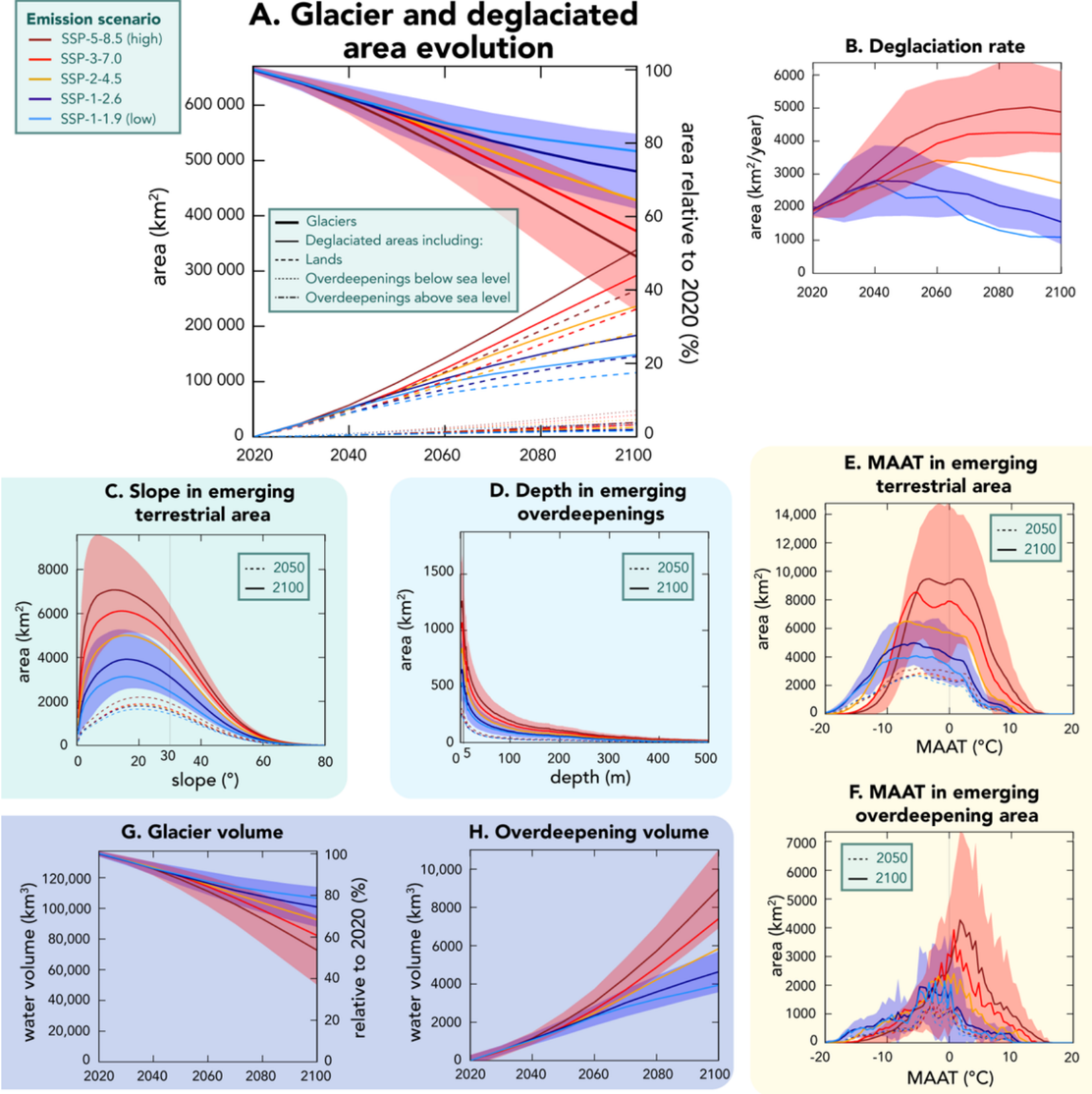
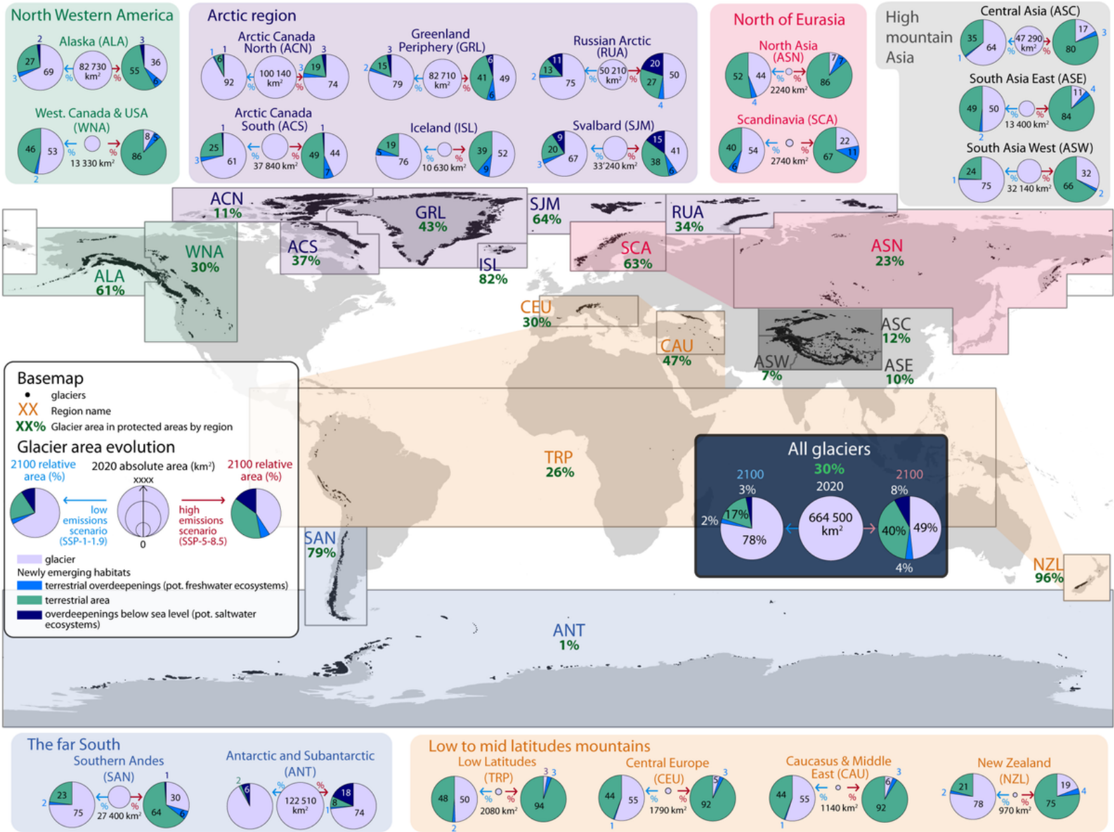
- Glaciers outside Antarctica and Greenland covered 664,500 ± 6,060 km² in 2020. Under SSP5-8.5, half of this area (339,000 ± 99,000 km²) is expected to vanish by 2100, with deglaciation approaching 50,000 ± 10,000 km²/decade; under SSP1-1.9, 78 ± 8% (517,000 ± 55,000 km²) would subsist.
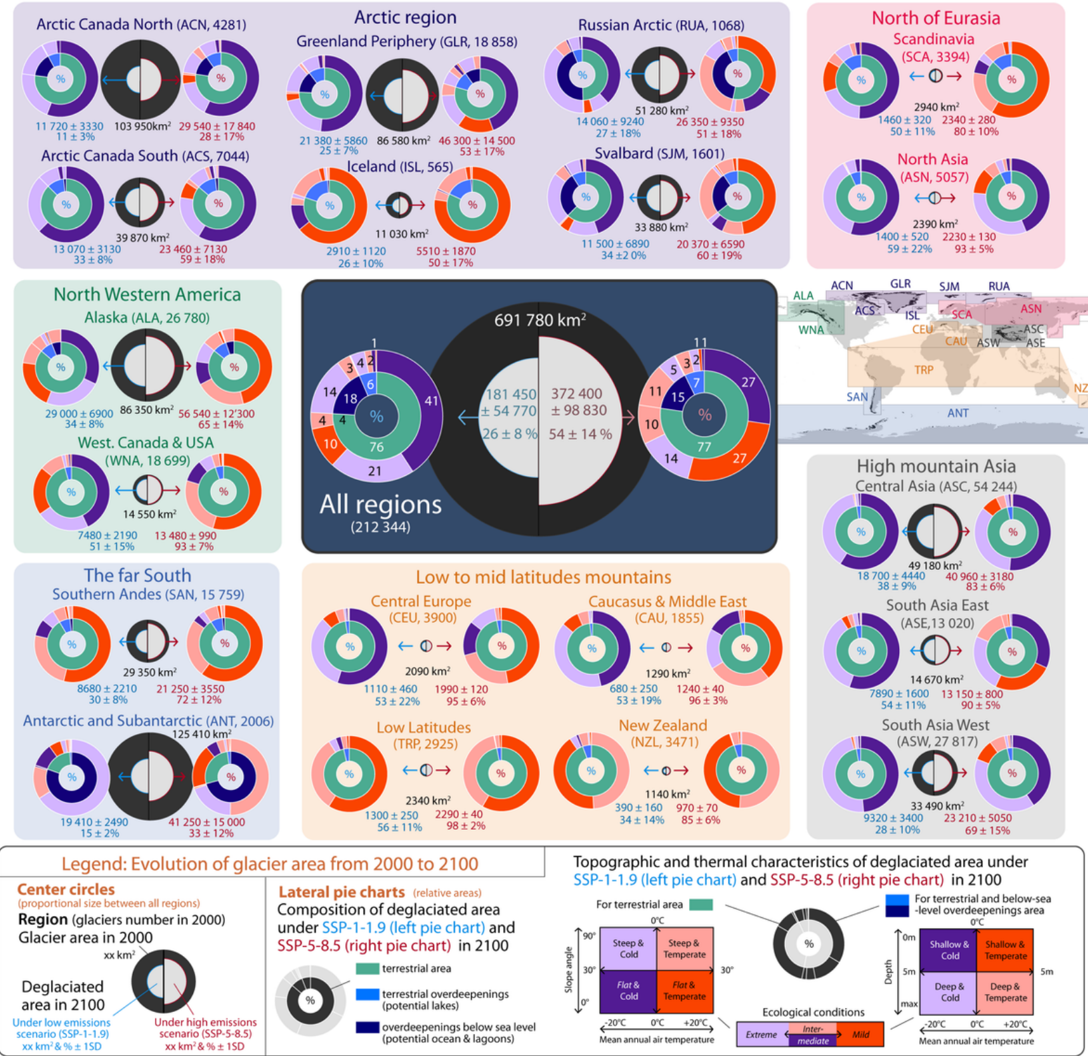
- Emerging deglaciated areas could range from 149,000 ± 55,000 km² (the area of Nepal) to 339,000 ± 99,000 km² (the area of Finland), composed of ~78% terrestrial areas, ~14% overdeepenings below sea level, and ~8% terrestrial overdeepenings. Median terrestrial slope is 21.5°, with ~70% below 30°; median overdeepening depth is ~70 m, with <9% shallower than 5 m.
- Under low emissions, >80% of 2100 terrestrial deglaciated area is projected to have negative MAAT (median −5.75°C); under high emissions, >55% is negative (median −0.25°C). Overdeepenings are warmer: ~75% negative MAAT under low emissions (median −3.75°C) versus ~35% under high emissions (median +2.25°C). Soils of emerging terrestrial areas could sequester 15–270 Mt of carbon over the 21st century.
- Only 30% of current glacier areas are within protected areas globally, including 8% in UNESCO natural World Heritage sites, 9% in Man and Biosphere sites, and 0.1% in Ramsar sites.
Methods
- Used Randolph Glacier Inventory v6.0 outlines, subglacial topography from a consensus of five ice-thickness models at 25–100 m resolution, ERA5 past climate, and GloGEM calibrated to 2000–2019 glacier volume changes. Future projections used 56 climate model chains from 13 CMIP6 GCMs and five SSPs.
- Classified future deglaciated areas into below-sea-level areas, terrestrial overdeepenings (>0.005 km² and >3 m deep), and remaining terrestrial areas. Habitat analysis combined slope (30° threshold), overdeepening depth (5 m threshold), and mean annual air temperature (0°C threshold).
- Carbon sequestration was estimated using literature soil accumulation rates (5, 10, 50 g C m⁻² yr⁻¹ for favourable mild habitats; 1, 5, 10 g C m⁻² yr⁻¹ for intermediate/extreme habitats). Protected-area overlap was computed against WDPA/IUCN, UNESCO, Man and Biosphere, and Ramsar outlines.
Limitations
- Stated: results carry considerable uncertainties from climate projections, initial glacier area and ice thickness, glacier-model simplifications, and bedrock topography. Overdeepening depth and volume are highly uncertain, sediment filling was not modelled, and potential water volumes are only rough first estimates; results provide first-order magnitudes and surface estimates should be treated with caution.
- Stated: RGI outlines are outdated in some regions; climate forcing dominates overall uncertainty; carbon and habitat estimates are rough because of simple thresholds and unknown nature of emerging surfaces.
- Evident from the text: material-dammed lakes/lagoons and sediment fluxes were not modelled, no in-situ validation is presented, and the protected-area analysis measures overlap rather than protection effectiveness.
Model-written summary. Check it against the paper before relying on it.
Integrity signals
Registry
Cites
Statistics
Figures
Verification
Claims the paper makes
18 Valid · 4 Not valid · 25 Not checked · 39 Own results and interpretations
At least one cited source doesn’t support this claim or points to a different paper, and none confirmed it — see the verdicts below.
In the paper
“Uncertainties in future climate forcing as evidenced by the partly large differences in projected temperature and precipitation changes of the individual global circulation models forced by the same greenhouse gas emission pathways dominate the overall uncertainties of the modelled glacier volume evolution of the 21st century (Marzeion et al., 2020).”
§ Glaciers and postglacial ecosystems: common goods to protect in the Anthropocene > E. Glaciers and protected areas
What the sources say
- Disputedcites Marzeion et al., 2020 matched to “Partitioning the Uncertainty of Ensemble Projections of Global Glacier Mass Change” (2020) sourceExperimental — accuracy not yet measured
Split into 2 atoms — 0 confirmed, 0 partially supported, 2 disputed, 0 misattributed, 0 unverifiable. Expand the claim to see per-atom verdicts.
Checked by a reasoning model — may be wrong.
plainstates a cause- Asserted: passes — The authors put it forward as true.
- Checkable: passes — It can be checked against evidence.
- Load-bearing: passes — The paper’s conclusions depend on it.
- Based: passes — The paper gives a reason why it holds.
- Disputed
The cited sources support only part of this claim — read each source’s verdict below.
In the paper
“Glacier shrinking and the development of postglacial ecosystems related to anthropogenic climate change is one of the fastest ongoing ecosystem shifts, with paramount ecological and societal cascading consequences globally”
§ Glaciers and postglacial ecosystems: common goods to protect in the Anthropocene > Abstract
What the sources say
- Partly supportedcites Huss et al., 2017 matched to “Toward mountains without permanent snow and ice” (2017) sourceExperimental — accuracy not yet measured
The Abstract (page not available) describes rapid, anthropogenic climate-driven cryosphere decline and cascading effects on ecosystems and societies. Section 6, Aquatic and Terrestrial Ecology (page not available), describes new habitats colonized after glacier retreat. The paper does not establish that this is one of the fastest ongoing ecosystem shifts. (LLM, conf=0.87)
- Partly supportedcites Milner et al., 2017 matched to “Glacier shrinkage driving global changes in downstream systems” (2017) sourceExperimental — accuracy not yet measured
The Introduction (page unavailable) links climate-driven glacier loss to far-reaching ecological and societal consequences, and the Summary describes major changes to riverine ecosystems and ecosystem services. The paper also discusses ecological change as glaciers retreat, but the passages do not establish that glacier shrinkage and postglacial ecosystem development are among the fastest ongoing ecosystem shifts, or explicitly attribute the warming to human activity. (LLM, conf=0.86)
- Not checked yetcites Cauvy and Dangles, 2019 matched to “A global synthesis of biodiversity responses to glacier retreat” (2019) source
plainstates a cause- Asserted: passes — The authors put it forward as true.
- Checkable: passes — It can be checked against evidence.
- Load-bearing: passes — The paper’s conclusions depend on it.
- Based: passes — The paper gives a reason why it holds.
- Partly supported
The cited sources support only part of this claim — read each source’s verdict below.
In the paper
“glaciers are melting at an accelerating pace”
§ Glaciers and postglacial ecosystems: common goods to protect in the Anthropocene > Main Text
What the sources say
- Not checked yetcites IPCC 2019 & 2021
- Supportedcites Hugonnet et al., 2021 matched to “Accelerated global glacier mass loss in the early twenty-first century” (2021) source
The Abstract of Hugonnet et al. (2021) states that they 'reveal the accelerated, albeit contrasted, patterns of glacier mass loss during the early twenty-first century', quantifying 267 ± 16 Gt yr-1 loss over 2000-2019 and 'a mass loss acceleration of 48 ± 16 Gt yr-1 per decade'. The 'Global contribution to sea-level rise' section repeats that 'Global glacier mass loss rapidly accelerated ... at a rate of 48 ± 16 Gt yr-1 per decade', with thinning rates outside ice sheet peripheries nearly doubling from 0.36 to 0.69 m yr-1 between 2000 and 2019. This directly supports the paraphrase that glaciers are melting at an accelerating pace (the paper's only qualification is regional contrast, e.g. the North Atlantic anomaly, which the citing sentence does not deny). (LLM, conf=0.92)
- Partly supportedcites Roe et al., 2021 matched to “On the attribution of industrial-era glacier mass loss to anthropogenic climate change” (2021) sourceExperimental — accuracy not yet measured
The Introduction (p. 1) of Roe et al. (2021) states that over the past 150 years mountain glaciers and ice caps worldwide 'have retreated dramatically, and associated with this retreat has been a loss of ice mass', and the Abstract confirms global mass loss since the start of the industrial era — so the 'glaciers are melting' component is supported. However, nothing in our copy states that the pace of melting is accelerating: the only rate comparison made, in Physical principles (Fig. 1g–i), is between the rapid-warming phase and the earlier slow-cooling phase ('the rate of mass loss during the rapid warming period is much greater than the rate of mass gain during the earlier slow-cooling period'), which is a step change between regimes rather than an acceleration within the industrial era. Indeed, the same section's linear-warming scenario describes a mass-balance deficit that 'evolves into a constant value', i.e. a steady rather than increasing rate of loss. Searched further with 'accelerating pace', 'rate of mass loss increasing', and 'nonlinear warming trend'; no passage addresses acceleration. (LLM, conf=0.72)
plain- Asserted: passes — The authors put it forward as true.
- Checkable: passes — It can be checked against evidence.
- Load-bearing: passes — The paper’s conclusions depend on it.
- Based: passes — The paper gives a reason why it holds.
The cited sources that could be checked couldn’t confirm or dispute this claim.
In the paper
“GloGEM has been calibrated by the 2000-2019 volume changes of each glacier”
§ Glaciers and postglacial ecosystems: common goods to protect in the Anthropocene > Main Text
What the sources say
- Could not verifycites Hugonnet et al., 2021 matched to “Accelerated global glacier mass loss in the early twenty-first century” (2021) sourceExperimental — accuracy not yet measured
The Spatiotemporally resolved estimation and Integration of elevation into volume changes sections describe estimating volume changes for individual glaciers during 2000–2019. The Validation of volume changes section describes comparing estimates for 588 glaciers with independent measurements, but none of these passages says GloGEM was calibrated using each glacier’s volume change. A search for GloGEM found no passage addressing that calibration. (LLM, conf=0.72)
plainstates a cause- Asserted: passes — The authors put it forward as true.
- Checkable: passes — It can be checked against evidence.
- Load-bearing: passes — The paper’s conclusions depend on it.
- Based: passes — The paper gives a reason why it holds.
- Could not verify
Every source the paper cites for this claim was checked and supports it.
In the paper
“postglacial ecosystems where primary successions occur under low initial nutrient availability (Ficetola et al., 2021), will offer new habitats and refuges for the particularly vulnerable cold-dependent and/or oligotrophic species”
§ Glaciers and postglacial ecosystems: common goods to protect in the Anthropocene > Main Text
What the sources say
- Supportedcites Ficetola et al., 2021 matched to “Dynamics of Ecological Communities Following Current Retreat of Glaciers” (2021) source
The citation sits inside the parenthetical clause describing postglacial ecosystems as settings of primary succession under low initial nutrient availability, and our copy states exactly that: Section 3.4 (facilitation and competition) says nitrogen-fixing organisms dominate early 'due to the initial lack of available nitrogen', Section 3.1 adds that soil pH and nutrient content change with age and that increased N availability in older soils facilitates plant growth, and Section 4.1 describes arthropods supplying 'additional nutrients on recently exposed terrains' during the transition from heterotrophic to productive communities. The framing of deglaciation as the classic case of primary succession appears in the introduction/'Additional information' text (which does, however, note the term is somewhat questionable because glaciers release ancient organic matter). The subsequent prediction that such ecosystems will offer refuges for cold-dependent/oligotrophic species is the citing authors' own inference and is not what this citation is offered for; our copy contains no passage on refugia for cold-adapted taxa. (LLM, conf=0.85)
plainstates a cause- Asserted: passes — The authors put it forward as true.
- Checkable: passes — It can be checked against evidence.
- Load-bearing: passes — The paper’s conclusions depend on it.
- Based: passes — The paper gives a reason why it holds.
- Supported
36 more claims · 11 with their cited sources checked
Create a free account to see all 86 claims and to verify the 54 references still open.
- It may state two separate claims as one. 38
- Probably not a substantial claim. 13
- The quote only partly states this claim. 1
Claims other papers make about this one
Each is checked against this paper’s own text: does it say what the citing paper says it does?
The source backs part of the claim, not all of it — or backs it for a different population, condition or comparison.
In the citing paper
“Loss of glaciers due to anthropogenic climate change will expose the ground, facilitating colonisation by pioneer species, as well as exposing new alpine and Antarctic environments to high UV-radiation [194].”
From Environmental consequences of interacting effects of changes in stratospheric ozone, ultraviolet radiation, and climate: UNEP Environmental Effects Assessment Panel, Update 2024 (2025) · cites this paper as [194]
Experimental — accuracy not yet measuredThe source backs part of the claim, not all of it — or backs it for a different population, condition or comparison.
In the citing paper
“The bulk of these new post-glacial terrestrial ecosystems are in mountainous regions of Asia and north-west America (48–51%). Potentially, 7–10% of the newly exposed ground will be along the Andes and in Antarctica [194, 196].”
From Environmental consequences of interacting effects of changes in stratospheric ozone, ultraviolet radiation, and climate: UNEP Environmental Effects Assessment Panel, Update 2024 (2025) · cites this paper as [194]
Experimental — accuracy not yet measuredThe cited source says what the claim attributes to it.
In the citing paper
“Spatial analysis using the Global Glacier Evolution Model [195] suggests that by 2100, loss of glaciers could expose an area ranging from 149,000 to 339,000 km2, depending on the greenhouse gas emission scenario [194].”
Self-check
Percentages, sums and reported differences re-computed from the paper’s own numbers.
Each contradiction between two passages listed here was confirmed by an independent check.
Rated minor: it would not touch a result — a value no result rests on, a p-value that stays on the same side of the significance level, or a conflict that is clerical, resolved elsewhere in the paper, or outside its own findings.
In the paper
§ Glaciers and postglacial ecosystems: common goods to protect in the Anthropocene > Main Text
“GloGEM has been calibrated by the 2000-2019 volume changes of each glacier (Hugonnet et al., 2021), and provides results at a 25-200 m spatial resolution on a regular grid.”
§ Glaciers and postglacial ecosystems: common goods to protect in the Anthropocene > E. Glaciers and protected areas
“the nal results on area and thickness changes in individual bands are extrapolated to a regular grid of 25 m to 100 m resolution (Steffen et al., 2022, Compagno et al., 2022b)”
Citations
Cites
Hersbach, H., Bell, B., Berrisford, P., Hirahara, S., Horányi, A., Muñoz‐Sabater, J., Nicolas, J., Peubey, C., Radu, R., Schepers, D., et al. (2020) · Quarterly Journal of the Royal Meteorological Society · doi:10.1002/qj.3803 · Cited by 31,882
Eyring, V., Bony, S., Meehl, G. A., Senior, C. A., Stevens, B., Stouffer, R. J., & Taylor, K. E. (2016) · Geoscientific Model Development · doi:10.5194/gmd-9-1937-2016 · Cited by 11,981
High-resolution mapping of global surface water and its long-term changes
Pekel, J.-F., Cottam, A., Gorelick, N., & Belward, A. S. (2016) · Nature · doi:10.1038/nature20584 · Cited by 5,513
Trajectories of the Earth System in the Anthropocene
Steffen, W., Rockström, J., Richardson, K., Lenton, T. M., Folke, C., Liverman, D., Summerhayes, C. P., Barnosky, A. D., Cornell, S. E., Crucifix, M., et al. (2018) · Proceedings of the National Academy of Sciences · doi:10.1073/pnas.1810141115 · Cited by 3,139
Pervasive human-driven decline of life on Earth points to the need for transformative change
Díaz, S., Settele, J., Brondízio, E. S., Ngo, H. T., Agard, J., Arneth, A., Balvanera, P., Brauman, K. A., Butchart, S. H. M., Chan, K. M. A., et al. (2019) · Science · doi:10.1126/science.aax3100 · Cited by 2,926
Classifying drivers of global forest loss
Curtis, P. G., Slay, C. M., Harris, N. L., Tyukavina, A., & Hansen, M. C. (2018) · Science · doi:10.1126/science.aau3445 · Cited by 2,340
Importance and vulnerability of the world’s water towers
Immerzeel, W. W., Lutz, A. F., Andrade, M., Bahl, A., Biemans, H., Bolch, T., Hyde, S., Brumby, S., Davies, B. J., Elmore, A. C., et al. (2020) · Nature · doi:10.1038/s41586-019-1822-y · Cited by 2,105
Nature-based solutions to address global societal challenges
(2016) · doi:10.2305/iucn.ch.2016.13.en · Cited by 2,064
Exceeding 1.5°C global warming could trigger multiple climate tipping points
Armstrong McKay, D. I., Staal, A., Abrams, J. F., Winkelmann, R., Sakschewski, B., Loriani, S., Fetzer, I., Cornell, S. E., Rockström, J., & Lenton, T. M. (2022) · Science · doi:10.1126/science.abn7950 · Cited by 1,931
Accelerated global glacier mass loss in the early twenty-first century
Hugonnet, R., McNabb, R., Berthier, E., Menounos, B., Nuth, C., Girod, L., Farinotti, D., Huss, M., Dussaillant, I., Brun, F., et al. (2021) · Nature · doi:10.1038/s41586-021-03436-z · Cited by 1,910
Self-citation
Research works printed but not linked: 30
- IPCC, 2021: Climate Change 2021: The Physical Science Basis. Contribution of Working Group I to the Sixth Assessment Report of the Intergovernmental Panel on Climate Change [Masson-Delmotte, V., P. Zhai, A. Pirani, S.L. Connors, C. Péan, S. Berger, N. Caud, Y. Chen, L. Goldfarb, M.I. Gomis, M. Huang, K. Leitzell, E. Lonnoy, J.B.R. Matthews, T.K. Maycock, T. Water eld, O. Yelekçi, R. Yu, and B. Zhou (eds.)]. Cambridge University Press, Cambridge, United Kingdom and New York, NY, USA, In press,
- IPCC, 2022: Climate Change 2022: Mitigation of Climate Change. Contribution of Working Group III to the Sixth Assessment Report of the Intergovernmental Panel on Climate Change [P.R. Shukla, J. Skea, R. Slade, A. Al Khourdajie, R. van Diemen, D. McCollum, M. Pathak, S. Some, P. Vyas, R. Fradera, M. Belkacemi, A. Hasija, G. Lisboa, S. Luz, J. Malley, (eds.)]. Cambridge University Press, Cambridge, UK and New York, NY, USA.
- CBD (Convention on Biological Diversity) (2022). Nations adopt four goals and 23 targets for 2030 in landmark UN Biodiversity Agreement. CBD press release 19.12.22.
- Rounce, D., Maussion, F., Hock, R., Hugonnet, R., Kochtitzky, W., Huss, M., Berthier, E., Brinkerhoff, D., Compagno, L., Copland, L., Farinotti, D., Menounos, B., McNabb, R.W. (in press). Global glacier change in the 21st century: Every tenth of a degree temperature increase matters. Science.
- Shugar, D. H., Burr, A., Haritashya, U. K., Kargel, J. S., Watson, C. S., Kennedy, M. C., ... & Strattman, K. (2020). Rapid worldwide growth of glacial lakes since 1990. Nature Climate Change, 10(10), 939- 945.
- Marzeion, B., Hock, R., Anderson, B., Bliss, A., Champollion, N., Fujita, K., ... & Zekollari, H. (2020). Partitioning the uncertainty of ensemble projections of global glacier mass change. Earth's Future, 8(7), e2019EF001470.
- Pörtner, H. O., Scholes, R. J., Agard, J., Archer, E., Arneth, A., Bai, X., ... & Ngo, H. (2021). Scienti c outcome of the IPBES-IPCC co-sponsored workshop on biodiversity and climate change. . RGI Consortium, 2017. Randolph Glacier Inventory -A Dataset of Global Glacier Outlines, Version 6. [Indicate subset used]. Boulder, Colorado USA. NSIDC: National Snow and Ice Data Center. doi: https://doi.org/10.7265/4m1f-gd79 · doi:10.7265/4m1f-gd79 · Paper page
- Haeberli, W., Buetler, M., Huggel, C., Friedli, T. L., Schaub, Y., & Schleiss, A. J. (2016). New lakes in deglaciating high-mountain regions-opportunities and risks. Climatic change, 139(2), 201-214.
- Cauvy-Fraunié, S., & Dangles, O. (2019). A global synthesis of biodiversity responses to glacier retreat. Nature Ecology & Evolution, 3(12), 1675-1685.
- IPCC (2019). IPCC Special Report on the Ocean and Cryosphere in a Changing Climate [H.-O. Pörtner, D.C. Roberts, V. Masson-Delmotte, P. Zhai, M. Tignor, E. Poloczanska, K. Mintenbeck, A. Alegría, M. Nicolai, A. Okem, J. Petzold, B. Rama, N.M. Weyer (eds.)]. In press.
- Boyd, D. R. (2017). The rights of nature: A legal revolution that could save the world. ECW Press.
- Khedim, N., Cecillon, L., Poulenard, J., Barré, P., Baudin, F., Marta, S., ... & Ficetola, G. F. (2021). Topsoil organic matter build-up in glacier forelands around the world. Global Change Biology, 27(8), 1662- 1677.
- Lee, E., Carrivick, J. L., Quincey, D. J., Cook, S. J., James, W. H., & Brown, L. E. (2021). Accelerated mass loss of Himalayan glaciers since the Little Ice Age. Scienti c reports, 11(1), 1-8.
- Linsbauer, A., Paul, F., & Haeberli, W. (2012). Modelling glacier thickness distribution and bed topography over entire mountain ranges with GlabTop: Application of a fast and robust approach. Journal of Geophysical Research: Earth Surface, 117(F3).
- Peck, L. S., Barnes, D. K., Cook, A. J., Fleming, A. H., & Clarke, A. (2010). Negative feedback in the cold: ice retreat produces new carbon sinks in Antarctica. Global Change Biology, 16(9), 2614-2623.
- Pitman, K. J., Moore, J. W., Huss, M., Sloat, M. R., Whited, D. C., Beechie, T. J., ... & Schindler, D. E. (2021). Glacier retreat creating new Paci c salmon habitat in western North America. Nature Communications, 12(1), 1-10.
- Huss, M., & Hock, R. (2018). Global-scale hydrological response to future glacier mass loss. Nature Climate Change, 8(2), 135-140.
- Hersbach, H., Bell, B., Berrisford, P., Hirahara, S., Horányi, A., Muñoz-Sabater, J., ... & Thépaut, J. N. (2020). The ERA5 global reanalysis. Quarterly Journal of the Royal Meteorological Society, 146(730), 1999-2049.
- Hugonnet, R., McNabb, R., Berthier, E., Menounos, B., Nuth, C., Girod, L., ... & Kääb, A. (2021). Accelerated global glacier mass loss in the early twenty-rst century. Nature, 592(7856), 726-731.
- Meinshausen, M., Nicholls, Z. R., Lewis, J., Gidden, M. J., Vogel, E., Freund, M., ... & Wang, R. H. (2020). The shared socio-economic pathway (SSP) greenhouse gas concentrations and their extensions to 2500. Geoscienti c Model Development, 13(8), 3571-3605.
- Aubert, J. (1956) Andiperla willinki n.sp., Plécoptère nouveau des Andes de Patagonie. Mitteilungen der Schweizerischen Entomologischen Gesellschaft 29(2), 229-232.
- Nørvang, A. The Zoology of Iceland, Foraminifera Vol. 2, Part 2 (Ejnar Munksgaard, 1945).
- Goetghebuer, M. Une espèce brachyptère de Diamésine (Diptère Chironomide). Bull. Ann. Soc. Entomol. Belg. 73, 54–56 (1933).
- Ricker, W. E. Systematic studies in Plecoptera. Report No. 595.735 R52 (Indiana Univ. Press, 1952).
- Mateu, J., & Moret, P. (2001) Cinq nouveaux Paratrechus de l'Équateur [Coleoptera, Carabidae, Trechini]. Revue française d'entomologie (1979) 23,1: 93-100.
- Maxwell, S. L., Cazalis, V., Dudley, N., Hoffmann, M., Rodrigues, A. S., Stolton, S., ... & Maron, M. (2020). Area-based conservation in the twenty-rst century. Nature, 586(7828), 217-227.
- Mayor, J. R., Sanders, N. J., Classen, A. T., Bardgett, R. D., Clement, J. C., Fajardo, A., ... & Wardle, D. A. (2017). Elevation alters ecosystem properties across temperate treelines globally. Nature, 542(7639), 91-95.
- Eyring, V., Bony, S., Meehl, G. A., Senior, C. A., Stevens, B., Stouffer, R. J., & Taylor, K. E. (2016). Overview of the Coupled Model Intercomparison Project Phase 6 (CMIP6) experimental design and organization. Geoscienti c Model Development, 9(5), 1937-1958.
- Farinotti, D., Huss, M., Fuerst, J., Landmann, J., Machguth, H., Maussion, F., and Pandit, A. (2019). A consensus estimate for the ice thickness distribution of all glaciers on Earth. Nature Geoscience, 12, 168-1973, doi:10.1038/s41561-019-0300-3. · DOI · Paper page
- GTN-G (2017): GTN-G Glacier Regions. Global Terrestrial Network for Glaciers. DOI: 10.5904/gtng- glacreg-2017-07. Online access: http.//dx.doi.org/10.5904/gtng-glacreg-2017-07. · DOI
Cited by
Items 101–200 of 252
Wild Andean camelids promote rapid ecosystem development after glacier retreat
Reider, K. E., de Mesquita, C. P. B., Anderson, K., Quispe-Pilco, R. E., Victorio, M. A. L., Gelona, A. R., & Schmidt, S. K. (2024) · Scientific Reports · doi:10.1038/s41598-024-83457-6 · Cited by 5
Ecological indicators predict functional diversity dynamics following glacier retreat
Losapio, G., Mottet, L., Khelidj, N., Tu, B. N., Cerabolini, B. E. L., Grand, S., de Vere, N., & Guisan, A. (2025) · Journal of Plant Ecology · doi:10.1093/jpe/rtaf110 · Cited by 5
Satellite Remote Sensing of Alpine Vegetation Dynamics: Challenges and Perspectives
Bayle, A. (2026) · Global Change Biology · doi:10.1111/gcb.70968 · Cited by 5
Ozodbekovich, T. (2025) · Dynamics of Politics and Democracy · doi:10.35912/dpd.v4i2.2952 · Cited by 5
Castellazzi, G., & Previtali, M. (2024) · Applied Sciences · doi:10.3390/app142411524 · Cited by 5
Legacy lead and fallout radionuclides recorded in high Arctic proglacial sediment
Xue, Y., Nie, Y., Xu, L., Wei, Y., Sun, G., & Liu, X. (2025) · Environmental Pollution · doi:10.1016/j.envpol.2025.126637 · Cited by 5
Stachnik, Ł., Hawkings, J. R., Spolaor, A., Stachniak, K., Ignatiuk, D., Sitek, S., Janik, K., Łepkowska, E., Burgay, F., Syczewski, M. D., et al. (2025) · Chemical Geology · doi:10.1016/j.chemgeo.2025.122940 · Cited by 4
A boost for integrative rethinking of resilience in water-driven transitional ecosystems
Hurtado, P., Lloret, F., Capdevila, P., & Arias‐Real, R. (2025) · BioScience · doi:10.1093/biosci/biaf147 · Cited by 4
Positive glacial regulatory processes promote sustainability of Asian glacier water resources
Wang, Q., Wang, X., Duan, K., Liu, Q., Yin, Y., Ran, W., Shiyin, L. I. U., Bolch, T., Baldacchino, F., He, J., et al. (2026) · Communications Earth & Environment · doi:10.1038/s43247-026-03225-4 · Cited by 4
Firth, L. B., Desiderato, A., Knights, A. M., Aguirre, J. D., Astudillo, J. C., Azofeifa‐Solano, J. C., Bilton, D. T., Chee, S. Y., Christie, H., Christofoletti, R. A., et al. (2026) · Global Ecology and Biogeography · doi:10.1111/geb.70208 · Cited by 4
Holt, A. D., Fellman, J. B., Spencer, R. G. M., Whitney, E. J., Flypaa, C., D’Amore, D. V., & Hood, E. W. (2026) · Geophysical Research Letters · doi:10.1029/2025gl119026 · Cited by 4
Zawierucha, K., Szudarek‐Trepto, N., Laniecki, R., Valle, B., Mikołajczyk, M., Trzebny, A., Nahimova, O., Wierzgoń, M., Kaźmierski, A., Niedbała, W., et al. (2026) · Journal of Zoology · doi:10.1111/jzo.70105 · Cited by 4
The global diversity and decline of glacier animals
Simoncini, A., Cantera, I., Giachello, S., Valle, B., Gobbi, M., Fontaneto, D., Zawierucha, K., Laniecki, R., Coulson, S. J., Lencioni, V., et al. (2026) · Proceedings of the National Academy of Sciences · doi:10.1073/pnas.2514455123 · Cited by 5
Self-citationArctic soil development under changing climate conditions
van Soest, M. A. J., Anderson, N. J., & Bullard, J. E. (2025) · CATENA · doi:10.1016/j.catena.2025.108938 · Cited by 4
Jiang, F., Fatichi, S., Losapio, G., & Peleg, N. (2025) · Agricultural and Forest Meteorology · doi:10.1016/j.agrformet.2025.110682 · Cited by 4
The great melt will shape unprotected ecosystems
Lecomte, N. (2023) · Nature · doi:10.1038/d41586-023-02490-z · Cited by 4
Tanner, L. H., Kikukawa, G., & Weits, K. (2024) · Land · doi:10.3390/land13071055 · Cited by 4
Glacial and periglacial processes in a changing climate
Zhang, T., Li, D., & Carrivick, J. L. (2024) · Elsevier eBooks · doi:10.1016/b978-0-443-13215-5.00008-5 · Cited by 4
Increasing high latitude coexistence of Antarctic salps and krill under projected climate changePreprint
Pakhomov, E. A. (2025) · Research Square · doi:10.21203/rs.3.rs-6149293/v1 · Cited by 4
Bhat, S. Y., Cooper, E.-L., Tielidze, L., Rashid, I., & Mackintosh, A. N. (2025) · Journal of Maps · doi:10.1080/17445647.2025.2521422 · Cited by 3
Ecosystem age drives food web architecture of glacier retreat‐formed fishless ponds in Greenland
López‐Rodríguez, A., Jeppesen, E., Davidson, T. A., Meester, L. D., González‐Bergonzoni, I., Vidal, N., Sommaruga, R., Özkan, K., Arndt, H., Jürgens, K., et al. (2025) · Oikos · doi:10.1002/oik.11415 · Cited by 3
Toward an integrated research agenda for cryospheric change: a socio-glaciology approach
Işlar, M., Johansson, E., Sinisalo, A., & Gómez‐Baggethun, E. (2025) · Global Sustainability · doi:10.1017/sus.2025.10028 · Cited by 3
Perspectives on abiotic ecosystem services provided by glacial lakes in high-mountain areas
Viani, C., Colombo, N., Rogora, M., Giardino, M. J., Freppaz, M., & Bollati, I. M. (2025) · Ecosystem Services · doi:10.1016/j.ecoser.2025.101798 · Cited by 3
Khelidj, N., Arraiano‐Castilho, R., Tu, B. N., Charles, C., de Vere, N., Grand, S., Guisan, A., Sanders, I. R., & Losapio, G. (2025) · Applied Soil Ecology · doi:10.1016/j.apsoil.2025.106651 · Cited by 3
Soil development and seasonal variation drive CO2 emission in the glacier forefield meadow
Li, S., Liu, Y., Chen, H., Liu, P., & Ji, M. (2025) · CATENA · doi:10.1016/j.catena.2025.109710 · Cited by 3
Minallah, S., Lipscomb, W. H., Leguy, G., & Zekollari, H. (2025) · Geoscientific model development · doi:10.5194/gmd-18-5467-2025 · Cited by 3
Moon, T., Cohen, B. R., Black, T., Laidre, K. L., Stern, H. L., & Joughin, I. R. (2024) · The Cryosphere · doi:10.5194/tc-18-4845-2024 · Cited by 3
Bio-climatic factors drive spectral vegetation changes in Greenland
Silva, T., Whitley, B. S., Biersma, E. M., Abermann, J., Raundrup, K., de Vere, N., Høye, T. T., Häring, V., & Schöner, W. (2025) · Biogeosciences · doi:10.5194/bg-22-4601-2025 · Cited by 3
Melting glaciers will reveal vast new ecosystems in need of protection
Tollefson, J. (2023) · Nature · doi:10.1038/d41586-023-02564-y · Cited by 3
Kühn, I., Hecht, C., Herzschuh, U., & Scherler, D. (2025) · Web Ecology · doi:10.5194/we-25-157-2025 · Cited by 2
Peter, H., Brandani, J., Kohler, T. J., Michoud, G., Deluigi, N., & Battin, T. J. (2025) · Limnology and Oceanography · doi:10.1002/lno.70304 · Cited by 2
Mountain glacier preservation with artificial interventions: A review
Wang, F., Liu, S., Wang, L., Xu, C., & Meng, H. (2026) · iScience · doi:10.1016/j.isci.2026.114744 · Cited by 2
Yang, Y., & Liu, G. (2026) · Progress in Physical Geography Earth and Environment · doi:10.1177/03091333261422198 · Cited by 2
Plankton distributional patterns in an emerging paraglacial Arctic lagoon reflect its complex nature
Lukashanets, D. A., Olenina, I., Grinienė, E., Kilmonaitė, G., Politi, T., Šiaulys, A., Šaškov, A., Samuilovienė, A., Zaiko, A., Jankowska, K. M., et al. (2026) · Polar Biology · doi:10.1007/s00300-026-03476-z · Cited by 2
Vanishing and vanished glaciers. Introduction to the Annals of Glaciology Collection
Andreassen, L. M., Ađalgeirsdóttir, G., Berthier, É., Flowers, G. E., Hannesdóttir, H., Huss, M., Menounos, B., Paul, F., & Ruiz, L. (2026) · Annals of Glaciology · doi:10.1017/aog.2026.10051 · Cited by 2
Self-citationAsymmetric climatic responses to permanent glacier and snow cover reduction over the Tibetan Plateau
Zong-Zhen, B. I. A. N., Shi-Hao, C. H. E. N., Xiao-Yu, H. A. N., Men, B., & Hong-Rui, W. A. N. G. (2026) · Advances in Climate Change Research · doi:10.1016/j.accre.2026.05.006 · Cited by 2
Yriberry, F. P., & Tanner, L. H. (2024) · Ecologies · doi:10.3390/ecologies5030026 · Cited by 2
Novel Proglacial Landscapes and Ecosystems in the Cordillera Blanca
Zimmer, A., Priotto, K., Beach, T., Luzzadder‐Beach, S., & RIVA-REGALADO, S. G. (2024) · Geoenvironmental disaster reduction · doi:10.1007/978-3-031-58245-5_14 · Cited by 2
Cryosphere degradation in a changing climate
Fernández‐Fernández, J. M., Oliva, M., Ribolini, A., & Sæmundsson, Þ. (2024) · Land Degradation and Development · doi:10.1002/ldr.5204 · Cited by 2
Rekadwad, B. N., Shouche, Y. S., & Jangid, K. (2024) · Environmental Sustainability · doi:10.1007/s42398-024-00319-7 · Cited by 2
Effects of glacier retreat on plant–soil relationshipsPreprint
Charles, C., Khelidj, N., Mottet, L., Tu, B. N., Adatte, T., Bomou, B., Faria, M., Monbaron, L., Reubi, O., de Vere, N., et al. (2024) · Research Square · doi:10.21203/rs.3.rs-4647918/v1 · Cited by 2
Koch, M., Berkhoff, J., Blindow, N., Farías-Barahona, D., Skvarca, P., Fürst, J. J., & Braun, M. H. (2026) · Earth System Science Data Discussions · doi:10.5194/essd-2025-678 · Cited by 2
Vegetation Succession Dynamics in the Deglaciated Area of the Zepu Glacier, Southeastern Tibet
Yang, D., Wang, N., Liu, X., Zhao, X., Lu, R., Ye, H., Liu, X., & Liu, J. (2025) · Forests · doi:10.3390/f16081277 · Cited by 1
Tanner, L. H. (2025) · Land · doi:10.3390/land14091827 · Cited by 1
ETCHEBERRY, L. N., Arthaud, F., BLANC, F., Galop, D., Gouix, N., Napoléoni, R., Rollet, S., & PRUD'HOMME, F. (2025) · Naturae · doi:10.5852/naturae2025a14 · Cited by 1
Self-citationChen, L., Che, Y., Cao, Y., Zhang, M., Gu, L., & Wang, S. (2025) · Cold Regions Science and Technology · doi:10.1016/j.coldregions.2025.104755 · Cited by 1
Rodríguez-Pérez, E. T., Vázquez-Selem, L., Lozano-García, S., Sosa-Nájera, S., Cañellas-Boltà, N., Trapote, M. D. C., & Montoya, E. (2025) · The Holocene · doi:10.1177/09596836251387246 · Cited by 1
Liu, Y., Li, S., Liu, P., Shi, Q., He, C., & Ji, M. (2026) · Plant and Soil · doi:10.1007/s11104-026-08305-0 · Cited by 1
Fu, P., Xu, S., Jia, T., Zhan, Y., Zhang, Q., & Lu, X. (2026) · CATENA · doi:10.1016/j.catena.2026.109908 · Cited by 1
Wu, Y., Pei, X., & Bing, H. (2026) · Plant and Soil · doi:10.1007/s11104-026-08497-5 · Cited by 1
Glacier Melt Enhances Suspended Sediment and Mercury Export from the Tibetan Plateau
Li, M., Li, D., Sun, X., Hawkings, J. R., Sonke, J. E., Zhang, Y., & Zhang, Q. (2026) · Environmental Science & Technology · doi:10.1021/acs.est.6c01369 · Cited by 1
A novel bioinspired integrated system for simultaneous fog harvesting and energy supply
Gao, H., Li, L., Hu, Y., Sofia, O. H. M. A., Wang, X., Meng, Z., Han, Z., & Liu, Y. F. (2026) · Microsystems & Nanoengineering · doi:10.1038/s41378-026-01240-1 · Cited by 1
The living glacier: Cultural memory, emotional impact, and the right to exist in the Andes
Dupuits, É. (2026) · PLOS Climate · doi:10.1371/journal.pclm.0000932 · Cited by 1
Lukashanets, D. A., Zawierucha, K., Petkuvienė, J., Overlingė, D., Vaičiūtė, D., Kalvaitienė, G., & Kataržytė, M. (2026) · Biogeosciences · doi:10.5194/bg-23-4199-2026 · Cited by 1
Programmable resilience: harnessing extreme fungi for climate-adaptive biosystems
Coleine, C. (2026) · Fungal Biology Reviews · doi:10.1016/j.fbr.2026.100502 · Cited by 1
A research agenda for mountain futures
Zimmer, A., Grêt‐Regamey, A., Palomo, I., Adler, C. E., Aakairi, M., Anière, M., Anthelme, F., Baruffa, C., Bele, B., Clark, V. R., et al. (2026) · Cell Reports Sustainability · doi:10.1016/j.crsus.2026.100775 · Cited by 1
Steen, B., Morán‐Ordóñez, A., Guisan, A., & Losapio, G. (2026) · Alpine Botany · doi:10.1007/s00035-026-00366-2 · Cited by 1
Ahmed, R., Dar, S. A., Aziz, K., Jadhav, J., Mir, R. A., & Ahmed, P. (2026) · Research in Cold and Arid Regions · doi:10.1016/j.rcar.2026.07.005 · Cited by 1
The Biodiversity of Retreating Glaciers Leaves an Ecological Legacy in Emerging Soil Communities
Cantera, I., Marta, S., Carteron, A., Guerrieri, A., Giachello, S., Bonin, A., Ambrosini, R., Azzoni, R. S., Caccianiga, M. S., Pittino, F., et al. (2026) · Global Change Biology · doi:10.1111/gcb.71040 · Cited by 1
Sergeant, C. J., Moore, J. W., Whited, D. C., Pitman, K. J., Connor, M., Sexton, E. K., & Milner, B. L. (2026) · Climatic Change · doi:10.1007/s10584-026-04296-0 · Cited by 1
The State of the Central Asian Cryosphere
Barandun, M., Saks, T., Atanov, S., Azisov, E., Bektursunov, Z., uulu, M. E., Fiddes, J., GULMURZAYEVA, B., Hilbich, C., Huss, M., et al. (2026) · Advances in global change research · doi:10.1007/978-3-032-29989-5_4 · Cited by 1
Self-citationEmerging glacier forelands alter carbon dynamics on the Tibetan Plateau
Gao, T., Zhang, Y., & Meadows, M. E. (2024) · Journal of Mountain Science · doi:10.1007/s11629-024-9008-y · Cited by 1
Vegetation Succession Patterns at Sperry Glacier’s Foreland, Glacier National Park, MT, USA
Bryant, A., Resler, L. M., Gielstra, D. A., & Pingel, T. J. (2025) · Land · doi:10.3390/land14020306 · Cited by 1
Ramada, M. H. S., Dohms, S. M., & Lourenço, A. L. P. (2025) · Elsevier eBooks · doi:10.1016/b978-0-443-40490-0.00010-6 · Cited by 1
Jaroměřská, T. N., Havránek, V., Novotný, D., Zawierucha, K., Romanenko, O. V., Štenc, J., Vondrovicová, L., Fayadová, M., & Trubač, J. (2025) · Methods in Ecology and Evolution · doi:10.1111/2041-210x.70023 · Cited by 1
Technical Report: Mountain glaciers melting
Benavides, M. M., Ardaya, A. B., Eberle, C., & Schneiderbauer, S. (2023) · UNU Collections (United Nations University) · doi:10.53324/sevx5525 · Cited by 1
Global Glacier Albedo Changing Over 2000 to 2022: Drivers and ImplicationsPreprint
Ming, J., Wang, F., Wang, L., Li, Z., & Du, Z. (2024) · SSRN Electronic Journal · doi:10.2139/ssrn.4848575 · Cited by 1
Microbial community succession and biogeochemical activity in deglaciating polar ecosystems
Sugden, S. (2026) · doi:10.82308/55941 · Cited by 1
Zekollari, H. (2024) · doi:10.5194/egusphere-2024-1013-ac2
Silva, T. (2024) · doi:10.5194/egusphere-2024-2571-ac1
Wimberly, F. (2024) · doi:10.5194/egusphere-2024-1778-ac1
Hartl, L. (2024) · doi:10.5194/egusphere-2024-3146-ac1
harrison, S. (2025) · doi:10.5194/egusphere-2024-4033-ac1
Liu, Y., Chen, Y., Zhu, C., Zhang, S., & Zhang, Q. (2026) · Journal of Hydrology Regional Studies · doi:10.1016/j.ejrh.2026.103466
Zhao, F., Gong, W., Yang, Z., Tang, Y., Bianchini, S., & Wang, L. (2025) · Natural Hazards · doi:10.1007/s11069-025-07637-x
Carbon Neutrality by 2060 Is Critical for Survival of Tibetan Plateau’s Largest GlacierPreprint
Duan, K., Wang, Q., He, J., Ren, S., Yang, J., Shang, W., Shi, P., & Li, X. (2025) · Research Square · doi:10.21203/rs.3.rs-7728346/v1
Sub-Antarctic fjord circulation and associated icefish larval retention in a changing climate
Zanker, J., Young, E. F., Brickle, P., & Haigh, I. D. (2025) · Progress In Oceanography · doi:10.1016/j.pocean.2025.103601
Modenutti, B. E., Vega, E., Navarro, M. B., Martyniuk, N., & Balseiro, E. (2025) · Frontiers in Ecology and Evolution · doi:10.3389/fevo.2025.1670481
Pimentel, S. (2025) · Elsevier eBooks · doi:10.1016/b978-0-443-32838-1.00006-0
Microbial mats promote surface water retention in proglacial streams
Paccolat, J., de Anna, P., Lane, S. N., Peter, H. M., & Battin, T. J. (2025) · Hydrology and earth system sciences · doi:10.5194/hess-29-7201-2025
Infiltration through clogged streambeds: theory and assessment of microbial mat clogging
Paccolat, J. (2025) · Infoscience (Ecole Polytechnique Fédérale de Lausanne) · doi:10.5075/epfl-thesis-11174
Plastic pollution and climate change effects on nesting beaches of loggerhead turtle Caretta caretta
Guedes, D. A. P. D. S. (2025) · Portuguese National Funding Agency for Science, Research and Technology (RCAAP Project by FCT) · doi:10.34626/9jyk-5g73
Quand l’oubli efface les changements
Giraudoux, P. (2025) · HAL
Salim, E. (2025) · Revue de géographie alpine · doi:10.4000/14vl6
Post-glacial microbial succession and carbon sequestration processes: insights from recent research
Li, W., Kang, S., & Sajjad, W. (2025) · Environmental Sciences Europe · doi:10.1186/s12302-025-01297-1
Kirkham, J. D. (2026) · Elsevier eBooks · doi:10.1016/b978-0-323-85242-5.00062-2
Simoncini, A., BERTONCINI, M., Cerofolini, A., Dalpasso, A., Ficetola, G. F., Falaschi, M., & Parrino, E. L. (2026) · Ecological Informatics · doi:10.1016/j.ecoinf.2026.104033
Tejero, P., Deschamps‐Berger, C., Roque, N. C., López‐Moreno, J. I., Revuelto, J., Rojas‐Heredia, F., Vidaller, I., René, P., Lavergne, S., Alvarez, A., et al. (2026) · Research Square · doi:10.21203/rs.3.rs-8663348/v1
Ao, X., Huang, J., Han, C., Liu, Z., Tian, Y., Liu, Y., Zhao, Y., & Chen, R. (2026) · Remote Sensing · doi:10.3390/rs18030471
Deschamps‐Berger, C., Roque, N. C., Revuelto, J., Rojas‐Heredia, F., Vidaller, I., Alvarez, A., López-Varela, A., Fernández, O., Palacio, S., López‐Moreno, J. I., et al. (2026) · doi:10.5194/egusphere-2026-527
Evaluating the effectiveness of artificial covering in reducing glacier melt
Liu, S., Wang, F., Zhang, M., Lin, W., & Xu, C. (2026) · Advances in Climate Change Research · doi:10.1016/j.accre.2026.01.011
Khelidj, N., Arraiano‐Castilho, R., Tu, B. N., Charles, C., Grand, S., Sanders, I. R., de Vere, N., Guisan, A., & Losapio, G. (2025) · SSRN Electronic Journal · doi:10.2139/ssrn.5391149
Irvine-Fynn, T. D. L., Stevens, I. T., Peacey, M. W., Miles, K. E., & Porter, P. R. (2026) · Elsevier eBooks · doi:10.1016/b978-0-323-85242-5.00056-7
The geoecological development of soil microbial communities following glacier retreat
Lardet, F., Maire, C., Lane, S. N., & Berg, J. S. (2026) · Arctic Antarctic and Alpine Research · doi:10.1080/15230430.2026.2614116
Masumoto, S., Wong, S.-K., Yihan, C., & Uchida, M. (2026) · doi:10.22541/au.177157450.02702386/v1
Shrinking glaciers drive the reorganisation of river food websPreprint
Brown, L. E., Fell, S. C., Carrivick, J. L., Woodward, G., Kerr, N. R., Brahney, J., Füreder, L., Hansen, I., Gesierich, D., Gíslason, G. M., et al. (2026) · Research Square · doi:10.21203/rs.3.rs-8875410/v1
Metadata
- Authors
- Bosson, J. B., Huss, M., Cauvy-Fraunié, S., Clément, J. C., Costes, G., Fischer, M., Poulenard, J., & Arthaud, F.
- Affiliations
- University of Fribourg (CH)
- Institut National de Recherche pour l'Agriculture, l'Alimentation et l'Environnement (FR)
- University of Bern (CH)
- Centre National de la Recherche Scientifique (FR)
- Corresponding author
- Bosson, J. B.
- Venue
- Nature
- Published
- 2023-08-16
- Volume
- 620
- Issue
- 7974
- Pages
- 562-569
- ISSN
- 0028-0836 (ISSN-L)
- 1476-4687
- OpenAlex
- W4385852890
- Semantic Scholar
- 1e7efe8d96ef04f328dba40dd6591358ede38a6c
- Cited by
- 197
- References
- 106
- Citations by year
- 2026: 58 · 2025: 75 · 2024: 50 · 2023: 13
- FWCI
- 21.61
- Type
- journal article
- Language
- en
- Open access
- green
- dx.doi.org
- Licence
- cc-by
- www.springernature.com/gp/researchers/text-and-data-mining (tdm)
- www.springernature.com/gp/researchers/text-and-data-mining (vor)
- Locations
- Nature (publishedVersion)
- Research Square (acceptedVersion, cc-by)
- PubMed (publishedVersion)
- HAL (submittedVersion, cc-by)
- RePEc: Research Papers in Economics (submittedVersion)
- BORIS (University Library Bern) (submittedVersion)
- DORA WSL (Swiss Federal Institute for Forest, Snow and Landscape Research) (submittedVersion)
- Funders
- Université Savoie Mont Blanc
- BNP Paribas Cardif
- Fondation BNP Paribas
- Topics
- Physical Sciences › Earth and Planetary Sciences › Atmospheric Science › Cryospheric studies and observations
- Physical Sciences › Environmental Science › Ecology › Polar Research and Ecology
- Physical Sciences › Environmental Science › Nature and Landscape Conservation › Ecology and Vegetation Dynamics Studies
- Keywords
- glacier retreat, climate change impacts, terrestrial ecosystems, marine ecosystems, freshwater ecosystems, cold-adapted species, biodiversity loss, freshwater scarcity, protected areas, in situ conservation, climate change mitigation, 2100 projections
- MeSH terms
- Animals, Fresh Water, Species Specificity, United Nations, Ecosystem, Biodiversity, Ice Cover, Global Warming, Spatio-Temporal Analysis
About these checks
Registry, retraction, Cites and statistics results are computed, not judged, with one exception: a printed reference that no index lists is read once by a model before it counts as a citation error. Claims are extracted by a model and kept only when their quote appears verbatim in the text; each cited source is then checked, with a model’s help, for whether it says what the claim relies on. Those verdicts can be wrong — read the claim’s quote and the cited source before relying on one.
The claim verdicts this report counts are experimental: their accuracy is not yet measured.
A language model drew the claims from the paper on 2026-10-07, under version 3 of the claim definition (model deepseek-v4.1-flash, prompt extract-v3).
A second model labelled each claim on 2026-10-07 (model jev-1.13-20260917, definition revision gold-guideline-v0.2).
Cited sources are checked with a language model’s help (qwen3.8-omni-flash and gpt-6-sol).
Statistics and arithmetic are recomputed, not judged.
Confidence bands are shown only for fields calibrated on our annotated test set. None is calibrated yet, so no band is shown.
What counts as a claim ›How we measure confidence ›How we check this ›
Are you an author, or do you see a problem with this page? Request a review
Data sources
Bibliographic data: Semantic Scholar, OpenAlex, Crossref.
Contains information from the Semantic Scholar Academic Graph Datasets, made available under the ODC Attribution License (ODC-BY 1.0).
Semantic Scholar’s data is described in: Kinney, R., et al. (2023). The Semantic Scholar Open Data Platform. arXiv:2301.10140.
